Millions of people download Duolingo each year, hit a paywall within days, and immediately wonder what the premium version actually costs and whether it is worth paying for. For anyone exploring Spanish for beginners, TK: how much Duolingo is a fair and practical question, since the difference between the free tier and Duolingo Plus affects how much you can study, how often ads interrupt your sessions, and how far the app can realistically take you.
Duolingo works well as a starting point, but no single app covers every gap a beginner faces, especially when it comes to real conversation practice and structured progression. Parrot pairs with your existing study routine to add those missing elements, turning scattered practice sessions into consistent, measurable progress, so anyone ready to learn Spanish has a clear and reliable path forward.
Table of Contents
Why So Many Language Learners Never Reach Fluency
The Hidden Cost of Choosing a Language App Based on Price
How Much Is Duolingo?
Why Traditional Language Learning Apps Don't Always Lead to Fluency
What Actually Helps People Learn a Language Faster
How Parrot Helps You Learn Spanish Through Content You Already Enjoy
Start Learning Spanish Today
Summary
Completing language lessons and building genuine conversational ability are two different outcomes, and most apps are designed around the first while promising the second. According to research cited in multiple language-learning sources, only 1 in 200 Duolingo users reaches conversational fluency, suggesting that engagement metrics and acquisition outcomes are not the same measure.
Gamification drives consistency, but consistency alone does not produce fluency. When streaks and XP points become the primary reward, learners optimize for app retention rather than language acquisition, and those two goals can quietly diverge without the learner noticing until months of effort have passed.
Price comparisons between language apps often obscure the more meaningful variable: how efficiently each method produces real comprehension. A $6.99 monthly subscription that requires 300 hours to build basic conversational ability is a more expensive investment than a 5 option that achieves the same result in half the time, because the hours spent are not recoverable.
The comprehensible input principle, developed by linguist Stephen Krashen, explains why context-rich exposure outperforms isolated drilling. Language acquisition happens when learners process meaning at a difficulty level just beyond their current ability, described in research as "i+1," where enough is familiar to stay engaged, and enough is new to keep the brain stretching.
Spaced repetition significantly compounds the gains from contextual input. Research cited by Scott H. Young shows that spaced repetition systems can reduce the number of study sessions needed to retain vocabulary by up to 50% compared to massed practice, meaning the same words, reviewed at better intervals, stick twice as efficiently.
Native speaker interaction remains the method most learners identify as most effective, with 67% of language learners in the Preply Global Language Learning Report naming it their top choice. What that preference really reflects is demand for unscripted, natural language in a context where meaning stays clear, which is the condition under which real-time comprehension develops.
Parrot addresses this by using short-form video immersion grounded in comprehensible input, so learners build listening comprehension through natural Spanish speech rather than structured exercises designed around app engagement.
Why So Many Language Learners Never Reach Fluency
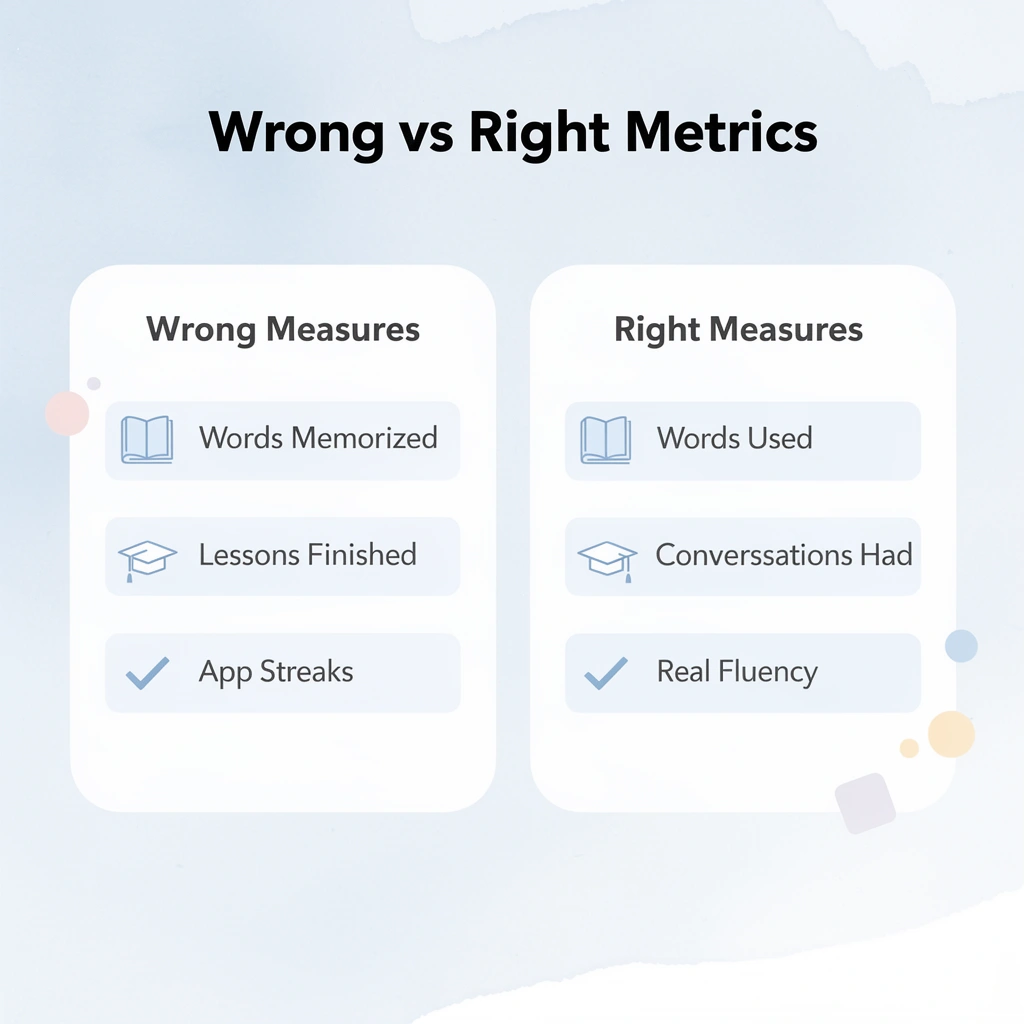
Most people who start learning Spanish fail not because they lack motivation, but because the tools they use measure the wrong things.
What is the real gap between activity and fluency?
Finishing a lesson is not the same as learning a language. Earning points is not the same as understanding a native speaker. According to Fluent in 3 Months, 95% of language learners quit before reaching fluency, and the reason is rarely a shortage of effort. The gap between activity and ability is where fluency dies: not in a dramatic moment of giving up, but in the slow buildup of progress that never becomes understanding.
Why do streaks and points fail to measure real progress?
Learners optimize for what is easy to count: streaks, lesson completions, XP points, daily minutes logged. A 300-day streak proves only that you showed up. It says nothing about whether you can understand a conversation between two friends at a café in Mexico City or follow a Spanish-language film without subtitles. Fluency is not a habit metric; it is a comprehension outcome.
Why do app-based learners freeze when real conversation starts?
A learner can spend six months in an app and still freeze when a native speaker responds at natural speed, uses slang, or drops a sentence absent from any lesson. Many describe this as a "thick fog" where the brain resists processing language in real time, even after hundreds of hours of structured practice. Apps built around gamification are designed to keep you opening the app tomorrow, not to dissolve that fog. Tools like Parrot take a different approach, using short-form video immersion grounded in comprehensible input so learners build real-time listening comprehension through content that reflects how Spanish is actually spoken, not how it is tested.
Why does the method matter more than the minutes?
The critical difference between learners who reach fluency and those who plateau is not how much time they spend, but whether the input they consume makes sense, fits the situation, and connects to real language use. Research by Hartshorne, Tenenbaum, and Pinker, published in Cognition, confirms that language acquisition responds to the right kind of exposure, not to repeated exposure alone. Passive vocabulary built through flashcards and translation exercises often cannot be retrieved under pressure in real conversation: the words exist, but the brain has not learned to access them at the speed real communication demands.
Measuring progress honestly means asking "How much more Spanish did I understand today than I could three weeks ago?" rather than "How many lessons did I finish this week?" That shift is harder to answer, but it is the only measurement that tracks fluency.
Yet even when learners start asking better questions, one obstacle rarely surfaces until it's too late.
The Hidden Cost of Choosing a Language App Based on Price
Choosing a language app based solely on price can become expensive when cost replaces effectiveness as your primary consideration.

The problem emerges months later. A learner finishes exercises, maintains daily streaks, and watches XP climb, only to struggle when a native speaker talks at normal speed. The subscription fee seemed worthwhile. The time spent is gone. That difference—a cheap monthly cost versus hundreds of irretrievable hours—is where the real cost hides.
What you're actually buying when you subscribe
Most learners compare apps like streaming services: features, price, and content volume. But a language app is a training system, and training systems should be evaluated by a single metric: does it produce the skill it promises? According to the MMR Statistics Online Language Learning Market Report, the global online language learning market is valued at USD 24.56 billion in 2025 and is projected to reach USD 63.43 billion by 2032. That growth reflects demand, not fluency outcomes. A market can expand on engagement alone, and gamified apps excel at generating engagement without building conversational ability.
Does repeating app lessons actually build fluency?
The familiar approach is to open an app, complete daily lessons, and trust that consistency compounds into fluency. Consistency matters, but repeating low-yield activities produces low yield. Dr. Stephen Krashen's comprehensible input research is clear: the brain acquires language by processing meaning in context, not by drilling isolated vocabulary or translating sentences in structured exercises. Apps built around points and streaks optimize for engagement, not the conditions under which real acquisition happens.
This is where learning Spanish takes a different approach. Rather than gamification, Parrot uses short-form video immersion grounded in comprehensible input, exposing learners to real Spanish through meaning, context, and repetition in natural speech. The learning method determines whether time invested produces fluency or mere familiarity with an app's interface.
Which app actually costs less when you count your time?
A more honest evaluation asks what a year of use costs. If a 0-per-month app requires 300 hours to produce conversational ability, and a 5-per-month app produces the same result in 150 hours, the cheaper app is the more expensive choice. Time has a value that monthly fees never capture. The question is not which app costs less, but which method closes the gap between where you are now and a real conversation in Spanish.
Related Reading
How Much Is Duolingo?
Duolingo offers a free version with ads and usage limits, plus paid tiers with higher prices and additional features.
💡 Tip: If you're committed to language learning, upgrading to a paid plan eliminates distractions and unlocks premium features that improve your progress.

According to SQ Magazine's Duolingo statistics, the Super plan costs $83.99 per year ($6.99 per month), and the Family Plan is $9.99 per month for up to six users. If you split the cost across four or five people, the cost per person drops below the price of a coffee.
"The Family Plan at $9.99 per month supports up to six users — making the per-person cost less than a cup of coffee when shared." — SQ Magazine
Free Plan
Cost
$0
Best For
Casual learners
Super Plan
Cost
$6.99/month or $83.99/year
Best For
Individual learners
Family Plan
Cost
$9.99/month
Best For
Up to 6 users
🔑 Takeaway: The Family Plan is easily the best value — splitting $9.99 across four to six people makes premium language learning remarkably affordable.
What each tier actually unlocks
Super Duolingo removes ads, grants unlimited hearts, enables offline access, and provides personalized review tools. Duolingo Max adds AI-powered roleplay conversations and on-demand explanations (currently available in select languages) for approximately 68 per year in the US. The free plan remains effective for learners comfortable with ads and the hearts system.
Does the tier you choose actually determine your results?
Most learners compare free and Super, but the more important comparison is between any Duolingo tier and the fluency it requires. Learners seeking real conversation aren't paying for ad removal; they're investing in a method, and the method matters more than the monthly fee.
Most learners start with Duolingo for its accessibility and structure. But as goals shift from completing lessons to understanding native speakers, the gap between app activity and actual comprehension widens. Apps built around comprehensible input, like Parrot, use short-form video from real Spanish content so learners build listening comprehension and vocabulary through meaningful context rather than isolated drills. The distinction isn't about price; it's about what the learning hours build.
Is subscription cost the right variable to compare?
Subscription cost is the easiest thing to compare and the least helpful for predicting results. A learner paying $6.99 monthly and building real conversational ability has made a better investment than one paying nothing but spending 200 hours reinforcing patterns that don't transfer to real speech. The pricing page tells you what you'll spend, but nothing about what you'll be able to do when a native speaker answers faster than you expected.
But knowing what Duolingo costs is only half the picture; the more unsettling half lies ahead.
Why Traditional Language Learning Apps Don't Always Lead to Fluency
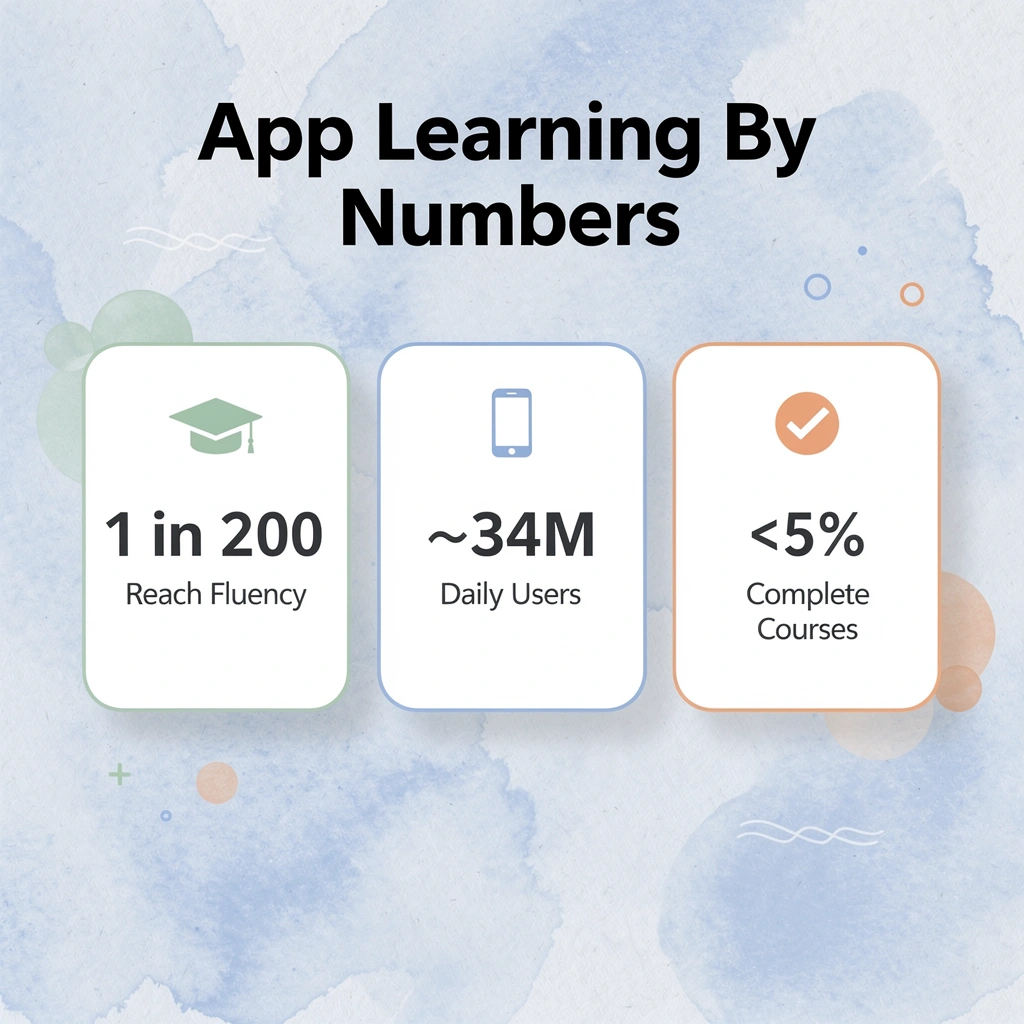
Finishing lessons isn't the same as learning a language. Most app-based systems are built around the first while promising the second. According to Taalhammer, only 1 in 200 Duolingo users reaches conversational fluency — a sobering statistic for anyone equating app streaks with actual ability.
"Only 1 in 200 Duolingo users reaches conversational fluency — a sobering reminder that finishing lessons and learning a language are not the same thing." — Taalhammer
🔑 Takeaway: A streak measures consistency with an app, not real-world language ability. Conversational fluency requires far more than daily check-ins and multiple-choice answers.
The core problem is structural. Most traditional apps treat language as separate units: words to memorize, sentences to translate, grammar rules to apply. This works for quizzes but fails against native speakers who drop syllables, blend sentences, and assume cultural context. The required skills are categorically different, and multiple-choice practice cannot bridge that gap.
⚠️ Warning: Drilling isolated vocabulary and grammar rules builds test-taking ability — not the real-time comprehension and spontaneous production that fluency actually demands.
Vocabulary
What Apps Train
Isolated vocabulary recall
What Fluency Requires
Contextual word usage
Speaking
What Apps Train
Translated sentences
What Fluency Requires
Spontaneous speech production
Grammar
What Apps Train
Grammar rule application
What Fluency Requires
Intuitive grammatical feel
Comprehension
What Apps Train
Multiple-choice recognition
What Fluency Requires
Real-time listening comprehension
Practice Environment
What Apps Train
Controlled quiz conditions
What Fluency Requires
Native-speaker pace & cultural context
💡 Tip: To actually close the gap, supplement app-based practice with immersive listening, unscripted conversation, and exposure to authentic native content as early as possible.
Why gamification pulls learners in the wrong direction
Gamification is not inherently bad. Streaks and points encourage consistency, but problems surface when the reward system becomes the goal. A learner who opens the app daily to protect a streak optimizes for app retention, not language acquisition. The app cannot tell you which one you are actually doing.
Why do most learners quit before they see real progress?
Most learners keep using the app because it feels productive. Finishing five lessons provides a sense of accomplishment. But Taalhammer reports that most language learners quit within the first three months, right around the point where the gap between lesson performance and real-world comprehension becomes impossible to ignore. That frustration stems from a method problem, not motivation. Apps built around structured exercises rarely expose learners to the connected, natural language needed to build the listening comprehension that real conversations demand.
How does comprehensible input build real conversation skills?
An approach based on comprehensible input works differently. Rather than drilling vocabulary in isolation, learners who encounter Spanish through short-form video content that mirrors native speech build pattern recognition that transfers to real conversations. Parrot applies this model, drawing on Dr. Stephen Krashen's comprehensible input research to expose learners to natural Spanish in context rather than through structured exercises. The result is a learner who recognizes speech as it sounds, not as it appears in a textbook.
What is the real cost of an app that produces no results?
The honest question every learner should ask is not "How much does this app cost per month?" but "What will I be able to do in six months that I cannot do today?" An app that costs nothing and produces nothing has a higher real cost than one that costs $6.99 a month and makes a meaningful difference.
What Actually Helps People Learn a Language Faster
Comprehensible input is the foundation, but how you apply it determines whether you progress or just accumulate hours. The difference lies in how your brain processes language during exposure — not just how much you consume.
"The difference lies in how your brain processes language during exposure, not just how much you consume."
💡 Tip: Don't measure your learning by hours logged — measure it by how actively your brain is engaged during every session.
🎯 Key Point: Comprehensible input only works when it's paired with intentional processing. Passive consumption without mental engagement is one of the most common reasons learners plateau early.
Passive Consumption
What It Looks Like
Listening without focus
Result
Minimal retention
Active Processing
What It Looks Like
Engaging with meaning and context
Result
Faster progress
Comprehensible Input Done Right
What It Looks Like
Exposure just above your level with intent
Result
Accelerated fluency

Why input quality matters more than input volume
Most learners focus on measurable progress: lessons finished, words added to flashcard decks, hours spent. The problem is that these metrics track effort, not learning. A learner can spend 2,000 hours consuming Spanish content and still freeze mid-sentence when a native speaker changes pace or switches topic, because passive exposure and active retrieval are different cognitive skills. Real comprehension comes from repeated, meaningful contact with language at the right difficulty level—where you understand enough to stay engaged but encounter enough new material to keep stretching.
What is the ideal difficulty level for language input?
That level of difficulty is called "i+1" in linguist Stephen Krashen's acquisition theory, where "i" represents your current level and "+1" is the next layer of complexity within reach. Too easy and your brain coasts; too hard and it shuts down. The sweet spot is content you can follow 80 to 90 percent of the time, where unfamiliar words are decoded through context rather than a dictionary. Short-form video works well for Spanish learners for this reason: a 60-second clip provides a complete, contextually rich unit of language with visual framing, natural speech rhythm, and sufficient repetition across similar content to reinforce vocabulary.
Why does practicing with native speakers accelerate learning?
According to the Preply Global Language Learning Report, 67% of language learners say that practicing with a native speaker is the most effective way to learn a language faster. This exposes learners to natural language with clear meaning. Native-speaker practice works because it requires real-time understanding of language.
The role of spaced repetition in locking vocabulary in
Context builds understanding. Spaced repetition locks it in. Research cited by Scott H. Young shows that spaced repetition systems can reduce the number of study sessions needed to retain vocabulary by up to 50% compared to massed practice. Vocabulary reviewed strategically sticks twice as well. Vocabulary encountered in context through video or reading, then practiced again through spaced review, builds a stronger mental network than either method alone.
How does embedding words in real spoken Spanish close the recall gap?
Apps built around short-form video immersion, like Parrot, apply this principle directly. Instead of presenting vocabulary as separate items, they embed words within real spoken Spanish, where tone, context, and visual cues reinforce meaning simultaneously. This layered encoding converts passive recognition into active recall: the gap most learners struggle to close.
What actually makes language learning faster in the long run?
Learning a language faster is not about finding an easy way out. It is about removing obstacles between you and real practice, then practicing often enough that your brain sees Spanish as a pattern to notice rather than a code to figure out. What you choose to spend time on matters more than how long you spend doing it.
Related Reading
How Parrot Helps You Learn Spanish Through Content You Already Enjoy
Many language learners realize they don't need more vocabulary lists, grammar drills, or streaks. They need real exposure to Spanish that they can understand and enjoy. That's the core idea behind Parrot.
"The most powerful shift a language learner can make is moving from isolated drills to meaningful, enjoyable input." — Language Acquisition Research
💡 Tip: If you've felt stuck despite completing daily lessons, the problem isn't your effort—it's the type of exposure you're getting.
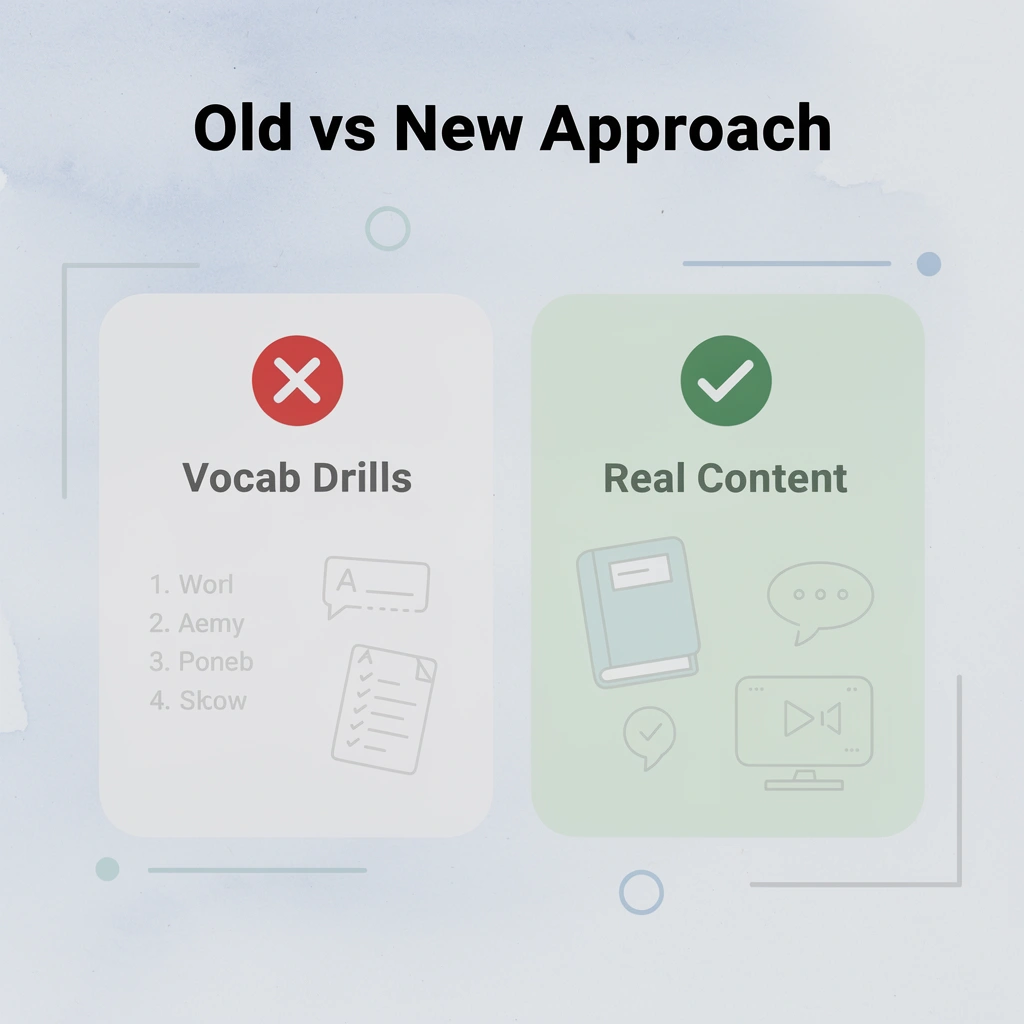
Instead of treating language learning as just lessons to complete, Parrot turns content you already enjoy into a personalized Spanish-learning experience—helping learners spend more time engaging with meaningful Spanish and less time memorizing isolated words.
🎯 Key Point: The secret to fluency isn't grinding through more drills—it's consistent, enjoyable engagement with Spanish that feels natural, not forced.
Vocabulary Lists & Drills
Traditional Learning
Vocabulary lists & drills
Parrot's Approach
Content you already love
Grammar Practice
Traditional Learning
Isolated grammar exercises
Parrot's Approach
Contextual, meaningful input
Motivation
Traditional Learning
Streak-based motivation
Parrot's Approach
Intrinsic enjoyment
Learning Experience
Traditional Learning
Generic lesson plans
Parrot's Approach
Personalized experience
What research-backed approach does Parrot use to teach Spanish?
At its core is a research-backed, comprehensible input approach. Rather than relying on drills and repetition, Parrot helps learners acquire Spanish through understandable content, exposing them to vocabulary, sentence structures, and expressions in real contexts.
Parrot uses short-form videos to make learning engaging and sustainable. The format resembles scrolling through social media, enabling consistency without forcing yourself through repetitive exercises.
How do clickable subtitles and instant translations make native content accessible?
To make native Spanish content accessible, Parrot includes clickable subtitles and instant translations. Unfamiliar words can be quickly translated without interrupting your viewing.
The platform lets learners save vocabulary directly from the content they watch. Since words are learned within meaningful contexts rather than from standalone lists, you build vocabulary while understanding how those words are used in real life.
How does Parrot personalize the Spanish learning experience for you?
Parrot's AI-powered recommendation system personalizes the experience by suggesting videos based on your level and interests, ensuring steady exposure to comprehensible Spanish while challenging you to improve.
Most importantly, Parrot makes Spanish learning feel less like studying and more like enjoying content, transforming daily practice into something you genuinely look forward to.
Start Learning Spanish Today
The real question isn't which app costs less, but which one moves you closer to a real conversation. If you freeze when a native speaker talks fast despite using gamified tools, that's a method problem, not a personal failure.
"If you freeze when a native speaker talks fast despite using gamified tools, that's a method problem — not a personal failure."
💡 Tip: Ask yourself one honest question after every study session: "Could I hold a real conversation right now?" If the answer is always no, it's time to change your method, not your motivation.

Before comparing Duolingo's pricing, try learning Spanish for free. Parrot matches you with short-form Spanish videos at your exact comprehension level, with clickable subtitles and vocabulary tracking, so each session builds toward real fluency rather than just maintaining a streak. Staying comfortable with an app that keeps you busy costs months, not dollars.
🎯 Key Point: There's a critical difference between staying busy and making progress — most language apps are designed to keep you engaged, not to make you fluent.
Learning Style
Gamified Apps
Streak-based repetition
Parrot
Comprehension-first immersion
Content Type
Gamified Apps
Isolated exercises
Parrot
Short-form native videos
Subtitle Support
Gamified Apps
Limited
Parrot
Clickable, interactive
Vocabulary Tracking
Gamified Apps
Basic
Parrot
Session-by-session tracking
Real Conversation Prep
Gamified Apps
Minimal
Parrot
Core focus
⚠️ Warning: An app that keeps you comfortable is not the same as an app that makes you fluent. Every month spent on the wrong method is a month of real progress lost.
Related Reading
Babbel Spanish Review
Pimsleur Spanish Review
Duolingo Spanish Review
Rosetta Stone Vs Pimsleur
Spanish Idioms
Duolingo Alternatives