
Staring at a blank page trying to form a single Spanish sentence, is a common experience for new learners. Speaking and listening can feel manageable early on, but writing quickly exposes gaps in grammar, vocabulary, and sentence structure. Spanish writing practice closes those gaps by training the brain to actively produce language rather than simply recognize it.
Consistent written output, whether through daily journal prompts or structured grammar drills, moves new words and verb conjugations from short-term memory into long-term use. The key is regular, intentional practice with real feedback. Those ready to build that habit can learn Spanish through Parrot, an app designed around active writing exercises and vocabulary reinforcement.
Table of Contents
Why Spanish Writing Practice Feels So Hard for Many Learners
Why Memorizing Vocabulary Does Not Automatically Improve Writing
What Effective Spanish Writing Practice Actually Looks Like
The Real Secret to Better Spanish Writing Is Better Input
Strong Spanish Writing Comes From Immersion, Not Isolation
How Parrot Helps You Build Better Spanish Writing Skills Naturally
Start Learning Spanish Today
Summary
Writing in Spanish feels harder than reading or listening because it demands retrieval rather than just recognition. A learner can recognize a word when they see it, but cannot produce it from memory. This gap between passive knowledge and active output is where most beginners stall, and it explains why even learners with large vocabularies still struggle to write a natural sentence.
Memorizing vocabulary in isolation does not build writing fluency. Research from a 2025 neuroscience study (PMC11943480) found that students who took notes by hand retained information at approximately 29% higher rates than those who typed, pointing to how the depth of encoding shapes whether a word remains passive or becomes usable. A word learned through a flashcard definition behaves differently in the brain than a word absorbed through repeated, meaningful context.
The quality of what a learner writes is shaped more by what they consume than by how often they practice writing. Research cited by Allison Lewis found that learners who encountered new words through extensive reading retained more than 2.5 times as many word meanings after five weeks compared to those who studied vocabulary lists. Input does not just support writing; it directly determines what the brain has available when writing begins.
The concept of comprehensible input, specifically material that is just one step beyond a learner's current level, is a practical filter, not a vague aspiration. When learners encounter unfamiliar structures inside content they mostly understand, acquisition happens through context rather than conscious rule memorization. That friction, small enough to resolve without stopping, is where language patterns get internalized.
Immersion consistently outperforms isolated grammar study when measured by writing fluency. According to research from CARLA at the University of Minnesota, English learners in two-way immersion programs performed at least as well as same-background peers in English-only schooling by upper elementary or early secondary grades, with evidence spanning 15 to 20 years. Immersion builds the instinct for what sounds right before a learner applies any conscious rule.
Short, frequent writing sessions outperform occasional long ones for building sustainable fluency. According to the Spanish Fluency Club Blog, learners benefit most when they commit to at least 3 to 5 hours per week of active language practice, and daily short sessions are among the most consistent ways to reach that threshold without burnout. Five sentences written daily build more retrievable language than one long composition written weekly.
Parrot app addresses the input gap directly by delivering short-form Spanish video content built around comprehensible input, so learners accumulate the sentence patterns and vocabulary that writing draws from before they sit down to produce it.
Why Spanish Writing Practice Feels So Hard for Many Learners
Writing in Spanish feels harder than reading or listening because output demands retrieval, not just recognition. You can recognize a word when you see it without being able to summon it from nothing. That gap between knowing a word exists and producing it under pressure is where most learners get stuck.
"The gap between passive recognition and active retrieval is the single biggest obstacle Spanish learners face when they sit down to write." — Language Acquisition Research
💡 Tip: When you practice Spanish writing, you're not just testing vocabulary — you're training your brain to retrieve language under pressure, which is a completely different skill from reading comprehension.
⚠️ Warning: Don't mistake reading fluency for writing readiness. Feeling comfortable reading Spanish gives false confidence — active production requires a separate, dedicated practice habit.
Here is a breakdown of what different language skills require and why they feel easy or hard:
Reading: Requires passive recognition, which feels easier because your brain is just matching patterns.
Listening: Requires passive recognition, which feels easier because context fills in the gaps.
Writing: Requires active retrieval, which feels harder because you must produce the language from nothing.
🔑 Takeaway: The real problem isn't your vocabulary size — it's the retrieval gap between what you know passively and what you can produce independently.

Why does conscious grammar study slow your writing down?
The failure point is usually not vocabulary size or grammar knowledge, but insufficiently absorbed language. When learners rely on conscious rule-application, every sentence becomes a negotiation: Which tense? Which preposition? Is this masculine or feminine? That mental overhead slows writing to a crawl and makes even simple messages feel like exams. The process stops feeling like communication and becomes translation.
Most learners respond by studying harder: more flashcards, longer grammar exercises, stricter vocabulary targets. But a user post in the Facebook group Learn Spanish Free for Beginners captured the frustration precisely—a full year of study using 100 to 200 words daily through a flashcard app without reaching expected proficiency. Knowing a word in isolation differs entirely from knowing how it behaves in a sentence.
What does comprehensible input have to do with writing ability?
Dr. Stephen Krashen's comprehensible input theory distinguishes between learning about a language and acquiring it. Grammar rules studied deliberately rarely transfer automatically to real-world writing. What works is language absorbed through repeated, meaningful exposure, where your brain processes Spanish as communication rather than as a code to decipher. Most learners lack sufficient exposure before attempting to write.
Apps built around short, immersive video content address this gap. Rather than drilling isolated rules, learn Spanish uses comprehensible input through short-form video to build the internalized language sense that makes writing feel less like construction and more like expression. When patterns are familiar from listening and reading, the blank page becomes less threatening.
How does fear of mistakes make Spanish writing practice harder?
Fear of making mistakes makes everything harder. Learners avoid writing because imperfect output feels like proof of failure rather than a normal part of learning. But avoiding output slows learning. Writing, even imperfect writing, forces your brain to retrieve and reorganize what it has absorbed—the active processing that moves language from passive recognition into active use.
Why Memorizing Vocabulary Does Not Automatically Improve Writing
Knowing a word and using it are two completely different things your brain does. Recognition is passive. Production is not. When you try to write a sentence in Spanish, your brain looks for patterns, word combinations, and structures that feel familiar enough to use without stopping to think. If those patterns were never absorbed through meaningful exposure, memorized words sit in your head like tools you have never held before.
"Recognition is passive. Production is not — and that gap is exactly where vocabulary memorization alone breaks down." — Key Insight
⚠️ Warning: Flashcard-heavy study routines can create a false sense of progress — you may recognize hundreds of words without being able to produce a single fluent sentence.
💡 Tip: To bridge the gap between passive recognition and active production, pair every new word with meaningful exposure — read it in context, hear it used naturally, and then try writing with it.

Why does the gap between vocabulary and real writing exist?
The failure point is the gap between isolated vocabulary and living language. A word like "conseguir" might appear on a flashcard with the translation "to get" or "to obtain," but knowing that translation doesn't tell you when Spanish speakers prefer "conseguir" over "obtener" or how it works alongside common verbs and prepositions. That knowledge comes only from encountering the word repeatedly in context: in real sentences, conversations, and stories.
Writing itself becomes a diagnostic tool. When you sit down to write a journal entry or message in Spanish, the words that flow are the ones you have seen used, not merely defined. According to The Neuroscience Behind Writing: Handwriting vs. Typing (PMC11943480), handwriting activates three key brain regions simultaneously: visual, motor, and cognitive, while typing activates significantly fewer. This multi-region engagement matters for language learners because handwriting processes words at a deeper level.
Why does measuring progress with flashcards mislead learners?
Most learners use flashcard apps because progress feels easy to measure. But that feeling can be misleading when writing remains difficult. Research from the same 2025 neuroscience study found that students who took notes by hand remembered information about 29% better than students who typed. How deeply you process a word determines whether you can recognise it or use it. Apps like Parrot use short videos to teach vocabulary in real, meaningful situations from the start, rather than in isolated repetition.
How does immersion in authentic Spanish build natural writing ability?
The deeper problem with vocabulary-first thinking is that it treats language as a collection of parts rather than a living system. Fluent writing comes from understanding how ideas connect, how clauses flow, and which expressions feel natural in which contexts. A learner who has spent hours listening to and reading authentic Spanish absorbs those rhythms without consciously studying them.
The learners who write most naturally are often not those with the largest vocabularies, but those who have spent the most time immersed in the language.
Related Reading
What Effective Spanish Writing Practice Actually Looks Like
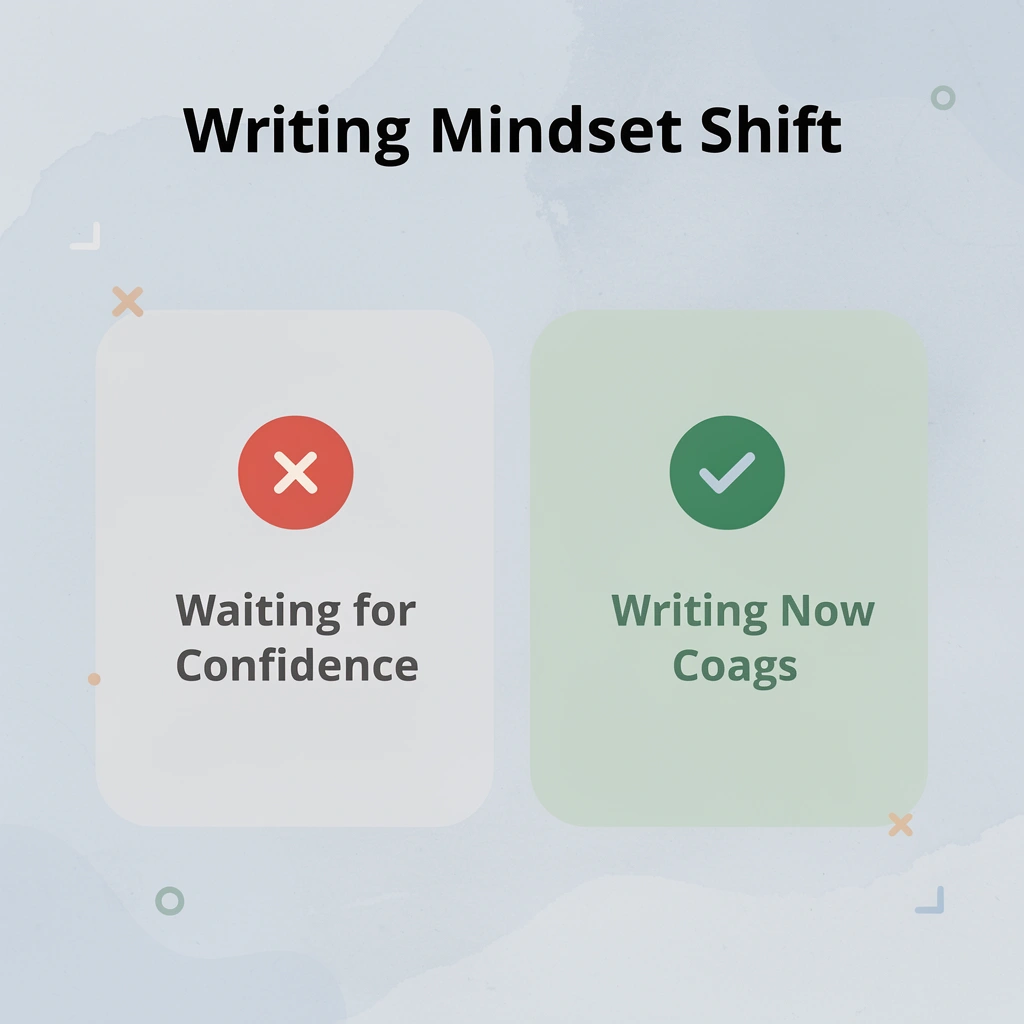
Good Spanish writing practice means building the habit of writing before you feel ready, using what you already know.
"The most effective learners start writing in Spanish before they feel confident — because consistent practice is what creates confidence." — Language Acquisition Research
💡 Tip: Don't wait until your Spanish feels "good enough" to start writing — starting early is the essential first step toward real fluency.
⚠️ Warning: Waiting until you feel "ready" is the #1 mistake Spanish learners make. Active writing practice from day one dramatically accelerates your vocabulary retention and grammar instincts.
Here is a breakdown of how different writing approaches impact your learning outcomes:
Writing before you feel ready: Leads to faster fluency gains and stronger habit formation.
Waiting until you feel confident: Results in slower progress and missed practice opportunities.
Using known vocabulary actively: Drives deeper retention and more natural recall.
Write short, then write often
Short journal entries work better than long pieces of writing. Writing five sentences about what you ate, what you noticed on your walk, or what you plan to do tomorrow pulls language from memory in a low-stress situation, which builds fluency. The limit is key: with only five sentences, you stop overthinking and start communicating. According to the Spanish Fluency Club Blog, learners do best when they commit to 3 to 5 hours per week of active language practice, and short daily writing sessions are among the most sustainable ways to reach that goal without burning out.
Why do personal prompts make writing practice more effective?
The most effective writing prompts are personal. Questions like "¿Qué harías si tuvieras una semana libre?" work because the answer already lives inside you. You are not inventing a topic; you are translating a thought. Retelling a short video or article in your own words works the same way: it reduces the mental effort needed to generate ideas, freeing your brain to focus entirely on producing Spanish.
How does keeping your mistakes visible change what you learn?
Most learners approach writing practice like grammar drills: find the correct answer, avoid the wrong one. Keeping your mistakes visible rather than erasing them turns every writing session into a diagnostic. You start to see patterns in what you get wrong, and patterns prove far more useful than isolated corrections.
How does immersion input make written output feel easier?
Learn Spanish tools like Parrot provide short-form video lessons that deliver meaningful, contextually rich input throughout the day. When writing practice follows that exposure, the words you need are already accessible, making output feel less like digging and more like conversation.
Structure without rigidity
Kwiziq Spanish covers all 6 CEFR levels (A1 through C2) in its writing practice exercises. Structured progression matters, but it should support expression, not replace it. The goal is to write something true in Spanish today, then do it again tomorrow. Consistency at a modest level will outperform occasional brilliance.
The quality of what you write is rarely determined by how much you practice writing.
The Real Secret to Better Spanish Writing Is Better Input
How well you write in Spanish depends far more on what you read and listen to than on writing practice alone. The patterns you absorb through reading and listening become the essential material your brain uses when you write. Without that supply of patterns, even with frequent practice, your sentences will feel stiff and translated from English rather than naturally composed.
"The patterns you absorb through reading and listening become the raw material your brain draws on when you sit down to write. Without that input, no amount of writing practice can fill the gap."
💡 Tip: Before your next writing session, spend time actively reading or listening to Spanish content. Your brain will have richer patterns to draw from, and the difference in your output will be immediate.
🔑 Takeaway: Better Spanish writing starts with better input. Writing practice alone won't fix sentences that feel translated. Only a strong foundation of reading and listening will give your brain the patterns it needs to write naturally.
Why does deep input shape what you can write?
The same issue shows up in music, cooking, and language learning: people who produce well have first consumed deeply. A jazz musician who has heard thousands of improvisations plays with a fluency that no theory textbook could produce. Spanish works identically. When you encounter phrases like acabo de llegar or me cuesta trabajo repeatedly in real conversations, stories, and dialogue, they stop being grammar entries and become natural moves. A 2025 empirical study published in Scientific Research Publishing found that contextualized input significantly supported vocabulary development, reinforcing what decades of second language acquisition research had already shown: meaningful exposure builds retention in ways that isolated memorization cannot.
What happens when output comes before input is ready?
The failure point is usually a mismatch between input quality and writing expectations. Most learners spend the majority of their study time on exercises designed to test knowledge they have not yet absorbed. They practice output before building up enough input to draw from, which is like squeezing water from a dry cloth. Research by Merrill Swain's Output Hypothesis acknowledges that writing helps learners identify gaps, but it works as a complement to input, not a substitute. Output reveals what is missing. Input fills it.
Why do grammar apps fall short for expressive writing?
Most learners use grammar apps and vocabulary lists because those tools feel measurable and organized. The hidden cost is practicing retrieval of isolated information rather than building the sentence-level fluency that real writing demands. Apps like Parrot deliver short-form video content built around comprehensible input, so learners absorb natural Spanish in context rather than grinding through drills that rarely translate into expressive writing.
What "slightly above your level" actually means in practice
The idea of n+1 input—material one step beyond what you currently know—is a useful way to choose what to read and watch. If you don't understand almost anything, the material is too hard, and acquisition stalls. If you understand everything easily, you don't encounter new patterns, and growth slows. The best situation is material where you grasp the meaning but still encounter unfamiliar structures or words in context.
Why does that friction point drive acquisition?
That friction, when small enough to solve through context rather than a dictionary, is where learning happens. Allison Lewis cites research showing that learners who encountered new words through extensive reading retained more than 2.5 times as many word meanings after five weeks compared to learners who studied vocabulary lists, because contextual exposure creates associations that definitions alone cannot build.
How does consistent, slightly challenging input improve your Spanish writing practice?
For your Spanish writing practice: invest in input that slightly challenges you consistently, and your written expression will improve. Read one short Spanish article at your level each morning. Watch a five-minute video with Spanish subtitles. Listen to a podcast episode on a topic you care about. These are not warm-up activities; they are the real work, and writing will follow.
This shift in where you place your effort changes everything about how quickly your Spanish develops.
Strong Spanish Writing Comes From Immersion, Not Isolation
Strong Spanish writing comes from immersing yourself in the language, not studying it. Writers who feel confident and write with a natural rhythm have spent significant time inside the language, not studying rules about it.
"Writers who feel confident and write with a natural rhythm are the ones who have spent significant time immersed in the language — not just studying rules about it."
💡 Tip: If your Spanish writing feels stiff or unnatural, the fix isn't more grammar drills—it's more immersion. Read, watch, and listen to Spanish daily to internalize the rhythms that make writing feel authentic.
🔑 Takeaway: Immersion is the engine behind strong Spanish writing. The writers who stand out aren't those who memorized the most rules; they're the ones who made the language a living part of their everyday life.

What immersion actually trains
The critical difference between immersion and isolation is what each builds inside you. Isolation trains your ability to remember rules under pressure. Immersion trains your instinct for what sounds right before you apply a rule. When you have read enough Spanish sentences, heard enough native conversations, and followed enough real stories, your brain pattern-matches automatically. You stop constructing sentences and start producing them.
What does the research say about immersion and writing competence?
Research supports this at scale. According to What the Research Says About Immersion by Tara Williams Fortune, CARLA, University of Minnesota, English learners in two-way immersion programs perform as well as same-background peers in English-only schools by upper elementary or early secondary grades. This finding has held for 15 to 20 years. Immersion builds strong language skills across abilities, including writing.
Why do most learners approach Spanish writing backward?
Most learners approach this backward. They sit down to write Spanish and wonder why it feels like assembling furniture without instructions. Writing fluency comes from consuming substantial input. Our Parrot app addresses this directly by providing short Spanish videos built around comprehensible content. This way, learners absorb the sentence patterns and vocabulary required for writing.
Why authentic content beats structured exercises
Textbooks teach you what Spanish can do. Real content shows you what Spanish does. A learner who has studied only structured exercises will write technically correct sentences that no native speaker would say. A learner who has spent time with real conversations, stories, and creators will write sentences that feel alive. Real content carries rhythm, idiom, and cultural weight that exercises cannot replicate. That texture is what makes written Spanish feel natural rather than translated.
Does immersion slow down academic progress for language learners?
According to the same CARLA research from Tara Williams Fortune, students in grades 4–8 in Chinese and English two-way immersion programs tested at or above grade level and performed as well as or better than peers with similar backgrounds in non-immersion programs. Immersion does not slow language development; it accelerates it by traditional academic standards.
The writing skill you are trying to build grows every time you use Spanish in ways that are real, meaningful, and slightly harder than your current level.
Related Reading
Alternatives To Duolingo For Spanish
Best Ai For Spanish
Spanish Past Tense
How To Start Learning Spanish
How To Learn Mexican Spanish
Spanish Slang
Babbel Alternatives
500 Most Common Spanish Words
Spanish Pronunciation Guide
Spanish Short Stories For Beginners
Spanish Pronunciation Tips
Spanish Verb Conjugation
Easy Spanish Books
Learn Spanish Through Music
How To Practice Spanish Speaking
How Parrot Helps You Build Better Spanish Writing Skills Naturally
Once learners understand that writing gets better through picking up language rather than memorizing it, the question becomes how to get enough meaningful exposure without turning language learning into a chore. Parrot uses research-backed comprehensible input to make Spanish acquisition feel natural, giving learners enough understandable input that writing develops on its own.
"Writing develops naturally when learners receive enough understandable input — Parrot's research-backed approach makes Spanish acquisition feel effortless rather than forced."
🎯 Key Point: Comprehensible input is the real engine behind better Spanish writing — not rote memorization or grammar drills.
💡 Tip: Let Parrot's natural exposure model do the heavy lifting. When meaningful input is consistent and understandable, writing skills improve without the grind.
Here is a breakdown of how the traditional approach compares to Parrot's Method:
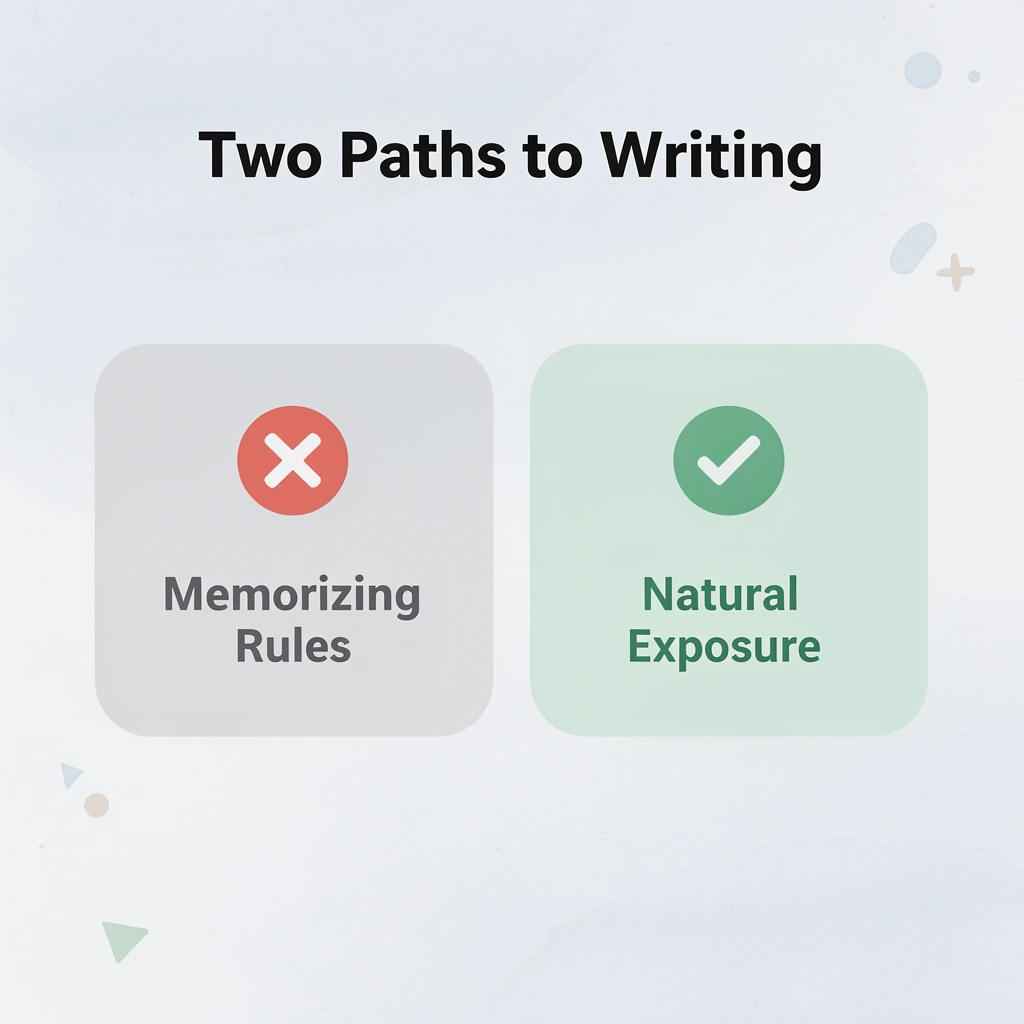
Traditional Learning: Relies on memorizing rules, resulting in slow, forced progress.
Parrot's Method: Utilizes comprehensible input, leading to natural writing growth.
🔑 Takeaway: The shift from passive memorization to active, meaningful exposure is what makes Parrot a genuinely effective tool for building Spanish writing skills that last.
How does engaging with real content make Spanish learning sustainable?
Parrot transforms short-form videos into personalized learning experiences. Rather than working through boring lessons, learners engage with entertaining content. Since consistency matters more than intensity, making Spanish enjoyable is essential to sustainable progress.
The platform's clickable subtitles and instant translations remove a major barrier to immersion. Learners can stay focused on understanding content without constantly switching to dictionaries, encountering vocabulary and sentence patterns in context, which makes them easier to remember and use in writing.
How does Parrot help you absorb vocabulary and sentence patterns for writing?
Parrot lets users save vocabulary words directly from the content they read. Because words are connected to real conversations rather than isolated flashcards, learners understand how expressions are used in context. These patterns become easier to recall when writing.
Parrot's AI-powered recommendation feed personalizes learning by matching content to your interests—whether travel, sports, relationships, business, movies, or personal development. This makes language learning feel less like studying and more like scrolling through content you'd enjoy anyway, creating a sustainable habit.
How does authentic Spanish input eventually show up in your own writing?
As learners consume authentic Spanish, they absorb sentence structures, common expressions, and vocabulary patterns that appear in their own writing. Instead of translating from English or overthinking grammar rules, they express ideas naturally because they've encountered those patterns hundreds of times before. Fluency becomes achievable rather than reserved for gifted learners.
Start Learning Spanish Today
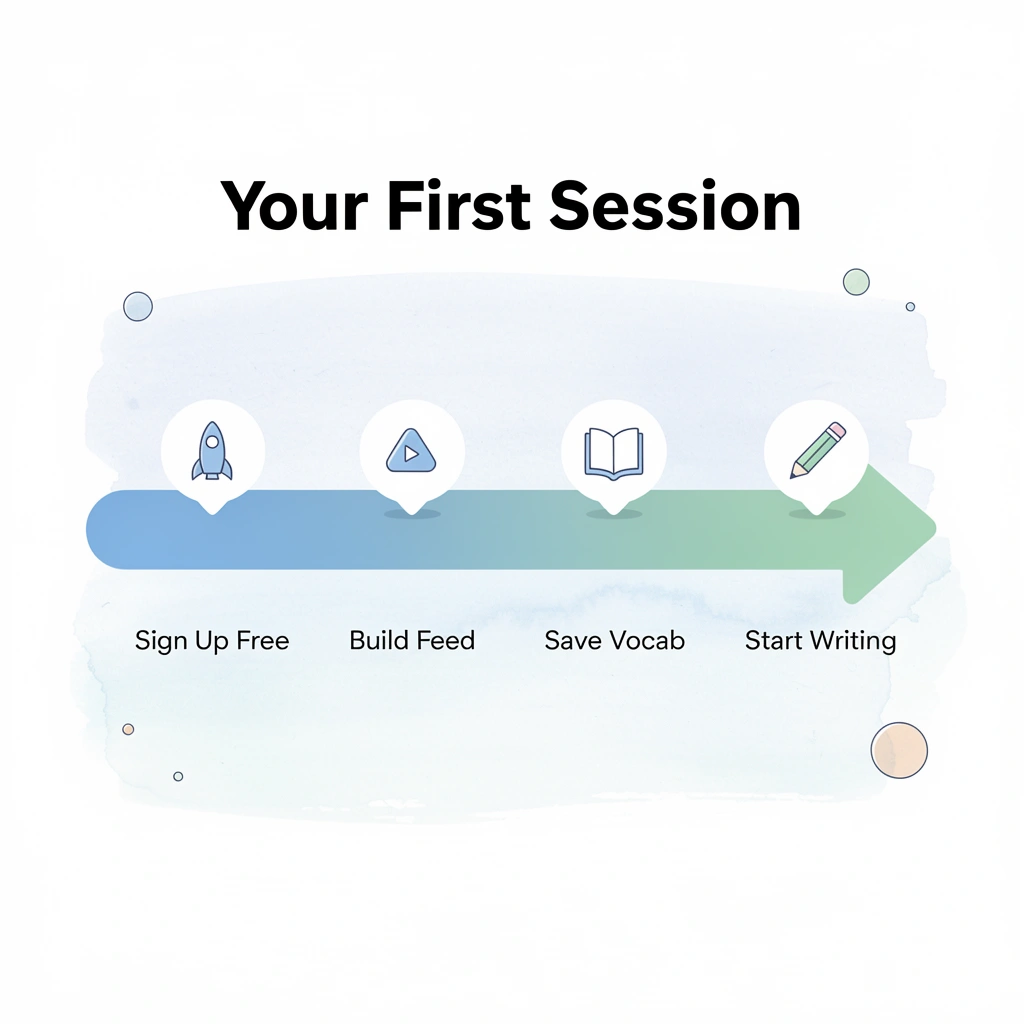
If this article helped you realize that better Spanish writing starts with better input, try Parrot for free. In your first session, you can build a personalized video feed and save vocabulary directly from content you enjoy, giving you sentence patterns and expressions you can use in your own Spanish writing.
💡 Tip: The fastest way to improve your Spanish writing is to start with content you enjoy. Parrot lets you build a personalized feed so every minute of input works for you.
The writing skill you want forms naturally when you consume Spanish that is real, meaningful, and just challenging enough to stretch you. Start there, and the words will follow.
"The writing skill you want forms naturally when you consume Spanish that is real, meaningful, and just challenging enough to stretch you." — Core Principle of Input-Driven Learning
✅ Best Practice: Don't force Spanish writing in isolation — feed your brain authentic, level-appropriate input first, and fluent expression becomes the natural result.
Here is a breakdown of how each approach translates into tangible learning benefits:
Personalized video feed: Provides sentence patterns from real Spanish.
In-context vocabulary saving: Delivers words you can immediately use.
Meaningful, challenging content: Builds natural writing skill that sticks.
🎯 Key Point: Better input = better output. Start with Parrot today and let real Spanish content do the heavy lifting for your writing journey.
Related Reading
Babbel Spanish Review
Pimsleur Spanish Review
Duolingo Spanish Revie
Rosetta Stone Vs Pimsleur
Spanish Idioms
Duolingo Alternatives