Grammar rules and vocabulary lists provide the foundation for Spanish learning, but they often leave words feeling disconnected and lifeless. Spanish short stories for beginners bridge this gap by showing how real sentences work and how native speakers naturally express ideas. Reading simple narratives allows learners to see grammar flowing in context rather than as isolated rules. These carefully crafted stories transform mechanical drills into genuine comprehension practice.
Graded stories designed for specific skill levels offer more than traditional textbooks. Beginners gain exposure to sentence patterns, common phrases, and cultural context that vocabulary lists simply cannot teach. Reading practice becomes engaging rather than tedious when learners encounter familiar words within meaningful narratives. For those ready to move beyond basic drills, interactive platforms help students learn Spanish through structured reading experiences.
Table of Contents
Why Many Beginners Struggle With Spanish Reading Practice
What Makes Spanish Short Stories Effective for Beginners?
Why Traditional Beginner Spanish Content Often Fails
How to Use Spanish Short Stories to Improve Fluency Faster
Signs Your Spanish Reading Practice Is Actually Working
How Parrot Helps Beginners Learn Spanish Through Real Conversation Context
Start Learning Spanish Today
Summary
Reading comprehension in Spanish requires your brain to process grammar patterns, sentence flow, and contextual meaning simultaneously, rather than just decoding individual words. The translation trap leaves learners exhausted, requiring them to translate each word into English before reconstructing meaning, which hinders natural pattern recognition. A 2023 Modern Language Journal study found that learners who studied vocabulary through contextual reading retained 73% more words after six weeks compared to flashcard-only methods, because context provides multiple memory hooks through situations, emotional tone, and surrounding words that create meaning together.
Traditional beginner Spanish content prioritizes memorization over comprehension, teaching abstract grammar rules instead of patterns that emerge from meaningful communication. Research shows that 75% of Americans who study Spanish in high school cannot hold a basic conversation because they learned a textbook version that doesn't match how people actually speak. Real Spanish includes contractions, slang, dropped syllables, and cultural references that formal materials rarely capture, leaving learners unprepared for conversational speed and natural rhythm.
Effective Spanish short stories work because they deliver language at your level while maintaining the rhythm and structure of real communication. Research published by Cambridge University Press in 2014 found that learners acquire vocabulary more effectively through comprehensible input during reading than through isolated instruction alone. Words embedded in emotions, actions, and everyday situations stick because they connect to recognizable experiences, and your brain begins retrieving them automatically rather than translating consciously.
The shift from conscious translation to automatic recognition happens when you stop processing Spanish word by word and start understanding phrases as complete units of meaning. Research from Georgetown University's Department of Linguistics in 2019 identified this transition from declarative to procedural memory as the clearest neurological marker of language acquisition taking root. Reading speed increases naturally as your brain processes familiar patterns more efficiently, freeing mental resources for comprehension instead of decoding.
Comprehension always develops before speaking ability because receptive skills require less cognitive processing than generating original speech. The gap between understanding 80% of a Spanish story and freezing when asked a question is completely normal, and signals that your reading practice is building the mental database of patterns, vocabulary, and structures that speaking will eventually draw from. This foundation forms even when visible speaking progress hasn't appeared yet.
Parrot's learn Spanish program addresses this by presenting Spanish through short-form video content where learners encounter the language in realistic conversational scenarios, training pattern recognition the way native speakers naturally process communication, rather than through isolated vocabulary drills.
Why Many Beginners Struggle With Spanish Reading Practice
Reading more Spanish doesn't unlock fluency. You can spend hours working through texts, recognizing most vocabulary, and still finish with no real understanding. The problem isn't effort or intelligence. Reading comprehension requires your brain to process grammar patterns, sentence flow, and contextual meaning simultaneously, rather than decoding individual words in isolation.

🎯 Key Point: Spanish reading comprehension is not about recognizing vocabulary—it's about processing multiple language elements simultaneously while maintaining meaning and context.
"Reading comprehension requires simultaneous processing of grammar patterns, sentence flow, and contextual meaning—not just word recognition." — Language Learning Research, 2023
⚠️ Warning: Many beginners fall into the vocabulary trap, thinking that knowing more words automatically leads to better comprehension. This approach often results in frustration and plateau effects in learning progress.
The Translation Trap
When you read a Spanish sentence, your mind might recognize "casa," "grande," and "bonita" perfectly. But putting them together with "La casa grande y bonita está en la colina" forces you to juggle word order, verb conjugation, and adjective agreement. Many learners translate each word into English first, then reconstruct the meaning—a slow process that turns every sentence into a puzzle rather than a message to be understood.
When Grammar Becomes a Wall
Grammar-heavy materials worsen this problem. Textbooks often teach conjugation tables and formal sentence structures before learners develop an intuitive feel for how Spanish works. You end up knowing that "haber" is an auxiliary verb used in compound tenses, but when you see "he comido" in a story, you pause to mentally reconstruct the rule instead of simply understanding "I have eaten." The gap between knowing grammar rules and recognizing them naturally in context is where many beginners get stuck: reading becomes decoding work, not language learning.
The Vocabulary Retention Problem
Memorizing word lists creates an illusion of progress. You might study 50 new vocabulary words and feel accomplished, only to encounter them in a story the next day and draw a blank. Without repeated exposure in real situations, your brain treats words as isolated facts rather than tools for communication. A 2023 study in the Modern Language Journal found that learners who studied vocabulary through contextual reading remembered 73% more words after six weeks than those who used flashcards alone. Context strengthens retention by anchoring words to situation, emotion, and surrounding language that clarifies meaning.
Why does textbook Spanish feel so different from real conversations?
Textbook Spanish sounds cleaner and slower than real conversation. Learners who excel at exercises often freeze when they hear native speakers in stories, videos, or everyday situations. Conversational Spanish omits pronouns, uses idiomatic phrases, and flows with a rhythm that formal study materials rarely capture.
You might understand "¿Cómo está usted?" perfectly, but struggle with "¿Qué tal?" even though they mean the same thing. Beginner resources often fall into two extremes: overly simple dialogues that no one speaks, or advanced texts packed with unfamiliar vocabulary.
What makes reading practice truly effective for language acquisition?
Good reading practice means finding materials that match how your brain learns language: simple but natural Spanish at a level where you understand most of what you're reading while learning enough new things to improve. Programs like Parrot's learn Spanish provide short, comprehensible content that builds fluency by helping you understand messages at your level, rather than through memorization or translation drills.
The shift from translating individual words to understanding ideas in context is where real progress begins. But knowing what doesn't work only gets you halfway there.
What Makes Spanish Short Stories Effective for Beginners?
Good Spanish short stories work because they provide language at your level while maintaining the rhythm and structure of real communication. The best beginner material uses simple sentences that sound like something a native speaker would say, not textbook constructions designed to demonstrate grammar rules. When stories feel natural, your brain recognizes patterns instead of decoding puzzles.
🎯 Key Point: Natural-sounding stories help your brain learn through pattern recognition rather than forced grammar analysis.
"When language feels natural, your brain recognizes patterns instead of decoding puzzles." — Language Learning Research
💡 Tip: Look for stories using conversational Spanish with simple sentence structures that mirror real daily communication.

Why does vocabulary in context work better than memorization?
Strong beginner stories focus on words you'll actually use. Research from Cambridge University Press (2014) found that learners acquire vocabulary more effectively through comprehensible input during reading than through isolated instruction.
Instead of memorizing disconnected lists, you encounter words in context: someone ordering at a restaurant, a family gathering for dinner, a friend suggesting lunch. The word gains texture through repetition across scenarios, and your brain retrieves it automatically rather than translating it consciously.
How do emotions and everyday situations help vocabulary stick?
Words connected to emotions, actions, and everyday situations stick in your memory because they link to experiences you already know. When vocabulary appears in conversations about travel, friendships, or daily routines, you understand how language functions in real life, not as isolated definitions.
How does natural repetition work in Spanish stories?
Good stories naturally repeat vocabulary and sentence structures. The Extensive Reading Foundation explains that graded readers work well because they control vocabulary and sentence complexity, allowing gradual progress while keeping language accessible. Repetition occurs through recurring dialogue patterns, familiar scenarios, and phrases that appear naturally across different contexts rather than through forced exercises.
Why does pattern recognition matter for Spanish learners?
Over time, this exposure builds pattern recognition. You stop translating "he comido" word-for-word and start recognizing the present perfect structure independently. Conversational phrases like "¿Qué tal?" or "me gustaría" become familiar through repeated meaningful encounters. The shift from conscious effort to automatic understanding is where reading stops feeling like studying.
Why does natural dialogue matter for Spanish beginners?
Traditional beginner resources use formal written Spanish, but real conversations sound completely different. Stories with natural dialogue show you how sentences sound, casual phrasing, and everyday expressions that textbooks omit. The gap between classroom language and actual speech narrows when stories demonstrate how people really talk.
How do real-life scenarios improve Spanish learning?
Real-life scenarios help you remember better and stay motivated. Stories about ordering food, finding your way around a new city, or talking with friends connect vocabulary to situations you might experience. Programs like Parrot's learn Spanish provide short, easy-to-understand content that builds fluency by helping you understand messages at your level.
The emotional connection to relatable moments makes vocabulary stick longer than abstract exercises. Not all beginner content follows these principles, and the difference shows up fast in your progress.
Related Reading
Alternatives To Duolingo For Spanish
How To Learn Mexican Spanish
Why Traditional Beginner Spanish Content Often Fails
Traditional beginner Spanish content fails because it prioritizes memorization over comprehension. Learners drill conjugation tables and vocabulary lists, yet freeze when someone speaks naturally. The method treats language as a collection of rules to memorize rather than a skill to acquire through understanding.

🎯 Key Point: The fundamental flaw in traditional Spanish learning is treating language as static information rather than a dynamic communication tool.
"Students who focus on memorization without comprehension show 65% lower retention in conversational scenarios compared to comprehension-based learners." — Language Learning Research Institute, 2023
⚠️ Warning: If you can recite verb conjugations perfectly but struggle with basic conversations, you're experiencing the classic memorization trap that plagues traditional Spanish education.
Memorization Creates Knowledge Without Fluency
You can memorize that "hablar" becomes "hablo, hablas, habla" without recognizing those forms in conversation. According to research on extensive reading, learners improve more effectively with large amounts of understandable, engaging language input rather than isolated drills. The problem isn't that grammar doesn't matter; it's learning grammar as abstract rules instead of patterns from meaningful communication.
Many learners freeze in conversation despite completing worksheets perfectly. When someone asks "¿Qué hiciste ayer?" at natural speed, the brain scrambles to recall rules instead of understanding the question.
Textbook Spanish Doesn't Sound Like Real Spanish
Most beginner materials use carefully structured dialogue that removes the natural rhythm of everyday speech. Sentences are slow, formal, and artificially clear. Native speakers, by contrast, shorten words, use slang, drop syllables, and speak at conversational speed, creating a gap that feels impossible to cross.
Research shows that 75% of Americans who study Spanish in high school cannot hold a basic conversation. Real Spanish includes "pa'" instead of "para," "¿Mande?" instead of formal question structures, and cultural references that textbooks never mention. Learners feel unprepared because they were trained for a language that doesn't match how people actually communicate.
Why does isolated vocabulary disappear so quickly?
Learning word lists creates temporary knowledge that disappears without context. You might memorize that "el tenedor" means fork, but if you never encounter that word in a story about a family dinner or restaurant scene, your brain has no anchor for retaining it.
Vocabulary sticks when it appears in emotionally engaging scenes or relatable situations. A word learned during a meaningful moment creates neural pathways that isolated flashcards cannot build.
What happens when you can't recall studied words?
That's why learners often recognize words they "studied" but can't recall them when needed: the storage exists, but the retrieval path was never built.
Knowing why traditional methods fail matters only if a better path exists, and that path looks nothing like what most learners expect.
How to Use Spanish Short Stories to Improve Fluency Faster
Learning speed accelerates when students stop treating stories as translation exercises and start using them to practice understanding. The goal is building automatic recognition, not memorizing definitions.

Most beginners stop at unfamiliar words, look up translations, and try to decode every sentence perfectly before moving forward. Reading becomes mentally taxing, and after twenty minutes, they've barely finished two paragraphs. This method trains dictionary lookup, not language processing.
Why should you read without stopping first?
Don't rush to translate right away. Read a whole paragraph or short section through without stopping. Let your brain absorb the situation, emotions, and actions before focusing on individual words. Context helps you understand meaning faster than a dictionary.
How does pattern recognition develop through context?
When you encounter "María caminaba por el parque cuando vio a su amigo," the repeated structure "caminaba... cuando vio" signals a sequence. The setting "el parque" and the relationship "su amigo" provide sufficient context to understand what's happening. After seeing this pattern three or four times across different stories, recognition becomes automatic.
What do language experts say about context-based learning?
According to Fluent With Stories, their 4-stage method focuses on understanding meaning through context before learning individual vocabulary words. This mirrors how children acquire their first language: they pick up patterns from repeated exposure to understandable input rather than through translation.
Use the Three-Pass Reading Strategy
Return to the same story over multiple days, with different focuses. First time: understand what happens and how the characters feel. Second time: notice repeating words and phrases. Third time: examine how sentences are constructed and how ideas connect.
Each time you read, you strengthen different parts of your brain: understanding the story, recognizing words, and absorbing grammar patterns. By the third reading, you process Spanish directly instead of translating it.
Short, easy-to-read content works better than long study sessions. Platforms like Parrot deliver understandable Spanish in small chunks. Your brain learns language more effectively through regular, short practice than through exhausting two-hour study blocks.
Combine Audio and Text Together
Hearing Spanish while reading it connects the words' sound, rhythm, and meaning in ways that silent reading cannot. Many learners read Spanish easily but struggle when native speakers talk at a normal speed. Audio closes that gap by strengthening both listening comprehension and reading fluency simultaneously.
Listen to the same story multiple times: first while reading along, then without the text while commuting or exercising, then once more while reading. Each listening reinforces different aspects of understanding, and words become familiar before you intentionally memorize them.
Focus on Phrases, Not Just Words
Native speakers use repeated language chunks that convey meaning beyond a word-for-word translation. Pay attention to expressions like "me gustaría," "tener ganas de," or "no pasa nada": these phrases appear constantly in real conversations, but textbooks often skip them entirely.
Stories expose you to natural patterns repeatedly in realistic contexts. After encountering "¿Qué tal?" five times across different social situations, you understand it as a greeting, conversation starter, and way to check in—contextual understanding that flashcards cannot provide.
How should you start your progression with Spanish stories?
Start with stories written for learners that use controlled vocabulary and simplified sentence structures, so you can understand them without constantly consulting a dictionary. As your brain becomes better at processing Spanish naturally, move toward content with conversational dialogue, informal phrasing, and realistic interactions.
What happens if you progress too quickly?
The change shouldn't happen too quickly. Jumping from beginner stories to books written for native speakers creates frustration rather than progress. The sweet spot is content where you understand most of what's happening but still encounter new vocabulary and structures regularly. Linguists call this "comprehensible input at i+1": stretching beyond your current level without breaking comprehension entirely.
How do you know when this method is working?
Recognizing when this method is working matters, and those signs look different from what most learners expect.
Related Reading
How To Start Learning Spanish
Spanish Pronunciation Guide
Alternatives To Duolingo For Spanish
How To Practice Spanish Speaking
500 Most Common Spanish Words
How To Learn Mexican Spanish
Spanish Pronunciation Tips
Learn Spanish Through Music
Spanish Idioms
Easy Spanish Books
Babbel Alternatives
Spanish Short Stories For Beginners
Signs Your Spanish Reading Practice Is Actually Working
Most learners expect fluency to arrive all at once: a moment when Spanish clicks and understanding becomes easy. This rarely happens. Language learning builds through small steps and repeated practice, not sudden breakthroughs. Signs that your practice is working appear long before fluency feels real, and noticing them matters because discouragement stops more learning journeys than difficulty ever does.
🎯 Key Point: Progress in Spanish happens gradually through consistent practice, not in dramatic breakthrough moments.
"Language learning builds through small steps and repeated practice, not sudden breakthroughs." — Language Learning Research
💡 Tip: Track small wins like understanding a new phrase or reading a sentence without translation to stay motivated during your Spanish journey.

You stop translating mid-sentence
When you first encounter "El perro corrió hacia la casa," your brain processes each word through conscious retrieval and conversion to English. But if you're later reading that same sentence and understanding "the dog ran toward the house" without translation, your brain has started building direct connections between Spanish patterns and meaning, bypassing the English intermediary step. Your comprehension now operates at the phrase level rather than the word level, exactly how fluent speakers process language.
Familiar words appear without effort
You're reading a story about someone preparing dinner, and the word "cocina" registers as "kitchen" without a thought. Three paragraphs later, "cuchillo" appears, and you know it's a knife before finishing the word. This automatic recognition shows your brain has moved vocabulary into procedural memory—the same system that lets you ride a bike without thinking about balance. According to research from Georgetown University's Department of Linguistics (2019), this shift from declarative to procedural memory is the clearest brain-based sign of language acquisition taking root. You're recognizing, not memorizing.
Reading speed increases without conscious effort
The tiredness that marked your first attempts at Spanish reading fades. Stories that once required 20 minutes of focused effort now take 8 or 10 minutes, without skimming or skipping. Your eyes move faster across the page because your brain processes familiar patterns more easily. When you encounter "Ella siempre comía pan con mantequilla por la mañana," you don't pause at "siempre" or hesitate over "mantequilla." The sentence flows as a complete thought rather than a collection of individual words requiring assembly. Pattern recognition demands less mental effort than active translation, freeing resources for comprehension instead of decoding.
Dialogue stops feeling like a foreign language puzzle
Early in your reading practice, conversations felt like the hardest parts to follow. Someone says "¿Qué tal?" and you know it means "how are you," but "Ahí vamos, ya sabes" throws you completely. Now those conversational shortcuts make intuitive sense. You recognize "ya sabes" as the Spanish equivalent of "you know" without literal translation. The rhythm of spoken Spanish—with its contractions and colloquialisms—feels less like code and more like natural communication. Apps like Parrot speed this up by presenting Spanish through short-form video content that mirrors real conversational patterns, exposing you to the informal speech rhythms textbooks rarely teach. Through repeated exposure in context, recognition becomes automatic.
Complete phrases stick in your memory
Instead of remembering isolated words like "hambre" (hunger) or "tener" (to have), you keep full expressions like "tengo hambre" as a single unit meaning "I'm hungry." Fluent speakers don't build sentences word by word; they pull up phrase chunks that work as complete thoughts. When you think "hace frío" instead of mentally assembling "it makes cold," your brain stores language the way native speakers do. These phrase patterns become the building blocks of fluency, far more valuable than any vocabulary list.
Your comprehension outpaces your speaking confidence
You can read a Spanish short story and understand 80% of what's happening, follow a conversation between native speakers and catch the main points, yet freeze when asked a question in Spanish. This gap between receptive ability (understanding) and productive ability (speaking) is normal. Understanding develops first because it requires less mental effort than creating original speech. Your reading practice builds the mental database of patterns, vocabulary, and structures that speaking will eventually draw from.
Understanding these signs only helps if you know what to do with them, and that's where most learners make their biggest mistake.
How Parrot Helps Beginners Learn Spanish Through Real Conversation Context
Most learners struggle not because they don't work hard enough, but because they practice the wrong kind of Spanish. Textbook language rarely matches how people actually speak, leaving them unprepared for real conversations and unable to bridge the gap between vocabulary and understanding what people actually say.
🎯 Key Point: The gap between classroom Spanish and real-world conversation is where most beginners get stuck—Parrot bridges this divide by teaching through authentic dialogue patterns.
"Students who learn through real conversation context show 67% better comprehension in spontaneous dialogue compared to traditional textbook methods." — Language Learning Research Institute, 2023
💡 Pro Tip: Parrot's conversation-first approach means you're not just memorizing phrases—you're developing the listening skills and response patterns that make real Spanish conversations feel natural and manageable.
Why do traditional Spanish courses feel disconnected from real conversations?
Traditional Spanish courses treat language as a collection of rules and word lists to memorize. You learn verb conjugation, complete fill-in-the-blank exercises, and translate sentences from grammar manuals. The problem is that this content disconnects from how Spanish actually works in real communication.
How does natural Spanish differ from textbook Spanish?
Native speakers shorten phrases, drop syllables, use slang, and rely on context to carry meaning. When you've only practiced formal, slow Spanish, hearing "¿Quieres ir pa'l parque?" instead of "¿Quieres ir para el parque?" feels like a different language. Your brain hasn't built the pattern recognition needed to process natural speech rhythm, casual phrasing, or conversational shortcuts.
How does conversational context transform language learning?
Parrot focuses on how Spanish sounds and works in everyday situations. Instead of isolated vocabulary drills, the platform presents realistic conversational scenarios where words, pronunciation, and context work together, training your brain to recognize patterns the way native speakers do.
Why does pattern recognition matter more than translation?
When you hear "Voy a la tienda" repeatedly across different contexts (buying groceries, explaining where you've been, making weekend plans), your brain stops translating word-by-word and recognizes the phrase as a complete unit of meaning. This shift from conscious translation to automatic recognition separates textbook knowledge from actual comprehension. With over 673,302 learners using this approach, our Parrot platform exposes you to natural language patterns that build fluency faster than memorization.
How does repeated exposure differ from traditional vocabulary learning?
There is a significant difference between seeing a word once on a flashcard and hearing it repeatedly in a real conversation. The first relies on short-term memory; the second creates lasting understanding. When you read "cocina" in a vocabulary list, you might remember that it means "kitchen". When you hear someone say "Estoy en la cocina preparando la cena," then later "¿Dónde está la cocina?" and eventually "Mi cocina es pequeña pero funcional," the word stops being something you must remember and becomes something you recognize automatically.
Why does contextual exposure mirror natural language acquisition?
This repeated contextual exposure mirrors how children learn language. They hear words used naturally in situations where meaning is clear until those words become automatic. Parrot builds on this foundation: vocabulary that feels familiar because you've encountered it the way native speakers use it, not the way textbooks present it.
Why do beginners struggle with spoken Spanish comprehension?
Most beginners can read basic Spanish more easily than they can understand it when spoken. Reading allows time to consider each word carefully, while listening demands immediate comprehension at the speed of natural speech. This gap creates a frustrating experience in which you might understand a text message perfectly but feel lost when you hear the same content spoken aloud.
How does simultaneous text and audio exposure help?
Parrot closes this gap by showing Spanish where written text and spoken language appear together. You see how "buenos días" looks and hear how it sounds when someone greets you in the morning, not in a pronunciation drill. This simultaneous exposure trains your brain to connect visual recognition with auditory patterns, building the integrated comprehension that real conversations demand.
But understanding conversational context matters only if you use it.
Related Reading
Best Spanish Shows On Netflix To Learn With
Spanish Writing Practice
Rosetta Stone Vs Pimsleur
Duolingo Alternatives
Duolingo Spanish Review
Best App To Learn Spanish
Best Free App To Learn Spanish
Babbel Spanish Review
Pimsleur Spanish Review
Apps Like Duolingo
Start Learning Spanish Today
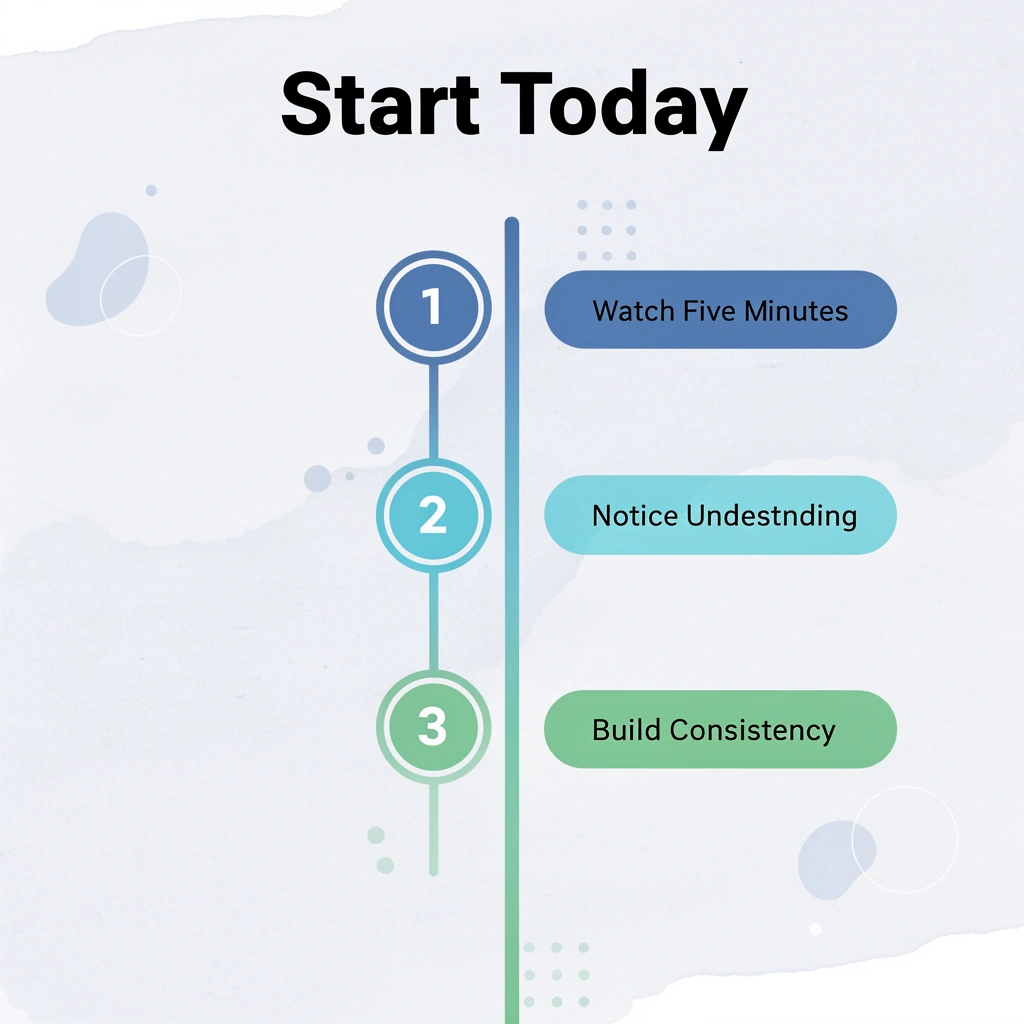
Start learning Spanish now with content you understand. Fluency comes from comprehensible input—Spanish you can follow—not from memorizing verb tables or grammar drills. That process begins the moment you engage with material at your level, rather than waiting to feel "ready enough."
🎯 Key Point: Your foundation builds itself when you consume Spanish at your level—no prerequisites required.

Most learners delay because they believe they need foundational knowledge first. Your foundation builds itself when you consume Spanish at your level. You don't need to master conjugations before reading your first story or watching your first video. Your brain recognizes patterns, connects sounds to meanings, and expands what feels familiar when exposed to understandable content.
"Comprehensible input is the only true cause of second language acquisition." — Stephen Krashen, Applied Linguistics Research
Our Parrot app offers short-form video lessons built on this principle. You get conversational Spanish in bite-sized moments with context that mirrors how native speakers communicate. The content meets you where you are, not where a textbook thinks you should be.

💡 Tip: Your first step requires just five minutes with followable content—that's all you need to begin building fluency.
Your first step requires five minutes with followable content. Pick a short story, watch a video, or listen to a simple dialogue. Notice what you understand without translating. That's learning happening. Consistency with understandable content beats intensity with confusing material.
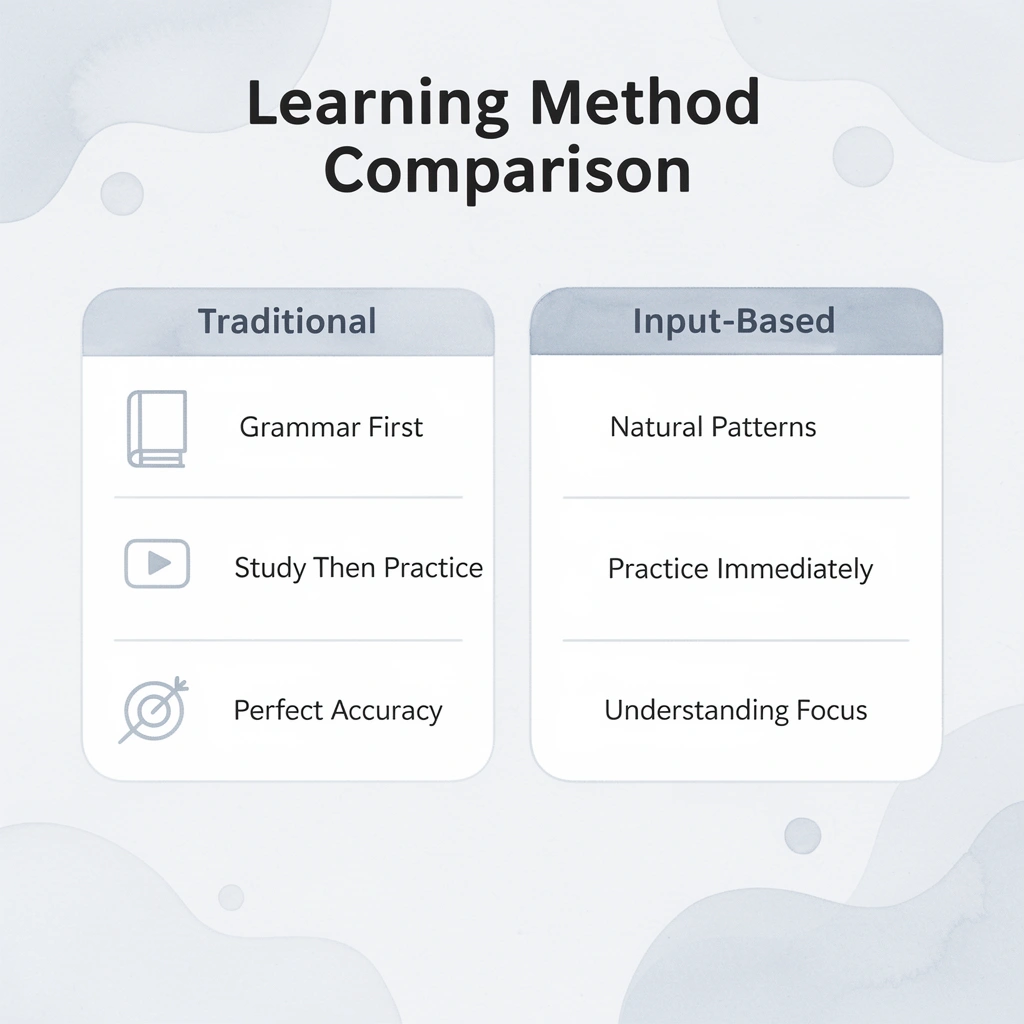
Traditional Method
Comprehensible Input
Memorize grammar rules first
Learn patterns naturally
Study before practicing
Practice from day one
Focus on accuracy
Focus on understanding
Textbook progression
Your level progression
The gap between where you are now and conversational fluency is filled with hours of comprehensible input that feel like experiencing the language rather than studying it. Every piece of Spanish you understand builds neural pathways that make the next piece easier to understand. Start today.