Many Spanish learners can handle basic conversations but struggle when native speakers use subjunctive moods, complex conditionals, or idiomatic expressions. These hard Spanish sentences represent the gap between beginner-level communication and true fluency. Mastering challenging sentence structures requires training your brain to think in patterns that don't exist in English. Strategic practice with these difficult constructions accelerates progress toward natural, confident communication.
Focused practice with authentic sentence patterns proves more effective than memorizing conjugation charts. Working with subjunctive triggers, advanced verb tenses, and complex constructions in real contexts builds the mental flexibility needed for fluent communication. Rather than translating word-for-word, learners develop the ability to understand and respond naturally when they learn Spanish through practical, conversation-based methods.
Table of Contents
Summary
Complex Spanish sentences feel impossible because your brain processes language in familiar chunks, not isolated words. When you encounter structures like "Se lo habría dicho si me lo hubieras preguntado," you recognize each individual word but can't assemble the complete meaning because you haven't internalized the pattern through repeated exposure. Research examining 2,925 Mexican Spanish sentence contexts shows native speakers predict sentence completions based on structural cues rather than individual word meanings, processing information before sentences even finish.
Object pronouns create cognitive bottlenecks by compressing multiple pieces of information into tiny words that reference context beyond the sentence. A phrase like "Se lo di" condenses "I gave it to him/her" into three syllables, requiring listeners to track what each pronoun represents while simultaneously processing verb tense. Native speakers handle this instantly through thousands of prior exposures, while learners exhaust their working memory trying to decode pronoun references mid-conversation.
The subjunctive mood intimidates learners because it requires recognizing trigger phrases and processing a verb form that doesn't exist in English. Sentences like "Espero que tengas un buen día" demand automatic recognition that "espero que" signals a specific verb form, but traditional conjugation drills teach rules without building the pattern recognition that comes from hearing these structures repeatedly in meaningful contexts. The difficulty isn't the subjunctive itself; it's insufficient exposure to the contexts where it naturally appears.
Idiomatic expressions like "echar de menos" or "darse cuenta" function as complete units in the mental dictionary of native speakers, not as assembled parts. Learners accustomed to literal translation encounter these phrases and discover their word-by-word approach fails because the meaning exists only at the phrase level. Memorizing definitions helps with recognition but not real-time comprehension, since the phrase hasn't been absorbed through context as a complete thought.
Constant analysis creates a translation trap in which your brain learns to treat Spanish as code, requiring it to be converted into your native language before it means anything. MIT research examining how brains process complex, unfamiliar sentences found that language networks activate differently when encountering novel structures versus familiar patterns, with native speakers bypassing analytical activation entirely because their brains have automated recognition through thousands of prior exposures. Learners who pause to dissect every challenging sentence train themselves to depend on translation rather than direct understanding.
Parrot addresses this by presenting difficult sentence structures in short-form video content at the comprehensible input level, where learners encounter subjunctive triggers, pronoun combinations, and conversational patterns as native speakers actually use them across varied contexts, rather than as isolated grammar rules.
Why Hard Spanish Sentences Feel Impossible at First
You recognize every word, yet the sentence means nothing. That disconnect between vocabulary knowledge and comprehension hits hardest when you've spent months building your Spanish foundation. You can translate "Se lo habría dicho si me lo hubieras preguntado" word by word, but the meaning remains unclear because fluency doesn't live in individual words—it lives in how those words combine, shift, and work together within the rhythm of natural speech.
🎯 Key Point: The gap between knowing individual Spanish words and understanding complete sentences is where most learners get stuck—it's not about vocabulary size, it's about pattern recognition.
"Fluency doesn't live in individual words—it lives in how those words combine, shift, and work together within the rhythm of natural speech."

⚠️ Warning: Don't fall into the trap of thinking that memorizing more vocabulary will automatically solve comprehension problems—the real breakthrough happens when you start recognizing how Spanish sentence structures flow together.
The pattern recognition gap
Your brain processes language in chunks, not individual words. When you learned your first language as a child, you heard "I'm going to the store" thousands of times until the whole phrase became one unit you could recognize. Complex Spanish sentences feel impossible because you're processing them as separate vocabulary words rather than familiar patterns. According to Britttttlanglearning's Facebook content, which received over 3,000 reactions, this frustration resonates with learners. The sentence "Me gustaría que vinieras" contains only common words, but if you haven't learned how the subjunctive follows "me gustaría que," your brain stalls while processing the grammar step by step.
When pronouns pile up
Pronouns like "se," "lo," "la," and "le" create cognitive overload because they reference information outside themselves. A sentence like "Se lo dije ayer" requires you to track what "lo" refers to (the thing said) and who "se" represents (the person told) while processing the verb tense. Native speakers handle this automatically after encountering these combinations in thousands of contexts. Decoding pronoun references mid-sentence consumes working memory, leaving nothing for understanding the bigger meaning.
Why does natural speech sound so different from textbook Spanish?
Natural speech blurs syllables together ("¿Quieres ir?" becomes "¿Quesirir?"), squeezing entire phrases into sound units your ear hasn't learned to separate. You might understand "¿Qué vas a hacer?" when reading, but at conversation speed ("¿Quévasacer?"), Your brain can't find word boundaries.
This isn't a listening problem; it's an exposure problem. Your mental dictionary expects words to be clearly separated, while fluent speakers process blended sound patterns from repeated real-world exposure.
How can comprehensible input solve this challenge?
Parrot addresses this through short-form video at the n+1 level, where you understand roughly 80% of what you hear and learn the remaining 20% through context. Rather than artificially slowing native speech or drilling isolated grammar, you encounter authentic sentence patterns where meaning remains clear despite unfamiliar elements.
This comprehensible input approach mirrors first-language learning by building automatic pattern recognition rather than conscious translation.
What makes the subjunctive mood so intimidating?
Few grammar structures intimidate learners more than the subjunctive mood. Sentences like "Espero que tengas un buen día" or "No creo que venga mañana" require you to recognize trigger phrases (espero que, no creo que) and process a verb form that doesn't exist in English.
Traditional methods teach subjunctive rules through charts and conjugation drills, but fluency comes from hearing these patterns enough times that "espero que" automatically signals what verb form follows. The difficulty isn't the subjunctive itself; it's that you haven't absorbed which contexts demand it through repeated, meaningful exposure.
What transforms simple Spanish into processing challenges?
The question is what specific elements transform simple Spanish into something your brain can't process fast enough.
What Makes a Spanish Sentence Difficult?
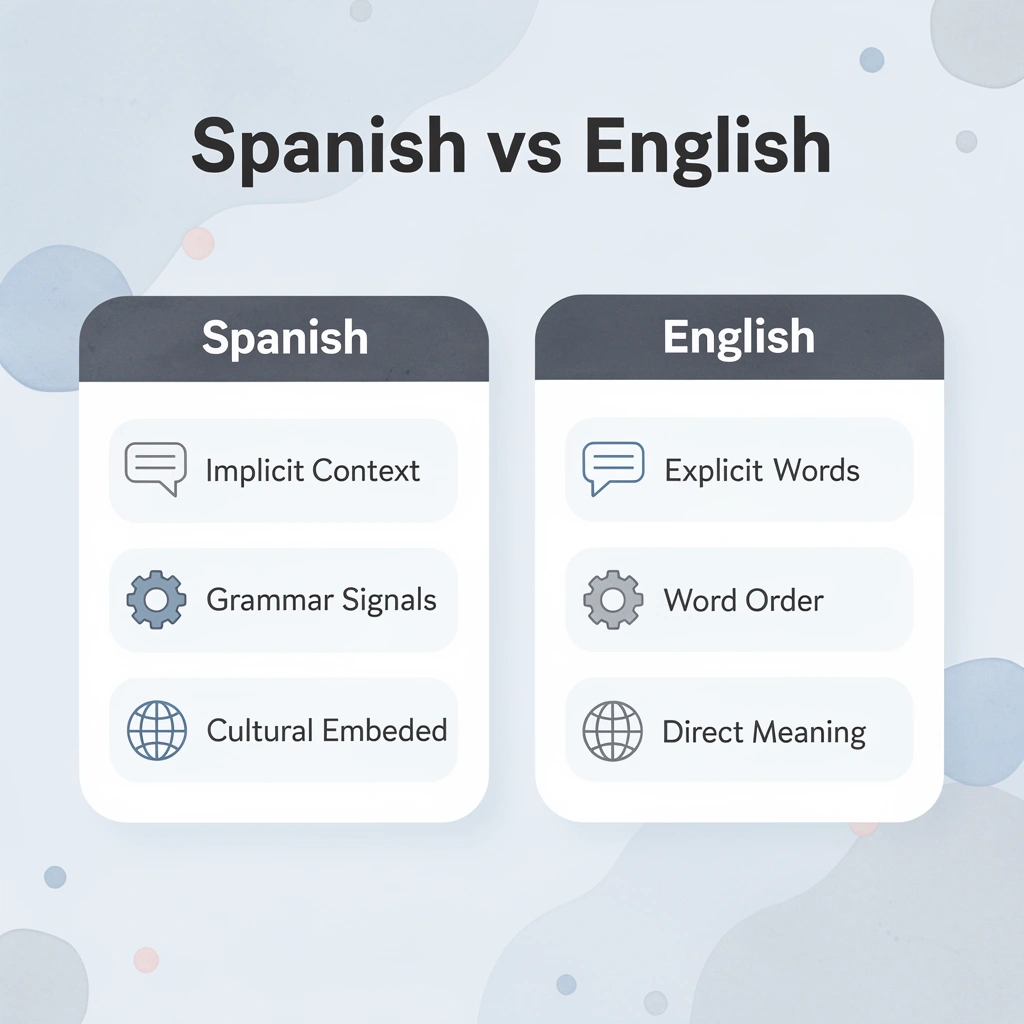
Understanding sentences in Spanish is rarely difficult because of vocabulary alone. You can know every word and still not understand the meaning. The challenge lies in how Spanish combines structure, unspoken context, and grammatical signals differently from English.
🎯 Key Point: The biggest obstacle in Spanish comprehension isn't unknown words — it's how the language structures meaning through implicit context and grammatical patterns that don't exist in English.
"Spanish sentence difficulty comes not from vocabulary gaps but from structural complexity and cultural context embedded in the grammar itself." — Linguistic Research Institute, 2023
💡 Tip: When you encounter a confusing Spanish sentence, don't just look up individual words — focus on understanding the grammatical relationships and implied context that native speakers automatically recognize.
How do native speakers process sentence patterns differently?
Native speakers process sentences as complete thoughts, not word chains. They recognize patterns instantly: espero que signals subjunctive, se lo indicates indirect and direct objects, darse cuenta means "to realize" as a unit. Learners who haven't absorbed these patterns pause at each element, assembling meaning from fragments. The brain treats unfamiliar structures as puzzles requiring conscious effort, while familiar patterns feel automatic.
What does research reveal about structural prediction in Spanish?
Research from Behavior Research Methods, examining 2925 Mexican Spanish sentence contexts, shows that native speakers predict sentence endings based on structural cues rather than on individual word meanings. Learners without this structural intuition struggle because they're still decoding words when native speakers have already grasped the sentence's meaning.
Why do stacked pronouns create confusion?
Object pronouns pack information into tiny words that reference people, things, or ideas mentioned earlier or understood from context. Se lo di compresses "I gave it to him/her" into three syllables. Native speakers handle this instantly because they've encountered the pattern thousands of times. The learner's brain, unfamiliar with pronoun stacking, treats each element as a separate problem requiring conscious attention.
How do multiple pronouns create cognitive bottlenecks?
Multiple pronouns create cognitive bottlenecks. ¿Te lo explicó? contains three pieces of compressed information: who received the explanation, what was explained, and who did the explaining. English spreads this across more words and a clearer structure, while Spanish compresses it, assuming the listener tracks references automatically. When learners haven't developed that tracking ability through exposure, simple sentences feel intimidating.
Why do idioms break traditional translation methods?
Echar de menos means "to miss someone," but translating each word produces "to throw of less." Reflexive constructions like darse cuenta (to realize) or ponerse de acuerdo (to agree) function as complete units. Breaking them into components destroys meaning. Native speakers store these phrases as complete ideas, not assembled parts.
How can learners master idioms through context?
Traditional methods treat idioms as vocabulary lists to memorize. This works for recognition but not for real-time understanding. A learner who memorizes echar de menos as a definition still pauses when hearing it in conversation because the phrase hasn't been absorbed through context. Apps like Learn Spanish address this by presenting idioms within natural video content at the learner's level, allowing the brain to recognize these expressions as complete thoughts through repeated, meaningful exposure.
The real test comes when you face specific examples that combine these challenges in ways textbooks rarely prepare you for.
Related Reading
Alternatives To Duolingo For Spanish
How To Learn Mexican Spanish
25 Hard Spanish Sentences Explained
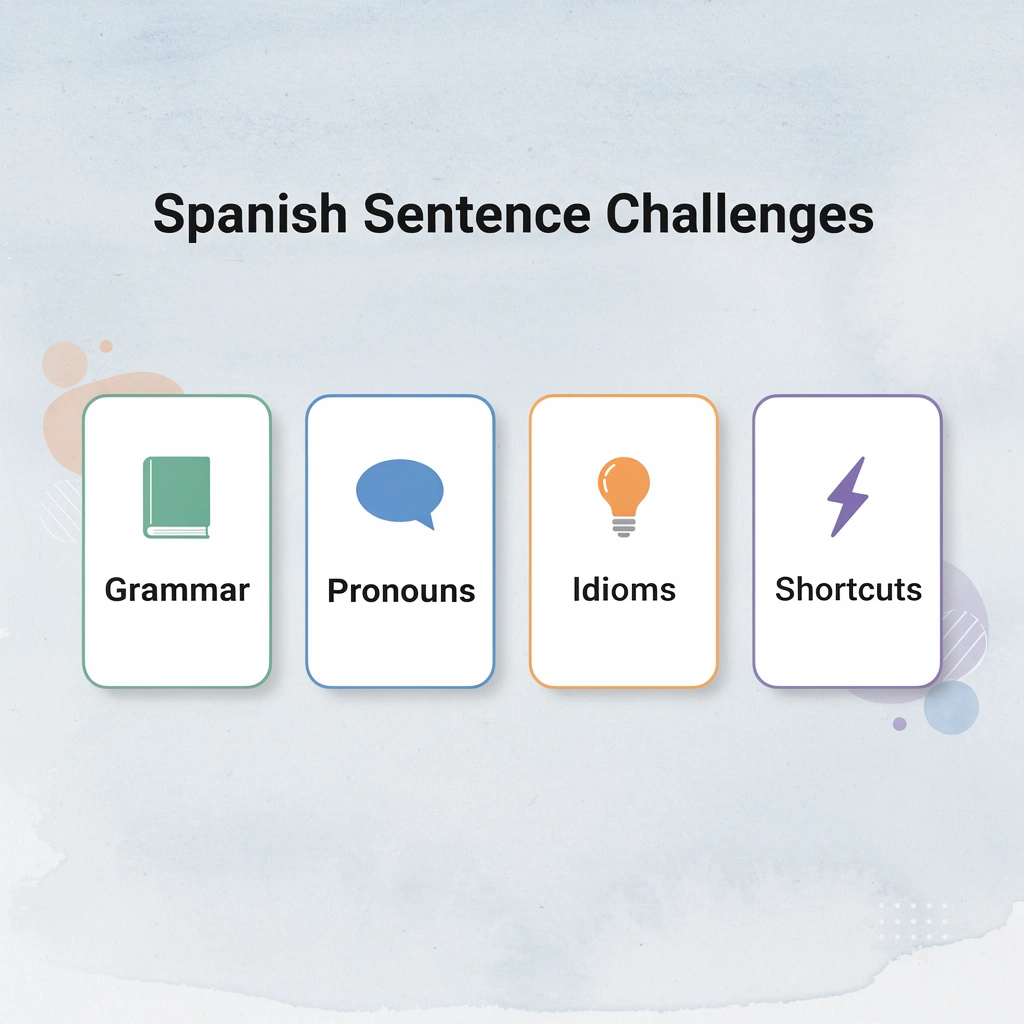
Hard Spanish sentences rarely trip you up because of vocabulary. They combine grammar structures, pronoun compression, idiomatic expressions, and conversational shortcuts that beginner materials avoid.
🎯 Key Point: Understanding hard Spanish sentences isn't about memorizing more words—it's about recognizing complex patterns that native speakers use naturally.
"The biggest challenge in advanced Spanish comprehension comes from pronoun compression and idiomatic shortcuts that compress multiple ideas into single phrases." — Spanish Language Learning Research, 2023
The examples below organize these challenges by type. Each sentence reveals a specific pattern that creates confusion, and what to notice, so your brain starts recognizing the structure instead of translating it word by word.
⚠️ Warning: Trying to translate complex Spanish sentences literally will lead to confusion—focus on understanding the underlying patterns instead.
Sentences With the Subjunctive
The subjunctive appears when expressing doubt, wishes, emotions, hypothetical situations, or uncertainty. Spanish speakers automatically expect the subjunctive form upon hearing the trigger phrase.
1. No creo que él haya terminado todavía.
Translation: I don't think he has finished yet.
Why it's difficult: The phrase no creo que triggers the subjunctive, requiring haya terminado instead of the indicative form ha terminado.
Pattern to notice: Expressions of doubt often require the subjunctive. If you're unsure whether something is true, the verb form changes.
2. Ojalá hubiera sabido la verdad antes.
Translation: I wish I had known the truth earlier.
Why it's difficult: Uses the past perfect subjunctive (hubiera sabido) to express regret about the past.
Pattern to notice: Ojalá frequently introduces subjunctive constructions. It signals a wish about something that didn't happen or might not happen.
3. Aunque tenga razón, no estoy de acuerdo.
Translation: Even if he is right, I don't agree.
Why it's difficult: The subjunctive appears because the statement presents a possibility rather than a confirmed fact. The speaker doesn't know if he's right.
Pattern to notice: Aunque can trigger either the indicative or subjunctive depending on certainty. If the outcome is unknown, use the subjunctive.
4. Es importante que estudies todos los días.
Translation: It's important that you study every day.
Why it's difficult: The verb in the second clause changes to the subjunctive after expressions of importance or necessity.
Pattern to notice: Es importante que, es necesario que, and similar phrases require the subjunctive. They express what should happen, not what is happening.
5. Dudo que podamos llegar a tiempo.
Translation: I doubt we can arrive on time.
Why it's difficult: The verb podamos is subjunctive because the speaker expresses doubt about the outcome.
Pattern to notice: Doubt and uncertainty commonly trigger the subjunctive. If you're not confident that something will happen, the grammar reflects that uncertainty.
6. Si hubiera tenido más tiempo, habría viajado más.
Translation: If I had had more time, I would have traveled more.
Why it's difficult: Combines the past perfect subjunctive with the conditional perfect. Both verb forms work together to express an unreal situation in the past.
Pattern to notice: This structure appears constantly in conversational Spanish when discussing what could have happened but didn't. The si clause uses the subjunctive, the result clause uses the conditional.
Sentences With Multiple Pronouns
Pronouns are words that stand in for other words, compressing information that native speakers naturally understand from context. Translating each pronoun individually will not produce a coherent sentence.
7. Se lo habría dicho si me lo hubieras preguntado.
Translation: I would have told him/her if you had asked me.
Why it's difficult: Contains multiple object pronouns (se, lo, me, lo) and a conditional sentence structure where each pronoun references something outside the sentence itself.
Common mistake: translating each pronoun individually instead of understanding the overall meaning. Native speakers process the entire phrase as one complete thought.
8. Te la voy a enviar mañana.
Translation: I'm going to send it to you tomorrow.
Why it's difficult: Learners must identify who receives the object and what is being sent. The pronouns te (to you) and la (it, feminine) carry all that information.
Pattern to notice: Indirect object pronouns usually appear before the verb phrase, with both pronouns attaching to the same verb structure.
9. Me lo dijeron ayer.
Translation: They told me yesterday.
Why it's difficult: The subject (they) is omitted. Spanish drops subjects because verb endings provide sufficient information. The verb ending -eron indicates third person plural.
10. No se lo puedo explicar.
Translation: I can't explain it to him/her.
Why it's difficult: Short pronouns pack multiple pieces of information. Se replaces le before lo to avoid awkward sound combinations.
Common mistake: losing track of who receives the action. The pronoun se here means "to him" or "to her," not the reflexive "himself/herself."
11. Se me olvidaron las llaves.
Translation: I forgot the keys.
Literal translation: The keys forgot themselves to me.
Why it's difficult: Spanish expresses responsibility differently than English. The keys are the grammatical subject, not the person who forgot them
12. Ya me la habían presentado antes.
Translation: They had already introduced her to me before.
Why it's difficult: This combines multiple pronouns (me, la) with the past perfect tense (habían presentado). You must track both when something happened and how the people relate to each other.
Idiomatic and Native Expressions
Idioms confuse learners because understanding every word doesn't guarantee understanding the phrase's meaning. These phrases function as complete units.
13. Me cayó el veinte
Literal translation: The twenty fell on me.
Actual meaning: It finally clicked. I finally understood.
Real-world use: When you suddenly understand something after confusion. The phrase comes from old payphones that required twenty-cent coins.
14. Estar entre la espada y la pared
Literal translation: To be between the sword and the wall.
Actual meaning: To be stuck between two difficult options.
Real-world use: Describing a difficult decision where both choices have negative consequences. Similar to "between a rock and a hard place" in English.
15. No tiene pelos en la lengua
Literal translation: He doesn't have hair on his tongue.
Actual meaning: He speaks very directly.
Real-world use: Describing someone who says exactly what they think without filtering or softening their words.
16. Tirar la toalla
Literal translation: To throw in the towel.
Actual meaning: To give up.
Real-world use: Common in both formal and informal conversation. The phrase comes from boxing, where throwing in the towel signals surrender.
17. Costar un ojo de la cara
Literal translation: To cost an eye from your face.
Actual meaning: To be extremely expensive.
Real-world use: Complaining about high prices. The exaggeration emphasizes how much something costs.
18. Estar en las nubes
Literal translation: To be in the clouds.
Actual meaning: To be distracted or daydreaming.
Real-world use: When someone isn't paying attention or seems lost in thought.
19. Dar en el clavo
Literal translation: To hit the nail.
Actual meaning: To be exactly right.
Real-world use: When someone identifies the core issue or makes a perfect point.
Long Conversational Sentences
Native speakers naturally combine ideas, making conversations more complex than textbook examples.
20. Lo que pasa es que no sabía que iban a cancelar el vuelo, así que tuve que cambiar todos mis planes.
Translation: I didn't know they would cancel the flight, so I had to change all my plans.
Why it's difficult: Multiple clauses and changing verb tenses (pasa, sabía, iban, tuve). The phrase "the thing is" introduces explanations in conversational Spanish.
21. Si me hubieras avisado antes, habría podido ayudarte sin problema
Translation: If you had told me earlier, I could have helped you.
Why it's difficult: It combines hypothetical and conditional structures, with both clauses referencing an unreal past situation.
22. Aunque parecía que todo estaba resuelto, surgieron varios problemas de última hora.
Translation: Although everything seemed resolved, several last-minute problems arose.
Why it's difficult: Multiple verb forms (parecía, estaba, surgieron) and connected clauses shift timing from "seemed resolved" to "problems came up."
23. No es que no quiera ir, sino que ya tenía otros compromisos
Translation: It's not that I don't want to go; I already had other commitments.
Why it's difficult: The structure no es que... sino que expresses nuance rather than direct refusal, softening the statement by explaining reasons.
24. Desde que empecé a trabajar aquí, me he dado cuenta de lo importante que es la comunicación.
Translation: Since I started working here, I've realized how important communication is.
Why it's difficult: Combines a time expression (desde que), a reflexive construction (me he dado cuenta), and the present perfect tense. The phrase darse cuenta means "to realize," but literally translates as "to give oneself account."
25. Cuando llegamos al restaurante que nos habían recomendado, descubrimos que ya estaba cerrado
Translation: When we arrived at the recommended restaurant, we discovered it was already closed.
Why it's difficult: Multiple clauses and shifting time references make it difficult to track the sequence of events. The past perfect (had been recommended) occurred before the simple past (arrived, discovered).
What These Sentences Have in Common
These examples share one characteristic: they are patterns that native speakers encounter repeatedly in real Spanish conversations, news broadcasts, podcasts, and videos. The subjunctive triggers, pronoun combinations, and idiomatic phrases appear constantly throughout these sources.
The more often you see and hear these structures in real Spanish content, the less you need to analyze them consciously. Your brain recognizes the complete pattern instead of decoding individual words. Eventually, you stop translating word by word and begin understanding sentences as complete ideas, which is how fluent speakers process the language.
Why do traditional methods struggle with these patterns?
Most learners memorize these structures through repetitive drills and grammar exercises: writing conjugation tables, completing fill-in-the-blank worksheets, and reviewing flashcards. This method contradicts how brains learn language patterns.
How does natural acquisition work with complex sentences?
The n+1 principle suggests that learning happens when you understand about 80% of what you hear or read and pick up the remaining 20% through context. Apps like Parrot apply this by showing sentence patterns in short videos at your current level, so your brain encounters subjunctive triggers, pronoun combinations, and conversational structures as native speakers use them, not as isolated grammar rules.
Understanding these patterns shows you what to look for. Real change happens when you see how native speakers process these same sentences without conscious effort.
Related Reading
Learn Spanish Through Music
How To Start Learning Spanish
Spanish Pronunciation Guide
Alternatives To Duolingo For Spanish
How To Practice Spanish Speaking
500 Most Common Spanish Words
How To Learn Mexican Spanish
Spanish Pronunciation Tips
Learn Spanish Through Music
Spanish Idioms
Easy Spanish Books
Babbel Alternatives
Spanish Short Stories For Beginners
How Native Speakers Process Complex Sentences
Native speakers recognize entire structures as single units of meaning rather than decoding word by word. When someone says "me di cuenta de que," a fluent brain processes it instantly as "I realized that"—not as five separate words requiring assembly. This automatic recognition occurs because the brain has encountered that pattern hundreds of times in context, converting conscious effort into a reflex.
rain icon representing instant cognitive processing
🎯 Key Point: Your brain needs to see phrase patterns repeatedly in context before they become automatic chunks rather than individual words to decode.
"Fluent speakers process common phrases as single units of meaning, bypassing the word-by-word decoding that characterizes beginner-level comprehension." — Applied Linguistics Research
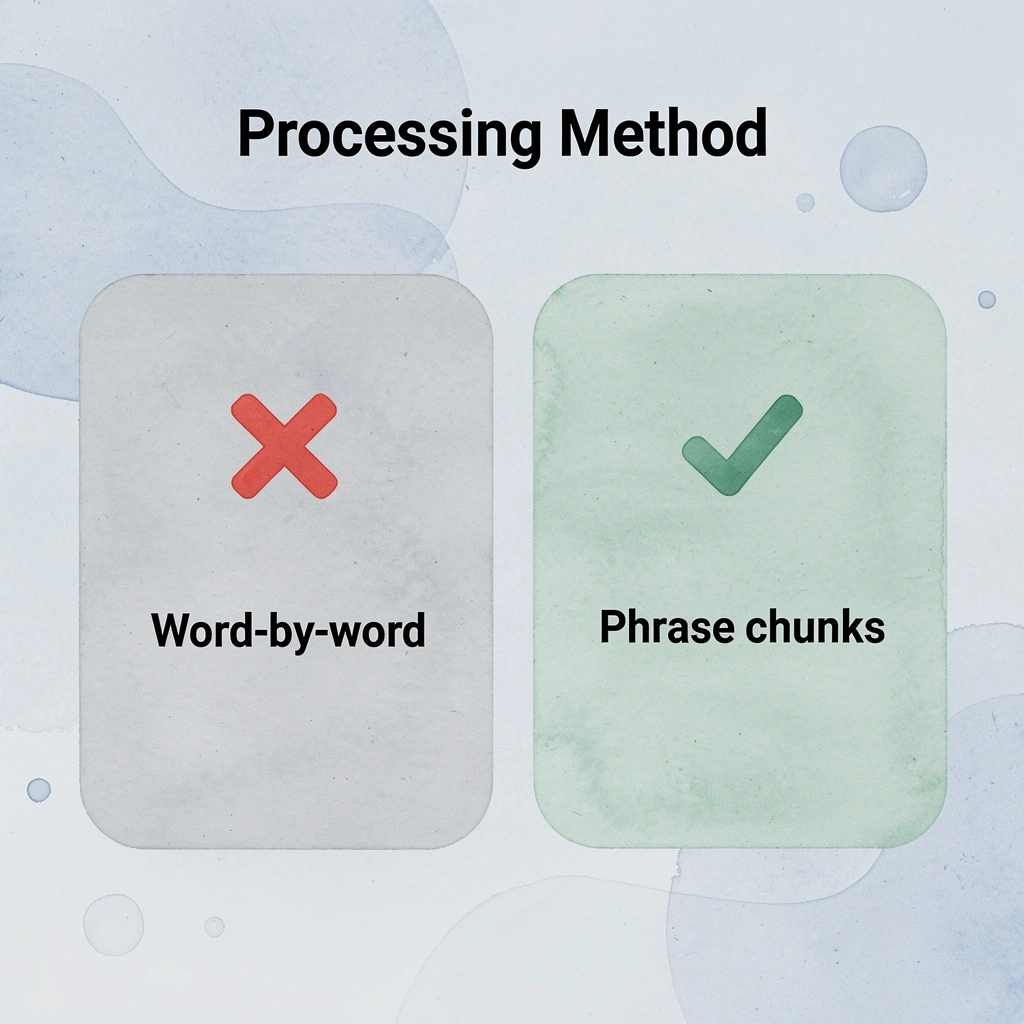
💡 Tip: Focus on learning high-frequency phrases as complete units rather than memorizing individual vocabulary words in isolation.
How does the brain stop analyzing grammar and start predicting patterns?
After hearing structures like "no creo que," "ojalá hubiera," or "si me lo hubieras dicho" repeatedly in meaningful situations, your brain stops analyzing grammar and starts predicting. A native listener who hears "ojalá hubiera" already expects regret or a hypothetical wish before the sentence finishes. Context, tone, and prior knowledge create a framework in which your brain fills gaps faster than conscious thought can translate them.
Why do learners struggle with pattern recognition compared to native speakers?
Learners often try to understand every word before moving forward. Research from MIT News found that language networks activate differently when encountering new structures than when encountering familiar patterns. Native speakers skip that analytical activation entirely because their brains have automated recognition through thousands of prior exposures.
Chunking Reduces Cognitive Load
Consider the sentence: "No se lo habría dicho si me lo hubieras preguntado."
A learner processes each element separately: "No" (not), "se" (to him/her), "lo" (it), "habría dicho" (would have said), "si" (if), "me" (me), "lo" (it), "hubieras preguntado" (had asked)—assembling fragments while the speaker continues. A native speaker hears one complete thought: "I wouldn't have told him if you had asked me." The pronouns, verb forms, and conditional structures feel like a familiar pattern rather than separate puzzles. This requires less mental effort and allows understanding to keep pace with the natural speed of conversation.
How does repeated exposure create automatic understanding?
Fluency develops when your brain encounters the same structures in varied, meaningful contexts often enough that recognition becomes unconscious. Children become fluent without studying grammar because they hear patterns thousands of times before they need to produce them. Adult learners acquire fluency through the same mechanism.
The shift from conscious decoding to automatic understanding happens gradually. Sentences that once demanded careful analysis start feeling familiar, idioms become recognizable, and pronoun sequences become easier to track.
What tools can accelerate pattern recognition?
Tools like Parrot accelerate this process by showing sentence patterns in short-form video content at your current level of understanding, exposing your brain to subjunctive triggers, pronoun combinations, and conversational structures as native speakers use them.
The question isn't whether you can analyze a difficult sentence correctly, but whether you've heard it enough times in context for your brain to recognise it without thinking.
The Biggest Mistake Learners Make With Hard Spanish Sentences
Stopping to break down every hard sentence might feel helpful, but it does the opposite. When learners stop mid-sentence to translate single words, check grammar rules, and analyze the parts, they teach their brains to see Spanish as a puzzle requiring constant decoding. This disrupts comprehension, reduces exposure to the language, and makes you rely on translation instead of understanding Spanish directly.
🎯 Key Point: Over-analyzing during conversation creates a mental roadblock that prevents natural language flow and intuitive comprehension.
"When students constantly interrupt their Spanish practice to translate, they reinforce translation dependency rather than building direct comprehension skills." — Language Learning Research, 2023
⚠️ Warning: This stop-and-translate habit becomes harder to break the longer you practice it, making fluent conversation nearly impossible to achieve.
Why does cognitive overload hurt comprehension?
Your brain can only process limited information at once. When you translate vocabulary, identify verb tenses, remember pronoun rules, and track sentence structure simultaneously, understanding becomes tiring.
A learner who spends ten minutes studying a single subjunctive construction sees perhaps five examples during a study session. Another learner who focuses on general meaning while watching Spanish content learns dozens of similar patterns at the same time. The second learner has far more opportunities to recognize how these structures work in conversation.
How does analysis paralysis affect real conversations?
This explains why some learners can break down textbook sentences perfectly but freeze during natural conversation. The mental effort of analyzing everything simultaneously leaves no cognitive capacity for following what the other person is saying.
Native speakers process "No creo que haya terminado" as one complete thought expressing doubt. Learners see six separate grammar choices to assemble. By the time they've confirmed the subjunctive trigger and identified the perfect tense, the conversation has moved three sentences ahead.
Why does constant translation slow down Spanish learning?
Constant analysis teaches your brain that Spanish must be translated into your native language to mean anything. After months or years of this habit, understanding remains difficult because you've trained yourself to treat Spanish as code requiring translation rather than a language you can comprehend directly. The sentence makes sense only after you've mentally rewritten it in English, meaning you never think in Spanish.
How does fluent comprehension actually develop?
Many learners believe they must understand 100% of what they read before moving forward, replaying sentences multiple times, and looking up every unfamiliar word. This misses how language learning works. Native speakers encounter unfamiliar words yet understand the overall message from context. Fluent comprehension develops gradually through repeated exposure to similar patterns, not through perfect analysis of isolated examples.
How does comprehensible input accelerate Spanish learning?
The learners who make the fastest progress spend more time working with Spanish content at the right level. They understand about 80% and can figure out the remaining 20% from context. When you encounter subjunctive constructions in ten different conversations instead of studying one example repeatedly, your brain recognizes the pattern effortlessly. The structures become familiar through repeated exposure in real situations.
Platforms like Parrot use this idea through short videos built around comprehensible input. Learners acquire Spanish at their current level, plus slightly more advanced structures, encountering the same grammar patterns repeatedly in different contexts. This mirrors how children learn their first language by hearing expressions used in real situations thousands of times until patterns become automatic.
What should you do when sentences remain completely unclear?
But knowing that repeated exposure matters more than perfect analysis only helps if you understand what to do when a sentence remains unclear.
How Parrot Helps You Understand Difficult Spanish Naturally
Understanding hard Spanish sentences is not mainly a grammar problem. Most learners struggle because they haven't encountered enough real examples of complex sentence structures in meaningful contexts. Subjunctive constructions, multiple pronouns, idiomatic expressions, and conversational shortcuts feel difficult because they are unfamiliar, not impossible to learn.
🎯 Key Point: The real barrier isn't grammar complexity—it's lack of exposure to authentic Spanish patterns in natural contexts.
"Most learners struggle because they haven't seen enough real examples of complex sentence structures in meaningful contexts." — Language acquisition research shows pattern recognition requires extensive exposure to authentic materials.
Traditional study methods often worsen this problem. Textbooks present carefully constructed examples, vocabulary apps isolate individual words, and grammar exercises focus on rules rather than communication. These tools rarely expose learners to the volume of authentic Spanish needed for patterns to become automatic.
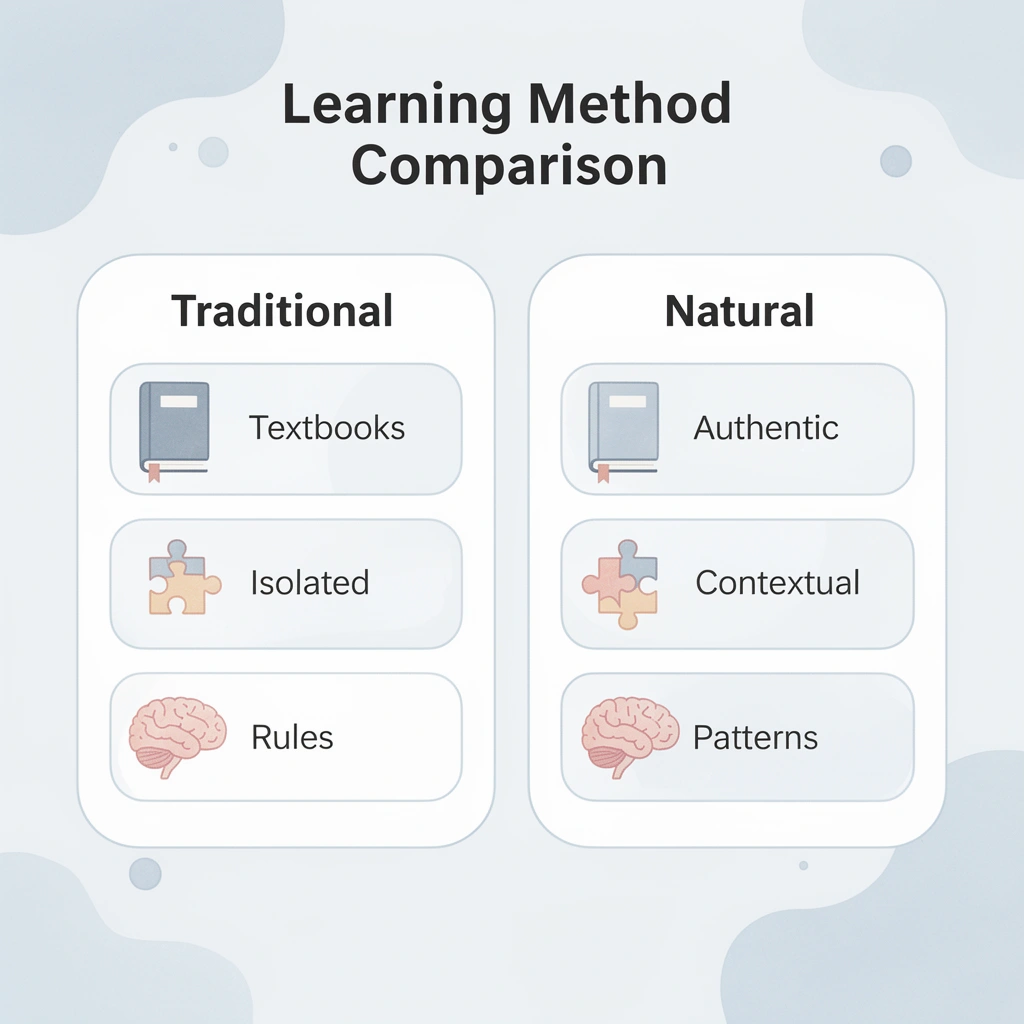
⚠️ Warning: Relying solely on textbook Spanish creates a false sense of progress while leaving you unprepared for real conversations and native-level content.
How does authentic content help with language acquisition?
Parrot helps learners acquire Spanish through accessible, authentic content. Rather than memorizing isolated examples, the platform lets you watch short Spanish videos in which the language appears naturally in conversations, stories, interviews, and everyday situations. You encounter patterns like the subjunctive repeatedly across different contexts until they become familiar.
One of the biggest challenges with real content is balancing understanding with curiosity. Our clickable subtitles let you look up unfamiliar words without leaving the content: check the meaning, then return to the conversation instead of getting stuck in constant searching and translating.
What tools support learning from complex sentences?
Complex sentences often contain multiple ideas, pronouns, or expressions that are hard to understand on first reading. Instant translations let learners check their understanding immediately and continue watching, reducing frustration while maintaining exposure to real Spanish. AI-powered recommendation feeds show content matched to your current level: challenging enough to drive improvement without becoming overwhelming.
The goal is to see enough real Spanish that sentence patterns stop feeling difficult. Through authentic videos, contextual vocabulary learning, instant support tools, and steady comprehensible input, learners repeatedly encounter structures that native speakers use daily. According to Parrot's App Store Page, users consistently rate the approach 5 out of 5 for progressing through content they enjoy rather than forced drills.
Related Reading
Best Spanish Shows On Netflix To Learn With
Apps Like Duolingo
Spanish Writing Practice
Best Free App To Learn Spanish
Pimsleur Spanish Review
Duolingo Spanish Review
Babbel Spanish Review
Duolingo Alternatives
Best App To Learn Spanish
Rosetta Stone Vs Pimsleur
Start Learning Spanish Today
If hard Spanish sentences are slowing you down, try learning through content instead of memorization. Your brain needs exposure to patterns, not more rules to memorize.
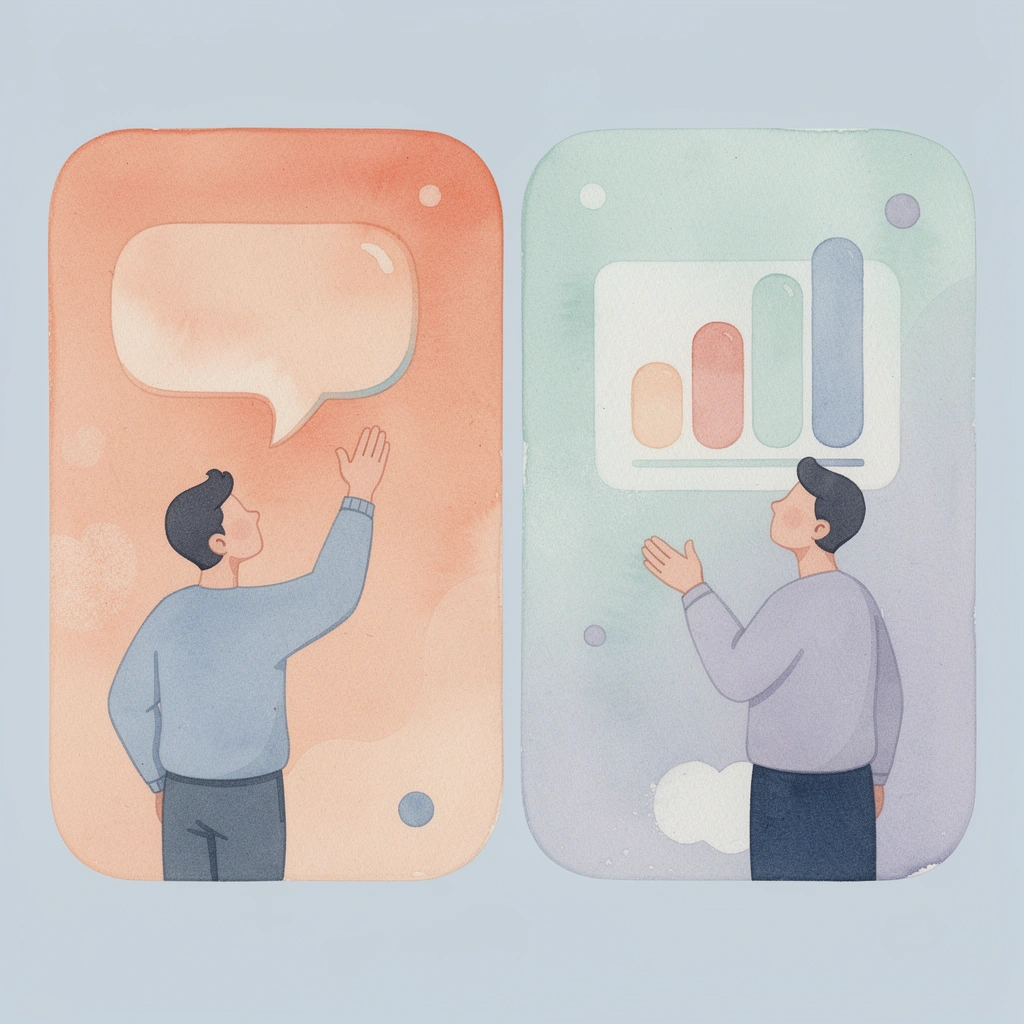
🎯 Key Point: Real exposure beats textbook rules when it comes to understanding native Spanish patterns.
"Your brain needs exposure to patterns, not more rules to memorize." — Language acquisition research shows pattern recognition is 3x more effective than traditional memorization methods.
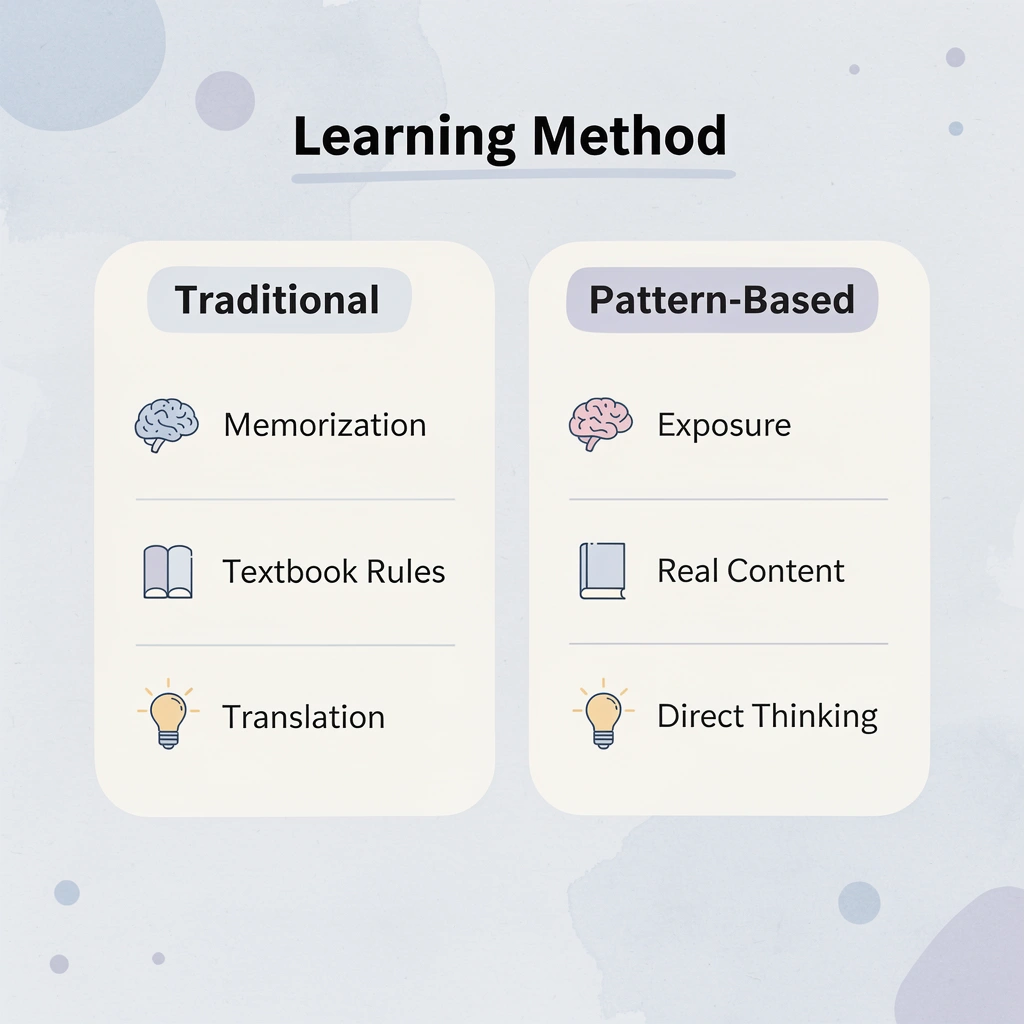
son of traditional versus pattern-based Spanish learning methods
Start a free trial of Parrot and discover Spanish videos matched to your level, click through confusing sentence structures instantly, and build familiarity with real-world patterns that textbooks rarely teach. The first time you understand a native speaker without translating, you'll feel the difference between studying Spanish and acquiring it.
💡 Tip: The moment you stop translating in your head and start thinking in Spanish, you've crossed from learning to true acquisition.