Getting stuck mid-sentence when describing something that has already happened is one of the most common frustrations for beginners in Spanish. The culprit is almost always an incomplete grasp of the past tense. Spanish has two key past tenses, the preterite and the imperfect, and knowing when to use each one is what separates basic phrases from fluid, natural conversation.
The good news is that past tense patterns are learnable with the right practice. Rather than drilling verb charts in isolation, the most effective approach is to use these forms in real sentences with real context. For anyone ready to build that skill through actual conversation practice, learn Spanish with Parrot.
Table of Contents
Why the Spanish Past Tense Feels So Confusing
Why Memorizing Rules Does Not Always Lead to Fluency
What Is the Spanish Past Tense?
How Native Speakers Actually Learn When to Use Past Tenses
The Best Ways to Practice Spanish Past Tense Naturally
How Parrot Helps You Master the Spanish Past Tense Naturally
Start Learning Spanish Today
Summary
Spanish has two distinct simple past tenses, whereas English has one, and that structural gap is the core reason learners struggle. The preterite handles completed, bounded actions while the imperfect covers ongoing states, habits, and background descriptions. Using the wrong one does not just create a grammar error; it changes the meaning of the sentence entirely.
Understanding a grammar rule and using it automatically in conversation are two separate cognitive skills stored in different parts of the brain. Research published in PMC found that retrieval fluency inflates perceived preparation for difficult problems, meaning learners who can quickly recall a conjugation rule tend to overestimate how ready they are to use it under real conversational pressure. This is why acing a fill-in-the-blank exercise offers little protection against freezing mid-sentence.
Spanish encodes four distinct past tenses because the language treats time with more precision than English does. According to Preply, these are the preterite, imperfect, present perfect, and past perfect, each reflecting a different relationship between the speaker and the event being described. Most everyday conversation relies on the first two working together, one capturing the event and the other holding the atmosphere around it.
Native speakers do not consult mental grammar charts when they speak. They respond to what sounds right, a sense built through repeated exposure to the same patterns in real contexts. Dr. Stephen Krashen's input hypothesis captures this directly: language acquisition happens when learners understand messages, not when they analyze grammatical structure.
Narrative exposure does the heaviest lifting in internalizing past-tense distinctions. Research on extensive reading shows vocabulary and structural gains of up to 44% after learners engaged with graded readers, with much of that retained three months later. Stories naturally weave completed actions and background descriptions together, training the brain to feel the contrast between tenses rather than consciously select between rules.
Short-form video content changes the consistency equation for adult learners by fitting into real daily routines rather than demanding scheduled study blocks. Research published in Frontiers in Medicine (2025) found that short-form video formats improve learner engagement and task efficiency without sacrificing learning outcomes. A study from Springer (2025) also reinforced that engagement driven by genuine interest produces stronger and more durable retention than obligation-based practice.
Parrot's Learn Spanish app addresses the gap between rule recognition and automatic production by using short-form video immersion built around comprehensible input, so that past-tense forms appear repeatedly in real contexts rather than in isolated drills.
Why the Spanish Past Tense Feels So Confusing
Spanish encodes the past in a way that has no clean equivalent in English. Where English uses one simple past form ("I walked," "she called," "they left"), Bilinguistics reports that Spanish has two distinct simple past tenses — the preterite and the imperfect — each carrying a different relationship to time, completion, and context. That structural difference changes how you have to think about every past event you describe.
"Spanish has two distinct simple past tenses — the preterite and the imperfect — each carrying a different relationship to time, completion, and context." — Bilinguistics / Science Direct
Preterite
English Equivalent
“I walked” (completed action)
Core Function
Finished, bounded past events
Imperfect
English Equivalent
“I was walking” (ongoing action)
Core Function
Background, habits, or ongoing states
🎯 Key Point: English speakers aren't just learning new verb endings — they're learning an entirely new way of categorizing past events that doesn't exist in their native language.
⚠️ Warning: Treating the preterite and imperfect as interchangeable is one of the most common mistakes Spanish learners make. Choosing the wrong one doesn't just sound awkward — it can change the meaning of what you're saying entirely.
What is the real difference between the preterite and the imperfect?
The preterite handles finished, bounded actions: you ate breakfast, the meeting ended, she called once. The imperfect handles everything else: habits, ongoing states, background descriptions, and repeated actions without a defined end. "I used to eat breakfast early" versus "I ate breakfast at seven." In English, both feel interchangeable. In Spanish, using the wrong one changes the meaning completely.
The distinction is not a grammar rule; it concerns how you think about things. You are deciding how to frame the event itself: was it a completed moment, or a condition that existed over time? That is a philosophical question dressed up as a grammar rule.
Why do rules and charts fail in real conversation?
Most learners study the rules, memorize the endings, and practice the charts. That works well enough to pass a quiz but breaks down in real conversation. The mental search for the right conjugation takes longer than the moment allows. Learners who use Parrot's learn Spanish app sidestep that freeze by building past-tense recognition through short-form video immersion, hearing the preterite and imperfect used in real sentences repeatedly until the pattern becomes instinct rather than a conscious decision.
The confusion is a structural feature of the learning process. Learners often describe the preterite versus imperfect stage as a rollercoaster: moments of clarity followed by sentences that feel wrong despite following the rules exactly. The brain is rebuilding how it categorizes time and action, which requires repeated exposure to real language rather than repeated review of the same chart.
Even after the rules click intellectually, the gap between understanding and speaking can persist for months. That gap is where the real work happens.
Why Memorizing Rules Does Not Always Lead to Fluency
That gap between understanding and speaking is not a motivation problem. It is a wiring problem, and it shows up the same way for almost every learner who has tried to study their way to fluency.
"The gap between knowing a language and speaking it fluently is not a matter of effort: it is a matter of how the brain stores and retrieves different types of knowledge." — Cognitive Neuroscience Research
💡 Tip: If you feel stuck despite hours of studying, you are not failing. Your brain is storing knowledge in the wrong system for real-time speaking.
Knowing a grammar rule and using it automatically are two completely separate skills your brain uses. Your brain stores explicit knowledge — like a conjugation chart you memorized — in a different place than it stores procedural knowledge, the kind that fires instantly when someone asks you a question mid-conversation. Speaking fluently requires practice.
Explicit Knowledge
What It Looks Like
Reciting a conjugation chart
Useful For
Written tests, grammar drills
Procedural Knowledge
What It Looks Like
Responding instantly in conversation
Useful For
Real-world fluency, speaking
The Gap
What It Looks Like
Knowing the rule but freezing mid-sentence
Useful For
Most traditional learners
⚠️ Warning: Memorizing grammar rules alone will never build the automatic, procedural fluency your brain needs for real conversation — no matter how many charts you study.
Why can you ace a grammar exercise but still freeze mid-conversation?
According to research published in PMC, 3 experiments showed that retrieval fluency inflates perceived preparation for difficult problems. Learners who can quickly recall a rule tend to overestimate their readiness to use it under pressure. This explains why a Spanish learner might ace a fill-in-the-blank exercise yet freeze when a native speaker asks what they did last weekend.
Most learners respond by studying harder, adding more flashcards and grammar exercises. But the gap persists because the practice doesn't target the right skill. Learn Spanish through short-form video immersion. Our approach at Parrot targets the procedural system directly by flooding the brain with real language in context, allowing patterns to be absorbed the way native speakers absorb them: through repetition tied to meaning rather than memorization.
How does meaningful exposure make past tense patterns stick?
Context is what makes past tense forms stick. When you hear a native speaker describe their childhood using the imperfect repeatedly across different stories, your brain connects that form to a feeling rather than a rule. The habitual past, the ongoing background of a story, the texture of memory—these patterns your brain recognizes after sufficient meaningful exposure to the preterite and imperfect working together in real speech.
Fluency is less about what you know and more about what your brain no longer has to think about. That shift from conscious effort to automatic recognition depends on something most people underestimate.
Related Reading
What Is the Spanish Past Tense?
Spanish uses several different past tenses because the language treats time with more precision than English does. Where English relies on a single past form, Spanish separates completed events from ongoing ones, recent experiences from distant ones, and sequential actions from simultaneous ones. According to the Preply Blog's Spanish past tense explanation, there are 4 past tenses in Spanish: the preterite, imperfect, present perfect, and past perfect, each showing a different relationship between the speaker and the event being described.
"There are 4 past tenses in Spanish: the preterite, imperfect, present perfect, and past perfect, each showing a different relationship between the speaker and the event being described." — Preply Blog
💡 Key Concept: Unlike English, Spanish past tenses are not interchangeable — each one signals a specific relationship between the speaker and the event in time.
⚠️ Common Mistake: Many learners assume one past tense works for everything, just like in English. In Spanish, choosing the wrong tense can completely change your meaning.
Preterite
Primary Use
Completed, one-time events
Imperfect
Primary Use
Ongoing or repeated past actions
Present Perfect
Primary Use
Recent experiences with present relevance
Past Perfect
Primary Use
Events completed before another past event
How do the preterite and imperfect work together?
The preterite handles completed actions with clear endpoints. "Ayer comí pizza" tells you that something was finished. The imperfect handles continuous, habitual, or descriptive situations. "Hacía calor" sets the temperature of a scene, not a moment. These two tenses carry most of the weight in everyday conversation, working together like a camera: one captures the event, the other holds the atmosphere around it.
What do the present perfect and past perfect add?
The present perfect and past perfect add more layers once those foundations are solid. The present perfect connects recent experience to now—"He comido" suggests the meal still matters. The past perfect establishes sequence, showing what had already happened before something else occurred. The difficulty is knowing which lens to reach for without stopping to think.
Why conjugation volume matters less than you think
The structural challenge is not the number of tenses but the number of forms within each one. As the Espanido Blog notes on conjugating AR, ER, and IR verbs, Spanish verbs change endings for 8 subject pronouns per tense. Multiply that across four past tenses, and you get a conjugation table that resembles a spreadsheet no one asked for. Most learners respond by drilling those tables, but drilling builds recognition under calm conditions, not retrieval under the pressure of real conversation at native speed.
Why do drilling charts fail in real conversations?
The familiar approach relies on memorizing charts and fill-in-the-blank exercises. Apps like Parrot take a different path, using short-form video immersion built around comprehensible input, so learners encounter the preterite and imperfect forms repeatedly in real contexts rather than in isolated drills. Your brain recognizes patterns the same way it recognizes a familiar face: not by reciting features, but by having seen it enough times in enough situations.
What happens when you treat past tenses as patterns to absorb?
The four past tenses are not obstacles; they are a more honest map of how humans experience time. Once you stop treating them as grammar problems to solve and start treating them as patterns to absorb, the conjugations stop feeling like a burden and start feeling like texture.
Related Reading
How To Start Learning Spanish
Spanish Pronunciation Guide
Alternatives To Duolingo For Spanish
How To Practice Spanish Speaking
500 Most Common Spanish Words
How To Learn Mexican Spanish
Learn Spanish Through Music
Spanish Idioms
Easy Spanish Books
Babbel Alternatives
Spanish Short Stories For Beginners
How Native Speakers Actually Learn When to Use Past Tenses
Native speakers respond to what sounds right — a feeling built through years of hearing patterns repeat in real situations. They do not check mental grammar charts when they speak.
"Native speakers develop an intuitive sense of tense through years of repeated exposure to patterns in real, meaningful contexts — not through conscious rule-checking." — Applied Linguistics Research
💡 Tip: This is the real secret to mastering past tenses — your goal isn't to memorize rules; it's to build the same intuitive pattern recognition that native speakers develop naturally over time.
🎯 Key Point: Native fluency isn't about grammar charts — it's about deeply internalized patterns formed through thousands of hours of real-world exposure.
How Native Speakers Learn
Intuitive pattern recognition
Years of repeated exposure
Real situational context
Sounds right instinct
How Most Learners Approach It
Memorizing grammar rules
Short study sessions
Textbook exercises
Mental rule-checking
How does implicit learning shape a native speaker's feel for the past tense?
The foundation is implicit learning. When a child hears "cuando era pequeño" followed by an imperfect verb hundreds of times across bedtime stories, family dinners, and television, the brain stops processing it as grammar and starts processing it as shape. The preterite and imperfect become textures the ear recognizes before the mind can name them. Dr. Stephen Krashen's input hypothesis captures this: language acquisition happens when learners understand messages, not when they analyze structure.
The same pattern surfaces in reading. Spanish speakers who grew up reading novels, comics, or text messages absorbed past tense usage through narrative rhythm: a completed event lands with the preterite, while a scene-setting description lingers in the imperfect. After sufficient exposure, that contrast becomes instinctive.
Why do most language apps fall short of real acquisition?
Most language apps skip this step by showing conjugation tables and multiple-choice exercises. That method builds recognition, but recognition differs from production. In real conversations, exercises won't suffice. Apps like Parrot use short videos focused on comprehensible input, so past tense forms appear as they do in real life: embedded in meaning, context, and stories.
How does varied exposure train the brain to feel past tense naturally?
What speeds this up for adult learners is exposure to the same forms across different contexts during real communication work. Hearing "ayer fui al mercado" in one video, "fui a la escuela cuando tenía cinco años" in another, and "no fui porque estaba cansado" in a third trains the brain to understand "fui" as a completed past action across different situations.
Errors are information. When a learner says "ayer estaba en el mercado" and a native speaker responds with "ah, ayer estuve," the correction occurs within a real communication moment, making it far more memorable than a red mark on a worksheet. The brain learns corrections best when they arrive in context and are connected to meaning.
The Best Ways to Practice Spanish Past Tense Naturally
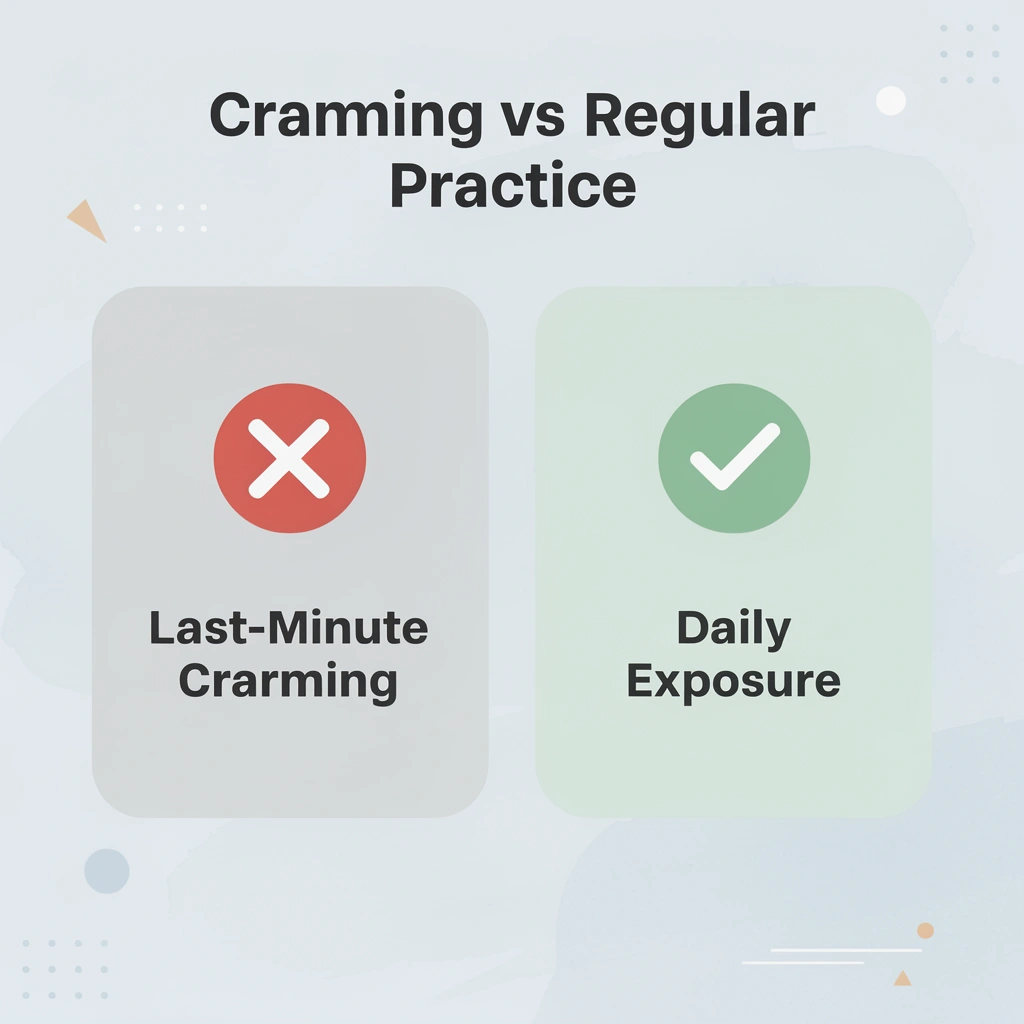
Practicing regularly is far better than cramming at the last minute. Learners who master the preterite and imperfect tenses fastest encounter Spanish past tense forms over and over again in content they actually want to read — not just through conjugation charts.
"The fastest path to mastering Spanish past tense isn't memorization — it's repeated, natural exposure through content you're genuinely motivated to consume." — Language Acquisition Research
💡 Tip: Instead of drilling conjugation charts in isolation, embed your past tense practice into real content — stories, podcasts, or shows you genuinely enjoy. Natural repetition beats forced memorization every time.
Conjugation Charts
Effectiveness
Low — passive exposure
Best For
Quick reference only
Regular Reading/Listening
Effectiveness
High — active immersion
Best For
Long-term retention
Last-Minute Cramming
Effectiveness
Very Low — short-term recall
Best For
Not recommended
Spaced Repetition
Effectiveness
Very High — deep encoding
Best For
Mastering both tenses
⚠️ Warning: Relying solely on conjugation charts without contextual exposure is one of the most common mistakes learners make — it builds recognition without building real fluency.
Stories do the heavy lifting
Narratives weave together completed actions and background descriptions, training your brain to distinguish between them. When you hear "Cuando era niño, jugaba al fútbol todos los días. Un día me rompí el brazo," you feel the difference between an ongoing childhood habit and a single, defining moment through emotional contrast rather than explicit instruction. This contrast embeds the grammar. Research on extensive reading shows vocabulary and structural gains of up to 44% after learners engage with graded readers, with much of it retained three months later, according to a study published in ERIC.
Why does short-form video change the consistency equation?
Most learners don't fail from lack of initial motivation. They fail because habits erode when study sessions feel like work. Short-form video content solves this by fitting into daily gaps rather than requiring scheduled time. Research published in Frontiers in Medicine (2025) found that short-form video formats improve learner engagement and task efficiency without sacrificing learning outcomes. When content is genuinely enjoyable, exposure accumulates without the friction that kills most study routines.
How does video immersion outperform grammar apps for the past tense?
Most learners use grammar apps because the structure feels safe and easy to measure: finish a lesson, get a badge, see progress. But that system teaches recognition, not use. When someone asks "¿Qué hiciste ayer?", the badge won't help you answer. Apps like Parrot use short videos to show language in real situations. Past tense forms appear repeatedly in context, the way native speakers encounter them, connected to meaning rather than drilled in isolation.
Phrases beat isolated conjugations
Native speakers reach for familiar chunks rather than building sentences word by word from a mental grammar table. Phrases like "Cuando era pequeño," "Siempre iba con mis amigos," and "Ayer fui al supermercado" function as ready-made building blocks. Collecting and repeating these patterns trains your brain to retrieve past-tense structures through recognition and habit rather than through conscious rule application. The difference between a learner who freezes mid-sentence and one who flows is how many of these stored patterns you have.
What you focus on during practice matters more than how long you practice
The critical difference is attention. Learners who replay a sentence such as "Estaba estudiando cuando sonó el teléfono" while focusing on meaning absorb the contrast between the imperfect and the preterite far more efficiently than those analyzing each verb ending in isolation. Meaning-first processing is how implicit learning works. A study by Springer (2025) on motivation and accessibility in digital learning environments found that engagement driven by genuine interest yields stronger retention. Fifteen focused minutes in content you care about consistently outperform an hour of mechanical repetition.
The question most learners never ask is not "How much should I practice?" but something far more specific, and the answer changes everything.
How Parrot Helps You Master the Spanish Past Tense Naturally
After learning how Spanish past tenses work, many learners still struggle to use them in real conversations. The answer isn't another grammar workbook: it's meaningful, repeated exposure to the language in action.
"The gap between knowing a grammar rule and using it fluently is one of the biggest obstacles language learners face, and it's rarely solved by studying more rules." — Language Acquisition Research
💡 Tip: If you've studied the rules but still freeze up when speaking, the problem isn't your grammar knowledge: it's your lack of exposure to those patterns in context.
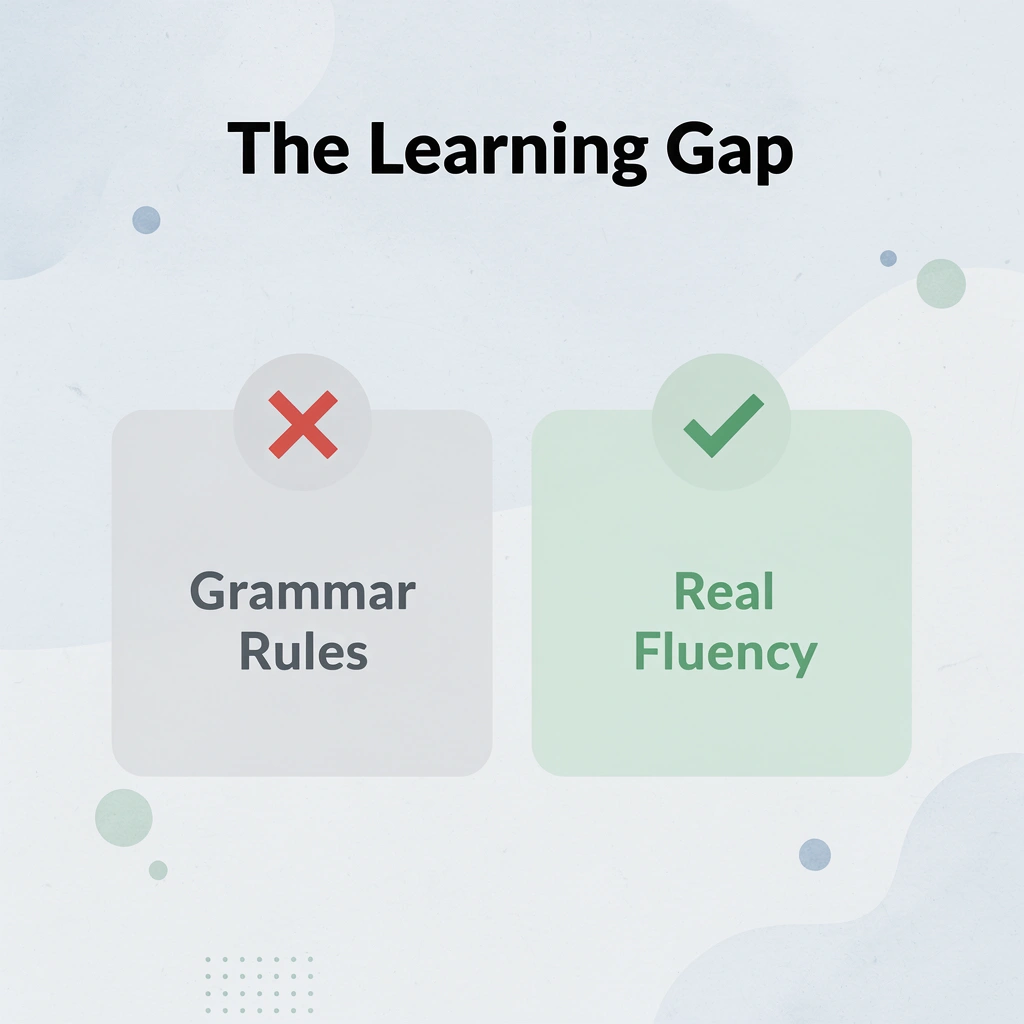
Most learners understand the difference between the preterite and the imperfect in their minds. What they lack is enough exposure to see those patterns again and again in meaningful contexts. Parrot addresses this through research-backed comprehensible input — the idea that languages are learned most effectively when learners take in content they can mostly understand.
Grammar Workbooks
What It Builds
Passive rule knowledge
Comprehensible Input
What It Builds
Intuitive pattern recognition
Repeated Meaningful Exposure
What It Builds
Real conversational fluency
🔑 Takeaway: Comprehensible input isn't just a theory — it's the most research-supported method for moving grammar from your conscious mind into automatic, natural speech.
⚠️ Warning: Skipping the exposure phase and relying only on grammar study is the #1 reason learners plateau before reaching conversational fluency.
How does short-form video make learning feel effortless?
Short-form videos are at the center of the experience. Rather than feeling like traditional studying, learning resembles scrolling TikTok, making it easier to maintain consistency.
Clickable subtitles and instant translations eliminate the frustration of switching between apps or dictionaries. If you encounter a sentence like:
Cuando era niño, jugaba al fútbol todos los días.
You can instantly understand the meaning without interrupting the video's flow. Repeated exposure makes these patterns familiar.
How does Parrot personalize your Spanish past tense practice?
Parrot lets you save vocabulary and useful phrases. Instead of collecting isolated words, you build a library of expressions native speakers use, making it easier to recognize and reproduce common past tense structures.
An AI-powered recommendation feed personalizes the experience by surfacing content based on your interests and comprehension level. Whether you're interested in travel, relationships, sports, cooking, or entertainment, you learn through content you enjoy rather than forcing yourself through disconnected lessons.
How does repeated exposure build real fluency over time?
Fluency is about intuition. Native speakers don't consciously think through grammar rules before speaking, and advanced learners eventually stop doing so too. They develop a feel for what sounds natural through repeated exposure.
Parrot helps you build intuition by turning language learning into an enjoyable, sustainable habit. Fluency develops through thousands of meaningful interactions with the language, not perfect conjugation charts.
Start Learning Spanish Today
The key question is not whether you should practice more, but whether what you're doing builds actual learning or familiarity with confusion. Most learners cannot distinguish between these two outcomes.
"The difference between feeling like you're learning and actually learning is one of the most overlooked traps in language acquisition." — Language Learning Research
💡 Tip: Before your next study session, ask yourself: "Am I building real understanding, or repeating the same confusion?" That question alone can transform your results.
⚠️ Warning: Passive familiarity is not the same as active mastery. If material feels vaguely recognizable but you cannot produce it under pressure, you haven't learned it yet.
If you're still second-guessing the preterite and imperfect mid-sentence, the missing piece isn't another conjugation chart — it's exposure to how native speakers actually move between completed actions and background context in real speech. Learn Spanish with Parrot by starting a free trial and exploring Spanish videos with clickable subtitles and instant translations. You'll build intuition around past tense patterns through meaning in context, not rules under pressure.
Slow Manual Builds
Build Time
Hours per page
Experiments Per Month
2–4 tests
Competitive Position
Falling behind
Templated Workflows
Build Time
30–60 minutes
Experiments Per Month
10–15 tests
Competitive Position
Keeping pace
Rapid Deployment System
Build Time
Minutes per page
Experiments Per Month
20+ tests
Competitive Position
Pulling ahead
🎯 Key Point: Real fluency comes from understanding how native speakers use tense shifts in natural speech — not from drilling grammar rules in isolation.
✅ Best Practice: Use Parrot's free trial to immerse yourself in authentic Spanish video content with instant translations — the fastest path to building genuine past tense intuition.
Related Reading
Rosetta Stone Vs Pimsleur
Babbel Spanish Review
Duolingo Spanish Review
Duolingo Alternatives
Pimsleur Spanish Review
Apps Like Duolingo
Best App To Learn Spanish
Spanish Writing Practice
Best Free App To Learn Spanish
Best Spanish Shows On Netflix To Learn With