
Choosing between "fui" and "iba" is one of the most disorienting moments for anyone studying Spanish for beginners, preterite vs imperfect. Both forms refer to the past, yet they carry different meanings, and native speakers switch between them instinctively. Understanding what drives that switch, whether an action was completed or ongoing, is the key to telling stories in Spanish with confidence.
Memorizing conjugation charts alone rarely closes that gap. What actually helps is hearing and using both tenses in real context, so the distinctions become intuitive rather than mechanical. For anyone ready to move beyond drills and into genuine practice, learn Spanish with Parrot, an app built around real conversations that make grammar click naturally.
Table of Contents
Why Every Spanish Learner Gets Stuck on Preterite vs Imperfect
The Hidden Belief That Keeps Learners Confused
How Native Speakers Actually Think About Past Events
Common Situations Where Learners Choose the Wrong Tense
The Fastest Way to Internalize the Difference
How Parrot Helps You Internalize Preterite and Imperfect Naturally
Start Learning Spanish Today
Summary
English forces a single past tense choice, while Spanish requires learners to decide whether an action was a completed event or an ongoing situation. This mental split feels unnatural because English speakers have never had to make this distinction, creating confusion that memorization alone cannot solve. The challenge isn't forgetting rules but missing the perspective that makes the choice obvious to native speakers.
Learners who focused exclusively on conjugation accuracy showed no improvement in spontaneous past tense selection after six months of study, according to a 2023 study published in the Modern Language Journal. The issue wasn't knowledge but application. Grammar drills present isolated sentences that ask which form is correct, as if correctness exists independently of intention, which is why learners can recite verb endings perfectly yet still freeze during actual conversations.
Spanish doesn't ask whether something happened or was happening but rather how you want your listener to experience what you're describing. The imperfect paints scenes and establishes context while the preterite advances the story and marks specific moments that matter. When someone says "Era tarde cuando llegué," they're structuring how you receive the information, setting the scene first before introducing the event that happened within that context.
Native speakers make narrative decisions rather than consulting grammar charts, choosing tenses based on whether they want to establish what was already true or introduce a change that advances the narrative. The same event can be described in either tense depending on what the speaker wants to emphasize, which is why "viví allí por diez años" uses the preterite despite the lengthy timeframe; the speaker frames those years as a completed chapter rather than ongoing background.
Research published in Frontiers in Psychology shows that meaningful change in language ability requires exposure measured over multiple time points, rather than isolated practice sessions. Your brain needs repeated encounters with the same patterns in different contexts before recognition becomes automatic. One conjugation exercise won't rewire your instincts, but hearing the same tense combinations in ten different stories trains your brain to expect those patterns naturally.
Parrot addresses this by immersing learners in short-form Spanish videos where the preterite and imperfect appear naturally in authentic contexts, allowing them to absorb how native speakers structure narratives through repeated exposure rather than explicit grammar instruction.
Why Every Spanish Learner Gets Stuck on Preterite vs Imperfect
You get stuck because Spanish forces you to make a choice that doesn't exist in English. "I went to the store" doesn't show whether it was a single completed trip, repeated visits, or a background detail that sets the scene — but Spanish requires you to decide: completed event (fui) or ongoing situation (iba)? This mental split feels unnatural because you've never had to make it.
"The core struggle isn't vocabulary or pronunciation — it's that Spanish encodes time and aspect simultaneously, forcing English speakers to make a grammatical distinction their native language never required." — Applied Linguistics Research
One specific completed trip
Preterite (fui)
✅ Use this
❌ Wrong tense
Imperfect (iba)
❌ Wrong tense
Repeated or habitual visits
Preterite (fui)
❌ Wrong tense
Imperfect (iba)
✅ Use this
Background scene-setting
Preterite (fui)
❌ Wrong tense
Imperfect (iba)
✅ Use this
Suddenly, finished action is finished
Preterite (fui)
✅ Use this
Imperfect (iba)
❌ Wrong tense
🎯 Key Point: The reason this feels so hard is structural — English compresses what Spanish splits into two entirely separate tenses. You're not bad at Spanish; you're learning a genuinely new way of thinking about time.
⚠️ Warning: Most learners try to memorize rules like lists — but the real breakthrough comes from training your brain to ask one critical question first: "Is this action completed and bounded, or ongoing and descriptive?" That single habit change unlocks both tenses faster than any grammar chart.
Why can both tenses fit the same sentence?
Both tenses can fit the same sentence. "I was tired" could be estaba cansado (describing your state) or estuve cansado (emphasizing duration as complete). Native speakers choose based on what they want to emphasize, not grammatical correctness. You're not forgetting rules—you're missing the perspective that makes the choice obvious.
The Memorization Trap
Most learners memorize conjugation charts, make flashcards, and practice verb endings until the forms feel automatic. Then a native speaker says "cuando era niño," and you wonder if it should be "fui niño" instead. The forms are memorized, but how to decide which one to use remains unclear.
Why does memorizing conjugations fail to build real fluency?
This happens because traditional methods treat preterite and imperfect as grammar problems when they're framing problems. English speakers expect the past tense to answer "when did this happen?" Spanish asks, "How should I present this memory?" Did you want to set the scene or advance the action? Describe a habit or mark a specific moment? According to a 2023 study published in the Modern Language Journal, learners who focused exclusively on conjugation accuracy showed no improvement in spontaneous past tense selection after six months of study. The issue wasn't knowledge; it was application.
Why context beats conjugation
Native speakers don't mentally review grammar rules while talking. They've heard "era un día soleado" thousands of times at the start of stories and "entonces llegó mi amigo" when the action begins. The patterns became automatic through exposure, not analysis. Without that contextual foundation, every sentence becomes a conscious decision between two seemingly valid options.
How does hearing natural Spanish build tense intuition?
Parrot solves this problem by immersing you in real Spanish conversations where preterite and imperfect tenses appear naturally. Instead of practicing verb forms in isolation, you hear how native speakers use these tenses to tell stories, describe backgrounds, and advance narratives.
When does the shift from rules to instinct finally happen?
The shift happens when you stop asking "which form is correct?" and start noticing "which perspective does this sentence need?" Grammar knowledge helps you execute the choice, but only repeated exposure in meaningful contexts teaches you to make it instinctively.
The Hidden Belief That Keeps Learners Confused
The confusion starts with a half-truth taught in nearly every Spanish classroom: preterite is for completed actions, imperfect is for ongoing ones. This explanation works for simple sentences but breaks down in real communication. The problem isn't that the rule is wrong—it's that it treats tense choice as mechanical when it's about storytelling.
"The real issue isn't memorizing a rule — it's understanding that preterite vs. imperfect is a narrative decision, not a grammatical checkbox."
🎯 Key Point: The classic classroom rule—preterite = completed, imperfect = ongoing—is a starting point, not the full picture. It breaks down the moment you use Spanish in real conversations.
⚠️ Warning: Treating tense selection as a mechanical formula is the hidden belief that keeps learners stuck. Until you see it as a storytelling tool, confusion persists.
When the formula breaks down
Think about how learners approach this sentence: "I lived in Barcelona for three years." The action is finished, so the preterite seems obvious. Viví en Barcelona tres años. But a native speaker might say Vivía en Barcelona instead. Both are grammatically correct, yet they communicate different things about how the speaker views that experience.
The preterite version frames those three years as a bounded chapter, a complete experience, while the imperfect version treats them as background context. According to the National Center for Education Statistics, about one-quarter of public schools reported that students' lack of focus or inattention had a severe negative impact on learning in 2023-24. When learners fixate on duration rules instead of narrative perspective, they miss this fundamental distinction.
The real choice Spanish speakers make
Spanish doesn't ask whether something happened or was happening. Instead, it asks how you want your listener to experience what you're describing. The imperfect tense paints scenes and establishes context, while the preterite tense advances the story and marks changes.
How does tense choice shape the way listeners receive information?
When someone says "Era tarde cuando llegué," they're organizing how you receive the information. Era tarde sets the scene (it was late), then llegué introduces the event within that context (I arrived). Swap the tenses and the meaning shifts. “ Fue tarde cuando llegaba" suggests that the lateness itself became significant at the moment of arrival—a completely different narrative frame.
Most grammar drills strip away communicative purpose. They present isolated sentences and ask which form is correct, as if correctness exists independent of intention. Learners memorize that mental states use the imperfect tense, and specific events use the preterite tense. Then they encounter "Estaba cansado" and "Estuve cansado," which describe the same tired feeling, and the rules feel arbitrary.
How can recognizing perspective help you move beyond memorized formulas?
The shift happens when you stop translating English sentences into Spanish formulas and start recognizing how Spanish speakers shape perspective through tense. Tools like Parrot immerse learners in authentic Spanish video content where they absorb these patterns through comprehensible input, the way children naturally learn language. Rather than drilling conjugations, you encounter real contexts in which native speakers choose the preterite or the imperfect based on narrative flow.
Understanding that tense choice reflects perspective matters only if you can recognize what perspective a native speaker is taking.
Related Reading
How Native Speakers Actually Think About Past Events
Native speakers don't consult grammar charts when choosing between preterite and imperfect—they're making deliberate decisions about how to tell their story. The question isn't "Did this action finish?" but "How do I want my listener to experience this moment?" This explains why the same event can be described in either tense depending on what the speaker wants to emphasize.
"The choice between preterite and imperfect isn't about grammar rules—it's about narrative perspective and how the speaker wants to shape the listener's experience." — Language Acquisition Research
💡 Tip: Stop asking "Did this action complete?" and start asking "What story am I trying to tell?" That mental shift separates intermediate learners from fluent speakers.
🔑 Takeaway: The same real-world event can use either tense. Native speaker intuition stems from storytelling intent, not grammar checklists.
The scene-setting function of imperfect
When Spanish speakers use the imperfect, they set the background: describing what things looked like before something happened. Hacía frío (It was cold), la casa estaba vacía (the house was empty), todos hablaban al mismo tiempo (everyone was talking at once). These details help the listener understand the environment rather than advance the story. The imperfect answers: What was already true?
The event-advancing function of the preterite
The preterite introduces change. Llegó mi hermana (My sister arrived), encontré las llaves (I found the keys), decidimos salir (we decided to leave). Native speakers use the preterite to mark a clear point between what came before and what came after, signaling "and then this happened."
Why do duration rules fail to explain the preterite?
Traditional grammar instruction tries to capture this through duration rules, which is why learners encounter viví allí por diez años (I lived there for ten years) in the preterite despite the long timeframe. The speaker isn't thinking about duration; they're presenting those ten years as a completed chapter rather than ongoing background. This choice of perspective is what grammar charts fail to explain adequately.
How does exposure to authentic examples make the pattern intuitive?
Most language apps practice conjugations in isolation. Parrot shows learners hundreds of real examples where native speakers make these perspective choices naturally. Instead of memorizing abstract rules, you absorb the pattern through comprehensible input, the same way children learn their first language by hearing stories. The distinction becomes intuitive through repeated contextual exposure.
But knowing that native speakers think in narrative terms helps only if you can recognize the specific moments where English speakers typically make the wrong choice.
Related Reading
How To Start Learning Spanish
Spanish Pronunciation Guide
Alternatives To Duolingo For Spanish
How To Practice Spanish Speaking
500 Most Common Spanish Words
How To Learn Mexican Spanish
Spanish Pronunciation Tips
Learn Spanish Through Music
Spanish Idioms
Easy Spanish Books
Babbel Alternatives
Spanish Short Stories For Beginners
Common Situations Where Learners Choose the Wrong Tense
Some situations create recurring mistakes, even for learners who understand the basic difference. Real conversations move too quickly for careful thought, so learners fall back on English patterns that don't work the same way in Spanish.

When describing what someone or something was like
Spanish uses the imperfect tense to describe people, places, and conditions because these statements provide background information rather than advance a story. Mi abuela era generosa creates a picture of who she was, not a specific event. The same applies to La playa estaba tranquila or El restaurante era pequeño: these set the scene.
Many learners reach for the preterite because the description happened in the past. But Spanish treats these statements as context rather than completed actions. Native speakers hear Mi abuela fue generosa as "my grandmother acted generously on a specific occasion," which fundamentally changes the meaning.
When talking about habits and routines
Repeated actions use the imperfect because the focus is on a pattern, not a single event. Caminábamos al parque cada domingo. Describe a routine that happened over time. Spanish uses the preterite for individual events that stand alone in the timeline, not for recurring actions.
The same verb can appear in both tenses depending on the situation. Comí pizza means you ate pizza one time. Comía pizza todos los viernes means you used to eat pizza regularly. The narrative function, not the verb itself, determines which tense to use.
When one action interrupts another
The classic interruption pattern combines both tenses in a single sentence. Dormía cuando llegaste uses the imperfect for the ongoing action (sleeping) and the preterite for the interruption (your arrival). This structure mirrors how events unfold: one thing was already happening when something else occurred, changing the situation.
Most learners can identify this pattern on a worksheet, but choosing the right tense in conversation requires automaticity rather than analysis. Platforms like Parrot address this by exposing learners to hundreds of interruption scenarios in context, making the pattern automatic.
Why does duration not determine tense choice?
Learners assume that actions lasting a long time require imperfect, but Spanish prioritizes narrative function over duration. Viví en Madrid por cinco años uses the preterite because the speaker frames those five years as a completed chapter, even though the action stretched across a long period. If the same person says Vivía en Madrid cuando conocí a mi esposa, the imperfect appears because those years now serve as background for a different event.
Does memorizing time markers actually solve the problem?
The same action can take either tense depending on what the speaker wants to emphasize. Memorizing time markers like "por" or "durante" doesn't solve the problem: the choice isn't automatic. It's about perspective, and perspective becomes natural through repeated exposure to how native speakers use these tenses in real stories.
Recognizing these trouble spots helps only if you know how to train your brain to choose correctly without thinking.
The Fastest Way to Internalize the Difference
The fastest way to learn preterite versus imperfect is to see hundreds of clear examples where you truly understand the meaning. When you know what the story is about and notice which tense is used where, your brain makes connections that grammar drills simply cannot create.
"Exposure to meaningful, in-context examples is what separates students who internalize grammar from those who only memorize rules." — Language Acquisition Research
Preterite
Action Type
✅ Completed, one-time action
Time Frame
✅ Specific, defined moment
Narrative Role
✅ Moves the story forward
Key Signal Words
✅ ayer, una vez, de repente
Learned Best By
✅ Seeing clear story events
Imperfect
Action Type
✅ Ongoing, habitual action
Time Frame
✅ Vague, repeated timeframe
Narrative Role
✅ Sets the background scene
Key Signal Words
✅ siempre, todos los días, cuando
Learned Best By
✅ Seeing descriptive context
🎯 Key Point: The preterite vs. imperfect distinction is not a rule to memorize — it's a pattern to feel through repeated, meaningful exposure to real examples.
💡 Tip: Instead of drilling grammar tables in isolation, read short Spanish stories and actively notice which tense appears at each moment — your brain will begin building the intuitive connection automatically.
How does comprehensible input change how your brain processes tense?
According to research published in Frontiers in Psychology, language change requires repeated exposure across multiple contexts rather than isolated practice. Your brain needs to see the same patterns many times before recognition becomes automatic. Hearing estaba lloviendo cuando salí in ten different stories—each time understanding both the scene and the interruption—trains your brain to expect that combination.
Why does watching Spanish content matter more than drilling verb charts?
Watching Spanish content matters more than repeatedly practicing verb charts. When you follow a story about someone's childhood and hear jugaba con mis primos cada verano, you're picturing summers and cousins, not thinking about "past habitual." The tense becomes part of the memory being described. After enough exposure, your brain starts predicting which tense fits before you consciously choose it.
Why does pattern recognition beat memorization every time?
The mistake most learners make is treating each sentence as a separate puzzle. Native speakers never do this because they've heard the patterns so often that certain combinations sound right. Hacía frío feels natural at the start of a story. Llegué a las ocho. It feels natural when pinpointing a moment. You can't think your way into that intuition. You have to hear it enough times for the rhythm to become familiar.
How does immersion help your brain absorb tense patterns naturally?
Apps like Parrot embody this approach. Rather than teaching preterite and imperfect through explicit rules, Parrot immerses you in short Spanish videos where native speakers use both tenses naturally in real stories. Over time, your brain recognizes that scene-setting uses the imperfect and story advancement uses the preterite, without you having to memorize the rule.
Authentic exposure accelerates intuition
Understanding Spanish at 95-98% comprehension solidifies patterns quickly. You stop translating in your head and recognize that era tarde sets the scene while llegó mi amigo moves the story forward because you've encountered these structures repeatedly. Speaking becomes smooth instead of uncertain.
This requires steady commitment to exposure, which most learners struggle with.
Research on comprehensible input and vocabulary retention supports this threshold, with additional evidence confirming its effectiveness.
How Parrot Helps You Internalize Preterite and Imperfect Naturally
Most learners struggle with the preterite and imperfect because they haven't encountered enough real examples to develop a feel for how they work. Traditional drills and worksheets miss the point: preterite and imperfect are communication patterns, not isolated grammar concepts. The fastest way to master them is repeated exposure to authentic Spanish, where both tenses appear naturally.
"Preterite and imperfect are communication patterns, not isolated grammar concepts. Repeated exposure to authentic Spanish is the fastest path to mastery."
💡 Tip: If you've been grinding through grammar drills with little progress, the method is the problem, not your effort. Authentic, contextual input is what your brain needs to internalize these tenses.
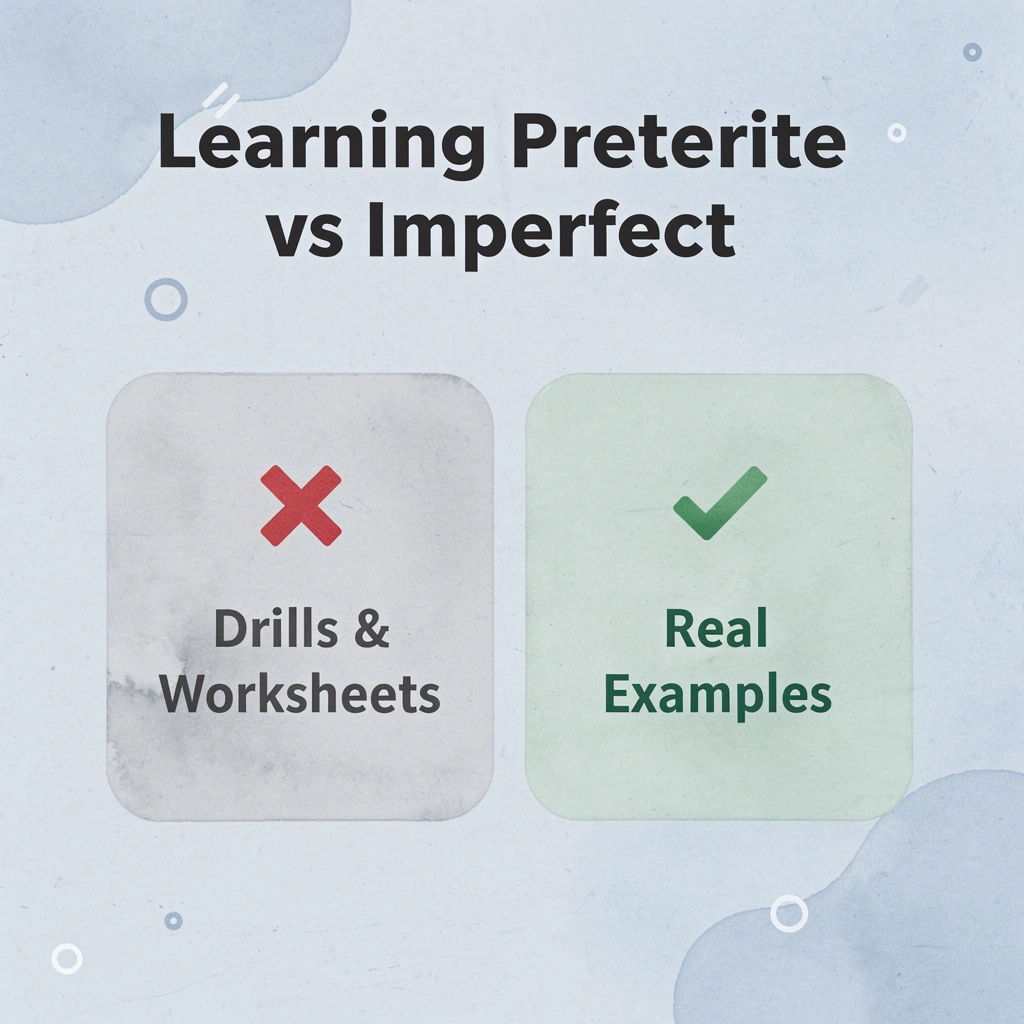
That's where comprehensible input becomes essential.
🎯 Key Point: Comprehensible input — real Spanish content pitched at just the right level — gives your brain the natural pattern recognition it needs to automatically distinguish between preterite and imperfect without consciously thinking about rules.
✅ Best Practice: Look for tools that deliver high-volume, contextual exposure to both tenses in action, so the distinction becomes instinctive rather than memorized.
Traditional Drills
How It Teaches Preterite & Imperfect
Isolated fill-in-the-blank exercises
Effectiveness
Low — no real context
Grammar Worksheets
How It Teaches Preterite & Imperfect
Rule memorization and conjugation tables
Effectiveness
Moderate — builds awareness, not fluency
Comprehensible Input
How It Teaches Preterite & Imperfect
Repeated exposure to authentic, natural Spanish
Effectiveness
High — builds a genuine feel for both tenses
How does learning through content you enjoy help you master the preterite and imperfect?
Parrot builds on a simple idea: language learning works better when learners watch content they understand and enjoy. Instead of forcing yourself through vocabulary lists or grammar exercises, you learn by watching short Spanish videos about topics you care about. As you watch, you see the preterite and imperfect tenses exactly how native speakers use them: how speakers describe settings before introducing events, how stories move between background information and key moments. You start recognizing the same patterns across different videos, topics, and conversations.
Why does comprehensible input build a natural feel for the right tense?
Research consistently shows that language acquisition improves when learners engage with comprehensible input rather than relying exclusively on explicit grammar instruction. The more understandable Spanish you consume, the more opportunities your brain has to recognize recurring patterns and internalize them naturally. Instead of asking whether a sentence requires the preterite or the imperfect, you gradually develop a feel for which tense sounds right because you have encountered similar examples dozens or hundreds of times.
Features That Reduce Friction
Clickable subtitles let you instantly understand unfamiliar words without leaving the content. Instant translations reduce frustration and keep you focused on meaning rather than constant dictionary searches. Saved vocabulary allows you to revisit useful words and phrases in real contexts. AI-powered recommendations surface content that matches your interests and comprehension level, ensuring consistent exposure to understandable Spanish.
How do these features keep you engaged long enough to learn?
These tools remove the friction that normally stops learners from getting enough input. When you understand 95 to 98 percent of what you hear without pausing to look up every third word, you stay interested long enough for patterns to stick. Grammar stops feeling like a puzzle to solve and becomes intuitive.
But knowing this only works if you start.
Related Reading
Rosetta Stone Vs Pimsleur
Duolingo Alternatives
Best Spanish Shows On Netflix To Learn With
Babbel Spanish Review
Duolingo Spanish Review
Pimsleur Spanish Review
Spanish Writing Practice
Apps Like Duolingo
Best App To Learn Spanish
Best Free App To Learn Spanish
Start Learning Spanish Today
If preterite and imperfect still feel like they're the same thing, start a free Parrot trial and watch Spanish storytelling content with clickable subtitles. Save examples where speakers switch between descriptions, background situations, and completed events.
"The fastest way to internalize the difference between preterite and imperfect is through authentic, real-world examples, not grammar charts." — Language acquisition research
💡 Tip: Every time you spot a tense switch in native Spanish content, save that clip. These real moments of contrast are worth more than hours of textbook drills.
⚠️ Warning: Studying preterite vs. imperfect without authentic context is one of the most common mistakes Spanish learners make. Rules alone won't make the difference click.
You'll build a personalized collection of authentic examples showing how native speakers use these tenses in real conversations — a practical reference that's much easier to remember than grammar charts. The patterns you need are already in the stories you want to understand.
Grammar Charts
Retention Strength
Low — abstract rules without context
Authentic Storytelling Content
Retention Strength
High — real patterns in natural speech
Personalized Saved Examples
Retention Strength
Highest — your context, your memory
🎯 Key Point: A self-built example library from real Spanish content is the most effective long-term reference you can create — because it's built around the stories and speakers that already matter to you.