Finding the right tool to learn Spanish can feel overwhelming when most resources are either too rigid or too slow to deliver real results. For beginners, especially, the gap between studying a language and actually speaking it is where motivation tends to collapse. The best apps close that gap by focusing on practical vocabulary, natural sentence structure, and speaking practice that reflects real conversation.
Parrot takes that approach seriously, building a Spanish learning experience around how people actually absorb and use language rather than how textbooks present it. Words connect to meaning quickly, lessons stay grounded in everyday speech, and progress feels tangible from the start. For anyone ready to move from hesitation to real fluency, learn spanish with a method designed to make it stick.
Table of Contents
Why So Many People Quit Learning Spanish
Why Most Spanish Learning Apps Don't Lead to Fluency
What Makes the Best App to Learn Spanish?
Common Mistakes That Slow Down Spanish Learning
Why Enjoyment Is One of the Biggest Predictors of Fluency
How Parrot Helps You Learn Spanish Naturally
Start Learning Spanish Today
Summary
Learners who engage with authentic spoken content retain vocabulary significantly longer than those who rely on text-based drills alone, according to research published by Babbel in 2022. The brain does not store language the way a spreadsheet stores data. It builds language through repeated exposure to meaning in context, which most gamified apps skip in favor of keeping daily active user numbers high.
Most Spanish learning apps cover only 2 of the 4 core language skills (reading, writing, speaking, and listening), according to MSU Today's analysis. That structural gap means even dedicated learners who complete every lesson are still only practicing half the skills required for real conversation. The listening and speaking components that matter most in real-world use receive almost no attention.
The scale of that omission is significant. Apps like Duolingo have over 300 million users worldwide, according to MSU Today, meaning hundreds of millions of people are actively using tools that, by design, skip the practice most essential to fluency. This is not a minor gap in an otherwise solid system. It is a structural problem affecting the majority of people currently trying to learn a language.
Dr. Stephen Krashen's research established that language acquisition happens through comprehensible input, meaning messages understood in context, slightly above a learner's current level, encountered repeatedly and naturally. This explains why learners can recognize every word in a written sentence and still understand nothing when a native speaker says something similar at normal speed. That is a listening comprehension problem, and it only resolves through consistent exposure to authentic spoken Spanish over time.
Spanish is spoken by over 500 million native speakers worldwide, each carrying regional rhythms, expressions, and cadences that no scripted lesson can replicate, according to makesyoufluent.com. Learners who connect Spanish to content they genuinely care about (football culture, travel, music, food) retain vocabulary faster and return to practice more consistently. That is not a motivational trick. It reflects how interest-driven attention deepens memory encoding.
Consistency outperforms intensity at every stage of language learning. Even 20 minutes of engaging Spanish content daily outperforms a three-hour session once a week, because daily habits keep neural pathways active and reinforce patterns before they fade. The learners who reach conversational fluency are not the ones who studied the most. They are the ones who found a format sustainable enough to return to every day.
Learn Spanish addresses this by delivering short-form immersive video content matched to a learner's interests and comprehension level, building listening fluency through authentic spoken Spanish rather than scripted exercises or isolated vocabulary drills.
Why So Many People Quit Learning Spanish
Millions of people start learning Spanish every year with real intention. Most quit before having a real conversation. The reason isn't willpower — it's the gap between how language apps are built and how the human brain actually learns.
"Most learners abandon a new language before reaching conversational ability — not from lack of motivation, but because the tools they use are misaligned with how memory and retention actually work." — Neuroscience & Language Research
🎯 Key Point: The #1 reason people quit Spanish isn't laziness or lack of time — it's a fundamental mismatch between app design and brain-based learning science.
⚠️ Warning: If your learning method doesn't align with how the brain builds long-term memory, you'll hit a wall no matter how motivated you are.
More Time in the App = More Learning
Brain-Based Reality
Active recall beats passive repetition
Streaks Signal Real Progress
Brain-Based Reality
Conversational use drives retention
Motivation Is the Key Factor
Brain-Based Reality
Learning method determines success
Quitting Means You Failed
Brain-Based Reality
Sometimes the learning system itself creates friction and reduces consistency, even when effort is present

Why do most Spanish learners stall before real conversation?
The failure point is usually boredom disguised as difficulty. Learners spend weeks translating isolated sentences, matching words to pictures, and chasing streak notifications, only to feel they're making progress. But when they try to understand a native speaker or string together a thought under pressure, nothing transfers. The app taught them to use the app, not to speak Spanish.
This pattern recurs: the further you move away from real language use, the faster motivation collapses. According to research published by Babbel in 2022, learners who engage with authentic spoken content retain vocabulary significantly longer than those who rely on text-based drills alone. The brain builds language through repeated exposure to meaning in context, which most gamified apps skip to maintain high daily active users.
What actually keeps Spanish learners coming back?
Most learners respond by downloading another app, buying a grammar workbook, or scheduling longer study sessions. Longer, guilt-driven sessions rarely fix the underlying problem. Apps like Parrot take a different approach by delivering short-form immersive video content built around comprehensible input. Our platform gives learners real Spanish in digestible doses the brain can absorb, rather than isolated vocabulary without a living context.
Consistency is the engine of fluency, but it only happens when showing up feels worth it. Ten minutes of engaging Spanish content each day beats a sixty-minute study session you dread and skip. Learners who reach conversational fluency aren't the ones who studied the most; they're the ones who found a format natural enough to sustain.
Why Most Spanish Learning Apps Don't Lead to Fluency
Most Spanish learning apps are built to keep you interested, not to help you become fluent. This critical difference shapes everything about how the app teaches, what it rewards, and what it ignores.
"Most language learning apps are designed around engagement metrics, not fluency outcomes." — The core problem with app-based learning
⚠️ Warning: If your app feels more like a game than a language course, it's optimizing for your attention, not your progress.

According to MSU Today's analysis of language learning apps, apps like Duolingo focus on vocabulary and translation, covering only 2 of the 4 key language skills. A dedicated learner who completes every lesson practices only half the skills needed for real conversation. The ability to hear natural speech and respond in real time gets almost no attention.
Reading
Covered by Most Apps?
✅ Yes
Writing
Covered by Most Apps?
✅ Yes
Speaking
Covered by Most Apps?
❌ Rarely
Listening
Covered by Most Apps?
❌ Rarely
🔑 Takeaway: Completing an entire app curriculum still leaves you with critical gaps in the real-world skills — speaking and listening — that actually define fluency.
💡 Tip: Supplement any app with dedicated listening practice and real-time speaking exercises to cover the 2 neglected skills most platforms ignore.
Why vocabulary drills create a false ceiling
The pattern appears at every learner level: strong quiz scores, real-world paralysis. A learner can identify the Spanish word for "train station" on a flashcard, then freeze when a native speaker rattles off directions at normal speed. Memorizing words differs from processing them under pressure. Fluency requires your brain to recognize meaning automatically, without translation, which only happens through repeated exposure to language in real contexts.
Why does app performance fail to transfer to real conversations?
Most apps show vocabulary in controlled, predictable formats: short sentences, slow audio, and four-choice answers. This structure builds confidence within the app but widens the gap between app performance and real-world comprehension. Apps like Parrot take a different approach, using short-form immersive video to expose learners to Spanish as it's spoken, building listening comprehension through authentic content rather than scripted exercises.
What the numbers reveal about app limitations
MSU Today reports that apps like Duolingo have over 300 million users worldwide, yet hundreds of millions use tools that skip the listening and speaking practice essential for fluency. This gap affects most people actively learning a language.
Do most apps teach Spanish as a living language or a subject to study?
The critical difference between apps that produce fluent speakers and apps that produce skilled quiz-takers comes down to one question: Is the learner exposed to Spanish as a living language or as a subject to be studied? Grammar rules and vocabulary lists treat language like chemistry formulas to memorize. Language, however, is a pattern your brain absorbs through exposure, the way a child learns without a textbook.
What would an app built around fluency look like?
Related Reading
What Makes the Best App to Learn Spanish?
The best app to learn Spanish is built around one core principle: your brain learns language by being exposed to meaning, not by memorizing rules. This fundamental difference shapes everything the app asks you to do.
"Your brain learns language by being exposed to meaning — not by memorizing rules. This distinction is the foundation of every effective Spanish learning method."
🎯 Key Point: The best Spanish learning apps prioritize meaningful exposure over rote grammar drills — because that's how real language acquisition works.
💡 Tip: When evaluating any Spanish app, ask yourself: Does this app expose me to real meaning, or does it just test isolated rules? The answer reveals everything about its effectiveness.
Meaning-Based Learning
What It Focuses On
Context, comprehension, real usage
Learning Outcome
Natural fluency
Rule Memorization
What It Focuses On
Grammar tables, conjugation drills
Learning Outcome
Surface-level recall
Best App Standard
What It Focuses On
Combines meaning with guided practice
Learning Outcome
Lasting retention
What your brain actually needs
The critical difference between apps that produce fluency and apps that produce quiz scores is comprehensible input. Dr. Stephen Krashen's research demonstrated that language acquisition occurs when you understand messages in context, slightly above your current level, and when they are repeated naturally. When you hear and understand Spanish used by real people in real situations, your brain learns the patterns without direct instruction. This is how children learn, and how adults learn best.
Why can you read Spanish but still not understand it when spoken?
Most learners feel this gap acutely. They can read a Spanish sentence on a screen and recognize every word, then hear a native speaker say something similar and understand nothing. That is not a vocabulary problem—it is a listening comprehension problem solved only through consistent exposure to authentic spoken Spanish at natural speed in varied contexts over time.
Why content type matters more than content volume
The familiar approach is to pile on more lessons, more flashcard decks, more grammar modules. But the type of input matters far more than quantity. According to makesyoufluent.com, Spanish is spoken by over 500 million native speakers worldwide, each carrying regional rhythms, expressions, and cadences that no scripted lesson can replicate. An app exposing you only to controlled, classroom-style audio prepares you for a version of Spanish that does not exist outside textbooks.
Why does authentic content build real listening fluency?
Real content—a video from a native Spanish speaker, a clip from a Spanish-language interview, or a cultural moment caught on camera—helps train your ear for authentic speech. Learners who connect Spanish to something they care about, whether football culture, travel, music, or food, acquire vocabulary faster and return to practice more often. This is how interest-driven attention strengthens memory.
How does interest-matched immersive content change the learning outcome?
Apps like Parrot are built around this idea. Instead of scripted exercises, the platform delivers short videos in engaging clips matched to your interests and comprehension level. Ten to fifteen minutes of focused exposure builds more listening fluency than an hour of vocabulary-list drilling, because the brain finds patterns in meaningful language.
What consistency actually looks like
Fluency is not a sprint but a pattern of daily exposure built over months. When learning Spanish feels like watching content you would seek anyway, consistency becomes self-sustaining. Consistency, more than any single feature or method, separates learners who reach conversational fluency from those who plateau after a few weeks.
But even with the right app and approach, one obstacle stops more learners than almost anything else.
Common Mistakes That Slow Down Spanish Learning
The most common mistakes Spanish learners make are quiet habits that feel productive in the moment but work against how language acquisition happens.
"The habits that feel most productive are often the ones doing the least work for real language acquisition." — Language Learning Research
⚠️ Warning: If your Spanish study routine feels comfortable and easy, that's a red flag. True language acquisition requires active struggle, not passive repetition.
💡 Tip: Identifying your hidden bad habits early is the most powerful step you can take to accelerate your Spanish progress.

Passive Re-reading
Why It Feels Productive
Feels like a deep review
Why It Fails
Builds false familiarity, not recall
Over-Translating
Why It Feels Productive
Feels accurate and careful
Why It Fails
Bypasses natural acquisition pathways
Studying in Silence
Why It Feels Productive
Feels focused and serious
Why It Fails
Skips critical speaking practice
🎯 Key Point: Language acquisition is not about what feels productive — it's about what forces your brain to actively process and retrieve Spanish in real time.
The vocabulary trap
It makes sense to want to memorize word lists before you start speaking, but learning a language doesn't work like assembling furniture. According to Cervantes EI guide on mistakes to avoid while learning Spanish, treating vocabulary as something you need to learn first, rather than something you pick up through using it, is one of the biggest mistakes English speakers make. Words stick in your memory when they have meaning and context, not when they sit in a spreadsheet. A word you see in a funny video, hear in a tense conversation, or read in a story you care about will stay with you longer than a hundred flashcard repetitions.
The grammar-first illusion
Grammar learned in isolation does not transfer to real-time listening or speaking. Your brain needs to hear patterns in motion, not memorize them while sitting still. Fluency comes from internalized rhythm, not remembered rules.
Many learners slow playback to 0.75x speed or ask tutors to speak slowly, which helps bridge the gap between classroom Spanish and real conversation in the short term. However, this delays adaptation to natural speech. Apps like Parrot take a different approach, using short-form immersive video to expose learners to authentic spoken Spanish at a natural pace. This builds comprehension through repetition and context rather than controlled slowdown.
The "not ready yet" delay
Waiting until you feel ready to consume real Spanish content is one of the most expensive mistakes learners make. Readiness is a feeling that never arrives on its own. Those who delay authentic exposure often spend months drilling basics that never connect to real communication. Research on comprehensible input is clear: meaningful progress happens when you engage with content that is mostly understandable but still stretches you, not after you have mastered the basics, but during the process of building them.
Why does inconsistency make every mistake worse?
Inconsistency worsens every one of these mistakes. A learner who studies hard for a weekend and then disappears for two weeks retains little from either session. The brain learns language through repeated exposure over time. Even 20 minutes of engaging Spanish content daily works better than a three-hour session once a week, because a daily habit keeps your brain's language pathways active and reinforces patterns before they fade. When the content is something you would choose to watch anyway, the habit builds on its own.
And knowing all of this does not guarantee the first step is easy.
Related Reading
Why Enjoyment Is One of the Biggest Predictors of Fluency
One of the biggest signs that you'll succeed in learning a language isn't how smart you are or if you have natural talent — it's whether you enjoy the learning process enough to keep doing it. The more often you're exposed to Spanish, the more chances your brain has to notice patterns, understand what things mean from the situation around them, and slowly but surely learn the language.
"The single greatest predictor of language fluency isn't intelligence or talent — it's consistent, enjoyable exposure that keeps learners coming back day after day." — Language Acquisition Research
🎯 Key Point: Enjoyment isn't a bonus — it's the engine behind consistent exposure, and consistent exposure is what builds real fluency.
💡 Tip: Ask yourself: Am I actually enjoying how I'm learning Spanish right now? If the answer is no, change your method — not your goal. Swap textbooks for music, shows, or conversation to make exposure feel effortless rather than forced.
Textbook Drills Only
Enjoyment Level
Low
Consistency Outcome
Short-lived effort
Mixed Media (Shows, Music, Apps)
Enjoyment Level
Medium–High
Consistency Outcome
Sustained daily habits
Fully Interest-Driven Content
Enjoyment Level
High
Consistency Outcome
Long-term fluency gains
How does integrating Spanish into daily habits make learning sustainable?
People already spend considerable time consuming digital content. According to DataReportal's Digital 2025 report, internet users spend an average of more than 2 hours per day on social media, with much of that time spent watching short-form videos. Language learning becomes easier to maintain when mixed into activities learners already enjoy, rather than requiring a new study habit. (datareportal.com)
When learning feels fun rather than hard, consistency naturally follows. Over weeks and months, small, enjoyable sessions add up to hundreds of hours of meaningful language exposure.
How does repeated exposure build real Spanish comprehension?
Repeated exposure builds listening comprehension and vocabulary. Hearing words, phrases, and sentence structures used naturally in different situations helps your brain recognize patterns without relying on constant translation. You understand Spanish through repeated exposure to the language in authentic contexts rather than by memorizing isolated vocabulary lists.
This immersive approach also reduces learner pressure. Instead of treating Spanish as another academic subject with quizzes and drills, it becomes a language you experience daily through conversations, stories, and content you enjoy.
The best language learning tools bring Spanish into the content people already love consuming, making it easier to stay consistent and progress toward fluency.
How Parrot Helps You Learn Spanish Naturally
If you've had trouble staying consistent with traditional language apps, the problem may not be your motivation—it may be the learning method. Parrot is designed around how people naturally learn languages through regular exposure to engaging, understandable content, rather than repetitive drills and memorization.
"The most effective language learning happens through consistent, meaningful exposure to content—not rote repetition." — Language Acquisition Research
💡 Tip: If traditional apps feel like a chore, it's a sign the method isn't working for you—not that you lack the ability to learn Spanish.
Traditional Language Apps
Repetitive drills
Memorization-heavy
Feels like studying
Low consistency rates
Parrot’s Approach
Engaging, real content
Natural exposure
Feels like entertainment
Built for habit formation
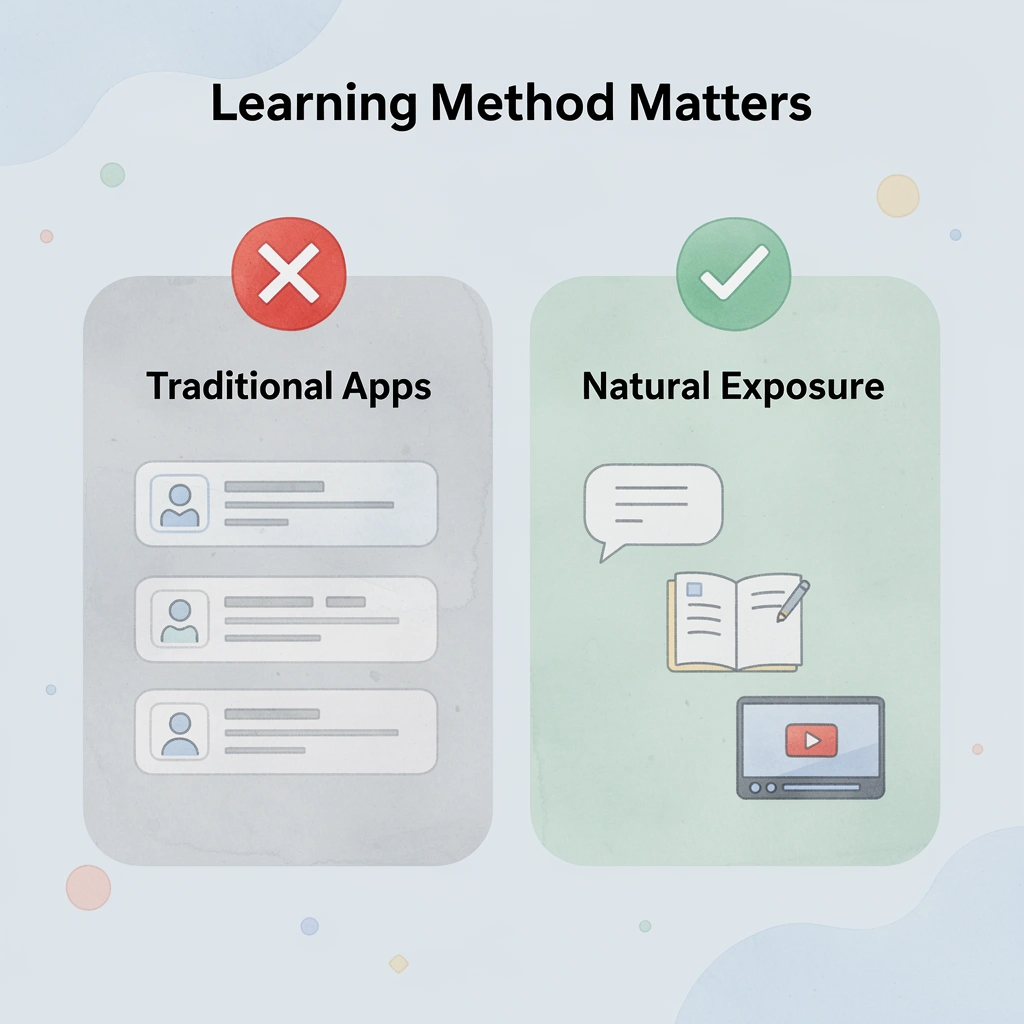
Parrot transforms short-form Spanish videos into personalized learning experiences by combining learning with entertainment. Every session feels enjoyable rather than repetitive, making it easier to build the daily consistency that drives language progress.
🎯 Key Point: When learning feels enjoyable, you show up more often. Frequency of exposure is the single biggest driver of language acquisition.
✅ Best Practice: Use Parrot's video-based sessions daily, even for a few minutes. Short, consistent sessions outperform long, infrequent study marathons.
What learning method does Parrot use to build Spanish skills?
At the heart of Parrot is a research-backed approach based on comprehensible input. Rather than memorizing vocabulary lists, you gradually come to understand Spanish through engaging, comprehensible content. As you watch more videos, your listening comprehension, vocabulary, and confidence grow naturally.
How does Parrot keep you consistent with daily Spanish practice?
Parrot uses an AI-powered recommendation feed that adapts to your interests: travel, cooking, sports, music, technology, or current events. Since you watch content you want to see, staying consistent becomes easier.
The experience feels like scrolling through your favorite social media platform rather than doing a language lesson. That familiar format encourages daily practice and regular language exposure, which builds fluency over time.
How does Parrot remove common frustrations when learning Spanish?
Parrot removes learning frustrations by offering clickable subtitles and instant translations so you understand unfamiliar words without leaving the video. Built-in vocabulary saving lets you revisit useful phrases later, allowing you to maintain concentration while learning naturally.
Whether you're learning Spanish for travel, relationships, career opportunities, or personal growth, Parrot helps you make steady progress by fitting naturally into your everyday routine.
Start Learning Spanish Today
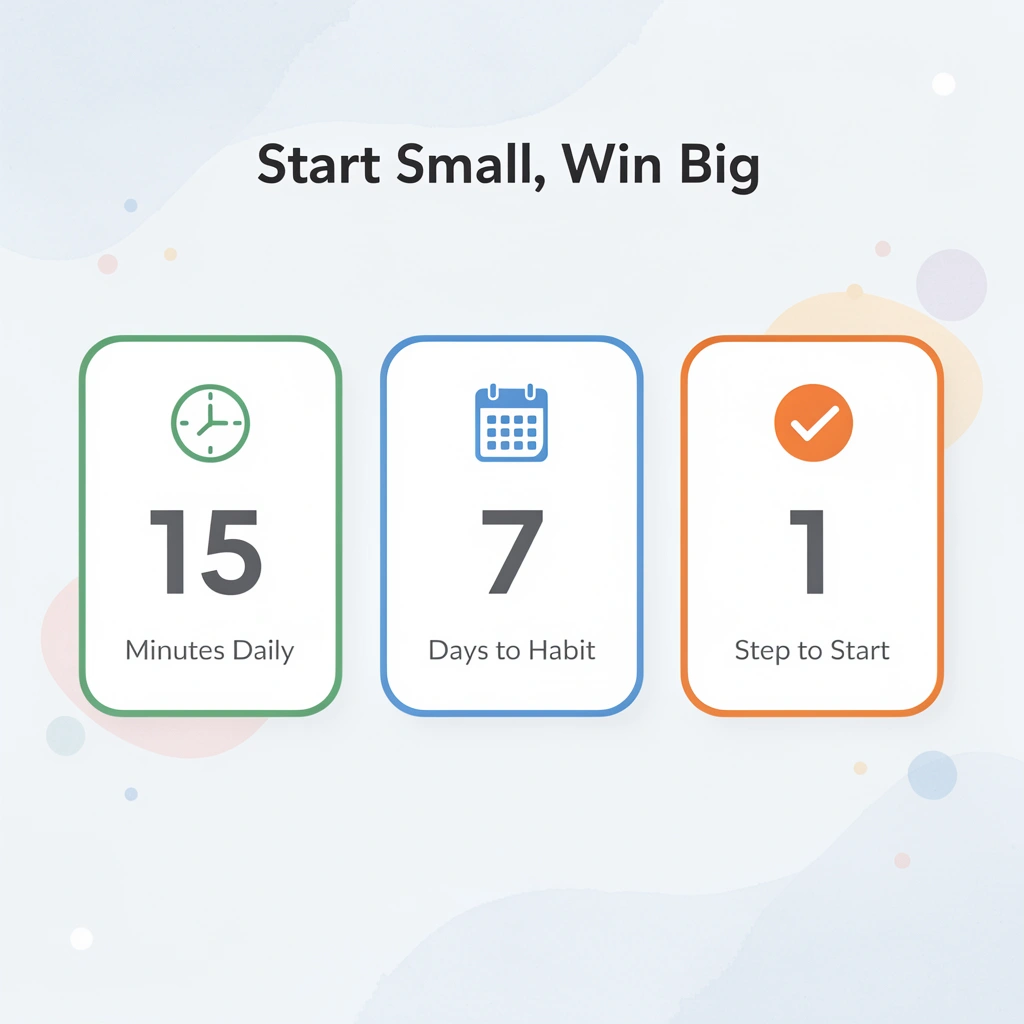
Real progress comes from people who build habits that are easy to stick with, not people waiting for motivation. Start with 15 minutes on any day: that's all it takes to begin building momentum.
💡 Tip: You don't need a perfect schedule or a large block of time. Consistency beats intensity — even 15 minutes daily adds up to over 90 hours of practice in a year.
"Real progress isn't about waiting for the right moment — it's about building small, repeatable habits that compound over time." — Learning Science Principle
⚠️ Warning: Don't fall into the trap of waiting for motivation to strike. Motivation follows action — start small, start now, and the habit will build itself.
If traditional apps haven't helped you move forward, try Parrot. Our platform matches short Spanish videos to what you like, with clickable subtitles, instant translations, and built-in vocabulary tools. You're watching content you'd choose anyway while your brain learns the language. Start your free trial today.
🎯 Key Point: Parrot works because it pairs real-world content with active language tools — so learning feels less like studying and more like entertainment.
Short Spanish Videos
What It Does
Matched to your personal interests
Clickable Subtitles
What It Does
Instant word lookup without leaving the video
Instant Translations
What It Does
Understand every line in real time
Built-in Vocabulary Tools
What It Does
Retain new words with zero extra effort
Related Reading
Babbel Spanish Review
Pimsleur Spanish Review
Duolingo Spanish Review
Rosetta Stone Vs Pimsleur
Spanish Idioms
Duolingo Alternatives