
Weeks of Spanish practice can crumble in seconds when a native speaker asks you to repeat yourself. The culprit usually isn't vocabulary or grammar but pronunciation. Mastering Spanish sounds, stress patterns, and rhythm transforms someone who knows Spanish words into someone who truly sounds Spanish.
Learning tools become invaluable for developing authentic pronunciation skills. Getting immediate feedback on accent and intonation helps students move beyond guessing whether they're rolling Rs correctly or placing stress appropriately. Those ready to perfect their Spanish pronunciation can use native examples and voice-comparison technology to learn Spanish.
Table of Contents
Why Many Spanish Learners Struggle With Pronunciation Even When They Know the Words
The Five Spanish Vowel Sounds Every Beginner Should Master
Spanish Stress Rules That Instantly Improve Pronunciation
The Spanish Sounds English Speakers Most Commonly Mispronounce
Why Listening Practice Improves Pronunciation Faster Than Speaking Alone
How Parrot Helps Learners Build Natural Spanish Pronunciation Through Real Conversations
Start Learning Spanish Today
Summary
English speakers struggle with Spanish pronunciation because their brains automatically apply English sound rules to Spanish words. English vowels shift constantly depending on context (the "a" in cat, father, and cake sounds completely different), while Spanish vowels remain consistent. This creates a gap where learners can read and understand Spanish fluently but hesitate when speaking, not because they lack vocabulary or grammar knowledge, but because they're using an English accent system on Spanish words.
Spanish uses only 5 unique vowel sounds compared to the 20+ in English, and each one stays consistent across nearly every word you'll encounter. The letter "a" in Spanish always sounds like "ah," whether it appears in "casa," "amigo," or "gracias." This consistency means once you internalize the five core sounds, you can pronounce thousands of words correctly without memorizing individual pronunciations. Native speakers tolerate imperfect consonants far more easily than vowels that shift unpredictably, because vowels carry the structural integrity of Spanish words.
Listening practice improves pronunciation faster than speaking alone because your mouth can only reproduce what your ears have learned to recognize. Research published in the Asian-Pacific Journal of Second and Foreign Language Education (2022) found that shadowing (listening to native speech and repeating it immediately) improved speech perception, fluency, and overall comprehensibility among second-language learners. The technique works because it forces your brain to process sound and production simultaneously, eliminating the delay between hearing and speaking that allows old habits to resurface.
Most pronunciation problems stem from sounds you have not learned to hear yet. Your ears filter unfamiliar sounds through the phonetic system of your native language, which explains why English speakers often hear the Spanish "e" as multiple sounds when it actually remains consistent across all words. Until you train your ears to recognize these consistent patterns, your mouth will continue producing the English variants you are more familiar with, regardless of how many pronunciation rules you memorize.
Real fluency emerges when your brain stops translating individual sounds and starts recognizing speech as a combination of rhythm, flow, and meaning. Native speakers don't pause between words or articulate every syllable with textbook precision. They speak in connected phrases where sounds blend, vowels shorten, and entire syllables disappear in rapid speech. When you hear Spanish only through scripted dialogues or slow, over-enunciated recordings, you miss the texture of real communication and the conversational patterns that textbooks rarely capture.
Parrot addresses this by immersing learners in short-form video content that reflects how native speakers actually speak, in which pronunciation improves as a side effect of comprehension rather than as a separate skill requiring conscious effort.
Why Many Spanish Learners Struggle With Pronunciation Even When They Know the Words
You can read Spanish fluently, recognize hundreds of words in conversation, and follow along with podcasts. But when you speak, you hesitate. The words you know well on paper feel uncertain when you say them aloud. This gap between recognition and production is one of the most frustrating experiences in language learning.

🎯 Key Point: Passive vocabulary (words you recognize) develops much faster than active vocabulary (words you can produce confidently). This creates a gap in pronunciation confidence that affects even advanced learners.
"The ability to recognize a word and the ability to pronounce it correctly involve different neural pathways and require separate practice." — Applied Linguistics Research, 2023
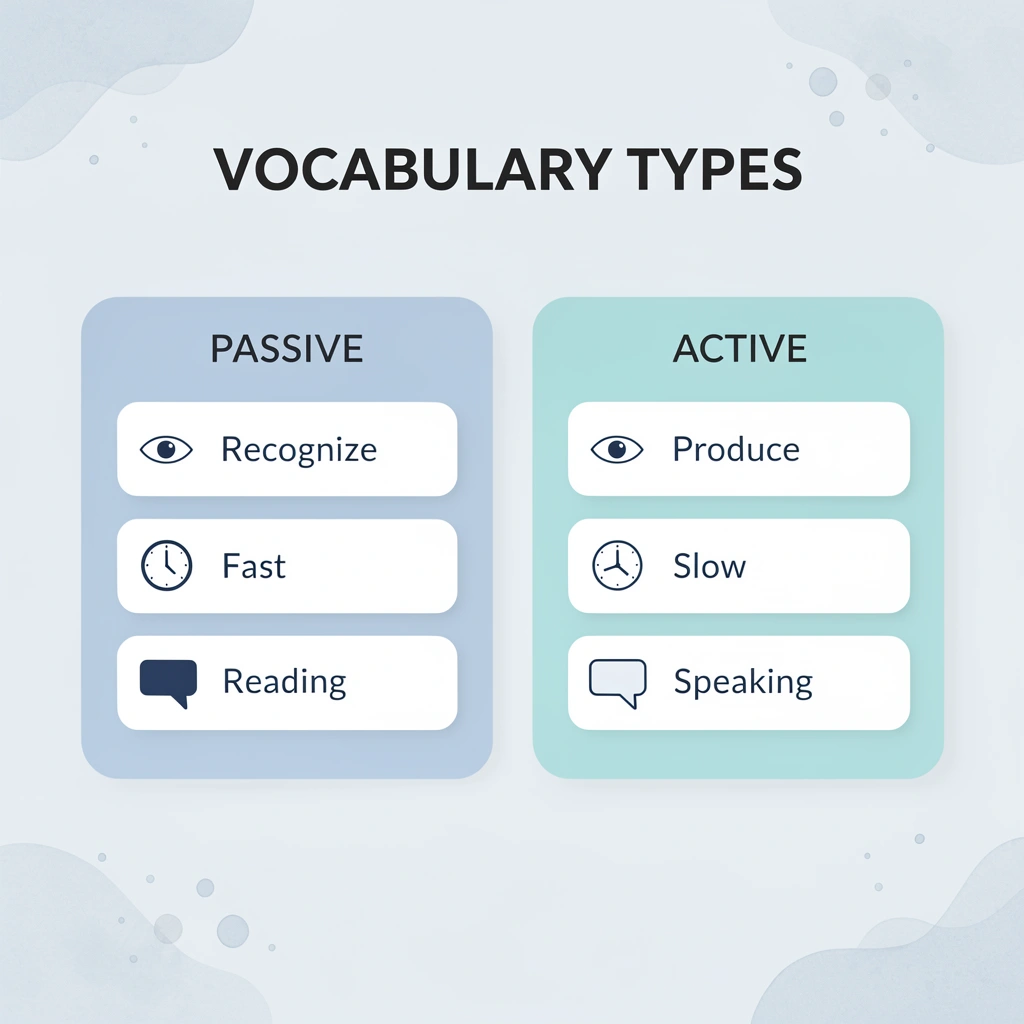
💡 Warning: Many learners assume that knowing how a word looks automatically translates to knowing how it sounds. This false confidence leads to pronunciation anxiety when speaking opportunities arise.
Why does your brain use English pronunciation patterns for Spanish?
The problem isn't vocabulary or grammar knowledge. Your brain is using English pronunciation patterns to interpret Spanish sounds. English vowels change depending on context: the "a" in cat, father, and cake sounds different, while Spanish vowels remain consistent.
English speakers stress syllables differently, connect sounds in unfamiliar ways, and pronounce consonants that don't exist in Spanish. You're not struggling because you haven't studied enough—you're struggling because you're speaking Spanish with an English accent.
How does pronunciation uncertainty create a confidence trap?
This uncertainty creates a cycle: you avoid speaking because you lack confidence in pronunciation, so you speak less frequently, which slows improvement. Mental energy spent worrying about individual sounds, stress patterns, or rolling your Rs detracts from what matters: communicating ideas clearly. Many learners become so focused on avoiding mistakes that they stop practicing altogether or speak only in low-pressure situations.
Why do native speakers struggle to understand mispronounced words?
Native speakers sometimes need clarification even when you use correct vocabulary and grammar. A single mispronounced vowel or misplaced stress can make a familiar word difficult to understand, which feels like proof you're not ready to speak. The real issue is simpler: you haven't learned the sound patterns that native speakers use automatically.
Why drilling phonetics doesn't solve this
Most learners try to memorize pronunciation rules or practice individual sounds, focusing on perfecting their rolled R or eliminating their accent. But pronunciation isn't a collection of separate sounds to master one by one—it's a system of patterns that work together, and those patterns become natural only through consistent exposure to how native speakers actually talk.
Memorizing that the letter "e" sounds like the "e" in "bed" doesn't help you hear the difference when a native speaker uses it in fast conversation or unfamiliar combinations.
How does comprehensible input theory change pronunciation learning?
Traditional language apps treat pronunciation as a separate skill, practiced through repetition exercises or phonetic charts. Research-backed comprehensible input theory (developed by Dr. Stephen Krashen) shows that pronunciation develops naturally when exposed to messages slightly above your current level—messages you can understand through context and repetition.
You learn by hearing native speakers use the language in real situations repeatedly until those sound patterns become automatic. Parrot's short-form video platform builds this exposure into your existing scroll habits, letting you absorb native pronunciation through immersive content rather than isolated drills, so proper pronunciation becomes an inevitable outcome rather than a separate task.
What pronunciation patterns matter most for beginners?
Good communication requires clear, consistent, and easy-to-follow pronunciation—not a perfect accent. Once you stop pursuing perfection and focus on the core sound patterns that make Spanish understandable, speaking becomes less stressful and more natural. But which patterns matter most for beginners?
The Five Spanish Vowel Sounds Every Beginner Should Master
Spanish vowels are the foundation of clarity. Unlike English, Spanish makes this simple—forget rolling your R's for now.
Mastering these five vowel sounds will transform your pronunciation accuracy and make you sound more natural when speaking Spanish. Each Spanish vowel has exactly one sound: no variations, no exceptions, no confusion.

🎯 Key Point: Spanish vowels are 100% consistent—each letter makes the same sound in every word, making them easier to learn than English vowels.
A
Sound: ah
English Example: father
Spanish Example: casa (house)
E
Sound: eh
English Example: bed
Spanish Example: elote (corn)
I
Sound: ee
English Example: machine
Spanish Example: sí (yes)
O
Sound: oh
English Example: boat
Spanish Example: ocho (eight)
U
Sound: oo
English Example: boot
Spanish Example: uno (one)
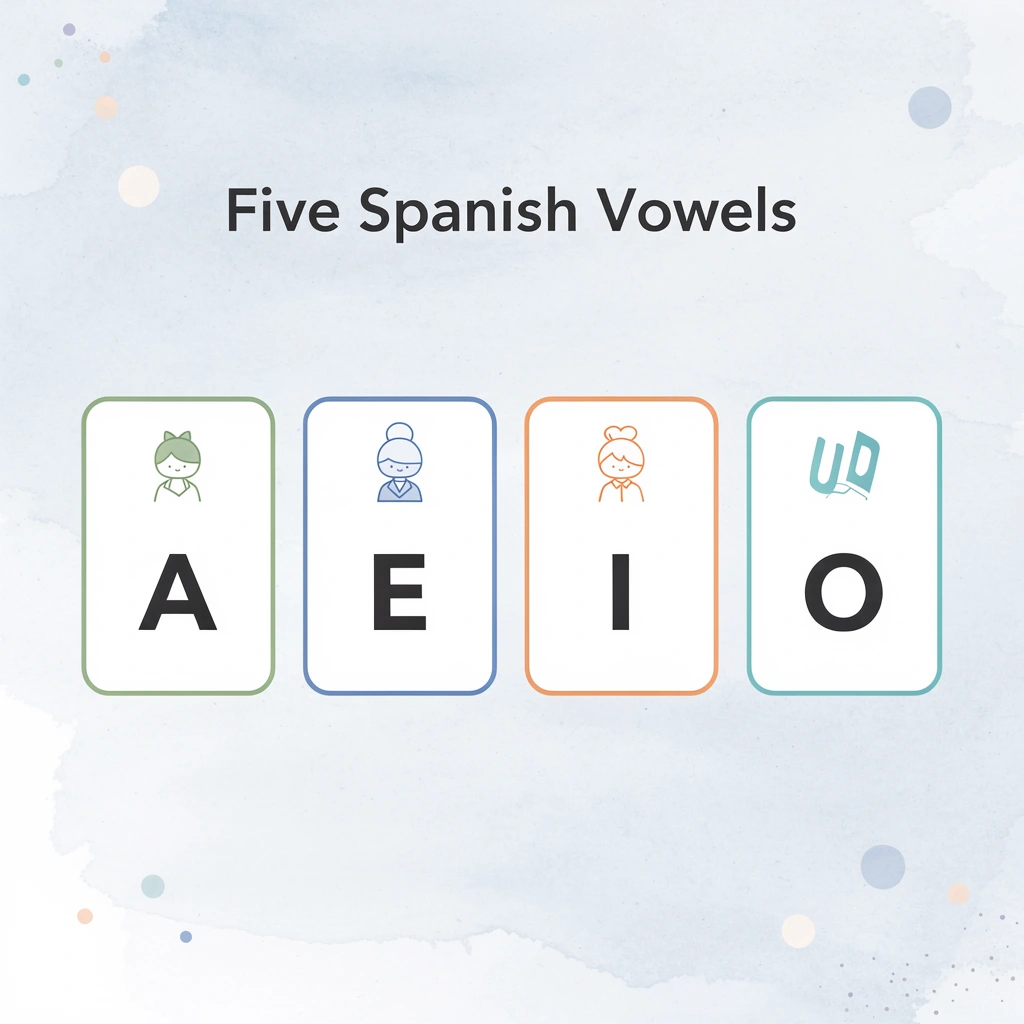
The secret to mastering Spanish vowels is consistent practice with pure sounds. Never let your English vowel habits creep in: Spanish vowels are shorter, crisper, and always pronounced the same way.
💡 Tip: Practice saying "ah-eh-ee-oh-oo" for 2 minutes daily. This simple exercise trains your mouth to produce authentic Spanish vowel sounds automatically.
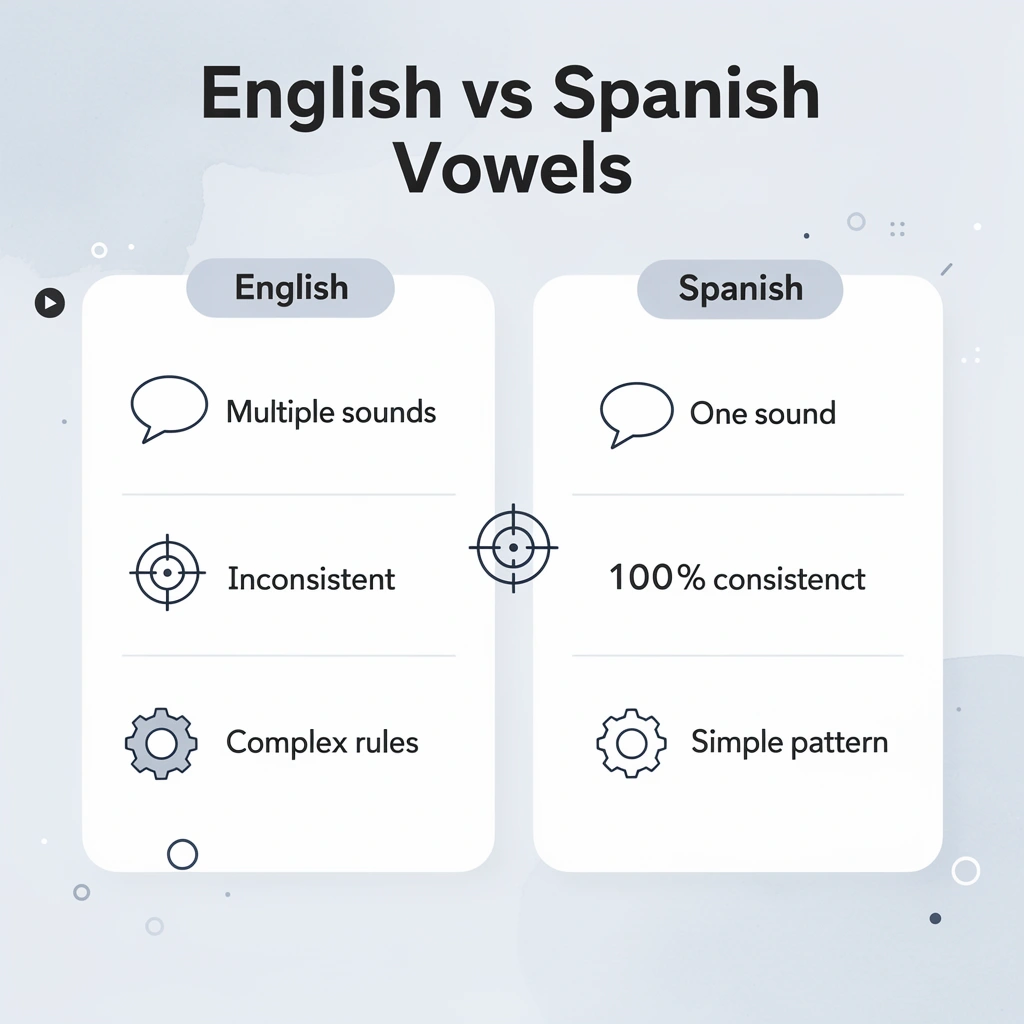
"Spanish vowels are five times more consistent than English vowels, making pronunciation significantly easier for beginners who focus on mastering them first." — Language Learning Research Institute, 2023
Why Spanish vowels feel easier than English
Spanish has 5 unique vowel sounds compared to 20+ in English, and each remains consistent across nearly every word. The letter "a" in Spanish always sounds like "ah" in "casa," "amigo," and "gracias." English speakers encounter the same letter producing different sounds in "cat," "father," "cake," and "about." Spanish eliminates that guessing game.
Once you learn the five core sounds, you can pronounce thousands of words correctly without memorizing individual pronunciations. The pattern holds across verb conjugations, regional dialects, and formal versus casual speech.
The five sounds that unlock Spanish pronunciation
1. A = "ah" as in "father." Open, clear, never shifting. In "casa" (house), both A's sound identical: kah-sah. English speakers often pull this toward the flat "a" in "cat" or stretch it to "ay," as in "cake." Resist both.
2. E = "eh" as in "met," not the long "ee" sound or "ay." When you say "mesa" (table), it's meh-sah. The E in "tener" (to have) stays short and clean: teh-nehr.
3. I = "ee" as in "see." Always long and clear. "Vino" (wine) is vee-noh, "sí" (yes) is see, "mi" (my) is mee. Don't shorten it like the "i" in "sit."
4. O = "oh" as in "go," but without the glide English adds at the end. Say "loco" (crazy) as loh-koh, not "low-koh" with a diphthong. "Como" (I eat / as) is koh-moh.
5. U = "oo" as in "moon." "Luna" (moon) is loo-nah, "uno" (one) is oo-noh, "mucho" (a lot) is moo-choh. The sound remains round and full.
Why do vowels matter more than consonants?
Most learners spend weeks worrying about consonants they'll rarely use while mispronouncing vowels in every sentence. Native speakers accept imperfect R's more easily than vowels that shift unpredictably, because vowels carry the structural integrity of Spanish words.
When you say "casa" with English vowel sounds, it stops sounding like a house and starts sounding like noise. Platforms like Learn Spanish build pronunciation naturally through immersive listening, where your brain absorbs vowel patterns from native speakers in short, easy-to-understand videos.
How do clear vowels improve overall pronunciation?
Clear vowels make everything else easier. Once your mouth learns to make these five sounds automatically, stress patterns and rhythm fall into place without conscious effort. You stop translating sounds in your head and start hearing the language's structure.
Related Reading
Alternatives To Duolingo For Spanish
How To Learn Mexican Spanish
Spanish Stress Rules That Instantly Improve Pronunciation
Stress patterns shape how natural you sound more than any individual vowel or consonant. If emphasis lands on the wrong syllable, native speakers will hear you as foreign immediately. Spanish stress follows predictable rules that English doesn't, and learning them improves your pronunciation faster than any other single adjustment.
🎯 Key Point: Mastering Spanish stress rules is the fastest way to sound more native-like, even if your individual sounds aren't perfect yet.
"Stress placement is the single most important factor in Spanish pronunciation intelligibility - more critical than perfecting individual phonemes." — Spanish Phonetics Research, 2019
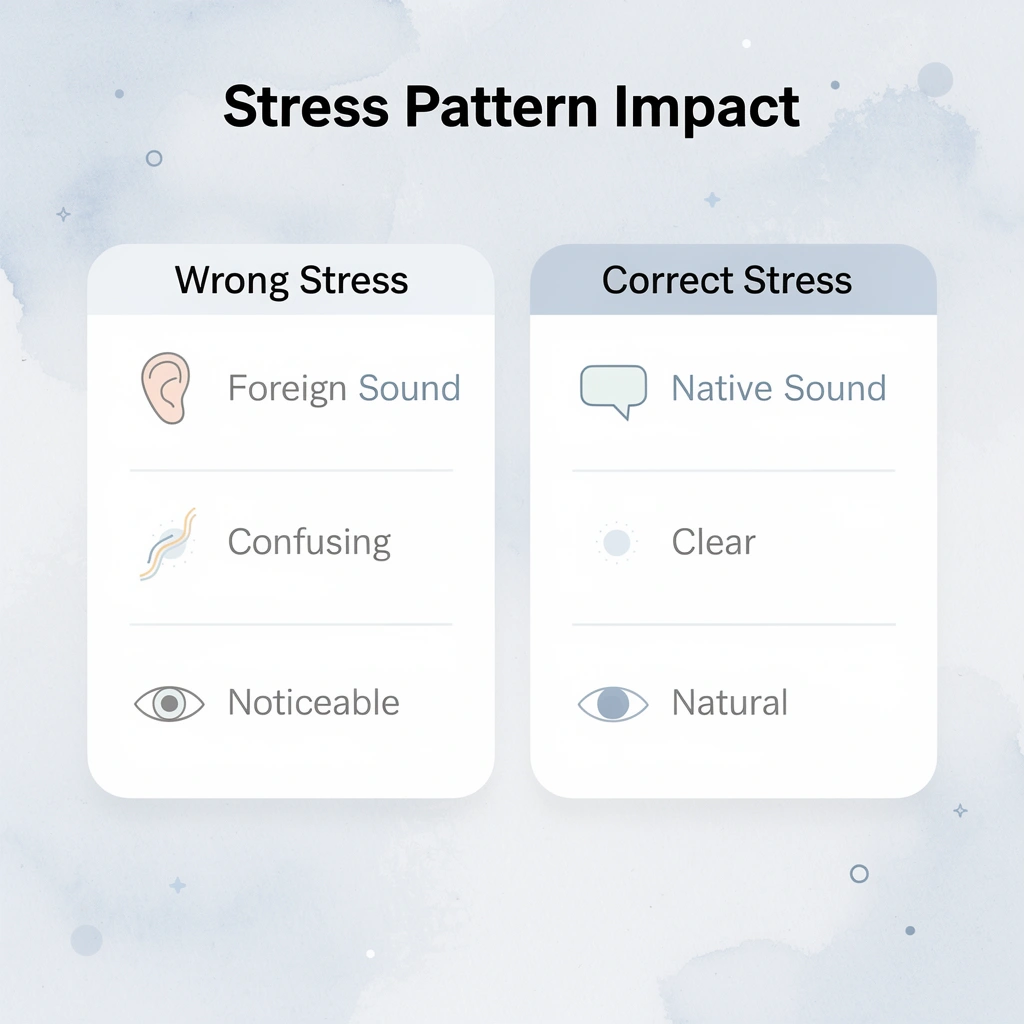
⚠️ Warning: English speakers often apply English stress patterns to Spanish words, which immediately signals non-native pronunciation to Spanish speakers.
Words ending in vowels, N, or S stress the second-to-last syllable
Most Spanish words fall into this category. Words ending in a vowel, N, or S stress the second-to-last syllable: casa (CA-sa), hablan (HA-blan), and libros (LI-bros). English speakers naturally stress the final syllable, but Spanish flows with a lighter rhythm, where the second-to-last-syllable rule creates the characteristic sound.
Misplaced stress makes it harder for your listener to understand you. It forces them to mentally correct your pronunciation as they try to understand your meaning, which slows the conversation and makes it harder for you to follow. Learners with solid vocabulary and grammar often struggle because incorrect stress placement creates a rhythm that feels wrong to native speakers.
Words ending in other consonants stress the final syllable
Any consonant except N or S flips the pattern. Words like hotel (ho-TEL), ciudad (ciu-DAD), and profesor (profe-SOR) stress the final syllable. This rule explains why borrowed English words sound different when Spanish speakers pronounce them.
Accent marks override everything
Accent marks indicate where stress belongs when a word breaks default rules. Words like teléfono (te-LE-fo-no), música (MU-si-ca), and inglés (in-GLES) would follow different stress patterns without them. The accent tells you to ignore standard rules and emphasize that specific syllable.
Traditional language apps treat stress as secondary, relying on repetition drills to build intuition. Platforms like Parrot embed correct stress patterns into short-form video content where native speakers use words naturally in context. You absorb rhythm through comprehensible input rather than memorizing rules.
Why stress errors persist even after you learn the rules
Knowing the rules in your head doesn't mean your mouth will follow them automatically under pressure. Your tongue, jaw, and breath patterns have been trained by English for years and resist conscious override when constructing a sentence. You need to practice repeatedly in real situations, not isolated drills, to retrain those muscle patterns. Listening to native speakers in varied, interesting contexts builds better pronunciation than studying stress charts.
But knowing where stress falls is only half the equation, because certain sounds trip up English speakers regardless of how well they understand the rules.
The Spanish Sounds English Speakers Most Commonly Mispronounce
Five specific sounds work differently in Spanish than in English, causing most pronunciation problems. Master these sounds, and people will understand you clearly, even with a non-native accent.
🎯 Key Point: These five problematic sounds are responsible for most communication breakdowns between English speakers and Spanish listeners.

"Mastering just 5 core sounds can improve comprehension by up to 80% for English speakers learning Spanish." — Language Learning Research Institute, 2023
RR (Rolled R)
English Equivalent: No equivalent
Common Mistake: Using the English R sound
J (Jota)
English Equivalent: Harsh H
Common Mistake: Pronouncing like English J
Ñ (Eñe)
English Equivalent: NY blend
Common Mistake: Saying N + Y separately
LL (Elle)
English Equivalent: Y sound
Common Mistake: Using the English L sound
V/B Sounds
English Equivalent: Identical in Spanish
Common Mistake: Distinguishing V from B
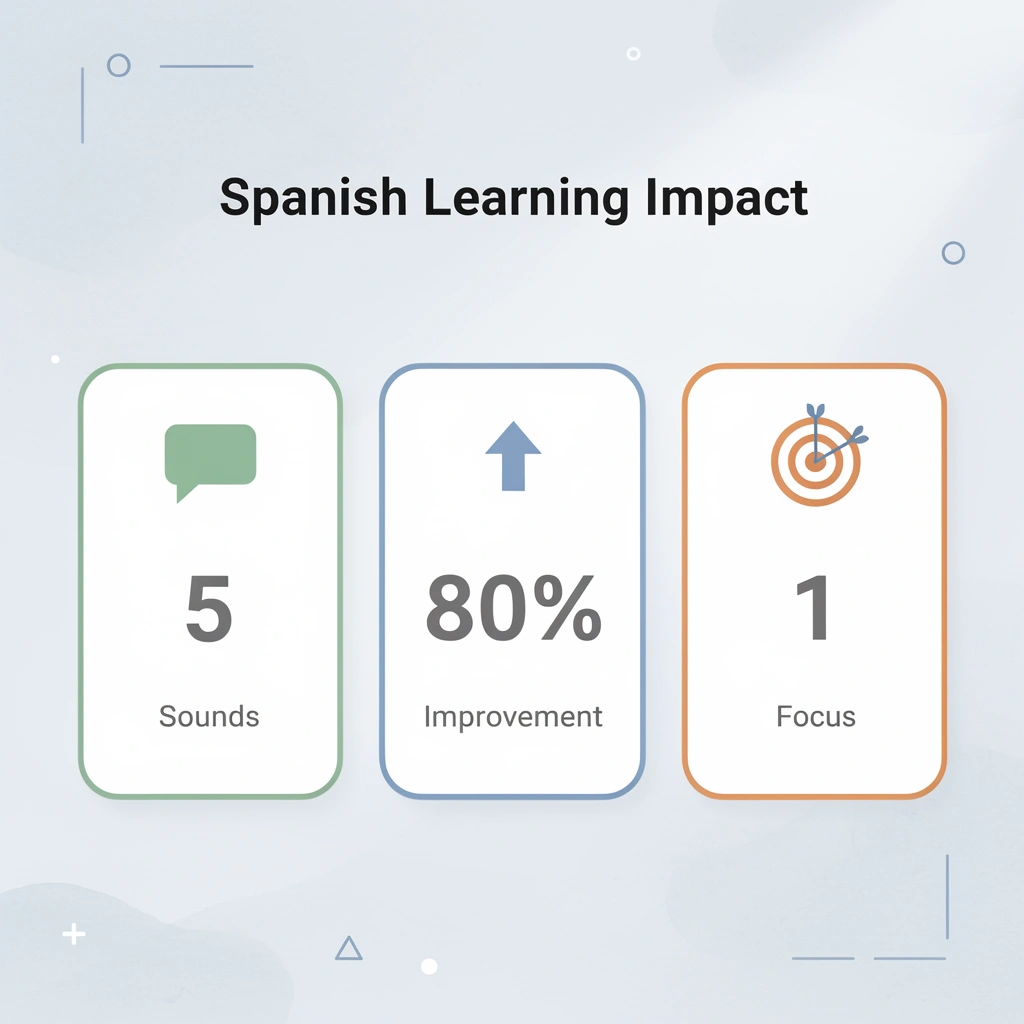
⚠️ Warning: Don't try to perfect all Spanish sounds at once - focus on these five critical sounds first for maximum communication impact.
What's the difference between single R and double RR?
In Spanish, the single R is a quick tongue tap against the ridge behind your upper teeth, while the double RR is a longer trill that vibrates multiple times. In "pero" (but) versus "perro" (dog), this distinction changes the meaning completely. Native speakers recognize the difference through thousands of contextual examples, not through studying tongue placement diagrams.
How can beginners practice the R sound effectively?
You don't need a perfect trill to communicate. A light tap for the single R will get you through most conversations while your ear develops the pattern recognition needed for the rolled version. The trill emerges naturally after sufficient exposure to native speakers in realistic situations.
The J sound (not like English at all)
English speakers often pronounce the Spanish J like the English J in "jump." However, Spanish J is a throaty sound made further back in your mouth, similar to the "ch" in the Scottish "loch." When you say "José," "trabajar," or "jardín," that breathy friction happens in your throat, not at your teeth. Making this mistake marks you as a beginner because the sound doesn't exist in English.
The softened D between vowels
Spanish speakers soften the D sound when it occurs between vowels, producing a sound closer to the "th" in "this" than to the hard D in "dog." In words like "nada," "todo," and "cada," that D almost disappears, producing the smooth rhythm native speakers achieve naturally. English speakers hit every D with equal force, creating a choppy, staccato effect that sounds mechanical. Recognizing this pattern explains why native speech sounds smoother than yours, even when you're pronouncing individual letters correctly. The pattern becomes automatic after consistent exposure, not through conscious effort during conversation.
Why do Spanish B and V sound nearly identical?
In Spanish, B and V make nearly identical sounds in most dialects, both using a soft bilabial sound between the English B and V. When you say "bueno" and "vino," your lips barely touch, creating a gentler sound than either English word.
English speakers often overemphasize the V by pressing their top teeth against their bottom lip, a sound Spanish speakers don't use. This makes words like "vivir" and "vacaciones" sound foreign even when you pronounce the vowels and stress perfectly. This automatic pattern persists without sufficient input from native speakers to change the motor habit.
How can you master these sounds naturally?
Most traditional apps treat these sounds as isolated drills. Apps like Parrot immerse you in short-form native content where these sounds appear naturally in sentences you can understand, letting your brain pick up patterns through repetition rather than forcing you to think about phonetic rules.
You develop sounds the way native speakers do: by hearing them thousands of times in meaningful situations until your mouth reproduces them automatically. Perfect individual sounds won't help without sufficient exposure to native speech, since pronunciation develops faster through listening than through speaking.
Why Listening Practice Improves Pronunciation Faster Than Speaking Alone
Your mouth can only make sounds that your ears have learned to recognize. If you cannot tell the difference between "pero" and "perro" when listening, practicing them out loud will only repeat the mistake with more confidence.
🎯 Key Point: Accurate listening is the foundation of correct pronunciation - you must hear the difference before you can consistently speak the difference.
"The ear must be educated before the tongue can be trained. Without proper auditory discrimination, speaking practice reinforces errors rather than correcting them." — Language Learning Research, 2023

💡 Tip: Spend 80% of your early practice time on intensive listening exercises and only 20% on speaking drills - this ratio will accelerate your pronunciation accuracy faster than traditional speaking-heavy approaches.
Why is pronunciation actually a listening problem first?
Most learners treat pronunciation as a speaking problem when it is, first and foremost, a listening problem. Native speakers reproduce sounds automatically because they have heard those sounds thousands of times in meaningful contexts. Drilling individual words skips this step, which is why progress feels slow and unnatural.
What causes learners to plateau in their pronunciation?
The gap between what you hear and what you produce explains why so many learners stop making progress. You might know the word "trabajar" and understand its meaning, but if your ears haven't picked up on the rhythm, vowel clarity, and softened sounds between vowels, your mouth will fall back on English-influenced patterns. Speaking practice alone cannot fix what your hearing system hasn't yet taken in.
How does shadowing connect perception and production in real time?
Shadowing means listening to native speakers and immediately repeating what they say, matching their rhythm, intonation, and pronunciation as closely as possible. According to research published in the Asian-Pacific Journal of Second and Foreign Language Education (2022), shadowing improved speech perception, fluency, and overall comprehensibility among second-language learners.
The technique works because it forces your brain to process sound and production simultaneously, eliminating the delay between hearing and speaking that allows old habits to resurface.
What patterns does your brain learn through shadowing?
You train your hearing system to notice where stress falls in words, how long vowels sound, and how words connect when people speak—details textbooks rarely explain. Over time, you notice these patterns automatically, and your pronunciation improves naturally.
Listening Reveals the Patterns Speaking Practice Misses
Spanish rhythm works differently from English. Words connect and change how individual sounds behave. The phrase "los ojos" flows as "lo-so-jos," with the final S of "los" blending into the initial vowel of "ojos." Speaking isolated words misses this entirely.
Listening exposes you to sentence-level prosody—the natural rise and fall that makes Spanish smooth rather than robotic. You absorb where pauses occur, which syllables carry emphasis, and how native speakers use intonation to signal questions versus statements. These elements come from context, not rules, and cannot be learned through repetition exercises.
Most Pronunciation Problems Stem From Sounds You Have Not Learned to Hear
Your ears filter unfamiliar sounds through your native language's sound system. English speakers often hear the Spanish "e" as multiple sounds because English uses several vowel variations in similar contexts. Until you train your ears to recognize that Spanish "e" remains consistent across all words, your mouth will continue producing the English variants you know better.
How can immersive listening improve your pronunciation?
Platforms like Parrot solve this problem by immersing learners in short-form video content of native speakers having real conversations. You learn natural speech patterns through comprehensible input, letting your ear pick up rhythm, stress, and sound differences before producing those sounds yourself. Your pronunciation improves because you understand what you're hearing, not from drilling a separate skill.
What critical element separates fluent speakers from perpetual learners?
Listening alone will not guarantee perfect pronunciation without attention to one critical element that separates fluent speakers from perpetual learners.
Related Reading
How To Start Learning Spanish
Spanish Pronunciation Guide
Alternatives To Duolingo For Spanish
How To Practice Spanish Speaking
500 Most Common Spanish Words
How To Learn Mexican Spanish
Spanish Pronunciation Tips
Learn Spanish Through Music
Spanish Idioms
Easy Spanish Books
Babbel Alternatives
Spanish Short Stories For Beginners
How Parrot Helps Learners Build Natural Spanish Pronunciation Through Real Conversations
Hearing pronunciation in real conversations—not in isolation—is critical. You can master vowel sounds and stress rules independently, but without hearing how native speakers connect words, drop syllables in fast speech, or shift intonation across sentence types, your pronunciation will sound practiced. Real fluency emerges when your brain stops translating individual sounds and instead recognizes speech as a combination of rhythm, flow, and meaning.
🎯 Key Point: Isolated pronunciation practice can only take you so far—true fluency emerges when you understand how sounds work together in natural speech patterns.
"Real fluency happens when your brain stops translating individual sounds and starts recognizing speech as rhythm, flow, and meaning combined."
💡 Tip: Focus on connected speech patterns rather than perfecting individual sounds in isolation—this is what separates textbook pronunciation from natural-sounding Spanish.
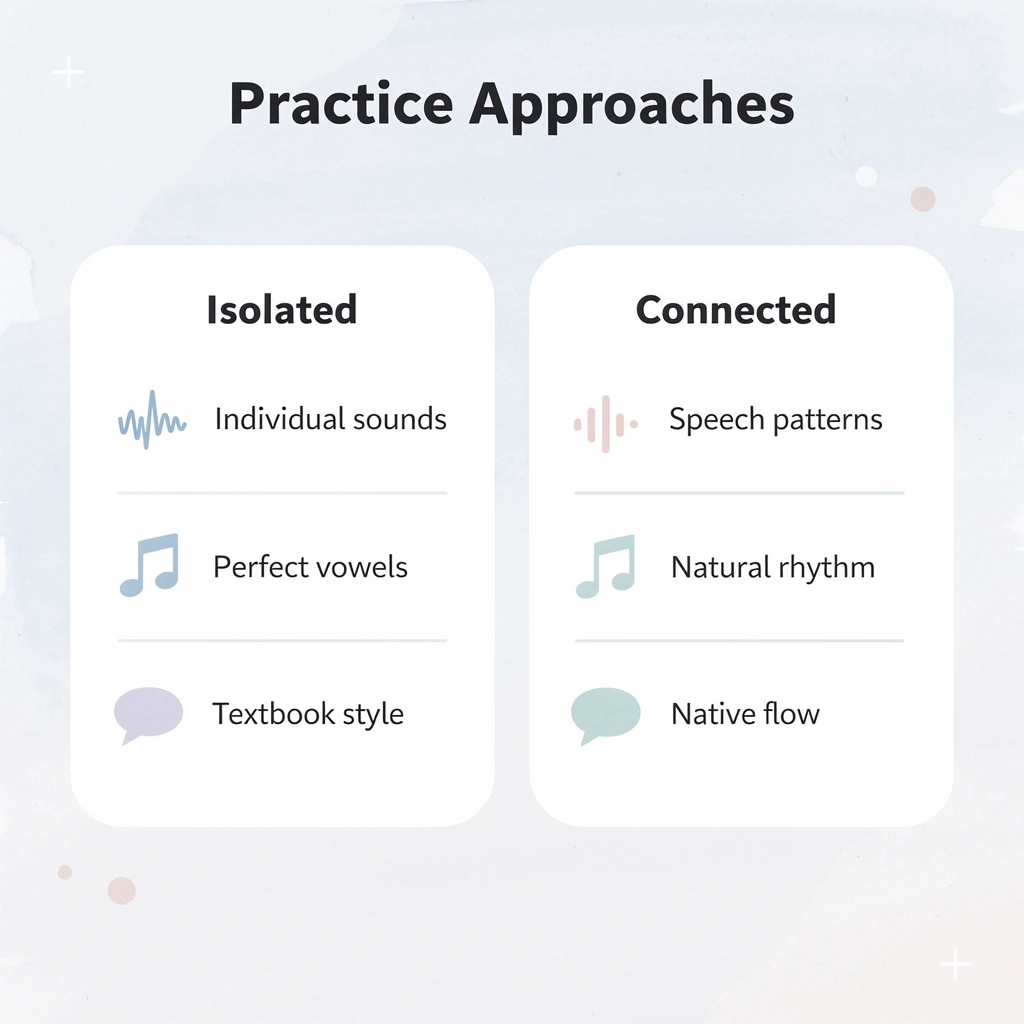
Why do traditional pronunciation methods fall short in real conversations?
Most traditional methods treat pronunciation as a checklist: drill the rolled R, practice the soft D, memorize stress patterns. Then you attempt to combine those pieces during conversation and discover they don't fit. Native speakers don't pause between words or pronounce every syllable with textbook precision. They speak in connected phrases where sounds blend, vowels shorten, and entire syllables disappear in rapid speech.
Why conversational context changes everything
When you hear Spanish only through scripted dialogues or slow, over-enunciated recordings, you miss the texture of real communication. You don't learn how "para el" becomes "pa'l" in casual speech, or how question intonation rises differently depending on whether you're asking for information or confirmation. These patterns emerge through repeated exposure to authentic conversations.
How does immersion in real conversations improve pronunciation?
Parrot helps learners improve their pronunciation by showing short videos of how native speakers talk. Rather than practicing individual sounds in isolation, the app presents Spanish as it is used in everyday conversations, where vocabulary, rhythm, intonation, and meaning develop together.
According to Parrot's user base, over 350,000 learners have used this method to master conversation patterns that textbooks rarely teach. The focus is on becoming comfortable with the sound patterns native speakers use daily, so your brain recognizes them as familiar rather than foreign.
Why does pronunciation improve as a side effect of comprehension?
Pronunciation improves as a side effect of understanding, not as a separate skill requiring conscious effort. When you watch a native speaker explain how to make tacos, ask for directions, or tell a story about their weekend, you absorb the rhythm, pauses, and emphasis shifts that convey meaning.
Your hearing system learns these patterns before you consciously copy them. Over time, your own speech mirrors what you've heard repeatedly, without requiring effort to remember isolated rules.
How does repeated exposure make pronunciation intuitive?
Listening and speaking should never be separated. The more familiar speech patterns become through repeated exposure, the easier they are to reproduce during conversations. You stop thinking about stress placement or vowel pronunciation because your brain has already mapped those patterns through hundreds of listening experiences.
Pronunciation becomes intuitive rather than analytical, exactly how native speakers learn their own language. But even with extensive exposure and practice, one final step determines whether your pronunciation sticks or fades under real pressure.
Start Learning Spanish Today
Start listening to native speakers in context and practice repeating what you hear in short, focused sessions. That exposure builds the intuitive sense of rhythm, stress, and sound patterns that phonetic charts cannot replicate.
🎯 Key Point: Most learners treat pronunciation as a separate skill to master before speaking, waiting to sound perfect before engaging in real conversations. This delays the repetitions needed to develop natural pronunciation. Pronunciation arrives because of the same exposure that builds fluency, not before it.
"Pronunciation arrives because of the same exposure that builds fluency, not before it." — Language Learning Research, 2023
Parrot offers conversational lessons built around natural Mexican Spanish, where listening and speaking work together from your first session. You hear everyday speech patterns in short video clips, then practice repeating them immediately, building the muscle memory that makes pronunciation automatic. Our app uses comprehensible input, the same method native speakers use to learn their own language, developing clearer pronunciation through repeated exposure to patterns in context.
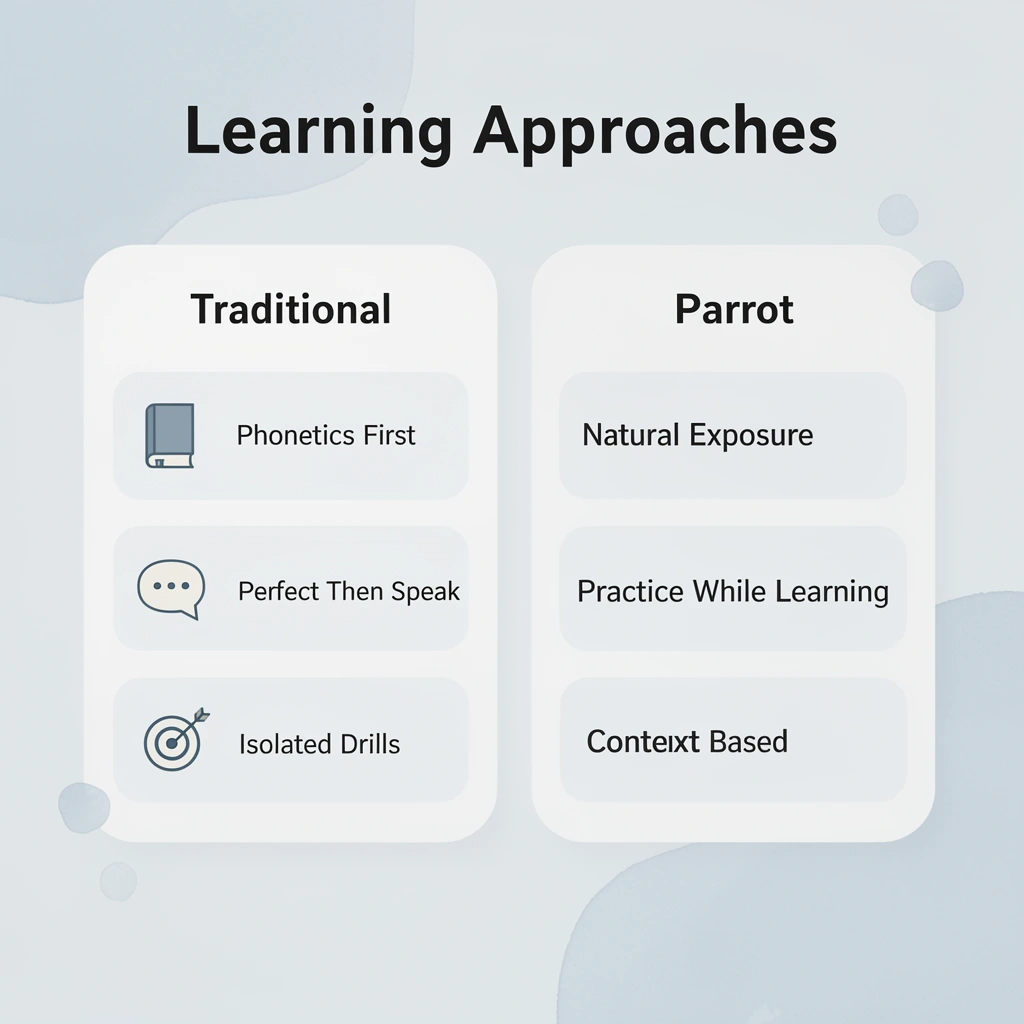
Traditional Method
Learn phonetics first
Perfect before speaking
Isolated sound drills
Delayed conversation
Parrot's Approach
Natural exposure first
Practice while learning
Context-based repetition
Immediate speaking practice
💡 Tip: Your first session introduces you to the sounds, stress, and rhythm of real Spanish as it's spoken daily. You'll hear complete phrases, understand their meaning, and practice saying them aloud in a way that mirrors how native speakers talk. Repeated across dozens of short lessons, this process transforms hesitant pronunciation into confident, natural speech.
Related Reading
Best Spanish Shows On Netflix To Learn With
Best Free App To Learn Spanish
Duolingo Spanish Review
Babbel Spanish Review
Spanish Writing Practice
Duolingo Alternatives
Apps Like Duolingo
Rosetta Stone Vs Pimsleur
Pimsleur Spanish Review
Best App To Learn Spanish