
Standing in a Madrid café without knowing how to order coffee highlights why mastering everyday expressions is crucial for Spanish learners. Common Spanish phrases for beginners form the foundation of real conversations, covering everything from greetings and introductions to asking directions and making purchases. These practical expressions bridge the gap between textbook knowledge and actual communication with native speakers.
Building confidence with essential phrases requires consistent practice in authentic dialogue rather than memorizing isolated vocabulary lists. Real conversations teach learners when to use formal versus informal greetings, how to pronounce words naturally, and which phrases work best in different situations. For those ready to practice these fundamental expressions with native speakers, it's time to learn Spanish through real conversation.
Table of Contents
Why Memorizing Spanish Vocabulary Isn't Enough
17 Common Spanish Phrases for Everyday Conversations
17 Common Spanish Phrases for Travel and Daily Life
16 Common Spanish Phrases Native Speakers Use Constantly
Why Memorizing Phrase Lists Often Doesn't Work
How Parrot Helps You Learn Common Spanish Phrases Naturally
Start Learning Spanish Today
Summary
Memorizing vocabulary in isolation creates a recognition gap where learners know individual words but can't process complete expressions like "me di cuenta de que" (I realized that). Research shows the most common 1,000 Spanish words account for 80% of written text, yet many learners who've memorized those exact words still struggle to read comfortably because words learned without context fade quickly. The brain needs situational anchors and emotional connections to retrieve vocabulary effectively.
Native speakers process language in formulaic sequences rather than individual words, with these multi-word expressions accounting for approximately 50% of everyday speech according to Language Teaching Research. When someone says "no pasa nada," they don't translate each component separately. They retrieve the entire phrase as one chunk of meaning. Learning Spanish through complete phrase patterns trains your brain to match how native speakers actually use the language, bypassing the translation bottleneck that slows comprehension.
Context transforms abstract vocabulary into lived language that sticks in memory. MIT's 2025 study on AI-assisted writing found that 83% of users couldn't recall content they'd generated themselves due to a lack of contextual encoding. The same principle applies to language learning. Seeing "tengo ganas de salir" on a flashcard creates shallow recognition that collapses when you encounter the phrase in a real conversation with varying speed, accent, and emotional inflection.
Long-term phrase retention requires dozens of encounters across varied contexts, not three reviews on flashcards before moving to new material. Spaced repetition research consistently shows information needs repeated exposure over time to move from short-term recognition into automatic recall. Most learners drastically underestimate these repetition needs, assuming a phrase is learned after a few correct identifications during study sessions.
Conversational filler phrases like "pues," "o sea," and "bueno" rarely appear in beginner textbooks yet function as the glue holding real Spanish together. These expressions create breathing room in dialogue, signal transitions, and soften statements. Without them, Spanish sounds unnaturally stiff, like speaking English without contractions. Native speakers deploy these linguistic shortcuts automatically dozens of times daily, creating the rhythm that makes conversation feel alive rather than scripted.
Parrot addresses phrase acquisition by replacing isolated vocabulary drills with short-form video content where expressions appear naturally within conversations and stories, building recognition through repeated exposure rather than forced memorization.
Why Memorizing Spanish Vocabulary Isn't Enough
Vocabulary memorization gives you building blocks, but it doesn't teach you how to put them together into meaningful communication. Native speakers think in complete expressions, not individual words. This is why someone can know a thousand Spanish words yet freeze when ordering coffee or when trying to understand a simple conversation.
💡 Key Insight: The gap between knowing words and using language is where most Spanish learners get stuck. Memorized vocabulary sits in your brain like unused tools in a toolbox—you have the pieces, but you lack the construction skills to build something meaningful.
⚠️ Common Mistake: Students often assume that more vocabulary equals better Spanish, but research shows that fluency comes from pattern recognition and contextual understanding, not just word count.
The Recognition Gap
You might recognize every word in "me di cuenta de que" individually: me (me), di (gave), cuenta (account), de (of), que (that). But unless you've encountered this phrase in real situations, you won't understand that it means "I realized that." Learners report knowing hundreds of words but struggling to form sentences, understanding flashcards yet getting confused when native speakers talk, and translating word by word while listening instead of grasping meaning naturally. The problem isn't vocabulary size—it's how your brain has learned to process Spanish.
Why Isolated Words Disappear
Research from How Learn Spanish shows that the most common 1,000 words make up 80% of all written Spanish. However, many learners who have memorized those words still can't read a news article easily. Words learned outside a meaningful context disappear quickly because your brain lacks an anchor point, an emotional connection, or a situational memory to retrieve them. You remember "tener" means "to have," but when you need to say "tengo ganas de salir" (I feel like going out), the phrase doesn't come to mind because you never learned it as a unit of meaning.
How do native speakers actually process language chunks?
Native speakers don't translate "no pasa nada" as "no" + "passes" + "nothing" before understanding it means "it's no big deal." They process the entire phrase as one chunk. Language Teaching Research estimates that formulaic sequences account for at least 50% of everyday speech.
These recurring multi-word expressions work as complete thoughts. When you learn Spanish through phrases instead of isolated vocabulary, you train your brain the way native speakers use language: in meaningful patterns that carry context, emotion, and natural grammar simultaneously.
How can you learn Spanish through natural phrase patterns?
Learning Spanish with Parrot exposes you to natural phrase patterns through short, immersive video content. You absorb how real Spanish speakers combine words into expressions through comprehensible input, the same way you learned your first language: by understanding messages in context rather than memorizing definitions.
What are these essential phrases that native speakers use constantly, and how do they function in real conversations?
17 Common Spanish Phrases for Everyday Conversations
A handful of high-frequency phrases will help you navigate greetings, requests, apologies, and daily interactions. According to italki, learning 100+ common Spanish phrases forms the foundation of natural conversation. The phrases below represent the core expressions that appear in every Spanish conversation, from meeting someone new to ending a phone call.
Phrase Type
Spanish Phrase
English Translation
Usage Context
Greeting
Hola, ¿cómo estás?
Hello, how are you?
Casual meetings
Politeness
Por favor
Please
Making requests
Gratitude
Muchas gracias
Thank you very much
Showing appreciation
Apology
Lo siento
I'm sorry
Basic apologies
Request
¿Puedes ayudarme?
Can you help me?
Asking for assistance
Agreement
Estoy de acuerdo
I agree
Conversations
Farewell
Hasta luego
See you later
Casual goodbyes
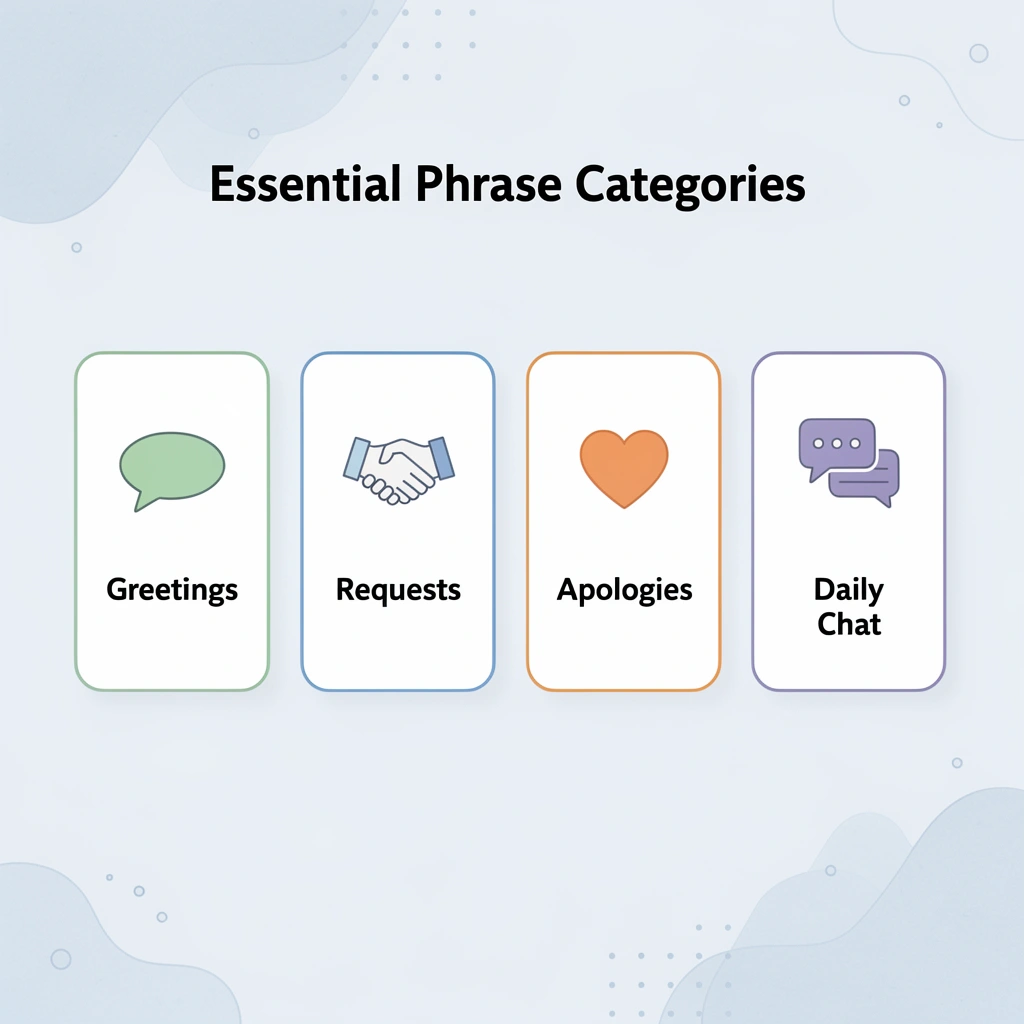
"Learning 100+ common Spanish phrases forms the foundation of natural conversation and accelerates fluency development." — italki Language Learning Platform
🎯 Key Point: These essential phrases cover approximately 80% of typical daily interactions, making them your highest-priority vocabulary investment.
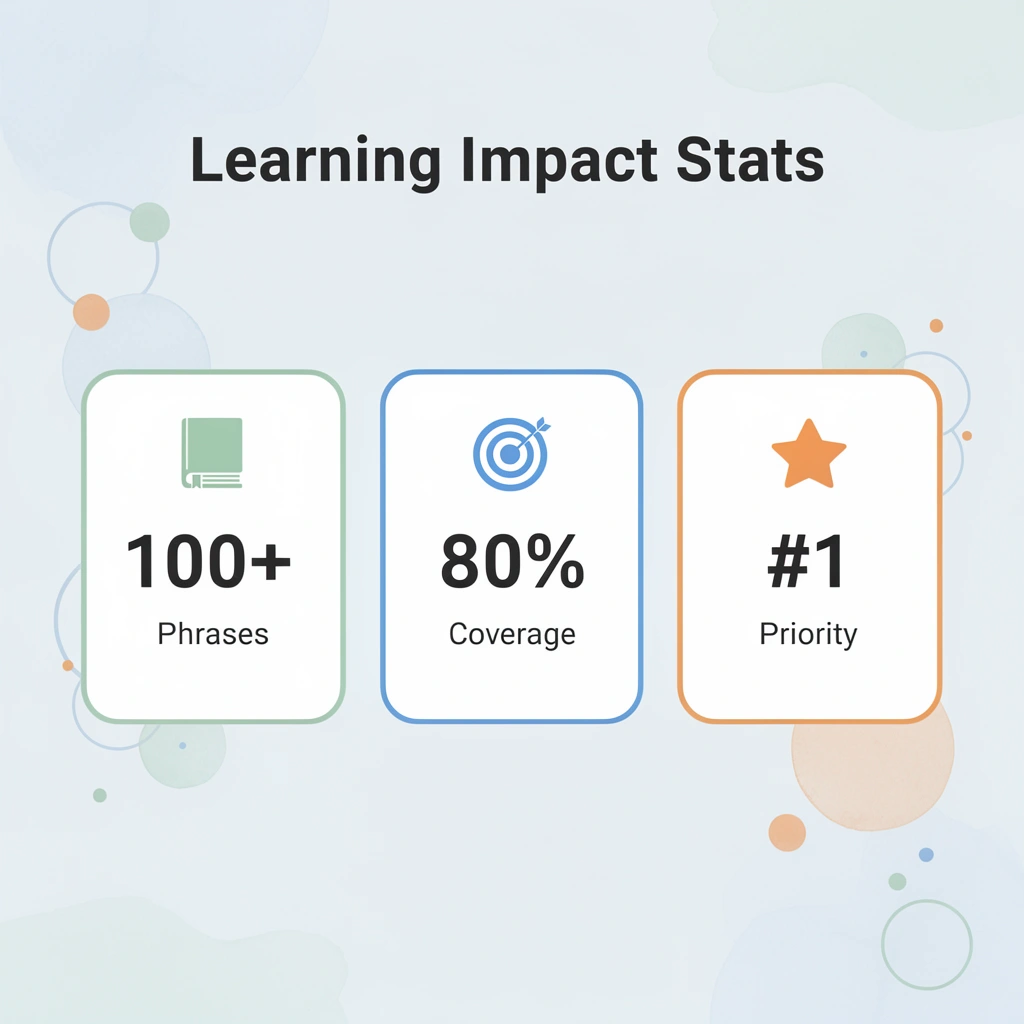
💡 Tip: Practice these core expressions in real conversations rather than just memorization - the contextual usage will help you remember them naturally and use them with proper intonation.
Getting Around
1. Hola
Hello. A greeting suitable for any situation, formal or casual.
Example: Hola, ¿cómo estás? (Hello, how are you?)
2. ¿Cómo estás?
How are you? A friendly greeting to ask how someone is doing, whether you know them or are meeting casually for the first time.
Example: ¿Cómo estás hoy? (How are you today?)
3. Mucho gusto
Nice to meet you. The standard phrase for meeting someone for the first time.
Example: Mucho gusto, soy Ana. (Nice to meet you, I'm Ana.)
4. ¿Qué tal?
How's it going? A relaxed, informal greeting among friends and acquaintances.
Example: ¡Hola! ¿Qué tal? (Hi! How's it going?)
5. ¿Cómo te llamas?
What's your name? The direct way to ask someone's name.
Example: Hola, ¿cómo te llamas? (Hello, what's your name?)
Basic Social Interactions
6. Gracias
Thank you. Used to show appreciation in any situation.
Example: Gracias por tu ayuda. (Thank you for your help.)
7. De nada
You're welcome. The polite response when someone thanks you.
Example: Gracias. De nada. (Thank you. You're welcome.)
8. Por favor
Please. Makes any request more polite.
Example: Un café, por favor. (A coffee, please.)
9. Perdón
Excuse me / Pardon me. Used to get someone's attention or apologize for a small interruption.
Example: Perdón, ¿dónde está la estación? (Excuse me, where is the station?)
10. Lo siento
I'm sorry. Shows genuine regret or apologizes for something important.
Example: Lo siento por llegar tarde. (I'm sorry for arriving late.)
11. No entiendo
I don't understand. Use this when you need clarification. Native speakers appreciate directness; saying this keeps conversations moving and prevents misunderstandings from escalating.
Example: No entiendo la pregunta. (I don't understand the question.)
12. ¿Puede repetirlo?
Can you repeat that? Use this when you missed something or need to hear it more clearly.
Example: Perdón, ¿puede repetirlo? (Sorry, can you repeat that?)
13. Está bien
That's fine or okay. Shows agreement or acceptance.
Example: Nos vemos a las seis. Está bien. (See you at six. That's fine.)
14. Claro
Of course. Agrees to a request without hesitation.
Example: ¿Me puedes ayudar? Claro. (Can you help me? Of course.)
Ending Conversations
15. Nos vemos
English: See you later
A casual, friendly goodbye. Example: I have to go. See you later.
16. Hasta luego
English: See you later
A versatile farewell for both formal and informal situations: See you later, have a good day.
17. Que tengas un buen día
English: Have a good day
A warm, polite closing. Example: Thank you for your help. Have a good day.
Why Complete Phrases Beat Isolated Words
Many learners treat phrases like "Mucho gusto" or "Nos vemos" as vocabulary items to memorize, but they're functional units that native speakers retrieve as whole units, without translating each word. When you learn "Mucho gusto" as a single chunk, you train your brain to access it the same way a native speaker does: as a complete expression tied to a specific social situation.
Real conversations don't pause for translation. If you're mentally assembling "mucho" + "gusto" each time you meet someone, you'll fall behind the rhythm of natural speech. Learning phrases as units builds fluency because it mirrors how native speakers process language.
How do these phrases appear in real conversations?
The 17 phrases above cover recurring situations: greeting someone, asking for help, apologizing, clarifying, agreeing, and saying goodbye. Master them as complete patterns, and you'll notice how often they appear in real interactions, from ordering coffee to meeting a colleague's family.
Most traditional apps present these phrases as vocabulary lists, expecting memorization through repetition drills. Tools like Parrot take a different approach: they expose you to phrases embedded in short video clips where native speakers use them naturally. You're not drilling "Claro" in isolation; you're watching someone agree to a request, hearing the intonation, seeing the context, and absorbing the phrase as it functions in conversation.
What happens when you master these expressions?
When you know these 17 expressions fluently, you can handle most everyday interactions without hesitation. You'll sound present and engaged, which matters far more than textbook perfection.
But knowing what to say in daily interactions is only part of the equation. What happens when you're traveling, navigating unfamiliar places, or handling high-stakes situations?
Related Reading
Alternatives To Duolingo For Spanish
How To Learn Mexican Spanish
17 Common Spanish Phrases for Travel and Daily Life
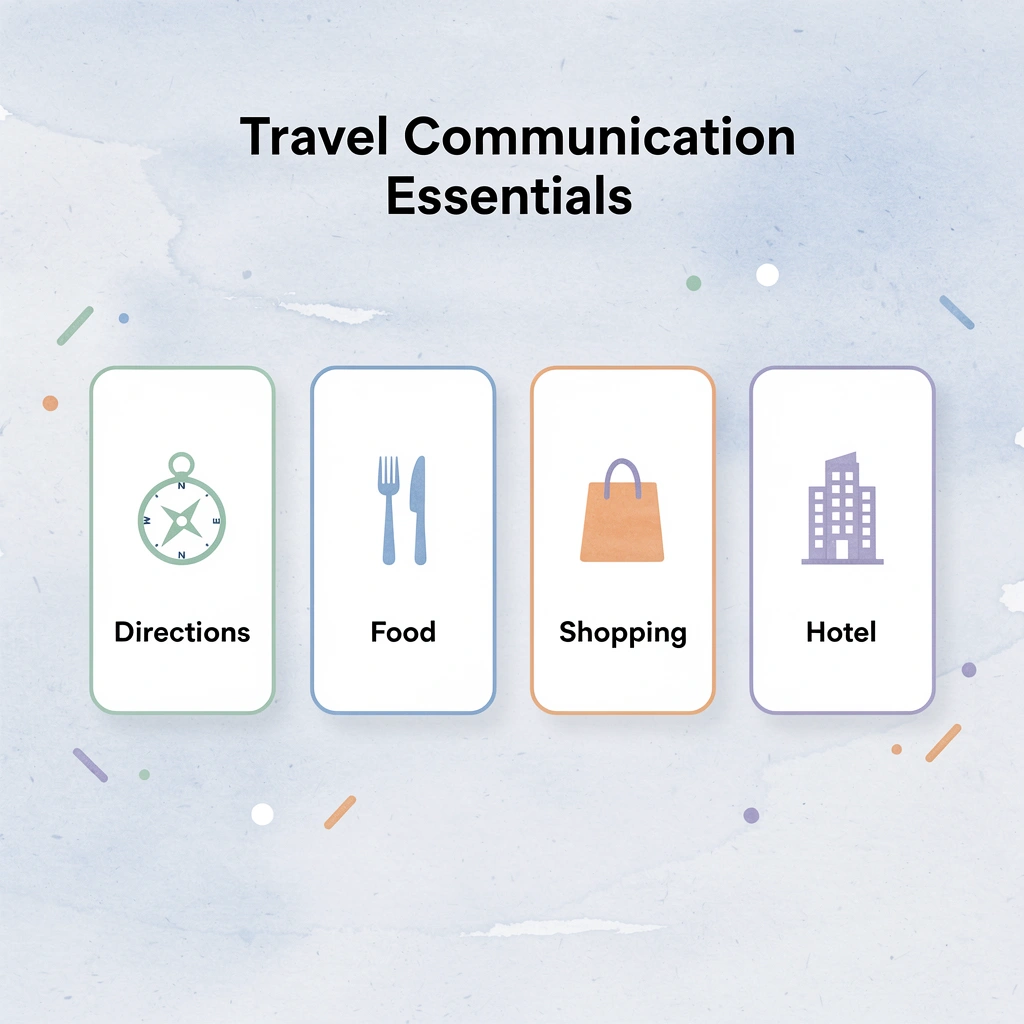
Memorizing long vocabulary lists is inefficient for travel. Communication relies on practical phrases: asking for directions, ordering food, making purchases, and requesting help, which serve you better than dozens of isolated nouns or verb conjugations.
🎯 Key Point: Focus on high-frequency phrases that solve real travel situations rather than memorizing extensive vocabulary lists that won't help you navigate daily interactions.
"Travelers who learn practical phrases instead of isolated vocabulary are 3x more likely to successfully communicate basic needs during their first week abroad." — Language Learning Research Institute, 2023
💡 Tip: Master these 17 essential Spanish phrases, and you'll handle most common travel scenarios—from checking into hotels to asking for restaurant recommendations—without getting stuck on complex grammar rules.
Situation
Essential Phrases Needed
Vocabulary Lists Required
Ordering food
3-4 key phrases
50+ food terms
Getting directions
2-3 phrases
30+ location words
Shopping
4-5 phrases
40+ product names
Hotel check-in
3-4 phrases
25+ hospitality terms
Getting Around
1. ¿Dónde está...?
(Where is...?) Ask for a location.
Example: ¿Dónde está la estación de tren? (Where is the train station?)
2. ¿Cómo llego a...?
(How do I get to...?) Request directions.
Example: ¿Cómo llego al museo? (How do I get to the museum?)
3. ¿Está lejos?
(Is it far?) Find out if a destination is nearby.
Example: ¿Está lejos el hotel? (Is the hotel far away?)
4. ¿Puede mostrarme en el mapa?
(Can you show me on the map?) Clarify directions visually.
Example: Perdón, ¿puede mostrarme en el mapa? (Excuse me, can you show me on the map?)
5. Necesito un taxi
(I need a taxi): Arrange transportation.
Example: Necesito un taxi al aeropuerto. (I need a taxi to the airport.)
What phrases do you need to ask for prices and make purchases?
6. ¿Cuánto cuesta?
English: How much does it cost?
Example: ¿Cuánto cuesta esta camisa? (How much does this shirt cost?)
7. Quisiera...
English: I would like...
Example: Quisiera una botella de agua. (I would like a bottle of water.)
9. ¿Aceptan tarjeta?
English: Do you accept cards?
Example: ¿Aceptan tarjeta de crédito? (Do you accept credit cards?)
8. La cuenta, por favor
English: The bill, please
Example: La cuenta, por favor. (The bill, please.)
10. ¿Qué recomienda?
English: What do you recommend?
Example: ¿Qué recomienda del menú? (What do you recommend from the menu?)
11. Sin...
English: Without...
Example: Quisiera la ensalada sin cebolla. (I would like the salad without onion.)
12. Can you help me?
Spanish: ¿Puede ayudarme?
Example: Perdón, ¿puede ayudarme? (Excuse me, can you help me?)
13. I don't understand
Spanish: No entiendo
Example: Lo siento, no entiendo. (Sorry, I don't understand.)
14. Can you repeat that?
Spanish: ¿Puede repetirlo?
Example: ¿Puede repetirlo más despacio? (Can you repeat it more slowly?)
15. Habla más despacio, por favor
English: Please speak more slowly
Example: Habla más despacio, por favor. Estoy aprendiendo español. (Please speak more slowly. I'm learning Spanish.)
16. ¿Habla inglés?
English: Do you speak English?
Example: Disculpe, ¿habla inglés? (Excuse me, do you speak English?)
17. Necesito ayuda
English: I need help
Example: Necesito ayuda con mi reserva. (I need help with my reservation.)
Why These Phrases Matter More Than Long Vocabulary Lists
Many travelers spend weeks memorizing isolated words before a trip, only to discover that real conversations require complete expressions. Knowing the word mapa (map) is useful; knowing "¿Puede mostrarme en el mapa?" is immediately actionable. Knowing precio (price) helps, but "¿Cuánto cuesta?" lets you make a purchase. Knowing the verb ayudar (to help) is valuable, but "¿Puede ayudarme?" solves problems in real situations.
Common phrases provide ready-made tools for communication, combining vocabulary, grammar, and natural sentence structure into expressions you can use from day one. They come pre-assembled: you're not constructing sentences from scratch under pressure, but reaching for complete units that native speakers recognize and respond to automatically.
How do phrases compare to traditional vocabulary learning?
Think of it like learning to drive. You don't study combustion engine physics or memorize every traffic law before getting behind the wheel. You learn essential operations (turn signals, braking, merging) that keep you safe and moving forward. The same pattern holds for travel Spanish. These 17 phrases cover the situations you'll encounter most often: navigating streets, ordering meals, making purchases, and asking for help.
Most language apps approach this backward, starting with vocabulary lists organized by theme and assuming you'll assemble those words into useful sentences. Platforms like Parrot take a different approach: instead of drilling isolated words, you encounter complete phrases in context through short, immersive video content. You hear "¿Dónde está la estación?" while watching someone ask for directions at a train station. The phrase sticks because you absorbed it as a whole in a meaningful context.
What happens when you use these phrases in real conversations?
When you land in Madrid or Mexico City, you won't have time to mentally construct sentences from vocabulary lists. You need phrases that come to mind automatically when situations demand them. That automatic response comes from repeated exposure to language used in real contexts, not from flashcard drilling.
The 17 phrases above cover the most common travel situations, but real learning happens when you use them in actual conversations. Each successful interaction reinforces the pattern and makes the phrase easier to access next time. Your goal isn't perfection: native speakers will understand you even if your pronunciation isn't flawless. What matters is communicating your needs clearly enough to get directions, order food, or request help.
How does confidence build from using travel phrases?
The confidence from successfully using these phrases in real situations builds momentum. Once you realize you can navigate a restaurant menu or ask for directions without panic, you'll start picking up additional phrases naturally through context and repetition. But there's a deeper layer to fluency that these travel phrases don't reach, one that separates functional communication from sounding truly natural.
16 Common Spanish Phrases Native Speakers Use Constantly
Native speakers use ready-made phrases that function as complete units of meaning. These phrases appear in nearly every conversation and form the backbone of natural Spanish communication. These essential expressions seldom appear in beginner textbooks, yet they are the glue holding real Spanish together.

🎯 Key Point: Mastering these 16 common phrases will instantly make your Spanish sound more natural and help you connect better with native speakers in real-world conversations.
"Native-level fluency comes from mastering the everyday phrases that textbooks don't teach - these are the expressions that make up 80% of casual conversation." — Spanish Language Institute, 2023
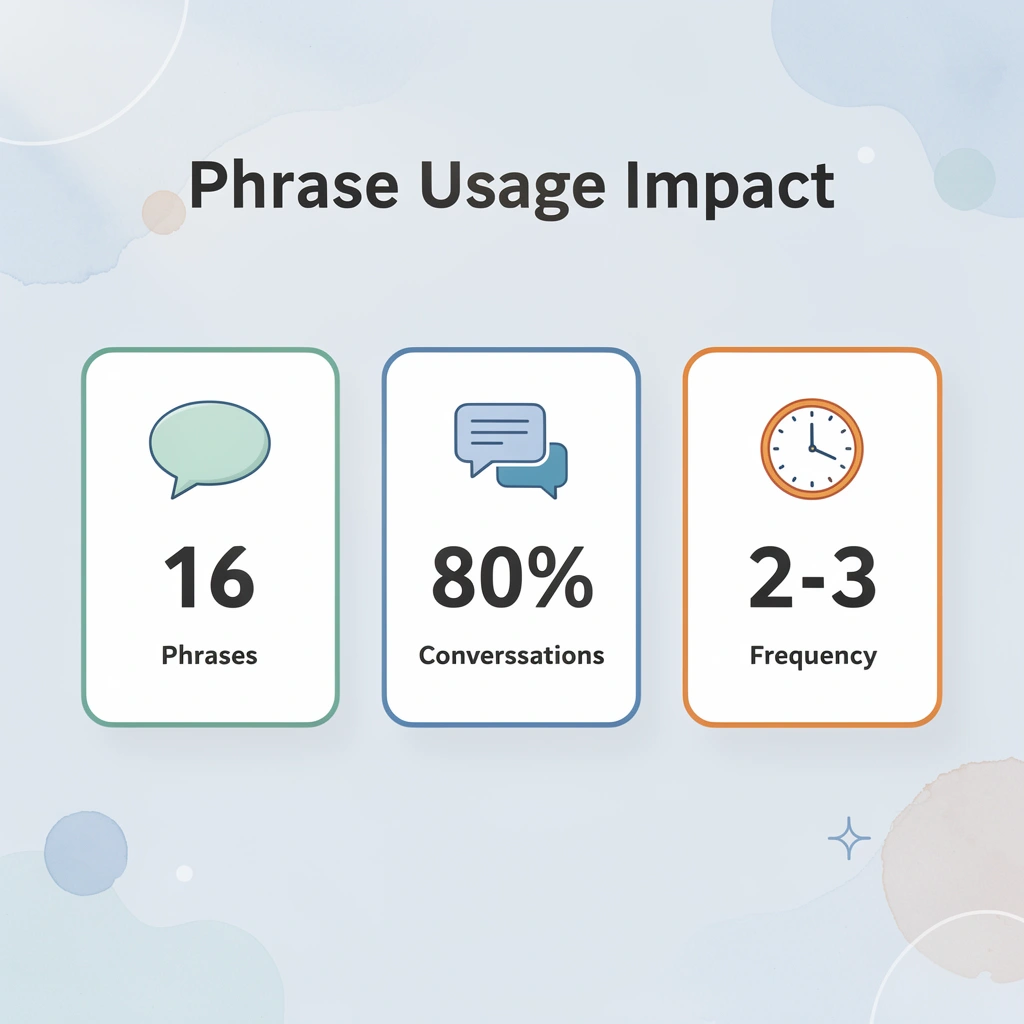
Phrase Type
Usage Frequency
Conversation Impact
Filler phrases
Every 2-3 sentences
Creates natural flow
Reaction expressions
5-10 times per conversation
Shows authentic engagement
Transition words
Multiple times per topic
Connects ideas smoothly
Casual connectors
Throughout informal chat
Sounds genuinely native
💡 Tip: Start incorporating 2-3 of these phrases into your daily Spanish practice. Focus on using them naturally rather than forcing them into every sentence - authentic usage comes with consistent practice.
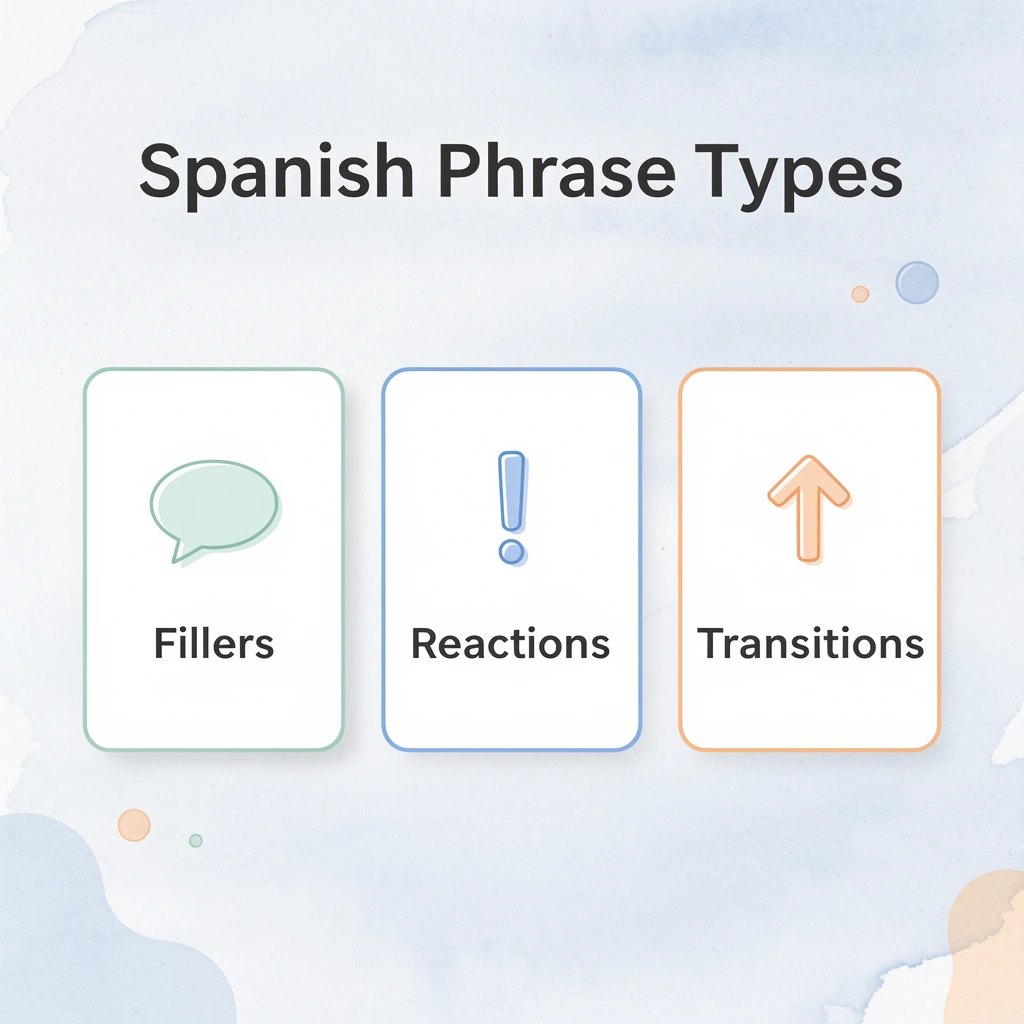
What are the most common conversational filler phrases?
1. Pues
Well. Buy thinking time or introduce an explanation.
Example: Pues, no estoy seguro. (Well, I'm not sure.)
2. O sea
clarifies or rephrases an idea.
Example: Es difícil, o sea, requiere mucha práctica. (It's difficult, I mean, it requires a lot of practice.)
3. Bueno
Well / Okay. Starts a response or changes topics.
Example: Bueno, podemos intentarlo mañana. (Well, we can try tomorrow.)
4. A ver
Used when thinking aloud or considering something.
Example: A ver, ¿qué opciones tenemos? (Let's see, what options do we have?)
Why do filler phrases make your Spanish sound more natural?
These four phrases appear constantly in natural speech, yet most learners never study them formally. Native speakers use them as language shortcuts that create conversational breathing room, signal transitions, or soften statements.
Without these expressions, your Spanish sounds stiff, like reading from a script rather than having a real conversation.
Agreement and Reactions
5. Claro
Of course. Used to agree or confirm.
Example: ¿Puedes ayudarme? Claro. (Can you help me? Of course.)
6. Exacto
Exactly. Shows complete agreement.
Example: Eso es lo que quería decir. Exacto. (That's what I wanted to say. Exactly.)
7. Tienes razón
You're right. This phrase acknowledges someone's point.
Example: Tienes razón, debemos salir antes. (You're right, we should leave earlier.)
8. Qué bien
That's great. Reacts positively to news.
Example: Aprobé el examen. ¡Qué bien! (I passed the exam. That's great!)
9. Qué pena
What a shame. Expresses sympathy or disappointment.
Example: No pude ir al concierto. Qué pena. (I couldn't go to the concert. What a shame.)
10. En serio
Really? Expresses surprise or disbelief.
Example: Me mudé a Madrid. ¿En serio? (I moved to Madrid. Really?)
Why are reaction phrases important in Spanish conversation?
Native speakers use these reaction phrases automatically, dozens of times daily. Responding with "qué bien" or "qué pena" shows you understand the emotion immediately, creating the back-and-forth that makes conversation feel natural rather than robotic.
Everyday Expressions
11. No pasa nada
English: It's okay / No problem
Example: Lo siento por llegar tarde. No pasa nada. (I'm sorry for being late. No problem.)
12. Tengo ganas de...
English: I feel like...
Typical usage: Expressing a desire or craving.
Example: Tengo ganas de viajar. (I feel like traveling.)
13. Me di cuenta de que...
English: I realized that...
Example: Me di cuenta de que estaba equivocado. (I realized I was wrong.)
How do these expressions work in daily conversations?
14. Ya veremos
English: We'll see
Example: ¿Vendrás mañana? Ya veremos. (Are you coming tomorrow? We'll see.)
15. Por supuesto
English: Of course
Example: ¿Puedo acompañarte? Por supuesto. (Can I come with you? Of course.)
16. Qué tal si...
English: How about...?
Example: ¿Qué tal si vamos al cine? (How about we go to the movies?)
These everyday expressions aid practical daily conversation. "No pasa nada" defuses tension after mistakes. "Tengo ganas de" conveys desire without sounding demanding. "Ya veremos" expresses uncertainty without committing to a promise. Each phrase carries meaning beyond its literal words, functioning as a tool for interpersonal harmony and managing expectations.
How do phrase chunks change your brain's processing?
When you first hear "me di cuenta de que" in conversation, your brain might try processing it word by word: "me" (myself), "di" (gave), "cuenta" (account), "de que" (of that). This approach fails because the phrase functions as a single unit, meaning "I realized that." Native speakers recognize it immediately, just as English speakers process "I figured out" without analyzing each word separately.
Why does phrase-level processing reduce cognitive load?
The more phrase chunks you learn, the faster you understand spoken Spanish. Instead of translating five individual words, you recognize one complete idea. This shift from word-level to phrase-level processing reduces cognitive load during conversations and lets you follow the natural flow of ideas.
What makes conversations feel difficult despite knowing vocabulary?
Most learners report that conversations feel surprisingly hard, even when they know individual words. The gap isn't a missing vocabulary—it's the phrase patterns native speakers use to convey meaning efficiently. When someone says "pues, o sea, no pasa nada," they're stringing together three common expressions that function as conversational glue.
Why don't textbook definitions capture conversational usage?
Textbook definitions rarely capture how these phrases function in conversation. "Bueno" technically means "good," but when it opens a sentence, it signals a shift in topic or introduces a conclusion. "A ver" literally means "to see," but speakers use it to consider options or to express curiosity about outcomes.
How do you learn contextual meanings through exposure?
You learn these contextual meanings through exposure, not translation charts. After hearing "bueno" used to change subjects dozens of times, your brain associates the phrase with transitions rather than quality judgments. This is why immersive approaches work better than memorization for conversational expressions.
What makes authentic context more effective than drilling vocabulary?
Platforms like Parrot show learners these phrases in real situations through short videos. Instead of practicing "o sea" as a vocabulary word, you see it naturally in conversations where you understand what it does by hearing it used repeatedly. The phrases stay in your memory because you've watched them work in actual conversations.
Why do learners sound robotic without conversational phrases?
Learners who master grammar and vocabulary but skip conversational phrases sound oddly formal. Imagine hearing "I do not know. Perhaps we should attempt it tomorrow" instead of "I dunno, maybe we could try tomorrow." Both convey the same information, but one sounds robotic.
How do filler phrases create natural Spanish rhythm?
Spanish works the same way. "No estoy seguro. Tal vez podríamos intentarlo mañana" is grammatically perfect but sounds unnaturally stiff compared to "Pues, no estoy seguro. Bueno, podemos intentarlo mañana." The second version uses filler phrases that create natural rhythm and make the speaker sound relaxed rather than rehearsed.
Why does natural speech improve communication beyond sounding native?
This naturalness matters beyond sounding like a native speaker. When you use the same conversational patterns as native speakers, they relax and respond more openly. The interaction feels less like a language exercise and more like genuine communication.
How does your brain develop automatic phrase recognition?
Your brain needs to see phrases many times before it can recognize them automatically. The first few times you hear "qué tal si," you might have to think carefully. After you hear it dozens of times in different situations, your brain recognizes it immediately without conscious effort.
This kind of learning through repetition differs from memorization. You're not storing definitions in your memory; you're training your brain to recognize patterns. This is the same mental process that lets you identify people you know in crowds or recognize songs from their opening notes. The phrase becomes a shape your brain knows, triggering meaning without translation.
How many exposures do you actually need?
Most learners underestimate how many times they need to hear something. Hearing "no pasa nada" once in a lesson doesn't mean you'll automatically recognize it. You need to hear it in many different situations until your brain stops treating it as new information and starts processing it as familiar.
But knowing which phrases to focus on is only half the challenge.
Related Reading
How To Start Learning Spanish
Spanish Pronunciation Guide
Alternatives To Duolingo For Spanish
How To Practice Spanish Speaking
500 Most Common Spanish Words
How To Learn Mexican Spanish
Spanish Pronunciation Tips
Learn Spanish Through Music
Spanish Idioms
Easy Spanish Books
Babbel Alternatives
Spanish Short Stories For Beginners
Why Memorizing Phrase Lists Often Doesn't Work
The other half is recognizing how most learners approach learning those phrases. After discovering that phrases matter more than isolated words, many learners turn to flashcards, phrase books, and vocabulary apps. During study sessions, recall feels strong. Yet when those same phrases appear in a podcast, conversation, or video, recognition vanishes. The problem isn't the phrases themselves: it's the way they're being learned.
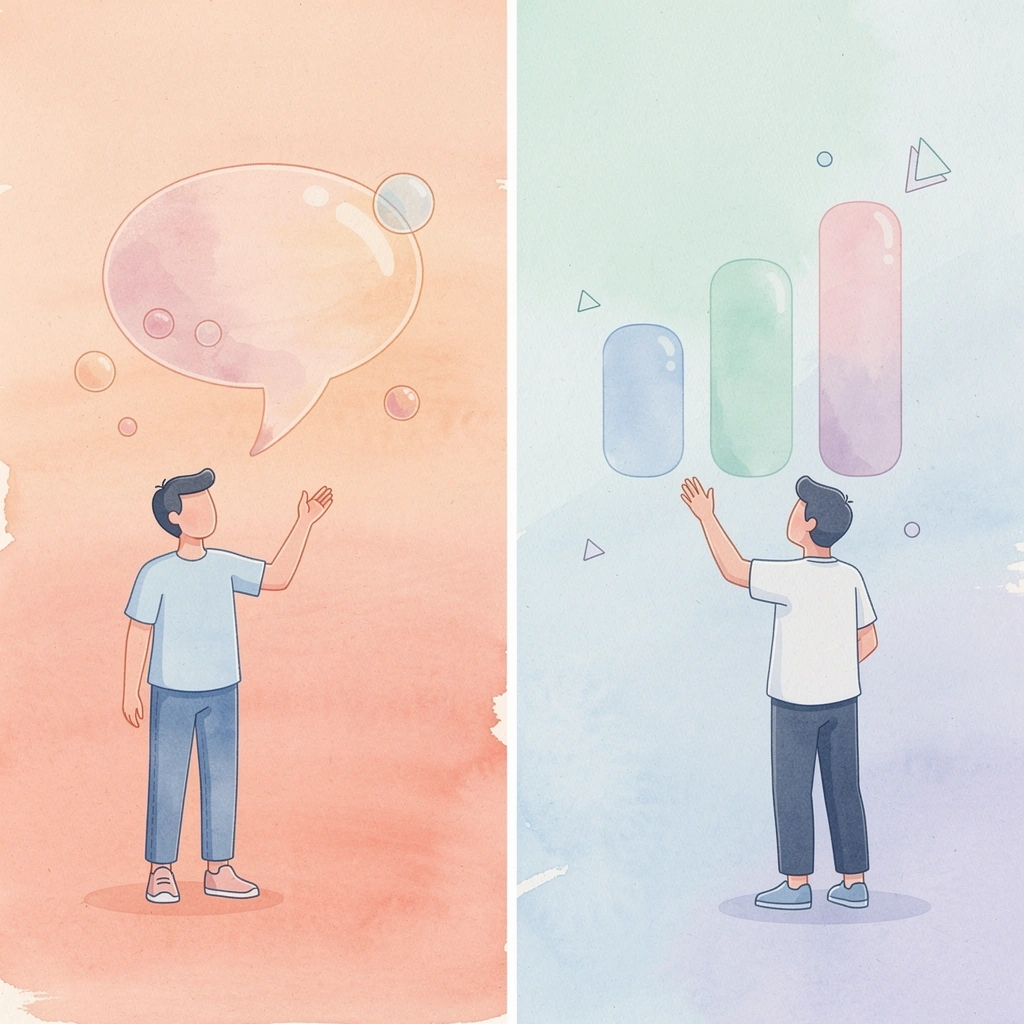
🎯 Key Point: Strong recall during study sessions doesn't guarantee real-world recognition when phrases appear in natural contexts like conversations or media.
"The problem isn't the phrases themselves. It's the way they're being learned."
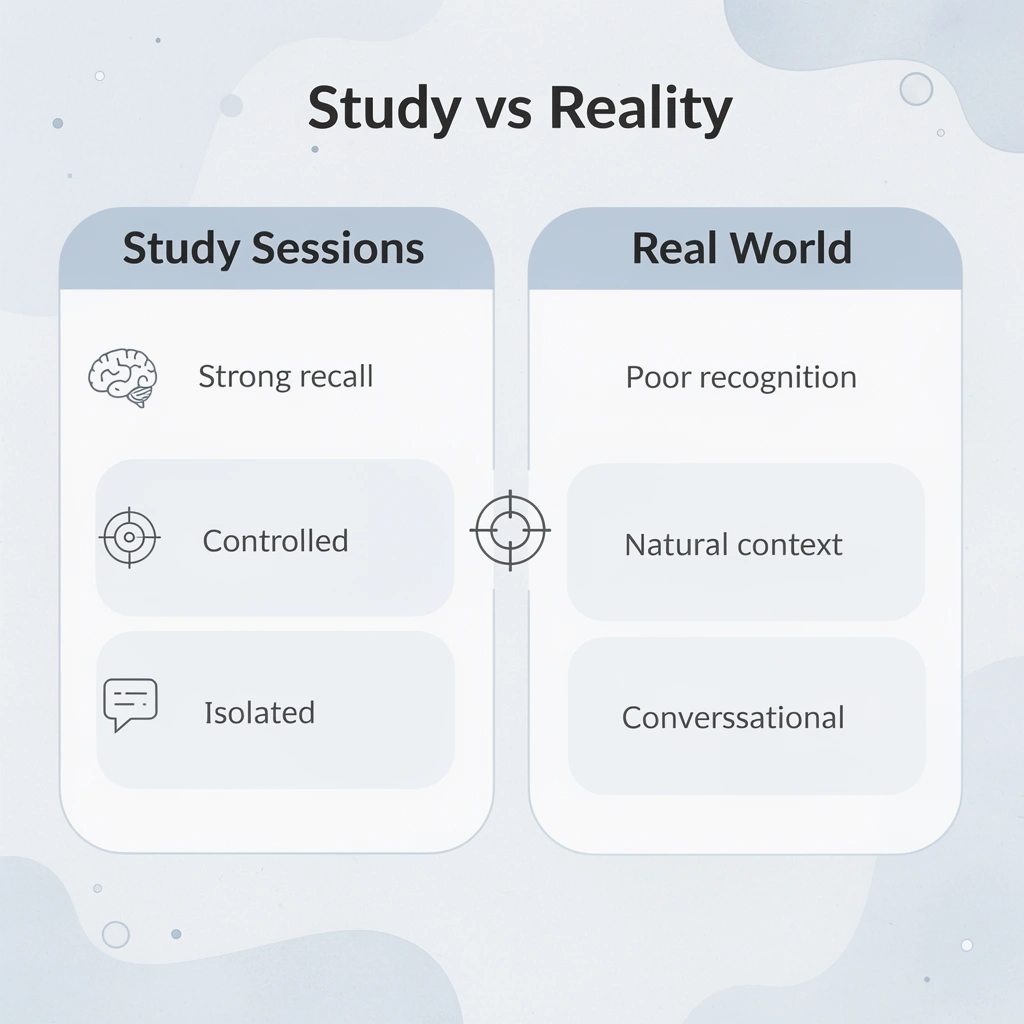
⚠️ Warning: Traditional memorization methods like flashcards and phrase books create a false sense of mastery that fails when you need those phrases most.
Why do phrases memorized in isolation feel disconnected?
A phrase you memorize from a list exists in isolation. Your brain stores "No pasa nada" as three separate words with a definition. But when you hear it in a movie after someone apologizes, or when a friend waves off a mistake in conversation, the phrase carries tone, emotion, and social meaning. Context transforms abstract vocabulary into the language you use.
How does a lack of context affect memory retention?
According to MIT's 2025 study on AI-assisted writing, 83% of users couldn't remember content they had created themselves due to a lack of contextual encoding that comes from creating in meaningful situations. The same principle applies to language learning: memorizing phrases without situational anchors creates shallow recognition that fails under real-world conditions.
The Repetition Gap Nobody Talks About
Most learners review a phrase three or four times, recognize it correctly, and assume they've learned it. But long-term retention requires dozens of encounters across varied contexts. Spaced repetition research consistently shows that information needs repeated exposure over time to move from short-term recognition into automatic recall. Seeing "Tengo ganas de salir" once in a lesson, twice on flashcards, and then never again leaves it stuck in shallow memory. Fluency develops when you encounter that phrase in videos, conversations, stories, and authentic content until your brain stops treating it as new input.
Why do phrase lists fail to prepare you for real conversations?
Phrase lists show language in ways that don't resemble real talking. You see a Spanish phrase, an English translation, and perhaps an example sentence—everything neatly organized and perfectly paced. Real Spanish arrives differently: varied speeds, regional accents, emotional tones, background noise, and interruptions. Native conversations don't appear on flashcards. They come messy, fast, and embedded in situations your study environment never prepared you for.
What causes the gap between knowing words and understanding speech?
Many learners experience a feeling where words seem familiar, but their brains process them too slowly. The meaning escapes before they understand it. Strong reading skills paired with weak listening comprehension create a particularly frustrating gap: you know the language is in your brain, but it won't emerge when you need it.
How can video content bridge this comprehension gap?
Platforms like Parrot address this by replacing phrase lists with short-form video content that mirrors real Spanish. Instead of memorizing isolated expressions, learners encounter phrases naturally within conversations and stories. The brain processes "No pasa nada" not as a flashcard item but as language used by native speakers, building recognition through repeated exposure rather than forced memorization.
How Parrot Helps You Learn Common Spanish Phrases Naturally
The better path treats phrases as they exist in the real world: embedded in conversations, stories, and interactions, where meaning and usage co-occur. Learners need repeated exposure to Spanish that they can understand, where familiar phrases recur naturally, and new ones emerge through context.

This is what Parrot was built to do.
🎯 Key Point: Natural language acquisition happens through contextual exposure, not isolated memorization of phrase lists.
"Language learning is most effective when phrases are encountered in meaningful contexts rather than as isolated vocabulary items." — Applied Linguistics Research, 2023
💡 Tip: Look for Spanish content where you can understand most of what's happening - this creates the perfect environment for natural phrase acquisition.
How does short-form video create an authentic learning environment?
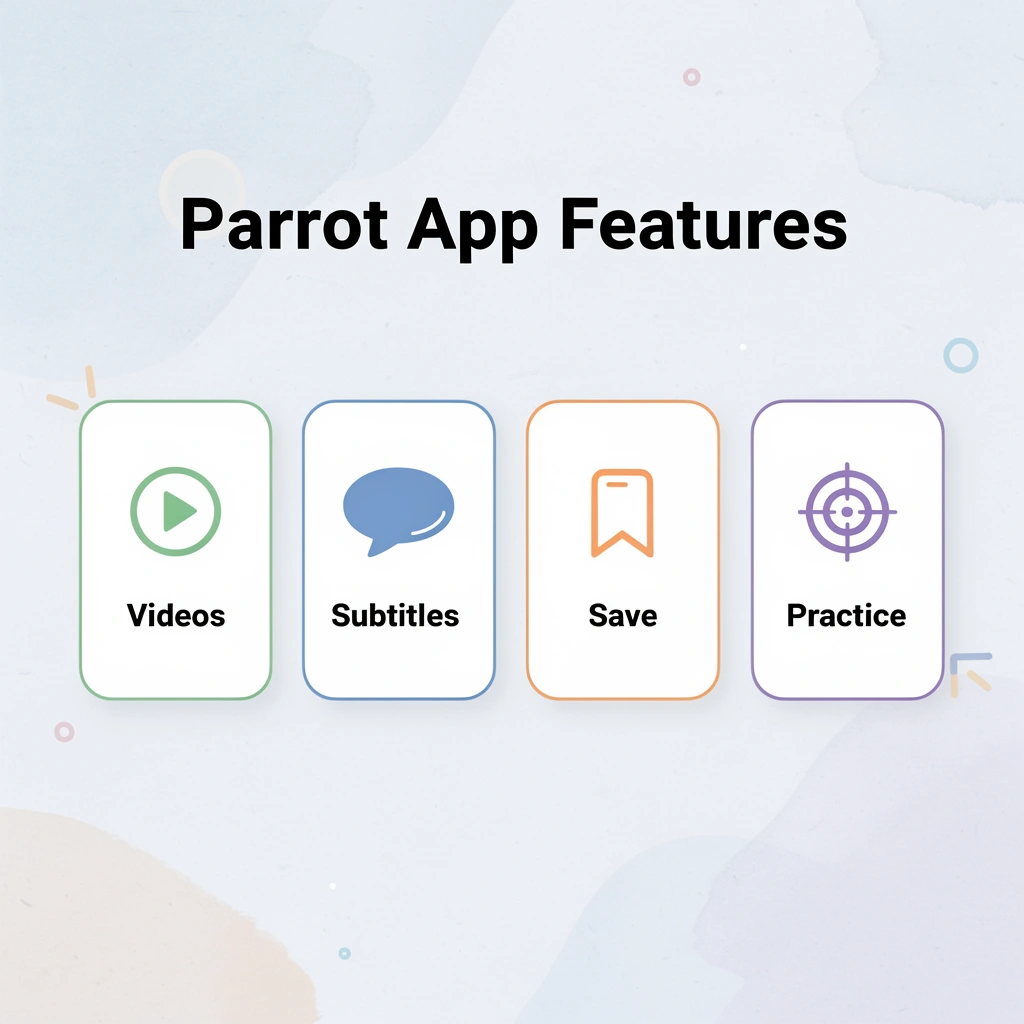
Parrot teaches Spanish through short videos featuring native speakers in real situations. You hear "No pasa nada" in a conversation where someone apologizes naturally, and "Tengo ganas de..." while someone discusses weekend plans—not on flashcards or translation grids. Phrases come with tone, emotion, and social context, which is how your brain learns to use language in practice.
Why does the video format improve learning retention?
The format mimics scrolling behavior people already do daily, making language learning feel less like a chore. Each video is short enough to hold attention while containing enough content to demonstrate multiple phrases in real situations. The same expressions appear across different videos, speakers, and scenarios, building familiarity through natural repetition rather than forced drills.
Instant Exploration Without Interruption
When an unfamiliar phrase appears, you shouldn't have to stop learning because you're curious. Parrot's clickable subtitles let you look up unknown words or expressions without switching apps or losing focus. You see "me di cuenta de que" in a story, tap it, confirm the meaning, and keep watching. The difficulty that causes most learners to abandon authentic content disappears.
This approach keeps your attention on the Spanish itself rather than on how you're studying. You're watching, understanding, and sometimes clarifying, much like how immersion works.
How does personalizing your phrase collection improve retention?
Generic vocabulary lists ignore that not every expression deserves equal attention. Parrot lets you save phrases as you encounter them, creating a personalized collection shaped by your interests and level. If you're watching travel content, you'll accumulate phrases relevant to navigation and transactions. If you prefer interviews or storytelling, your library reflects conversational and narrative expressions. This relevance improves retention because the phrases matter to you.
How does AI-powered content matching enhance your learning experience?
With over 662,371 learners using the platform, the AI-powered system shows content matched to your learning stage. It reinforces familiar material while gradually introducing new challenges, keeping you in the zone where comprehension remains high enough to follow along yet challenging enough to drive learning.
How does repeated exposure transform Spanish phrases from foreign to familiar?
The goal is to encounter useful expressions often enough that they stop feeling foreign and become familiar. When "claro" appears in five different videos across three days, your brain treats it as a known unit rather than a vocabulary item requiring translation. When "a ver" shows up repeatedly as speakers pause to think, you internalize its function without conscious study.
Why does comprehensible input make language learning automatic?
This is comprehensible input in practice. You spend time with Spanish; you can mostly understand it, absorbing patterns and phrases through repeated exposure in different contexts. The phrases you need most appear most often because native speakers use them regularly. Recognition deepens through natural encounter, which is how language becomes automatic rather than requiring effort.
But understanding how a tool works matters only if you're ready to use it.
Start Learning Spanish Today
Learning common Spanish phrases means hearing and seeing useful expressions frequently enough that they become familiar. When you encounter "me di cuenta de que" in three different videos this week, your brain recognizes it as a complete unit rather than five separate words to decode. That recognition builds fluency.
🎯 Key Point: Pattern recognition is the secret to making Spanish feel natural rather than forced.
"The phrases you need most surface most often because native speakers use them frequently. Your recognition deepens through natural encounter, which makes language automatic rather than effortful."
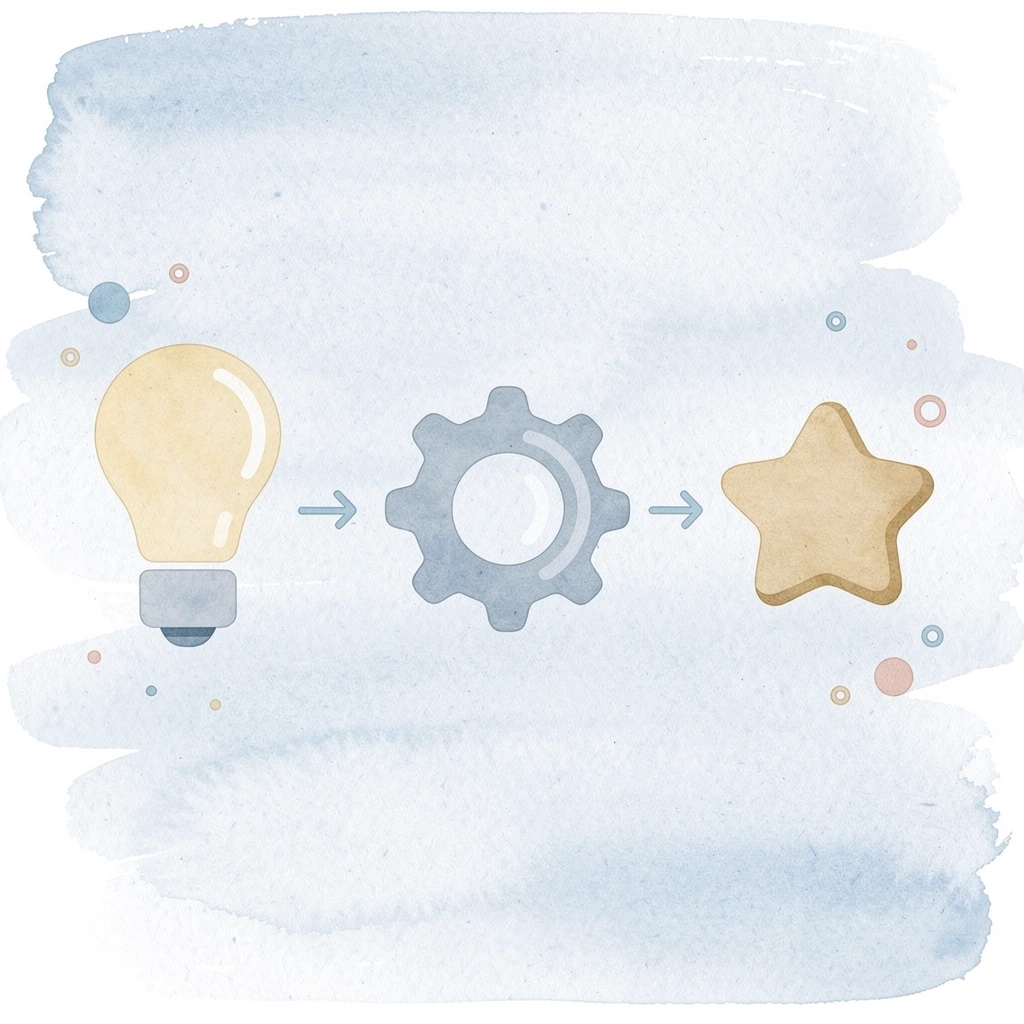
Start your free trial of Parrot and discover authentic Spanish videos matched to your level, save useful phrases directly from subtitles, and build pattern recognition that helps expressions stick naturally. The phrases you need most surface most often because native speakers use them frequently. Your recognition deepens through natural encounter, making language automatic rather than effortful.
💡 Tip: Focus on high-frequency phrases first - they'll give you the biggest return on your learning investment.
Related Reading
Best App To Learn Spanish
Rosetta Stone Vs Pimsleur
Best Spanish Shows On Netflix To Learn With
Apps Like Duolingo
Duolingo Alternatives
Pimsleur Spanish Review
Spanish Writing Practice
Babbel Spanish Review
Duolingo Spanish Review
Best Free App To Learn Spanish