Even when grammar is correct, Spanish can still sound stiff and unnatural without idiomatic expressions. Native speakers rely on these phrases constantly, and for anyone exploring Spanish for beginners resources, learning them early closes the gap between textbook knowledge and real conversation. Idioms carry cultural weight that vocabulary lists rarely capture, making them one of the most practical areas to study.
Parrot is designed to address exactly this challenge by pairing colloquial expressions with their cultural context. Rather than focusing solely on conjugations and vocabulary drills, it builds the kind of fluency that holds up in actual conversations. For anyone ready to move beyond the basics and connect with native speakers, learn Spanish with Parrot offers a direct and practical way forward.
Table of Contents
Why Spanish Idioms Confuse So Many Learners
What Are Spanish Idioms and Why Do They Matter?
50 Common Spanish Idioms and What They Really Mean
Why Memorizing Idioms Usually Doesn't Work
How to Learn Spanish Idioms Naturally Through Content
How Parrot Helps You Learn Spanish Idioms Without Memorizing Lists
Start Learning Spanish Today
Summary
Spanish is spoken by over 500 million native speakers worldwide, which means idiomatic expressions span continents, cultures, and generations of daily use. These phrases are not decorative features of the language. They are the connective tissue of real conversation, carrying emotional weight, cultural logic, and social context that vocabulary lists and grammar drills cannot replicate.
The gap most intermediate learners feel is not a vocabulary problem. It is an exposure problem. Learners who reach an intermediate level often discover that the Spanish they studied and the Spanish people actually speak function as two different languages, separated not by word count but by the figurative meaning packed into everyday phrases.
Rote memorization of idioms produces what linguists call passive knowledge. Research published in the Journal of Psycholinguistic Research found that native speakers encounter thousands of idioms across the adult lifespan, absorbing them through repeated, situated exposure rather than through lists. A phrase reviewed on a flashcard does not activate fast enough during natural speech at full speed, surrounded by unfamiliar words, to become usable.
A 2025 study on idiom understanding in large language models found that memorization alone is insufficient for comprehension and that even sophisticated AI systems rely on compositional reasoning for idioms they have not directly encountered. If memorization fails for AI systems processing language at scale, it signals something important about how context-dependent idiomatic meaning actually is.
The expressions that stick fastest are tied to vivid, concrete images rather than abstract concepts, which aligns with how memory works. Spanish idioms consistently use ordinary objects, food, and animals to encode complex human experiences. Milk, bread, goats, frying pans, cucumbers. The mundane carries the emotional weight, and that specificity is part of what makes the phrases durable once heard in context.
Idiom acquisition is less about study and more about mileage. Every genuine encounter with a colloquial phrase in authentic spoken Spanish moves a learner closer to automatic comprehension, where recognition no longer requires translation and starts to feel like instinct.
Parrot's Learn Spanish app addresses this by delivering short-form video content from native speakers, so idiomatic expressions appear in real conversations, with tone, timing, and emotional context intact, rather than as isolated entries on a list.
Why Spanish Idioms Confuse So Many Learners
Intermediate learners often find that the Spanish they studied differs surprisingly from what native speakers actually speak. This gap can feel discouraging, but understanding why it exists is the first step to closing it.
"The Spanish taught in classrooms is a foundation — but real fluency lives in the idioms, rhythms, and cultural reflexes that textbooks rarely capture." — Language acquisition research
💡 Tip: If your classroom Spanish isn't landing in real conversations, you're not failing — you're hitting a normal wall that every intermediate learner faces.

The gap isn't vocabulary or grammar. Spanish idioms, colloquial expressions, and figurative language carry meaning entirely outside individual words. When someone says no hay mal que por bien no venga, a word-for-word translation gives you "there is no bad that good doesn't come from." The emotional weight, reassurance, and cultural reflex of finding silver linings — none of that survives literal reading. The phrase only makes sense when you've heard it used in context by someone who means it.
Literal vocabulary and grammar rules
What native speakers actually use: Idiomatic expressions with cultural meaning
Word-for-word sentence construction
What native speakers actually use: Figurative language tied to emotional context
Textbook phrases
What native speakers actually use: Colloquial shortcuts shaped by lived experience
⚠️ Warning: Relying on literal translation for Spanish idioms will almost always produce the wrong meaning — and sometimes cause genuine confusion in conversation.
🔑 Takeaway: True comprehension of Spanish idioms requires contextual exposure — hearing phrases used by real speakers in real situations, not just memorizing their dictionary definitions.
Why do traditional learning methods fall short with idioms?
Traditional learning methods fall short here. Textbooks and flashcard apps test what's easy: vocabulary lists, verb tables, grammar drills. They don't teach what's hard: the rhythm of real speech, how a single idiom replaces three sentences, or the cultural shorthand native speakers share without thinking. Most learners respond by studying harder within the same system—more vocabulary cards, more conjugations. But the friction they feel isn't a vocabulary problem. It's an exposure problem.
Drilling lists of Spanish idioms and English equivalents hits the same wall. You can memorize that costar un ojo de la cara means something is expensive, but without hearing it used naturally in conversation or video, the phrase stays inert. According to Dr. Stephen Krashen's comprehensible input theory, language acquisition occurs when learners encounter meaningful content slightly above their current level, rather than through memorizing decontextualized rules. Idioms acquired through immersion in real spoken Spanish stick because the brain stores them with emotional and situational context attached. Parrot is built around this principle: short-form video content from native speakers that delivers idiomatic Spanish in context, so expressions land with meaning rather than as list entries.
What does this confusion actually feel like for learners?
The result is a specific confusion intermediate learners know well: you catch every word, but the sentence still makes no sense. You feel the gap between recognition and understanding, between knowing Spanish and speaking it. That feeling isn't failure—it's a sign the method has reached its limit, not the learner.
The deeper reason idioms resist memorization is more surprising than it first appears.
What Are Spanish Idioms and Why Do They Matter?
Spanish expressions carry meaning the way jokes do: you either get it or you don't, and no amount of dictionary work closes that gap. An idiom is a fixed phrase whose meaning goes beyond its individual words. When a native speaker says no tener pelos en la lengua (literally, "to have no hairs on the tongue"), they mean someone who speaks bluntly. Translate it word by word, and you get nonsense. Understand it in context, and you get character.
💡 Example: No tener pelos en la lengua literally means "to have no hairs on the tongue," but it means someone speaks their mind without a filter. That's the power of idiomatic meaning over literal translation.

That gap between literal and intended meaning is how all living languages work. Spanish carries particular weight here. According to the Pimsleur Blog, Spanish is spoken by over 500 million native speakers worldwide, which means these expressions span continents, cultures, and generations of daily use. Idioms are the connective tissue of real conversation.
"Spanish is spoken by over 500 million native speakers worldwide — meaning its idioms span continents, cultures, and generations of daily use." — Pimsleur Blog
🔑 Takeaway: Mastering Spanish idioms isn't a bonus skill — it's the essential bridge between textbook fluency and genuine, natural communication.
Word-for-word translation
What you get: Literal nonsense, lost meaning
Idiomatic understanding
What you get: Cultural nuance and real fluency
Context-based learning
What you get: Natural, confident conversation
⚠️ Warning: Relying only on a dictionary to decode Spanish idioms will leave you confused in real conversations — context and cultural exposure are non-negotiable.
Why does memorizing idiom lists fall short?
Most learners approach idioms the same way they approach vocabulary: write them down, review the list, repeat. The BaseLang Blog covers 46 of the best Spanish sayings worth learning. But memorizing 46 phrases doesn't teach you when to use them, what feeling or tone they carry, or how native speakers actually say them. A phrase like más vale tarde que nunca ("better late than never") sounds different in a tense family dinner than in a casual text message. Context is the whole lesson.
Studying idioms through flashcards or grammar exercises feels productive but leaves phrases brittle—disconnected from tone, timing, and the natural rhythm of speech. Apps like Parrot use short-form video from native speakers, letting learners encounter expressions in real conversations and hear exactly how and when they're used.
What do Spanish idioms reveal about culture and thinking?
What idioms reveal is how Spanish-speaking communities think. Camarón que se duerme, se lo lleva la corriente ("the shrimp that falls asleep gets carried away by the current") warns against laziness while reflecting a worldview about staying alert and the consequences of your choices—a lesson no vocabulary list teaches. Expressions like this encode cultural logic, and hearing them in context lets you absorb that logic too. That is the difference between knowing Spanish and understanding it.
Related Reading
Spanish Spoken Worldwide And Why You Should Learn It
1000 Most Common Spanish Words
Sentences In Spanish
What Countries Speak Spanish
Hard Spanish Sentences
Common Spanish Phrases
Spanish Books For Beginners
Quotes In Spanish
Spanish Numbers
Mexican Spanish Slang
50 Common Spanish Idioms and What They Really Mean
Knowing idioms helps your brain move from translating words to recognizing patterns: the way native speakers understand language.
"The shift from word-for-word translation to pattern recognition is the defining leap between a struggling learner and a fluent speaker." — Language acquisition research
💡 Tip: When you encounter a new idiom, don't ask "what do these words mean?" Ask, "what situation is this used in?" That's how native speakers store language in their brains.
The 50 expressions below are organized by situations where you're most likely to encounter them, with literal translations, actual meanings, and real sentences showing each in use.
🎯 Key Point: Each idiom entry includes three layers of understanding — the literal translation, the real meaning, and a contextual example sentence — so you build genuine fluency, not just memorization.
Literal translation
Why it matters: Shows why the idiom sounds strange word-for-word
Actual meaning
Why it matters: Gives the real-world definition native speakers actually use
Example sentence
Why it matters: Demonstrates context and usage so you know when to apply it
Situational grouping
Why it matters: Helps you recall idioms faster in real conversations
⚠️ Warning: Memorizing idioms out of context is one of the most common mistakes language learners make — always study them with a real example sentence attached.
Everyday Expressions
1. Estar en las nubes
Literal: To be in the clouds
Meaning: To be distracted or daydreaming
Example: Siempre está en las nubes durante las reuniones. (She's always daydreaming during meetings.)
2. Tener mala leche
Literal: To have bad milk
Meaning: To have a bad attitude or short temper
Example: Hoy tiene mala leche; mejor no discutir con él. (He's in a foul mood today, better not argue.)
3. Meter la pata
Literal: To put in the paw
Meaning: To make a mistake or put your foot in it
Example: Metí la pata al decir su edad. (I put my foot in it by mentioning her age.)
4. Ser pan comido
Literal: To be eaten bread
Meaning: To be very easy, a piece of cake
Example: El examen fue pan comido. (The exam was a breeze.)
5. Estar hecho polvo
Literal: To be made of dust
Meaning: To be completely exhausted
Example: Después del viaje, estoy hecho polvo. (After the trip, I'm completely wiped out.)
6. Ir al grano
Literal: To go to the grain
Meaning: To get to the point
Example: Ve al grano y dime qué pasó. (Get to the point and tell me what happened.)
7. Dar igual
Literal: To give the same
Meaning: To not matter, to be indifferent
Example: Me da igual dónde cenemos. (I don't mind where we eat.)
8. Tener la sartén por el mango
Literal: To hold the frying pan by the handle
Meaning: To be in control of a situation
Example: Ella tiene la sartén por el mango en las negociaciones. (She's calling the shots in the negotiations.)
9. Hacer la vista gorda
Literal: To make the fat eye
Meaning: To turn a blind eye, to deliberately ignore something
Example: El profesor hizo la vista gorda con el retraso. (The teacher turned a blind eye to the lateness.)
10. Estar como una cabra
Literal: To be like a goat
Meaning: To be a little crazy
Example: Está como una cabra, pero es divertido. (He's a bit nuts, but fun to be around.)
The pattern you're already noticing is worth naming. Spanish idioms often use the most ordinary objects, food, and animals to express something deeply human. Milk, bread, goats, frying pans. The mundane carries the emotional weight. That is not an accident. It reflects how figurative language grows out of daily life, not out of textbooks.
Emotions and Reactions
11. Ponerse las pilas
Literal: To put in the batteries
Meaning: To get serious, to get moving
Example: Tengo que ponerme las pilas con el español. (I need to get my act together with Spanish.)
12. Costar un ojo de la cara
Literal: To cost an eye from the face
Meaning: To be extremely expensive
Example: Ese coche cuesta un ojo de la cara. (That car costs an arm and a leg.)
13. No tener pelos en la lengua
Literal: To have no hairs on the tongue
Meaning: To speak bluntly, to say exactly what you think
Example: Ella no tiene pelos en la lengua. (She doesn't sugarcoat anything.)
14. Estar de mala leche
Literal: To be of bad milk
Meaning: To be in a bad mood
Example: Está de mala leche porque no durmió bien. (She's in a bad mood because she didn't sleep well.)
15. Estar muerto de hambre
Literal: To be dead from hunger
Meaning: To be absolutely starving
Example: Estoy muerto de hambre. (I'm starving.)
16. Quedarse de piedra
Literal: To become stone
Meaning: To be stunned or shocked
Example: Me quedé de piedra cuando escuché la noticia. (I was speechless when I heard the news.)
17. Sacar de quicio
Literal: To take out of the frame
Meaning: To drive someone crazy, to irritate deeply
Example: Ese ruido me saca de quicio. (That noise drives me up the wall.)
18. Estar hasta las narices
Literal: To be up to the nose
Meaning: To be completely fed up
Example: Estoy hasta las narices del tráfico. (I'm sick to death of the traffic.)
19. Tener mariposas en el estómago
Literal: To have butterflies in the stomach
Meaning: To feel nervous or excited
Example: Tenía mariposas en el estómago antes de la entrevista. (I had butterflies before the interview.)
20. Dar miedo
Literal: To give fear
Meaning: To be scary or unsettling
Example: Esa película da miedo. (That film is terrifying.)
Notice how many of these emotional expressions use the body as a map. Stones, noses, tongues, eyes. Spanish encodes feeling through physical sensation in a way that makes the expressions almost impossible to forget once you've heard them used correctly. That physicality is part of what makes them stick.
Why does context matter when learning Spanish emotional idioms?
Most learners copy expressions into a notebook and review them before bed. The hidden cost is that they remain abstract, disconnected from the tone, timing, and social context that give them meaning. Our Learn Spanish platform uses short-form video immersion, so those same expressions arrive wrapped in real conversation, facial expression, and natural pacing: the contextual input that moves a phrase from recognized to usable.
Relationships and Social Situations
21. Dar en el clavo
Literal: To hit the nail
Meaning: To be exactly right, to nail it
Example: Diste en el clavo con tu comentario. (You hit the nail on the head with that comment.)
22. Tirar la toalla
Literal: To throw the towel
Meaning: To give up
Example: No voy a tirar la toalla. (I'm not giving up.)
23. Buscarle tres pies al gato
Literal: To look for three feet on the cat
Meaning: To overcomplicate something simple
Example: Siempre le busca tres pies al gato. (He always overcomplicates the simplest things.)
24. Echar de menos
Literal: To throw less
Meaning: To miss someone or something
Example: Te echo de menos. (I miss you.)
25. Llevarse bien
Literal: To carry oneself well
Meaning: To get along with someone
Example: Nos llevamos muy bien. (We get along really well.)
26. Ser uña y carne
Literal: To be nail and flesh
Meaning: To be inseparable, best friends
Example: Su uña y carne. (They're joined at the hip.)
27. Tener química
Literal: To have chemistry
Meaning: To have a natural connection with someone
Example: Los dos tienen mucha química. (Those two have real chemistry.)
28. Poner los cuernos
Literal: To put horns on someone
Meaning: To cheat on a partner
Example: Le puso los cuernos. (She cheated on him.)
29. Hacer las paces
Literal: To make the peaces
Meaning: To reconcile after a conflict
Example: Después de discutir, hicieron las paces. (After arguing, they made up.)
30. Caer bien
Literal: To fall well
Meaning: To like someone, to find them agreeable
Ejemplo: Me cae muy bien tu hermana. (I really like your sister.)
The Preply Blog explains 25 common Spanish idioms with cultural context, showing how many of these expressions relate to relationships and social dynamics. Language is a social tool: you learn it by using it with people, not through studying alone.
Work and Life
31. Ahogarse en un vaso de agua
Literal: To drown in a glass of water
Meaning: To overreact to small problems
Example: No te ahogues en un vaso de agua. (Don't make a mountain out of a molehill.)
32. Dormirse en los laureles
Literal: To fall asleep on the laurels
Meaning: To become complacent after success
Example: No podemos dormirnos en los laureles. (We can't afford to get comfortable.)
33. Echar una mano
Literal: To throw a hand
Meaning: To help someone out
Example: ¿Puedes echarme una mano? (Can you give me a hand?)
34. Estar al pie del cañón
Literal: To be at the foot of the cannon
Meaning: To be dependable and ready at all times
Example: Mi madre siempre está al pie del cañón. (My mother is always there when it counts.)
35. Dar la talla
Literal: To give the size
Meaning: To measure up, to meet expectations
Example: Espero dar la talla en mi nuevo empleo. (I hope I measure up in my new job.)
36. Hacer horas extras
Literal: To do extra hours
Meaning: To work overtime
Example: Hoy tengo que hacer horas extra. (I have to work late today.)
37. Tomar las riendas
Literal: To take the reins
Meaning: To take control of a situation
Example: Ella tomó las riendas del proyecto. (She took charge of the project.)
38. Tener las manos llenas
Literal: To have full hands
Meaning: To be overwhelmed with responsibilities
Example: Tengo las manos llenas con este proyecto. (I'm swamped with this project.)
39. Dar el brazo a torcer
Literal: To bend the arm
Meaning: To give in after resisting
Example: Finalmente, dio el brazo a torcer. (He finally backed down.)
40. Ahogarse en un vaso de agua (variant use)
Literal: To drown in a glass of water
Meaning: To overreact to a minor problem or make something simple seem difficult
Example: No te ahogues en un vaso de agua por ese pequeño error. (Don't make a big deal out of that small mistake.)
When someone toma las riendas instead of ahogándose en un vaso de agua, you can hear the difference in tone immediately. One phrase signals leadership; the other signals panic. That contrast is something a dictionary definition alone will never teach you.
Food and Fun Expressions
41. Ser la leche
Literal: To be the milk
Meaning: To be amazing or outstanding
Ejemplo: Esa película es la leche. (That film is incredible.)
42. Importar un pepino
Literal: To matter a cucumber
Meaning: To not care at all
Example: Me importa un pepino. (I couldn't care less.)
43. Estar como un tomate
Literal: To be like a tomato
Meaning: To be blushing
Example: Se puso como un tomate. (She went bright red.)
44. Tener un cacao mental
Literal: To have a mental cocoa
Meaning: To be confused or mentally scrambled
Example: Tengo un cacao mental con tantas opciones. (I'm totally confused by all these options.)
45. Ser un pez gordo
Literal: To be a fat fish
Meaning: To be an important or influential person
Example: Es un pez gordo de la empresa. (He's a big fish in the company.)
46. Hacer castillos en el aire
Literal: To build castles in the air
Meaning: To fantasize or make unrealistic plans
Example: Deja de hacer castillos en el aire. (Stop daydreaming and face reality.)
47. Estar en el ajo
Literal: To be in the garlic
Meaning: To be in the know, involved in something
Ejemplo: Él está en el ajo. (He's in on it.)
48. Tener sangre fría
Literal: To have cold blood
Meaning: To stay calm under pressure
Example: Necesitas sangre fría para ese trabajo. (You need nerves of steel for that job.)
49. Ser un libro abierto
Literal: To be an open book
Meaning: To be transparent and easy to read
Example: Con ella todo se nota, es un libro abierto. (You can read her like a book.)
50. No pegar ojo
Literal: Not to stick an eye
Meaning: To not sleep at all
Example: Anoche no pegué ojo. (I didn't sleep a wink last night.)
Why do vivid images help Spanish idioms stick faster?
Spanish gets playful and surreal in this category. Garlic, cucumbers, tomatoes, cocoa. These expressions feel absurd until you hear a native speaker use one mid-conversation, completely naturally. Learning happens then—not when you write it down, but when you hear it land.
According to the BaseLang Blog's guide to Spanish idioms, expressions tied to vivid, concrete images stick faster than abstract concepts. The stranger the image, the more durable the memory.
This is not a reference list. It is a map of how Spanish speakers think about time, effort, relationships, and failure. Every category reflects a different part of daily life, and the expressions carry social weight beyond their words. Use them in the right moment, and you stop sounding like someone who studied Spanish. You start sounding like someone who lives in it.
Why Memorizing Idioms Usually Doesn't Work
Rote memorization feels productive. You make the list, run the flashcards, test yourself before bed. But weeks later, when a native speaker drops ponerse las pilas into a casual sentence, your brain goes quiet. That gap between knowing a word and recalling it under pressure is not a personal failure. It is a structural flaw built into the method itself.
"The gap between knowing an idiom and recalling it naturally is not a personal failure — it is a structural flaw built into rote memorization itself."
⚠️ Warning: If you can recognize an idiom on a flashcard but freeze when you hear it in conversation, your study method — not your memory — is the problem.
🔑 Takeaway: Memorizing lists creates passive recognition. Fluency demands automatic, context-triggered recall — and those are not the same skill.

Idioms are not separate units of meaning. They are social gestures, tied to tone, timing, and context. According to research published in the Journal of Psycholinguistic Research, idioms and formulaic multiword phrases represent a substantial part of vocabulary knowledge, with native speakers encountering thousands of idioms across the adult lifespan. Native speakers do not acquire that volume through lists. They absorb it through years of repeated, situated exposure — hearing the same expressions across arguments, jokes, news stories, and conversations until meaning becomes automatic.
💡 Tip: Instead of drilling isolated idiom lists, prioritize repeated exposure in context — podcasts, native-speaker conversations, and story-based input all build the kind of situated memory that actually sticks.
Flashcard memorization
How it works: Isolated word-to-meaning drilling
Why it falls short: No tonal or situational anchoring
List review
How it works: Passive re-reading of idiom definitions
Why it falls short: Builds recognition, not active recall
Situated exposure
How it works: Hearing idioms in real, repeated contexts
Why it works better: Mirrors how native speakers actually acquire language
Why does passive knowledge fail at natural speed?
Flashcard-based learning creates what linguists call passive knowledge. You can match tirar la toalla to "give up" on a quiz, but your brain has not processed the phrase in motion, attached to a real speaker's frustration. When the idiom appears in a podcast at natural speed, surrounded by other unfamiliar words, that passive memory does not activate fast enough.
Most learners respond by studying harder, adding more cards, and reviewing more often. The effort is real, but returns diminish quickly. Learn Spanish through short-form immersion video works differently: instead of drilling isolated phrases, our Parrot app places idiomatic expressions inside real conversations with native speakers, so your brain builds the contextual associations that make recall feel less like retrieval and more like instinct. Ten to fifteen minutes of that exposure does more for long-term retention than an hour of flashcard review.
What does research reveal about memorization and idiom understanding?
A 2025 study on idiom understanding in large language models found that memorization alone is insufficient for understanding and that models rely on compositional reasoning for most unmemorized idioms. If sophisticated AI systems cannot derive idiomatic meaning through memorization, it reveals something important: idioms require reasoning grounded in context, not storage through repetition.
What is the real difference between knowing a phrase and owning it?
The failure point is not effort but exposure without environment. Memorizing "estar en las nubes" tells you that someone is daydreaming. Hearing it said with mild affection about a distracted friend in a real conversation, with surrounding words intact, teaches you when to use it, how it lands, and what it signals about the speaker's relationship with the person they're describing. That is the difference between knowing a phrase and owning it.
And that gap between knowing and owning has a surprisingly practical solution hidden in how you already consume content every day.
How to Learn Spanish Idioms Naturally Through Content
Watching content in Spanish embeds idioms with real context—something flashcards simply cannot replicate. When you encounter dar en el clavo mid-conversation, your brain files the phrase with emotional and situational detail attached, making retrieval fast and automatic later.
"Context-rich exposure is the single most powerful driver of idiomatic fluency—no vocabulary list can compete with the brain's ability to anchor meaning through lived experience." — Language Acquisition Research
💡 Tip: The next time you hear a Spanish idiom in a show or podcast, pause immediately and replay the scene. Your brain will lock in both the phrase and its emotional context far more effectively than any rote memorization method.
⚠️ Warning: Don't just passively watch content and expect idioms to stick. Active engagement—pausing, repeating, and noting the context—is what transforms casual viewing into genuine language acquisition.
Flashcards
Context retention: Low
Idiomatic fluency: Slow
Passive watching
Context retention: Medium
Idiomatic fluency: Moderate
Active content immersion
Context retention: High
Idiomatic fluency: Fast & natural

Why does pushing through unfamiliar phrases build real fluency?
The critical gap is between exposure and understanding. Most learners stop to look up unfamiliar phrases, breaking immersion and training their brain to treat Spanish as a puzzle rather than a language to absorb. Learners who push through, catching meaning from surrounding words and tone, build tolerance for ambiguity: one of the most underrated skills in language acquisition.
How does repeated exposure to common idioms create active fluency?
According to the Preply Blog, 25 common Spanish idioms help learners sound native. What matters is frequency: these phrases appear repeatedly in real content, so every video and conversation reinforces what you've already learned. Repetition in real context transforms passive recognition into active fluency.
Why does emotional context teach idioms better than vocabulary lists?
Personal vocabulary lists are tempting but create knowledge that stalls at the moment of use. When a native speaker drops tirar la toalla into a heated argument, the emotional charge teaches you something a definition cannot. Apps like Parrot deliver short-form video immersion in 10 to 15 minutes daily, placing idiomatic expressions within real emotional situations rather than stripping them of context.
What makes an idiom finally stick?
The Polyglottist Language Academy identifies 10 common Spanish expressions as starting points for natural speech. Phrases like ponerse las pilas carry cultural weight: an attitude, tone, and implied relationship between speaker and listener. When you encounter them used by native speakers in authentic contexts, that weight anchors the phrase to your memory. You stop translating and start recognizing.
Learning idioms depends on practice, not study. Each genuine encounter with a colloquial phrase in authentic Spanish content builds automatic understanding, making conversations feel effortless.
Related Reading
How To Practice Spanish Speaking
Spanish Pronunciation Tips
How To Start Learning Spanish
Easy Spanish Books
Spanish Pronunciation Guide
500 Most Common Spanish Words
Spanish Verb Conjugation
Spanish Short Stories For Beginners
Best AI for Spanish
How To Learn Mexican Spanish
Alternatives To Duolingo For Spanish
Spanish Slang
Spanish Past Tense
Preterite Vs Imperfect
Por Vs Para
Babbel Alternatives
Learn Spanish Through Music
How Parrot Helps You Learn Spanish Idioms Without Memorizing Lists
Many learners know they should consume more Spanish content, but struggle to find material that is engaging, understandable, and personalized to their level.
"The gap between knowing you should practice and actually finding content worth practicing with is where most language learners quietly give up." — Language Learning Research
💡 Tip: Don't just search for any Spanish content — look for material that matches your current comprehension level to maximize vocabulary retention and idiom acquisition.
🎯 Key Point: Parrot solves the three biggest content problems at once — engagement, comprehension, and personalization — so you spend less time searching and more time actually learning.
Content is too advanced or too easy
What Parrot does instead: Matches material to your exact level
Idioms feel random and hard to retain
What Parrot does instead: Teaches idioms in context, not as isolated lists
Generic content feels boring
What Parrot does instead: Delivers personalized, engaging material
How does Parrot turn content you love into a Spanish learning experience?
Parrot helps you become fluent in Spanish by turning the content you already love into a personalized language learning experience. Instead of grinding through vocabulary lists, Parrot uses research-backed comprehensible input and short-form videos to expose you to authentic Spanish as native speakers use it.
Idioms are best learned in context. Rather than memorizing meter la pata from a flashcard, you might hear it naturally in a funny video, encounter it again in another clip, and eventually recognize it instantly without translating word by word. The meaning becomes obvious through repeated exposure.
Which Parrot features support the natural acquisition of Spanish idioms?
Parrot's features support natural language learning: clickable subtitles help you understand unfamiliar phrases without interrupting playback, instant translations provide context when needed, and saved vocabulary lets you revisit expressions that catch your attention. The AI-powered recommendation feed continuously shows videos matching your interests and comprehension level, keeping you engaged while expanding your understanding of real Spanish.
Over time, idioms stop feeling mysterious. Expressions like tirar la toalla, dar en el clavo, and ponerse las pilas become familiar through repeated exposure in meaningful situations. This mirrors how native speakers acquire language and proves far more sustainable than memorizing phrases from a list.
Start Learning Spanish Today
Real skill with everyday Spanish—including the figurative language and idiomatic expressions that native speakers use—comes from repeated exposure in context, not from drilling word pairs in isolation.
"Authentic fluency is built through contextual exposure, not isolated memorization: the brain encodes language more effectively when meaning is tied to real situations." — Language Acquisition Research
💡 Tip: To sound like a native speaker, focus on learning idioms in context rather than as isolated word pairs. Context makes expressions stick.
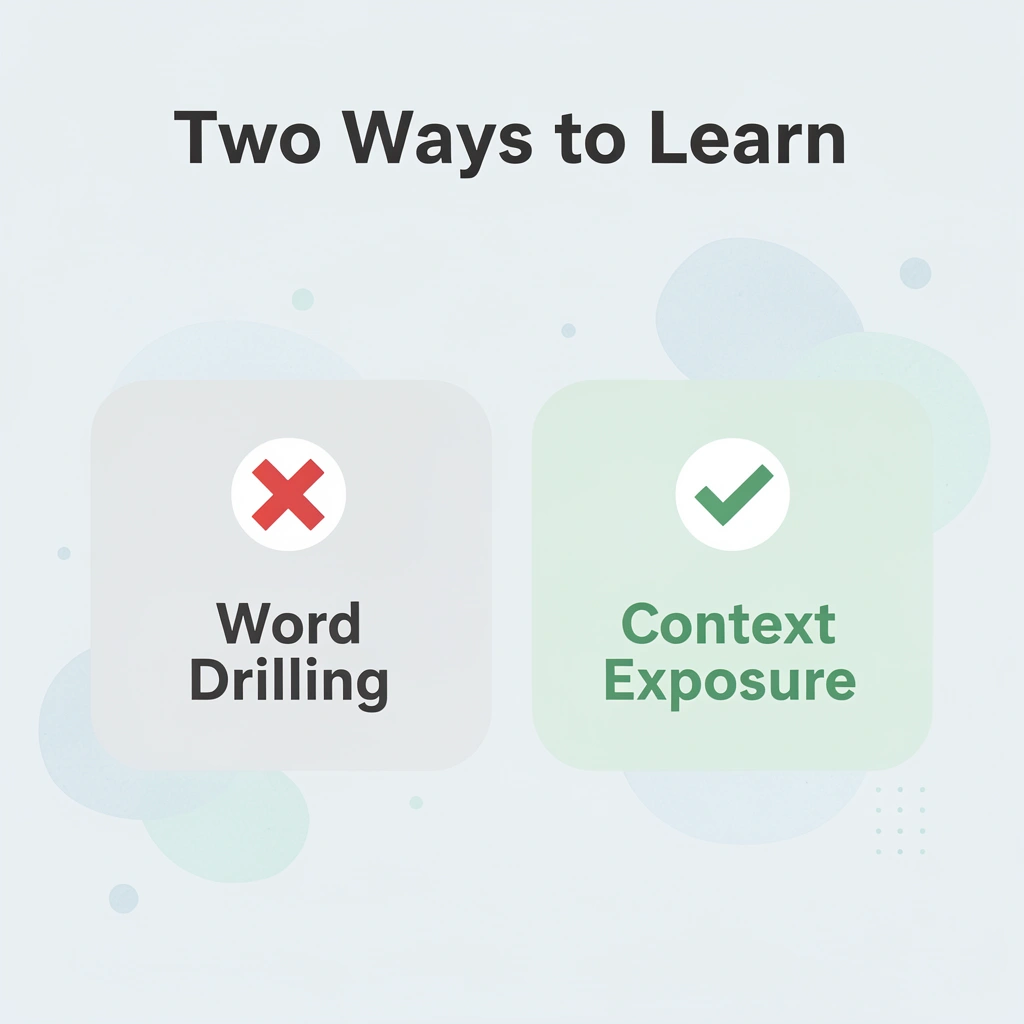
Start your free trial of Parrot today. In your first session, you'll get a personalized feed of short-form Spanish videos with clickable subtitles and instant translations, so you can start recognizing common idioms in context and building automatic recall instead of memorizing expressions one by one.
Contextual video feed
What you get: Idioms learned naturally in real situations
Clickable subtitles
What you get: Instant meaning without breaking immersion
Automatic recall
What you get: Long-term retention instead of short-term memorization
🎯 Key Point: Automatic recall — the ability to instantly recognize and use expressions — is the difference between textbook Spanish and real-world fluency.
✅ Best Practice: Use your first Parrot session to identify 3–5 idioms that appear repeatedly in your video feed. These are the expressions native speakers reach for most — and the ones worth mastering first.
Related Reading
Pimsleur Spanish Review
Babbel Spanish Review
Rosetta Stone Vs Pimsleur
Duolingo Alternatives
Spanish Writing Practice
Best Free App To Learn Spanish
Best Spanish Shows On Netflix To Learn With
Best App To Learn Spanish
Duolingo Spanish Review
Apps Like Duolingo