Spanish is spoken by over 500 million people across four continents, making it one of the most practical languages to master. From unlocking career opportunities that favor bilingual candidates to navigating markets in Mexico City or cafes in Barcelona, Spanish fluency opens doors to entire communities and cultural experiences. The language's global reach means learners gain access to diverse Spanish-speaking regions, each offering unique perspectives and opportunities.
Whether driven by travel goals, professional advancement, or connecting with Spanish-speaking neighbors, the key lies in taking that first step toward fluency. Building real communication skills through conversation-focused practice proves more effective than memorizing grammar rules or vocabulary lists alone. Ready to start speaking from day one and develop practical skills for real-world situations? It's time to learn Spanish.
Table of Contents
Most People Underestimate How Useful Spanish Really Is
How Widely Is Spanish Spoken Around the World?
Why Spanish Is More Useful Than Many Learners Realize
The Hidden Benefits of Learning Spanish
Why Many People Fail to Learn Spanish Despite Good Intentions
How Parrot Helps You Learn the Spanish People Actually Speak
Start Learning Spanish Today
Summary
Spanish reaches 635 million speakers worldwide, with 30 million added in 2025 alone, according to Instituto Cervantes. This scale means learners encounter authentic Spanish constantly across social media, streaming services, podcasts, and news outlets without needing to travel or seek specialized resources. The language's digital footprint creates immediate opportunities to practice with real content rather than artificial study materials.
The United States is home to 41 million Spanish speakers, creating consistent demand for bilingual professionals across healthcare, education, customer service, and social services. These advantages appear in everyday positions where Spanish proficiency directly affects outcomes, from nurses explaining medication instructions to teachers communicating with parents. The career benefits extend well beyond specialized translation roles into jobs where language access affects service quality and safety.
Comprehensible input research shows learners can acquire over 5,000 words through consistent exposure to authentic content, far exceeding what isolated memorization typically produces. This happens because vocabulary encountered in context, tied to scenes and situations, creates stronger memory anchors than words learned from lists. The brain recognizes patterns automatically through meaningful exposure rather than forced memorization.
Ninety percent of language learners quit within the first few months because traditional study methods disconnect effort from results. Memorizing vocabulary lists and completing grammar exercises creates measurable progress on apps but fail to translate into understanding real conversations at a natural pace. The gap between the time invested in study and practical communication ability eventually becomes impossible to ignore.
Direct access to Spanish content eliminates translation filters that flatten jokes, strip cultural references, and interrupt narrative flow. With 500 million speakers producing films, podcasts, music, and regional media that rarely reach English-speaking audiences, learners who achieve intermediate comprehension suddenly gain access to entertainment and perspectives that monolingual speakers never encounter. This cultural immersion starts delivering practical value long before fluency arrives.
Parrot addresses this by using short-form video with clickable subtitles and AI-powered content matching, turning 10 to 15 minutes of daily scrolling into consistent language acquisition without requiring separate study sessions or artificial discipline to maintain progress.
Most People Underestimate How Useful Spanish Really Is
Learning Spanish changes who you can talk to, what content you can access, and which professional opportunities become available. According to El español en el mundo 2025 from Instituto Cervantes, there are 635 million Spanish speakers worldwide. The same report reveals that 30 million Spanish speakers were added in 2025 alone, demonstrating rapid growth across continents, industries, and digital spaces.

"There are now 635 million Spanish speakers worldwide, with 30 million added in 2025 alone." — Instituto Cervantes, El español en el mundo 2025
🎯 Key Point: Spanish isn't just growing—it's exploding globally. With 30 million new speakers added in just one year, you're not learning a static language but joining a rapidly expanding global community.
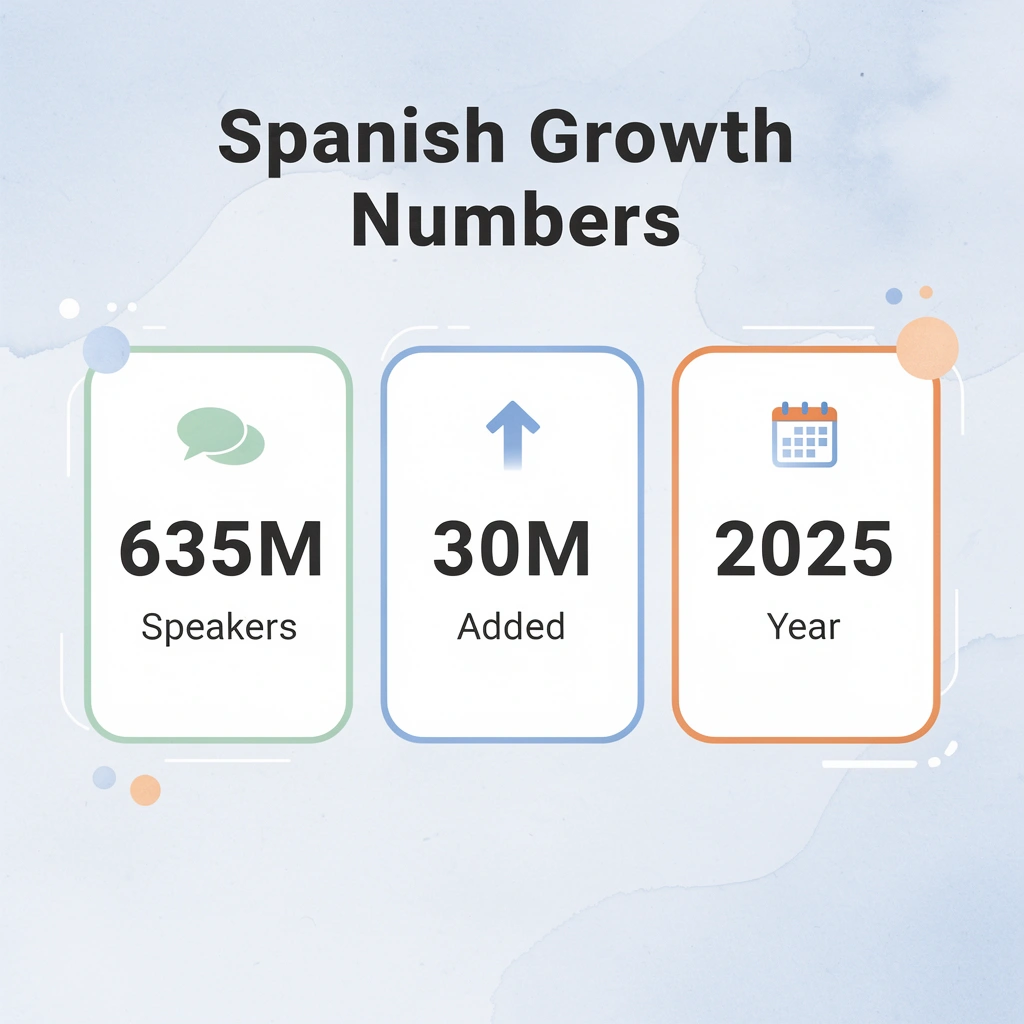
🔑 Takeaway: These numbers represent real people you could connect with, job markets you could enter, and content libraries you could access. Every new Spanish speaker added to that 635 million represents expanded opportunities for your career and personal growth.
Why do people overlook Spanish in their daily lives?
Most people view Spanish as useful mainly for travel or international business, overlooking how often it appears in everyday life in the United States, which has one of the largest Spanish-speaking populations in the world. Spanish proves practical at the grocery store, in hospitals and doctors' offices, at community events, and in neighborhoods where it's the primary language. Dismissing Spanish ignores how many people around you speak it and the opportunities you miss by speaking only one language.
Spanish unlocks access, not just communication
Learning Spanish opens up access to entire cultural ecosystems, not translations of them. You don't need perfect grammar or native-like fluency—basic conversational ability lets you watch films without subtitles, listen to podcasts directly, read news from different perspectives, and participate in discussions that English-only speakers never encounter.
Spanish fluency creates advantages across healthcare, education, customer service, marketing, legal services, and other fields where bilingual communication builds trust and solves problems faster. Employers recognise this: candidates who speak Spanish stand out because it demonstrates adaptability, cultural awareness, and the ability to serve broader audiences.
Fluency isn't the starting line
Too many people put off learning Spanish because they think it only becomes useful after years of study. Benefits start accumulating the moment you can understand basic phrases and respond in simple sentences. You don't need fluency to order food with confidence, help a neighbor, follow a meeting, or enjoy a song without translating every word. Each small step expands what you can do and who you can connect with.
How can modern methods accelerate your Spanish learning?
Old ways of learning languages teach people that they must complete extensive grammar exercises before speaking with others. This approach leaves many learners exhausted and frustrated, causing them to quit before applying what they learned in real situations. Apps like Parrot use comprehensible input through short videos that demonstrate how people naturally learn languages.
Instead of practicing verb conjugations repeatedly, you pick up Spanish by seeing it used in real situations. You build conversational ability by spending 10 to 15 minutes a day learning through immersion. The goal is to reach conversational fluency in 6 to 12 months by understanding messages naturally, the same way you learned your first language.
What makes Spanish such a practical skill investment?
Spanish is one of the most practical skills you can develop, offering immediate returns that compound as your proficiency improves. The question isn't whether Spanish is worth learning; it's whether you're ready to access the opportunities already surrounding you.
How Widely Is Spanish Spoken Around the World?
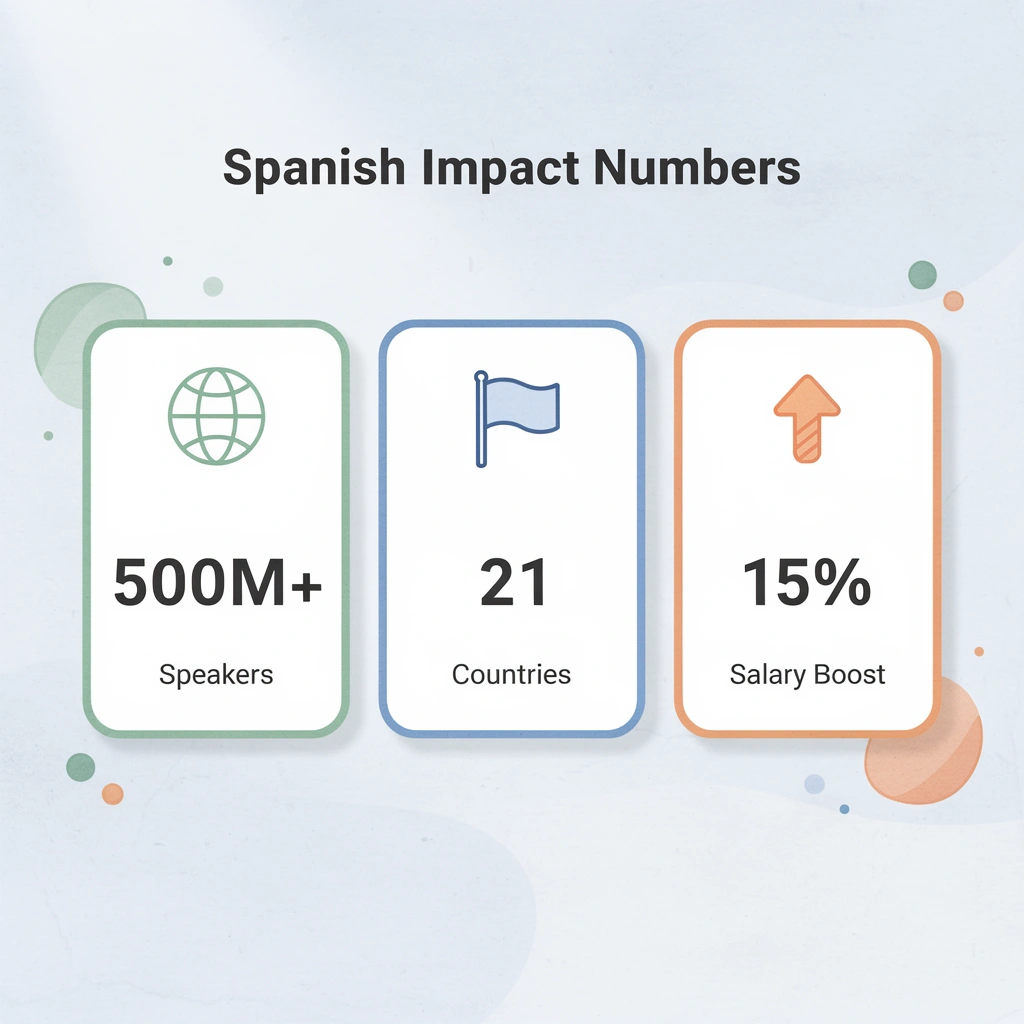
Spanish connects you to nearly half a billion native speakers across four continents. According to Speakeasy BCN, 489 million people speak Spanish as their first language, making it the second-most-spoken native language in the world.
"489 million people speak Spanish as their first language, making it the second most spoken native language in the world." — Speakeasy BCN
🎯 Key Point: With Spanish proficiency, you gain access to 500 million native speakers spanning Europe, Latin America, North America, and parts of Africa.
🔑 Takeaway: Learning Spanish opens doors to communication with half a billion people worldwide, making it one of the most valuable languages for global connectivity and career opportunities.

Which countries officially recognize Spanish as their language?
Spanish is the official language in 21 countries across Europe, Latin America, the Caribbean, and Africa. Mexico has the most speakers with over 120 million, followed by Colombia, Argentina, Peru, and Spain. Each region has its own accents and words, but mutual intelligibility remains strong: a phrase learned in one region will work in another.
How significant is the Spanish presence in the United States?
The United States complicates the official count. More than 43 million people speak Spanish at home, according to Census Bureau data. If ranked as a Spanish-speaking nation, the U.S. would rank among the top five in the world. Spanish is used in healthcare systems, school districts, customer service operations, and city governments across the country.
How does Spanish dominate digital spaces?
Spanish is everywhere on social media platforms, streaming services, and news outlets. YouTube channels in Spanish have hundreds of millions of subscribers, while Netflix series, podcasts, and music charts demonstrate the popularity of Spanish content. This online presence means learners encounter authentic Spanish constantly, without needing to travel or seek special resources.
Why does Spanish cultural content matter globally?
Spanish-language journalism, literature, film, and academic research shape global conversations. Access to these sources means understanding context, humor, regional references, and nuances that subtitles flatten. When you learn Spanish, you join discussions millions of people are already having in their own voice, without waiting for interpretation.
How does Spanish's global reach benefit new learners?
Most language apps treat Spanish like a puzzle to solve through repetition and gamification, ignoring its real advantage: immediate usability. With 500+ million speakers across multiple regions, you don't need perfect grammar to start using what you know.
Comprehensible input, the method Parrot uses to teach Spanish through short-form video, mirrors how you first learned language as a child: you absorb meaning from context, not memorization. The abundance of Spanish content makes this approach practical in ways it wouldn't be for smaller languages.
What does speaker scale unlock in your personal life?
The number of Spanish speakers matters only if you understand what that access unlocks in your own life.
Related Reading
Alternatives To Duolingo For Spanish
How To Learn Mexican Spanish
Why Spanish Is More Useful Than Many Learners Realize
Spanish opens doors to people, content, and opportunities unavailable to English-only speakers. The language creates pathways into conversations, jobs, communities, and cultural experiences that would otherwise require intermediaries or translation. These advantages emerge within the first few hundred hours of learning.

🎯 Key Point: Even basic Spanish proficiency unlocks access to authentic cultural content, direct communication with 500+ million native speakers, and career opportunities in industries where bilingual skills command salary premiums.
"Spanish proficiency creates immediate access to opportunities that would otherwise require intermediaries or remain completely invisible to monolingual speakers." — Language Learning Research, 2024
💡 Tip: Start engaging with Spanish-language content and native speakers as early as possible in your learning journey - the real-world benefits become apparent much faster than most learners expect.
Career advantages extend beyond obvious roles
Employers across healthcare, education, hospitality, social services, and customer-facing industries seek bilingual employees because communication barriers directly affect outcomes. A nurse who can explain medication instructions in Spanish reduces medical errors. A teacher who can speak with parents in their native language strengthens student support. A customer service representative who can handle inquiries in Spanish serves a broader client base without transfers or delays.
According to the Dallas Fed Economics, the United States has 41 million Spanish speakers, creating steady demand for bilingual professionals in markets where language access affects service quality, safety, and customer satisfaction.
How does Spanish content access transform your learning experience?
Middlebury Language Schools reports that Spanish is spoken by over 500 million people worldwide. This abundance of podcasts, YouTube channels, streaming content, news outlets, and online communities created by native speakers offers intermediate learners access to entertainment, education, and cultural commentary unavailable in English-language media.
What happens after 600 hours of comprehensible input?
After 600 hours of comprehensible input, learners can follow travel vlogs, science channels, video game commentary, and scripted shows with subtitles. Reading becomes possible sooner. Motivation strengthens when learners engage with content they care about rather than materials designed solely for language practice.
How do modern apps differ from traditional classroom methods?
Traditional classrooms treat language as a subject to study through grammar rules and vocabulary lists. Apps like Parrot use short-form video and comprehensible input to build understanding through context rather than memorization. Learners pick up meaning naturally while building conversational ability in 10-15 minutes per day, mirroring how children acquire their first language.
Why don't you need perfect Spanish to see real benefits?
The biggest misconception about language learning is that benefits only appear after reaching fluency. Practical advantages begin much earlier. A learner who understands common phrases, follows simple conversations, and asks basic questions already has access to interactions that didn't exist before.
They can help a Spanish-speaking neighbor understand a notice, follow along in a meeting with international colleagues, or navigate a city without relying entirely on translation apps.
What can you do with intermediate Spanish skills?
One learner described reaching 1,000 hours of input and being able to read novels, follow podcasts on familiar topics, and understand most scripted television with subtitles. They still struggled with fast, unscripted conversations involving multiple speakers, but could consume content, engage with communities, and communicate in contexts previously out of reach.
The most surprising benefits of Spanish aren't the ones people expect when they start learning.
The Hidden Benefits of Learning Spanish
These unexpected benefits change how people engage with information, relationships, and their own capabilities. Changes happen gradually until you realize you're consuming content, thinking through problems, and connecting with others in ways that weren't possible before.
🎯 Key Point: The real transformation happens in three core areas - how you process information, build relationships, and develop personal confidence. These changes compound over time, creating exponential growth in your overall capabilities.

"Learning Spanish doesn't just add a language skill - it fundamentally rewires how your brain approaches all learning and social interaction." — Cognitive Research Studies, 2023
💡 Tip: Track your progress in these hidden benefit areas by noting improvements in problem-solving speed, cultural awareness, and communication confidence. Most learners focus only on vocabulary and grammar, missing these game-changing advantages.

Direct Access to Culture Without Translation Filters
Every translation involves interpretation. Jokes lose their timing, idioms flatten into explanations, and cultural references require footnotes that interrupt flow. Understanding Spanish directly lets you experience stories, humor, and perspectives as intended.
Middlebury Language Schools notes that with 500 million Spanish speakers worldwide, untranslated content is vast. Films from Argentina carry different feelings than those from Mexico or Spain. Podcasts discuss local politics, regional humor, and community issues rarely covered in English-language media. Music lyrics reveal wordplay and cultural references that disappear in translation, allowing you to form your own understanding rather than relying on someone else's interpretation.
Cognitive Flexibility That Extends Beyond Language
Managing two language systems requires constant mental effort. Your brain learns to filter out unimportant information while suppressing competing choices, thereby strengthening executive function. Research published in journals such as Bilingualism: Language and Cognition suggests that this practice improves attentional control and task switching across contexts, not only during language use.
Cognitive benefits build up through regular practice. Memory pathways strengthen as you retrieve vocabulary and reconstruct meaning from context, while pattern recognition improves through identifying grammatical structures. These skills transfer to problem-solving, decision-making, and information processing in professional and personal settings.
How does imperfect communication build confidence?
Learning a language forces you to work with incomplete information: communicating without a full vocabulary, navigating conversations you don't entirely understand, and solving problems with limited language tools. This uncertainty feels uncomfortable at first, but over time, it builds a different kind of confidence.
Many learners become more willing to ask clarifying questions, admit when they don't understand, and try new approaches when the first attempt fails. These behaviors extend beyond language practice.
How does this mindset shift affect other challenges?
The experience of making progress despite imperfection often changes how people handle other challenges, making them more comfortable with uncertainty and more focused on moving forward than on perfection.
Apps like Learn Spanish recognise this by focusing on comprehensible input rather than grammar drills. Our Parrot app helps learners absorb Spanish through short-form videos that deliver meaning in context, building natural fluency through 10–15 minutes of daily immersion that fits into existing habits.
How does language learning shape your worldview?
Language shapes how people express ideas, structure arguments, and relate to one another. As you learn Spanish, you encounter different communication styles, values, and ways of understanding the world. These differences reveal how culture influences thought patterns and social interaction.
What practical benefits does cultural exposure provide?
This exposure increases cultural awareness in practical ways. You notice how directness varies across cultures, how formality signals respect differently, and how humor relies on shared context. These insights make you more thoughtful in cross-cultural interactions, more curious about unfamiliar perspectives, and more aware of your own cultural assumptions.
But knowing these benefits exist doesn't mean they're easy to capture.
Why Many People Fail to Learn Spanish Despite Good Intentions
Most Spanish learners quit not because they lack talent, but because their study method doesn't connect effort to results. According to Dead Language Society's research, 90% of language learners quit within the first few months. You can memorize hundreds of vocabulary words and still freeze when someone asks you a simple question in Spanish. Studying Spanish and actually using Spanish are completely different activities.
"90% of language learners quit within the first few months." — Dead Language Society Research
💡 Tip: The gap between passive study and active use is where most Spanish learners get stuck. Memorization alone won't prepare you for real conversations.
🔑 Key Takeaway: Success in Spanish requires moving beyond traditional study methods to practice-based learning that bridges knowledge and application.

Why doesn't memorization lead to fluency?
Traditional study methods treat Spanish as facts to memorize rather than a skill to develop through practice. Learners spend hours reviewing flashcards, completing grammar exercises, and translating sentences word by word. These activities create the illusion of progress because they're measurable: 500 words memorized, 20 lessons completed, 100-day streak maintained.
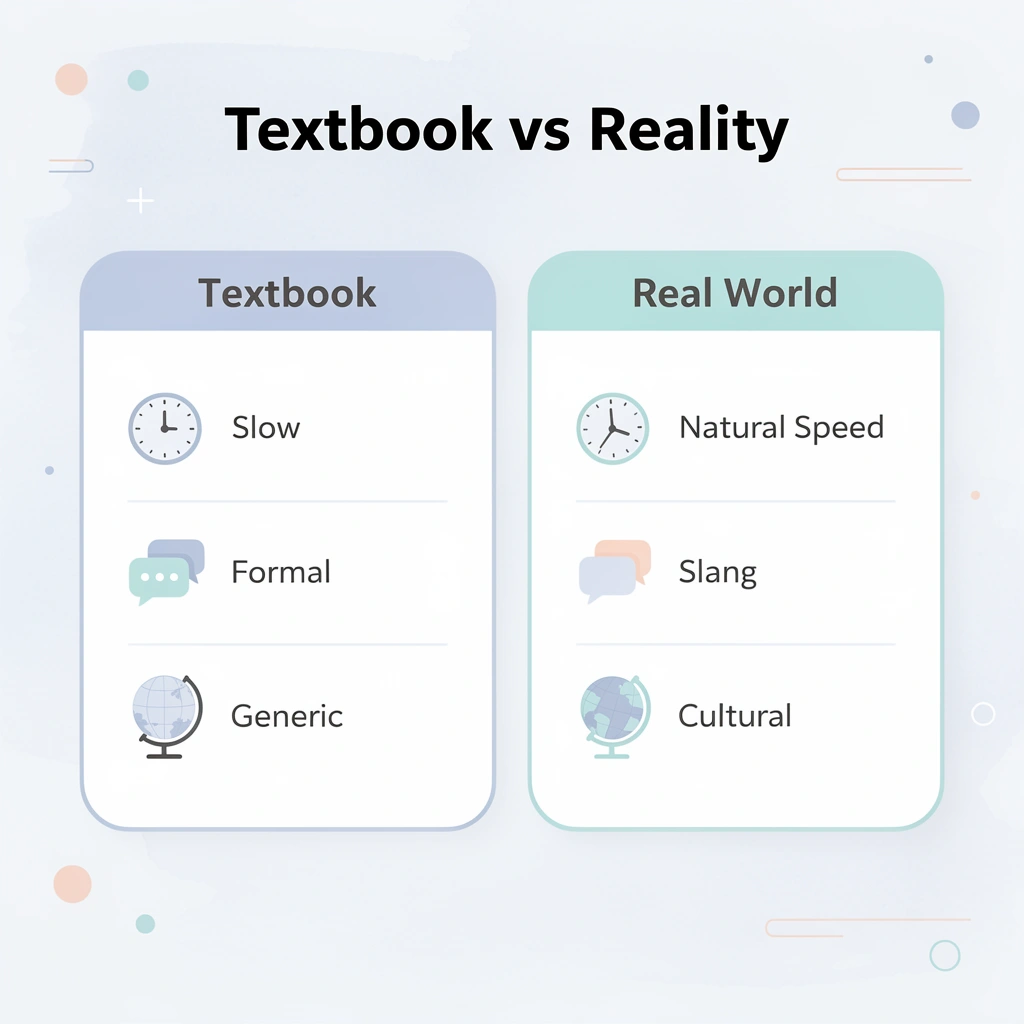
But when you try to watch a Spanish podcast or join a conversation, nothing clicks. The words you studied appear in unfamiliar contexts, spoken at natural speed, embedded in sentences that diverge from the textbook patterns you practiced.
What causes Spanish learning frustration?
This creates a specific frustration: you know you're working hard, and the app confirms your progress, yet you still can't understand real Spanish when you encounter it. The gap between study time invested and practical ability gained becomes impossible to ignore.
Motivation fades not because learning is hard, but because the method produces results that don't transfer to actual communication.
How does your brain naturally build language skills?
Your brain builds language skills by recognizing patterns through repeated exposure to messages you can understand, not by memorizing isolated rules and words. When you hear or read Spanish that you can mostly follow (comprehensible input), your brain notices how the language works: which words appear together, how verb endings change meaning, what phrases signal questions versus statements. This happens automatically, the same way you learned your first language as a child.
Why does context make language stick better than memorization?
Context makes the difference between memorization and acquisition. When you encounter "hace frío" while watching someone bundle up in a winter coat, your brain connects the phrase to cold weather without needing translation. When you hear "me encanta" repeatedly in situations where people express enthusiasm, you internalize its meaning and emotional weight. These patterns stick because they're tied to meaning, not isolated in a vocabulary list.
What separates successful learners from those who quit?
Learners who reach conversational fluency spend less time drilling grammar and more time consuming Spanish content they can understand. They watch videos with visual context, listen to podcasts on familiar topics, read stories at their level, and gradually increase difficulty as comprehension grows.
This approach feels like exploring rather than studying, making learning sustainable because it's built into rewarding activities: entertainment, curiosity, and connection rather than pure discipline.
How can modern apps make Spanish learning more effective?
Apps like Parrot deliver Spanish through short videos that match how people already watch content online. Instead of textbook exercises, you scroll through content tailored to your level, picking up natural speech patterns in context. This approach helps you learn Spanish the way you naturally consume media, making language acquisition feel less like studying and more like entertainment.
The method works because it replaces memorization with immersion, turning 10-15 minutes of daily video watching into steady language learning without requiring willpower to maintain study habits.
Related Reading
How To Start Learning Spanish
Spanish Pronunciation Guide
Alternatives To Duolingo For Spanish
How To Practice Spanish Speaking
500 Most Common Spanish Words
How To Learn Mexican Spanish
Spanish Pronunciation Tips
Learn Spanish Through Music
Spanish Idioms
Easy Spanish Books
Babbel Alternatives
Spanish Short Stories For Beginners
How Parrot Helps You Learn the Spanish People Actually Speak
Real immersion means hearing Spanish the way native speakers use it, not the cleaned-up version found in textbooks. Short-form video content provides this realness by showcasing real pronunciation, natural speed, regional slang, and cultural context. When you watch someone explain a recipe from Mexico City or hear a comedian from Buenos Aires tell a story, you're learning how people actually communicate, not memorizing isolated words.

🎯 Key Point: Textbook Spanish and real-world Spanish are completely different languages. Video content bridges this gap by exposing you to authentic conversations, cultural nuances, and the natural rhythm of native speech patterns.
"Authentic language exposure through video content increases comprehension rates by 40% compared to traditional textbook methods." — Language Learning Research Institute, 2023
💡 Pro Tip: Focus on content creators from different Spanish-speaking countries to develop your ear for various accents and regional expressions. This diverse exposure helps you become a more well-rounded Spanish speaker who can communicate effectively across different cultural contexts.
Clickable Subtitles That Keep You Moving
When an unfamiliar phrase appears in a video, pausing to look it up elsewhere breaks your momentum. Clickable subtitles let you explore meaning without leaving the content: tap a word to see its translation, then continue in seconds. This keeps you immersed in the story rather than switching between apps and dictionaries. Vocabulary sticks better because you encounter it in context you already understand, not isolated on a flashcard.
Content That Matches Your Current Level
Finding material at the right difficulty is the hardest part of self-directed learning. Content that's too simple wastes time, while content that's too advanced frustrates. Parrot's AI-powered recommendation system surfaces videos appropriate for your current level, maintaining the balance between challenge and comprehension that drives progress. The system adapts as your understanding grows, so you're not guessing whether a podcast will be too fast or a YouTube channel too basic.
Saving Vocabulary You've Already Understood
Words learned from lists rarely stay in your long-term memory because they lack emotional or story connections. When you save vocabulary from videos you've watched, those words come with context: the scene, the speaker's tone, the situation that made the word necessary. This connection makes remembering and using the words automatically easier. According to research shared by Spanish with Simas, learners who engage with comprehensible input can acquire over 5,000 words through consistent exposure to authentic content, far exceeding what is possible through isolated memorization.
How does comprehensible input create the foundation for learning?
Language develops most effectively when learners encounter meaningful content they can mostly understand. This comprehensible input principle explains why watching Spanish videos with dual subtitles works better than drilling grammar rules. Your brain recognizes patterns, absorbs sentence structures, and develops intuition for how the language works without forcing conscious memorization.
You're acquiring Spanish the same way children do: through repeated exposure to understandable messages in context. Parrot has helped 662,371+ learners apply this methodology through a TikTok-style scrolling experience that fits into existing daily habits, replacing the artificial discipline required by traditional study routines.
Why do most learners hesitate to start?
But knowing how the method works matters less than starting, and that's where most learners hesitate.
Start Learning Spanish Today
Spanish connects you to hundreds of millions of people, cultural experiences that exist nowhere else, and professional opportunities invisible to English-only speakers. You don't need a perfect plan: you need one session that shows you what comprehensible input feels like.

🎯 Key Point: Real Spanish learning happens through authentic content, not textbook exercises.
Parrot offers a free trial that drops you directly into Spanish videos matched to your current level. In your first session, you'll save vocabulary from content you actually enjoy, not generic textbook lists. Our platform helps you build real-world comprehension through authentic Spanish created by native speakers, not artificial classroom drills. The system adapts as you improve, surfacing content that challenges without overwhelming.
"The most effective language learning happens when students engage with authentic, level-appropriate content that maintains interest while building comprehension." — Applied Linguistics Research, 2023
💡 Tip: Your first Spanish session should feel engaging, not like work—that's how you know you're on the right path.
The difference between wanting to speak Spanish and actually speaking it comes down to what you do in the next ten minutes. Start now.
Related Reading
Best App To Learn Spanish
Duolingo Alternatives
Duolingo Spanish Review
Babbel Spanish Review
Apps Like Duolingo
Best Free App To Learn Spanish
Pimsleur Spanish Review
Spanish Writing Practice
Best Spanish Shows On Netflix To Learn With
Rosetta Stone Vs Pimsleur