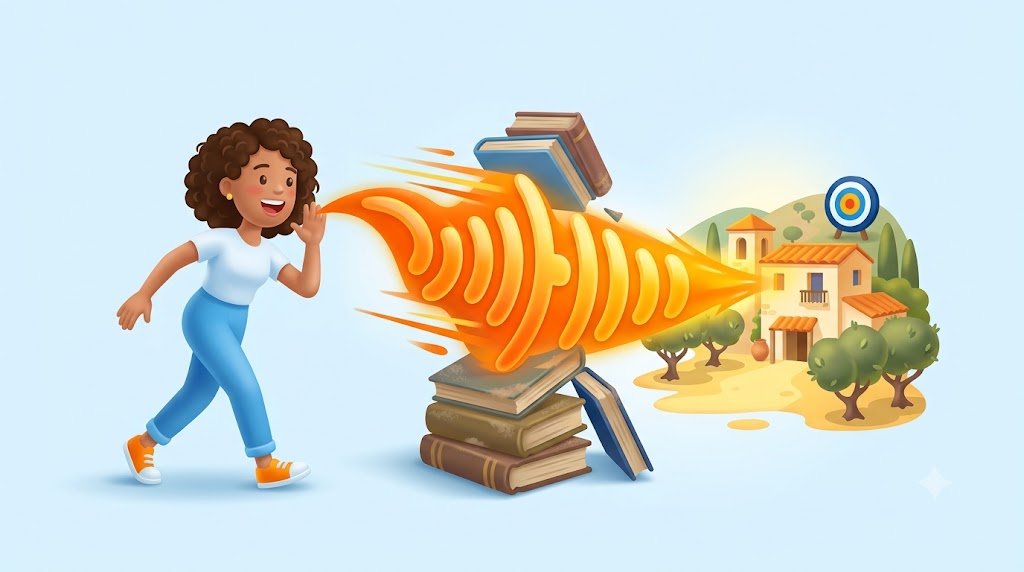
Many beginners pick up Duolingo, work through weeks of lessons, and still freeze when a real conversation starts. The gap between app progress and actual speaking ability is one of the most common frustrations in language learning, and it usually comes down to one thing: most apps reward recognition over production. Several stronger alternatives exist for anyone serious about moving from passive study to real fluency.
Platforms that prioritize speaking practice close that gap far more quickly than streak-based tools. For those exploring Spanish for beginners, Duolingo alternatives range from structured grammar courses to immersive conversation apps, each suited to different learning styles and goals. Anyone ready to build real spoken confidence can learn Spanish with Parrot, a platform built around active speaking practice rather than points and passive drills.
Table of Contents
Looking for Duolingo Alternatives? The Real Problem May Not Be the App
Why Traditional Language Learning Apps Often Hit a Plateau
What Actually Helps People Become Fluent in Spanish
What to Look for in a Duolingo Alternative
10 Best Duolingo Alternatives for Different Types of Learners
How Parrot Helps Learners Turn Entertainment Into Spanish Fluency
Start Learning Spanish Today
Summary
Learners who plateau on language apps are not failing at Spanish. They are succeeding at completing exercises, which is a different skill entirely. Research from Dr. Stephen Krashen on comprehensible input suggests that language acquisition happens through meaningful, contextual exposure, not through drilling isolated words or selecting answers from multiple-choice prompts. The gap between in-app performance and real conversation is a method problem, not a motivation problem.
Over 90% of language app users plateau before reaching conversational fluency, according to Taalhammer. The reason is structural: most apps are designed to maximize engagement through streaks, progress bars, and short feedback loops, not to build the retrieval speed and contextual processing that real conversations require. When nobody shows you the word first, and you have to surface it under pressure, no amount of recognition-based drilling prepares you for that moment.
Consistent daily practice shapes fluency more than total hours logged. Learners who practice at least 30 minutes daily reach conversational fluency significantly faster than those who study sporadically, according to leviflint.com. The advantage is not just accumulation. The brain reinforces patterns and builds automatic recognition through regular exposure, while sporadic study forces learners to rebuild familiarity each session rather than compound it.
The Foreign Service Institute estimates that English speakers need 600 to 750 hours of study to reach upper-intermediate fluency in Spanish. That commitment is only realistic when the content is engaging enough to return to consistently. Learners who describe breakthrough moments almost never credit grammar workbooks. They credit podcasts they binged, shows they watched obsessively, or conversations with people they genuinely liked. Motivation is not separate from method in language learning. It functions as the method itself.
Adults can reach conversational proficiency in Spanish within 18 to 24 months with regular practice, according to the Noun Town Blog. That timeline holds only if the content remains relevant to the learner's actual interests. Platforms that serve mismatched content quietly erode motivation until learners stop showing up entirely. The strongest alternatives allow learners to shape what they consume, because a person who genuinely wants to watch the next video will always outperform someone grinding through assigned lessons.
The 90-to-98-percent comprehension threshold represents the acquisition zone where learners understand enough to follow meaning but still encounter enough new material to grow. Content that falls too far below or above that range stops producing gains. Authentic short-form video, when paired with in-context comprehension support, keeps learners inside that zone without the friction of pausing, switching apps, and losing the thread of what they were watching.
Parrot's learn Spanish addresses this by pairing short-form Spanish video content with clickable subtitles and instant translations, keeping learners inside the language rather than constantly stepping outside it to look things up.
Looking for Duolingo Alternatives? The Real Problem May Not Be the App
The frustration is real. Most learners searching for Duolingo alternatives are not failing at Spanish—they are succeeding at completing exercises. The app works as designed. The question is whether that design was built to make you fluent.

Why do so many learners plateau even when the app says they are progressing?
A consistent pattern emerges among learners who plateau: they score well inside the app, maintain their streak, and recognize hundreds of words on screen. Then they sit across from a native speaker or press play on an unscripted video, and the language becomes noise. That gap is not a motivation problem—it is a method problem.
The distinction between learning Spanish and using Spanish is critical. Completing a multiple-choice exercise activates recognition. Holding a real conversation requires retrieval, processing speed, and contextual understanding: skills built through fundamentally different exposure. Dr. Stephen Krashen's research on comprehensible input argues that we acquire language by understanding it in meaningful contexts, not by studying it. Most app-based learning skips that step, replacing it with drills that feel productive but do not build the neural pathways fluency requires.
How does real-world input exposure change the way your brain learns Spanish?
Apps like Parrot take a different approach: instead of drilling isolated words, they show learners short videos with real Spanish speech. This provides the contextual, comprehensible input the brain needs to process language as native speakers do.
What does the gap between in-app performance and real-world comprehension actually cost you?
The emotional weight of this realization matters. Spending months building a streak, only to freeze during a basic exchange, feels personal rather than methodological. According to the Nibble Blog, there are now 20+ topic categories available in free versions of newer language platforms, reflecting how quickly the alternative app market is responding to this frustration. Learners are voting with their attention, seeking platforms that close the gap between in-app performance and real-world comprehension.
Stop measuring progress by lessons completed and start measuring it by whether you can understand something you have never seen before. That shift in benchmark changes how you choose a learning method and spend your time.
The plateau learners hit is not random; it is structural, built directly into how most apps are designed.
Related Reading
Why Traditional Language Learning Apps Often Hit a Plateau
The plateau is not a mystery. It is a design feature hiding in plain sight.
"Most language apps are built to keep you engaged, not to make you fluent: that distinction changes everything." — Language Learning Research
⚠️ Warning: If you've felt stuck at the same level for months despite daily practice, you haven't failed. The app's architecture has failed you.

Most language apps are built to keep you engaged, not to make you fluent. Engagement is measured by daily active users, streak counts, and lesson completions. Fluency is measured by whether you can follow a fast-talking native speaker who just dropped three idioms in a row. Apps optimized for the first metric will always underserve the second.
Success Signal: Apps prioritize streaks to keep you logged in; fluency requires native-level listening to understand real-world context.
User Feeling: Apps aim for easy wins to keep you clicking; fluency involves uncomfortable, challenging stretches that force brain growth.
Outcome: Apps optimize for retention/engagement metrics; fluency focuses on the ability to actually communicate in the real world.
Design Priority: Apps are built for daily active users; real fluency is built on long-term acquisition that transcends daily app habits.
🎯 Key Point: There is a fundamental conflict between app engagement metrics and genuine language fluency — and users pay the price.
💡 Tip: Supplement any app with unscripted listening practice — podcasts, films, and real conversations — to break through the engagement-fluency gap.
Why do most learners stop progressing before conversational fluency?
According to Taalhammer, over 90% of language app users stop making progress before they can speak Spanish well. Beginner content feels easy with short exercises, quick feedback, and satisfying progress bars. As learners advance, their needs change, but the app's format does not. Exercises remain static, sentences stay simple, and the gap between what the app teaches and real Spanish widens.
The problem usually happens the same way: apps teach recognition, not retrieval. You see a word, identify it, and get a green checkmark. In real conversation, your brain must pull it out under pressure while simultaneously processing tone, speed, and context. Multiple-choice practice cannot build that skill. Learners who use apps like Duolingo as their primary tool often find that real Spanish feels like a completely different language from what they studied.
What happens when learners push harder without changing their method?
Most learners push through the plateau by doing more of the same: another unit, another streak, another review session. But effort applied to the wrong method yields no progress. Apps built around short-form video immersion, like Parrot, take a different approach by exposing learners to authentic Spanish content in the format they already scroll through daily, closing the gap between structured practice and real-world comprehension.
Why are beginner apps structurally unable to take you all the way?
What makes this a real problem is that the apps were never designed to take you all the way—they were designed to get you started. The beginner stage rewards memorization because the vocabulary load is manageable and the grammar is simple. Past that point, complexity compounds fast: verb conjugations multiply, sentence structures bend, and regional accents diverge. Apps built for beginners do not account for how dramatically different the learning needs become at intermediate and advanced stages.
What moves people past this point turns out to be less about studying harder and more about changing what you practice entirely.
What Actually Helps People Become Fluent in Spanish
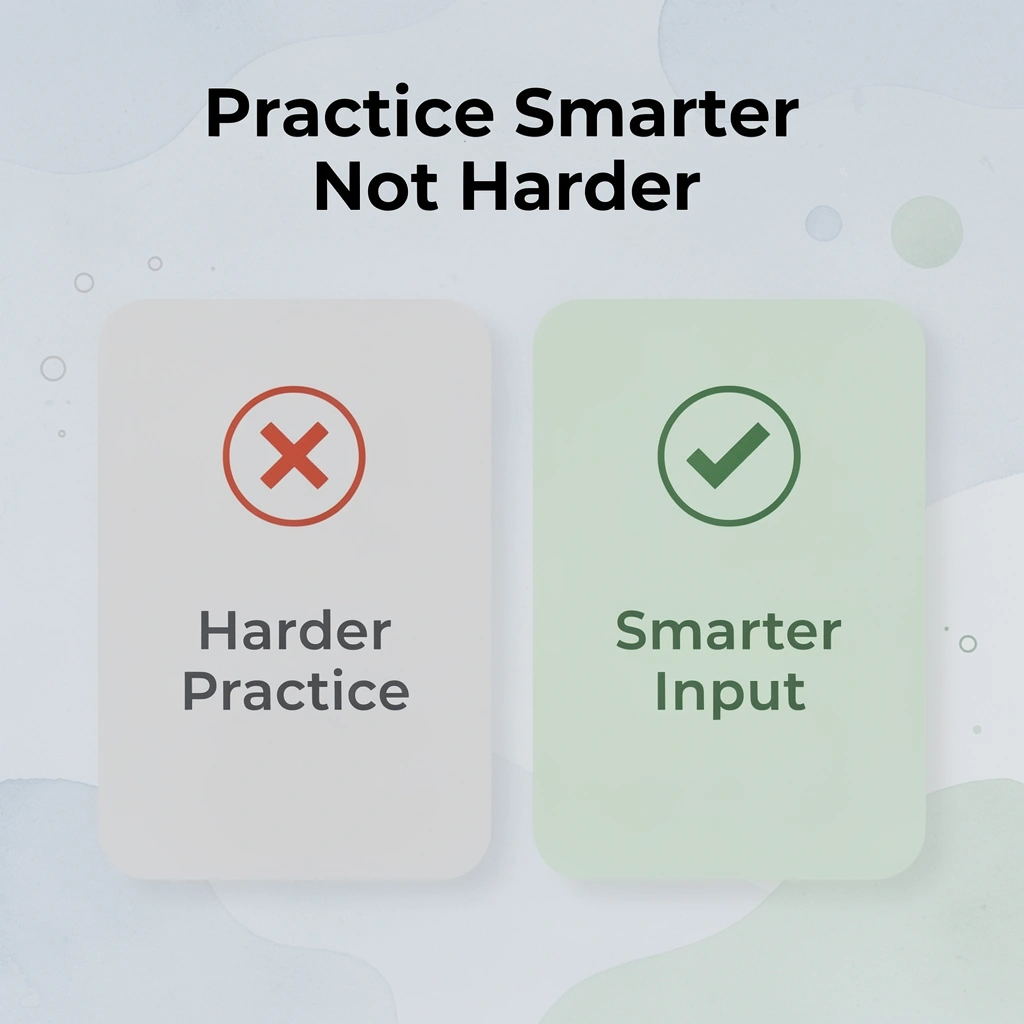
Changing what you practice matters more than practicing harder. Fluency develops through comprehensible input, consistent exposure to real Spanish, and engaging content you'll return to daily.
"Fluency is built through comprehensible input and consistent daily exposure — not through sheer effort alone." — Language Acquisition Research
🎯 Key Point: It's not about studying harder — it's about what you practice and how often you return to it.
💡 Tip: Prioritize engaging, real-world Spanish content you genuinely enjoy — because daily return is the true driver of fluency.
To achieve true language fluency, you must shift from passive memorization to active, meaningful engagement. Here is the breakdown of why certain approaches succeed while others stall:
Comprehensible Input:
Impact: Builds natural understanding by focusing on meaning rather than rote rules.
The Sweet Spot: Best results occur when 90–98% of the input is already familiar, allowing you to infer new vocabulary and grammar from context without frustration.
Consistent Daily Exposure:
Impact: Strengthens neural pathways and moves knowledge into long-term memory.
Routine Advantage: Shorter, frequent sessions are scientifically more effective than occasional, high-intensity "cramming" for building sustainable habits.
Engaging Content:
Impact: Drives habit formation by making the process a part of your life you actually look forward to.
Retention: When content is personally meaningful, you are more likely to return, resulting in the "massive and repeated exposure" required for actual acquisition.
"Grinding" (Harder without Strategy):
Impact: Leads to minimal fluency gains and high burnout.
The Trap: Relying on isolated word drills or gamified apps creates an "illusion of progress" where you may feel busy, but remain unable to respond or participate in real conversations.
Why exposure beats memorization
The critical difference is not how many words you study but how many times you encounter them in context. When you hear a word in a story, conversation, or short video clip, your brain connects it to meaning, tone, and situation rather than to a definition alone. Learners who break through their plateau consistently point to one shift: they stopped studying Spanish and started immersing themselves in it.
How does daily practice change the pace of progress?
Consistency shapes progress more than most people expect. According to leviflint.com, learners who practice at least 30 minutes daily reach conversational fluency faster than those who study sporadically. This gap reflects how regularly your brain recognizes patterns, strengthens connections, and builds the automatic recognition real conversation requires. Daily exposure to compounds and sporadic study force you to rebuild what you learned each session.
Why do structured drills stop working as your level grows?
The familiar approach of opening an app, completing exercises, and moving on feels productive initially. But as complexity grows, short drill formats stop delivering new understanding. Content becomes too controlled and too far removed from how native speakers actually talk. Apps like Parrot address this by using short-form video content in real Spanish, giving learners the contextual, native-speed exposure that structured exercises cannot replicate.
What is the comprehension threshold that keeps you learning?
The 90 to 98 percent comprehension threshold keeps you in the learning zone: understanding enough to follow meaning while encountering new material to grow. Too easy and nothing sticks. Too difficult, and your brain decodes rather than absorbs. A gripping short video in Spanish often teaches more than a grammar chart because it hits that sweet spot of comfortable challenge.
Why does engagement drive fluency more than study hours alone?
Engagement is not a bonus feature of good language learning—it is the mechanism. The Foreign Service Institute estimates that reaching upper-intermediate fluency in Spanish requires 600 to 750 hours of study for English speakers. The only realistic path is through content you genuinely want to return to. Learners credit their breakthroughs to podcast series they completed, shows they rewatched, or conversations with people they liked—not grammar workbooks. Motivation is the method.
Knowing that comprehensible input works and finding the right version for your current level are two different problems.
What to Look for in a Duolingo Alternative
Finding the right alternative requires asking: does this platform help you actually understand real Spanish, or just complete lessons? Mixing up the two is how learners spend months on an app and still freeze when a native speaker talks to them.
"The difference between completing lessons and truly learning a language is the difference between recognizing words on a screen and understanding them in the wild." — Language Learning Research
💡 Tip: Before committing to any platform, ask yourself one critical question — does it expose you to authentic, real-world language, or does it only reward you for tapping the right answer?
⚠️ Warning: Many learners fall into the completion trap — racking up streaks and XP while making zero real-world progress. Don't confuse app engagement with language acquisition.
To ensure you aren't just "playing" a game but actually acquiring language, prioritize platforms that emphasize communication over completion:
Real conversation practice: Look for interactive dialogue; avoid apps that rely solely on mindless multiple-choice tapping.
Native speaker audio: Ensure you are training your ear on authentic speech; steer clear of robotic, synthetic voices that misrepresent natural intonation.
Contextual vocabulary: Seek apps that teach words within phrases; avoid isolated word drilling that lacks meaningful usage.
Comprehension-based learning: Focus on content that builds actual understanding; avoid platforms where "pure gamification" replaces educational depth.
Measurable speaking progress: Prioritize tools that track your actual output; be wary of apps that treat daily "streaks" as your only indicator of success.

Authentic content over student-facing exercises
Most language platforms build their entire content library for learners, not for Spanish speakers, keeping you in a controlled environment that doesn't resemble actual conversation. Authentic content—short videos, podcasts, and stories made for native audiences—exposes you to real vocabulary, rhythms, regional expressions, and cultural meaning behind words that textbooks cannot convey. When you engage with content never designed to teach you, your brain does the real work.
Why does comprehension support matter for staying immersed?
Real content only works if you can follow it. Without quick translations, subtitle support, or word definitions in the text, a beginner watching a fast-spoken Mexican vlog will quit within two minutes, not because they lack ability but because the gap between their level and the content is too large. The best options close that gap without breaking your focus. A learner who stays focused for twenty minutes learns more than one who switches between five apps, deciphering a single sentence.
How do the best platforms keep learners inside the language?
Most learners pause content, open a dictionary, type out phrases, and hope context survives the interruption. This cycle breaks momentum and, over time, breaks motivation. Platforms like Parrot eliminate that friction by offering short-form Spanish video content with comprehension support layered directly into the viewing experience, keeping learners immersed in the language rather than constantly stepping outside it.
Why does personalization determine how long you actually stick with it?
According to the Noun Town Blog, adults can reach conversational proficiency in a Category 1 language like Spanish within 18 to 24 months with regular practice. This timeline requires using the platform daily without dread. Content unrelated to your actual life is one of the most common reasons learners stop progressing early on. If the platform offers travel content when you care about food culture, or business vocabulary when you want to watch comedy, your motivation weakens until it disappears.
How do the strongest alternatives turn your interests into a retention loop?
The best alternatives let your interests shape what you consume. A learner who wants to watch the next video will always do better than one grinding through assigned lessons. Vocabulary tools that let you save words directly from content you already care about create a retention loop that feels natural rather than forced. That combination of the content you chose, the words you saved, and the in-context review separates a platform built for fluency from one built for engagement metrics.
Related Reading
10 Best Duolingo Alternatives for Different Types of Learners
Ten platforms with different ways of teaching — and the right one depends on how your brain learns language.
"The best language learning app is the one that matches how you think, not just what you want to learn." — Language Learning Research
💡 Tip: Don't default to the most popular app — default to the most compatible one. The wrong platform can kill motivation faster than a difficult grammar rule.
🎯 Key Point: Each of the 10 platforms below targets a specific type of learner — from visual learners to conversation-first students to those who need structured grammar instruction.
Choosing the right language learning platform depends on your unique cognitive style and specific goals:
Structured Grammar Apps: Ideal for analytical learners who prefer a systematic, rule-based approach to language progression.
Conversation Platforms: Best for social learners who prioritize live, real-time speaking practice with native speakers.
Immersion Tools: Suited for visual and contextual learners who want to bridge the gap between classroom theory and real-world usage.
Flashcard Systems: Perfect for memory-focused learners leveraging the science of spaced repetition to lock in vocabulary.
AI-Powered Apps: Designed for self-paced learners who need adaptive, personalized paths that evolve based on their individual progress.

1. Parrot
Best for learners who want to become fluent by learning from content they enjoy.
Most learners start with structured drills, but around month three, they find them boring, and the gap between app performance and real conversation persists. Parrot uses short-form Spanish videos with clickable subtitles and instant translations, letting learners build understanding through content they would watch anyway. Vocabulary saved from real speech comes with context attached, unlike organized word lists.
2. Babbel
Best for learners who want a structured curriculum
Babbel offers lessons in 14 languages with a clear learning path. According to the Nibble Blog, its Spanish course emphasizes practical conversation over abstract grammar rules, making sentence building logical and satisfying for learners who want to understand before speaking.
3. Memrise
Best for rapid vocabulary building
Memrise pairs spaced repetition with short video clips of native speakers using words in natural settings. Hearing words spoken by real people in real sentences outperforms flashcard memorization alone. It's a strong supplementary tool, though learners who use it tend to reach a limit when conversation requires more than word recall.
4. italki
Best for developing speaking confidence
Most self-study plans fail without real-time feedback. italki connects learners with tutors for one-on-one sessions tailored to specific goals: pronunciation, business Spanish, and casual conversation. Quality varies by tutor, so review ratings before booking.
5. HelloTalk
Best for authentic exchange with native speakers
HelloTalk connects learners with native Spanish speakers for live language exchange through text, voice notes, and calls. Native speakers correct your messages as you write, and learning about culture through real conversations offers far more depth than app exercises alone.
6. Dreaming Spanish
Best for understanding Spanish through video
Dreaming Spanish organizes hundreds of videos by difficulty level, from complete beginner to near-native. The approach is based on learning principles that make immersion work: understanding meaningful content repeatedly, without translation. Learners who commit to consistent listening report noticeable gains in comprehension within weeks.
7. Baselang
Best for intensive speaking practice
Baselang's flat-rate subscription model provides unlimited tutoring sessions, making speaking practice affordable at scale. Most apps offer passive exposure; Baselang demands production, where fluency is built. It suits learners seeking accountability and accelerated conversational ability.
Learners plateau fastest when spending most time in recognition mode: reading and selecting rather than producing language under pressure. Apps that push you to speak, respond, and construct sentences from memory move the needle on real-world ability.
8. Busuu
Best for structured learning with native speaker feedback
Busuu combines lesson-based progression with native speaker reviews of your written and spoken exercises. This feedback surfaces errors that automated systems miss, particularly idiomatic mistakes that sound unnatural despite being technically correct. The structure suits learners who want guided progress with real-world input.
9. LingQ
Best for independent learners who love reading and listening
LingQ lets you import any Spanish content—articles, podcasts, transcripts—and turn it into interactive lessons. Unknown words are highlighted, saved, and tracked over time. The platform suits self-directed learners who want to build vocabulary around content they choose rather than algorithmic selections.
10. Pimsleur
Best for audio-first learners
Pimsleur is built entirely around listening and speaking, with no reading required. Lessons use spaced recall: you hear a phrase, respond out loud, and encounter it again at planned intervals. For commuters, drivers, or anyone with busy hands and eyes, Pimsleur transforms dead time into productive practice.
Can any single platform get you to a real conversation?
None of these platforms work alone if your goal is to have a real conversation with a native speaker. According to the Noun Town Blog, adults reach conversational proficiency in 18 to 24 months for Category 1 languages like Spanish, assuming steady, meaningful exposure rather than occasional drilling. The fastest learners combine real content with live speaking practice.
What determines whether most learners actually succeed?
Choosing the right platform is only half the equation. Knowing when to start and how to build momentum from day one determines whether most learners succeed.
How Parrot Helps Learners Turn Entertainment Into Spanish Fluency
Many learners quit Spanish not because they lack motivation, but because the learning process feels disconnected from their everyday lives. Completing exercises, memorizing vocabulary lists, and working through repetitive lessons become difficult to sustain, especially when progress toward real-world understanding feels slow.
Parrot approaches language learning by transforming content people already enjoy into opportunities for language acquisition. Rather than requiring additional study time, the platform helps learners understand Spanish through engaging short-form videos.
What is the comprehensible input method behind Parrot?
At the center of Parrot's approach is comprehensible input, a research-backed language learning method that emphasizes understanding meaningful content rather than memorizing isolated vocabulary and grammar rules. By consuming comprehensible and engaging Spanish, learners naturally develop comprehension skills, vocabulary, and familiarity with sentence patterns.
To make authentic Spanish content more accessible, Parrot includes clickable subtitles that allow learners to instantly understand unfamiliar words and phrases without pausing or opening a separate translation app. Instant translations support comprehension while preserving the viewing experience and keeping learners immersed in Spanish.
Learners can save vocabulary directly from videos for later review, creating a personalized collection based on content they consume rather than on generic word lists.
How does Parrot keep learners consistently exposed to Spanish?
Parrot's AI-powered recommendation feed adapts to individual interests and viewing habits, surfacing Spanish-language content on travel, food, sports, relationships, business, and entertainment to keep learners engaged and encourage sustained language exposure.
This entertainment-driven model solves a critical challenge in language learning: consistency. Watching genuinely interesting content feels far less demanding than completing lessons or vocabulary drills. When learning becomes enjoyable, daily engagement follows naturally.
Why does sustained exposure matter for reaching Spanish fluency?
This consistency supports many different goals: preparing for travel, communicating with family or partners, pursuing career opportunities, or achieving personal growth through bilingualism. Regardless of your goal, fluency requires steady exposure to comprehensible Spanish.
Parrot transforms everyday entertainment into a language-learning experience, making exposure easier, more enjoyable, and longer-lasting. Learners can have fun while mastering Spanish simultaneously.
Start Learning Spanish Today
The method you choose matters more than how long you've been studying. If you've spent months completing lessons but still struggle to understand real Spanish content, the gap isn't your effort: it's what you've been practicing with.
"The gap isn't your effort: it's what you've been practicing with." — A critical insight for every Spanish learner
💡 Tip: Before adding study hours, ask yourself whether your current method exposes you to real, natural Spanish or just textbook patterns.
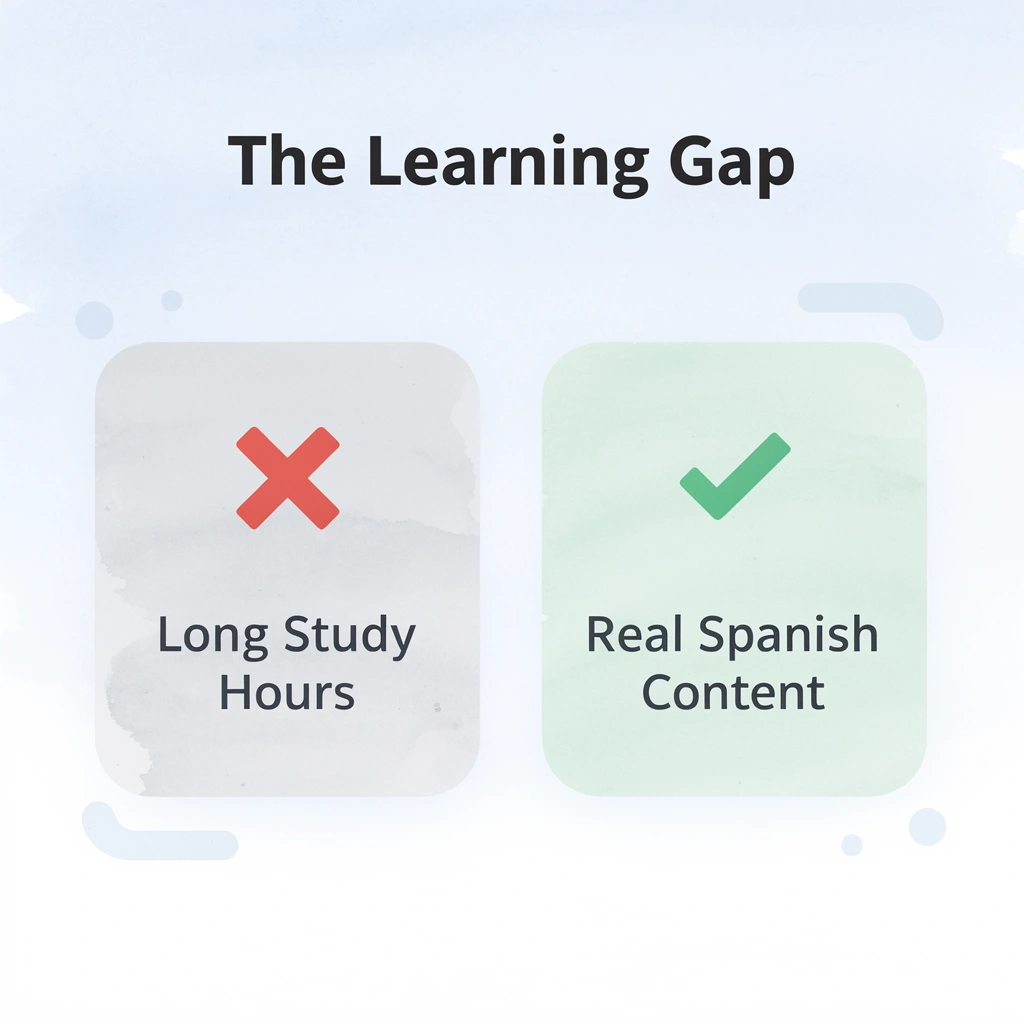
Learn Spanish with Parrot by watching short-form Spanish videos tailored to your interests, clicking unfamiliar words for instant translations, and building a personalized vocabulary list from content you actually enjoy. It turns passive scrolling into real language exposure that builds conversational ability.
Using short-form content to learn Spanish creates a high-impact, immersive loop that bridges the gap between textbook study and real-world fluency:
Short-form Spanish videos: Expose you to natural speech patterns, regional slang, and cultural nuances in manageable, bite-sized segments.
Instant word translations: Remove the friction of "unknown vocabulary" by allowing you to clarify meaning in real-time without disrupting the flow of the video.
Personalized vocabulary list: Enables you to build a custom bank of words from content you actually enjoy, which significantly increases long-term retention compared to generic word lists.
🎯 Key Point: Parrot transforms content you already want to watch into a powerful language learning engine — no extra study time required.
✅ Best Practice: Start with topics you're genuinely interested in. Engagement drives retention, and learning Spanish through content you love accelerates conversational fluency faster than traditional methods.
Related Reading
Babbel Spanish Review
Pimsleur Spanish Review
Duolingo Spanish Review
Rosetta Stone Vs Pimsleur
Spanish Idioms