Pimsleur Spanish has built a strong reputation among beginners drawn to its audio-first, listen-and-repeat method. For anyone exploring Spanish as a beginner, it promises real conversational progress without textbooks or grammar drills. Understanding exactly how it works, what it costs, and where it falls short helps learners decide whether it fits their goals.
Comparing Pimsleur against other tools on the market reveals meaningful differences in flexibility, vocabulary retention, and lesson structure. Some programs pair spaced repetition with audio instruction to accelerate progress in ways Pimsleur does not. Learners weighing their options can learn Spanish with Parrot, a platform built around practical conversation skills and study habits that adapt to real life.
Table of Contents
Pimsleur Spanish Promises Conversational Fluency. Does It Deliver?
What Pimsleur Spanish Does Well
Where Pimsleur Spanish Falls Short
Why Many Learners Eventually Look for Pimsleur Alternatives
Best Pimsleur Spanish Alternatives in 2026
How Parrot Helps You Move Beyond Language Lessons
Start Learning Spanish Today
Summary
Pimsleur Spanish is built around a speaking-first model that separates it from most beginner language tools. Rather than training recognition through tapping and matching, the program requires verbal responses from lesson one, using spaced repetition and active recall across 30-minute sessions. That structure produces measurable early results, with learners typically reaching an A1 or A2 level within 3 to 5 months of consistent practice.
The vocabulary ceiling is the most significant structural limitation of the program. Completing all five Pimsleur levels leaves learners with roughly 1,500 words, while conversational fluency generally requires between 3,000 and 5,000. That gap means even committed learners who finish every lesson are still working with less than half the vocabulary needed to handle unpredictable, real-world conversations.
Pimsleur's audio-only format offers a genuine advantage for pronunciation development. Because learners hear words before seeing them written, they avoid the common trap of applying English phonics to Spanish sounds. This early phonetic grounding is one reason Pimsleur users often sound more natural in basic exchanges than learners who spent comparable time with text-heavy methods.
The 30-minute daily lesson format creates a consistency problem that most reviews understate. Modern learners rarely have predictable, uninterrupted blocks of time, and missing even a few sessions creates psychological friction that stalls momentum. When the format demands a specific kind of focused attention that daily life rarely provides, the program loses effectiveness faster than more flexible approaches do.
Learners who complete Pimsleur and still feel stuck typically discover that the issue is not effort but exposure volume. Structured audio builds reliable recall for the words it covers, but it cannot replicate the pattern recognition that comes from hearing thousands of words in dozens of different real contexts. The shift toward authentic, unscripted Spanish content is where most learners achieve the comprehension gains that scripted repetition cannot produce. According to research cited on multiple language-learning platforms, 15 minutes of daily practice with spaced repetition is an effective session length for busy adults.
Free alternatives like Language Transfer and library-accessible tools like Mango Languages lower the barrier to starting, while platforms like LingQ and FluentU serve learners who have outgrown structured progression and need dense, varied input from real speakers to continue advancing.
Learn Spanish through Parrot addresses the exposure gap that structured audio programs leave behind by using short-form, authentic video content from native speakers, so learners build the kind of listening comprehension that transfers to real conversations.
Pimsleur Spanish Promises Conversational Fluency. Does It Deliver?
Pimsleur Spanish helps you build real spoken confidence faster than most beginners expect. But confidence and fluency are not the same thing, and the gap between them matters more than the program's marketing suggests.
"Confidence and fluency are not the same thing — and the gap between them matters more than the program's marketing suggests."
🎯 Key Point: Pimsleur Spanish is effective at building spoken confidence, but learners should understand the critical difference between feeling fluent and being fluent before committing to the program.
⚠️ Warning: Don't confuse early conversational wins with true fluency. Pimsleur's strongest promise is confidence-building, not complete language mastery.

How does Pimsleur build spoken confidence from day one?
The method works by making you speak from day one. Most learners spend months reading vocabulary lists without speaking. According to Lingtuitive's guide on getting the best results from Pimsleur, the program has 5 levels with 30 lessons each, totaling 150 lessons, each built around active verbal response. Learners who finish the first level can produce basic sentences in real time, surpassing many app users who have spent six months tapping screens.
Where does the scripted format start to break down?
The failure point is the ceiling. Pimsleur's lessons are scripted conversations with predictable patterns, but real Spanish does not follow a script. Native speakers drop syllables, blend words, shift register depending on context, and respond in ways no audio lesson can anticipate. When a learner trained entirely on structured prompts encounters a fast-talking street vendor in Mexico City or a regional accent from Medellín, the gap between what they practiced and what they hear becomes enormous.
Most learners handle this by doing more Pimsleur, staying in a controlled environment long after outgrowing it. Parrot's approach to learning Spanish addresses this friction by using short-form native speaker video content grounded in comprehensible input theory: the kind of real-world exposure that structured audio cannot replicate, delivered in 10 to 15 minutes a day rather than a fixed 30-minute block.
What level of Spanish can you realistically reach with Pimsleur?
A HiNative user review from 2021 suggests that Pimsleur can bring learners to an upper A1 or A2 level within 3 to 5 months. A2 is elementary: you can order food, introduce yourself, and ask for directions, but cannot follow a conversation between two friends, understand a Spanish-language film without subtitles, or negotiate with nuance. For travelers needing survival phrases, that outcome is valuable. For learners seeking conversational depth, it is a starting point, not a finish line.
Does the 30-minute daily format work for modern learners?
Thirty-minute daily lessons were designed for a world with less divided attention and more predictable routines. For the modern learner juggling work, family, and competing demands, a rigid daily commitment can be a source of pressure. Miss a few days and the streak breaks; the app gets abandoned. That is a format problem, not a personal failure.
Pimsleur delivers on part of its promise more reliably than most people credit. However, whether it delivers full conversational fluency is worth considering before you commit.
What Pimsleur Spanish Does Well
Pimsleur trains your mouth and ears before your brain overthinks — and for beginners, that order matters.
"Pimsleur trains your mouth and ears before your brain overthinks, and for beginners, that order matters."
🎯 Key Point: Pimsleur's audio-first approach prioritizes spoken fluency and listening comprehension before diving into grammar rules — making it uniquely effective for absolute beginners.
💡 Tip: If you're just starting out, lean into Pimsleur's method of speaking out loud during every lesson. The muscle memory you build early becomes your strongest foundation for real-world conversation.

The speaking-first design is genuinely different
Most language apps rely on recognition: matching words to translations, selecting answers, tapping tiles. Recognition and production are fundamentally different skills. Pimsleur forces production from lesson one. You hear a phrase, respond aloud, and get corrected through repetition rather than a red screen. According to Pimsleur's own learning methodology, each 30-minute lesson uses spaced repetition and active recall, which align with how memory consolidation works. Learners build verbal muscle memory rather than passive word recognition, a difference that shows up fast in early conversations.
Why does Pimsleur build pronunciation confidence so early?
Pimsleur's audio-only format prevents a common problem for learners who start with writing: reading Spanish using English sounds. When you learn a word by seeing it before hearing it, your brain locks in a pronunciation that can take months to correct. Learners absorb rhythm, stress patterns, and connected speech from native speakers before encountering the written word. This early sound-based learning is why Pimsleur users often sound more natural in basic conversations than learners who have spent an equivalent amount of time with text-heavy methods.
How does the no-screen format affect daily practice?
Pimsleur fits the pattern of fitting practice into gaps—between meetings, during commutes, on walks—because it requires no screen. The hidden cost emerges when 30-minute structured sessions prove harder to maintain daily than expected, and missing a few days slows momentum. Apps like Parrot address this differently by using short-form, native-speaker video content built around comprehensible input, so learners absorb real Spanish in 10 to 15 minutes without guilt over a broken streak.
How does Pimsleur's cumulative structure build vocabulary?
The program's design is built step by step. According to Pimsleur, each level teaches about 500 main vocabulary words, introduced gradually so new words always connect to something you've already practiced. For beginners, this limit is helpful: you learn a smaller set thoroughly, building the ability to remember and use words quickly in real conversations rather than in practice exercises.
Why does the structured format help beginners stay consistent?
The structure removes the decision burden that undermines consistency in self-directed learners. There is no syllabus to build, no YouTube rabbit hole to fall into, no debate about what to study. The lesson tells you what comes next, keeping beginners moving forward when motivation dips. Pimsleur works particularly well in the first 30 to 60 days, when the biggest risk is abandoning any method entirely.
But the same design choices that make Pimsleur effective initially create friction later, a tension worth understanding before you commit.
Related Reading
Where Pimsleur Spanish Falls Short
Pimsleur can help you learn a meaningful amount, but the friction starts when you realize how specific that amount actually is.
⚠️ Warning: The gap between what Pimsleur delivers and what fluency requires is far larger than most learners expect going in.
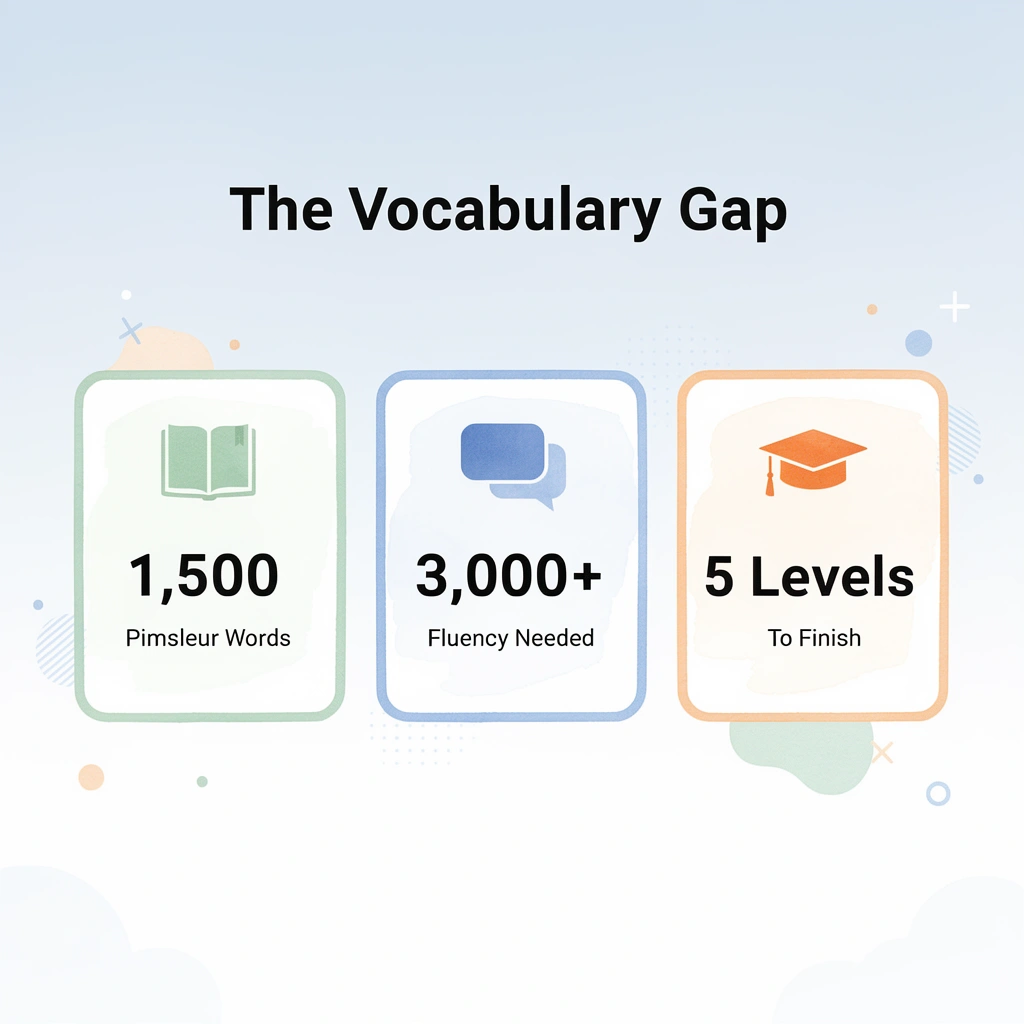
According to Lingtuitive's 2026 analysis of Pimsleur Spanish, finishing all five levels leaves learners with roughly 1,500 words. Being able to have conversations fluently requires 3,000 to 5,000 words — meaning you'll finish Pimsleur with less than half the vocabulary needed for comfortable, unpredictable conversations with native speakers.
"Finishing all five levels of Pimsleur leaves learners with roughly 1,500 words — less than half the 3,000 to 5,000 words needed for comfortable, fluent conversation." — Lingtuitive, 2026
🔑 Takeaway: Pimsleur is a solid starting point, but completing the entire program still leaves you well short of the vocabulary threshold required for real-world fluency with native speakers.
What the vocabulary ceiling actually costs you
The problem is what a thin vocabulary does to your confidence in real situations. When a native speaker uses an unfamiliar word, the conversation stops. You cannot figure out the meaning from context the way fluent speakers do, because your mental library lacks the depth to make those connections quickly. Pimsleur builds reliable recall for the words it teaches, but it cannot build the instinctive pattern recognition that comes from hearing thousands of words in dozens of different contexts.
Why does staying inside the program stop your progress?
Most learners handle this gap by staying in the program longer, hoping repetition will produce fluency. What happens instead is they improve at Pimsleur lessons without improving at Spanish. The structured audio environment becomes a comfort zone, and comfort zones in language learning halt progress. Apps like Parrot address this differently by exposing learners to short-form native-speaker video content, in which comprehensible input theory drives learning through real-world context rather than scripted repetition. Our platform trains the brain to process Spanish as it actually sounds, not as a curriculum designer arranged it, with ten to fifteen minutes of daily exposure.
The format works against modern learning habits
Lingtuitive's review notes that Pimsleur Spanish reaches A2 to B1 proficiency across all five levels, falling short of the B2 threshold, where Spanish feels natural and automatic. The 30-minute lesson format requires focused, uninterrupted attention, which is suitable for commutes but rarely fits busy schedules. When life interrupts a lesson, the momentum Pimsleur depends on collapses.
Why does the program lose effectiveness when conditions aren't consistent?
Pimsleur was designed for a learning environment many people no longer have. It assumes a predictable block of time, a quiet space, and the patience to return to the same structural rhythm for 150 lessons. When those conditions aren't consistently met, the program loses effectiveness faster than more flexible formats do. This design constraint matters more than most Pimsleur reviews acknowledge.
For learners who finish every level and still feel stuck, the question that follows is often the most uncomfortable one.
Why Many Learners Eventually Look for Pimsleur Alternatives
Finishing every Pimsleur level is a significant achievement, but completing a course and understanding Spanish as it exists in the real world are two different things. Most learners discover this gap only when they try to cross it.
"Completing a course and truly understanding a language as it exists in the real world are two very different things—and most learners only discover this gap when they try to cross it."
💡 Tip: If you've finished every Pimsleur level and still feel lost in real conversations, you're not alone. This is one of the most common reasons learners search for alternatives.
⚠️ Warning: Don't mistake course completion for language fluency. Finishing a structured program is a milestone, not a finish line. The real test is how well you perform outside the lesson.

What vocabulary ceiling do Pimsleur learners hit?
The core problem is a vocabulary ceiling that structured audio lessons cannot break through. According to Lingtuitive's 2026 guide to using Pimsleur, Pimsleur covers only 500 to 600 words per level, far below the 2,000 to 3,000 words needed for conversational fluency. Learners who complete multiple levels still lack sufficient vocabulary for real conversations, where topics shift unexpectedly, and words appear without context clues.
Why does real Spanish feel so different after Pimsleur?
The failure point is usually exposure volume, not effort. Pimsleur delivers carefully controlled input: vocabulary is selected, pace is managed, and responses are predictable. Real Spanish does none of those things. Native speakers drop syllables, blend words, and draw on regional expressions that no scripted lesson anticipates. When learners move from structured audio to actual conversation or a Spanish podcast, the mismatch feels sharp and discouraging—not because they learned wrong, but because they lacked sufficient unscripted exposure to build real comprehension.
What actually builds comprehension when structured practice falls short?
Most learners respond by adding more structured practice: another app, another set of exercises. More controlled input does not build the skill that uncontrolled input requires. Apps like Parrot approach this differently, using short-form native video content grounded in comprehensible input theory to expose learners to authentic Spanish in 10- to 15-minute sessions that fit naturally into daily life, rather than the rigid, scheduled commitment that Pimsleur demands.
Why does the format itself become the obstacle?
The Lingtuitive report notes that Pimsleur offers courses in over 50 languages, though most have only one or two levels available, limiting progression. Even for Spanish, the structured format eventually hinders deeper learning. Language acquisition requires massive, varied exposure to meaningful messages in context. A 30-minute audio drill repeated across 150 lessons builds discipline but cannot match the input from watching real people speak, argue, laugh, and explain things in Spanish.
When does structure stop serving the learner?
The shift many learners make is recognizing that structure was always a starting point, not the destination. Learners who reach genuine fluency stop treating Spanish as a subject to complete and start treating it as a language to absorb through real conversations, native videos, and authentic moments.
Once you understand why that shift matters, the question of which tools actually support it becomes far more interesting.
Best Pimsleur Spanish Alternatives in 2026
The tools that support real learning meet learners where their attention already is, not where a curriculum designer wishes it were. Choosing the right Pimsleur alternative comes down to a single question: what kind of input does your brain process as language, versus what it processes as an exercise? That distinction separates platforms that build lasting understanding from ones that keep you occupied without moving you forward.
💡 Tip: Before committing to any Spanish learning platform, ask yourself whether you're experiencing genuine comprehension or pattern-matching to pass drills. The difference determines your long-term fluency.
"The best language tool isn't the most structured one — it's the one that delivers real language input in a format your brain stops treating as study and starts treating as communication." — Language Acquisition Research
🎯 Key Point: The right alternative to Pimsleur isn't about finding a shinier app. It's about matching your learning style, daily schedule, and the type of cognitive engagement that moves you toward fluency.

Which alternatives offer the most structure and grammar support?
Babbel and Rocket Spanish are the best Pimsleur replacements for learners who want organized progression with visual and grammatical support. Babbel integrates grammar explanations into practical conversations rather than treating them as afterthoughts. Rocket Spanish combines audio practice with cultural context and detailed pronunciation feedback, serving as a full course rather than a daily-habit app. Both suit learners who feel more confident when they understand the rules behind what they're saying.
How does real native speaker feedback change the learning experience?
Busuu adds real feedback from native speakers on written and spoken responses, a social layer that matters significantly. Knowing a real person will read your sentence changes how carefully you construct it, speeding up the deliberate practice that builds accuracy.
What tools are built around authentic exposure to real Spanish?
Learners who reach fluency consistently use unscripted Spanish rather than relying on structured repetition. LingQ and FluentU both operate on this principle. LingQ lets you import any content—podcasts, articles, YouTube transcripts—and tracks vocabulary in context. FluentU uses real Spanish media (commercials, interviews, music videos) to build interactive lessons. While Duolingo has over 500 million registered users, learners who reach conversational fluency typically move toward content that sounds like real people talking.
How does short-form authentic video help you handle native speech?
Most learners hit a wall when they encounter native speech outside lessons: vocabulary differs, pace quickens, and speakers don't wait. Learn Spanish through Parrot addresses this using short-form authentic video from native speakers, with clickable subtitles and instant translations. This builds pattern recognition that transfers to real conversations. According to the Noun Town Blog, 15 minutes of daily practice works well for busy adults, and Parrot fits this window without rigid schedules or streak-based pressure.
Free and Structure-Light Options
Language Transfer is free, audio-based, and built around understanding why Spanish works rather than memorizing sounds. Many learners use it as a foundation before moving to content-heavy platforms. Mango Languages, available through most public library systems at no cost, focuses on practical phrases with cultural context. Neither replaces immersive exposure, but both ease the path to getting started.
The right alternative keeps you inside Spanish long enough for learning to happen naturally.
Once you know which tool fits your life, the next question is the one most people skip entirely.
Related Reading
How Parrot Helps You Move Beyond Language Lessons
Many Spanish learners reach a frustrating stage where they've finished lessons and memorized vocabulary, yet struggle to understand Spanish videos, podcasts, or native conversations. This gap exists because traditional language courses build foundations, while fluency develops through meaningful, authentic interaction.
"Language courses build the foundation: real fluency only develops through meaningful, authentic interaction with native content."
💡 Tip: If you can pass your Spanish course but still can't follow a native conversation, you haven't hit a wall—you've simply outgrown your lessons. This is exactly the stage where your approach needs to change.
Parrot takes a different approach. Instead of teaching Spanish through lessons and drills, our platform helps learners acquire Spanish through real content from native speakers, exposing them to natural vocabulary, conversational patterns, accents, and expressions that are difficult to replicate in traditional courses.
🎯 Key Point: Parrot doesn't replace your foundation — it transforms it into actual fluency by bridging the gap between classroom Spanish and the real thing.
What features does Parrot offer to support real-world learning?
AI-powered content recommendations help learners discover videos tailored to their interests and level, eliminating time spent searching for suitable material. Clickable subtitles let you instantly look up unfamiliar words without pausing the video, and you can save vocabulary words directly from the content for later study.
Parrot's personalized learning feed updates recommendations based on learners' interests—travel, interviews, food, entertainment, sports, or lifestyle content—so they build skills while watching topics they care about.
Why does learning through authentic content work so well?
This approach is grounded in comprehensible input, which emphasizes learning through understandable content that introduces new language. Rather than memorizing rules first, learners acquire vocabulary, sentence structures, and patterns through repeated exposure to meaningful communication.
This is particularly valuable for listening comprehension, where many learners struggle after traditional courses. Authentic content exposes them to the speed, rhythm, and variety of real Spanish, helping them understand native speakers in everyday situations.
By combining authentic videos, AI-powered recommendations, clickable subtitles, instant translations, vocabulary-saving tools, and personalized discovery, Parrot helps learners bridge the gap between studying Spanish and understanding it.
Start Learning Spanish Today
You have already done the real work: you found the method that fits your life. The only step left is starting before the moment passes.
"The best time to start learning a language is now—every day you wait is a day of potential fluency lost." — Language Learning Research
💡 Tip: Don't overthink your starting point. Momentum builds mastery. Even 10 minutes today puts you ahead of where you were yesterday.

If you learn best through content that feels alive rather than scripted, learn spanish with Parrot gives you a free trial with personalized Spanish video recommendations and the ability to save vocabulary from real conversations. Ten to fifteen minutes of that exposure builds listening comprehension faster than a month of audio drills, because your brain processes language the way it was designed to learn it.
🎯 Key Point: Real conversational content triggers the brain's natural language acquisition pathways — making Parrot's approach significantly more effective than traditional methods.
✅ Best Practice: Start your free trial with Parrot today and commit to just 10–15 minutes per day of real Spanish video content — your listening comprehension will improve faster than you expect.
Related Reading
Babbel Spanish Review
Pimsleur Spanish Review
Duolingo Spanish Review
Rosetta Stone Vs Pimsleur
Spanish Idioms