
Textbook Spanish and real spoken Spanish are two very different things. Native speakers rely on slang, informal expressions, and colloquial shortcuts that most courses never cover, leaving learners confused mid-conversation. Knowing these words closes that gap and makes everyday interactions feel far less intimidating.
Spanish slang varies by country and context, but many expressions appear consistently across regions and social settings. Understanding them helps beginners follow natural speech, respond with confidence, and sound less like a phrasebook. Anyone ready to move beyond the basics and start speaking like a real person can learn Spanish with Parrot, an app built around the informal, everyday language that people actually use.
Table of Contents
Why You Can Understand Spanish Lessons But Not Native Speakers
What Makes Spanish Slang So Difficult to Learn?
30 Spanish Slang Words You'll Hear in Real Conversations
The Biggest Mistakes Learners Make With Spanish Slang
The Fastest Way to Remember Spanish Slang
How Parrot Helps You Learn Spanish Slang Naturally
Start Learning Spanish Today
Summary
Textbook Spanish and real spoken Spanish are genuinely different registers, and the gap between them is where most learners get stuck. Formal instruction filters out slang, filler words, and informal expressions precisely because they are harder to teach in a structured format. The result is learners who can pass written exams but freeze the moment two native speakers start talking naturally to each other.
Regional variation makes Spanish slang especially difficult to master because the same concept can produce completely different expressions depending on where a speaker grew up. "Cool" alone has at least four common translations across the Spanish-speaking world, including guay in Spain, padre in Mexico, chévere across parts of Latin America, and bacán in Chile, Peru, and Colombia. A learner who masters one version may still feel lost when the conversation shifts to a different region.
Learning vocabulary in context can improve retention by up to 10 times compared to rote memorization, according to the Speechling Blog. That gap exists because context gives the brain an anchor. A word heard inside a real conversation carries emotional weight, speaker tone, and social stakes, while a word on a flashcard carries none of those things, so the brain treats it as low priority.
The deepest trap in Spanish slang is not the unfamiliar word but the familiar one used in an unexpected way. A student who knows "padre" as "father" will pause when someone says "la fiesta estuvo padre," because the sentence makes no literal sense. That pause, repeated across dozens of expressions, is what makes real conversations feel exhausting even when a learner's grammar is solid.
Overusing a newly learned slang term is one of the most common mistakes learners make, and native speakers notice it immediately. Real speakers distribute slang across conversations purposefully and sparingly, the way a good writer uses punctuation. A learner who drops a word like "güey" into every third sentence signals that they recently learned it but have not yet absorbed the social rhythm that governs when it actually belongs.
Spanish is spoken by over 500 million native speakers worldwide, according to the Instituto Cervantes, which means slang is not a footnote to the language but a central part of how people communicate in the moments that matter most. The expressions that stick fastest are the ones encountered in motion, within a sentence, in response to a reaction, and spoken by a real person in a real moment, because that is how language acquisition actually works.
Parrot's Learn Spanish app addresses this by delivering short-form video content built around authentic native speech, in which informal expressions and regional slang appear in real conversational contexts rather than as isolated items to memorize.
Why You Can Understand Spanish Lessons But Not Native Speakers
Textbook Spanish and real Spanish are two completely different languages. One is designed for clarity and instruction: clean, deliberate, and perfectly paced. The other is shaped by culture, speed, region, and how people speak in the real world.

A learner can pass a written exam and hold a slow conversation with a teacher, then completely freeze when two friends from Mexico City start talking. The problem isn't vocabulary or grammar — it runs deeper than that. Formal Spanish instruction systematically filters out the elements that make native speech natural: slang, clipped phrases, and colloquial expressions that no dictionary entry fully captures.
"Formal Spanish instruction filters out the elements that make native speech natural — slang, clipped phrases, and colloquial expressions that no dictionary entry fully captures."
🎯 Key Point: The gap between classroom Spanish and native Spanish isn't a vocabulary problem — it's a cultural and acoustic exposure problem.
⚠️ Warning: Passing written exams and acing slow-paced teacher conversations create false confidence. Real fluency is tested when native speakers talk to each other, not to you.
Why textbook dialogue sounds nothing like a real conversation
Structured lessons teach you Spanish the way a script teaches you acting. Native speakers use informal vocabulary, regional slang, and everyday phrases that vary by location—for example, Bogotá, Madrid, or Buenos Aires. A phrase like "no manches" or "tío, qué fuerte" carries emotional weight and social context that grammar exercises cannot replicate. When you encounter unfamiliar expressions, the sentence collapses even if you recognise every surrounding word.
Why does drilling grammar rules fail to build real fluency?
Most learners respond by studying harder within the same system: reviewing conjugations, adding flashcard decks, working through grammar modules. Research in applied linguistics, including decades of work building on Dr. Stephen Krashen's comprehensible input theory, shows that language acquisition happens through meaningful exposure to real messages, not through repeated drilling of isolated rules. The learner who hears "está de pelos" in a funny short video clip will absorb its meaning faster and retain it longer than someone who memorizes it from a vocabulary list.
What do gamified apps get wrong about learning conversational Spanish?
Gamified apps feel productive because progress is visible and immediate, but the hidden cost is that content stays controlled and sanitized. Learners rack up points while remaining insulated from informal register, street slang, and casual speech patterns that define actual fluency. Apps like Parrot use short-form video content built around comprehensible input so learners absorb colloquial Spanish, regional expressions, and conversational vocabulary as native speakers use them: in context, with meaning attached.
What your brain actually needs to bridge the gap
The failure point is usually exposure depth, not exposure volume. A learner can spend two years with Spanish content and never encounter the informal register if every resource targets learners rather than native audiences. Real fluency requires contact with authentic speech: the slang, filler words, and culturally specific phrases that demonstrate understanding not just of the language but of the people speaking it. That familiarity comes from repeated listening until patterns feel predictable.
Closing the gap between learning Spanish and speaking Spanish like a native speaker is harder than most learners expect.
What Makes Spanish Slang So Difficult to Learn?
Spanish slang is hard to learn because you cannot figure it out by looking at each word by itself. The meaning comes from the situation, the culture, and how the speaker and listener know each other — not from what you find in a dictionary.
"The meaning of slang comes from the situation, the culture, and the relationship between speaker and listener — elements no dictionary can fully capture." — Core Insight
🎯 Key Point: Spanish slang is context-dependent — the same phrase can mean completely different things depending on the region, relationship, and setting.
💡 Tip: When learning Spanish slang, always study it within a real-world context — a conversation, a scene, or a cultural moment — rather than as an isolated vocabulary word.
Situation & Setting
Why It's Difficult
Meaning shifts based on where and when it's used
Cultural Background
Why It's Difficult
References insider knowledge non-natives may lack
Speaker Relationship
Why It's Difficult
Same word can be friendly or offensive depending on closeness
Regional Variation
Why It's Difficult
One term can mean opposite things across countries

Why regional variation creates a moving target
The same idea manifests across regions. "Cool" has at least four common translations: guay in Spain, padre in Mexico, chévere across parts of Latin America, and bacán in Chile, Peru, and Colombia. A learner who masters one version may still feel lost when the conversation shifts to a different region, simply because slang is inherently local.
Regional gaps erode confidence. Many learners report understanding every word in a sentence yet missing the point entirely, a sign that words were learned in isolation, stripped of the social context that gives them meaning.
The problem with treating slang as vocabulary
Most learners approach unfamiliar slang as they would a verb conjugation: look it up, memorize the definition, move on. Dictionaries describe what a word means in the abstract, not how it feels in real exchange. A dictionary might tell you that padre means "cool" in Mexican slang, but it won't tell you whether it sounds natural from a non-native speaker or how the tone shifts depending on context.
Why do repetition apps fall short for learning slang?
This is where apps built around repetition and gamified point systems fall short. Completing a vocabulary streak doesn't expose you to the rhythm of real speech. Our Learn Spanish platform uses short-form video content built around authentic native-speaker input to offer what flashcards cannot: the same expression heard in multiple real contexts, so your brain builds intuition rather than recognition. Native speakers learn slang by absorbing it until it feels predictable, not by studying it.
When familiar words stop meaning what you think
The biggest trap in Spanish slang is not learning an unfamiliar word. It's when a familiar word takes on an unexpected meaning. A student who knows padre as "father" will hesitate when someone says "la fiesta estuvo padre," since the sentence lacks literal sense. That pause, repeated across dozens of expressions, is what makes real conversations feel tiring even when your grammar is solid.
What actually closes the gap between study and real conversation?
The solution is authentic speech exposure, where expressions appear naturally and repeatedly until meaning clicks without translation. The learners who close the gap fastest listen more rather than study harder.
Once you start listening, the next question becomes obvious: which expressions matter in real conversations?
Related Reading
30 Spanish Slang Words You'll Hear in Real Conversations
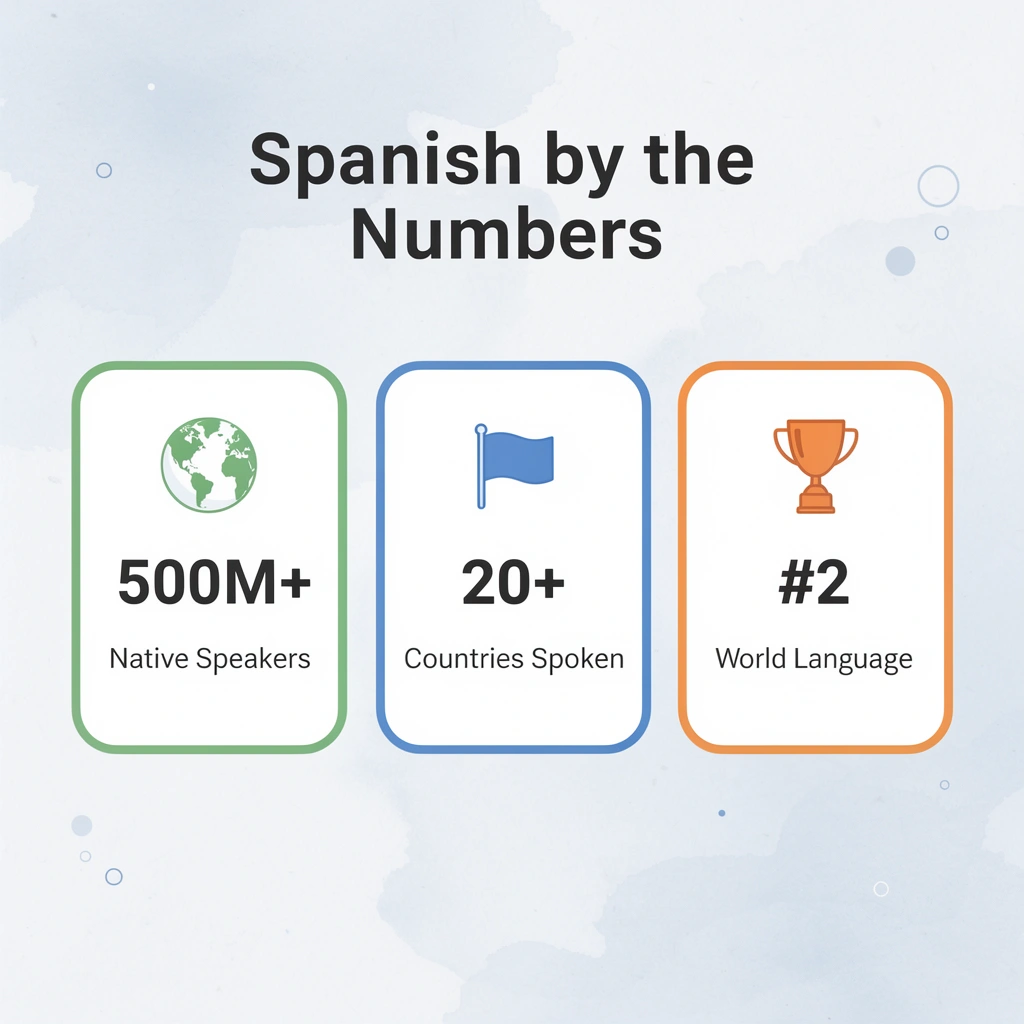
According to the Instituto Cervantes, Spanish is spoken by over 500 million native speakers around the world. Slang isn't just a small detail in the language — it's how people actually talk in the moments that matter most.
"Spanish is spoken by over 500 million native speakers around the world." — Instituto Cervantes
🔑 Takeaway: With 500 million+ native speakers globally, Spanish slang isn't optional — it's the real language hiding beneath the textbook. If you want to truly connect, mastering everyday slang is essential.
💡 Tip: Don't just study formal Spanish — the most natural, authentic conversations happen in slang-heavy exchanges that no classroom will fully prepare you for.
Native Speakers Worldwide
Stat
500 million+
Countries Where Spanish is Official
Stat
20+
Role of Slang in Daily Speech
Stat
Critical
Common Slang for "Cool," "Great," or "Awesome"
1. Guay
(Spain) means "cool" or "great". "La película estuvo guay." Use it as English speakers use "nice" for casual approval.
2. Chévere
Is used in Venezuela, Colombia, and Peru to mean awesome. "Tu nuevo coche está chévere." It conveys warmth alongside approval.
3. Bacán
Is used in Chile, Peru, and Colombia to describe something excellent or impressive. "La fiesta estuvo bacán."
4. Padre
Is Mexico's version of cool. "Ese restaurante está padre." The literal translation is "father," which tells you nothing; context tells you everything.
5. Mola
Is Spain's way of expressing that something clicks with you? "Me mola esa canción." It's personal and immediate.
Everyday Conversation Fillers
The most common slang learners miss first are not colorful expressions, but the small agreement words that hold conversations together.
6. Vale
Is Spain's all-purpose "okay." "Vale, nos vemos mañana." Use it in any agreement, and you'll sound less like a textbook.
7. Dale
Does the same job across Argentina, Uruguay, and much of Latin America. "Dale, vamos al cine." It signals momentum in a single syllable.
8. Órale
In Mexico, it carries surprise, encouragement, and agreement depending entirely on tone. "¡Órale! No lo sabía." The same word does three jobs, which is why listening matters more than memorizing.
Most learners treat these filler words as single vocabulary items with one English meaning. The problem is that a word like "órale" changes meaning with every change in pitch and context. The only way to understand that range is to hear it used repeatedly in real speech.
9. Ojo
Means watch out or pay attention. "Ojo con ese correo electrónico." It's a one-word warning that native speakers use constantly.
10. Anda
Shows surprise in Spain. "¡Anda! Qué interesante." Short and punchy, though difficult to pronounce authentically without repeated exposure.
Words for Friends and People
Ethnologue identifies Spanish as the second-most-spoken language by native speakers, so the words people use to address friends vary significantly by region.
11. tío and tía
In Spain, " in " means "dude" or "guy" for any person, regardless of family relation. "Ese tío es muy simpático." The usage stops feeling strange after hearing it on Spanish TV or in a film.
12. Güey
Is Mexico's most recognizable term of address between friends. "¿Qué pasa, güey?" It's informal and friendly, used constantly among native speakers. Without it, you'll miss how Mexican people actually communicate with each other.
13. Pana
In Venezuela and the Caribbean, " pana " means a close friend: "He is my pana."
14. Parce
serves the same purpose in Colombia: "How are you doing, parce?"
15. Compa and carnal
are both Mexican terms for a close friend or partner. Carnal carries more weight, closer to "brother" than "buddy."
Reactions and Opinions
16. Neta
In Mexico, it means "seriously?" or "for real?" It's a truth check: "¿Neta hiciste eso?" prompts someone to confirm they mean what they said.
17. No manches
Is Mexico's clean version of a stronger expression? "¡No manches! Qué increíble" expresses genuine disbelief or amazement and is heard everywhere.
17. Qué onda
Is how Mexicans say "what's up." It works as a greeting, check-in, and conversation starter.
18. Flipar and Alucinar
Both describe being blown away by something in Spain. "Vas a flipar cuando lo veas." "Aluciné con el concierto." These vivid, physical words capture reactions that transcend simple surprise.
Work, School, and Daily Life
Spanish speakers in different countries have developed distinct informal vocabularies for the same everyday experiences at work, at school, and in daily life.
Which everyday slang words differ most between Spanish-speaking countries?
19. Chamba
Means "work" or "job" in Mexico and Peru ("I have a lot of work today"),
20. Curro
Means the same in Spain ("I'm going to work early").
21. Jato
Means "home" in Peru ("Let's go to my home"),
22. Lana
Means "money" in Mexico ("I don't have money right now"), and
22. Pasta
Serves that purpose in Spain ("I need more money"). These words appear in casual speech but disappear in formal instruction.
Where do learners actually encounter these everyday slang terms in context?
Short-form video content built around real conversations from native speakers is where these terms live. Apps like Parrot provide understandable input through real speech in 10 to 15 minutes daily, so expressions like "chamba" and "lana" make sense in context rather than in isolation.
Personality and Lifestyle Terms
23. Fresa
In Mexico, it describes someone as preppy or snobbish ("Dicen que es muy fresa"),
24. Pijo
Covers similar ground in Spain ("Parece muy pijo"). Both carry a slight edge as social observations rather than outright insults.
25. Chido
Is Mexico's word for cool, alongside "padre" and "chévere" ("Qué chido está eso").
26. Majo
In Spain, it means pleasant or likable ("Es una persona maja").
These words describe people you like, and their warmth is evident in context.
Common Expressions You'll Hear Online and in Everyday Speech
27. Crudo
In Mexico and Latin America, it means hungover. "Estoy crudo después de la fiesta." The word literally means "raw," which accurately captures the feeling.
28. Estar en la luna
Means to be daydreaming or checked out. "Siempre está en la luna." The direct translation makes it one of the easier expressions to understand.
29. Buen rollo
In Spain, it means good vibes or a positive atmosphere, as in "Hay muy buen rollo aquí."
30. Estar rayado
Describes someone who is stressed, obsessed, or overthinking something: "Está muy rayado por el examen."
A Quick Note About Regional Variation
None of these 30 expressions need to be memorized. The goal is recognition first. When you hear "buen rollo" in a Spanish podcast or "dale" in an Argentine series, your brain needs a foothold, not a flashcard.
Expressions stick fastest when encountered in motion: inside a sentence, attached to a reaction, spoken by a real person in a real moment. This is how learning works.
But knowing these words is only half the picture. The harder question is what learners do wrong when they start using them.
The Biggest Mistakes Learners Make With Spanish Slang
Slang mistakes happen when you use the wrong way of thinking about a type of language that doesn't follow normal vocabulary rules. The biggest error learners make is treating slang like standard vocabulary — memorizing a direct translation and assuming it will work in every context. In reality, Spanish slang is deeply tied to regional identity, social setting, and tone, meaning a phrase that sounds cool in Mexico City could be completely meaningless — or even offensive — in Madrid or Buenos Aires.
"Slang is not just vocabulary — it's cultural currency, and using it incorrectly signals a deeper misunderstanding of the language's social rules." — Linguistics in Practice
⚠️ Warning: Never assume a slang term is universally understood across all Spanish-speaking countries. Regional variation is one of the most common traps for intermediate learners.
💡 Tip: Before using any slang word, always ask yourself three key questions — Where does this term come from? Who uses it? In what setting is it appropriate? This simple habit can save you from major social blunders.
Direct Translation of Slang
Why It Happens
Treating slang like standard vocab
Better Approach
Learn the cultural context, not just the meaning
Using Regional Slang Everywhere
Why It Happens
Assuming Spanish is uniform
Better Approach
Research the country-specific usage first
Overusing Slang in Formal Settings
Why It Happens
Misjudging social tone
Better Approach
Match slang use to the right environment
Ignoring Tone and Intent
Why It Happens
Focusing only on the literal meaning
Better Approach
Study slang in real conversations and media
🎯 Key Point: The real problem isn't learning slang — it's learning slang without context. Mastering Spanish slang means understanding the culture, region, and relationship dynamics behind every expression.

When the source region doesn't match your target
The most confusing mistake is treating Spanish slang as a single system. A learner who picks up Mexican Spanish through telenovelas will encounter expressions that sound strange to someone from Buenos Aires or Madrid. Using padre to mean "cool" in Spain marks you as someone who learned from a specific source without understanding regional differences. The fix is to stay consistent with your input source and let regional vocabulary develop naturally.
Why does overusing a new phrase backfire?
When learners find a new informal expression, they want to use it constantly. Real speakers use slang the way a good writer uses punctuation: purposefully and sparingly. A learner who uses güey in every third sentence shows they recently learned the word but haven't yet grasped the social rhythm governing when it belongs.
What does vocabulary study miss about real slang use?
Most learners build vocabulary lists, study definitions, and test themselves with flashcard apps—a process that feels productive but skips what matters: understanding who says something, to whom, under what circumstances, and with what emotional weight. Apps like Parrot address this by exposing learners to short-form video content from native speakers, in which slang appears in genuine social contexts rather than as isolated items to memorize.
The literal translation trap
The failure point is usually when a learner encounters an unfamiliar expression and reaches for a dictionary. With standard vocabulary, that instinct works. Slang regularly causes confusion. Estar en las nubes translates literally as "to be in the clouds" but means "to be daydreaming" or "to be out of it." Slang lives in the gap between what words say and what they do.
Why does slang carry more meaning than a definition can capture?
Slang is not informal vocabulary—it is social signaling compressed into language. When a speaker uses no manches instead of a stronger expletive, or chooses chévere over bacán, they communicate register, familiarity, and cultural identity simultaneously. A definition captures none of that. Only repeated exposure in real conversations builds the understanding needed to use it correctly rather than merely recognize it.
What is the real gap between knowing a slang term and owning it?
Knowing a slang term is not the same as owning it, and the distance between those two things is where fluency either develops or stalls.
The Fastest Way to Remember Spanish Slang
The gap between knowing slang and owning it is a gap in repetition, not intelligence. Your brain doesn't file away a word like chido or tía after one encounter — it needs to hear the expression in jokes, complaints, and moments of surprise before treating it as familiar rather than foreign.
"Your brain requires multiple exposures across varied contexts before a new word moves from short-term recognition to long-term ownership." — Cognitive Linguistics Research
💡 Tip: Don't just look up a slang word once — encounter it at least 5–7 times across different contexts (music, memes, conversation) to make it truly stick.
🎯 Key Point: The fastest way to remember Spanish slang isn't memorizing lists — it's engineering repeated exposure so your brain stops treating the word as foreign input and starts treating it as natural vocabulary.
Reading a Word Once
Memory Impact
Low — easily forgotten
Hearing It in a Joke or Story
Memory Impact
Medium — context helps
Using It in Conversation
Memory Impact
High — active recall locks it in
Repeated Exposure Across Contexts
Memory Impact
Highest — true ownership

Why context beats repetition drills
The problem is usually the learning environment, not the learner. According to the Speechling Blog, learning vocabulary in context can improve retention by up to 10 times compared to memorizing through repetition. Context gives the brain something to hold onto: a word heard in real conversation carries emotional weight, speaker tone, and social stakes, while a word on a flashcard does not, so the brain treats it as low priority.
Why do immersion learners produce slang while list learners only recognize it?
The same pattern emerges when comparing learners who study Spanish slang through phrase lists versus those who learn from real content. List learners can recognize expressions when tested; immersion learners produce them without thinking. Production is the goal, and it only comes from exposure that feels real.
Why does structured study feel productive but fall short of real fluency?
Most learners choose structured study because it feels productive: finishing decks, checking off lists, getting good scores on quizzes. But learning Spanish through short-form video built around comprehensible input works differently. With Parrot, learners pick up casual Spanish, regional slang, and everyday speech patterns in real conversational moments, building natural recognition that structured review rarely produces.
Why do certain expressions stick in long-term memory?
The expressions that stick are almost always tied to a specific moment. You remember qué oso because you heard it when someone described an embarrassing situation, and the whole room reacted. You remember al tiro because a Chilean friend used it right before something urgent happened. Memory attaches more reliably to emotion and situation than to definitions.
How does real context make slang acquisition automatic?
The fastest way to retain Spanish slang is to create more opportunities to hear authentic language in real situations at a comprehensible pace. When conversation makes sense, and a new expression appears within it, your brain learns naturally. You stop translating and start recognizing.
Related Reading
How To Start Learning Spanish
Spanish Pronunciation Guide
Alternatives To Duolingo For Spanish
How To Practice Spanish Speaking
500 Most Common Spanish Words
How To Learn Mexican Spanish
Spanish Pronunciation Tips
Learn Spanish Through Music
Spanish Idioms
Easy Spanish Books
Babbel Alternatives
Spanish Short Stories For Beginners
How Parrot Helps You Learn Spanish Slang Naturally
Picking up Spanish slang naturally means encountering real expressions in content you understand often enough that recognition becomes automatic. This isn't about memorizing lists; it's about repeated, meaningful exposure that trains your brain to absorb informal phrases the way native speakers learned them.
💡 Tip: Even 10 to 15 minutes a day of authentic content exposure compounds faster than you'd expect — consistency beats intensity every time.
Learn Spanish with Parrot by watching short videos built around authentic native content, where informal phrases, regional expressions, and everyday slang appear exactly as native speakers use them. Clickable subtitles let you tap any unfamiliar word while watching — without losing your place — and AI-powered recommendations keep surfacing content precisely matched to your level. Ten to fifteen minutes a day adds up faster than hours of passive flashcard review.
Short Native Videos
What It Does
Exposes you to real slang in authentic context
Clickable Subtitles
What It Does
Instant word lookup without interrupting playback
AI Recommendations
What It Does
Matches content to your current level
Daily Micro-Sessions
What It Does
Builds a habit through 10–15 min of consistent practice
"The most effective vocabulary learning happens in context — not in isolation. Encountering a word multiple times in meaningful situations is what moves it from recognition to automatic recall." — Language Acquisition Research
🎯 Key Point: Parrot's clickable subtitles remove the #1 friction point in immersion learning — the moment you stop to look something up and lose your flow entirely.
✅ Best Practice: Let AI-powered recommendations do the heavy lifting. The more you watch, the better Parrot understands your level and serves you content that stretches — but doesn't overwhelm — your current vocabulary.

🔑 Takeaway: This method mirrors how language learning actually works — through natural, repeated exposure rather than forced memorization. Real fluency is built one authentic encounter at a time.
Start Learning Spanish Today
If you've ever understood every word in a sentence except the slang expression that completely changed the whole meaning, it's time to try Parrot for free. Watch real Spanish videos with clickable subtitles and save unfamiliar slang as you come across it — building your vocabulary naturally, in real-world context. By the end of your first session, you'll have a personalized collection of authentic expressions and contextual examples that no textbook can replicate.
"The fastest way to close the gap between classroom Spanish and real Spanish is immersion in authentic content — slang, rhythm, and all." — Language Acquisition Research
💡 Tip: Don't skip over slang — it's often the single word or phrase that unlocks the true meaning of an entire conversation.
🎯 Key Point: Clickable subtitles let you capture new expressions instantly, so you're building a personalized slang library from your very first video.
Traditional Textbook
Slang Exposure
❌ Rarely included
Contextual Examples
❌ Formal only
Generic Flashcard Apps
Slang Exposure
⚠️ Limited
Contextual Examples
⚠️ Out of context
Parrot (Real Videos)
Slang Exposure
✅ Authentic & current
Contextual Examples
✅ Real-world context
Related Reading
Apps Like Duolingo
Best App To Learn Spanish
Rosetta Stone Vs Pimsleur
Babbel Spanish Review
Duolingo Alternatives
Pimsleur Spanish Review
Duolingo Spanish Review
Best Free App To Learn Spanish
Best Spanish Shows On Netflix To Learn With
Spanish Writing Practice