Choosing between Rocket Spanish and Pimsleur is a common dilemma for anyone serious about holding real conversations in Spanish. Both programs have loyal followings and genuine strengths, but they take very different approaches to teaching the language. Understanding those differences makes it far easier to pick the one that matches your learning style, schedule, and goals.
For those who want a practical head start before committing to either program, building some speaking confidence first puts the comparison in much clearer perspective. A solid foundation helps learners evaluate what each program offers rather than feeling lost from the first lesson. The best way to learn conversational Spanish, whether through Rocket Spanish vs. Pimsleur or another method, depends heavily on how much groundwork a learner has already laid. Learn Spanish with Parrot to build that foundation at your own pace before diving into a full program.
Table of Contents
Why Comparing Rocket Spanish and Pimsleur Isn't as Simple as It Looks
Why Neither Rocket Spanish nor Pimsleur Automatically Makes You Conversational
Rocket Spanish vs. Pimsleur: What Each Program Does Best
What to Look for Beyond Rocket Spanish or Pimsleur
Is Rocket Spanish or Pimsleur Better for Your Spanish Goals?
How Parrot Complements Rocket Spanish and Pimsleur With Authentic Spanish
Start Learning Spanish Today
Summary
Structured language programs are not interchangeable, even when they target the same goal. Rocket Spanish builds comprehension through layered audio lessons, grammar explanations, and voice recognition across more than 120 hours of course material, while Pimsleur centers on spoken recall and anticipation across approximately 150 hours of audio. The format difference shapes everything from how you schedule sessions to whether the method sticks long-term.
Format friction is one of the most underestimated reasons learners quit. Pimsleur's audio-first design works during commutes, walks, and hands-free moments, while Rocket Spanish requires a screen and focused attention across multiple activities. If you skip the program three days in a row, it isn't working for you, no matter how well it is designed.
Completing a structured Spanish course and becoming conversational are two different achievements. Both programs train learners to respond to predictable prompts, but real conversation does not offer prompts. It offers an unpredictable person, and the gap between controlled practice and unscripted exchange is where fluency either develops or stalls for most learners.
Listening is the skill that most programs underinvest in. Lesson audio is recorded, paced, and engineered for clarity, which is nothing like the speed, accent variation, and natural rhythm of a native speaker in conversation. Breadth of listening exposure across different voices and topics rewires comprehension so unfamiliar input stops feeling like noise and starts feeling like language.
Vocabulary retention depends heavily on context. Words learned inside sentences, stories, and real exchanges carry more usable meaning than words learned from a list, because context tells learners not just what a word means but how Spanish speakers actually reach for it. Actual Fluency rated Rocket Spanish 3.5 out of 5 stars, partly reflecting the tension between structured depth and organic, contextual word exposure.
Spontaneous speaking is the hardest skill to develop inside any course, because courses give learners the answer before they need it. ACTFL's Oral Proficiency Interview is built specifically to assess unrehearsed language use, which highlights that recalling a memorized phrase and constructing a response under pressure are two different cognitive events that require different kinds of practice.
Parrot's Learn Spanish tool addresses the gap between structured course practice and real conversational Spanish by using short-form video built on comprehensible input, giving learners 10 to 15 minutes a day of contextual exposure that complements the grammatical grounding of programs like Rocket Spanish or Pimsleur.
Why Comparing Rocket Spanish and Pimsleur Isn't as Simple as It Looks
Rocket Spanish and Pimsleur are built on fundamentally different ideas about how people learn language, and that core difference shapes everything — from how you spend your time to whether the method actually sticks long-term.
"The method behind a language program isn't just a design choice — it's the single biggest factor determining whether a learner retains what they study or forgets it within weeks." — Language Learning Research
🎯 Key Point: This isn't a simple feature-by-feature comparison — it's a clash of two distinct philosophies about what effective language learning actually looks like.
Factor
Rocket Spanish
Pimsleur
Core Philosophy
Structured, multi-skill learning
Audio-first, listen-and-repeat
Primary Format
Text, audio & interactive lessons
Spoken audio sessions
Learning Style
Active, visual + auditory
Passive-friendly, auditory
Time Commitment
Flexible, self-paced
~30 minutes per session
💡 Tip: Before choosing between them, identify your dominant learning style — the wrong method for your style can slow progress dramatically, no matter how good the program is.

What each program is really asking of you
Rocket Spanish offers a structured course that layers audio lessons, grammar explanations, cultural content, pronunciation tools, and voice recognition into a multi-level progression. According to The Spanish Experiment's Rocket Spanish review, the program includes 31 interactive audio lessons averaging around 20 minutes each. This format suits learners who want to understand why Spanish works the way it does, rather than simply repeat phrases until they feel familiar.
Pimsleur takes a focused path centered on listening, anticipation, and spoken recall, prompting you to produce responses before hearing the correct answer. As Langoly's comparison of Rocket Languages and Pimsleur notes, Pimsleur lessons run 30 minutes each and cover more than 50 languages. The screenless format lets you practice during commutes, walks, or any moment when your eyes are busy but your ears are free.
Does one build understanding while the other builds reflex?
The critical difference is not features. Both platforms offer reading lessons, flashcards, pronunciation coaches, and conversation practice. Rocket Spanish asks you to read, analyze, and respond across multiple formats. Pimsleur asks you to listen and speak out loud repeatedly until the response becomes automatic. One builds a map of the language; the other builds a reflex.
Does either method match how the brain actually acquires language?
Most learners choose based on surface-level factors: format preference, price, or friend recommendations. This overlooks something crucial: whether the method matches how your brain learns language. Dr. Stephen Krashen's research on comprehensible input shows learning happens when learners encounter language they can mostly understand in context, not by memorizing rules or doing isolated drills. Neither Rocket Spanish nor Pimsleur is built primarily around that principle. Tools like Parrot address this gap, using short-form video immersion in real, contextual Spanish so learners absorb language the way the brain is wired to receive it, in 10 to 15 minutes a day.
What happens when life gets in the way of your study schedule?
A 30-minute Pimsleur session or 20-minute Rocket lesson sounds manageable until life gets busy and you break your streak. The programs assume you'll show up ready to learn at your best, which is when most learners quietly stop.
Why Neither Rocket Spanish nor Pimsleur Automatically Makes You Conversational
Finishing a structured Spanish program feels like progress because it is. You've learned patterns and built real skills. The problem is that completing a course and becoming conversational are two different things: most learners don't realize this gap exists until they're facing a native speaker with nothing to say.
⚠️ Warning: The moment you finish a course and feel "ready" is often when the real learning challenge begins. Completion ≠ conversational fluency.

Both Rocket Spanish and Pimsleur build genuine skills. According to TrusteDaily Languages, Pimsleur structures its core conversational lessons at 30 minutes each, training your brain to respond to prompts in a controlled sequence. But here's the critical problem: real conversation doesn't give you prompts. It gives you a person.
"Pimsleur structures its core conversational lessons at 30 minutes each, training your brain to respond to prompts in a controlled sequence. Real conversation doesn't give you prompts. It gives you a person." — TrusteDaily Languages
🔑 Takeaway: Structured programs train you to respond to predictable inputs. Native speakers are anything but predictable, which is why the gap between course completion and real fluency catches many learners off guard.
💡 Tip: After finishing any structured Spanish program, supplement immediately with unscripted practice — language exchange partners, immersion audio, or real back-and-forth conversation — to close the fluency gap before it widens.
What breaks down when the script disappears
The failure point is retrieval under pressure. Recognizing a word during a lesson and retrieving it mid-sentence while someone waits for your answer are fundamentally different tasks for your brain. A lesson tells you what language you need to know; a conversation doesn't. That gap is where fluency either grows or stalls.
Why do structured programs struggle with unscripted moments?
Most learners who finish a Spanish program can read menus, handle hotel check-ins, and answer expected questions. They struggle when speakers change the subject, use regional phrases, or answer in unexpected ways. Structured practice cannot fully replicate that unpredictability. The brain needs repeated exposure to natural, varied Spanish to build the automatic responses that conversation demands.
Why does method matter more than content for real acquisition?
This is where the method matters more than the content. Programs built on grammar explanation train learners to analyze language; programs built on audio repetition train learners to reproduce it. Neither trains the brain the way Dr. Stephen Krashen's research on comprehensible input suggests it acquires language: through meaningful, understandable exposure at volume. Apps like Parrot use short-form video immersion to expose learners to real Spanish in 10- to 15-minute sessions that fit naturally into daily life.
Why listening is the skill that gets underbuilt
Speaking is only half the exchange. A learner who can produce clean Spanish sentences but can't understand a fast, accented, naturally connected response isn't yet conversational. Real fluency means understanding what comes back at you, not what you send out. Both Rocket Spanish and Pimsleur include audio, but neither provides the wide range of listening exposure across voices, speeds, and regional patterns that conversational readiness requires.
But this raises a question that shapes which program is worth your time.
Related Reading
Rocket Spanish vs. Pimsleur: What Each Program Does Best
Rocket Spanish works well for learners who want structure, variety, and clear instruction. Pimsleur works well for learners who want listening and speaking practice to be the main focus. The better choice depends on which one matches your learning style and lifestyle.
Feature
Rocket Spanish
Pimsleur
Primary Focus
Structure & variety
Listening & speaking
Instruction Style
Clear, guided lessons
Audio-first immersion
Best For
Visual & structured learners
On-the-go audio learners
Content Variety
✅ High
❌ Limited
Speaking Practice
✅ Included
✅ Core focus
Lifestyle Fit
Desk-based study
Commutes & multitasking
"The best language program is not the most popular one — it's the one that matches your learning style and fits your daily routine." — Language Learning Research Consensus
🎯 Key Point: Rocket Spanish is your go-to if you thrive with structured lessons and instructional variety — while Pimsleur dominates when audio immersion is your preferred path to fluency.
🔑 Takeaway: There is no single "best" program — the right choice comes down to whether your lifestyle and learning style align with structured variety or pure audio-driven practice.

How format shapes whether you'll stick with it
The failure point is usually not motivation but friction. According to Spanish Hackers, Rocket Spanish offers over 120 hours of lesson material across its three levels, while Pimsleur lessons total about 150 hours of audio. Rocket's multi-component structure—grammar lessons, culture modules, and voice-recognition exercises—suits learners who can dedicate time to layered material. Pimsleur's audio-first design suits the commuter, the walker, the person whose best learning window is hands-free.
Does your daily schedule have a clean study block or only stolen minutes?
The format that works with your daily schedule is the format you'll use. Pimsleur's hands-free mode and CarPlay integration recognise that most adults lack a clean 30-minute study block each evening. Rocket's broader curriculum suits learners who want to understand the "why" behind what they're saying, rather than repeat it until it sticks.
What happens when the format fights your schedule?
Most learners choose a program based on popularity or perceived completeness, then spend weeks using a format that doesn't fit their schedule. Apps like Parrot deliver comprehensible input through short videos built on Dr. Stephen Krashen's research on language acquisition. Parrot fits 10 to 15 minutes of natural Spanish exposure into existing daily gaps rather than demanding a restructured schedule.
Where each program genuinely pulls ahead
Rocket Spanish excels at explaining grammar: it tells you how new structures work instead of simply showing examples. This matters after you move past the beginner level, when grammar patterns become more complicated and missing explanations can hinder progress. Pimsleur's strength differs: it builds automatic spoken response through anticipation and recall, making Spanish feel more physically available under pressure. Reddit users reflect this split: some praise Pimsleur for basic speaking and listening, while others turn to Rocket to fill in the explanations Pimsleur leaves out.
What does fluency actually require that neither program provides?
Neither program is wrong; they solve different problems for different learners. But once you understand what each does well, a sharper question emerges: what does fluency require that neither program was designed to provide?
Related Reading
What to Look for Beyond Rocket Spanish or Pimsleur
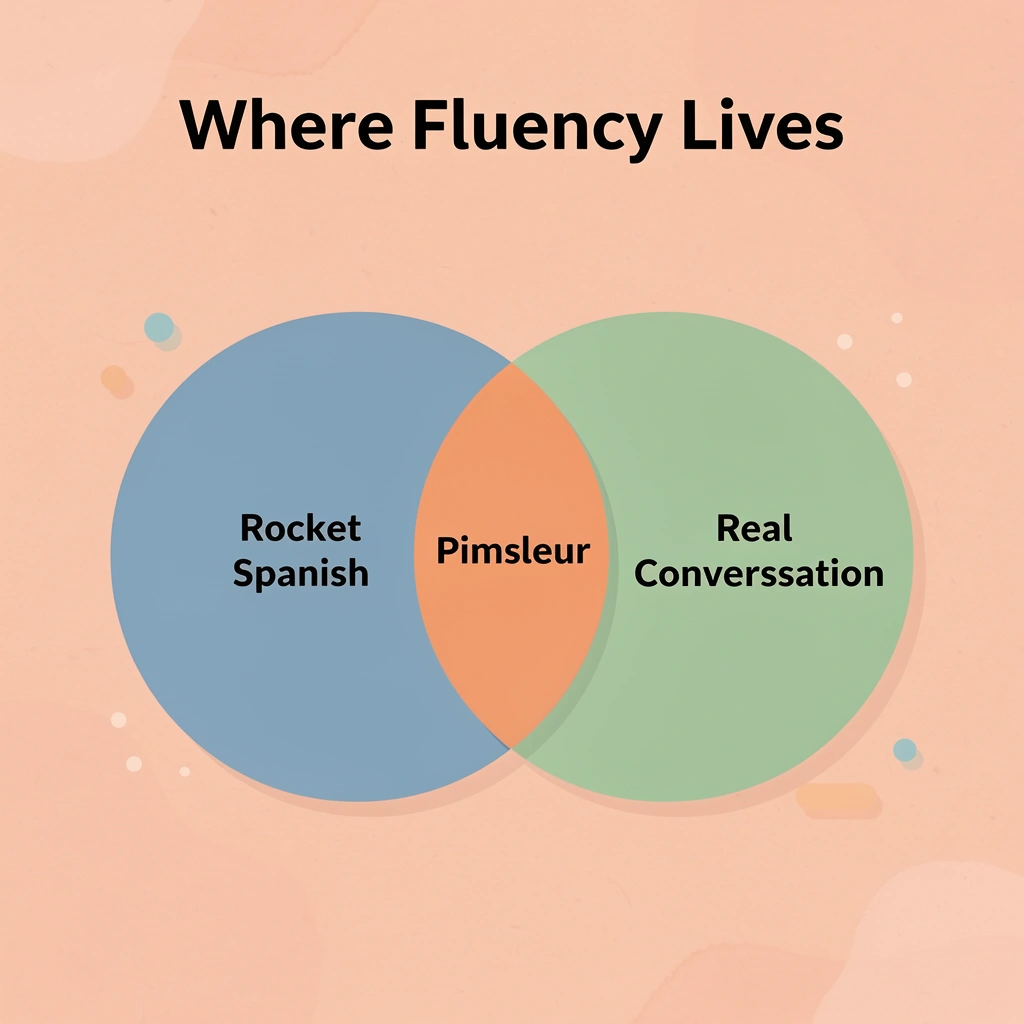
Fluency lives in the gap between what a program teaches and what real conversation demands. Both Rocket Spanish and Pimsleur build genuine skills, but neither closes that gap alone. The question is what you add once you understand what each one can't give you.
"Fluency lives in the gap between what a program teaches and what real conversation demands: no single tool closes it alone."
💡 Tip: Once you've identified the limits of your current program, layer in tools that target your exact weak points: spontaneous speaking, reading comprehension, or cultural fluency.
🔑 Takeaway: The real question isn't Rocket Spanish vs. Pimsleur—it's what complementary resources you build around whichever one you choose.
What to Look For
Why It Matters
Unscripted conversation practice
Bridges the gap between structured lessons and real-world speaking
Reading & writing exposure
Builds literacy skills that audio-only programs skip entirely
Cultural context
Makes language feel natural, not just technically correct
Spaced repetition review
Reinforces long-term retention beyond the lesson window
What actually moves the needle
The most reliable path forward runs through comprehensible input: language you can mostly understand while encountering enough unfamiliar vocabulary to stretch your comprehension. According to Langoly's comparison of Rocket Languages vs Pimsleur, Pimsleur offers 30-minute daily audio lessons across 50+ languages. While this builds solid listening habits, it keeps you in a controlled audio environment rather than exposing you to the unpredictable rhythm of natural speech. Your brain learns language most efficiently when processing meaning, not decoding drills.
Why does authentic listening close the gap that structured programs leave?
Authentic listening is where most structured programs fall short. Lesson audio is recorded, paced, and deliberately clarified. Native speakers in real conversation are none of those things. Exposing yourself to different speakers, accents, and topics rewires your listening so unfamiliar input stops feeling like noise and starts feeling like language.
What happens when learners never encounter unscripted Spanish?
Most learners respond by adding more course material, another app, another grammar unit. The hidden cost is never encountering unscripted Spanish. Apps like Parrot approach this differently, using short-form video built on comprehensible input theory, so learners spend 10 to 15 minutes daily immersed in real, contextually grounded Spanish rather than another lesson format.
The skill that structured courses can't rehearse
Spontaneous speaking is the hardest skill to develop in any course, because courses provide answers before you need them. Real conversation doesn't work that way. ACTFL's Oral Proficiency Interview assesses unrehearsed, spontaneous language use—a useful reminder that recalling a memorized phrase and constructing a response under pressure are two different cognitive events. The only way to develop this skill is to practice with tutors, language partners, or conversation groups where you don't know what's coming next.
Why does vocabulary context matter as much as volume?
The words you learn matter as much as how many words you learn. Actual Fluency's review of Rocket Spanish gave it 3.5 out of 5 stars, partly because of the tension between structured learning and natural, contextual exposure. Words learned in sentences, stories, and real conversations are more useful than words from a list, since context shows not only what a word means but how Spanish speakers use it.
What you choose to study matters more than most learners expect.
Is Rocket Spanish or Pimsleur Better for Your Spanish Goals?
Match the program to your goals by asking: how do you want to spend your study time? Rocket Spanish works well for learners who want grammar explained, vocabulary built step by step, and culture included in the structure. According to Comligo, Rocket Spanish offers 3 levels covering beginner to advanced. Pimsleur works well for learners who want to train their ear and mouth first, with everything else coming second.
"Rocket Spanish offers 3 levels covering beginner to advanced, while Pimsleur prioritizes audio-first training for spoken fluency above all else." — Comligo
🎯 Key Point: Your ideal program depends entirely on how you learn best — through structured grammar study or immersive audio repetition.
Feature
Rocket Spanish
Pimsleur
Learning Style
Visual + structured
Audio-first
Grammar Instruction
Explicit, step-by-step
Minimal
Vocabulary Building
Systematic
Contextual
Culture Included
✅ Yes
Limited
Levels Available
3 levels (beginner–advanced)
Multiple levels
Best For
Reading, writing, grammar
Speaking, listening
💡 Tip: If your primary goal is conversational confidence — ordering food, asking directions, surviving real conversations — Pimsleur's audio method gives your mouth and ear a head start. If you want long-term fluency with grammar mastery, Rocket Spanish is the stronger structural foundation.
🔑 Takeaway: Neither program is universally better — Rocket Spanish wins for comprehensive, structured learning, while Pimsleur wins for fast spoken fluency.

Which program fits the time you actually have?
The failure point is usually a mismatch between what the program demands and what your life allows. Pimsleur's audio-first format fits inside a commute, walk, or workout. Rocket Spanish requires you to sit down, engage with a screen, and work through multiple activity types in sequence. If you skip it three days in a row, it isn't working for you, no matter the design quality.
What does each program treat as the core skill?
The critical difference is what each program treats as the core skill. Pimsleur builds spoken recall through repetition and anticipation: you hear a prompt, pause, and produce language aloud before confirmation. That loop trains automatic response, closer to real conversation than most exercises. Rocket Spanish builds comprehension and analytical understanding, providing a stronger foundation for reading, writing, and grammar, but requires more active effort to convert into spontaneous speech.
Why do so many learners stall between lessons and real conversation?
Most learners choose structured programs because finishing lessons, earning scores, and completing modules show progress. However, a gap exists between finishing lessons and speaking Spanish, and many people get stuck there. Apps like Parrot fill that gap by using short videos based on comprehensible input: real Spanish in context at a level you can follow, watched for 10 to 15 minutes daily. It doesn't replace the structural foundation that Rocket Spanish or Pimsleur provides, but it closes the distance between controlled practice and native speech.
Do you have to choose just one program?
If speaking is your main goal, Pimsleur offers the more direct path. If you need grammar and structural confidence before speaking, Rocket Spanish provides that support. Most intermediate learners need both: the spoken automaticity Pimsleur trains and the grammatical range Rocket Spanish builds. Choosing one doesn't mean abandoning the other; it means being clear about which gap you're closing now.
The program you finish matters far more than the program you choose.
How Parrot Complements Rocket Spanish and Pimsleur With Authentic Spanish
Rocket Spanish and Pimsleur provide structured lessons, but expose you to only a limited range of the language. As your skills develop, you need to hear Spanish from different speakers across different topics and in less predictable situations. Parrot complements that structured practice by making authentic Spanish easier to discover, understand, and revisit.
"Structured programs like Rocket Spanish and Pimsleur build a strong foundation, but real fluency demands exposure to authentic, unpredictable Spanish from a wide range of native speakers."
🎯 Key Point: No single course can replicate the full diversity of real-world Spanish. Different accents, topics, and conversational situations require a complementary tool like Parrot.
💡 Tip: Use Parrot alongside your structured lessons to bridge the gap between textbook Spanish and the authentic language you'll encounter in the real world.
Rocket Spanish combines audio, grammar, vocabulary, culture, and interactive practice, while Pimsleur centers on listening, recall, and spoken response. Both provide a strong foundation, but neither can represent every speaker, topic, accent, expression, or conversational situation you may encounter. Parrot uses research-backed comprehensible input through engaging short-form videos, giving learners regular exposure to authentic Spanish from native speakers.
Program
Core Strength
Key Limitation
Rocket Spanish
Audio, grammar, vocabulary & culture
Limited speaker and accent diversity
Pimsleur
Listening, recall & spoken response
Narrow range of conversational situations
Parrot
Authentic short-form video & comprehensible input
Complements structure, not a standalone course
🔑 Takeaway: Rocket Spanish and Pimsleur are excellent for building structure, but Parrot's research-backed comprehensible input is what bridges the gap between classroom Spanish and real fluency — exposing you to the full spectrum of how native speakers actually talk.
How does Parrot help you find authentic Spanish at the right level?
Going straight from structured lessons to random native videos can be overwhelming. You may understand a Rocket Spanish or Pimsleur lesson comfortably but struggle with a fast interview, casual conversation, or unfamiliar topic. Our AI-powered recommendation feed personalizes Spanish videos based on your skill level and interests, helping learners discover engaging content while gradually increasing the challenge.
Even motivated learners lose valuable study time searching for authentic, interesting, and level-appropriate content. Our personalized recommendations help you keep discovering relevant Spanish without restarting your search each session, so more of your study time goes toward listening and understanding.
How does Parrot support understanding when unfamiliar language appears?
Real content will always contain unfamiliar words and phrases. Stopping a video to look something up breaks your focus and obscures the main message. Parrot's clickable subtitles and instant translations help you when you encounter unfamiliar language, letting you check a word and continue watching without interrupting your listening experience.
Hearing a word once doesn't guarantee you'll remember it next time. Parrot lets learners save words straight from videos and review them in real situations, giving useful language multiple chances to stick while keeping it connected to the Spanish context where you first encountered it.
How does adding Parrot build on what Rocket Spanish and Pimsleur already give you?
Rocket Spanish and Pimsleur provide structured practice, but they work better when combined with other content types. Parrot's personalized recommendations expose you to different speakers, topics, and types of Spanish matched to your level and interests, helping you learn Spanish around subjects you enjoy.
You can use Rocket Spanish for its complete, course-based approach or Pimsleur for its audio-first method. Then add real, easy-to-understand Spanish to connect structured lessons with how people actually speak. Parrot helps by making it easier to find, understand, and review Spanish you've learned. The goal is to create a learning setup that provides enough structure to build your foundation and enough real Spanish to use what you've learned.
Start Learning Spanish Today
The program you finish matters more than the program you choose. Finishing gets easier when the Spanish you're studying feels real, not mere exercises waiting to be completed.
"The program you finish matters more than the program you choose." — ScienceDirect Research
💡 Tip: Don't chase the perfect Spanish program — chase the one you'll complete. Consistency beats perfection.

To complement your Rocket Spanish or Pimsleur practice with real language, learn Spanish with Parrot and start your free 7-day trial. Our short-form Spanish videos are matched to your level, with clickable subtitles, instant translations, and vocabulary saved directly from what you watch — just ten to fifteen minutes a day. Keep your structured practice and spend more study time inside the Spanish you're actually trying to reach.
Feature
What It Does
Clickable Subtitles
Instant word-level translations as you watch
Level-Matched Videos
Content calibrated to your current Spanish level
Vocabulary Saving
Words saved directly from what you watch
Short-Form Format
10–15 minutes a day — fits any schedule
🎯 Key Point: Real Spanish content — not just drills — is what bridges the gap between studying a language and speaking it.
✅ Best Practice: Pair your structured program (Rocket Spanish, Pimsleur) with Parrot's immersive video practice to cover both the foundation and the fluency.
Related Reading
Rocket Spanish Vs Babbel
Alternative To Pimsleur
Pimsleur Vs Babbel
Rosetta Stone Alternatives
Rocket Spanish Vs Rosetta Stone