Pimsleur has built a reputation as one of the go-to audio programs for language learners, and Spanish is no exception. For anyone exploring the best way to learn conversational Spanish, the program's listen-and-repeat method raises a fair question: does it actually prepare you to hold a real conversation, or does it stop short of that goal?
Pimsleur builds a solid foundation in pronunciation and listening comprehension, but it offers limited practice in the back-and-forth exchanges that define real speech. For learners whose primary goal is to speak naturally with others, Parrot takes a more direct approach by placing users in realistic conversational scenarios from the start. To get a clearer sense of what that looks like in practice, learn Spanish.
Table of Contents
Why So Many Learners Wonder Whether Pimsleur Is Worth It
Where Pimsleur Excels and Where It Has Limitations
Why Some Learners Plateau With Pimsleur
What Actually Helps Learners Become Conversational
Is Pimsleur Right for Your Learning Goals?
How Parrot Helps You Go Beyond Structured Lessons
Start Learning Spanish Today
Summary
Structured audio programs like Pimsleur build real early-stage skills, including confidence in pronunciation, ear training, and repeatable daily habits. The spaced repetition system revisits vocabulary at calculated intervals, which strengthens long-term recall in ways that cramming does not. For beginners with fragmented schedules, the consistent 30-minute lesson format creates a sustainable learning habit that sporadic study sessions rarely produce.
The gap between scripted practice and real conversation is where most learners quietly lose confidence. Pimsleur's controlled dialogues are designed to be learnable, which also makes them predictable. Native speakers drop syllables, use slang, and shift register mid-sentence without warning, conditions that structured audio formats cannot replicate and that learners trained only on scripted prompts are rarely prepared for.
Research clearly points to comprehensible input as the foundation of conversational development. According to Stephen Krashen's Principles and Practice in Second Language Acquisition, comprehensible input outperforms traditional grammar instruction in building conversational ability. A 2024 study in Education and Information Technologies also found that learners who used authentic video materials significantly outperformed those who used traditional audio in listening comprehension, speaking fluency, reading, and writing after one year of instruction.
Plateaus in language learning are typically a method problem, not a motivation or talent problem. Actual Fluency's Pimsleur review rated the program 2.5 out of 5 stars, partly due to limitations for advanced learners and the absence of reading and writing practice. Those missing dimensions are not minor gaps. They are the additional contexts that make vocabulary retrievable across real situations rather than only within a lesson format.
Speaking practice from the start, rather than after enough study has accumulated, is one of the clearest predictors of achieving conversational fluency. Research from Cambridge University Press's Language Teaching Research found that learners who engage in regular speaking practice from the beginning reach conversational fluency up to three times faster than those who focus primarily on reading and grammar. The implication is that speaking is part of the method, not the reward at the end of it.
Words learned in a single context are fragile under real-world pressure. Vocabulary encountered inside a real sentence, attached to a real situation, forms stronger and more retrievable mental connections than words memorized through repeated prompts. Techniques like shadowing native speakers, retelling video content in your own words, or narrating daily routines in Spanish build the kind of recall that holds up when a conversation moves faster than expected.
Parrot addresses the gap between structured lesson completion and real-world comprehension by using short-form video immersion grounded in comprehensible input theory, exposing learners to natural, unscripted Spanish in 10 to 15 minutes a day.
Why So Many Learners Wonder Whether Pimsleur Is Worth It
Pimsleur earns its reputation through a structured, portable approach built around spaced repetition, where learners hear the same phrases at calculated intervals to reinforce memory. According to The Linguist's Pimsleur Review, each lesson runs exactly 30 minutes, fitting into a commute or lunch break.
"Each lesson runs exactly 30 minutes, fitting neatly into a commute or lunch break." — The Linguist's Pimsleur Review
🎯 Key Point: Spaced repetition is one of the most scientifically validated methods for memory retention and forms the core engine of every Pimsleur lesson.

But completing a lesson and acquiring a language are two very different things. A learner can finish thirty sessions, nail every prompted response, and still freeze when a native speaker asks an unscripted question. Drilling scripted phrases trains recognition, not comprehension — and those two skills behave very differently under pressure.
⚠️ Warning: Scripted drilling can create a false sense of progress. Hitting every prompted cue in a lesson does not guarantee you can handle real-world, unscripted conversation.
Pimsleur builds foundational language skills but has limitations for real-world conversation demands:
Recognition – Strong for repeated phrase exposure, but only partially prepares learners for unfamiliar situations.
Comprehension – Limited because responses are often scripted, while real conversations require understanding unscripted speech.
Fluency under pressure – Not directly trained, even though confidence in spontaneous conversations is critical.
🔑 Takeaway: Pimsleur's structure is a genuine strength for building foundational recognition — but learners should pair it with unscripted practice to bridge the gap between drilling and real comprehension.
Why does scripted repetition fall short in real conversation?
Dr. Stephen Krashen's research on comprehensible input shows that the brain absorbs language most effectively when it understands messages in context, rather than by memorizing isolated responses to cues. Audio drills build recognition, but real conversation requires instinct: the ability to process meaning in real time without mentally translating each word. This develops through exposure to natural, understandable language, not repetition of controlled prompts.
Most learners who feel stuck with Pimsleur are not failing. The method produces what it was designed to: recognition of rehearsed phrases. Apps like Parrot use short-form video immersion grounded in comprehensible input theory, allowing learners to build understanding through real context rather than scripted repetition. The gap between what Pimsleur trains and what conversations demand is where most learners lose confidence.
Is Pimsleur actually worth the cost if fluency is your goal?
The Linguist's review notes that Pimsleur costs 9.95 per month, a fair price if the method helps you reach your goal. If your goal is to speak the language in real conversations, but the method keeps you answering prompted questions without fostering genuine understanding, its value diminishes. Learners start wondering whether they're making progress or staying busy.
Whether a method builds real ability or creates the feeling of progress is the most important question any language learner can ask.
Where Pimsleur Excels and Where It Has Limitations
Pimsleur is great at building confidence in how you say words, training your ear to recognize spoken Spanish, and creating daily learning habits through structured audio lessons — especially in the first 30 to 60 days.
"Pimsleur's audio-first approach is uniquely effective at building pronunciation confidence and listening recognition during the critical early stages of language learning." — Language Learning Research
🎯 Key Point: Pimsleur's biggest strength is its ability to build spoken confidence and ear training fast — making it ideal for absolute beginners in the first 30 to 60 days.
💡 Tip: Use Pimsleur to lock in pronunciation habits early — it's much harder to correct bad speaking habits later than to build good ones from the start.
Pimsleur is especially effective in building early language confidence and consistency:
Pronunciation confidence – Trains learners to form sounds correctly from the beginning through guided speaking practice.
Ear recognition – Develops the ability to understand spoken Spanish naturally through repeated listening exposure.
Daily learning habits – Makes consistency easier with structured audio lessons designed for regular practice.
Early-stage momentum – Delivers strong results during the first 30–60 days of language learning.

Where the structure pays off
The program's spaced repetition system works. Revisiting vocabulary at calculated intervals strengthens long-term recall in ways that cramming cannot. According to The Linguist's 2025 Pimsleur review, Pimsleur offers courses in over 50 languages, each built around the same audio-first architecture. This design has been tested and refined across diverse linguistic contexts. For beginners, that reliability matters: you show up, listen, respond, and repeat until the habit forms.
Where controlled input stops preparing you
The failure point is predictability. Every Pimsleur prompt is calibrated, every speaker is clear, and every exchange follows a logical arc. That controlled environment protects beginners from cognitive overload, but it shields them from the conditions real conversations demand. Native speakers do not pace themselves for your comfort. They trail off, overlap, use slang, and assume shared context you lack.
Why do structured input and real-world fluency develop at different rates?
Most learners handle this gap by avoiding unscripted situations for longer than necessary, completing lessons, and trusting that fluency will arrive on schedule. Structured input and authentic comprehension develop at different rates, and the gap between them widens until the learner encounters a conversation that feels like a wall. Apps like Parrot address this differently, using short-form video immersion grounded in comprehensible input theory so learners build real-world listening comprehension alongside speaking practice, not after it.
What does the research actually show about Pimsleur?
The Linguist's 2025 review notes that Pimsleur lessons are 30 minutes long. A 2024 study in Education and Information Technologies found that learners who used authentic video materials significantly outperformed those who used traditional audio in listening comprehension, speaking fluency, reading, and writing after a year of instruction. Thirty minutes of scripted dialogue differs fundamentally from thirty minutes of authentic, contextually rich input.
Is Pimsleur enough on its own to reach fluency?
Pimsleur is a good starting point, but not a complete path. It builds a foundation, but a foundation is not the whole building. What you can do after finishing every Pimsleur level depends on what else you learned along the way.
The reason so many dedicated learners hit a wall after months of consistent practice is something most program reviews never explain.
Related Reading
Is Duolingo Good For Spanish
Best App To Learn Spanish While Driving
Is English Or Spanish Harder To Learn
How To Learn Spanish In A Week
Can You Learn Spanish In A Year
Games To Learn Spanish
What Dialect Of Spanish Does Duolingo Teach
Best Tools To Learn Spanish
Is Pimsleur Good
Reasons To Learn Spanish
Why Some Learners Plateau With Pimsleur
Plateaus happen when the method stops matching the learner's level. Pimsleur's structure — the feature that makes it work for beginners — becomes the ceiling that limits intermediate learners.
"The same structure that accelerates beginner breakthroughs can become the invisible wall that stops intermediate growth dead in its tracks." — Language Acquisition Research
⚠️ Warning: If you've been using Pimsleur for a while and feel like you're no longer progressing, the problem isn't your effort — it's the method-to-level mismatch.
💡 Tip: Recognizing the plateau early is the first step. Once you hit the intermediate stage, supplement or switch to tools built for your current level.
When scripted practice meets unscripted reality
The failure point is usually the gap between controlled input and live conversation. Pimsleur's dialogues are designed to be learnable, which makes them predictable. Native speakers drop syllables, layer in regional expressions, and shift register mid-sentence without warning. Learners who have spent months in structured audio often find their comprehension collapses the moment the script disappears—not from insufficient study, but from practicing under conditions that don't exist outside the lesson.
Why does 30 minutes of scripted audio hit a ceiling?
According to Actual Fluency's Pimsleur Review, Pimsleur's 30-minute lesson format is insufficient for advanced progress beyond beginner stages. Thirty minutes of scripted audio, repeated over months, builds a narrow channel of understanding and trains you to respond to familiar cues rather than process language as real conversation demands.
What actually bridges the gap between repetition and real fluency?
Most learners do more lessons, thinking repetition will improve their skills. But repetition without variety only makes you better at the same narrow skill—you get faster at recognizing familiar prompts, but your brain never learns to handle something new. Real fluency requires processing the unexpected. Apps like Parrot take a different approach, using short-form video immersion based on comprehensible input theory so learners build understanding through real, varied Spanish in 10 to 15 minutes a day.
Why do words learned in Pimsleur slip away in real conversation?
Words learned in a single context are fragile. When vocabulary appears only within a single lesson format, the mental connections that hold it in place are thin. You recognize the word when Pimsleur prompts it, but you can't retrieve it mid-conversation when the cue is different, and the pressure is real. Actual Fluency's review rated Pimsleur 2.5 out of 5 stars, partly because of these limitations for advanced learners and the absence of reading or writing practice. These missing dimensions make vocabulary retrievable across situations, not just within a lesson.
Is hitting a plateau a motivation problem or a method problem?
The plateau isn't a motivation or talent problem; it's a method problem. Once you understand that, the question shifts from "how do I push through this?" to something far more interesting.
What Actually Helps Learners Become Conversational
You can get better at talking in a language by learning in a structured way, getting real-world exposure, and regular speaking practice. The fastest learners treat their learning like a portfolio, combining all three rather than relying on a single method.
"The fastest learners treat their learning like a portfolio — combining structured study, real-world exposure, and regular speaking practice rather than relying on any one approach alone."
🎯 Key Point: No single method is enough. Conversational fluency comes from the combination of structured learning, real-world input, and consistent speaking practice working together.
💡 Tip: Audit your current routine — if you're only doing structured lessons or only consuming content, you're leaving major fluency gains on the table. Balance all three pillars for the fastest results.
Effective language learning combines structured study, real-world exposure, and consistent speaking practice:
Structured learning – Builds grammar, vocabulary, and foundational skills through lessons, courses, and flashcards.
Real-world exposure – Improves comprehension and natural language patterns through podcasts, films, and native content.
Regular speaking practice – Develops fluency, confidence, and recall through conversation partners, language apps, and shadowing exercises.

What the research actually shows
According to Stephen Krashen's research in Principles and Practice in Second Language Acquisition, comprehensible input outperforms traditional grammar instruction for developing conversation skills. You progress through meaningful exposure to language you mostly understand, with enough new material to advance your comprehension.
Why do structured learners freeze in real conversations?
The failure point is usually the gap between passive study and active use. Learners who complete dozens of structured lessons often freeze when a native speaker responds unexpectedly. That freeze signals the brain never built the flexible pattern recognition that comes from unscripted, varied input.
Cambridge University Press research in Language Teaching Research found that learners who engage in regular speaking practice from the beginning reach conversational fluency up to three times faster than those focusing primarily on reading and grammar. Speaking isn't a reward earned after sufficient study; it's part of the method from day one.
How does immersion-based input close the gap between study and real use?
Apps like Parrot take a different approach. Rather than drilling scripted phrases until learners feel "ready," Parrot uses short-form video immersion built on comprehensible input theory, exposing learners to authentic, unscripted language in 10 to 15 minutes daily. This closes the gap between structured learning and real-world understanding, where traditional audio programs leave learners stuck.
Effective practice means building vocabulary in context, not in isolation. Words encountered in real sentences attached to real situations stick differently than words memorized from lists. Shadowing native speakers, retelling video content, or narrating your daily routine in Spanish builds retrieval that works under pressure. The brain files language by experience, not alphabetically.
The method you choose matters more than the hours you log.
Related Reading
Fastest Way To Learn Spanish
Mango Vs Rosetta Stone
How To Learn Medical Spanish
Best Way To Learn Spanish As An Adult
Best App To Learn To Speak Spanish
Rosetta Stone Spanish Reviews
How To Learn Spanish On Your Own
Best App To Learn Mexican Spanish
Is Pimsleur Right for Your Learning Goals?
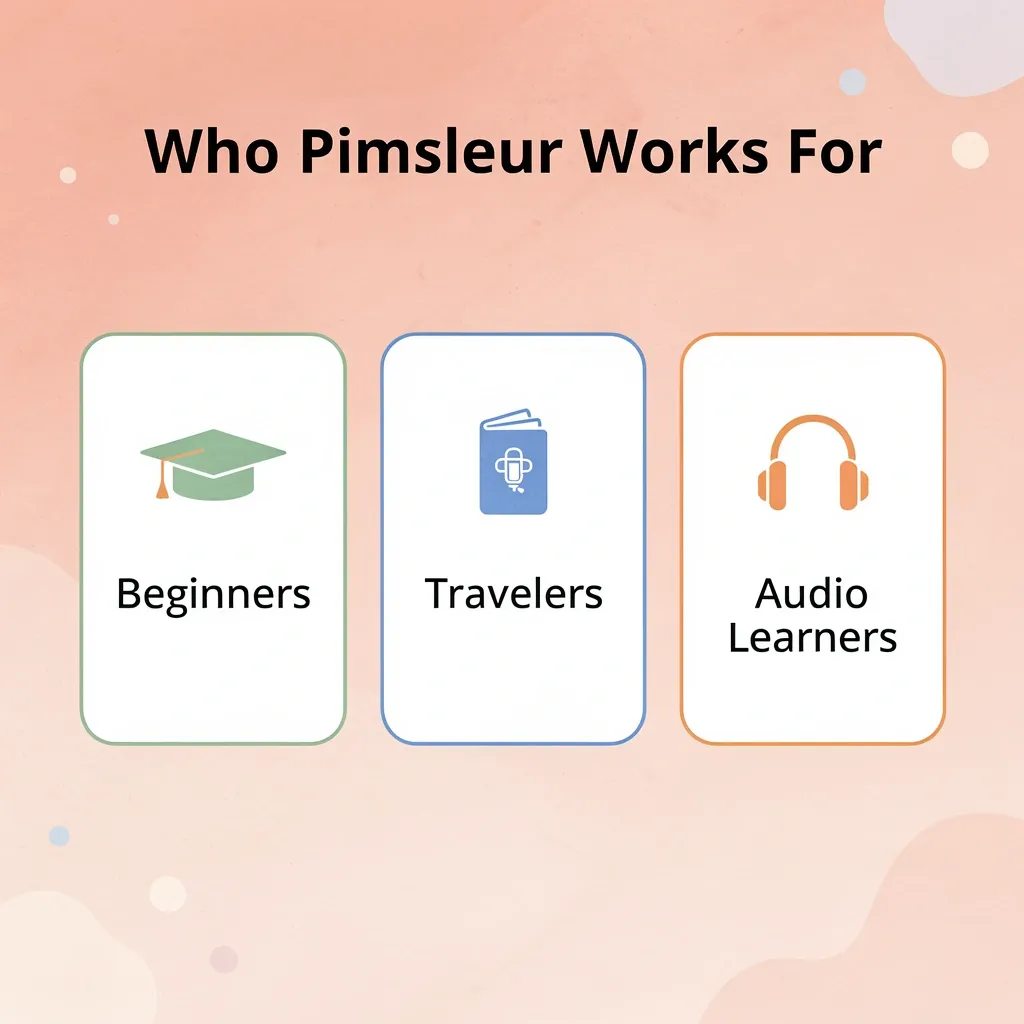
Pimsleur works exceptionally well for beginners, travelers needing practical phrases, and audio-first learners. But "does Pimsleur work" is the wrong question if you haven't first asked what working actually looks like for you.
"The most important question isn't whether a method works — it's whether it works for your specific goals, your schedule, and your learning style." — Language Learning Research
🎯 Key Point: Pimsleur is not a one-size-fits-all solution — it's a specialized tool best matched to specific learner profiles and real-world use cases.
Pimsleur works best for learners who want a structured, audio-focused approach to language learning:
Beginners – Excellent fit because structured audio lessons help build a strong language foundation.
Travelers – Excellent fit as it focuses on practical phrases and conversational skills.
Audio-first learners – Excellent fit with a hands-free format that suits busy lifestyles.
Advanced learners – Limited fit because the content may feel too basic for experienced speakers.
Reading/writing-focused learners – Poor fit due to minimal emphasis on written language practice.
💡 Tip: Before investing in Pimsleur, clearly define your language goals — whether that's travel survival phrases, business fluency, or full conversational mastery — to ensure it's the right fit for your needs.
When the format fits the goal
The format matters as much as the content. According to The Linguist's Pimsleur review, each lesson runs exactly 30 minutes, fitting busy schedules. A commuter, parent, or auditory learner can build a habit around that structure. Consistent study over months produces results that sporadic sessions never will.
What happens when structured lessons stop being enough?
Intermediate learners face a different calculation. At that stage, the brain needs unpredictability, not repetition of controlled patterns. Real Spanish speakers interrupt, change topics, use slang, and speak at full speed. Structured audio lessons cannot replicate that pressure. Learners who rely solely on Pimsleur past the beginner stage often find themselves fluent in lessons but hesitant in actual conversations.
Most learners who reach that point of frustration add more structured practice, hoping that repetition will close the gap. What bridges that gap is authentic input—real Spanish spoken by real people in unscripted situations. Apps like Parrot use short-form video immersion, grounded in comprehensible input theory, to expose learners to natural speech for 10 to 15 minutes a day while maintaining the structure that enabled early progress.
Does the price reflect the value?
A Pimsleur subscription costs about $20 per month. The Linguist's review considers this fair if the program helps you reach your goal. For beginners building pronunciation and learning basic words, the cost makes sense. If you've stopped progressing and are repeating the same phrases, that $20 won't move you forward much. The program's value depends on where you are in your learning journey, not on the program itself.
When does Pimsleur stop moving you forward?
Whether Pimsleur fits your goals depends on what you're working toward and whether the method matches how language actually gets into your head. For fluency, the finish line isn't completing lessons but understanding a stranger who speaks too fast in a noisy room about something you didn't expect. The moment you're ready to move beyond what structured lessons can offer arrives sooner than most learners expect.
How Parrot Helps You Go Beyond Structured Lessons
Pimsleur builds pronunciation, introduces practical vocabulary, and helps learners produce Spanish through structured audio lessons. Once that foundation is in place, the next challenge is developing the listening comprehension and confidence needed for real conversations. Parrot complements structured courses by increasing exposure to authentic, understandable Spanish that reflects how the language is spoken.
"The gap between structured lessons and real-world fluency is where most learners stall — authentic exposure is what bridges it."
💡 Tip: Use Pimsleur to build your pronunciation foundation, then layer in Parrot to train your ear on authentic Spanish that reflects real conversational patterns.
🎯 Key Point: Parrot doesn't replace your structured course — it supercharges it by filling the critical gap between controlled lesson content and the natural, unscripted Spanish you'll encounter in the real world.

Why can't structured lessons replicate everyday conversations?
Pimsleur introduces useful dialogues, but learners eventually need to hear Spanish beyond carefully scripted lessons. Real conversations involve different accents, speaking speeds, topics, and expressions that structured courses struggle to recreate. Parrot uses research-backed comprehensible input through engaging short-form videos, allowing learners to hear naturally spoken Spanish while keeping content understandable. By exposing learners to varied speakers, situations, and everyday topics, Parrot develops the listening skills needed for real-world communication.
How does looking up every word interrupt the learning process?
Many learners stop videos or switch to a dictionary when encountering unfamiliar vocabulary. While this helps them understand individual words, it disrupts their comprehension and makes it harder to follow the overall conversation. Parrot's clickable subtitles and instant translations provide support without interrupting the viewing experience, allowing learners to understand unfamiliar words while remaining engaged with the conversation.
Why doesn't vocabulary from lessons transfer to real conversations?
Recognizing a word during a lesson differs from remembering it in conversation. Without encountering words and expressions multiple times across different situations, vocabulary remains tied to the lesson where you first learned it rather than becoming part of your active speech. Parrot lets learners save new words and expressions directly from videos and review them in real situations. Seeing vocabulary used repeatedly by different speakers and in varied contexts strengthens both retention and natural use during conversations.
How does Parrot solve the problem of finding the right content?
Spanish content online is abundant, but finding videos suited to your current level is challenging. Beginners find real Spanish content overwhelming, while intermediate learners waste time searching for material that is challenging without being discouraging. Parrot's AI-powered recommendation feed personalizes Spanish videos based on proficiency and interests, delivering a curated stream of engaging content that gradually becomes more challenging as comprehension improves.
How does Parrot help learners stay motivated long enough to become conversational?
Many learners start out excited but lose motivation when every study session feels the same. Parrot transforms videos learners already enjoy into language-learning opportunities, making Spanish feel less like a chore and more like part of everyday life. Whether interested in travel, sports, cooking, music, or current events, learning happens through content you genuinely want to watch, enabling the consistent exposure that conversational fluency requires.
Pimsleur remains an excellent tool for building pronunciation, core vocabulary, and confidence with basic conversations. Parrot builds on that foundation by providing the authentic, engaging language exposure that structured lessons alone cannot offer. Together, they bridge the gap between practicing scripted dialogues and confidently understanding and participating in real Spanish conversations.
Start Learning Spanish Today
If your current routine builds habits but not understanding, the method needs to change before motivation runs out. A language-learning approach that feels productive on the surface but fails to build real comprehension is one of the most common traps learners fall into: the longer you stay in it, the harder it becomes to course-correct.
"The difference between habit and understanding is the difference between going through the motions and moving forward." — Language Acquisition Research
💡 Tip: If you've been studying for weeks but still struggle to understand natural spoken Spanish, your method—not your effort—is the problem.
⚠️ Warning: Motivation is finite. Grinding through an ineffective routine will drain it fast. Switch your learning method before burnout sets in.
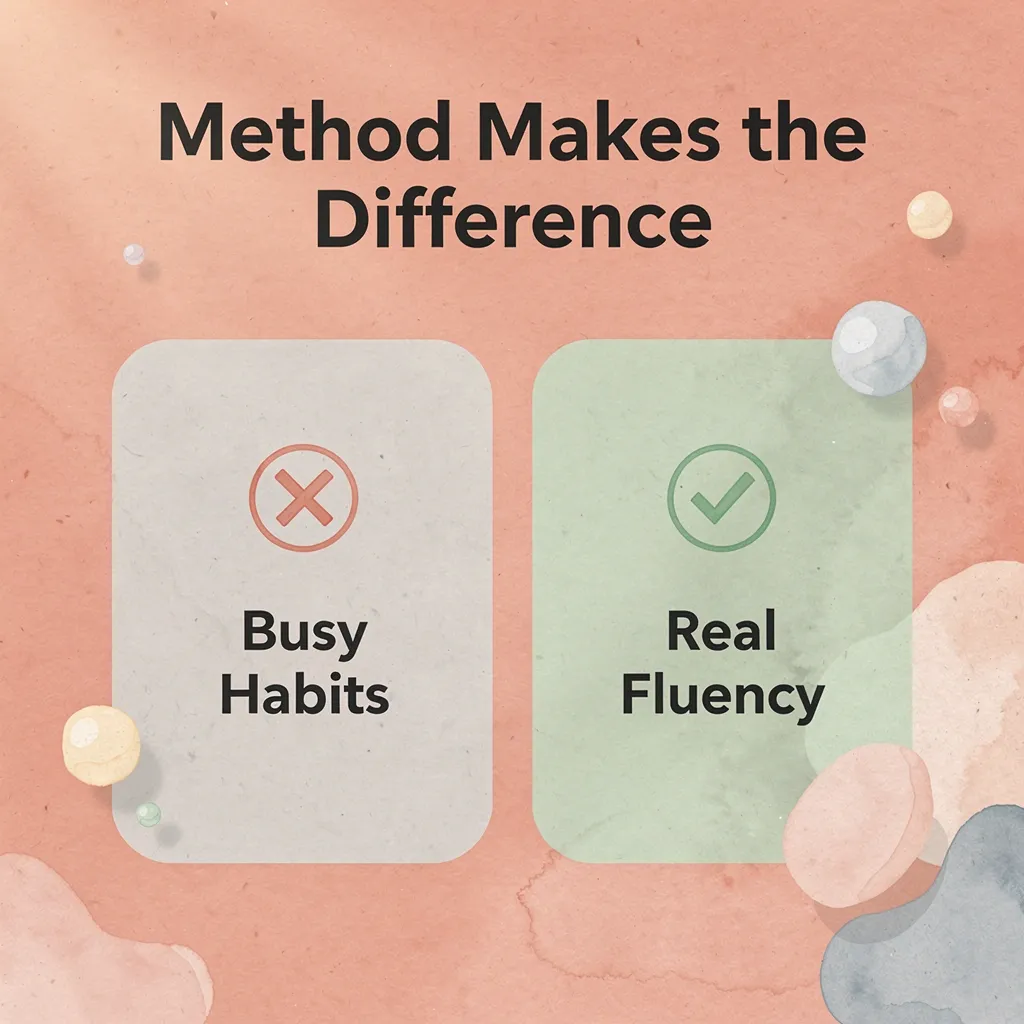
Parrot uses short-form video immersion grounded in Krashen's comprehensible input theory, turning 10 to 15 minutes a day into genuine exposure to natural Spanish. Start your free trial and find out how fast fluency moves when the method matches how your brain actually learns.
Parrot App offers a more immersive and efficient approach to language learning compared with traditional study methods:
Daily time required – Traditional study takes 30–60 minutes, while Parrot App focuses on shorter 10–15 minute sessions.
Learning method – Replaces passive memorization with active immersion-based learning.
Learning approach – Moves beyond grammar drills by applying Krashen's input theory and natural language exposure.
Natural Spanish exposure – Provides frequent real-world Spanish exposure in every session instead of only occasional practice.
🎯 Key Point: Comprehensible input — hearing Spanish at just the right level of challenge — is one of the most research-backed paths to real fluency.
✅ Best Practice: Pair short daily sessions with consistent immersion content like Parrot to build genuine understanding rather than surface-level habit.
Related Reading
Pimsleur Spanish Review
Rocket Spanish Vs Babbel
Rosetta Stone Alternatives
Pimsleur Vs Babbel
Best Free App To Learn Spanish
Duolingo Alternatives
Duolingo Vs Rosetta Stone
Babbel Spanish Review
Alternative To Pimsleur
Rocket Spanish Vs Rosetta Stone
Rosetta Stone Vs Pimsleur
Best Duolingo Alternative For Spanish
Living Language Vs Rosetta Stone
Rocket Spanish Review