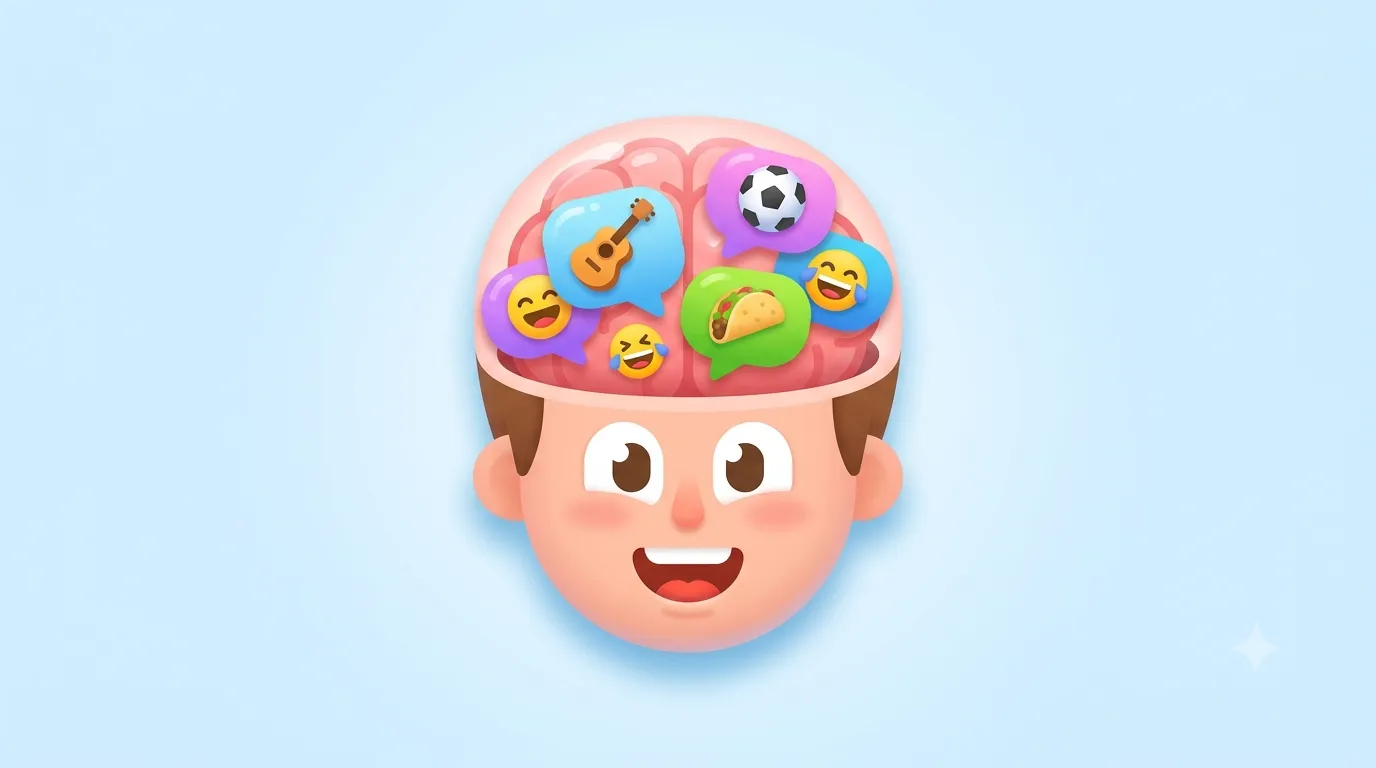
Most people studying Spanish can read a menu or conjugate a verb, yet freeze the moment a native speaker responds at full speed. That gap between textbook knowledge and real conversation is where traditional methods fall short, and it is why so many learners plateau early. The best way to learn conversational Spanish is not more grammar drills but deliberate practice with the kind of language people actually use.
Parrot is built around exactly that principle, training learners through real dialogue, everyday phrases, and listening practice calibrated to natural speech. The focus stays on spoken Spanish from the start, so skills transfer directly to real-world situations rather than sitting unused on a page. Anyone ready to move from hesitant student to confident speaker can learn Spanish with a method designed for genuine fluency.
Table of Contents
Why Learning Conversational Spanish Feels So Difficult for Most People
Why Traditional Spanish Learning Methods Often Fall Short
The Habits That Keep Learners Stuck at the Beginner Stage
What Actually Works for Building Conversational Spanish
How to Choose a Learning Method That Matches Your Goals
How Parrot Helps You Learn Conversational Spanish Naturally
Start Learning Spanish Today
Summary
Conversational fluency and language knowledge are two separate things, and most learners spend years building one while expecting the other to follow. Native speakers contract, blend, and drop sounds constantly, turning textbook phrases into something the untrained ear cannot decode in real time. Spanish is spoken by over 500 million people across dozens of countries and accents, which means learners who train on a single variety of the language often find themselves lost the moment they encounter a different one.
Traditional instruction tends to train the wrong skill entirely. Grammar exercises and vocabulary drills build declarative knowledge, the kind that performs well on tests but collapses under the pace of real conversation. Research on bilingual language development found that single-language instruction approaches show measurable limitations in developing oral language ability, with gaps between what learners know and what they can do in real time widening when instruction is structured around isolated rules rather than meaningful use.
Common self-study habits feel productive but rarely build conversational ability. Studies in behavioral science research found that learners rely on ineffective methods, such as rereading and cramming, in the majority of self-directed sessions. The translation habit compounds this problem further. Native speech moves at roughly 150 to 200 words per minute, and mentally converting each Spanish sentence into English before processing it creates a lag that compounds sentence by sentence until comprehension collapses.
The research behind second language acquisition points to one consistent finding: comprehensible input drives fluency faster than output-focused practice. According to Berlitz, adults need at least 600 to 750 hours of study to reach conversational Spanish proficiency, which makes the quality of every hour matter enormously. Dr. Stephen Krashen's acquisition research identifies input slightly above a learner's current level as the primary mechanism for advancing fluency, rather than grammar drills or speaking exercises alone.
Consistency across time matters more than intensity on a single day. Research comparing learning methods shows that spaced repetition can improve long-term retention by up to 200% compared to massed practice. A learner who engages with Spanish for ten focused minutes five days a week builds more genuine comprehension than someone who studies for two hours on Saturday and nothing else during the week. The brain strengthens language pathways through repeated, distributed exposure, not occasional effort.
The right learning method is neither the most rigorous nor the most popular. It is the one a learner will consistently return to, shaped around their specific goal, whether that is travel, professional communication, or long-term fluency. Active learning methods produce meaningfully stronger results than passive instruction, but only when practiced with enough regularity that the brain can build automatic retrieval rather than deliberate translation.
Parrot's Learn Spanish app addresses this by placing learners inside short-form video content from real native speakers, calibrated to comprehensible input at the learner's current level, so that 10 to 15 minutes during a commute or lunch break functions as genuine acquisition time rather than activity for its own sake.
Why Learning Conversational Spanish Feels So Difficult for Most People
Being able to talk naturally and knowing a language are two very different things. You might recognize a word when you read it on a page, but still not understand it when a native speaker says it quickly, connects it to other words, or uses a regional accent.
"Recognition and recall are not the same skill — you can know a word on paper and still be completely lost when a native speaker delivers it at full speed." — Language Acquisition Research
🎯 Key Point: Reading comprehension and conversational fluency are entirely separate skills — mastering one does not guarantee the other.
⚠️ Warning: If your Spanish practice relies mostly on written exercises, you are training your brain for passive recognition — not the real-time listening and speaking that actual conversations demand.
Reading Spanish
What It Trains
Passive word recognition
Real-World Result
Understand written text but struggle with spoken conversation
Listening to Native Speakers
What It Trains
Active audio processing
Real-World Result
Follow fast, natural conversations with greater confidence
Speaking with Different Accents
What It Trains
Real-time adaptation to regional pronunciation and speech patterns
Real-World Result
Communicate effectively across different Spanish-speaking regions
Why does listening to native speakers feel so overwhelming?
The gap shows up most clearly in listening. Native speakers contract, blend, and drop sounds constantly. "¿Cómo estás?" becomes something closer to "¿Cómoestás?" in real speech. Your brain, trained on written Spanish or slow audio recordings, lacks the pattern recognition to decode that in real time. Without that decoding ability, conversations feel less like communication and more like a test you are perpetually failing.
According to the NLL Coach Blog, Spanish is spoken by over 500 million people worldwide. This scale means Spanish spans dozens of countries, accents, and cultural registers. Learners who train on only one variety often find themselves lost when encountering a different one.
Why do traditional study methods fail to build real conversation skills?
Most learners respond by studying harder, adding vocabulary, or repeating grammar exercises. The hidden cost is time spent building knowledge that does not transfer to real-time conversation. Apps like Parrot take a different approach, using short-form video immersion in native-speaker content so your brain learns to process spoken Spanish as it actually sounds.
Conversational Spanish requires processing speed that only comes from repeated exposure to real speech. Dr. Stephen Krashen's research on language acquisition shows the brain acquires language by understanding messages it is almost ready to comprehend—that slight stretch, input above your current level, pushes fluency forward. Grammar drills do not create that stretch. Authentic dialogue does.
How much time does it actually take to build conversational fluency?
This kind of immersion does not require hours of daily commitment. Ten to fifteen minutes of focused exposure to real conversational Spanish, practiced consistently across natural gaps in your day, builds the listening intuition and phrase recognition that formal study rarely develops.
Most learners fail not from lack of effort, but because the method was never designed to get them where they want to go.
Related Reading
Is Duolingo Good For Spanish
Reasons To Learn Spanish
Games To Learn Spanish
Best Tools To Learn Spanish
Can You Learn Spanish In A Year
Is English Or Spanish Harder To Learn
What Dialect Of Spanish Does Duolingo Teach
Best App To Learn Spanish While Driving
Is Pimsleur Good
How To Learn Spanish In A Week
Why Traditional Spanish Learning Methods Often Fall Short
Traditional Spanish learning methods fail conversational learners because they train the wrong skill. Grammar exercises and vocabulary drills build declarative knowledge — what you can show on a test. Real conversation demands automatic, intuitive language processing that fill-in-the-blank exercises simply cannot replicate.
"Grammar exercises and vocabulary drills build declarative knowledge — but real conversation demands automatic, intuitive processing that traditional methods cannot train." — Core Insight
⚠️ Warning: If your Spanish study routine consists mostly of grammar worksheets or rote vocabulary drills, you may be building test knowledge — not the conversational fluency you actually need.
Grammar Exercises
Skill Trained
Declarative knowledge of grammar rules
Conversational Value
Low
Vocabulary Drills
Skill Trained
Memorized word lists and definitions
Conversational Value
Low–Medium
Automatic Language Processing
Skill Trained
Intuitive, real-time language processing
Conversational Value
High
🎯 Key Point: The real gap in traditional Spanish learning isn't effort — it's that fill-in-the-blank exercises train a fundamentally different skill than live conversation requires.

Why do grammar drills fail to build real conversational ability?
This pattern appears consistently across classrooms, apps, and textbooks. Students spend months conjugating subjunctive verbs, then freeze when a native speaker drops the pace or swallows a syllable. They practiced analytical language processing, which doesn't transfer to spontaneous speech. Research from Moving Forward by Looking Back: Understanding Why Some Spanish-Speaking English Learners Fall Behind confirms that traditional single-language instruction has measurable limitations in developing oral ability, with gaps identifiable as early as Grade 2. When instruction centers on isolated rules rather than meaningful language use, the gap between what learners know and what they can do in real time widens.
Why assessment shapes the bad habits
The common way to learn Spanish treats fluency as a finish line reached by accumulating correct answers. Apps reward streak maintenance. Classrooms reward test scores. Both focus on measurable results rather than communication ability. When feedback rewards accuracy over speed, learners train themselves to be careful and slow, the opposite of what real conversation requires.
Most learners using game-like apps learn vocabulary by tapping matching tiles or translating single sentences. While this feels like progress, it rarely builds the listening skills needed to follow native-speed conversation.
How does rewarding exposure instead of correct answers change what you learn?
Learn Spanish through Parrot immerses learners in short-form video content from native speakers. The videos are organized around comprehensible input slightly above their current level. Rather than rewarding correct answers, our approach rewards repeated exposure to meaningful messages: how the brain moves from knowing a word to using it without thinking.
What the research actually supports
According to Moving Forward by Looking Back: Understanding Why Some Spanish-Speaking English Learners Fall Behind, the language used for teaching is a key factor in how well students read and use language. This principle applies to adults learning a language: how you practice matters more than how much you practice. Forty-five minutes of grammar review creates a different brain state than fifteen minutes of listening to real Spanish conversation. One builds knowledge about the language; the other builds the brain pathways that enable understanding and response without translating.
The critical difference is whether your method matches the thinking skills you need for real conversation. That realization changes how you view your daily habits.
The Habits That Keep Learners Stuck at the Beginner Stage
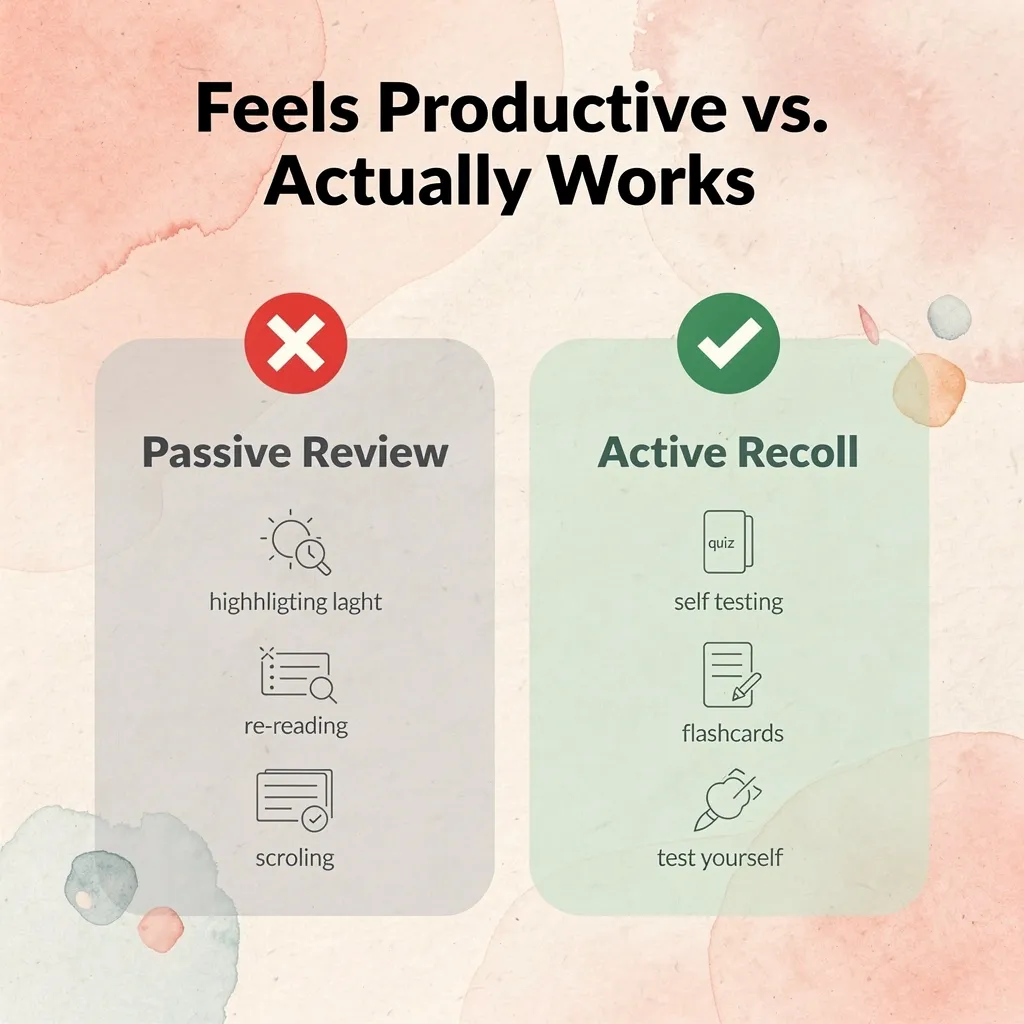
Studying regularly without making progress is deeply discouraging. The habits that feel productive in the moment — like re-reading notes, highlighting passages, or passively reviewing material — actually produce finished work, not real skill. The gap between feeling busy and building genuine competence is where most learners get permanently stuck.
"The habits that feel most productive are often the ones doing the least for long-term learning and retention." — PMC, National Library of Medicine
⚠️ Warning: If you're putting in consistent study hours but seeing little to no improvement, your methods — not your effort — are the problem.
💡 Tip: Swap passive review habits for active recall strategies to start building real, measurable skill instead of just logging study time.
Re-reading Notes
Feels Productive?
✅ Yes
Builds Real Skill?
❌ No
Passive Highlighting
Feels Productive?
✅ Yes
Builds Real Skill?
❌ No
Active Recall Testing
Feels Productive?
⚠️ Harder
Builds Real Skill?
✅ Yes
Spaced Repetition
Feels Productive?
⚠️ Slower
Builds Real Skill?
✅ Yes
The trap of isolated vocabulary practice
Words without context are slippery. A learner can recognize "cita" on a flashcard and still miss it entirely when a native speaker uses it mid-sentence in a fast-moving exchange. The brain stores language as a web of connections, sounds, emotions, and situations, not as a list. Memorizing vocabulary alone skips the process that makes words stick and emerge automatically in conversation. According to research published in PMC/Behavioral Sciences, students rely on ineffective methods such as rereading and cramming in the majority of self-directed study sessions—habits that feel disciplined but produce limited long-term retention.
Why translation is a ceiling, not a bridge
The habit of translating is one of the most common reasons learners plateau at the beginner level. Converting every Spanish sentence into English before processing it adds a cognitive step that real conversation will not accommodate. Native speech moves at roughly 150 to 200 words per minute, and the mental detour through English creates a lag that compounds sentence by sentence until comprehension collapses. The fix is to build direct meaning associations between Spanish words and the concepts they represent, bypassing English altogether.
Why does classroom content keep the English safety net in place?
Most learners consume Spanish content designed for classrooms: written dialogues and structured exercises that move slowly enough to allow translation. This never trains the brain to operate without the English safety net. Apps like Parrot address this by immersing learners in short-form native video content calibrated to their current level, building direct comprehension through repeated exposure rather than deliberate translation.
The waiting game that never ends
The pattern shows up everywhere: learners put off speaking or listening to native content until they feel ready, and ready never quite comes. Confidence in a language is not something you need before you practice; it is what you get from practicing. Every week spent waiting for fluency before engaging with real Spanish is a week the brain misses the input it needs to develop automatic processing. Short, daily exposure to understandable spoken Spanish—even fifteen minutes during a commute or lunch break—builds listening stamina and vocabulary recall faster than occasional long sessions. Consistency across time is the mechanism; intensity on a single day is not a substitute.
The engagement problem nobody talks about
The failure point is usually motivation, not intelligence. Learners who rely on textbook dialogues, repetitive drills, and grammar worksheets study in bursts followed by long gaps. Those gaps erode the neural connections that repeated exposure builds. Language acquisition requires the brain to encounter patterns frequently enough that retrieval becomes effortless, which only happens when learners return consistently.
Engagement is not a luxury; it is a requirement for the repetition on which fluency depends. When content connects to something a learner genuinely cares about—food, travel, music, or sport—showing up daily becomes a choice rather than discipline.
Once you understand which habits are holding you back, the next question becomes urgent: what does it look like to replace them with something that works?
What Actually Works for Building Conversational Spanish
You get better at speaking Spanish by practicing with real Spanish many times over a long period, not by finishing a course. Learners who succeed organize their practice around how the brain actually learns language.
"You get better at speaking Spanish by practicing with real Spanish many times over a long period—not by finishing a single course." — Core Principle of Language Acquisition
💡 Tip: Consistent, repeated exposure to real Spanish is the single most important factor in building conversational fluency more than any app, course, or textbook alone.
🔑 Takeaway: Learners who succeed long-term don't complete lessons; they organize their practice around how the brain acquires language, prioritizing repetition, real input, and time on task.
The input-first principle most learners skip
Research on second-language learning shows that comprehensible input accelerates fluency more than speaking practice alone. When you engage with Spanish content you mostly understand—such as travel videos, sports recaps, or cooking channels—your brain learns how words combine, how sentences are structured, and how meaning emerges without translation. According to Berlitz, adults need 600 to 750 hours to reach conversational proficiency, making every hour count. Isolated drills consume those hours less efficiently than engaging, comprehensible content.
Why does speaking practice alone fall short?
The common approach treats speaking practice as the main way to become conversational, but this puts the cart before the horse. Speaking fluency grows from internalized patterns built through listening and comprehension, not output alone. Dr. Stephen Krashen's research shows that input slightly above your current level—what he calls n+1—drives progress forward. You cannot speak what you have not yet absorbed.
How does short-form video immersion replace passive app drills?
Most learners use gamified apps with daily streaks, which feel productive but rarely build the listening comprehension that real conversation demands. Apps like Parrot take a different approach, using short-form video immersion around comprehensible input, so 10 to 15 minutes during a commute becomes genuine learning time rather than an activity.
Why short, daily sessions outperform marathon study
The failure point is usually intensity without consistency. A learner who studies for two hours on Saturday and nothing else during the week keeps Spanish at arm's length. A learner who watches one short Spanish video every morning, narrates a simple task to themselves at lunch, and reviews a few phrases before bed builds a neural habit. Daily contact, even in small doses, keeps the language active and reduces the retrieval effort that makes spontaneous conversation difficult.
How does grammar fit into a daily practice?
Grammar has a supporting role. When a tense or structure appears repeatedly in content you're reading, a quick explanation helps you understand what you've been noticing. This order—watch first, then explain—makes grammar stick because it answers a real question instead of teaching an abstract rule.
Does the same method work for every learner?
The method that works requires patience with a process that feels slower than memorization initially. However, not every learner starts from the same place or aims for the same destination, so the right method for one person can be wrong for another.
Related Reading
Rosetta Stone Spanish Reviews
Best App To Learn To Speak Spanish
Mango Vs Rosetta Stone
Fastest Way To Learn Spanish
How To Learn Spanish On Your Own
How To Learn Medical Spanish
Best Way To Learn Spanish As An Adult
Best App To Learn Mexican Spanish
How to Choose a Learning Method That Matches Your Goals
Your goal shapes everything. A learner preparing for a two-week trip through Mexico City needs something fundamentally different from someone building long-term relationships with Spanish-speaking colleagues over years. Each requires a different approach — and choosing the wrong one means wasted time, wasted effort, and slower progress.
"The single most important factor in choosing a learning method is alignment — matching your approach to your actual goal, not the goal you think you should have." — Language Learning Research
🎯 Key Point: There is no universal best method — only the method that is best matched to your specific goal. A short-term traveler and a long-term professional need completely different strategies.
Short-Term Traveler
Primary Goal
Survival phrases for navigation, dining, and everyday interactions
Best-Fit Approach
Phrasebook-style rapid immersion
Professional Colleague
Primary Goal
Relationship-building and nuanced workplace communication
Best-Fit Approach
Long-term, structured language study
Heritage Speaker
Primary Goal
Reconnecting with cultural roots and family communication
Best-Fit Approach
Conversational practice combined with cultural immersion
⚠️ Warning: Choosing a method designed for fluency when you only need two-week survival skills is one of the most common — and costly — mistakes learners make. Always define your goal before you choose your method.

Does your timeline change your approach?
If your goal is travel, learning common words and listening practice tied to real situations—ordering food, asking directions, understanding a hotel receptionist—will help you communicate faster than grammar courses. But long-term fluency requires broader exposure to different accents, registers, and topics until Spanish stops feeling like a code you're decoding and becomes a language you understand naturally. The gap between those two goals isn't about time; it's about what you train your ear and mind to process daily.
How does your profession shape what you need to learn?
The same principle applies to professionals. A healthcare worker needs different vocabulary and listening exposure than someone in sales or education. The acquisition process follows the same rules: comprehensible input slightly above your current level. However, the content should reflect conversations you'll have in your field. Most learners waste months studying Spanish in ways disconnected from their real lives, only to wonder why fluency feels distant.
Why does a one-size approach create friction as your goals get specific?
Most people use the same learning method regardless of what they want to learn. When your goal is specific, that one-size-fits-all approach creates problems. According to Goals and Progress – Learning Methods Compared, spaced repetition can improve long-term memory by up to 200% compared to massed practice. Platforms like Parrot match short videos from native speakers to your current level and interests, keeping content understandable and relevant rather than generic, which supports daily consistency.
What can you realistically do each week?
The failure point is usually ambition without infrastructure. Learners set a goal of an hour a day, miss three sessions, feel guilty, and quietly stop. Research from Goals and Progress – Learning Methods Compared shows that active learning methods produce stronger results than passive instruction, but only when practiced consistently. Ten focused minutes during a commute, repeated five days a week, build more real comprehension than a two-hour weekend session followed by five days of nothing. Consistency is not motivational—it's neurological. The brain strengthens language pathways through repeated, distributed exposure, not occasional intensity.
Self-directed or structured which actually fits you?
Classroom instruction provides accountability and clear structure, helping learners who struggle with self-direction. However, it forces everyone to learn at the same pace regardless of personal goals. Self-directed learning offers control over what and when you study, but without structure, many learners jump between resources without building momentum. The strongest approach combines structured methods that adapt to your level and interests with daily engagement with content you want to consume. When learning feels like a choice rather than a chore, consistency largely follows naturally.
The right method is the one you will return to tomorrow and the day after that.
How Parrot Helps You Learn Conversational Spanish Naturally
You develop conversational fluency by hearing Spanish regularly in ways you can understand and find interesting, not by memorizing vocabulary lists or doing grammar exercises.
"Comprehensible input—hearing language you can mostly understand—is the foundation of natural fluency, not rote memorization or structured drills." — Language Acquisition Research
💡 Tip: The most effective path to conversational Spanish is consistent exposure to content that feels natural and engaging, not textbook repetition.
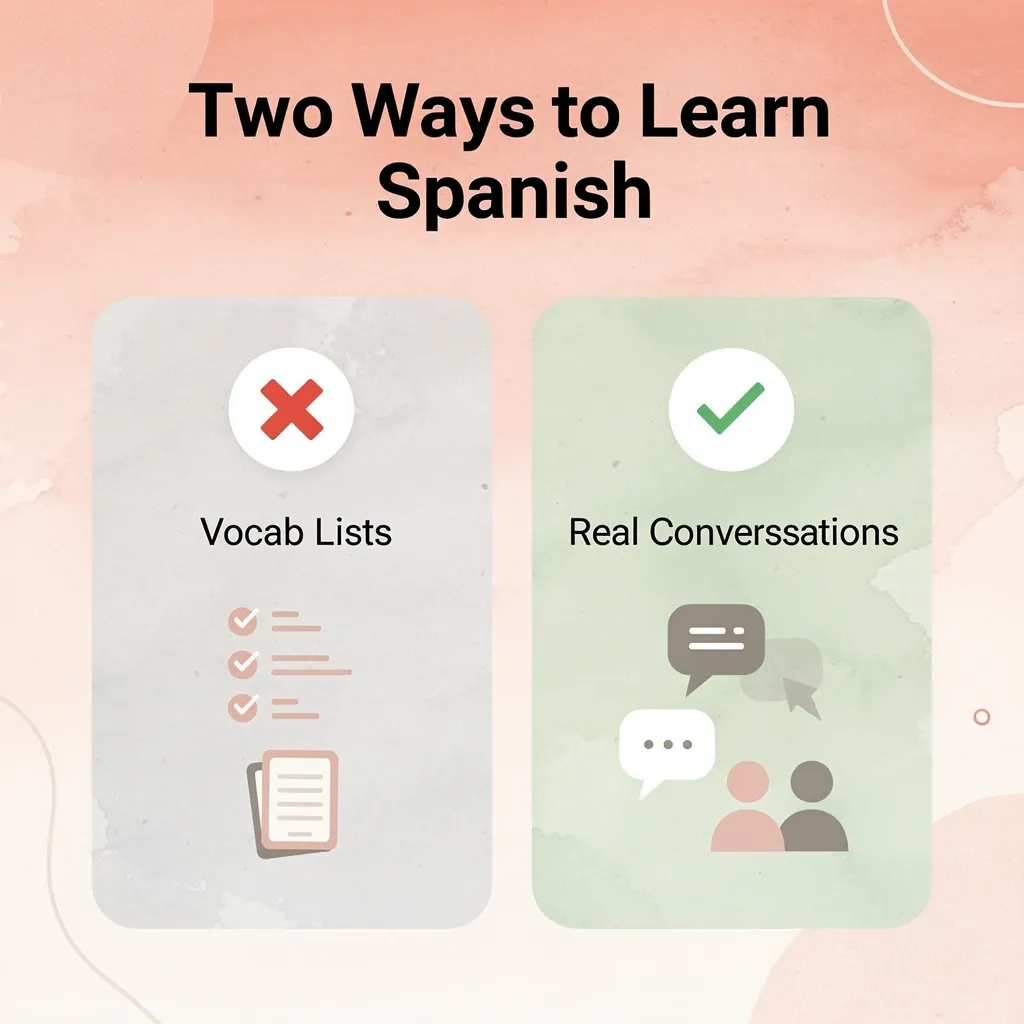
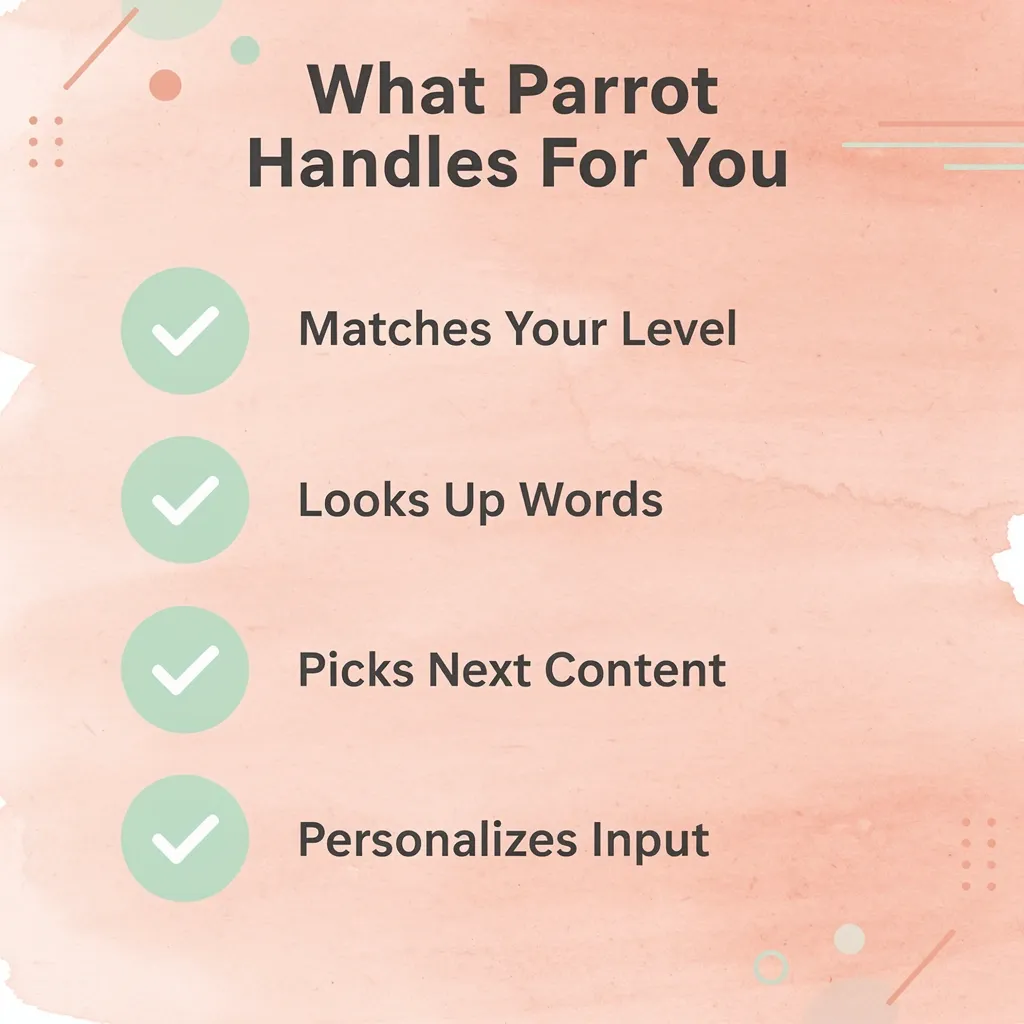
Creating this kind of learning environment on your own is hard. Finding content that matches your level, looking up words you don't know, choosing what to watch next, and staying motivated all take significant time and effort. These challenges often make learners go back to structured lessons that are easier to follow but don't work nearly as well for building conversational skills.
⚠️ Warning: Falling back on structured grammar lessons feels comfortable—but it's a trap. Comfortable doesn't mean effective when your goal is real conversational fluency.
Finding Level-Appropriate Content
Why It Hurts Your Progress
Content that's too difficult or too easy leads to frustration and disengagement
Looking Up Unknown Words
Why It Hurts Your Progress
Interrupts immersion and breaks learning momentum
Choosing What to Watch Next
Why It Hurts Your Progress
Decision fatigue makes it harder to stay consistent and can lead to quitting
Staying Motivated
Why It Hurts Your Progress
Without a clear structure, consistency quickly falls apart
Parrot removes these barriers by making comprehensible input practical, personalized, and enjoyable.
🎯 Key Point: Parrot delivers the right content, at the right level, with the right support to keep you learning naturally and consistently.
✅ Best Practice: Let Parrot handle content selection, level-matching, and vocabulary support so you can focus on absorbing the language.
How does Parrot make daily practice feel less like studying?
Challenge: Traditional lessons become repetitive and difficult to sustain engagement with
Many learners lose momentum because their study routine feels disconnected from how they naturally consume content. Grammar exercises and vocabulary drills become a chore, undermining consistency.
How Parrot helps: Parrot uses research-backed comprehensible input delivered through short-form videos. Learning feels like browsing content you enjoy rather than sitting through a language lesson, making daily practice easier. Since long-term consistency is one of the strongest predictors of language acquisition, turning practice into an enjoyable habit has greater impact than increasing study time alone.
How does Parrot keep comprehension flowing without constant translation?
Challenge: Constant translation interrupts comprehension
Stopping every few seconds to search for unfamiliar words breaks concentration and keeps learners dependent on translating everything into English.
How Parrot helps: Our clickable subtitles and instant translations provide support exactly when needed. Learners can quickly understand unfamiliar words without leaving the video, maintaining focus on the message.
How does Parrot help new vocabulary actually stick long term?
Challenge: Vocabulary disappears as quickly as it is learned
Memorizing vocabulary lists creates short-term recognition but poor long-term retention because words lack meaningful context.
How Parrot helps: Learners can save new words directly from videos and revisit vocabulary in the same context where they first encountered it. Seeing words repeatedly across different videos reinforces meaning and usage, making recall more natural during conversations.
How does Parrot match content to your level without the search effort?
Challenge: Finding the right content takes too much effort
Spanish content is everywhere, but not all of it works for every learner. Beginners feel overwhelmed by material made for native speakers, while intermediate learners struggle to find content that is challenging without being discouraging.
How Parrot helps: Our AI-powered recommendations personalize content based on learner interests and proficiency level. Rather than searching for suitable videos, learners receive a continuous stream of engaging, understandable content that gradually introduces new vocabulary and language patterns.
How does Parrot help learners stay consistent when motivation fades?
Challenge: Staying consistent over the long term
Learners often stop not because Spanish is too difficult, but because maintaining a study routine becomes difficult once motivation fades.
How Parrot helps: By combining entertaining short-form content with personalized recommendations, built-in vocabulary support, and contextual learning tools, Parrot reduces the effort required for daily practice. When learning fits naturally into existing habits—watching videos during breaks or while commuting—consistency becomes easier to maintain.
Parrot combines entertainment and education through an approach grounded in decades of language acquisition research: learners make the greatest progress when they regularly engage with understandable, meaningful language. Rather than relying on memorization or grammar drills, Parrot helps learners build conversational Spanish through consistent exposure to real language in real contexts.
Start Learning Spanish Today
The method you return to tomorrow matters more than the perfect one you abandon next week. Build real conversational Spanish through daily immersion in content that holds your attention, structured enough to keep pulling you forward without burning you out.
"Consistency beats perfection: the learner who shows up every day with an imperfect method will always outpace the one waiting for the ideal approach." — Language Acquisition Research
💡 Tip: Don't chase the perfect app or course—chase the one you'll open tomorrow. Daily habit is the real accelerator.
🎯 Key Point: Parrot turns short-form video into personalized immersion, matching you with comprehensible input at your level and building listening comprehension, vocabulary, and conversational confidence in just 10 to 15 minutes a day. It's built around the acquisition principles covered throughout this guide — not rote memorization, but real language absorbed naturally.
Listening Comprehension
How It Works
Level-matched short-form videos
Vocabulary
How It Works
Personalized immersion content tailored to your level
Conversational Confidence
How It Works
Daily practice in just 10–15 minutes
Acquisition Habits
How It Works
Structured around proven language acquisition principles
✅ Best Practice: Start your free trial today and discover how fast Spanish can feel natural — because consistent, comprehensible input is how fluency actually happens.
Related Reading
Duolingo Alternatives
Pimsleur Spanish Review
Best Duolingo Alternative For Spanish
Babbel Spanish Review
Best Free App To Learn Spanish
Rosetta Stone Vs Pimsleur
Alternative To Pimsleur
Pimsleur Vs Babbel
Rocket Spanish Vs Babbel
Rocket Spanish Review
Rosetta Stone Alternatives
Rocket Spanish Vs Rosetta Stone
Duolingo Vs Rosetta Stone
Living Language Vs Rosetta Stone