Speaking conversational Spanish within a year is a realistic goal, but the outcome depends heavily on method, consistency, and understanding what language acquisition actually requires. Research shows that structured daily practice, especially focused on spoken output, produces faster results than passive study alone.
For learners serious about reaching that milestone, combining proven habits with the right tools closes the gap between studying Spanish and actually speaking it. Apps built around real conversation practice, contextual vocabulary, and daily speaking exercises give learners a measurable edge, and those ready to commit can learn Spanish with Parrot, a platform designed around exactly that approach.
Table of Contents
Can You Really Learn Spanish in a Year?
What Research Says About Learning Spanish in One Year
What Determines How Much Progress You Make
A Practical Roadmap for Learning Spanish in One Year
Is Learning Spanish in a Year the Right Goal?
How Parrot Helps You Make Faster Progress Throughout the Year
Start Learning Spanish Today
Summary
Conversational Spanish fluency is achievable within a year for most English speakers, but the timeline depends almost entirely on method rather than motivation. Research from Expanish indicates that most native English speakers can reach conversational fluency in 6 to 9 months when their daily practice involves meaningful, contextual exposure rather than isolated vocabulary repetition. The gap between learners who hit that window and those who stall at beginner level traces back to what they were doing daily, not how long they studied.
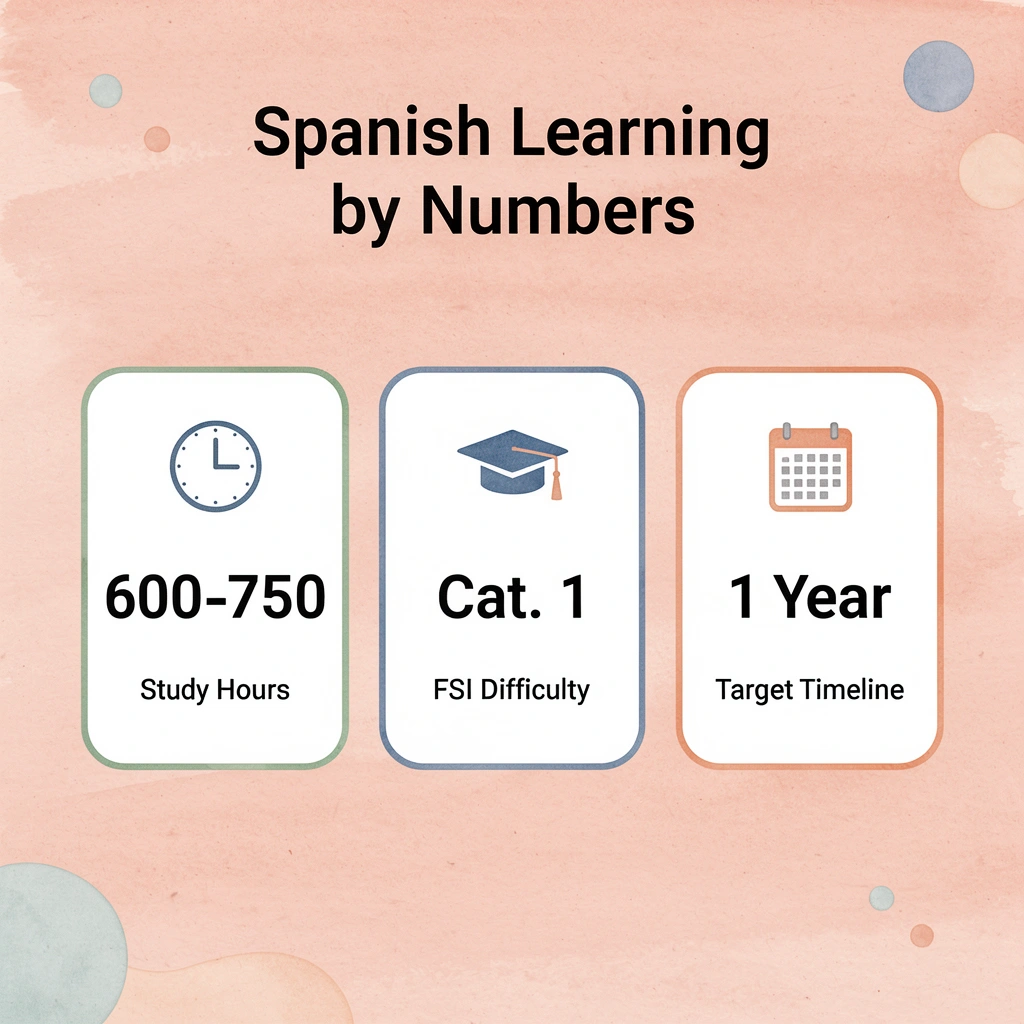
Spanish falls into Category 1 for English speakers, meaning it requires roughly 600 to 750 hours of study to reach solid working proficiency according to FSI data analyzed by Migaku in 2025. Spread across a full year, that works out to approximately two hours per day, but the total hour count matters far less than what fills those hours. A learner spending 600 hours in grammar drills will not arrive at the same place as one who spent 600 hours listening to, watching, and speaking real Spanish in context.
Grammar-first approaches feel productive but tend to build knowledge about a language rather than fluency inside it. Conjugating verbs and completing fill-in-the-blank exercises create a sense of forward motion, yet when a real conversation arrives, that grammar knowledge rarely transfers fast enough, and learners freeze. Comprehensible input, content where meaning is communicated in context even when individual words are unfamiliar, is where acquisition happens fastest.
Consistency is a stronger predictor of progress than session length. Research on habit formation by James Clear shows that improving by just 1% each day for a year results in ending up 37 times better than at the start. Ten focused minutes of Spanish every single day outperforms a two-hour session once a week because the brain consolidates language during the gaps between exposure, not during the exposure itself.
Visible progress directly shapes whether learners stay in the habit. A 2010 study by Conrad et al. found that users who saw a progress indicator showing faster-than-actual advancement were 10% more likely to complete a task than those shown no indicator at all. Learners who track small wins, sentences understood without translation, conversations held without freezing- sustain their practice longer than those who measure only by the distance still remaining.
The scale of the Spanish-speaking world creates a significant practical advantage for motivated learners. Instituto Cervantes reported that Spanish speakers worldwide will exceed 600 million people in 2024, making authentic input, podcasts, films, music, and real conversations freely accessible without a classroom or a plane ticket. Learners who treat that abundance as daily practice material close the gap between study and real-world fluency considerably faster than those waiting for structured instruction to provide it.
Parrot's Learn Spanish addresses the method gap directly by delivering comprehensible input through short-form video in 10- to 15-minute daily sessions, so that listening comprehension and speaking confidence develop together rather than sequentially.
Can You Really Learn Spanish in a Year?
Yes, you can reach conversational Spanish fluency in a year. Most learners who hit that milestone do so because they chose a method that matched how the brain actually learns language — not because they worked harder than everyone else.
"Reaching conversational fluency isn't about grinding harder — it's about choosing the right method that aligns with how the brain actually acquires language." — Language Learning Research
💡 Tip: The single biggest factor in hitting fluency within 12 months isn't talent or time — it's method selection. Choose a system built around how your brain learns, and the results follow.
🎯 Key Point: Conversational Spanish fluency is an achievable goal in one year — but only for learners who prioritize brain-compatible learning strategies over sheer effort.

Why does method matter more than motivation?
The failure point is usually method, not motivation. Most people start with apps that reward streaks and grammar drills, which feels productive but trains you to pass quizzes rather than hold a conversation. According to Expanish, most English speakers can reach conversational Spanish fluency in 6 to 9 months with consistent, meaningful exposure rather than isolated vocabulary repetition. The gap between learners who hit that window and those stuck at beginner level comes down to their daily practice.
What does a faster path to fluency actually look like?
The familiar approach—open an app, complete a lesson, earn points, close it—feels productive but rarely builds understanding for native-speed speech. Learners who break through faster spend time with real Spanish: short videos, authentic audio, and content where meaning emerges in context. Apps like Parrot use short-form video immersion grounded in Dr. Stephen Krashen's comprehensible input method, allowing learners to absorb Spanish through meaningful exposure rather than memorization.
Does daily time investment actually matter?
Doing the same thing every day in small amounts adds up faster than doing a lot of work occasionally, because language learning depends on regular exposure, not on intensive single sessions. Ten focused minutes daily works better than a two-hour session on Sunday, because your brain needs regular contact with the language to develop automatic comprehension rather than translating word by word.
The one-year timeline suits anyone who builds a small, daily habit filled with the right input. The learner who watches a short Spanish video during lunch, listens to a podcast on a commute, or practices speaking for a few minutes before bed is building something real, even if each session feels small in isolation.
Research reveals how quickly that accumulation can make a difference.
What Research Says About Learning Spanish in One Year
According to the Migaku Blog's 2025 analysis of FSI data, Spanish is a Category 1 language for native English speakers, requiring roughly 600 to 750 hours of study to reach solid working proficiency. Spread across a full year, that amounts to two hours a day. The barrier is not the total number of hours, but whether those hours contain the right kind of input.
"Spanish requires roughly 600 to 750 hours of study to reach solid working proficiency for native English speakers — breaking down to two hours a day over a full year." — Migaku Blog, 2025 FSI Data Analysis
🔑 Takeaway: 600 to 750 hours sounds daunting, but spread across 12 months, it becomes a manageable daily commitment. The real question is how you fill those hours.
The FSI benchmark was built around intensive, instructor-led immersion with structured feedback and constant speaking practice. Self-directed learners working from apps or textbooks rarely replicate those conditions. A learner spending 600 hours drilling grammar rules will not end up in the same place as one who spent 600 hours listening to, watching, and speaking real Spanish in context. The method shapes the outcome far more than the clock does.
Different learning approaches produce different outcomes after consistent practice:
Grammar drills and textbooks – Build structural knowledge and language rules, but often result in limited conversational fluency.
App-based repetition – Improves vocabulary recall and basic recognition, but may provide weaker preparation for real conversations.
Immersive input (listening, watching, speaking) – Builds practical language ability and can lead to real-world working proficiency.
🎯 Key Point: The FSI's 600-hour estimate assumes structured, instructor-led immersion — a standard that self-directed learners must consciously work to replicate.
⚠️ Warning: Logging 600 hours on a language app is not the same as 600 hours of immersive practice. The quality of your input determines your outcome, not the total time logged.
Why does grammar-first learning fall short in real conversations?
Most learners choose grammar-first approaches because they feel productive. Conjugating verbs, memorizing rules, and completing fill-in-the-blank exercises create a sense of forward motion, but they build knowledge about the language rather than fluency in it. When a real conversation arrives, grammar knowledge does not transfer quickly enough. Apps built around learning Spanish through short-form video immersion deliver comprehensible input in brief windows people already spend scrolling, replacing passive consumption with active language acquisition.
Does daily consistency matter more than longer study sessions?
Doing something consistently is a stronger predictor of progress than session length. Ten focused minutes daily outperform a two-hour weekly session, because the brain consolidates language during gaps between exposure. Frequent contact with Spanish keeps vocabulary accessible, sharpens listening comprehension, and builds the automatic processing that makes real conversations feel less like translation.
How does treating authentic input as daily practice close the fluency gap?
Instituto Cervantes reports that Spanish speakers worldwide will exceed 600 million people in 2024. This scale means authentic input is everywhere: podcasts, films, news, music, and real conversations are all accessible without travel. Learners who treat this abundance as daily practice material close the gap between study and real-world fluency faster than those who wait for classroom instruction.
The research confirms that a year is enough time, but only when the method respects how language acquisition works.
Related Reading
Is Duolingo Good For Spanish
Best App To Learn Spanish While Driving
Is English Or Spanish Harder To Learn
How To Learn Spanish In A Week
Can You Learn Spanish In A Year
Games To Learn Spanish
What Dialect Of Spanish Does Duolingo Teach
Best Tools To Learn Spanish
Is Pimsleur Good
Reasons To Learn Spanish
What Determines How Much Progress You Make
Two people can follow the same curriculum, use the same app, and study the same number of hours, yet arrive at completely different places twelve months later. The difference comes down to how they spend their daily time with Spanish, not total hours logged.
"The difference comes down to how they spend their daily time with Spanish — not the total hours logged." — Core Insight
🎯 Key Point: Equal time ≠ equal results. Two learners on the same curriculum can end up at completely different levels based on the quality of their daily practice — not the quantity.
💡 Tip: Before tracking how many hours you study, ask yourself how you're using each session. Intentional, active practice will always outperform passive time spent with an app.
Language learning progress depends more on learning quality than time spent alone:
Study method – Low-progress learners rely on passive review, while high-progress learners use active recall to strengthen retention.
Time focus – Low-progress learners measure success by total hours logged, whereas high-progress learners focus on the quality and effectiveness of each session.
Engagement – Low-progress learners repeat material mindlessly, while high-progress learners use deliberate practice to improve specific skills.
12-month outcome – Low-progress learners often see minimal gains, while high-progress learners are more likely to reach meaningful fluency milestones.

Does consistency actually compound?
Small, repeated actions create big results across every skill-based discipline. According to James Clear's research on habit formation, improving by 1% each day for a year results in ending 37 times better than when you started. A language learner who spends 15 focused minutes with Spanish daily builds a fundamentally different brain foundation than someone who crams for two hours on Saturdays.
The daily learner reinforces vocabulary when memory needs refreshing, while the weekend learner largely re-learns what they forgot.
The failure point is not laziness, but the belief that longer sessions occasionally can substitute for shorter, regular ones. Memory consolidation happens during the gaps between practice, not during practice itself.
What keeps most learners stuck at the intermediate stage?
Most learners stop making progress because they stop getting feedback. Reviewing grammar rules or vocabulary lists creates an illusion of progress without building real learning. Progress occurs when your brain actively retrieves information from memory, applies it, and adjusts based on results. Speaking, even with mistakes, forces this cognitive work in ways flashcards cannot.
Why does building vocabulary first leave learners frozen in real conversation?
The familiar approach of spending months building vocabulary and grammar before attempting conversation feels logical but creates learners who understand Spanish on paper and freeze at natural speed. Apps like Parrot address this by placing learners inside short-form video content featuring real conversational Spanish from day one, so comprehension and speaking confidence develop together rather than sequentially. The exposure is calibrated to be understandable, allowing learners to process meaning in context rather than translate word by word.
How much does visible progress shape behavior?
Motivation is a response to feedback. When learners see forward movement, they keep going. Research in a 2010 study by Conrad et al. on task completion behavior found that users shown a progress indicator with faster-than-actual advancement were 10% more likely to complete tasks than those shown no indicator. For language learning, this applies directly: a learner who tracks small wins—new words recognized, sentences understood without translation, conversations held without freezing—stays in the habit longer than one measuring only remaining distance.
Progress compounds when the method respects how the brain retains language.
A Practical Roadmap for Learning Spanish in One Year
One year is enough time to reach conversational Spanish: not perfect, but capable of holding real conversations, understanding native speakers at moderate speed, and navigating new situations with confidence. The critical condition is that your approach matches how language acquisition actually works.
"One year of structured, consistent practice is a realistic timeline to reach conversational fluency: the level where real communication becomes possible." — Language Acquisition Research
🎯 Key Point: Conversational fluency in one year is an achievable goal, but only if your learning strategy is built around how the brain acquires language, not how most people assume it does.
💡 Tip: Define success clearly from day one. Targeting conversational ability rather than perfect grammar or native-level fluency keeps your roadmap realistic and your motivation intact for the full 12-month journey.

Months 1 to 3: Build the right foundation
Focus on high-frequency vocabulary: the 500 to 1,000 words that appear in roughly 80% of everyday conversation, along with basic sentence structures for discussing time, desires, and actions. Train your ear early by listening to native speakers daily, even if you don't understand everything. This exposure helps your brain recognise Spanish rhythm before your vocabulary catches up.
Create a daily habit of twenty minutes of focused, comprehensible input. Your brain learns language between practice sessions, so frequent practice matters more than extended sessions.
Months 4 to 6: Surround yourself with real Spanish
The familiar approach is to keep drilling grammar rules and vocabulary lists, but this keeps you in a controlled environment where Spanish never surprises you. Shift toward authentic exposure: beginner-friendly videos, slow-paced podcasts, graded readers above your current level. You will not understand everything—that gap is productive. Comprehensible input, where you grasp meaning even when individual words are unfamiliar, is where learning happens fastest.
This is when short speaking attempts start to matter: ordering food, introducing yourself, describing your day in two sentences. These micro-conversations improve retention more than repeatedly reviewing the same flashcard deck.
Months 7 to 12: Use Spanish to learn Spanish
The second half of the year tests whether months one through six built knowledge you can use or knowledge you merely recognize. Learners who only gathered information often hit a wall; those who mixed information with regular practice find conversations begin to flow. Shift your priority to speaking practice through language exchanges or tutoring, copying native speakers to internalize rhythm and pronunciation, and consuming content made for native audiences rather than learners.
What does progress actually look like by month ten?
By month ten, grammar should feel less like a rulebook you consult and more like a pattern you notice. You will still make mistakes—that is how you improve. Every conversation reveals something new, and every gap is a specific thing you can work on rather than a vague distance to fluency.
Why do so many learners stall before reaching conversational Spanish?
Most learners who fail to reach conversational Spanish in a year lack effective practice methods, not effort. A recurring pattern: years of daily app use produce recognition without production—the ability to identify correct answers in multiple-choice prompts but not generate sentences from scratch. Apps built around short, context-rich video immersion, like Learn Spanish, deliver comprehensible input in 10 to 15 minutes daily, building the speaking and listening skills conversation requires.
Six to twelve months of consistent, method-driven practice enables most learners to reach functional fluency in Spanish. Knowing the roadmap determines whether you finish the year speaking confidently or still waiting to feel ready.
Is Learning Spanish in a Year the Right Goal?
Setting a goal to learn Spanish in a year can be motivating, but defining what success looks like is essential. Without realistic expectations, learners may feel discouraged despite making measurable progress.
"Without realistic expectations, learners may feel discouraged even though they are making real progress." — A critical reminder before setting any language learning timeline.
🎯 Key Point: A one-year Spanish goal is achievable, but only if you define what you're aiming for before you start.
💡 Tip: Before committing to a timeline, write down your definition of success. Are you aiming to survive a vacation abroad or hold a deep conversation with a native speaker? Your answer changes your study plan.
A big misconception is treating conversational fluency and native-like fluency as the same goal — they are not. Understanding the difference is critical to staying motivated throughout your journey.
Different levels of fluency require different amounts of time and learning depth:
Conversational fluency – Enables everyday conversations, real-life interactions, and practical communication, even with occasional mistakes. Typically requires 1–2 years of consistent practice.
Native-like fluency – Requires deep vocabulary, cultural understanding, and near-perfect language ability. Usually takes several years of immersive practice.
Conversational fluency means understanding everyday speech, participating in common conversations, expressing your thoughts, and handling real-life situations with confidence — even with occasional mistakes. Native-like fluency, by contrast, requires deeper vocabulary, strong cultural understanding, and a level of language skill that typically takes years of consistent, immersive practice.
⚠️ Warning: Measuring yourself against native-like fluency as a beginner is a fast track to burnout. Set conversational fluency as your Year 1 benchmark instead.

What kind of Spanish do you actually need?
If you're learning Spanish for travel, you may only need to understand common questions, ask for directions, order meals, and have simple conversations—achievable within a year with consistent practice.
Professional proficiency is different. Using Spanish in healthcare, education, customer service, or business requires specialized vocabulary, understanding different accents, and confidence in complex discussions. These skills demand practice beyond everyday conversational ability.
How much does your time investment shape your progress?
How much time you spend learning matters significantly. A casual learner studying a few times weekly progresses differently than someone who uses Spanish daily through listening, reading, speaking, and conversation. Each approach yields different results after twelve months.
Measure your progress by signs beyond finished lessons or study hours. Better indicators include understanding podcasts without translating every sentence, following conversations more easily, responding faster in Spanish, and thinking less in English while listening.
Is consistency more important than study time?
Sustainable routines work better than ambitious schedules. Studying 20 to 30 minutes most days while regularly engaging with authentic Spanish proves more effective than several-hour sessions driven by sporadic motivation. Consistency creates the repeated exposure language acquisition requires.
Learning Spanish in a year is the right goal if you expect conversational ability, not perfection. Twelve months provides enough time to build a solid foundation and communicate confidently in everyday situations through listening, reading, speaking, and meaningful communication rather than memorization alone.
Modern language learning tools make it easier to build these habits by bringing authentic Spanish into your daily routine and maximizing every month of consistent practice.
Related Reading
Best App To Learn To Speak Spanish
Mango Vs Rosetta Stone
Fastest Way To Learn Spanish
How To Learn Medical Spanish
Rosetta Stone Spanish Reviews
Best Way To Learn Spanish As An Adult
Best App To Learn Mexican Spanish
How To Learn Spanish On Your Own
How Parrot Helps You Make Faster Progress Throughout the Year
Learning Spanish in a year requires steady progress through consistent exposure, meaningful practice, and real communication. While structured lessons build a critical foundation, learners need authentic experiences to keep improving. Parrot bridges that gap.
"Real language acquisition accelerates when learners move beyond structured lessons into authentic, communicative practice." — Language Acquisition Research
🎯 Key Point: Consistent exposure combined with real communication is the fastest path to Spanish fluency, not passive study alone.
💡 Tip: Don't wait until your structured lessons feel "complete" before seeking authentic practice. Real progress happens when both work together. Parrot is built to make that happen throughout the year.
Why do real conversations feel so different from textbook Spanish?
As learners progress, many can complete exercises but struggle to understand native speakers. Real conversations move faster, include informal expressions, and sound different from textbooks. Parrot delivers research-backed comprehensible input through engaging short-form videos, designed to be understandable while gradually becoming more challenging.
How does Parrot help learners stay in the flow of a conversation?
A common problem is stopping frequently to translate unfamiliar words, which disrupts your focus on understanding the overall meaning. With clickable subtitles and instant translations, Parrot lets learners understand new vocabulary without losing the flow of conversation.
How does Parrot turn new words into vocabulary you can actually use?
You lose vocabulary words when you don't see them enough in real situations. Parrot lets learners save vocabulary from videos and revisit those words in meaningful contexts, turning passive vocabulary into words they can recognise and use with confidence.
How does Parrot find Spanish content at the right level for you?
Finding Spanish content at the right level becomes harder as your proficiency increases. Material that's too easy won't help you improve; content that's too hard frustrates you quickly. Parrot's AI-powered recommendation feed personalizes authentic Spanish videos based on your proficiency level and interests.
Learning Spanish in a year requires consistently engaging with understandable, authentic Spanish. Parrot helps learners maximize every study session by bridging the gap between studying Spanish and using it in real-life situations.
Start Learning Spanish Today
You have the roadmap, the method, and a realistic timeline. What separates learners who finish the year speaking Spanish from those who are still preparing to start is one decision made today, not a perfect plan made later.
"The gap between learners who succeed and those who don't isn't talent or time — it's the moment they decide to begin." — Language Acquisition Research
🎯 Key Point: No plan is perfect. The learners who reach real fluency start imperfectly and adjust — not wait for the ideal moment.
⚠️ Warning: Over-planning is the #1 trap for language learners. Every day spent preparing to start is a day of potential progress lost.

If your goal is real conversation, learn Spanish with Parrot using comprehensible input, personalized short-form video, and contextual vocabulary tools matched to your level. Ten to fifteen minutes a day is enough with the right method. Start your free trial at Parrot and move closer to the conversations you actually want to have.
💡 Tip: Comprehensible input — hearing and reading Spanish just above your current level — is one of the most research-backed methods for accelerating fluency. Parrot is built around this principle.
Parrot focuses on practical, engaging language acquisition through personalised learning experiences:
Comprehensible input – Matches content to your current ability level to maximise understanding and long-term retention.
Personalised short-form video – Keeps learning engaging with focused 10–15 minute sessions.
Contextual vocabulary tools – Teaches vocabulary through real usage and context rather than isolated word lists.
Free trial – Allows learners to start immediately with no upfront commitment.
Related Reading
Rosetta Stone Alternatives
Living Language Vs Rosetta Stone
Best Duolingo Alternative For Spanish
Pimsleur Spanish Review
Pimsleur Vs Babbel
Best Free App To Learn Spanish
Babbel Spanish Review
Rocket Spanish Vs Babbel
Duolingo Alternatives
Duolingo Vs Rosetta Stone
Alternative To Pimsleur
Rocket Spanish Vs Rosetta Stone
Rocket Spanish Review
Rosetta Stone Vs Pimsleur