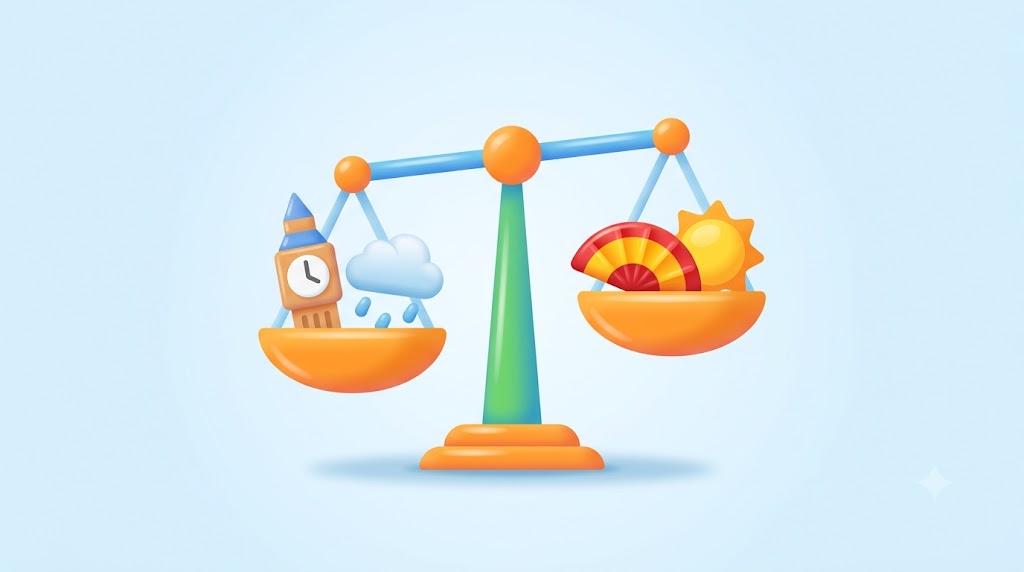
Spanish and English sit on opposite ends of the language-learning spectrum, and understanding why helps learners make smarter decisions from the start. Spanish offers consistent pronunciation rules and straightforward verb patterns, while English piles on irregular spellings, inconsistent grammar, and a vocabulary drawn from dozens of languages. For anyone weighing the two, the difference is not just academic. It directly affects how long fluency takes and what study methods actually work.
Knowing where the real difficulty lies removes guesswork and points learners toward strategies that match how conversations actually unfold. The best way to learn conversational Spanish, for instance, looks very different from memorizing grammar charts or translating sentences word by word. For anyone ready to build real speaking skills through a structured, conversation-first approach, learn Spanish.
Table of Contents
Why So Many Learners Compare English and Spanish
What Makes English and Spanish Difficult in Different Ways
Why Some Learners Progress Faster Than Others
What Actually Makes Learning Spanish Easier
Is Spanish the Right Language for Your Goals?
How Parrot Helps You Learn Spanish More Naturally
Start Learning Spanish Today
Summary
Learners who compare Spanish and English difficulty often overlook the most important variable: their native language background. A native Portuguese speaker and a native Korean speaker are not starting from the same place when they sit down to learn Spanish. Generic difficulty rankings ignore this reality, which is why so much online advice fails to match what individual learners actually experience.
English and Spanish front-load difficulty in different areas rather than one being uniformly harder. English carries roughly 20 distinct vowel sounds compared to Spanish's 5, making pronunciation unpredictable for learners from most language backgrounds. English also contains approximately 171,000 words in active use versus Spanish's roughly 93,000, nearly double the vocabulary surface area, while Spanish compensates with complex verb conjugations that encode tense, subject, and certainty within a single word form.
Learning rate differences between students can vary by a factor of 5 to 1 across typical classroom populations, according to Five Twelve Thirteen. This means two people investing identical hours can arrive at completely different outcomes, not because of intelligence, but because of method. Learners who accumulate hours through grammar drills without sufficient exposure to authentic spoken language consistently plateau before reaching conversational fluency.
English speakers carry a structural head start with Spanish that most learners underuse. Spanish shares over 3,000 cognates with English, meaning words like "hospital," "animal," and "natural" transfer almost instantly. Despite this advantage, FSI data estimates that it takes 600 to 750 hours to reach conversational proficiency, and that hours spent on isolated grammar review rather than real spoken input build knowledge without building the processing speed that actual conversations require.
Consistency compounds in ways that most learners underestimate. A learner who spends 25 focused minutes daily with authentic spoken Spanish will outpace someone who studies for two hours every Sunday, not because of total time, but because daily exposure keeps the language active and reinforces prior sessions, rather than having to recover forgotten ground each time.
Motivation tied to real-world stakes, such as healthcare work, travel, family relationships, or career requirements, sustains effort far longer than abstract fluency goals do. Learners with relationship-driven or professionally specific reasons to practice tend to show up consistently even after novelty fades, at the stage where most method-driven learners stall.
Parrot's Learn Spanish addresses the gap between passive vocabulary knowledge and active conversational fluency by delivering short-form video immersion built around comprehensible input, giving learners exposure to real spoken Spanish at a level their brains can process during the small gaps of a normal day.
Why So Many Learners Compare English and Spanish
Learners search "Is English or Spanish harder to learn?" to understand what they're getting into before starting.

Both languages are spoken across many continents and matter for work and personal reasons. Both offer abundant learning resources, making them accessible to beginners. This combination naturally invites comparison.
Why does your native language change everything about this comparison?
The problem is that most answers online ignore the most important variable: the person asking the question. A native Portuguese speaker and a native Korean speaker are not taking the same test when they learn Spanish. Their starting points differ so greatly that calling one language "easier" without that context is meaningless.
According to Kent State University's Global Language Learning Trends and Statistics, Spanish is the most studied foreign language in the United States, with over 50% of language learners choosing it. Spanish feels more accessible to English speakers than Mandarin or Arabic, but "accessible" and "easy" are not synonymous.
Where do traditional learning methods break down for real fluency?
The familiar approach—grammar charts, vocabulary lists, quiz scores—feels productive because it produces visible output. But the friction emerges months in, when a learner can conjugate a verb correctly in writing yet freezes when a native speaker responds at natural speed. The gap between knowing rules and understanding real speech is where traditional methods break down. This is the problem that Learn Spanish is built to close. Our Parrot app uses short-form video immersion grounded in comprehensible input so learners build listening fluency alongside vocabulary.
What actually drives fluency regardless of which language you choose?
What makes you fluent is not which language you pick, but whether you receive steady, meaningful exposure at the right difficulty level. Dr. Stephen Krashen's comprehensible input research demonstrates this: learning happens when you understand the message, not when you memorize rules. The question is not which language is harder in general, but which learning environment lets you understand real language early and often.
That is where the real differences between these two languages matter.
What Makes English and Spanish Difficult in Different Ways
English and Spanish are hard in genuinely different ways. English puts most of its difficulty into pronunciation and vocabulary breadth. Spanish puts most of it into grammar and verb morphology. Neither language is uniformly harder — they just make you work in different places.
"English and Spanish don't compete on the same difficulty — English challenges you with pronunciation and vocabulary, while Spanish demands grammatical precision and verb mastery."
English and Spanish present different learning challenges depending on the skill area:
Pronunciation – English can be very difficult due to inconsistent spelling patterns, while Spanish is more consistent and predictable.
Vocabulary breadth – English has an extremely wide vocabulary, whereas Spanish vocabulary is generally more predictable with clearer patterns.
Grammar complexity – English grammar is relatively simpler, while Spanish requires more complex rules and structures.
Verb morphology – English uses fewer verb forms, while Spanish requires learning extensive conjugation patterns.
🎯 Key Point: The real question isn't which language is harder overall — it's which type of difficulty matches your weaknesses as a learner.
💡 Tip: If you struggle with memorizing rules and conjugations, English may feel more natural to pick up. If irregular spelling and pronunciation trip you up, Spanish's phonetic consistency gives you a real advantage.

Where English actually trips people up
According to Spanish Mama's comparison of Spanish and English, English has roughly 20 vowel sounds, while Spanish has only 5. This difference means English learners must train their ears and mouths to distinguish sounds that many other languages never require. Spanish learners face the opposite challenge: fewer sounds to produce, but each must be exact and consistent, since vowels do not shift based on stress as they do in English.
How does vocabulary complexity differ between the two languages?
Spanish Mama also reports that English contains approximately 171,000 words in active use compared to Spanish's roughly 93,000. English uses phrasal verbs like "put off," "give in," and "run out of," where meaning cannot be deduced from individual words alone. Spanish builds complexity through verb conjugations that encode who is speaking, when, and how certain they are within a single word form.
Why does drilling conjugation tables fail in real conversations?
Most learners practice Spanish verb conjugation through repetition and flashcards, an approach that boosts test scores rather than conversational skills. When native speakers respond at natural speed, conjugation tables offer little help. The real problem is processing language fast enough to participate.
Parrot addresses this problem through short-form video content pitched at the right level of difficulty, so learners hear Spanish as it is spoken. Rather than drilling grammar in isolation, our platform helps learners encounter conjugations in real sentences and contexts, enabling the brain to map form to meaning over time.
Which difficulty actually slows you down?
Spanish grammar complexity rarely stops learners from reaching conversational fluency. What stops them is insufficient exposure to real spoken Spanish at an understandable level. English pronunciation irregularities rarely stop English learners either. What stops them is insufficient exposure to native speakers who use natural rhythm and connected speech. Structural difficulty is less predictive of progress than the quality and quantity of comprehensible input learners receive.
This realization points to a place most learners never consider.
Related Reading
Is Duolingo Good For Spanish
Best App To Learn Spanish While Driving
Is English Or Spanish Harder To Learn
How To Learn Spanish In A Week
Can You Learn Spanish In A Year
Games To Learn Spanish
What Dialect Of Spanish Does Duolingo Teach
Best Tools To Learn Spanish
Is Pimsleur Good
Reasons To Learn Spanish
Why Some Learners Progress Faster Than Others
Two learners can start Spanish on the same day, use the same app, and sit through the same lessons. Six months later, one holds a real conversation. The other is still conjugating verbs on flashcards. The gap stems from how smart someone is or how hard the language is to learn.
"The difference between learners who break through and those who plateau isn't talent — it's the quality of daily practice and whether their habits keep improving over time."
🎯 Key Point: Starting at the same time with the same tools doesn't guarantee the same results — what happens in between is everything.

The difference is how good their daily practice is and whether their habits keep getting better over time. Most learners assume that simply showing up is enough — but consistent, high-quality repetition is what separates those who plateau from those who achieve real fluency.
Language learning outcomes depend heavily on the quality and consistency of daily practice habits:
Fast progressor – Uses targeted, active practice and can achieve real conversational ability within six months.
Slow progressor – Relies on passive review with little iteration, often remaining focused on basic flashcard practice.
Plateaued learner – Lacks consistency and feedback loops, resulting in minimal measurable improvement.
💡 Tip: Don't just practice more — practice better. Regularly audit your habits and ask whether they're actually moving you toward fluency, or just keeping you comfortable.
⚠️ Warning: Repeating the same low-quality habits every day creates the illusion of progress without delivering real results.
The hidden math of learning rate
According to Five Twelve Thirteen, learning rates can differ significantly among students—sometimes by as much as 5-to-1 in a typical classroom. Two people can spend the same amount of time studying but reach different levels. This doesn't reflect intelligence; it reflects how efficiently they use their time. A student who spends 30 minutes daily having conversations in Spanish builds skills that someone studying only grammar tables does not.
Why do so many learners plateau despite logging hours?
Most learners who stop making progress share a recognizable pattern: they spend hours without getting the right kind of exposure. They read conjugation rules, complete exercises, and score well on written quizzes, yet freeze when a native speaker picks up speed. Knowing a word on paper and retrieving it mid-sentence are two entirely different cognitive acts, and only the latter is trained through authentic listening and speaking practice.
How do the fastest learners use comprehensible input as the engine?
The fastest learners treat comprehensible input as the engine, not the supplement. Short, consistent sessions built around real spoken content—video clips, street conversations, informal interviews—train the brain to process rhythm, connected speech, and natural phrasing in real time. Apps like Parrot use short-form video immersion so learners encounter Spanish as the brain acquires it: through meaningful messages at the right level, in small gaps of a normal day rather than demanding a dedicated hour at a desk.
A learner who spends 25 focused minutes daily with authentic spoken Spanish will outpace someone who studies for two hours every Sunday. Daily exposure keeps the language active and builds on itself, whereas weekly sessions waste the first 20 minutes recovering forgotten material.
Related Reading
How To Learn Medical Spanish
Fastest Way To Learn Spanish
Rosetta Stone Spanish Reviews
Best Way To Learn Spanish As An Adult
How To Learn Spanish On Your Own
Best App To Learn To Speak Spanish
Best App To Learn Mexican Spanish
Mango Vs Rosetta Stone
What Actually Makes Learning Spanish Easier
What makes Spanish easier has more to do with where you're starting than the language itself. English speakers have a big structural advantage: Spanish shares over 3,000 cognates with English, meaning words like "hospital," "animal," and "natural" transfer almost instantly. According to Worlds Across Blog, this is a head start most learners never fully use.
"Spanish shares over 3,000 cognates with English — meaning thousands of words transfer almost instantly for native English speakers." — Worlds Across Blog
🎯 Key Point: Your native language is one of your biggest assets when learning Spanish. Cognate recognition alone can fast-track your vocabulary acquisition by thousands of words before you even open a textbook.
💡 Tip: Don't overlook your built-in advantage. Actively scanning for cognates during reading and listening practice is one of the most underused strategies for accelerating fluency.
Spanish cognates help English speakers accelerate vocabulary acquisition through familiar word patterns:
Hospital → Hospital – Has an identical meaning in both languages, allowing instant recognition.
Animal → Animal – Transfers directly with no learning barrier.
Natural → Natural – Shares the same spelling and meaning, making it immediately recognisable.
Possible → Posible – Requires only a minor spelling adjustment for near-instant understanding.
Important → Importante – Follows a predictable pattern, enabling near-instant vocabulary transfer.

Why do so many learners plateau before reaching real fluency?
The critical difference between learners who stop improving and those who continue is how they handle the gap between structured study and real-world use. Many learners spend months in apps or textbooks building grammar knowledge, only to freeze when a native speaker speaks at full speed. Real fluency is not about knowing more words; it is about training your brain to handle the rhythm, compression, and spontaneity of actual speech.
Does adding more structured lessons actually build conversational fluency?
FSI data cited by My Daily Spanish estimates that it takes 600 to 750 hours to reach conversational proficiency. Most learners respond by adding structured lessons, but reviewing isolated grammar tables instead of processing real spoken Spanish builds knowledge without fluency. Apps like Parrot address this by delivering short-form video immersion around comprehensible input, giving learners authentic Spanish in manageable doses that fit daily life.
What actually closes the gap
The learners who improve fastest treat listening as a skill to practice rather than passively consume. Adjusting playback speed on Spanish video content calibrates your learning. Starting at 80% speed and slowly increasing it over weeks trains your ability to understand sounds, much like interval training builds cardiovascular strength. The goal is controlled difficulty that pushes your understanding incrementally higher.
Why does speaking before you feel ready accelerate fluency?
Speaking practice works the same way. Learners often wait to speak until they feel ready, which usually means they never do. Readiness happens when you speak, not before you start. Talking to yourself, repeating what you hear, and low-stakes conversation practice help you speak faster than silent study alone. Every mistake in real conversation teaches you something.
Does your method matter more than the language you choose?
The method determines the experience more than the language does.
Knowing Spanish is accessible does not tell you whether it is the right language for your goals.
Is Spanish the Right Language for Your Goals?
Your motivation matters most. Spanish aligns with practical goals for English speakers more consistently than nearly any other language option.
"Spanish is one of the most practical language choices an English speaker can make, offering unmatched access to global communication, career opportunities, and cultural connection." — Language Learning Research
🎯 Key Point: Before committing to any language, align your choice with your real-world goals. Spanish wins for most English speakers because it delivers immediate, tangible results.
💡 Tip: Ask yourself one critical question: where do you want this language to take you? If the answer involves travel, career growth, or connecting with communities, Spanish is your best first choice.

Spanish delivers strong value across travel, career, culture, and accessibility goals:
Travel and tourism – Spoken across 20+ countries, making it highly useful for international travel.
Career advancement – Offers valuable opportunities due to strong demand in global markets.
Cultural connection – Provides access to diverse cultures, traditions, and communities.
Ease of learning – Can be acquired relatively quickly by English speakers due to shared linguistic features.
When your goal shapes everything
The clearest sign that Spanish is the right choice for you comes from how often you will use it. A healthcare worker in Texas, a traveler planning six months in South America, or someone whose partner's family speaks only Spanish at Sunday dinners each has a built-in reason to practice daily. That daily pressure is the engine that keeps you going. Learners motivated by relationships persist longer than those chasing fluency as an abstract goal, because every conversation carries real stakes and real rewards.
Why do career learners stall before reaching real fluency?
People who want to advance their careers in healthcare, education, and public service need Spanish for more than just a credential—employers actively seek employees who can communicate without a translator. A significant gap exists between "studied Spanish in school" and "can handle an unscripted patient intake conversation." Most professional learners get stuck in this gap, which hinges on the ability to process information quickly under pressure. This skill develops only through repeated exposure to real, unscripted speech.
How do you move from understanding Spanish to actually producing it?
Learners who focus on one goal and use only one method—textbooks, apps, or grammar drills—often reach a point where they understand a lot but can't use what they know. You understand much more than you can say, and that difference feels like failure even though it's a normal stage. Parrot helps by mixing short videos with comprehensible input at the right level, moving learners from understanding Spanish to using it without lengthy study sessions.
What if you already speak a Romance language?
If you speak Portuguese, Italian, or French, Spanish will feel less like learning and more like tuning a slightly different instrument. Shared grammatical structure, overlapping vocabulary, and similar phonetic patterns shorten the timeline considerably. For these learners, the question is not whether Spanish is achievable, but how quickly they want to get there.
What changes if your native language isn't in the Romance family?
For learners whose native language is not in the Romance family, the situation differs but remains hopeful. English speakers already have access to thousands of shared cognates and a sound system that functions predictably. What matters is whether your learning method provides sufficient contact with real, understandable Spanish to build the mental models that grammar charts alone cannot create.
How does motivation shape which language you should learn?
The right language is one that connects to something you care about enough to keep showing up for, week after week, long after the novelty wears off.
How Parrot Helps You Learn Spanish More Naturally
Learning Spanish becomes easier when you move beyond memorizing rules and understand how people use the language. Conversational fluency develops through regular exposure to authentic, understandable Spanish.
"Conversational fluency develops through regular exposure to authentic, understandable Spanish, not through rules alone." — Core Language Acquisition Principle
💡 Tip: Focus on authentic Spanish content from day one. Real language exposure builds natural fluency faster than textbook drills.
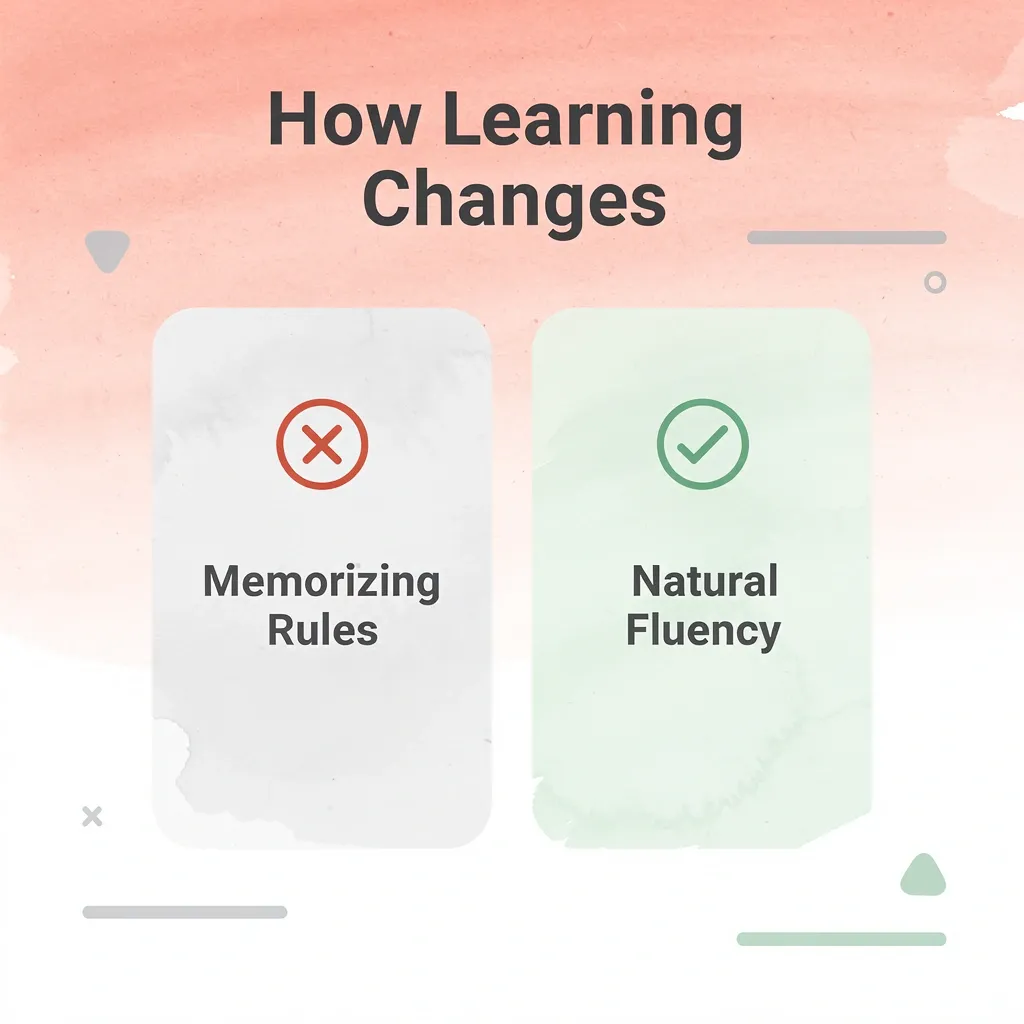
Parrot complements your current study routine by helping you apply what you've learned in real-world contexts, transforming passive study into active language acquisition through engaging content.
🎯 Key Point: The shift from passive memorization to active language acquisition is the single most important factor in achieving conversational fluency.
Parrot focuses on active language acquisition rather than passive memorisation:
Passive memorization – Leads to limited real-world application and difficulty using language naturally in conversations.
Active acquisition with Parrot – Builds natural, conversational fluency through practical language use.
Authentic content exposure – Improves retention and recall by exposing learners to real-world language patterns.
✅ Best Practice: Use Parrot alongside your existing routine to bridge the gap between textbook knowledge and real-world Spanish fluency.
Challenge: You Understand Grammar but Struggle to Follow Native Speakers
Many learners can explain Spanish grammar or complete textbook exercises but feel lost when listening to native speakers. Real conversations move faster, include informal expressions, and vary across speakers and situations.
Parrot is built around research-backed comprehensible input, delivering Spanish through engaging short-form videos that are easy to understand while gradually introducing more advanced language. Learners experience naturally spoken Spanish, developing listening comprehension alongside vocabulary and grammar.
Challenge: You Pause Every Video to Translate New Words
Stopping to look up unfamiliar words breaks your focus and impedes comprehension of the main message.
Clickable subtitles and instant translations provide immediate support without interrupting your viewing. Learners can understand new words while following the conversation, acquiring vocabulary as it's naturally used.
Challenge: Vocabulary Doesn't Stick
Words you learn once typically don't stay in your memory because you don't encounter them again in real situations.
Learners can save new words and expressions from videos and review them later in real contexts. Seeing vocabulary used naturally across different conversations strengthens long-term memory and helps you recall the words when needed.
Challenge: Finding the Right Content Is Overwhelming
The internet offers abundant Spanish content, but beginners find native speakers too difficult, while intermediate learners spend more time searching for videos than learning.
Parrot's AI-powered recommendation feed personalizes videos based on your skill level and interests, adjusting as your understanding improves to keep content challenging without becoming discouraging.
Challenge: Staying Motivated Long Enough to Become Conversational
Many learners lose motivation when every study session feels the same, making it difficult to stay consistent as learning becomes just another task on the to-do list.
Parrot turns videos you already enjoy into language-learning opportunities. Whether you're interested in travel, sports, food, music, current events, or lifestyle content, Spanish becomes part of your everyday entertainment rather than a separate study task, enabling regular practice.
Spanish becomes easier when learners spend regular time understanding real Spanish in meaningful situations and gradually build confidence through repeated exposure. Parrot bridges the gap between learning about Spanish and confidently understanding and speaking it in real life.
Start Learning Spanish Today
Consistency matters more than finding the perfect starting point. The method shapes the outcome far more than the language itself does.
"The method shapes the outcome far more than the language itself does. Most learners stall not from lack of effort, but from relying on the wrong approach."
💡 Tip: Don't wait until you feel ready to start. Consistent daily exposure, even in short bursts, outperforms sporadic marathon study sessions.
🎯 Key Point: The starting method you choose determines whether you acquire Spanish naturally or simply memorize it temporarily.
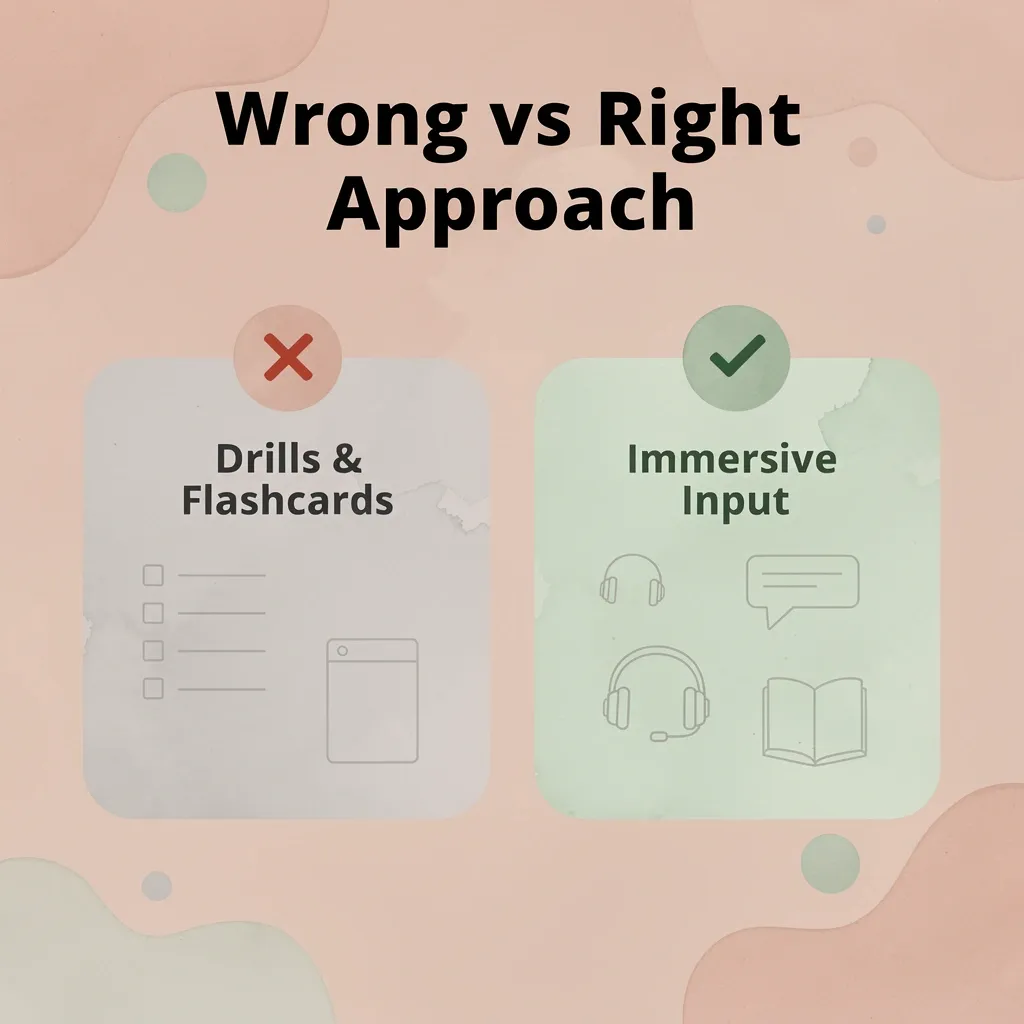
If your current study routine relies on drills, flashcards, or grammar tables alone, learn Spanish with Parrot offers a different entry point. Parrot builds comprehensible input directly into short-form video immersion, so your brain encounters real spoken Spanish at a level it can actually process — not just memorize. That distinction — between studying a language and acquiring it — is where most learners either stall or accelerate. Start your free trial today and find out which side of that line you land on.
Different study approaches create different outcomes in language learning:
Drills and flashcards – Build isolated vocabulary recall, but often result in slower retention and information that is easier to forget.
Grammar tables – Build rule memorisation and passive understanding, but may not translate into natural language use.
Parrot video immersion – Builds comprehensible input, supporting natural language acquisition that is more likely to stick long term.
⚠️ Warning: Relying solely on traditional drills and grammar tables trains you to study Spanish — not to speak it. Real fluency comes from comprehensible input, not rote memorization.
Related Reading
Pimsleur Vs Babbel
Rocket Spanish Vs Babbel
Rocket Spanish Vs Rosetta Stone
Living Language Vs Rosetta Stone
Rosetta Stone Alternatives
Alternative To Pimsleur
Rocket Spanish Review
Best Duolingo Alternative For Spanish
Babbel Spanish Review
Best Free App To Learn Spanish
Pimsleur Spanish Review
Rosetta Stone Vs Pimsleur
Duolingo Vs Rosetta Stone
Duolingo Alternatives