
.Learning Spanish as an adult is entirely achievable with the right approach, and millions of people prove it every year through consistent, focused practice. The best way to learn conversational Spanish isn't memorizing textbooks; it's building real speaking habits that stick.
Adults who make the fastest progress tend to focus on practical vocabulary and phrases they can use immediately, rather than abstract grammar rules. Parrot is built around exactly that principle, helping learners develop genuine speaking confidence through everyday conversation practice. Those ready to take that step can learn Spanish with a method designed specifically for how adults absorb language best.
Table of Contents
Why Learning Spanish as an Adult Is Different
Why Many Adults Struggle to Learn Spanish
What Makes a Spanish Learning Method Effective for Adults?
10 Best Ways to Learn Spanish as an Adult
Which Spanish Learning Approach Is Right for You as an Adult?
How Parrot Helps Adults Learn Spanish More Naturally
Start Learning Spanish Today
Summary
Adult learners carry genuine cognitive advantages into language learning, including pattern recognition, analogical thinking, and decades of contextual knowledge that help new vocabulary stick faster. The gap between adult and childhood language acquisition is not about ability. It is about fit, since most teaching systems were designed for classroom settings that do not match how adults actually live and learn.
Desire to speak Spanish is widespread but rarely the limiting factor. Pew Research Center data shows that 72% of Latinos who do not speak Spanish wish they could, and 61% of Latino adults who are not Spanish-dominant express the same wish. The persistent gap between wanting to speak and actually speaking points to a method problem, not a motivation problem.
Structural mismatch kills more adult learning routines than lack of discipline. Most adults have 20 to 30 minutes available on a given day, but most learning systems require far more time to function at all. When a plan demands an hour and life delivers twenty minutes, sessions get skipped, skipped sessions compound, and the routine collapses without the learner ever consciously deciding to quit.
Grammar study is one of the most common reasons adult learners stall. Completing conjugation tables creates a measurable sense of progress, but recognizing a rule on a worksheet and retrieving it mid-conversation are entirely different cognitive tasks. Adults who spend months drilling grammar often find themselves frozen in real conversations, not because they lack knowledge, but because knowledge of rules and active language use are not the same thing.
Retrieval practice and recognition are often treated as interchangeable, but they produce very different outcomes. Recognizing a word when it appears in a lesson does not mean the word is accessible under the mild pressure of a real conversation. Learners who maintain long streaks in gamified apps can still struggle to order food in Spanish because the apps measure completion and recognition, not the kind of active recall that transfers to spoken language.
Authentic content exposure becomes necessary at a certain point because learner-focused material stops preparing you for Spanish as it is actually spoken. Berges Institute notes that Spanish has over 500 million native speakers worldwide, meaning the range of accents, rhythms, and regional expressions a functional listener will encounter is enormous. Gradually introducing native-speaker content, even in small doses alongside regular practice, helps build real listening comprehension.
Parrot's Learn Spanish app addresses the friction between limited daily time and meaningful immersion by surfacing short-form native-speaker video content matched to a learner's comprehension level, so available minutes go toward actual language exposure rather than setup and searching.
Why Learning Spanish as an Adult Is Different
Adults don't struggle with Spanish because they've lost the ability to learn. They struggle because the systems designed to teach them were built for someone else's life.
"The challenge isn't adult capability — it's that most language-learning systems were designed around the schedules, motivations, and environments of younger learners, not the complex realities of adult life."
🎯 Key Point: The problem isn't you — it's the mismatch between the method and the learner. Adult brains are fully capable of language acquisition; they simply require a different approach.
💡 Tip: When choosing a Spanish learning program, ask yourself: "Was this built for my life?" Look for tools that respect your limited time, existing responsibilities, and adult learning strengths like pattern recognition and contextual reasoning.
Children and adults often need different language-learning approaches because their time, motivation, and learning environments are fundamentally different:
Immersive, unstructured exposure vs. structured, goal-driven learning – Children can benefit from broad immersion, while adults often progress more effectively with clear goals and structured learning.
Unlimited time vs. efficient practice – Children typically have more opportunities for repetition; adults need focused, efficient sessions that fit around other responsibilities.
Peer pressure vs. intrinsic motivation – Children may be motivated by school and peers, while adults benefit more from personal goals and real-world applications.
School reinforcement vs. flexible scheduling – Children receive regular reinforcement through school, whereas adults often need self-directed learning and schedules that adapt to their lives.
⚠️ Warning: Don't mistake difficulty for inability. Adult learners bring massive advantages — including stronger vocabulary transfer, metacognitive awareness, and the ability to understand grammar rules explicitly — that children simply don't have.
What advantages do adult learners actually bring to Spanish?
Adult learners have distinct advantages when learning a language. You already know how to recognize patterns, make comparisons, and self-correct when something doesn't make sense. An adult brings decades of knowledge about how the world works, and that background makes new vocabulary stick faster when words connect to something real. The gap isn't ability. It's fit.
Why do so many adults struggle to speak Spanish well?
According to the Pew Research Center, 75% of U.S. Latinos say speaking Spanish matters to them personally. However, only 4 in 10 U.S.-born Latino adults speak it well, compared to 9 in 10 immigrant Latinos. This gap stems not from desire or intelligence, but from exposure to the language. Immigrant adults encounter Spanish in real-world contexts, while U.S.-born adults often receive only grammar workbooks and study assignments.
What actually changes when you're an adult learner
The familiar approach to adult Spanish learning looks like this: download an app, earn points, repeat vocabulary in isolation, and hope it translates into real conversation. The problem is that gamified drill systems reward completion, not comprehension. They measure streaks, not fluency. Apps built around learning Spanish through short-form video immersion take a different approach, placing you inside real spoken Spanish from day one so your brain absorbs the language through context and repetition in use, not rule memorization.
Is the real barrier motivation or method?
Pew Research Center data shows that 61% of Latino adults who aren't Spanish-dominant wish they spoke the language better. The barrier isn't motivation but access to effective learning systems. Wanting to speak Spanish and having a system that helps you achieve fluency are two different things.
How does urgency shape what adult learners need to focus on first?
Adults learning Spanish to speak with a partner's family, manage a team, or feel less invisible during travel need usable language now. That urgency reveals what to learn first, but only when the method respects it.
Related Reading
Why Many Adults Struggle to Learn Spanish
Most adults don't fail at Spanish because they lack discipline. They fail because the method they're using was never designed for them.
💡 Tip: Before blaming yourself for not sticking with it, ask a harder question: was the learning system ever built to fit your life in the first place?
"Most adults don't fail at Spanish because they lack discipline — they fail because the method was never designed for them." — Core insight, this article

The failure point is usually structural, not personal. Adults typically have 20 to 30 minutes available daily, squeezed between work, family, and competing demands. Most learning systems require far more time to work. When the plan demands an hour and life delivers twenty minutes, the session gets skipped. One skipped session becomes three. Three becomes a month. The routine falls apart — not because the learner gave up, but because the system was never built to survive real life.
Real-life schedules often make traditional language-learning routines difficult to maintain, which is why flexible learning needs to accommodate imperfect conditions:
60+ minute sessions vs. 20–30 minutes – Many learning systems expect long sessions, while adults may realistically have only 20–30 minutes on a good day.
Consistent daily blocks vs. fragmented windows – Fixed study periods don't always match unpredictable schedules, where learning time may come in short, scattered windows.
Low-distraction environments vs. competing demands – Traditional study assumes focus and quiet, while real life includes work, family, and other interruptions.
Long-term unbroken streaks vs. missed days – Real schedules inevitably include missed days and restarts, so sustainable learning should accommodate setbacks rather than depend on perfect consistency.
⚠️ Warning: Skipping one session is rarely the problem — it's the compounding effect of a system that can't absorb real-life interruptions. One missed day becomes three, three becomes a month, and the habit collapses entirely.
🔑 Takeaway: The goal isn't to find more willpower — it's to find a learning method built around 20-minute windows, not ideal conditions that never actually exist.
Why does focusing on grammar leave adult learners stuck?
Relying too much on grammar is one of the most common reasons adult learners stop making progress. Grammar study feels productive because you can measure it—you finish a conjugation table, understand a rule, check a box. But knowing when to use the subjunctive on a worksheet and using it while talking are completely different tasks for your brain. One is recognizing something with no pressure; the other is retrieving it from memory while speaking in real time. Adults who spend months practicing grammar often get stuck in conversation, not because they don't know the rules, but because knowing rules and using language are not the same thing.
What actually converts limited study time into real Spanish output?
Most learners respond by adding more resources—another app, podcast, YouTube channel, or textbook—hoping volume compensates for the gap. According to the Pew Research Center, 72% of Latinos who do not speak Spanish wish they could speak it better, suggesting desire to learn is rarely the missing ingredient. What's missing is a method that converts limited daily time into actual comprehension and output. Apps like Parrot address this with short-form video immersion grounded in comprehensible input, giving adult learners meaningful exposure to real spoken Spanish in 10 to 15 minutes rather than requiring study blocks most schedules cannot accommodate.
Why does waiting to speak make everything harder?
Self-consciousness is a quiet but powerful force in adult language learning. Adults are acutely aware of how they sound, which pushes them to prepare more before attempting real conversation. The logic feels reasonable: learn more vocabulary, master more tenses, then speak. But that threshold never arrives, because there is always more to learn. Speaking practice reveals which words you can recognize but cannot retrieve under pressure—a gap no amount of listening or reading will close. Starting imperfect conversations early isn't a shortcut; it's a necessary part of the process.
Why does input difficulty matter as much as speaking practice?
The same pattern applies to input difficulty. Material that's too easy stops challenging the brain; material that's too hard becomes noise. Neither produces progress. The goal is content beyond your current level—comprehensible enough to follow but unfamiliar enough to stretch you. That balance is harder to find than most learners expect, and getting it wrong is one of the quietest reasons adults stop making progress.
What Makes a Spanish Learning Method Effective for Adults?
Learning Spanish as an adult works best when you practice different skills at the same time: understanding, vocabulary, grammar, and speaking all improve together rather than in isolation.
"Learners who develop skills in isolation often find their progress stalls — balanced, multi-skill practice is the hallmark of methods that work for adults." — Language Acquisition Research
🎯 Key Point: The most effective Spanish learning methods for adults treat vocabulary, grammar, listening, and speaking as interconnected, not separate subjects to master sequentially.

The problem happens a lot: adults focus hard on one area, often listening or reading, spending lots of hours on it while speaking ability doesn't improve. Learners with thousands of hours of comprehensible input often say speaking feels embarrassingly weak compared to what they understand. That gap happens when a method develops one skill and ignores the others.
⚠️ Warning: Pouring hundreds of hours into passive input — like listening and reading alone — without active speaking practice creates a frustrating skill gap that becomes harder to close over time.
💡 Tip: Choose a Spanish learning method that builds all four core skills — reading, listening, speaking, and vocabulary — simultaneously to avoid the trap of lopsided progress.
A balanced language-learning approach helps prevent one skill from developing far ahead of the others, creating more consistent overall progress:
One skill advances rapidly vs. all skills grow together – A skill-focused approach can create uneven development, while a balanced approach supports growth across listening, reading, speaking, and other core skills.
Speaking lags behind comprehension vs. speaking matches understanding – Focusing heavily on input can leave speaking behind; balanced practice helps bring active communication closer to comprehension ability.
Frustrating skill gaps vs. consistent progress – Uneven development can create noticeable gaps, whereas balanced practice encourages more even and sustainable improvement.
Extra corrective practice vs. less backtracking – Large skill gaps may require additional corrective work later, while balanced development can reduce the need to catch up.
Why structure and input need each other
Structure gives adult learners direction and reduces decision fatigue in early stages. But structure alone produces the grammar-trap outcome: learners who can explain Spanish rules but freeze when a native speaker talks at natural speed. According to the Berges Institute Spanish Classes Blog, adults learn languages more effectively using deductive methods with explicit grammar instruction, though that instruction works best when it supports exposure and communication rather than replacing them. Grammar study should function like a map: useful for orientation, not a substitute for the journey itself.
Why does recognition fail when real conversation starts?
Most adults use passive review because it feels productive: re-reading vocabulary lists, skimming grammar notes, watching Spanish videos without active engagement. Recognition and retrieval are different cognitive processes. Recognizing a word when you see it doesn't mean you can use it in conversation. Retrieval practice, where you actively recall the Spanish before checking the answer, builds the access you need when speaking. Apps built around gamified streaks rarely make this distinction, which is why learners can maintain a 200-day streak and still struggle to order food in Spanish.
How does comprehensible input build the skills that transfer to conversation?
Parrot anchors daily practice in short-form video immersion built around comprehensible input, the principle research identifies as central to language acquisition. Rather than drilling isolated vocabulary or earning points for correct answers, learners spend 10 to 15 minutes with authentic Spanish, building listening comprehension and contextual vocabulary that transfers to conversation. Berlitz reports that consistent practice of at least 30 minutes per day speeds up adult language acquisition. Though 10 to 15 focused minutes of immersion differ from passive background listening, it provides the deliberate daily contact that accumulates over weeks and months.
What separates adults who make progress from those who quietly quit?
The adults who make the most progress aren't those who find the most time, but those who use their available time across multiple skills, practice retrieval instead of recognition, speak before they feel ready, and reduce friction between intention and action. A method that checks all those boxes theoretically but requires 90 minutes of daily setup will be abandoned by most adults by week three.
The question is never whether a method is theoretically sound, but whether it fits into real life and what happens when you apply these principles to specific learning approaches.
10 Best Ways to Learn Spanish as an Adult
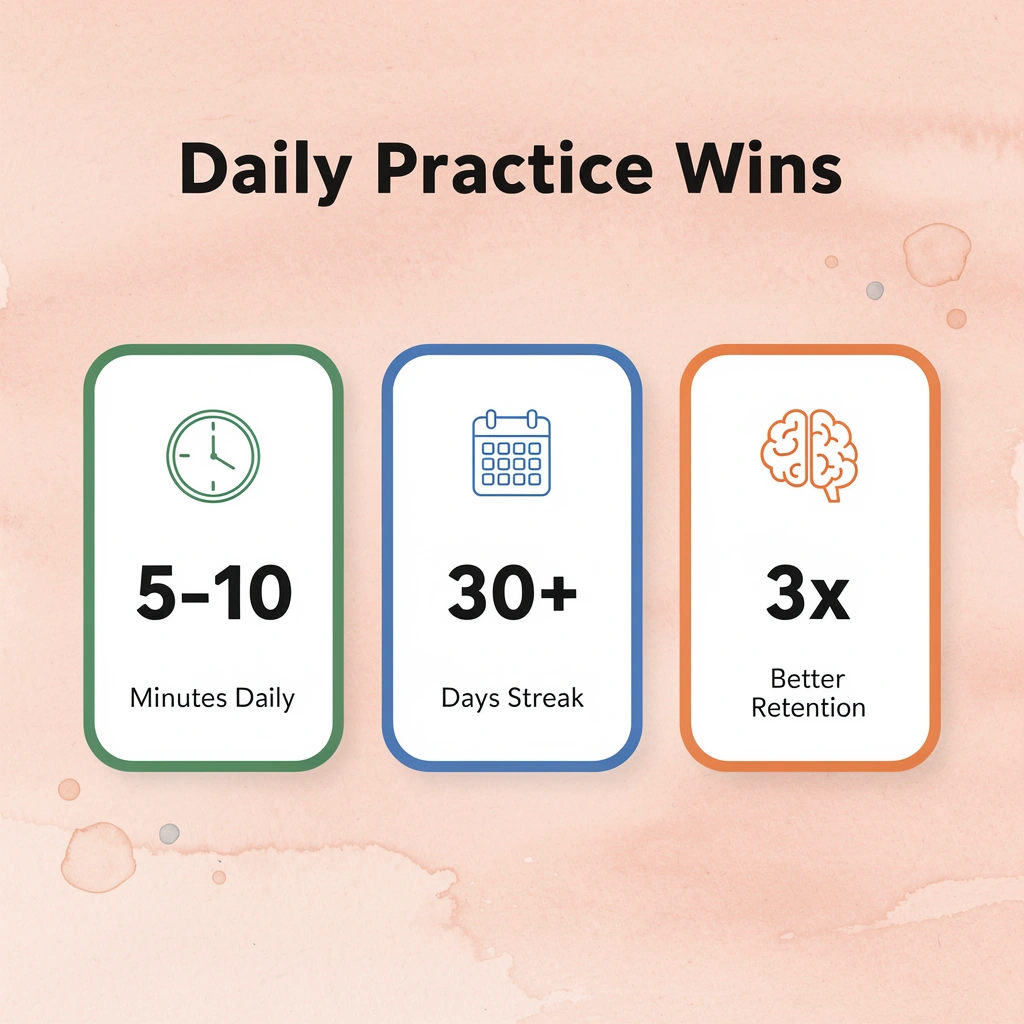
Having specific goals and methods is important, but the best approach will fail if it doesn't fit into real adult life. Consistency over perfection is the real key — even 5–10 minutes of daily practice beats an occasional marathon session that doesn't fit your schedule or lifestyle.
"The most effective language learning strategy is the one you can actually stick to — built around real constraints, real routines, and real life." — Language Acquisition Research
💡 Tip: Map your Spanish practice to existing habits — commute, lunch break, or bedtime — to make it effortless to maintain long-term.
⚠️ Warning: Even the most proven method will deliver zero results if it's too rigid to survive a busy adult schedule. Flexibility is essential.
For adults balancing work, family, and other responsibilities, flexible and consistent learning tends to be easier to sustain than rigid or intensive schedules:
Short daily sessions (5–15 min) – Yes – Fit naturally into existing routines and make language practice easier to maintain consistently.
Weekend marathon sessions – Sometimes – Can provide focused study time, but are often harder to sustain consistently over the long term.
Rigid classroom schedules – Often no – Fixed sessions can conflict with work, family, and other commitments.
Flexible app-based learning – Yes – Adapts to your timeline, allowing you to study when and where it works best for you.
1. Set a Goal You Can Actually Use
Start with a concrete reason to guide decisions. Wanting to "learn Spanish" is a direction. Wanting to have a conversation with your partner's family at dinner or navigate a work meeting in Mexico City is a destination. The destination tells you what vocabulary to prioritize, what listening practice counts, and when you're making real progress.
Someone preparing for travel needs restaurant phrases, directional language, and the ability to follow fast, informal speech. Someone preparing for a professional environment needs different vocabulary. The goal shapes the method.
2. Start With High-Frequency Spanish
The failure point is usually scope. Beginners try to learn Spanish as if they need it all before they can use any of it.
High-frequency vocabulary—the few hundred words and patterns that carry most everyday conversation—offers more return per hour of study than anything else at the beginner stage. You're learning the parts of the language that appear repeatedly in real speech, creating more chances to recognize, retrieve, and reuse what you've studied. Exposure to common language comes first; learning variety comes later.
3. Build a Short Daily Routine
A routine requiring a clear 90-minute window rarely works during a real week. A 20-minute routine works almost any day.
A short session organized around three purposes- structured input, listening practice, and active recall or speaking- gives you meaningful contact with Spanish without ideal conditions. When your schedule opens up, extend the listening or add a conversation session. When it doesn't, run the 20-minute version anyway. Consistency across imperfect days beats intensity on perfect ones.
4. Make Listening a Daily Habit
You get better at understanding natural Spanish by listening to it many times at different speeds, from different people, and about different topics, not by studying grammar.
Beginners should start with slower audio designed for learners to develop familiarity with Spanish sounds and rhythm. Intermediate learners should progress to native speaker content, which reflects authentic Spanish rather than simplified versions. You don't need to understand every word; the goal is to follow the main idea and get used to natural speech pace and accents.
5. Start Speaking Early
Waiting until you feel ready keeps you stuck. Adults who delay speaking until they are fluent build strong reading and listening comprehension but develop almost no ability to retrieve language under conversational pressure.
Start with low-stakes speaking: describe what you're doing out loud in Spanish, shadow sentences from podcasts, answer a tutor's questions imperfectly. The discomfort isn't a sign you're unready; it's the practice itself. Retrieval under mild pressure builds the neural pathways that let you speak without translating every word in your head first.
6. Learn Vocabulary in Context
Memorizing Spanish word-translation pairs builds recognition, not communication skill. You'll recognize isolated words in conversation but struggle to use them naturally because you never learned the surrounding language.
The better approach is noticing how words behave in context: what comes before and after them, what situation they appear in. A phrase from real conversation or video carries more usable information than a flashcard definition. Review it later in that context, not as a stripped-down translation.
7. Gradually Introduce Authentic Spanish
Learner-focused content is a support system, not an end goal. At some point, simplified Spanish stops preparing you for native speech, and the gap between what you understand and real language works against you.
Introduce one piece of authentic content alongside regular practice: a short interview, social media clip, or film scene. The goal is gradual adjustment, not immersion shock. According to the Berges Institute, Spanish has over 500 million native speakers worldwide, creating enormous variety in accents, rhythms, and regional expressions. Even small doses of exposure build functional listening skills.
8. Use Your Existing Routine
Adults who find time for Spanish don't usually discover extra hours in the day. They replace or layer activities. Commuting, cooking, exercising, and walking are already part of your routine. Spanish listening fits inside them without requiring new time.
Does passive listening during daily tasks actually add up?
Passive listening during existing activities won't replace active study, but it adds meaningful hours of contact with spoken Spanish each week without extra scheduling.
How do you stop wasting your study window on setup?
Most adult learners treat finding content as a separate task: searching for podcasts, scanning YouTube, and scrolling through apps for something that matches their level. That search consumes the session. Parrot solves this by showing short videos from native speakers matched to your comprehension level, so your 10 to 15 minutes goes toward learning the language, not preparation.
9. Stop Chasing Every New Learning Method
Progress slows, and the instinct is to look for a better tool: a new app, a different course, a more structured system. Switching resets the learning curve and creates momentum without substance.
Choose resources that serve distinct purposes: one for structured learning, one for listening, one for speaking practice. Then use them long enough to develop skill within them. The anxiety about "am I using the right method" is less productive than another 20 minutes spent with the method you already have.
10. Measure Progress Through Communication
Finished lessons feel like progress because you can count them. But a 70% completion rate on a language app tells you almost nothing about whether you can have a conversation, understand a native speaker, or describe your weekend without deliberation.
What does honest progress actually look like in conversation?
The better ways to measure progress are based on what you do. Can you follow the main idea of a conversation without stopping to figure out each word? Can you keep talking when you encounter an unfamiliar word? Can you understand a speaker you've never heard before? These skills make Spanish useful in everyday situations, and they improve through real communication practice, not recognition tasks alone.
Knowing what to do and starting are two different things, and what happens in those first few days shapes everything that comes after.
Related Reading
Best App To Learn Mexican Spanish
Mango Vs Rosetta Stone
Best App To Learn To Speak Spanish
How To Learn Spanish Fluently
How To Learn Medical Spanish
How To Learn Spanish On Your Own
Fastest Way To Learn Spanish
How To Learn Colombian Spanish
Rosetta Stone Spanish Reviews
Which Spanish Learning Approach Is Right for You as an Adult?
There isn't one Spanish learning method that works equally well for every adult. The right approach depends on how much time you have, your current level, why you're learning, and what kind of Spanish you actually need to use. Ask yourself which approach gives you the right practice for your situation and is realistic enough to keep doing.
"The best Spanish learning method is the one that fits your real life — your schedule, your goals, and the specific Spanish you need to use." — Language Learning Principle
Choosing the right Spanish-learning approach starts with understanding your available time, current ability, goals, and the type of Spanish you actually need:
Time available – Ask whether you can commit to studying daily or only a few times a week. Consistency will shape how quickly you progress.
Current level – Determine whether you're a complete beginner or already somewhat familiar with Spanish so the material matches your ability.
Learning goal – Clarify whether you're learning for travel, work, or personal connection, since each goal requires different vocabulary and practice.
Type of Spanish needed – Decide whether you need spoken fluency or primarily reading and writing, as this determines how much listening and speaking practice you should prioritise.
🎯 Key Point: There is no universal "best method" — the right Spanish approach is the one that matches your unique situation and that you can realistically sustain long-term.
💡 Tip: Before committing to any learning program or method, spend 5 minutes honestly answering these four questions — time, level, goal, and type of Spanish needed — to find your best-fit approach.

What should you do if you only have 15 to 30 minutes a day?
Keep your routine focused. Prioritize high-frequency vocabulary, understandable Spanish listening, and a few minutes of speaking or shadowing. The priority is maintaining regular contact with Spanish and making those limited minutes count.
What can you do with an hour a day to learn Spanish?
You have more room to balance different activities. For example, you might spend 15 minutes on structured learning, 25 minutes listening or reading, 10 minutes reviewing useful vocabulary, and 10 minutes speaking.
Where should a complete beginner start?
Start with a foundation: how to say words, high-frequency vocabulary, basic sentence patterns, and essential grammar. Listen from the beginning, but choose material that provides enough support to understand the general meaning. As your comprehension develops, gradually introduce more natural Spanish.
What should an intermediate learner focus on instead?
If you already handle basic Spanish, spending most of your time reviewing beginner vocabulary yields diminishing returns. Increase your exposure to real Spanish through listening, reading, unplanned speaking practice, and learning new words from authentic contexts. The goal is to move from understanding how Spanish works to using it automatically.
How should you approach learning Spanish for travel?
Focus on practical communication rather than broad fluency. Prioritize greetings, ordering food, transportation, directions, accommodation, and asking questions. Listening practice is particularly valuable because knowing a phrase on paper doesn't mean you'll recognize it when spoken.
How do you learn Spanish effectively for work?
Mix general Spanish with the language you'll use at work. If you work in sales, you may need to explain products and handle customer conversations. Healthcare professionals need different specialized vocabulary. Build the general foundation first, then add industry-specific language and practice realistic workplace situations.
What matters most when learning Spanish for family or relationships?
Prioritize everyday communication and listening. You may need to understand casual conversations, family stories, jokes, and expressions that standard courses don't cover. Focus on the specific type of Spanish your family or partner uses rather than attempting to learn every regional expression.
What helps if you struggle with staying consistent?
Focus less on finding the perfect method and more on removing barriers to starting. Keep your resources easily accessible, set a regular time or trigger for Spanish, and have a shorter version of your routine for busy days. A flexible routine is easier to maintain than an all-or-nothing schedule.
What does the best Spanish learning approach actually look like?
The "best" Spanish learning method isn't the one with the most features or the most intensive schedule, but rather the approach that matches your goals, available time, current level, and interests while providing enough meaningful exposure and practice to sustain progress.
A beginner with 20 minutes a day needs a different routine from an intermediate learner with two hours. Someone preparing for a holiday has different priorities from someone moving abroad or communicating with Spanish-speaking clients. All learners, however, face a similar challenge: knowing that authentic Spanish exposure matters differs from finding enough engaging content you can understand. Instead of spending part of every study session searching for appropriate material, an environment that makes relevant Spanish easier to find proves invaluable.
How Parrot Helps Adults Learn Spanish More Naturally
Adults need real Spanish exposure without spending time deciding what to study, searching for content, or switching between tools. Parrot makes authentic Spanish easier to discover and engage with, complementing structured study, listening, and speaking practice.
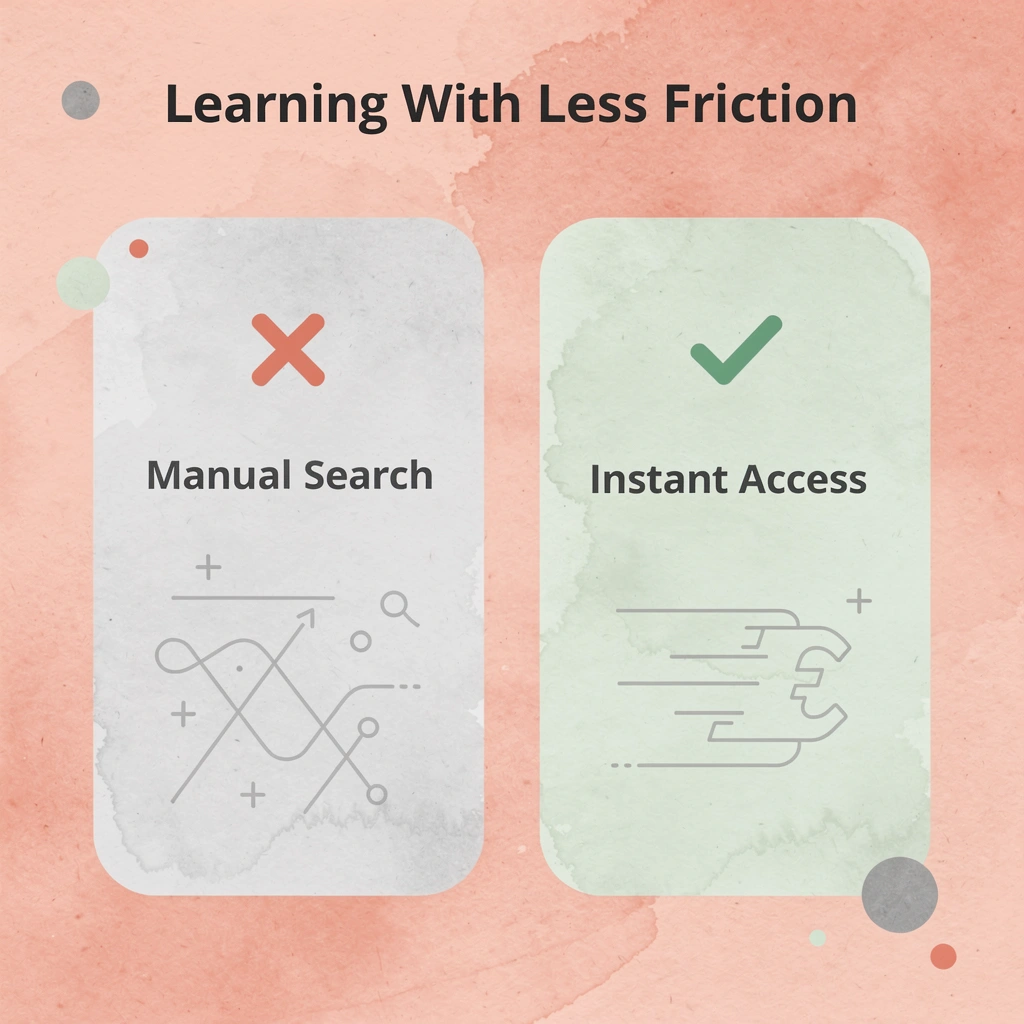
💡 Tip: The biggest barrier for adult learners isn't motivation — it's friction. Parrot removes the friction of finding, filtering, and accessing genuine Spanish content so you can focus on what actually matters: learning the language.
"Adults learn best through authentic exposure to real content — not just textbook drills. Removing the barriers between learners and genuine language input is one of the most powerful accelerators of natural acquisition." — Language Acquisition Research

✅ Best Practice: Instead of juggling multiple tools and wasting mental energy on setup, let Parrot handle content discovery so every study session starts with immediate, meaningful engagement in Spanish.
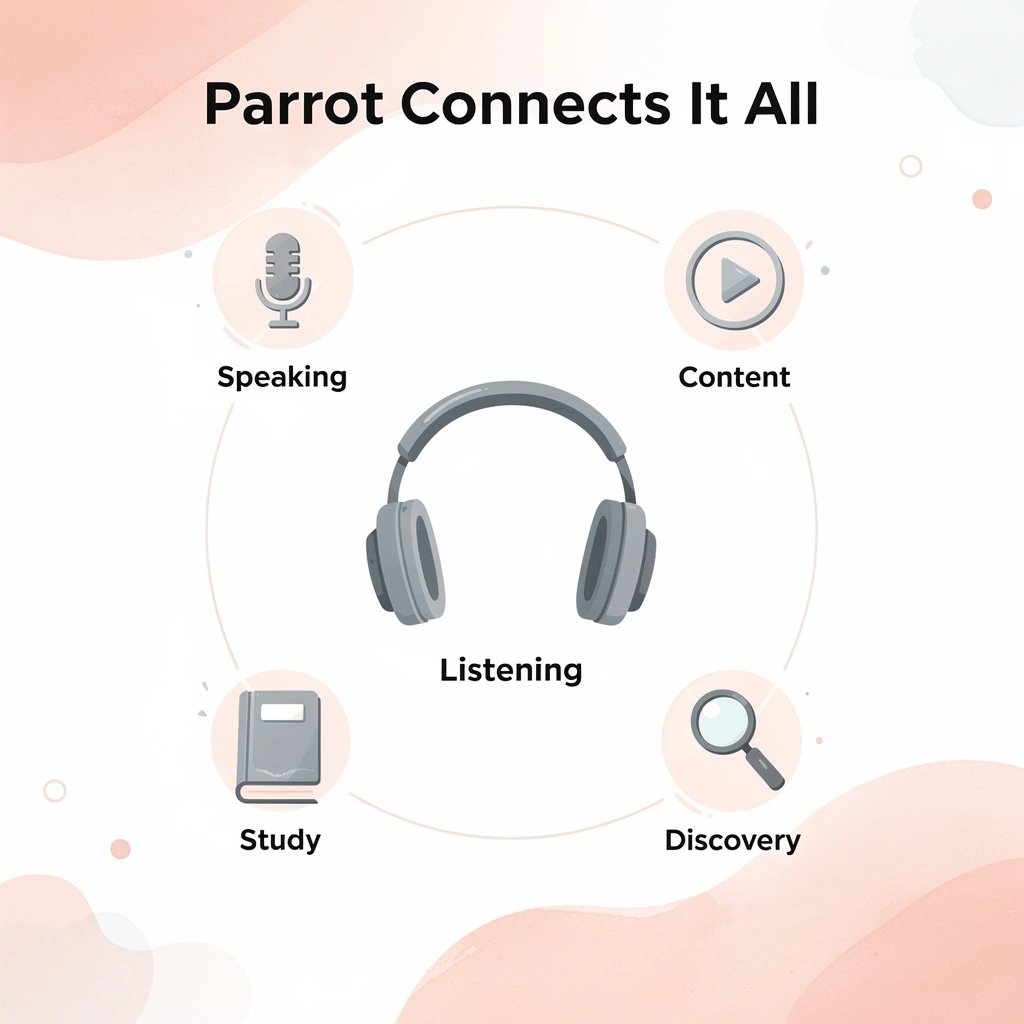
Parrot is designed to remove the friction of self-directed Spanish study by combining content discovery, guidance, and multiple learning modes in one workflow:
Manual content search vs. automatic discovery – Instead of spending time searching for suitable Spanish material, Parrot surfaces authentic content automatically.
Multiple tools vs. one platform – Brings the core learning experience into one place, reducing the need to switch between apps.
Choosing what to study vs. guided exposure – Provides structured exposure without the guesswork, helping learners know what to engage with next.
Isolated practice vs. integrated learning – Connects listening, reading, and speaking support so learners can develop multiple skills around the same content.
What happens when adults don't have time to search for what to study?
Spending 15 minutes searching for the right video can consume an entire short study session. Our AI-powered recommendation feed personalizes Spanish videos based on your skill level and interests, so you can start learning Spanish immediately instead of searching through content repeatedly.
Why can native Spanish content feel too difficult at first?
Real Spanish is valuable, but randomly picking native content can be frustrating when your listening ability isn't developed enough to follow it. Parrot's personalized recommendations help learners discover real Spanish suited to their skill level, making it easier to gradually increase difficulty as understanding improves.
Why does listening practice get pushed aside so easily?
Adults may have time for a quick vocabulary exercise but skip listening because finding suitable content feels like another task. Parrot's engaging short-form videos provide regular comprehensible input from native speakers, offering an accessible way to incorporate listening into short study sessions.
How does looking up words interrupt a study session?
When you encounter an unfamiliar word, you might stop the video to look it up in a dictionary or translation tool, breaking your listening flow. Parrot's clickable subtitles and instant translations let you check word meanings without leaving the content, so you can quickly return to understanding the bigger message.
Why doesn't new vocabulary always stick after a session?
An adult learner might encounter a useful word during a study session and recognize it later without remembering its meaning or how to use it. Parrot lets learners save words directly from videos and review them in meaningful contexts, giving vocabulary more exposure while keeping it connected to the Spanish they learned.
How do you stop language learning from feeling like another chore?
A repetitive routine that doesn't match your interests becomes hard to sustain alongside other responsibilities. Parrot's personalized recommendations introduce varied Spanish content based on your skill level and interests, making it easier to find content worth returning to.
How can you make Spanish fit your life as an adult?
The best way to learn Spanish as an adult is to build a learning environment that fits your life while providing consistent Spanish exposure. Parrot supports this by making real, understandable Spanish easier to find and engage with. It doesn't replace structured learning or speaking practice; instead, it strengthens the listening and contextual exposure that are easy to neglect when learning around a busy schedule.
Start Learning Spanish Today
Most learning attempts fail in the first few days because there is too much friction before any reward arrives, not because people lose motivation. Where you start matters as much as why you want to learn.
"The biggest barrier to language learning isn't ability—it's the gap between effort and reward in those critical first sessions." — Language Acquisition Research
💡 Tip: Choose a starting point that delivers immediate value. Your first session should feel rewarding, not overwhelming, or you risk quitting before the habit forms.
⚠️ Warning: High-friction methods—like rigid schedules, dense textbooks, or vocabulary drills with no context—are the #1 reason early learners drop off before seeing real progress.

To make better use of the Spanish time you already have, download Parrot and start your free 7-day trial. From your first session, explore short-form videos matched to your proficiency and interests, use clickable subtitles and instant translations, and save useful vocabulary directly from content you want to watch. It's comprehensible input built around time you already have—not a schedule you must build from scratch.
The platform makes language learning more personalised and convenient by turning everyday video content into an interactive study experience:
Short-form videos – Recommends content matched to your proficiency level and interests, making practice more relevant and engaging.
Clickable subtitles – Provides instant translations on demand, so you can understand unfamiliar words without interrupting the video.
Vocabulary saving – Lets you save words directly from the content you watch, building a personalised vocabulary bank.
Free 7-day trial – Provides full access for seven days with zero commitment, letting learners explore the experience before deciding to continue.
🎯 Key Point: Comprehensible input—content you almost understand—is one of the most research-backed methods for rapid language acquisition. Parrot delivers it through videos you actually want to watch.
✅ Best Practice: Use your free 7-day trial to build a daily micro-habit. Even 5–10 minutes of engaging, interest-matched Spanish content compounds into real fluency faster than traditional study methods.
Related Reading
Living Language Vs Rosetta Stone
Rocket Spanish Vs Rosetta Stone
Best Duolingo Alternative For Spanish
Rocket Spanish Review
Alternative To Pimsleur
Rosetta Stone Vs Pimsleur
Pimsleur Spanish Review
Pimsleur Vs Babbel
Rocket Spanish Vs Babbel
Rosetta Stone Alternatives
Best Free App To Learn Spanish
Duolingo Alternatives
Babbel Spanish Review
Duolingo Vs Rosetta Stone