Dominican Spanish is fast, regional, and nothing like what most textbooks teach. Consonants disappear mid-word, sentences blend together, and local slang shifts the meaning of phrases entirely. For anyone serious about learning conversational Spanish, understanding Dominican speech patterns makes the difference between following a conversation and getting lost in one.
Progress comes faster when practice reflects how Dominicans actually talk, not how grammar guides say they should. Parrot is built around natural, spoken Spanish, helping learners train their ear, absorb real phrases, and build vocabulary that holds up in genuine conversation. For anyone ready to connect with Dominican speakers, the most practical first step is to learn spanish.
Table of Contents
Why So Many Learners Want to Learn Dominican Spanish
Why Knowing General Spanish Doesn't Always Prepare You for Dominican Spanish
How to Learn Dominican Spanish Effectively
Is Dominican Spanish the Right Variety for Your Goals?
6 Tools for Learning Dominican Spanish
How Parrot Helps You Learn Dominican Spanish Naturally
Start Learning Spanish Today
Summary
Dominican Spanish is widely considered one of the most challenging dialects for learners to understand, largely because of its rapid speech, consonant deletion, and heavy African linguistic influences that deviate significantly from standard Latin American Spanish. This means a learner can complete an entire Spanish course, perform well on written exercises, and still feel completely lost in a real conversation in Santo Domingo or Santiago. The gap is not a knowledge problem. It is an auditory exposure problem.
Most learners fail at listening comprehension, not vocabulary. A word like "para" can compress into something closer to "pa" at full conversational speed, and a brain trained on clearly articulated input has not yet learned to decode that transformation in real time. Dominican phonological patterns, including consonant reduction and vowel shifts, are automatic and context-dependent, which means they cannot be memorized like grammar rules. The only reliable path through is repeated listening until those patterns stop registering as noise.
Short daily listening sessions consistently outperform longer, infrequent study blocks when the goal is auditory pattern recognition. Even 15 to 20 minutes of daily exposure gives the brain the frequency it needs to keep emerging patterns from resetting between sessions. Dominican speech in particular, with its compressed rhythm and fluid consonant reduction, requires that repetition at a pace that weekly study sessions simply cannot deliver.
Content calibration matters as much as content volume. When comprehension sits around 30 percent, most mental effort goes toward decoding individual sounds rather than absorbing patterns, which stalls real acquisition. The Dominican Spanish 101 podcast holds a 4.9 out of 5 stars average rating across 79 reviews, signaling how much learners value content matched to their level rather than generic material that happens to feature a Dominican speaker.
Speaking before comprehension feels solid is not a mistake. Attempting to produce language, even imperfectly, surfaces gaps that passive listening never reveals. When a Dominican speaker responds faster than expected, or when a word simply will not come, that friction is useful information showing exactly where a learner's current model of the language is incomplete. Shadowing clips, narrating daily activities in Spanish, or working with a Dominican tutor even once a week creates feedback loops that accelerate what listening builds slowly on its own.
Strong immersion in one Caribbean variety creates acoustic familiarity that transfers meaningfully to others. A learner who has spent months absorbing Dominican speech rhythms, dropped consonants, and regional vocabulary will find Puerto Rican or Cuban Spanish notably more accessible than someone who only studied textbook Castilian. The listening ear and pattern-recognition system built through focused immersion adapt across varieties, which means the investment compounds over time rather than staying narrowly specific.
Parrot's Learn Spanish app addresses the consistency and calibration challenge by delivering short-form authentic Spanish video content matched to a learner's current proficiency level, reducing the time spent hunting for appropriate material and increasing actual listening time.
Why So Many Learners Want to Learn Dominican Spanish
People search for Dominican Spanish because something specific motivated them: a relationship, workplace, or trip where the Spanish they knew didn't work as expected.
"The motivation to learn a regional dialect is almost always personal: a moment where standard Spanish simply wasn't enough." — Language Learning Research
💡 Tip: If your textbook Spanish has fallen flat in real conversations, you're the kind of learner Dominican Spanish is designed for.
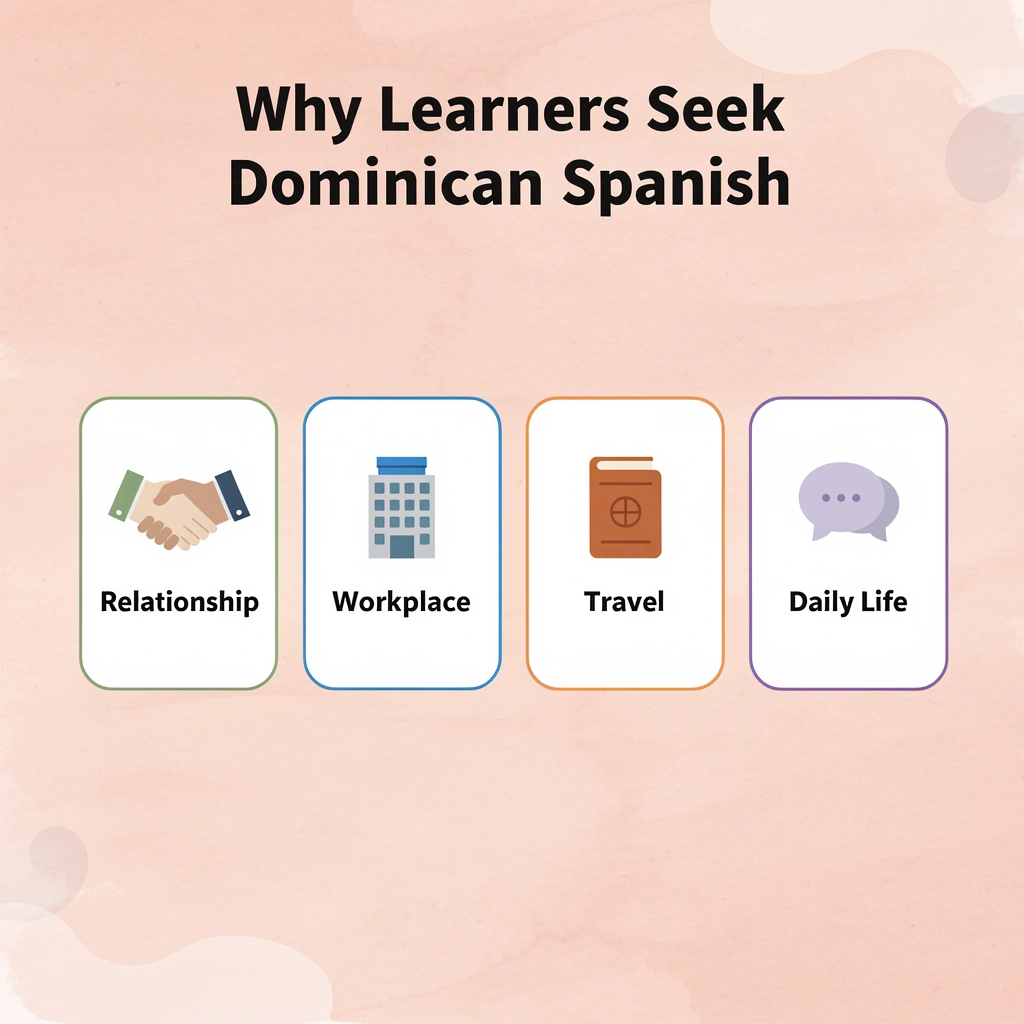
Reasons for learning vary a lot. Some learners are preparing to move to the Dominican Republic and want to speak Spanish well in everyday life. Others work with Dominican coworkers or help Dominican customers and realize that formal textbook Spanish creates distance — local fluency closes that gap. Many are driven by personal reasons: a Dominican partner, a bilingual family, or a community where understanding how people actually speak means belonging.
Reason for Learning
Core Goal
Relocating to the Dominican Republic
Everyday fluency in local life
Working with Dominican colleagues
Professional connection and trust
Serving Dominican customers
Closing the communication gap
Dominican partner or family
Personal belonging and intimacy
Living in a Dominican community
Cultural integration
🎯 Key Point: Whether the motivation is professional, personal, or practical, the common thread is the same — standard Spanish alone isn't enough to truly connect.
🔑 Takeaway: Dominican Spanish isn't just a dialect — it's the real language of relationships, workplaces, and communities where belonging matters.
Dominican Spanish Is Still Spanish
If you already speak general Spanish, you're not starting from zero. Core grammar, sentence structure, and vocabulary carry over directly. What changes is the texture: how sounds are shaped, which words get used, and the rhythm of natural conversation. Dominican Spanish compresses certain sounds, drops consonants in ways that catch intermediate learners off guard, and uses expressions absent from standard curricula.
Why do slang lists and videos fall short for learning Dominican Spanish?
Most learners assemble differences through slang lists and YouTube videos, but this fragments learning into isolated facts rather than intuitive understanding. Apps built around comprehensible input, like Parrot, immerse you in short, real-speech content so your ear recognizes patterns before your brain consciously decodes them.
Why culture accelerates the learning
Dominican music, television, and social media demonstrate how people pronounce words, use slang, and speak conversationally in ways no word list can teach. Bachata lyrics, YouTube comments, and everyday social media videos provide authentic records of language use. Watching this content regularly helps you recognize patterns the way native speakers do over many years.
What habits do the fastest learners share?
The fastest learners stay consistent, even in small doses, and use material that sounds like the people they want to talk to.
What happens when theory meets real Dominican speech?
Knowing why you want to learn Dominican Spanish doesn't prepare you for what happens the first time a native speaker talks at full speed.
Related Reading
Why Knowing General Spanish Doesn't Always Prepare You for Dominican Spanish
Finishing a Spanish course builds real skill, but that skill is matched to a version of Spanish that sounds nothing like a fast, casual conversation in Santo Domingo or Santiago. The gap isn't about how smart you are or how hard you try — it's about hearing a specific kind of speech that standard courses rarely include.
"The gap isn't about intelligence or effort — it's about exposure to a specific kind of speech that standard Spanish courses rarely, if ever, include." — Key Insight
What Standard Spanish Courses Teach
What Dominican Spanish Actually Sounds Like
Clear, neutral pronunciation
Rapid, blended syllables and dropped consonants
Textbook vocabulary
Hyper-local slang and regional expressions
Slow, structured dialogue
Fast, casual street-level conversation
Castilian or Latin American "standard"
Caribbean rhythm and intonation patterns
💡 Tip: If you've completed a full Spanish course and still feel lost in Dominican conversations, you're not failing — you're simply missing targeted exposure to Caribbean Spanish speech patterns.
⚠️ Warning: Don't assume general fluency automatically transfers to Dominican Spanish comprehension. The real challenge is retraining your ear for a completely different sonic experience than what most courses prepare you for.

Why is Dominican Spanish so hard to understand even for fluent speakers?
According to Learn Medical Spanish, Dominican Spanish is considered one of the most challenging dialects to understand because speakers talk quickly, drop consonants, and incorporate heavy African language influences that differ from standard Latin American Spanish. This explains why learners can excel at written exercises yet feel confused in conversation. The problem isn't your Spanish; your ear hasn't been trained on this particular sound system.
Why the gap between knowing and recognizing is so wide
The failure point is usually about hearing, not vocabulary. A learner can know the word "para" perfectly and still miss it when a Dominican speaker compresses it into something closer to "pa" mid-sentence at full conversational speed. Words don't disappear in Dominican speech—they transform. Your brain, trained on clearly spoken input, hasn't learned to decode those transformations in real time. That's a listening problem requiring different practice to fix.
Why does switching apps fail to close the gap?
Most learners respond by downloading another app or switching courses, hoping something new will close the gap. This substitutes novelty for what works: spending time listening to natural Dominican speech. Platforms like Parrot use short-form video content from real speakers, giving your ear consistent, daily contact with authentic conversational Spanish rather than structured drills.
Why can't you just memorize the rules of Dominican phonology?
Dominican pronunciation isn't controlled by a single fixed set of rules that a learner can memorize and apply. Speech changes by region, social context, and formality level, and as Learn Medical Spanish notes, unique sound features including consonant deletion and vowel reduction differ significantly from general Spanish norms. Native speakers produce these patterns automatically in context-dependent ways that resist predictable grammar rules. The path forward requires repeated listening until those patterns transform from noise into language.
What does building familiarity with Dominican speech actually look like?
Familiarity is what you're building, not a rule set. Every time you hear a Dominican speaker reduce a syllable-final consonant or shift an "r" sound, your brain quietly updates its model of what Spanish can sound like. That process is slow with infrequent exposure and fast with daily listening. Learners who close this gap aren't the ones who study hardest in one sitting; they're the ones who keep showing up until Dominican speech feels less like a puzzle and more like conversation.
Once that familiarity starts to build, the real question becomes: what's the most effective way to speed it up?
How to Learn Dominican Spanish Effectively
Getting better at Dominican Spanish happens when you listen every day in short sessions using content that's easy to understand. It's not about finding the perfect resources or studying harder — it's about showing up consistently and letting daily exposure do the heavy lifting.
"The fastest path to fluency isn't more study time — it's smarter, daily immersion in content pitched at the right level." — Language Acquisition Research
💡 Tip: Aim for short, daily listening sessions over long, infrequent study marathons. Even 10–15 minutes of Dominican Spanish audio per day builds real comprehension faster than a weekend cram session.
⚠️ Warning: Don't fall into the trap of chasing perfect resources before you start. The real mistake most learners make is waiting until they feel "ready" — consistency beats perfection every single time.
You're right. I was leaving out the column heading words because I treated them as table headers, but you want all words from the table preserved, including the heading.
For your last table, the correct version is:
Approach
Effectiveness
Daily short sessions (10–15 min)
✅ High — builds lasting habits
Long weekend study sessions
❌ Low — retention drops fast
Waiting for perfect resources
❌ Low — delays real progress
Easy, comprehensible content
✅ High — accelerates fluency
What consistent exposure actually looks like
The familiar approach of blocking out a long study session once or twice weekly to work through grammar or vocabulary feels productive but creates long gaps between exposures. Your brain resets pronunciation patterns before they fully settle. Dominican speech, with its fluid consonant reduction and compressed rhythm, requires repetition frequency that weekly sessions cannot deliver.
Short daily listening sessions of 15–20 minutes outperform longer infrequent ones for auditory pattern recognition. This is why we learn Spanish structures through Dominican Spanish immersion in short-form video content that fits naturally into existing phone habits, making consistency the default rather than requiring dedicated study blocks.
Why does content difficulty determine whether you actually acquire Dominican Spanish?
The key difference between helpful exposure and excessive exposure is whether you can follow the message. When you catch 30% of Dominican Spanish, most of your attention goes toward deciphering sounds rather than learning patterns. According to Dominican Spanish 101 on Apple Podcasts, the show has a 4.9-star average rating across 79 reviews, showing that learners value content at their level over regular Spanish material with a Dominican speaker.
What happens when you skip the middle ground between structured and authentic content?
A common pattern among learners who plateau is jumping too quickly from structured Spanish to fully authentic Dominican content, then feeling defeated when comprehension doesn't follow. This gap signals the need for content slightly above your current level, where you can follow the main idea even if individual words pass too quickly. That middle ground is where real learning happens, and it requires active selection rather than defaulting to whatever is easiest to find.
Speaking before you feel ready
Waiting until your Dominican Spanish comprehension feels solid before attempting to speak is the wrong approach. Producing language, even imperfectly, forces you to notice gaps that passive listening never reveals. When you try to say something and can't find the word, or when a Dominican speaker responds faster than expected, that moment of difficulty shows you exactly where your understanding is incomplete. Shadowing short clips, talking through your day in Spanish, or working with a tutor from the Dominican Republic once a week creates the feedback loop that accelerates what listening alone builds slowly.
Research supports this: interaction and instructed second language acquisition demonstrate that output drives acquisition, and the roles of input and output confirm that production accelerates comprehension development.
Is Dominican Spanish the Right Variety for Your Goals?
Your goals determine your variety. If Dominican Spanish is the Spanish you'll hear most—at work, home, or in your neighborhood—it deserves your focused attention. If you're planning a two-week vacation in Punta Cana, general Spanish with some listening exposure beforehand is enough.
"The variety of Spanish you prioritize should match the real-world context where you'll use it most — anything else is wasted effort." — Language Learning Principle
Work, home, or neighborhood is Dominican Spanish-dominant
Focused, dedicated study of Dominican variety
Short trip to the DR (e.g., two-week vacation)
General Spanish + targeted listening exposure
Long-term immersion or relocation
Full Dominican Spanish immersion strategy
🎯 Key Point: Dominican Spanish isn't just a dialect curiosity — if it's the variety you'll live with daily, it should be your primary learning focus, not an afterthought.
💡 Tip: Before committing to a full study plan, ask yourself one question: "Where and with whom will I actually be speaking Spanish?" Your honest answer should drive every learning decision you make.

When your situation shapes your focus
The failure point is usually misalignment between what someone is studying and what they need to understand. A beginner trying to master Dominican slang before holding a basic conversation in any Spanish variety is building the roof before the walls. Start with high-frequency vocabulary, core sentence patterns, and pronunciation fundamentals. Once those feel natural, shifting your listening time toward Dominican speakers becomes productive rather than frustrating.
How does your daily communication reality shape what you should study?
Your daily communication reality should drive your content choices. Someone moving to Santiago needs to follow fast-moving conversations happening in real time with service workers, neighbors, and colleagues who won't slow down. Someone whose Dominican partner visits occasionally needs informal language, humor, and cultural references that no textbook teaches.
How do you find Dominican Spanish content that actually matches your level?
Most learners waste time searching YouTube or podcast directories for Dominican Spanish content, then give up because it's either too fast or too simple. Apps like Parrot solve this by showing short-form video content matched to your comprehension level, so your immersion time goes toward listening rather than hunting for the right clip.
You don't need to lock in a permanent decision
Spanish varieties share enough common ground that a strong foundation in one transfers meaningfully to others. A learner who has spent six months learning Dominican speech rhythms, dropped consonants, and regional vocabulary will find Puerto Rican or Cuban Spanish significantly more accessible than a learner who studied only textbook Castilian. Immersion in one Caribbean variety creates acoustic familiarity that carries over.
Does your daily life shape which variety you should prioritize?
What matters most is how well the Spanish fits your real life. If Dominican Spanish is the type you'll hear regularly, focus on that content—not because it's better than other types, but because it helps you understand what you need to know next.
Choosing which type to focus on is straightforward, but figuring out where to start is where things get interesting.
Related Reading
Mango Vs Rosetta Stone
Best App To Learn To Speak Spanish
Rosetta Stone Spanish Reviews
6 Tools for Learning Dominican Spanish
Different resources serve different purposes — from building your Spanish foundation to practicing real conversation and getting used to authentic Dominican speech.
"The best language learners don't rely on a single tool — they build a stack of resources that covers listening, speaking, reading, and cultural immersion." — Language Learning Research
💡 Tip: Don't just pick one tool and call it a day. The real gains come from combining resources that target different skills — vocabulary, listening comprehension, and conversational fluency.
Language Apps
Vocabulary & grammar drills
Building your core foundation
Podcast & Audio
Listening practice
Exposure to authentic Dominican accents
Conversation Partners
Speaking fluency
Real-time cultural immersion
YouTube Channels
Visual + audio learning
Hearing natural speech patterns
Phrasebooks & Guides
Quick reference
Learning local slang & expressions
Immersion Media
Passive listening
Getting used to Dominican rhythm & tone
🎯 Key Point: The most effective learners treat their tools as a complete system — not isolated resources. Match each tool to a specific skill gap for maximum progress.
⚠️ Warning: Relying only on general Spanish apps will leave you unprepared for Dominican-specific vocabulary, fast speech, and the unique cultural expressions locals actually use.

1. Parrot
Parrot uses easy-to-understand Spanish through short videos, giving learners regular exposure to real Spanish from native speakers. Personalized recommendations help you discover content based on your skill level and interests, while subtitles and translation support clarify unfamiliar language.
2. italki
italki connects learners with Dominican tutors, offering opportunities to practice spontaneous conversation, pronunciation, everyday vocabulary, and regional expressions with personalized feedback.
3. YouTube
YouTube offers Dominican content including interviews, entertainment, podcasts, news, and educational videos from Dominican creators. It's a helpful source for authentic listening practice, though you'll need to find videos matching your current level.
4. Podcasts
Dominican podcasts let you hear longer conversations and multiple speakers, helping you become comfortable with natural speech. They're especially useful once you move past shorter, controlled listening practice.
5. SpanishDict
SpanishDict is a helpful resource for unfamiliar Spanish words. It offers a dictionary, example sentences, pronunciation tools, verb conjugations, and grammar information to help you understand new vocabulary from your studying or listening.
6. Anki
Anki uses flashcards and spaced-repetition scheduling to help you review vocabulary over time. Create cards from Dominican expressions and words you've encountered, making your review more relevant than generic vocabulary lists.
Use Tools for Different Jobs
These resources aren't interchangeable. You might use structured lessons to build your foundation, a Dominican tutor for speaking practice, YouTube or podcasts for authentic listening, and Anki for vocabulary review.
The key is creating a system rather than collecting resources. For independent learners, a major challenge is finding engaging, understandable authentic Dominican Spanish at your current level. A personalized learning environment reduces time spent searching and keeps you exposed to useful content.
How Parrot Helps You Learn Dominican Spanish Naturally
Learning Dominican Spanish doesn't require memorizing endless slang or starting over. What matters is building a strong foundation and gaining sufficient exposure to Dominican Spanish so its pronunciation, vocabulary, expressions, and conversational patterns become familiar. Parrot makes that exposure easier to integrate into your regular learning routine.
"The key to mastering any dialect isn't memorization: it's consistent, meaningful exposure until the patterns feel natural." — Language Acquisition Research
💡 Tip: You don't need to overhaul your entire study plan. Adding targeted Dominican Spanish exposure through Parrot is enough to make the dialect feel natural over time.
🎯 Key Point: Parrot is designed to weave real Dominican Spanish — its authentic pronunciation, vocabulary, and rhythm — directly into your existing learning routine.
How does Parrot provide exposure to authentic natural speech?
General Spanish lessons provide an important foundation but cannot teach every pronunciation pattern, expression, speaking speed, or conversational style learners encounter in real conversations. Parrot uses research-backed comprehensible input through engaging short-form videos, giving learners regular exposure to authentic Spanish from native speakers and more opportunities to process natural speech.
Authentic Dominican videos include fast speech, unfamiliar expressions, and pronunciation patterns that challenge developing listening skills. Parrot's AI-powered recommendation feed personalizes Spanish videos based on proficiency and interests, helping learners find content suited to their current ability. As comprehension improves, learners can gradually engage with more challenging material.
How does Parrot help you understand unfamiliar expressions in context?
Stopping a video to check unfamiliar regional expressions interrupts conversation flow. With clickable subtitles and instant translations, Parrot lets learners quickly check unfamiliar vocabulary without leaving the content, making it easier to understand new expressions and connect them to their conversational context.
Encountering a Dominican expression once doesn't guarantee you'll remember it. Vocabulary becomes more useful when learners encounter it repeatedly and see how it functions in real language. Parrot lets learners save words directly from videos and revisit them in meaningful contexts, providing extra exposure to useful vocabulary.
How does Parrot fit into a complete Dominican Spanish learning system?
Searching by hand for Dominican videos that are interesting, authentic, and accessible wastes study time. Parrot's personalized recommendations deliver Spanish content matched to your skill level and interests, so learners spend less time deciding what to watch and more time listening.
Learning Dominican Spanish requires a strong Spanish foundation and repeated exposure to Dominican Spanish in real situations until its patterns become familiar. Parrot supports this by making authentic, understandable Spanish easier to find and use. Structured lessons provide grammar and foundational knowledge, while tutors or conversation partners offer speaking practice. Parrot adds regular real exposure to the system.
Start Learning Spanish Today
Start with content that sounds like real Dominican life, not rehearsed dialogues. Parrot offers short-form authentic Spanish videos matched to your proficiency level, clickable subtitles for unfamiliar words, and vocabulary saving directly from what you watch. This means less time hunting for appropriate content and more time absorbing the patterns that make Dominican Spanish click.
💡 Tip: Clickable subtitles are a game-changer — instead of pausing to Google an unfamiliar word, you get the definition instantly without breaking your immersion flow.
"Authentic input — content made for native speakers, not learners — is the fastest path to understanding real conversational Spanish." — Language acquisition research
Short-form videos
Bite-sized authentic content
Easier to stay consistent daily
Proficiency matching
Content at your level
Less frustration, more progress
Clickable subtitles
Instant word lookup
No flow interruption
Vocabulary saving
Save words from real content
Learn vocab in context

Consistency separates learners who understand native speakers from those who plateau after a few months. A daily 15-minute session with content you can mostly follow builds the auditory recognition that textbooks cannot provide.
🎯 Key Point: 15 minutes a day of authentic content outperforms a 2-hour weekend cram session because your brain needs repeated, spaced exposure to lock in real Dominican Spanish patterns.
⚠️ Warning: Skipping even 2–3 days in a row breaks the auditory momentum you've built. Short and daily always beats long and occasional.
Related Reading
Rocket Spanish Review
Duolingo Vs Rosetta Stone
Duolingo Alternatives
Rocket Spanish Vs Rosetta Stone
Rosetta Stone Alternatives
Pimsleur Spanish Review
Alternative To Pimsleur
Pimsleur Vs Babbel
Rocket Spanish Vs Babbel
Best Duolingo Alternative For Spanish
Best Free App To Learn Spanish
Babbel Spanish Review
Living Language Vs Rosetta Stone
Rosetta Stone Vs Pimsleur