Holding a real conversation in Spanish, not just reciting textbook phrases but actually connecting with people, is a goal many learners share. The challenge is knowing which habits and methods move the needle fastest. Finding the best way to learn conversational Spanish comes down to prioritizing real speech patterns, consistent listening practice, and speaking out loud from the start.
Parrot is an app built around exactly those habits. Rather than drilling grammar rules in isolation, it guides learners through the kind of practice that builds genuine fluency, making progress feel steady and measurable. For anyone serious about going from beginner to confident speaker, it offers a focused daily routine to learn Spanish.
Table of Contents
Why Everyone Wants the Fastest Way to Learn Spanish
Why Most Attempts to Learn Spanish Fast Don't Work
What Actually Makes Spanish Learning Faster
15 Ways to Learn Spanish Faster
Is Learning Spanish Faster Actually Possible for Your Goal?
How Parrot Helps You Learn Spanish Faster
Start Learning Spanish Today
Summary
Knowing the 1,000 most common Spanish words covers roughly 88% of everyday conversation, according to frequency analysis of Spanish language usage. This means the vocabulary ceiling for functional communication is far lower than most learners assume. The barrier to conversational ability is rarely raw knowledge. It is consistent exposure to that vocabulary in context, across time, in formats that train listening and speaking rather than just reading.
English speakers have a structural advantage that most learners underuse. Spanish shares roughly 30 to 40 percent of its vocabulary with English through cognates, words like "hospital," "animal," and "natural" that transfer almost directly. Learners who treat this overlap as a foundation to build from, rather than a curiosity, compress the early part of the learning curve significantly.
The Foreign Service Institute estimates that English speakers need approximately 600 to 750 hours to reach professional working proficiency in Spanish. That figure is less about total time and more about what fills those hours. An hour of comprehensible listening and active retrieval produces meaningfully different results than an hour of passive review or gamified exercises that reward recognition without building real-time processing ability.
Consistency outperforms intensity at every stage of language acquisition. Research on distributed practice from Studies in Second Language Acquisition shows that spacing practice across sessions produces stronger, longer-lasting fluency gains than cramming the same material into a single block. A 20-minute daily session creates more retrieval opportunities than a two-hour weekly session, and retrieval is what converts exposure into durable memory.
Most learners who struggle do not lack motivation or time. They lack alignment between what they practice and what they actually need to do. A traveler drilling restaurant phrases and transportation vocabulary for three weeks will often outperform someone who spent three months working through a general-purpose textbook, because precision of input matters more than volume of study.
Speaking before feeling ready is one of the most consistent separators between learners who progress quickly and those who stall. Fluency does not arrive before speaking practice. It arrives because of it. Mistakes made during real output are more valuable than perfect answers constructed silently, because speaking forces retrieval rather than recognition, and retrieval is the mechanism through which language becomes usable.
Parrot's Learn Spanish addresses this by delivering short-form video content built around comprehensible input, structured around a four-step cycle of listening, repeating, saving, and reviewing, so daily practice mirrors the rhythm and pace of real Spanish speech rather than a simplified version designed for a generic learner.
Why Everyone Wants the Fastest Way to Learn Spanish
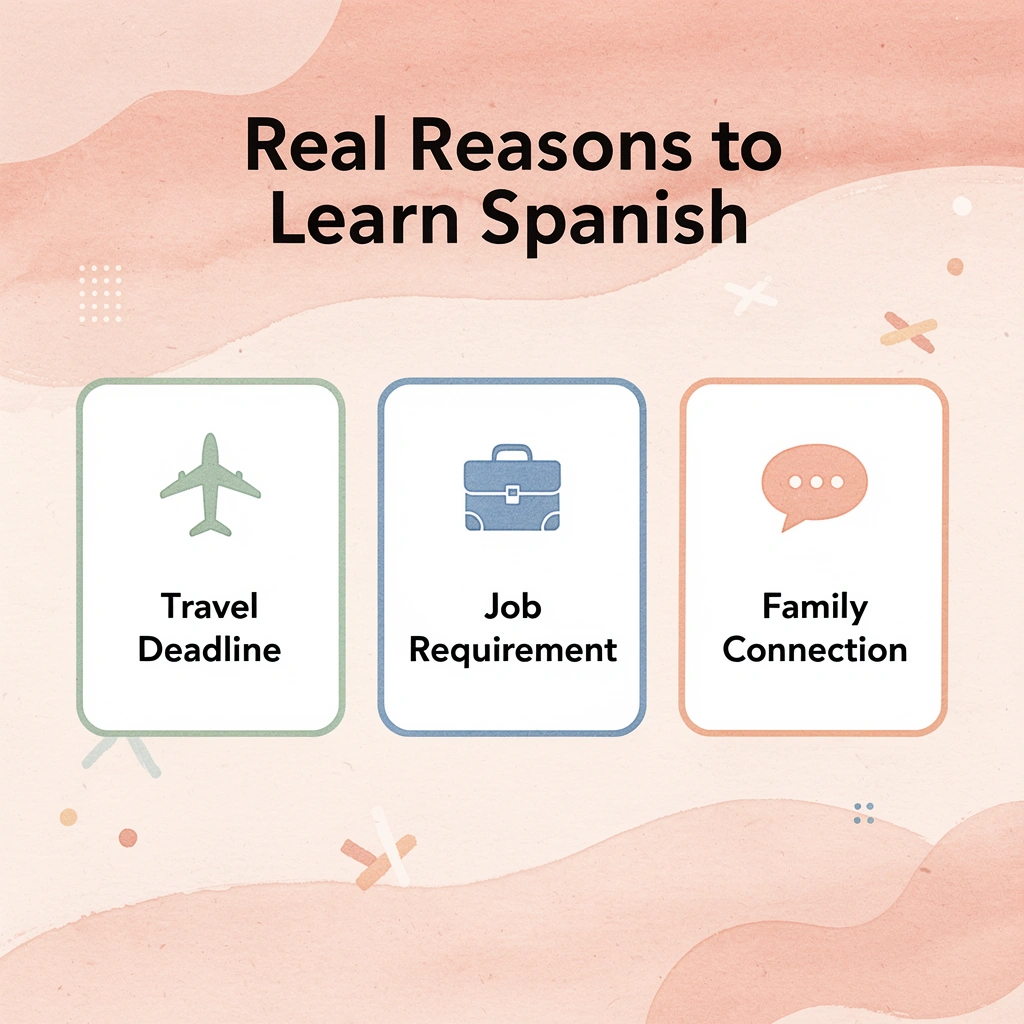
People search for the fastest way to learn Spanish because they have real deadlines: a flight booked three months away, a job requiring Spanish skills, a partner's family they want to actually talk to.
"The fastest way to learn Spanish isn't a myth — it's a necessity for millions of learners racing against real-world deadlines." — Language Learning Research
🎯 Key Point: The drive to learn Spanish fast isn't impatience — it's purpose-driven motivation, one of the most powerful accelerators in language acquisition.
This urgency reflects something learners sense but can't name. According to Middlebury Language Schools, Spanish is spoken by over 500 million native speakers worldwide, making the chance to use it everywhere. That massive scale makes the goal feel both achievable and urgent.
The strength of a learner's motivation can depend heavily on the reason they need Spanish and the deadline attached to it:
Travel – With a flight booked in 3 months, the upcoming trip creates high urgency to develop practical Spanish.
Career – A job requiring Spanish skills creates high urgency, particularly when language ability is tied directly to professional opportunities.
Family – Communicating with a partner's native-speaking family creates medium-high urgency and a strong personal reason to improve.
Cultural – Learning for general cultural connection and curiosity creates medium urgency, offering motivation without a fixed external deadline.🔑 Takeaway: With 500 million+ native speakers, Spanish isn't just widely spoken — it's everywhere. That scale means every hour of study translates into real opportunities to connect, work, and communicate.
💡 Tip: Use your specific deadline as a motivational anchor — learners with a concrete goal date progress measurably faster than those studying without one.
Why does more studying not always mean faster fluency?
The common assumption is that speed comes from volume: more vocabulary lists, more grammar drills, more hours logged. Most learners spend weeks on apps and textbooks, then freeze in front of a native speaker. The problem isn't effort; these activities feel productive without building actual communication ability.
Most learners default to structured methods because structure feels like progress. However, research on distributed practice from Studies in Second Language Acquisition shows that spacing practice across sessions produces stronger, longer-lasting fluency gains than cramming. The brain builds language through repeated, spaced retrieval and use. Tools like Parrot use short-form video content and a four-step cycle of listening, repeating, saving, and reviewing to fit practice naturally into daily life rather than requiring a dedicated hour.
How does method matter more than motivation when learning Spanish?
How fast you learn a language depends on your method, not your motivation. Two learners with equal practice time will achieve different results based on whether their practice develops communication skills or merely builds familiarity with content. Choosing input slightly harder than your current level but still comprehensible helps your brain learn language in ways that passive reading or isolated word practice cannot.
But knowing that efficiency matters more than intensity leaves one uncomfortable question unanswered.
Why Most Attempts to Learn Spanish Fast Don't Work
Speed is the wrong target. Most learners who want to learn Spanish fast focus on coverage — finishing lessons, completing decks, moving through units — rather than developing the actual ability to communicate. Those are different goals with very different results.
"Focusing on coverage instead of communication is the single most common reason learners plateau — they mistake activity for progress." — Language Acquisition Research
⚠️ Warning: Rushing through lessons and decks creates the illusion of progress while leaving your real communication skills underdeveloped.
💡 Key Insight: The learners who succeed don't chase speed — they chase comprehension and output. Shift your target from finishing units to actually speaking, and your results will follow.
Language learning can be measured by how much content you complete—or by how effectively you can actually communicate:
Finishing lesson units quickly vs. practising real conversations – A coverage-focused approach prioritises completing lessons, while a communication-focused approach prioritises using Spanish in real interactions.
Completing flashcard decks vs. building active recall in context – Finishing cards measures volume, while contextual recall helps learners retrieve and use language naturally.
Moving through course modules vs. developing speaking confidence – Course progress tracks how much material you've covered; communication progress reflects your ability to express yourself confidently.
Measuring lessons completed vs. measuring ideas expressed – Completion-based metrics show activity, while communication-focused metrics measure what you can actually communicate in Spanish.

Why does studying Spanish not lead to speaking Spanish?
The gap between studying Spanish and speaking Spanish is wider than most people expect. According to the Foreign Service Institute, English speakers need roughly 600 to 750 hours of study to reach conversational fluency in Spanish. The critical detail is what those hours contain. Six hundred hours of rearranging vocabulary lists produces vastly different results than 600 hours of comprehensible listening, speaking, and meaningful retrieval. The hours matter less than what fills them.
The failure pattern is consistent. Someone starts with an app that rewards streaks and feels productive because the interface is designed to feel productive. But gamified point systems maximize engagement, not learning. Weeks pass. They can identify colors and count to ten. They freeze when a native speaker talks at normal speed because the app trained recognition, not real-time processing.
What does the research say about why learners quit?
Most people who quit Spanish believe they lack the ability or discipline to continue. However, research tells a different story. Frequency analysis of Spanish language usage shows that knowing the 1,000 most common Spanish words covers roughly 88% of everyday conversation. The vocabulary level needed for functional communication is lower than learners fear. What's missing is exposure to that vocabulary in context, repeated over time, in formats that train the ear and mouth, not just the eye.
How does consistent daily exposure change the learning outcome?
Parrot leverages existing scrolling habits by delivering comprehensible content through short videos that fit into daily gaps. The four-step cycle of listening, repeating, saving, and staying consistent transforms passive screen time into active learning without requiring separate study sessions.
The learners who move fastest are not the ones who study the hardest. They treat Spanish not as a subject to learn in isolation, but as a communication system to use imperfectly and often from the start.
Related Reading
What Actually Makes Spanish Learning Faster
What separates learners who reach conversational fluency in months from those who spend years at the beginner plateau is not talent, but the quality of their practice: specifically whether it builds the ability to process and produce Spanish in real conditions.
"What separates fluent speakers from permanent beginners is not talent — it's whether their practice builds real-condition processing and production." — Language Acquisition Research
🎯 Key Point: High-quality practice that mirrors real conditions is the strongest predictor of how fast you reach conversational fluency.

Research confirms that comprehensible input is the engine of language acquisition. Dr. Stephen Krashen's acquisition theory shows we acquire language by understanding messages slightly beyond our current level, not by drilling grammar rules. This critical distinction transforms what you should practice daily.
💡 Tip: Prioritize comprehensible input—content above your current level—over rote grammar drills to accelerate your path to fluency.
🔑 Takeaway: Krashen's theory is a practical blueprint for structuring your daily Spanish practice around meaningful input rather than passive rule memorization.
What the hours actually tell you
According to Live Lingua, the FSI estimates it takes around 600 to 750 hours to reach professional working proficiency in Spanish. However, not all hours are equal. An hour spent passively re-reading a textbook chapter helps less than an hour spent listening to Spanish at a challenging level. The method you use matters more than the time you invest.
Why does recognition feel like progress but slow you down?
The most efficient learners fill their hours with the right kind of exposure, retrieval, and output. Most learners default to reviewing what they already know because recognition feels like progress—it's comfortable. Acquisition happens at the edge of what you can follow.
What does a session actually need to build real conversation skills?
Most people open a gamified app, complete timed exercises, and call it a session. This builds a habit of showing up, but not the listening comprehension or spontaneous recall that real conversation demands. Parrot uses short-form video content structured around comprehensible input in a four-step cycle: listen and immerse, repeat and parrot back, save and review, stay consistent. It redirects your existing scroll habit toward actual acquisition.
Why Spanish gives you a head start worth using
Spanish shares roughly 30 to 40 percent of its vocabulary with English through cognates—words like "hospital," "animal," and "natural" that transfer almost directly, according to Live Lingua. Learners who leverage that overlap by consuming content above their current level reach functional comprehension faster than those who treat Spanish as a language built from scratch.
The gap between knowing this and applying it is where most learners get stuck. The specific habits that close that gap are more surprising than most people expect.
15 Ways to Learn Spanish Faster
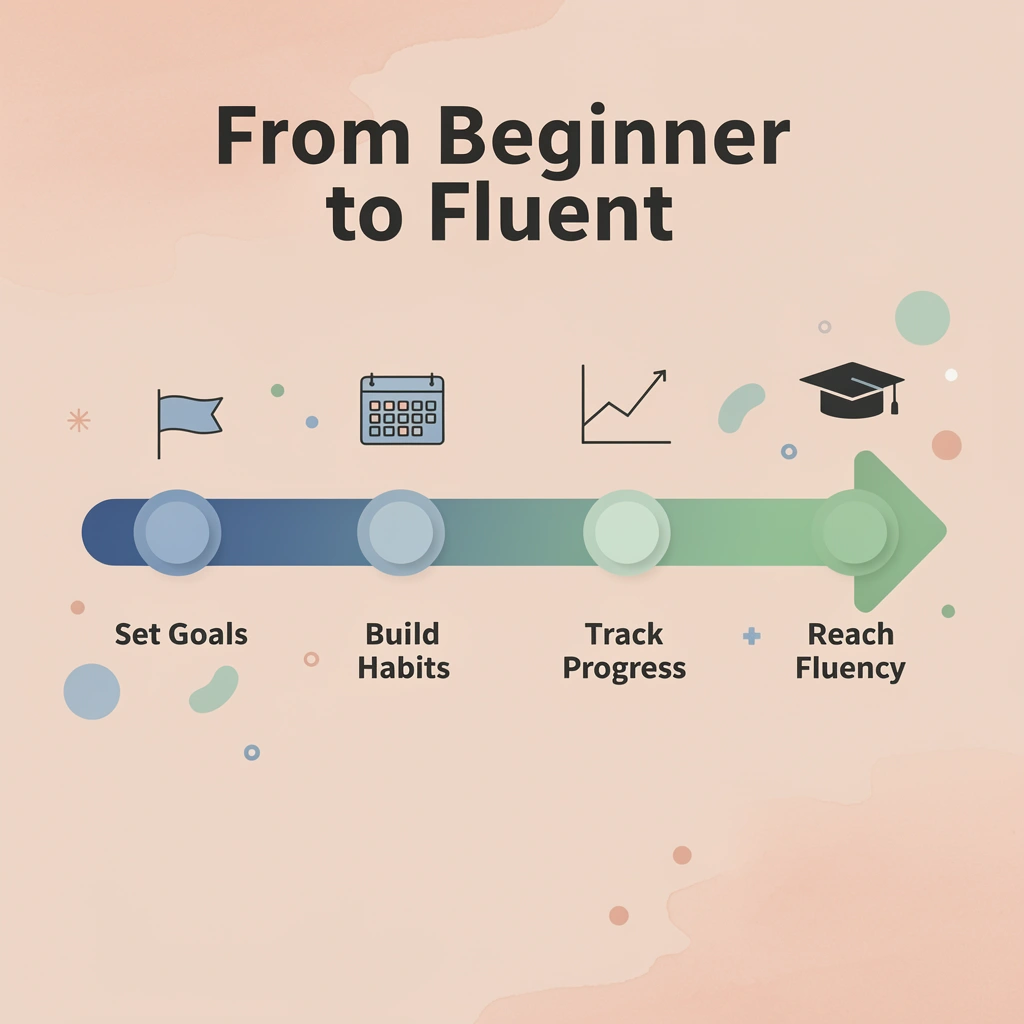
Specific goals separate learners who make real progress from those who stay permanently "almost ready." Progress depends on the habits you build with the time you have, not the time you wish you had.
💡 Tip: Set concrete, measurable targets — like "learn 10 new words per day" or "complete one lesson every morning" — instead of vague intentions like "study more Spanish." Small, consistent habits compound into fluency faster than you think.
"Specific goals transform wishful thinking into measurable momentum — the difference between learners who break through and those who stay stuck at the starting line." — Language Learning Research
🎯 Key Point: Your available time is your real resource — protect it, schedule it, and build repeatable habits around it. Learners who treat goal-setting as a system always outpace those who rely on motivation alone.
The way a Spanish-learning goal is structured can have a major impact on consistency, accountability, and progress:
Vague goal — “learn Spanish someday” – Provides little structure, leading to minimal progress and low accountability.
Specific goal — “30 minutes daily” – Creates a clear target that supports consistent gains and measurable milestones.
Habit-backed goal — scheduled + tracked – Combines a specific target with regular scheduling and progress tracking, creating a more reliable path toward fluency.
1. Set One Specific Spanish Goal
Start by deciding what you want Spanish to help you do. Preparing for a trip to Colombia requires different vocabulary and listening practice than speaking with your partner's family or negotiating contracts in Mexico City. A focused goal removes the paralysis of trying to learn everything and directs your attention to what matters most.
2. Learn High-Frequency Words and Phrases First
The 1,000 most common Spanish words cover most of everyday conversation. Focusing on frequently used words yields the fastest return on study time. Build a core set of usable words, then expand as you encounter new language in real contexts. Chasing rare vocabulary before mastering common phrases slows your progress.
3. Master Pronunciation Early
The way you pronounce words becomes a habit quickly and is hard to change later. Learn how Spanish vowels sound, where to stress words, and how sounds differ across regions early on. Good pronunciation also helps you understand what you hear because you recognise the sounds you have practiced making.
4. Learn Reusable Sentence Patterns
Learning individual words gives you building blocks. Learning sentence patterns gives you a construction system. Learning "quiero + infinitive" instead of "quiero" means you can express dozens of intentions immediately without building every sentence from scratch.
5. Study a Little Every Day
Consistency beats intensity. A 20-minute daily session gives your brain repeated retrieval opportunities that a single two-hour weekly session cannot replicate. The fastest learners protect small, regular windows and use them without negotiation.
6. Use Comprehensible Spanish Every Day
Most learners fail not because they lack motivation but because the material is either too easy or too hard. Comprehensible Spanish hits the sweet spot: you understand enough to follow along while learning new words and sentence patterns. Beginner-friendly videos, graded stories, and level-appropriate podcasts work when you choose them honestly based on your current level.
How does daily comprehensible input close the gap with real Spanish?
Textbooks and apps provide structured exercises that rarely sound like real Spanish, creating a gap between lesson language and authentic speech. Parrot closes this gap by delivering short-form video content built around comprehensible input, so the Spanish you consume matches what you'll encounter in actual conversations.
7. Start Listening Before You Understand Everything
Waiting until you "know enough" to start listening is how learners spend months studying Spanish they can read but not hear. Start with material that provides enough context to follow the general meaning, and accept partial understanding as normal. Your ear adjusts faster than expected with consistent exposure.
8. Speak Before You Feel Ready
You get fluency by practicing speaking, not before you start. Say out loud what you're doing, repeat sentences from native speakers, and answer simple questions without translating first. Mistakes you make while speaking are more valuable than perfect answers you think of silently, because speaking forces retrieval rather than recognition.
9. Use Spaced Retrieval for Vocabulary
Learning a word once and moving on causes vocabulary to disappear. Return to useful words across multiple sessions and try to remember them before checking the answer. That effort to remember, even when you get it wrong, builds strong memory you can use in conversation.
10. Learn Words in Context
A translation tells you what a word means, but a sentence shows how Spanish speakers use it. When you find vocabulary in a video, story, or conversation, save the phrase around it, not just the word. Reviewing expressions as complete phrases gives your brain the context clues it needs to remember them naturally.
11. Choose Content That's Challenging but Understandable
Content that's too easy keeps you comfortable but doesn't drive progress. Content that's too hard frustrates you. The best learning occurs when material challenges you enough to teach something new, yet remains comprehensible. Ask yourself honestly: are you learning something new, or simply confirming what you already know?
12. Stop Switching Between Learning Methods
Learners at every level fall into this trap: discovering a new app or technique, abandoning their current approach, and starting over. Switching methods resets the repetition and exposure that language learning requires. Choose resources for distinct purposes: listening, vocabulary retrieval, speaking practice. Give each enough time to work.
13. Build Spanish Into Activities You Already Do
You don't need to find new time—use the time you're already spending. According to The Linguist's tips for learning Spanish, Spanish is spoken by over 500 million native speakers around the world, meaning real content in every format and interest area is unlimited. Listen to Spanish while you walk, watch Spanish-language content during your free time, read about subjects you're already interested in. The more naturally Spanish fits into your daily routine, the less it feels like studying and the more it works like immersion.
14. Increase Authentic Exposure as Your Comprehension Improves
Learner materials are stepping stones, not the final goal. As your comprehension improves, gradually add interviews, films, social media videos, and conversations made for native speakers. This exposes you to different speakers, regional accents, and casual language—vocabulary and rhythm that structured lessons cannot fully capture.
15. Track What You Can Do, Not How Many Lessons You Complete
Finished lessons measure how much you do, not how much you learn. Periodically ask yourself if you can understand unfamiliar Spanish speakers, describe recent events without translating sentence by sentence, or sustain a real conversation beyond the first exchange. These are the true signs that your Spanish is becoming usable.
Making the 15 Strategies Work Together
These strategies form one interconnected learning system rather than 15 separate tasks. Set a clear goal, prioritize useful language, expose yourself to comprehensible Spanish daily, retrieve vocabulary actively, speak before you're comfortable, and gradually increase difficulty. The fastest way to learn Spanish isn't about doing more things; it's about spending more time on activities that build real comprehension and communication, not on activities that create the illusion of progress.
What surprises most learners is that progress speed depends on something more specific than method or motivation.
Related Reading
How To Learn Colombian Spanish
How To Learn Spanish On Your Own
Mango Vs Rosetta Stone
Best App To Learn To Speak Spanish
Best App To Learn Mexican Spanish
How To Learn Spanish Fluently
How To Learn Medical Spanish
Rosetta Stone Spanish Reviews
Best Way To Learn Spanish As An Adult
Is Learning Spanish Faster Actually Possible for Your Goal?
Your goal determines what "faster" actually means — and this distinction is critical. Reaching survival-level Spanish for a two-week trip and reaching full fluency to negotiate a contract are completely different destinations that require entirely different timelines and strategies. You can learn Spanish faster, but only once you define your finish line with precision.
"The definition of 'faster' is meaningless without a clear target — survival Spanish and contract-level fluency are not the same race."
🎯 Key Point: Before optimizing how fast you learn, you must define what success looks like for your specific situation. A vague goal produces a vague result.
Spanish learning timelines vary significantly depending on the level of fluency you want to achieve and how consistently you practise:
Survival Spanish – For a two-week vacation or basic travel, expect roughly 4–8 weeks of focused study to build useful phrases and essential communication skills.
Conversational fluency – For making friends and handling everyday conversations, a realistic target is 6–12 months of consistent practice.
Professional fluency – For negotiating contracts and participating in business meetings, expect 2–3+ years of immersive, sustained learning.
💡 Tip: Identify your finish line first — then every shortcut, method, and tool you choose can be precisely calibrated to get you there as fast as possible.

What "fast" really depends on
The critical difference is not how hard you study but how closely your input matches your actual target. A traveler who spends three weeks drilling restaurant conversations, transportation phrases, and number recognition will outperform someone who spent three months working through a textbook cover to cover. According to the Superprof NZ Blog, reaching conversational fluency in Spanish requires roughly 600 to 750 hours of study, though that assumes a general proficiency target. If your target is narrower, your timeline compresses significantly.
Why does misalignment between practice and need slow you down?
The failure point is usually misalignment between what you practice and what you need to do. Someone moving to Mexico City needs to understand spoken Spanish quickly and respond without preparation time. Someone learning Spanish for occasional family dinners needs warmth, cultural context, and common conversational patterns. Treating these as the same goal wastes months.
How does matching real speech close the gap between courses and conversations?
Most learners pick a popular app or course and hope it covers everything they need. But as weeks pass, the gap between what the course teaches and what real conversations demand becomes clear. Platforms like Parrot take a different approach: short-form video content centered on comprehensible input, so what you practice mirrors the rhythm, vocabulary, and pace of real Spanish speech rather than a simplified version for generic learners.
How does your goal change what you should do first?
Constraint-based thinking works better than motivation-based thinking. If you have 20 minutes a day and a trip in six weeks, that constraint tells you exactly what to cut: grammar tables, passive review, and anything that doesn't simulate a real interaction you'll have. If you have three months and a move ahead, the constraint shifts toward building listening stamina with authentic speech, because understanding fast, natural Spanish is the skill that will matter most when you arrive. The available time shapes the method; the goal shapes the content.
Do beginners and intermediate learners need different approaches?
Beginners and intermediate learners need fundamentally different approaches. Beginners require structured exposure to high-frequency patterns before authentic content becomes useful. An intermediate learner who repeats beginner material isn't learning faster; they're spinning in place. The fastest path forward at the intermediate level is more input at a slightly uncomfortable level, not more review of what is already known.
Most people spend enough time on their goals. What they lack is spending it on the right things.
How Parrot Helps You Learn Spanish Faster
Learning Spanish faster means making better use of the time you already have. Progress depends on regular exposure to understandable Spanish, repeated encounters with useful language, and opportunities to turn what you recognize into something you can actually use. Parrot makes one of the most time-consuming parts of that process easier: finding Spanish content you can understand and stay engaged with.
"Progress depends on regular exposure to understandable Spanish, repeated encounters with useful language, and opportunities to turn recognition into real use." — Core Language Acquisition Principle
🎯 Key Point: The biggest barrier to faster Spanish learning isn't motivation — it's finding the right content at the right level, consistently.
💡 Tip: Parrot removes the friction of content discovery so you can spend more time on active language exposure and less time searching for material you can actually understand.
Spanish learners often struggle less with access to material and more with finding the right content, staying engaged, and turning comprehension into active language use:
Finding comprehensible content – Parrot surfaces Spanish you can actually follow, reducing the time spent searching for suitable material.
Staying engaged with material – Matches content to your interests, making consistent practice easier.
Getting repeated exposure to useful language – Encourages repeated contact with high-value vocabulary, helping reinforce what matters most.
Turning passive recognition into active use – Helps bridge the gap between understanding and speaking by moving learners from recognising language to using it.

How does Parrot help you spend more time actually learning?
Independent learners can spend surprising amounts of study time deciding what to watch or listen to next. Parrot's AI-powered recommendation feed personalizes Spanish videos based on your proficiency and interests, so you don't have to sort through content to find something suitable. You can spend more of your limited study time engaging with Spanish instead of deciding what to study.
Real Spanish is valuable, but jumping straight into content you barely understand doesn't make learning more efficient. Beginners and lower-intermediate learners can spend entire sessions decoding speech rather than following what is being said. Parrot personalizes recommendations around your proficiency, helping you discover real Spanish appropriate for your current level and interests. As your comprehension develops, you can gradually tackle more challenging content without searching for new material each time your ability changes.
How does Parrot make listening a regular part of your routine?
When learners focus heavily on vocabulary lists and grammar exercises, listening becomes an afterthought. Parrot uses comprehensible input through engaging short-form videos, giving you regular exposure to authentic Spanish from native speakers. This makes listening easier to incorporate into your daily routine while bridging the gap between studying Spanish and hearing it used.
An unfamiliar word can quickly disrupt a listening session. With Parrot, clickable subtitles and instant translations let you check unfamiliar vocabulary without leaving the content. You can get the information you need and return to the video while keeping the bigger picture in view.
How does Parrot help you retain vocabulary and stay engaged?
Seeing a word once doesn't guarantee you'll remember it later. Parrot lets you save words directly from videos and revisit them in meaningful contexts. Rather than treating each new word as something to memorize and discard, you can return to language you've already encountered and observe how it's used.
A Spanish routine can become hard to maintain when every session feels identical. Parrot's personalized recommendations introduce varied Spanish content based on your interests and proficiency level, exposing you to different topics, speakers, and situations while building the listening and vocabulary skills that support communication.
The fastest way to learn Spanish isn't about cramming information into the shortest period. It's about reducing wasted effort and maximizing time spent understanding, hearing, retrieving, and using Spanish. Parrot supports that process by making authentic, understandable Spanish easier to find and more engaging to consume consistently.
Start Learning Spanish Today
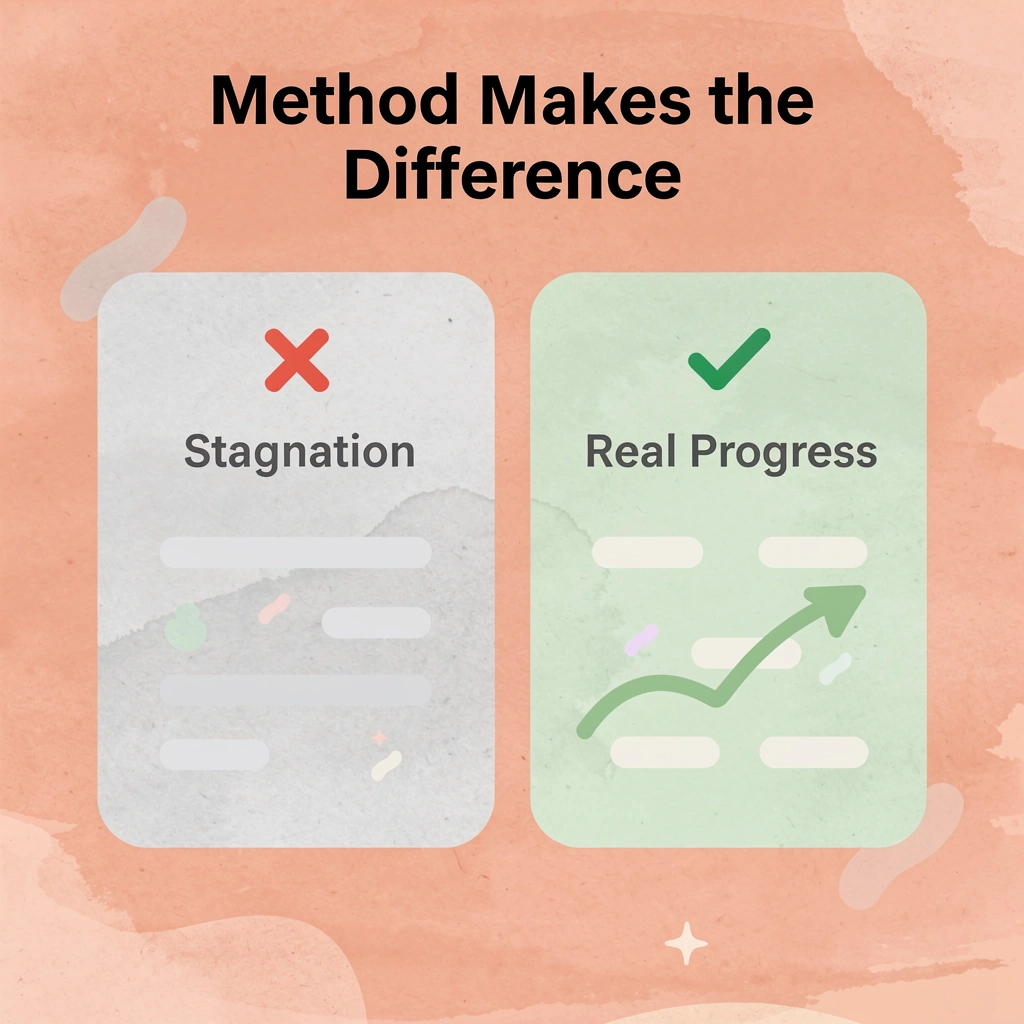
The right method changes everything. If you've been studying Spanish without feeling real progress, your tools weren't built for genuine learning. The difference between stagnation and momentum comes down to how you study, not how long.
"The method matters as much as the effort — the right tools transform time spent into real progress." — Language Learning Research
💡 Tip: If your current approach feels like going through the motions, it's not a motivation problem—it's a method problem. Switch to tools designed for active acquisition.
⚠️ Warning: Spending hours on Spanish with the wrong tools doesn't waste time; it builds bad habits and erodes confidence. Choose your platform carefully.
If you're tired of searching for content instead of actually studying it, try learning Spanish with Parrot and start your free 7-day trial. Our platform delivers short-form videos matched to your exact level and interests, complete with clickable subtitles, instant translations, and the ability to save vocabulary directly from content you watch — so you spend less time deciding what to study next and more time building real Spanish.
The platform is designed to make learning from authentic video content easier, more personalised, and less disruptive:
Level-matched videos – Delivers content that fits your current ability, keeping the material appropriately challenging.
Clickable subtitles – Lets you look up words instantly while watching, without interrupting the learning flow.
Instant translations – Removes the need for tab-switching or dictionary hunting, making comprehension faster.
Vocabulary saving – Builds a personal word bank from real content, so useful words can be revisited later.
🎯 Key Point: Parrot eliminates the biggest time-waster in self-study — the endless search for the right content. Everything is curated, leveled, and ready to learn from.
✅ Best Practice: Start your free 7-day trial today and experience the difference between browsing for Spanish content and actually learning from it.
Related Reading
Rosetta Stone Alternatives
Pimsleur Vs Babbel
Rosetta Stone Vs Pimsleur
Best Duolingo Alternative For Spanish
Best Free App To Learn Spanish
Rocket Spanish Vs Babbel
Babbel Spanish Review
Pimsleur Spanish Review
Rocket Spanish Vs Rosetta Stone
Duolingo Vs Rosetta Stone
Rocket Spanish Review
Duolingo Alternatives
Alternative To Pimsleur
Living Language Vs Rosetta Stone