Millions of people learn Spanish without a classroom, a tutor, or a structured course. The best way to learn conversational Spanish on your own comes down to consistent, practical exposure rather than memorizing grammar tables in isolation. Real progress happens when learners engage with the language the way native speakers actually use it, through listening, repeating, and forming sentences that reflect everyday situations.
Choosing the right tools matters just as much as putting in the time. Platforms designed around speaking and comprehension help learners move from hesitant beginner to confident speaker far more efficiently than traditional study methods alone. For anyone ready to take that step, learn Spanish with Parrot, an app built specifically for practicing Spanish the way real conversations demand.
Table of Contents
Why Learning Spanish on Your Own Is Harder Than It Looks
Why Studying Spanish Alone Doesn't Always Lead to Fluency
7 Helpful Ways to Learn Spanish on Your Own
9 Best Tools for Learning Spanish on Your Own
How to Build a Spanish Self-Study Routine That Actually Works
How Parrot Helps You Learn Spanish on Your Own
Start Learning Spanish Today
Summary
Choosing how to study Spanish matters more than how many hours you put in. Research from the Foreign Service Institute estimates English speakers need 600 to 750 hours of study to reach professional working proficiency in Spanish, but only if that time is spent on well-sequenced, purposeful practice. Scattered sessions across apps, podcasts, and grammar sites can add up to hundreds of hours without producing real conversational ability.
Most self-learners gravitate toward grammar drills and vocabulary flashcards because they feel measurable and controllable. But a 2023 meta-analysis by Webb, Uchihara, and Yanagisawa covering 24 studies and 2,771 learners found that contextual exposure through meaning-focused reading and listening produces vocabulary retention ranging from 6% to 17% depending on conditions. What sticks is shaped by how and where you encounter language, not by repetition alone.
Listening is the most commonly neglected skill in self-directed language study. The same 2023 meta-analysis found that meaning-focused listening produced average vocabulary gains of 15% on immediate tests and 13% on delayed tests. Beyond vocabulary, listening builds comprehension of natural rhythm, connected speech, and the way real conversations compress and blur in ways that written Spanish never does.
Spaced practice outperforms concentrated study by a significant margin. A 2022 meta-analysis by Kim and Webb covering 48 experiments and more than 3,400 participants found a medium-to-large effect for distributing practice over time compared to massed study sessions. Five short focused sessions spread across a week produce better retention than one long session before the week ends.
The failure point in most self-study routines is not motivation but format. Routines designed for ideal conditions collapse the first time a workday runs long or a week gets disrupted. A practical structure for most working adults- 20 to 30 minutes of structured study, 20 to 30 minutes of comprehensible input, speaking or shadowing three to four times per week, and contextual vocabulary review two to three times per week- is realistic enough to survive an imperfect week while still producing measurable progress.
Only about 1 in 3 learners who study without structured guidance ever reach conversational fluency, which means the majority hit a ceiling they cannot identify or break through on their own. The learners who reach fluency are rarely the ones who found the perfect system. They are the ones who kept showing up with an imperfect one long enough for the language to settle in.
Parrot's Learn Spanish addresses the content friction that derails consistent routines by delivering curated, interest-based short-form video immersion with clickable subtitles, so learners get comprehensible input matched to their level without spending time searching for appropriate material before every session.
Why Learning Spanish on Your Own Is Harder Than It Looks
Teaching yourself Spanish feels like freedom — until you realize that structure was doing more work than you thought. You trade the classroom's framework for flexibility, then discover the hidden cost.
"The absence of structure isn't freedom — it's the silent killer of self-directed language learning." — Language acquisition research
⚠️ Warning: Most self-learners underestimate how much classroom structure was quietly holding their progress together — until it's gone.
💡 Tip: Before going fully self-taught, identify exactly which structural elements — deadlines, feedback loops, accountability — you'll need to replace on your own.
Self-study can provide flexibility, but learners must replace the structure and support normally provided by a classroom:
Structured curriculum – Requires a self-designed learning path so you know what to study and in what order.
Built-in accountability – Requires personal discipline and progress tracking to stay on course without external pressure.
Immediate feedback – Requires active self-correction tools to identify mistakes and improve independently.
Scheduled practice – Requires consistent daily habits to maintain regular progress over time.

Why do so many self-taught Spanish learners quit before they make real progress?
The failure point is rarely motivation. Most people who quit weren't lazy—they were lost. Without clear progression, every study session starts with a decision: what do I work on today? That decision, repeated daily, drains energy needed for learning. According to the Foreign Service Institute, English speakers need approximately 600 to 750 hours of study to reach professional working proficiency in Spanish. Six hundred hours of purposeful, well-sequenced practice differs fundamentally from 600 hours of scattered app sessions and YouTube rabbit holes.
Why do beginners and intermediate learners both stall in the same way?
Beginners and intermediate learners follow the same pattern: they spend too much time choosing what to study and not enough time learning Spanish. A beginner downloads three apps, bookmarks a podcast, and saves a grammar website. An intermediate learner buys a textbook, subscribes to a YouTube channel, and starts a flashcard deck. Both feel productive. The problem isn't the number of resources you have; it's the lack of a clear path for what to study at your level.
What does the research say about self-directed learners reaching fluency?
Most people who teach themselves a language start with vocabulary lists and grammar drills because they feel easy to measure. But Spanish fluency isn't built from facts you collect—it's built from hearing language the way real people speak it. That gap between knowing the rules and understanding what real speakers say is where most independent learners get stuck. Research on self-directed language learning suggests only about 1 in 3 learners who study without structured guidance reach conversational fluency.
When progress slows, is the effort the problem or the method?
When progress slows down, the usual answer is to study harder: learn more words, review more grammar, keep up your app streak. But your brain doesn't learn language by memorizing. Dr. Stephen Krashen's research on comprehensible input shows that you become fluent by getting meaningful exposure to language you can mostly understand, not by drilling grammar rules in isolation. When learners get stuck, the problem is usually the method, not effort. Learn Spanish through Parrot uses this approach, offering short videos for 10 to 15 minutes daily so you build understanding through context and repetition rather than memorization.
Why consistency collapses before fluency arrives
The early weeks of Spanish study feel rewarding because you can see progress. Greetings, numbers, basic phrases come quickly. Then the curve flattens. You're deepening what you partially know, and that progress becomes nearly invisible without outside feedback. Without a teacher or conversation partner to mark improvement, it's easy to interpret the plateau as failure. Sessions get shorter, then skipped, then the app collects dust.
That quiet stall is where most self-directed learners lose the thread, for reasons more specific than anyone wants to admit.
Related Reading
Why Studying Spanish Alone Doesn't Always Lead to Fluency
Studying Spanish alone fails not because you are lazy, but because common self-learning methods — grammar drills, vocabulary flashcards, and gamified apps — are structurally misaligned with how the brain acquires language. The gap between knowing Spanish and speaking it is a method gap, not a discipline gap.
"The gap between knowing Spanish and speaking it is a method gap, not a discipline gap." — Key Insight
🎯 Key Point: Grammar drills and flashcard apps build passive recognition — but fluency requires active, real-time production that isolated study methods rarely train.
⚠️ Warning: If your study routine relies entirely on gamified apps or rote memorization, you may be reinforcing a structural misalignment between how you study and how your brain actually acquires language.
Different study methods build different language skills, but methods that require real-time language production tend to have the strongest direct impact on fluency:
Grammar drills – Train rule recognition and provide foundational knowledge, but have low fluency impact when the knowledge remains passive.
Vocabulary flashcards – Build word recall, but practising vocabulary in isolation provides only moderate fluency impact because contextual use is limited.
Gamified apps – Encourage engagement and repetition, but generally have low fluency impact when they rarely simulate natural conversation.
Conversational practice – Trains real-time language production and requires learners to respond in context, giving it a high fluency impact.

The real problem with how most people study
The failure point is usually invisible until it happens. You can spend months recognizing vocabulary in flashcard drills and still freeze when a native speaker uses that same word at natural speed. Recognition and retrieval are two different cognitive skills, and most self-study systems train only one. A 2023 meta-analysis by Webb, Uchihara, and Yanagisawa, covering 24 studies and 2,771 learners, found that incidental vocabulary gains through meaning-focused reading and listening ranged from 6% to 17% depending on conditions. Context and exposure mode shape what sticks, not repetition alone.
Why does grammar study feel productive but fall short?
Grammar has the same trap. It feels productive because it's measurable, so self-learners gravitate toward it not because it's more effective, but because it's more comfortable. Research on second-language interaction, reviewed by Loewen and Sato, identifies input, negotiation of meaning, and output as the core mechanics of language learning. Grammar study does not address any of those three.
What happens when self-study quietly neglects listening?
Most self-study routines skip listening. You can read grammar explanations, complete exercises, and review vocabulary for weeks while barely hearing natural spoken Spanish, creating a predictable gap: strong reading comprehension, weak audio processing. The 2023 meta-analysis found that meaning-focused listening produced average vocabulary gains of 15% on immediate tests and 13% on delayed tests. Listening also builds your ear for rhythm, connected speech, and the way real sentences compress in ways written Spanish never does.
The familiar fix is to add more resources—another app, another podcast. Apps like Duolingo or Babbel work well for early familiarity, but their gamified format isn't designed for the listening depth fluency requires. Apps like Parrot use short-form video immersion built around comprehensible input, allowing learners to absorb real spoken Spanish in context rather than drilling isolated vocabulary. This method aligns with how acquisition works and fits into 10 to 15 minutes a day.
Why does consistency matter more than how long you study?
Doing something consistently matters more than session length. A 2022 study by Kim and Webb found that spacing practice over time helps with learning a second language. Results depend on practice frequency, feedback timing, and intervals between sessions. Five short, focused sessions spread across a week outperform one long cramming session. Without accountability, routine collapses first. You don't need a classroom, but you do need enough structure to make Spanish a daily habit rather than something you keep meaning to do.
Knowing where the gaps are is half the work.
7 Helpful Ways to Learn Spanish on Your Own
Learning Spanish on your own is a design problem, not a motivation problem. The seven approaches below are structural components of a system that produces conversational fluency.
"Language learning success comes down to system design — the right structural components compound into conversational fluency faster than raw willpower ever could."
A well-rounded language-learning approach combines structured learning, active practice, and consistent reinforcement:
Structured input – Builds a strong vocabulary foundation and gives learners a clear starting point; high impact.
Active output practice – Develops speaking confidence by requiring learners to produce language rather than simply recognise it; high impact.
Spaced repetition – Reinforces information at strategic intervals, helping lock vocabulary and concepts into long-term memory; high impact.
Immersive listening – Exposes learners to natural speech patterns and improves real-world comprehension; medium-high impact.
Grammar frameworks – Provide structure and reduce guesswork when forming accurate sentences; medium-high impact.
Consistency systems – Make regular practice easier to maintain and help prevent burnout and dropout; high impact.
Feedback loops – Identify and correct mistakes early before inaccurate patterns become habits; medium-high impact.
💡 Tip: Before diving into the seven approaches, recognize that motivation fades — but a well-designed system keeps you moving forward even on low-energy days.
🎯 Key Point: Self-directed Spanish learning works best when you treat it as a structural challenge — building the right habits, tools, and feedback mechanisms — rather than relying on willpower alone.

1. Build a structured foundation first
Start with common words, basic sentence patterns, and pronunciation. A structured course or textbook provides a step-by-step plan that prevents you from stalling at the beginner level.
You don't need to master grammar before using Spanish—only enough basics to understand listening, speaking, and reading. Think of it like building blocks that support your learning, not something you must complete first.
2. Make comprehensible input your daily engine
Most people who teach themselves Spanish treat every Spanish encounter like a test. Comprehensible input flips that: you engage with Spanish you can mostly follow, where meaning is accessible, and learning happens as a byproduct of understanding rather than memorization.
Graded readers and learner-friendly videos are the right starting point. As comprehension grows, material grows with it. Vocabulary research confirms that contextual exposure, where words appear in meaningful situations, outperforms isolated repetition for long-term retention.
3. Add authentic listening gradually
The gap between textbook Spanish and real Spanish closes through deliberate exposure to natural speech. Podcasts, interviews, films, and conversations featuring different speakers train your ear to recognize words at native speed, across accents, and with the fillers and rhythm that no classroom script includes.
Many self-learners build solid reading comprehension while remaining lost in actual conversations. Authentic listening bridges that gap. Start with learner-friendly audio and increase difficulty as your ear adjusts.
4. Speak from the beginning, not after
Waiting until you feel ready to speak is the most reliable way to stay permanently unready. Speaking reveals which words and structures you can access under pressure, as opposed to merely recognizing when you see them.
Self-talk, shadowing native speakers, and language exchanges are good starting points that require no tutor or conversation partner from day one. The fear of sounding foolish costs learners months of irretrievable practice.
5. Review vocabulary in context, not in isolation
Flashcard loops create the illusion of progress. You recognize a word in a deck and feel satisfied, but recognition in a controlled environment differs from retrieving it in real conversation, a gap most flashcard routines never close.
When you encounter a useful word in a video or story, notice how it is used and return to it across different contexts throughout the week. According to a 2022 meta-analysis published in Language Learning covering 48 experiments and more than 3,400 participants, spacing practice over time produces a medium-to-large benefit for second-language acquisition, far outperforming concentrated study sessions.
6. Build a routine that fits your actual life
The most common self-study plan failure is ambition without architecture. A three-hour daily schedule designed for ideal conditions collapses when a work deadline or sick child appears. The routine that survives is built around your real constraints, not your aspirational ones.
What does a realistic daily study structure actually look like?
A practical structure for most working adults: 20–30 minutes of structured study daily, 20–30 minutes of understandable Spanish daily, speaking or shadowing three to four times per week, and contextual vocabulary review two to three times per week. This produces progress and helps you survive a bad week.
Is consistency a discipline problem or a format problem?
Most learners see this as a discipline challenge requiring more willpower. The more accurate perspective is a format challenge. Parrot delivers short-form Spanish video immersion in 10–15 minutes a day, fitting into existing scroll habits rather than demanding a dedicated study block you'll skip.
7. Integrate your tools into a system, not a collection
According to Berlitz, Spanish is spoken by over 500 million native speakers worldwide, making authentic material—podcasts, YouTube channels, films, news, and social media—effectively unlimited. The resource problem is not scarcity but coherence.
Why does treating tools as separate activities stall your progress?
The failure point is treating a popular app, a textbook, and a podcast as a complete learning plan when they are three separate activities with no connective tissue. Each tool should serve a specific function: structured study builds the foundation, comprehensible input develops meaning-based acquisition, authentic listening trains your ear, speaking builds active retrieval, and spaced review locks in vocabulary over time. When every tool has a role, you stop asking which resource is best and start asking whether your system has gaps.
What is the right question to ask about any Spanish-learning tool?
The right question about any Spanish-learning tool is not "Is this popular?" but "What does this develop, and does my current system already cover that?"
Knowing which tools belong in your system and which only feel productive is where most learners discover the sharpest gap between intention and results.
9 Best Tools for Learning Spanish on Your Own
The right three or four tools, chosen on purpose and used consistently, will help you move forward in Spanish. The difference between learners who stop making progress and those who keep improving usually isn't about effort or motivation — it's about whether their resources cover different areas.
"The difference between learners who stop making progress and those who keep improving usually isn't about effort or motivation — it's about whether their resources cover different areas."
💡 Tip: Don't overwhelm yourself with every tool available — picking three or four that target different skill areas (vocabulary, listening, speaking, grammar) is the most effective strategy for consistent progress.
🎯 Key Point: Intentional tool selection matters more than sheer quantity. A focused set of resources used daily will outperform a scattered collection used occasionally.
Different language-learning tools develop different skills, so a balanced approach is often more effective than relying on a single method:
Vocabulary – Builds your core word bank and provides the foundation for understanding and expressing ideas; flashcard apps are useful for reinforcement.
Listening – Trains your ear to recognise real speech, including natural pronunciation and rhythm; podcasts and audio tools provide valuable exposure.
Speaking – Develops active language production and conversational fluency; conversation platforms provide opportunities to practise.
Grammar – Provides the structural foundation needed to form accurate sentences; structured courses offer systematic instruction.

1. Parrot
Parrot is built around the insight that comprehensible input, not grammar drilling, drives conversational fluency. Our short-form videos are matched to your proficiency level and interests, providing regular contact with authentic Spanish without requiring you to hunt for content. Clickable subtitles and vocabulary-saving tools ensure you absorb rather than passively watch. Parrot fills the gap most study systems leave: meaningful listening exposure.
How does Parrot compare to gamified apps like Duolingo?
Most learners choose apps that focus on streaks instead of real learning. Duolingo's familiar approach—complete exercises, feel productive—works well for building habits. According to Comligo, Duolingo has over 500 million registered users, which indicates popularity rather than effectiveness. Gamified repetition builds habits with real value, but it doesn't replicate processing Spanish at natural speed, where meaning arrives before translation does.
2. Pimsleur
Pimsleur works best during commutes, walks, or other screen-free time when your hands and eyes are busy. Audio-based lessons build pronunciation and listening recall through structured repetition. Its Latin American Spanish course provides a solid spoken foundation, though you'll eventually outgrow its pace and need more varied input for real listening range.
3. Anki
The problem with Anki isn't the tool itself: it's the cards you make. Learners who build decks from real Spanish content (videos, podcasts, real sentences) remember far more than those who import generic frequency lists. Spaced repetition works best when the material has emotional or contextual weight. Without it, you're drilling symbols, not language.
4. Dreaming Spanish
Dreaming Spanish organizes comprehensible input by difficulty level, solving the challenge of finding content slightly above your current level—challenging enough to stretch you but clear enough to follow. The limitation is that listening and reading, even hours of it, won't automatically produce speaking ability. Input is necessary but not sufficient on its own.
Parrot addresses a gap most learner systems leave open: daily, contextually rich Spanish exposure woven into real life rather than demanding dedicated study blocks. Short-form video matched to your level delivers comprehensible input during minutes you'd otherwise spend scrolling.
5. Language Transfer
Language Transfer's Complete Spanish course teaches you to think through grammar instead of memorizing rules. The guided audio format walks you through how Spanish structures work, helping you understand patterns. According to The Spanish Experiment, Language Transfer is free on a donation basis, whereas Michel Thomas costs around 00.
6. italki
Speaking practice is the most commonly skipped part of teaching yourself Spanish. italki connects you with tutors and native speakers for live conversation, testing your passive knowledge under pressure. You'll discover which words you recognize but can't say, which grammar you understand but can't use when put on the spot—the gap between knowing something and using it that italki helps you close.
7. SpanishDict
SpanishDict works best for looking up unfamiliar word forms and hearing pronunciation. The problem arises when using it as a primary learning tool. Looking things up creates an illusion of progress without providing the practice and exposure necessary to learn the language.
8. YouTube
YouTube offers diverse content: interviews, vlogs, news, comedy, and commentary from native speakers across different countries and speaking styles, all free. The challenge is that YouTube doesn't organize content by level, so you must develop the ability to judge what's appropriately challenging—a skill newer learners often lack.
9. Netflix
Netflix works well for intermediate-to-advanced learners. Following natural conversation in Spanish films and series requires sufficient listening experience to understand unsimplified speech. Spanish audio with Spanish subtitles keeps your brain in the language, making it an immersion tool. If you use it too early, it becomes frustrating background noise.
How these tools fit together
The right question when building your toolkit isn't which resource is most popular, but which part of your current routine is missing. Structure, vocabulary review, listening exposure, speaking practice, and authentic input are distinct skills. A system covering all five with focused, non-overlapping tools works better than any single resource.
What's harder to figure out, and what most learners skip, is how to sequence these tools across a week to build momentum rather than fill time.
Related Reading
How To Learn Colombian Spanish
Best App To Learn Mexican Spanish
Fastest Way To Learn Spanish
Best App To Learn To Speak Spanish
Mango Vs Rosetta Stone
Best Way To Learn Spanish As An Adult
How To Learn Medical Spanish
Rosetta Stone Spanish Reviews
How To Learn Spanish Fluently
How to Build a Spanish Self-Study Routine That Actually Works
Putting your tools in order is only half of what you need to do. Spreading out your energy across a week so that each session builds on the one before it is just as important.
"Consistency over intensity — a structured weekly rhythm is what separates learners who plateau from those who achieve real fluency." — Language Learning Research
Effective studying depends on more than simply spending time with the material; how learning is organised and developed over time also matters:
Tool organization – Creates a clear foundation for learning by keeping resources and materials structured; moderate impact.
Session spacing – Reinforces retention by spreading learning across multiple sessions instead of relying on one intensive study period; high impact.
Progressive building – Develops knowledge and skills step by step, allowing each new concept to build on previous learning; critical impact.
💡 Tip: Schedule your sessions at the same time each day — your brain will begin to prime itself for learning before you even open a textbook.
⚠️ Warning: Cramming all your study time into one or two days is not the same as spreading it out — spaced practice is what drives long-term retention, not raw hours.
What does a 30-minute daily routine actually cover?
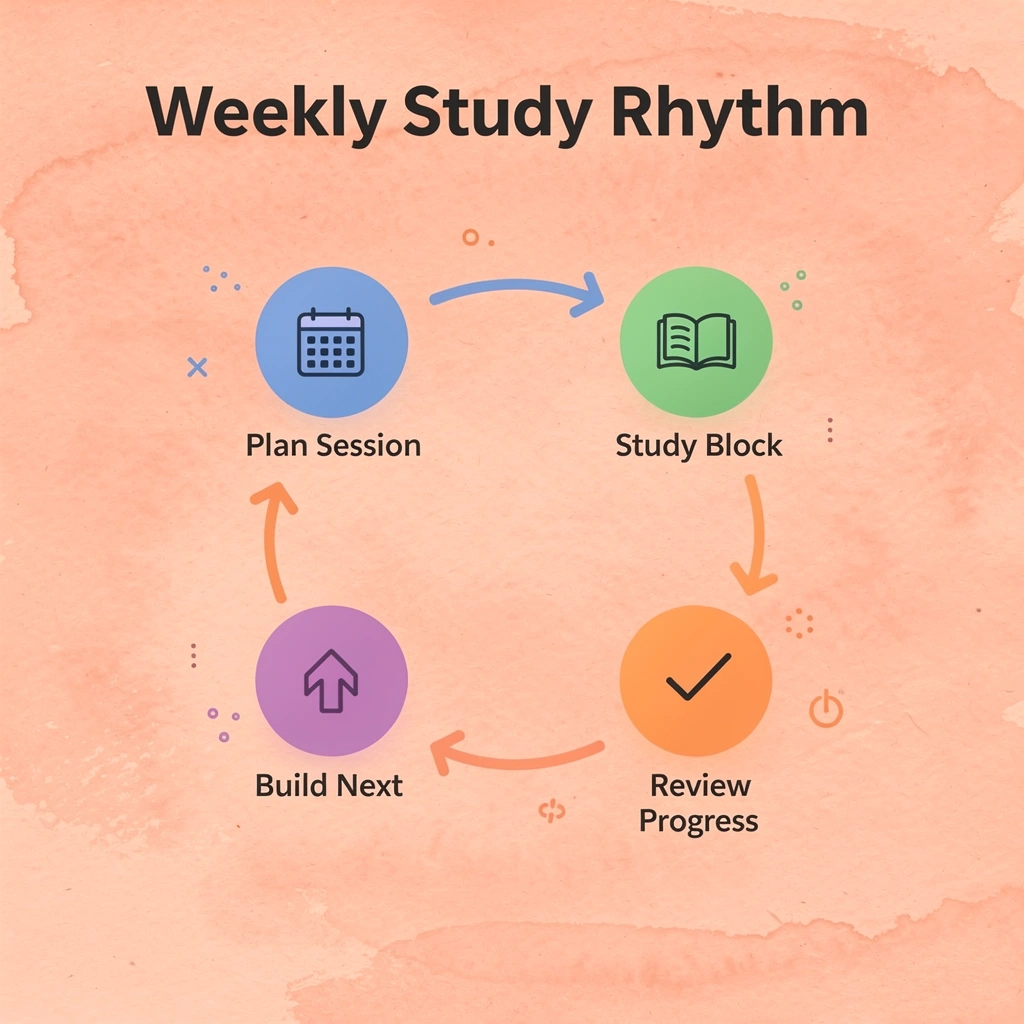
A 30-minute daily routine covers all four core skills: 10 minutes of structured study, 10 minutes of comprehensible Spanish input, 5 minutes of vocabulary review, and 5 minutes of speaking or shadowing. The goal is consistent contact with the language across all areas, not depth in any single one. With 60 minutes, spend the extra time on listening and reading rather than doubling grammar study; you understand better through exposure than explanation.
How do you keep the habit alive when life gets complicated?
Self-directed learners often find their routine falls apart when life gets complicated. Missing one longer session triggers avoidance. The fix is designing a routine with a smaller version built in. Ten minutes of meaningful Spanish contact keeps the habit alive far better than skipping entirely, and consistency across weeks matters more than intensity on any single day.
How should you structure your week, not just your day?
Plan your week to focus on different skills. Mix structured study with Spanish listening or reading Monday through Friday. Add speaking, shadowing, or self-talk three to four days per week. Save two or three days for reviewing vocabulary encountered during the week. Weekends work well for longer authentic input sessions: a full podcast episode, short film, or tutor conversation, followed by brief reflection on what felt easier or harder.
How do you fill a weekly routine without spending time searching for content?
Most learners face a real problem: finding enough interesting, level-appropriate Spanish to fill a weekly routine without spending 20 minutes searching before each session. Short-form video immersion, like what Parrot provides, solves this. Curated, interest-based Spanish content with clickable subtitles means input is ready when you are, fitting into a 10-15 minute window without requiring you to hunt for something appropriate first.
How do you know if your Spanish routine is actually working?
The most reliable way to know your routine is working is to stop counting completed lessons and start asking functional questions. Can you follow a conversation between two native speakers without rewinding constantly? Can you describe something that happened to you without mentally translating each sentence first? Can you understand a speaker you've never heard before, not just the one voice you've been training with? These questions cut through the false comfort of streaks and lesson counts. According to research referenced by the American Council on the Teaching of Foreign Languages, communicative competence—the ability to use language in real contexts—is the only metric that reliably predicts whether a learner will function in the real world.
Why does progress in self-study feel uneven?
Getting better at teaching yourself a language rarely feels like a straight path. Some weeks your listening comprehension will improve significantly; others will feel stagnant despite consistent effort. The learners who become able to have conversations are rarely those who found the perfect study method. They're the ones who kept showing up with an imperfect way long enough for the language to stick.
How Parrot Helps You Learn Spanish on Your Own
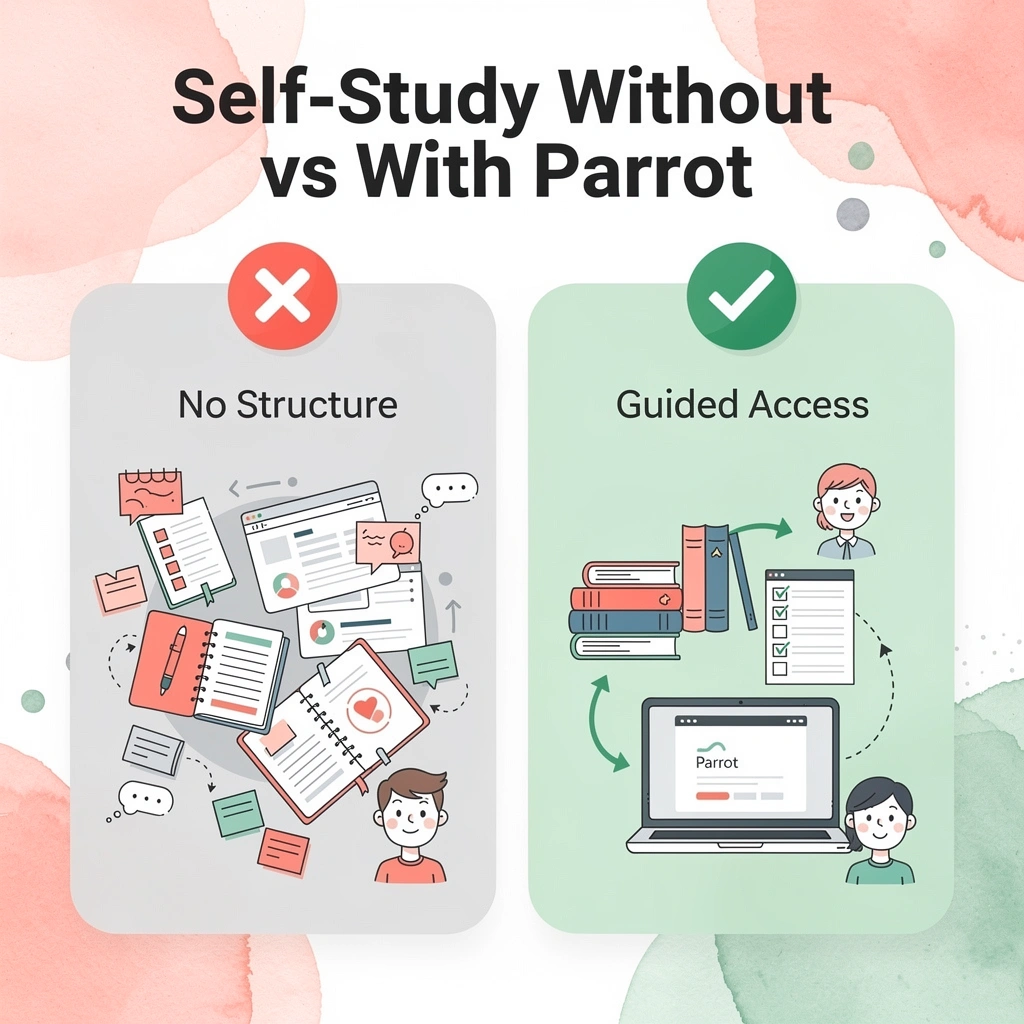
Learning Spanish on your own gives you complete control over when and how you study, but you must find good content and maintain regular study habits to make real progress. Parrot solves an essential problem with self-study: getting regular access to Spanish that you can genuinely understand and enjoy.
"The biggest barrier to self-directed language learning isn't motivation — it's finding comprehensible, engaging content consistently enough to build real fluency." — Language Learning Research
💡 Tip: Self-study works best when you remove friction — Parrot handles the hardest part by delivering Spanish content that's perfectly matched to your level, so you can study consistently without burning out searching for material.
🎯 Key Point: Regular exposure to understandable Spanish is the #1 driver of fluency — and it's exactly what Parrot is built to provide.
Self-study becomes easier to sustain when learners have the right content, structure, and guidance built into the experience:
Finding content at the right level – Delivers comprehensible Spanish automatically, so learners spend less time searching for suitable material.
Staying consistent over time – Provides regular, structured access to learning material, making it easier to maintain a steady routine.
Staying engaged with dry content – Focuses on content learners can understand and enjoy, making practice more motivating.
Knowing what to study next – Guides the learning path so learners always have a clear next step instead of having to plan everything themselves.
Why do self-learners struggle to find authentic Spanish at the right level?
Native Spanish content provides helpful practice, but material that is too hard becomes frustrating. Parrot uses research-backed comprehensible input through engaging short-form videos, giving independent learners regular exposure to real Spanish from native speakers at their skill level. You spend more study time understanding Spanish instead of searching for suitable material.
How does Parrot help when native content is too difficult?
Finding content that's both interesting and appropriately challenging takes time. Random searches might lead from beginner material to fast conversations with native speakers that you can barely follow. Parrot's AI-powered recommendation feed personalizes Spanish videos around your skill level and interests, helping you discover relevant content without manually sorting through endless options. You can gradually increase difficulty while staying engaged with content you want to understand.
How does Parrot keep your learning flow from breaking down?
Independent learners lack a teacher to explain unfamiliar words. This means they must pause videos frequently to look up words in a dictionary. Parrot's clickable subtitles and instant translations provide immediate help without leaving the video. You can understand the main message while building vocabulary, rather than turning each session into separate searches.
How does Parrot help you retain vocabulary learned while self-studying?
Seeing a word once doesn't guarantee you'll remember it, especially if a teacher or syllabus doesn't revisit important vocabulary. Parrot lets you save words directly from videos and review them in meaningful ways. Important vocabulary gets multiple opportunities to reappear, helping you build on what you've already learned.
How does Parrot prevent independent learning from becoming repetitive?
Self-study can become monotonous when repeating the same exercises and beginner content. Parrot's personalized recommendations show you varied Spanish videos matched to your skill level and interests, exposing you to different subjects, speakers, and contexts. Your daily Spanish input stays relevant and engaging, helping you maintain your routine over time.
How do you build your own Spanish learning environment?
Learning Spanish on your own means creating your own structure. You still need a foundation, understandable input, authentic listening, speaking practice, vocabulary review, and regular exposure, but you can build those around your goals, schedule, interests, and current level. Parrot makes one important part easier by providing steady, understandable, engaging Spanish without requiring constant searching.
Start Learning Spanish Today
Starting is the move that makes everything else possible. If you've been waiting for more time or a better plan, that wait is the problem.
"The best time to start learning Spanish was yesterday. The second best time is right now." — Language Learning Research
💡 Tip: Don't wait for the perfect moment. Momentum builds from action, not preparation.

If you've been learning Spanish on your own but lose time hunting for the right content — or hit material that's too easy or too hard to understand — Learn Spanish gives you a faster way to get started. In your first session with Parrot, you can watch short Spanish videos matched to your level, tap any word for an instant translation, and save vocabulary directly from what you're watching. You build a comprehensible input habit from day one, without the setup friction that kills most self-study attempts.
Parrot makes language learning more accessible by combining personalised content with contextual vocabulary support:
Level-matched videos – Delivers content at the right difficulty level, keeping lessons challenging without becoming overwhelming.
Instant word translation – Lets you tap any unfamiliar word to see its meaning immediately in context, so you can keep learning without interrupting the experience.
Vocabulary saving – Builds a personal word bank from the words you encounter, making it easier to review and reinforce vocabulary over time.
🎯 Key Point: Comprehensible input — content you can almost fully understand — is the most effective method for building real fluency fast.
⚠️ Warning: Setup friction is the silent killer of self-study. Every extra step between you and real Spanish content is a reason to quit — Parrot eliminates that gap.
Related Reading
Duolingo Alternatives
Babbel Spanish Review
Duolingo Vs Pimsleur
Alternative To Pimsleur
Pimsleur Spanish Review
Rocket Spanish Review
Living Language Vs Rosetta Stone
Best Duolingo Alternative For Spanish
Rosetta Stone Alternatives
Rosetta Stone Vs Pimsleur
Rocket Spanish Vs Rosetta Stone
Duolingo Vs Rosetta Stone
Pimsleur Vs Babbel
Rocket Spanish Vs Babbel
Best Free App To Learn Spanish