For healthcare professionals, a language barrier between provider and patient is more than an inconvenience. When a Spanish-speaking patient cannot clearly describe their symptoms, and a clinician cannot ask the right follow-up questions, the quality of care suffers. Medical Spanish bridges that gap, giving providers the vocabulary and conversational confidence to handle real clinical situations.
Generic language courses rarely address the specific phrases, terminology, and patient interactions that come up in a healthcare setting. Focused practice on medical conversations, common diagnoses, and health-related instructions is what actually moves the needle for busy professionals. Those ready to build that skill set can learn Spanish through Parrot, a tool designed specifically for practical, real-world language use.
Table of Contents
Why Learning Medical Spanish Is Harder Than Learning General Spanish
Why Knowing Spanish Doesn't Automatically Prepare You for Medical Conversations
7 Ways to Learn Medical Spanish
7 Best Tools to Learn Medical Spanish
How to Build a Medical Spanish Learning Routine
How Parrot Helps You Build Medical Spanish Through Authentic Exposure
Start Learning Spanish Today
Summary
Medical Spanish is fundamentally different from general conversational Spanish, and treating them as the same skill is where most healthcare professionals run into trouble. A clinician who can navigate daily life in Spanish may still struggle when a patient uses informal, regional, or colloquial language to describe symptoms. That gap between social fluency and clinical communication competence is wider than most learners expect before they encounter it in practice.
Self-assessed Spanish proficiency is a poor predictor of actual clinical communication ability. Research published in the Journal of General Internal Medicine found that only 13% of physicians who self-report Spanish proficiency pass a formal medical Spanish language assessment. Confidence built through general language exposure does not reliably transfer to the specific demands of a patient encounter.
Communication failures, not the absence of any Spanish at all, account for the majority of medical errors involving limited English proficient patients. According to the Joint Commission, 56% of such errors are attributed to communication breakdowns. Most of those failures happen when a clinician attempts communication but lacks the clinical language depth or listening comprehension to handle the conversation accurately.
Regional variation in Spanish is a significant and underestimated challenge in clinical settings. The AAMC reports more than 40 million Spanish speakers in the United States, representing communities from Mexico, Puerto Rico, Cuba, Central America, and South America, each bringing distinct pronunciation patterns, vocabulary choices, and colloquial expressions for describing physical symptoms. Training on a single accent or standardized dialect leaves clinicians underprepared for the actual range of patients they will encounter.
Vocabulary memorization alone does not build the listening comprehension that clinical Spanish requires. Patients speak quickly, use informal phrasing, change direction mid-sentence, and rely on colloquial descriptions rather than medical terminology. Developing the ability to understand real spoken Spanish across varied speakers requires consistent, repeated exposure to authentic speech, not just recognition of written terms or controlled recordings.
No single tool covers every skill that medical Spanish demands. Structured courses address clinical vocabulary, audio-first tools build spoken confidence, spaced repetition apps lock in retention, and conversation practice with tutors develops spontaneous production. The most effective self-study system assigns each tool a specific role rather than relying on one approach to cover all of them. Learn Spanish addresses the listening comprehension piece specifically, using short-form video content from native speakers to build the kind of real-world auditory recognition that formal study methods typically leave underdeveloped.
Why Learning Medical Spanish Is Harder Than Learning General Spanish
Medical Spanish isn't a dialect—it's a completely different communication challenge entirely. General Spanish gets you through a pharmacy or hotel check-in. Medical Spanish requires you to understand what a patient means when describing pain they've never had words for, then respond with both accuracy and clarity. The gap between "I can communicate" and "I can communicate clinically" is wider than it appears.
"The gap between 'I can communicate' and 'I can communicate clinically' is wider than it appears — and in a medical setting, that gap can cost lives."
🎯 Key Point: General Spanish fluency does not automatically translate into clinical competency. Medical contexts demand a higher standard of precision that requires dedicated, specialized training.
⚠️ Warning: Assuming your conversational Spanish skills are enough for patient care is one of the most dangerous mistakes a healthcare provider can make. Clinical miscommunication carries real consequences.
General Spanish provides a foundation for communication, but medical Spanish requires additional vocabulary, precision, and clinical communication skills:
Everyday vocabulary vs. anatomical and clinical terminology – General Spanish covers common words and phrases, while medical Spanish requires specialised language for anatomy, conditions, treatments, and care.
Casual conversation flow vs. symptom elicitation and diagnosis – Everyday Spanish focuses on natural conversation, whereas medical communication requires accurately asking about and understanding symptoms.
Cultural pleasantries vs. informed consent and patient safety – General conversation includes social and cultural conventions, while medical Spanish requires clear communication around consent, treatment, and patient safety.
Low-stakes errors vs. high-stakes precision – Mistakes in casual conversation are usually minor, but errors in clinical communication can have serious consequences, making accuracy essential.
Why vocabulary lists aren't enough
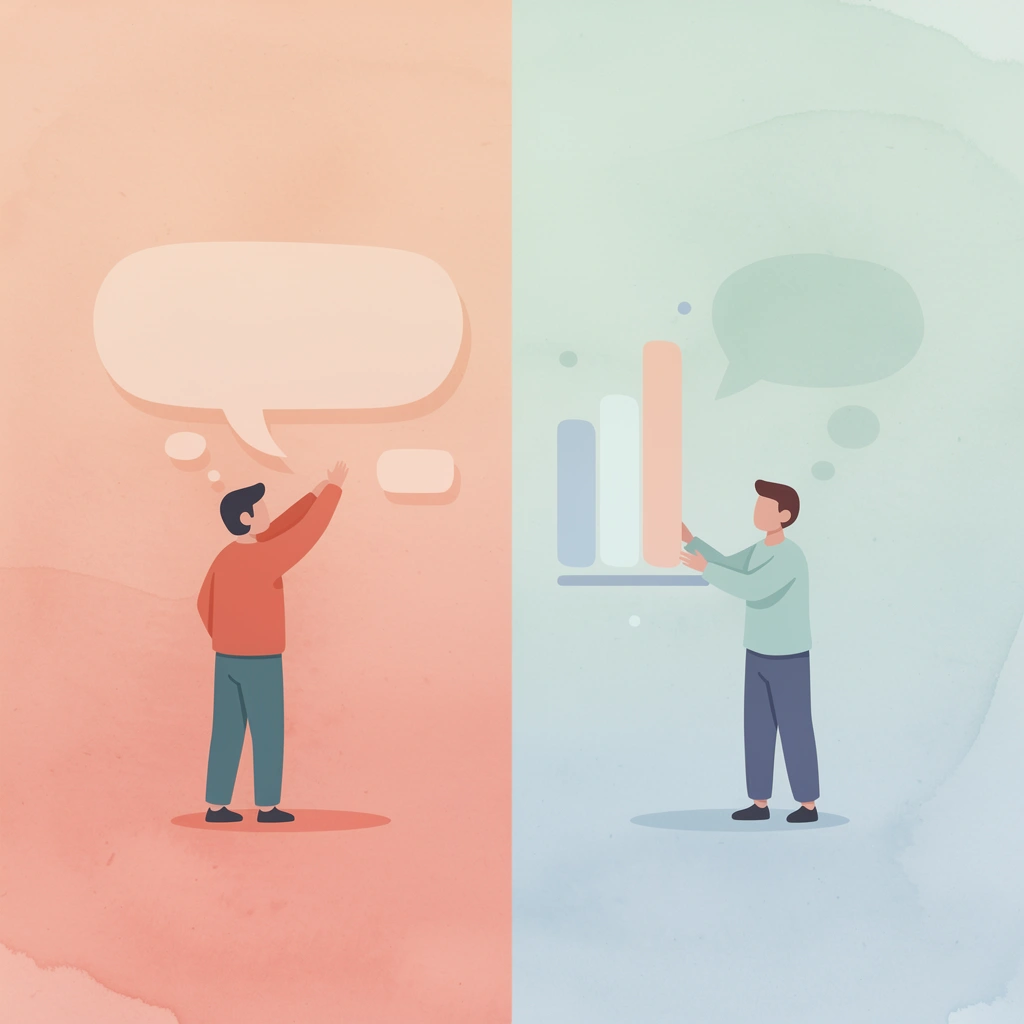
Medical Spanish isn't general Spanish with extra terms added. Healthcare professionals must understand how words function in full clinical exchanges, not their isolated meanings. Knowing the Spanish word for "nausea" doesn't prepare you to ask whether it started before or after the pain, whether it comes in waves, or whether they've vomited. That requires sentence construction, contextual listening, and real-time comprehension working together. According to a 2021 survey published in PMC, while more than 80% of US medical schools offer medical Spanish education, fewer than 50% of those programs have dedicated faculty educators, leaving most training without the depth to build integrated, conversational competence.
Why do patients rarely use the words you studied?
The vocabulary challenge goes both ways. Patients rarely use clinical terms; they describe a burning feeling, heaviness in the chest, or pain that comes and goes. A healthcare professional trained in formal medical Spanish but not everyday conversational language will understand the textbook but miss what the patient is saying.
What actually builds real communicative competence?
Most professionals use printed vocabulary sheets during appointments or avoid Spanish-speaking patients and wait for interpreters. Neither builds communicative competence. What works is consistent exposure to real spoken Spanish in medical contexts: comprehensible input that trains your ear and instincts simultaneously. Parrot uses short-form video content reflecting real patient conversations rather than scripted grammar exercises, so recognition and response become automatic rather than effortful.
The regional variation problem
Spanish varies significantly across regions, which matters in hospitals and doctors' offices. According to the AAMC, more than 40 million Spanish speakers in the United States come from Mexico, Puerto Rico, Cuba, Central America, and South America. Each group brings different vocabulary, regional expressions, and distinct ways of describing bodily sensations.
A learner trained on one type of Spanish may understand a tutor clearly, then struggle when a patient from a different background describes the same symptom with different words. Building medical Spanish skills means training your ear to understand multiple voices, not one standard accent.
This raises an important question: what happens when a Spanish speaker sits across from a clinician who thought they were ready?
Why Knowing Spanish Doesn't Automatically Prepare You for Medical Conversations
Conversational Spanish gets you through a dinner order or friendly exchange at the front desk. It does not get you through a patient describing chest tightness in broken sentences while visibly frightened. Those are two completely different cognitive tasks.
"Conversational fluency and medical communication fluency are not the same skill — one handles social exchanges, the other handles high-stakes, life-or-death clinical moments."
⚠️ Warning: Assuming everyday Spanish fluency translates to clinical competency is one of the most dangerous misconceptions in healthcare settings — the cognitive demands are on an entirely different level.
🔑 Takeaway: Medical Spanish requires processing fear-laden, fragmented speech under pressure — a skill that casual conversational ability simply does not train you for.
Conversational Spanish and medical Spanish require very different levels of precision, especially when communication happens under pressure:
Everyday situations vs. clinical situations – Conversational Spanish covers things like ordering food and small talk, while medical Spanish requires describing chest tightness, pain levels, and other symptoms accurately.
Low-stakes vs. high-stress communication – Everyday conversations are generally relaxed, whereas medical interactions can be high-stress and emotionally charged.
Complete sentences vs. fragmented speech – Everyday speakers may use simple, complete sentences, while patients in distress may communicate in broken or fragmented speech.
Social vocabulary vs. clinical terminology – General Spanish focuses on social and everyday vocabulary; medical Spanish requires clinical terminology and precise symptom language.

Why does fluency still leave clinicians unprepared in the exam room?
A clinician who studied Spanish for two years and traveled through Latin America can still freeze when a patient says "me pica por dentro" or "siento que me va a dar algo." Neither phrase appears in standard medical Spanish courses, yet both describe symptoms that matter. According to the Joint Commission, 56% of medical errors involving patients with limited English skills stem from communication failures: most occur not because no one tried, but because the person trying wasn't prepared for the version of Spanish that showed up in the room.
What general fluency misses
The pattern shows up consistently among healthcare professionals who studied Spanish seriously before starting clinical work. Someone logs hundreds of hours of input, gets comfortable with natural speech, handles daily life in Spanish without friction, and then sits across from a patient and realizes that "a basic medical intake" is not the same as confident clinical communication. General fluency builds the foundation, but the structure needed for medical conversations must be built deliberately. You need to recognize everyday symptom descriptions, not textbook terminology alone. You need to process speech under pressure, not during relaxed listening sessions.
How wide is the gap between self-assessed and tested clinical Spanish?
That gap is wider than most people expect. The Journal of General Internal Medicine found that only 13% of physicians who say they can speak Spanish pass a formal medical Spanish language test. What doctors believe they can do differs from what they can do when talking to patients.
Why do vocabulary lists and drills fall short for real clinical listening?
Most approaches to closing that gap rely on vocabulary lists, grammar drills, or structured courses. These work for recognition on paper but don't build the listening muscle needed when a patient speaks quickly, changes direction mid-sentence, or uses unfamiliar regional expressions. Platforms like Parrot use short-form video immersion built on comprehensible input, exposing learners to real spoken Spanish across different voices and contexts in sessions short enough to fit between patient appointments. The method is grounded in Dr. Stephen Krashen's research on language acquisition, which argues that fluency comes from understanding meaningful input, not from memorizing rules.
The critical difference between a clinician who communicates well in Spanish and one who only thinks they do comes down to exposure and repetition across varied, real-world speech. Reading a translated symptom list is passive; hearing a nervous patient describe pain in their own words in real time is not.
Related Reading
7 Ways to Learn Medical Spanish
1. Build a General Spanish Foundation First
Medical Spanish builds on general Spanish, not alongside it. Without common vocabulary, basic sentence structures, and question formation in place, every medical term becomes isolated. Develop everyday Spanish sufficient to ask questions, listen, and respond before adding job-specific terminology.
2. Learn High-Value Medical Vocabulary by Role
Healthcare professionals need words that fit their specific role. An emergency nurse needs different terms than a physical therapist or pediatrician. Focus on words you'll use: body parts, symptom descriptions, pain scales, medication names, allergy language, and follow-up instructions. Learning deeply about relevant words is better than learning superficially about every word in a medical dictionary.
3. Learn Medical Terms Inside Real Sentences
Most medical Spanish learners fail by treating vocabulary as isolated lists rather than communication tools. Knowing the word for "pain" means little without asking where it is, how long it's lasted, and whether it's changed. Practicing vocabulary within questions, dialogues, and patient scenarios gives it communicative weight.
Flashcard drilling breaks down here. Most learners cycle through English-to-Spanish pairs, building recognition but not production. Apps like Parrot work differently: short-form video immersion places medical and conversational vocabulary in real spoken context, so your brain processes language through meaning rather than memorization.
4. Develop Listening Skills Across Real Speech
Reading a term differs from hearing it when a nervous patient says it quickly, mid-sentence, in an unfamiliar regional accent. Listening comprehension for medical Spanish requires deliberate exposure to varied speakers, natural speech rates, and informal symptom descriptions. Educational recordings with slow pronunciation serve as a starting point, not a finish line.
According to ThriveAP, over 41 million native Spanish speakers in the US bring diverse regional pronunciations, vocabulary, and communication styles into clinical settings. Training your ear on a single speaker or dialect leaves you underprepared for that range.
5. Practice Speaking Through Realistic Scenarios
Medical Spanish needs to become something you can produce under pressure, not recognize in a workbook. Role-playing patient intake conversations, medication explanations, and follow-up instructions builds fluency that holds up in a real exam room. Start with predictable, structured scenarios and gradually increase spontaneity as your confidence grows.
How does motivation alone fall short when a scared patient is describing symptoms?
Many healthcare professionals are drawn to this work because they want to help patients in underserved communities where Spanish is the primary language. But wanting to help alone doesn't close the gap between passive Spanish knowledge and the ability to have calm, clear conversations with scared patients describing symptoms in their own words.
6. Learn Everyday and Clinical Language Together
Patients rarely use clinical terminology to describe what they feel. A patient will say "me duele aquí" and point, or describe a sensation as "como hormigueo" rather than the formal term for paresthesia. Learning formal medical terms alongside the everyday Spanish patients use helps bridge the gap between classroom knowledge and clinical practice.
Professionals trained only in formal medical Spanish vocabulary miss informal symptom descriptions because they lack exposure to how ordinary people describe their experiences in their own language.
7. Build Exposure to Different Spanish Varieties
Spanish varies significantly by region. Patients from Mexico, Puerto Rico, Cuba, Guatemala, and other communities use different words, pronunciation, and regional expressions. Exposure to multiple speakers builds flexibility: you needn't learn every variety, but you should understand several.
The U.S. Department of Health and Human Services addresses this through its National CLAS Standards, which call for care that responds to patients' language, health literacy, cultural beliefs, and communication preferences. This is a clinical and ethical standard, not a communication preference.
Put the Seven Skills Into a Weekly Routine
A realistic weekly structure for a busy healthcare professional: 15–20 minutes of structured medical Spanish study on weekdays, combined with 15–30 minutes of listening. Three times weekly, practice vocabulary in sentences and short scenarios. Two to three times weekly, simulate patient interactions through role-play or conversation with a tutor. Once weekly, review challenging material and adjust accordingly.
Build all seven skills in parallel rather than focusing solely on terminology. General Spanish, medical vocabulary, listening, speaking, contextual understanding, and exposure to varied speech develop together.
Know the Limits of Medical Spanish Training
Medical Spanish improves communication and builds rapport but does not replace qualified interpretation. The HHS CLAS Standards are clear that patients with limited English proficiency are entitled to competent language assistance, and family members or friends are not reliable substitutes in situations involving informed consent or complex medical decisions.
The goal is to become a more capable, present clinician within your professional role while knowing precisely when to bring in qualified language support.
Once you know what effective medical Spanish learning requires, the next question is which specific tools deliver on each of those seven skills.
7 Best Tools to Learn Medical Spanish
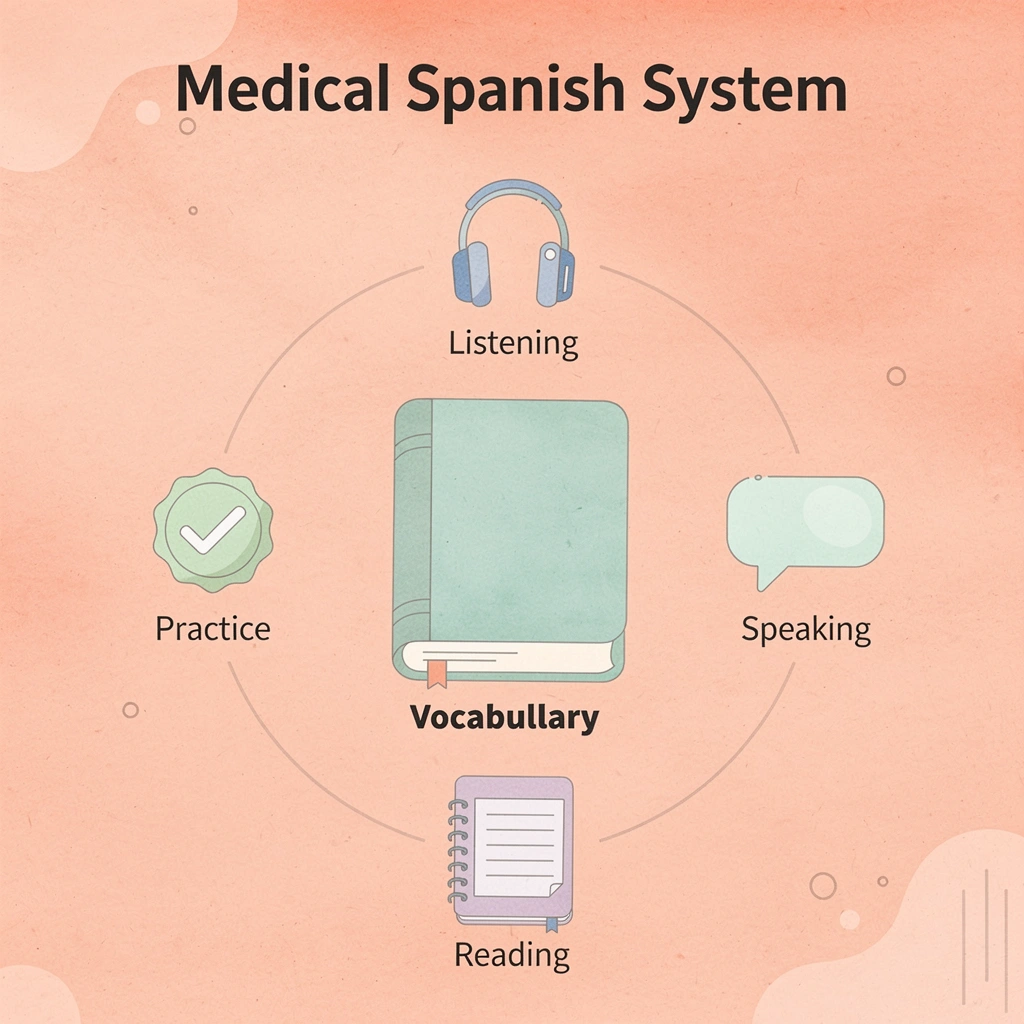
Seven tools stand out for healthcare professionals building medical Spanish skills. Each one targets a different part of learning, creating a complete system that actually works rather than scattered study habits.
"A structured, multi-tool approach to medical Spanish targets every learning layer — vocabulary, listening, speaking, and clinical application — making mastery far more achievable than isolated study."
Different learning tools support different aspects of medical Spanish, so combining them can create a more complete learning routine:
Vocabulary apps – Focus on medical terminology and are best for daily word retention.
Audio/podcast tools – Build listening comprehension and work especially well for commute learning.
Flashcard platforms – Support active recall, helping strengthen long-term memory.
Video courses – Provide structured lessons that are useful for building foundational grammar.
Clinical phrase guides – Focus on patient communication and help translate learning into real-world clinical situations.
AI conversation tools – Provide speaking practice and support fluency building.
Immersion resources – Provide full-context exposure and are particularly valuable for advanced proficiency.
💡 Tip: Don't rely on just one tool — combining at least 2–3 tools from different categories creates the strongest learning system for busy healthcare professionals.
🎯 Key Point: The real difference between professionals who achieve clinical fluency and those who plateau is using a targeted, layered approach — not random, passive exposure to Spanish content.
1. Parrot
According to the PCOM Library Medical Spanish LibGuide, there are 41 million native Spanish speakers in the United States. Parrot's method is based on Dr. Stephen Krashen's research on language acquisition. Our approach closes the communication gap by having learners listen to real spoken Spanish daily rather than relying solely on grammar exercises. Short lessons, real-world content, and personalized video suggestions make Parrot ideal for healthcare workers with limited study time.
2. Canopy
Canopy is built for healthcare professionals, with lessons focused on clinical vocabulary and patient communication. According to CanopyLearn Medical Spanish + LLU Health, the course includes over 40 hours of instructional material. If you work in a hospital, clinic, or urgent care setting, this offers the most direct path to role-specific medical Spanish.
3. Medical Spanish Pro
Medical Spanish Pro is designed for people with existing Spanish knowledge who need to learn medical terminology for their work. It helps with patient check-in forms, discharge instructions, and symptom assessment. Rather than teaching general Spanish, it focuses on job-specific vocabulary that standard Spanish classes don't cover.
4. Duolingo
Duolingo works best as a starting point, not a final destination. It builds basic sentence patterns and vocabulary through short daily sessions for beginners with little to no Spanish. The limitation is real: Duolingo teaches you to order coffee, not to ask a patient where their pain is located or whether they've had this symptom before. Use it to build momentum, then add medical-specific resources.
5. Pimsleur
Most medical Spanish learners read better than they speak. Pimsleur's audio-first design forces you to listen and respond without a screen, building the pronunciation confidence and spontaneous recall that patient encounters demand. It won't teach clinical vocabulary, but it trains your ear and mouth in ways flashcard apps cannot.
Why does listening practice matter more than vocabulary lists?
Healthcare professionals often use vocabulary lists to learn medical Spanish quickly. But lists don't teach you to understand a patient speaking fast, nervously, and using an unfamiliar regional dialect. Parrot uses short videos from native speakers to build listening comprehension through comprehensible input—the same way people learn their first language. For busy doctors and nurses with ten minutes between shifts, regular exposure to real spoken Spanish accelerates learning beyond vocabulary cards.
6. Anki
Anki earns its place in any serious medical Spanish system through spaced repetition, which shows you terms right before you're about to forget them. The key is building your own decks from words and phrases you encounter in your clinical role rather than downloading generic decks. Relevance drives retention.
7. italki
Speaking practice is the most skipped yet most important step in self-directed language learning for clinical communication. italki connects you with tutors who can run simulated patient scenarios, correct pronunciation in real time, and push you to produce Spanish spontaneously rather than recognise it. Find a tutor who understands your clinical context and can structure sessions around the conversations you need to have.
How these tools fit together
No single tool covers every skill. Canopy or Medical Spanish Pro handles clinical vocabulary and structured medical training. Duolingo or Pimsleur builds your general Spanish foundation and spoken confidence. Anki locks in the terminology you need to retain. italki gives you the speaking practice that turns passive knowledge into active language. Parrot builds the listening comprehension that lets you understand patients when they speak, not when they answer yes or no questions.
What does a strong self-study system actually look like?
The strongest self-study system has each tool doing a clear job and is used consistently enough to see results.
The hardest part isn't finding the right tools. It's knowing what to do first.
How to Build a Medical Spanish Learning Routine
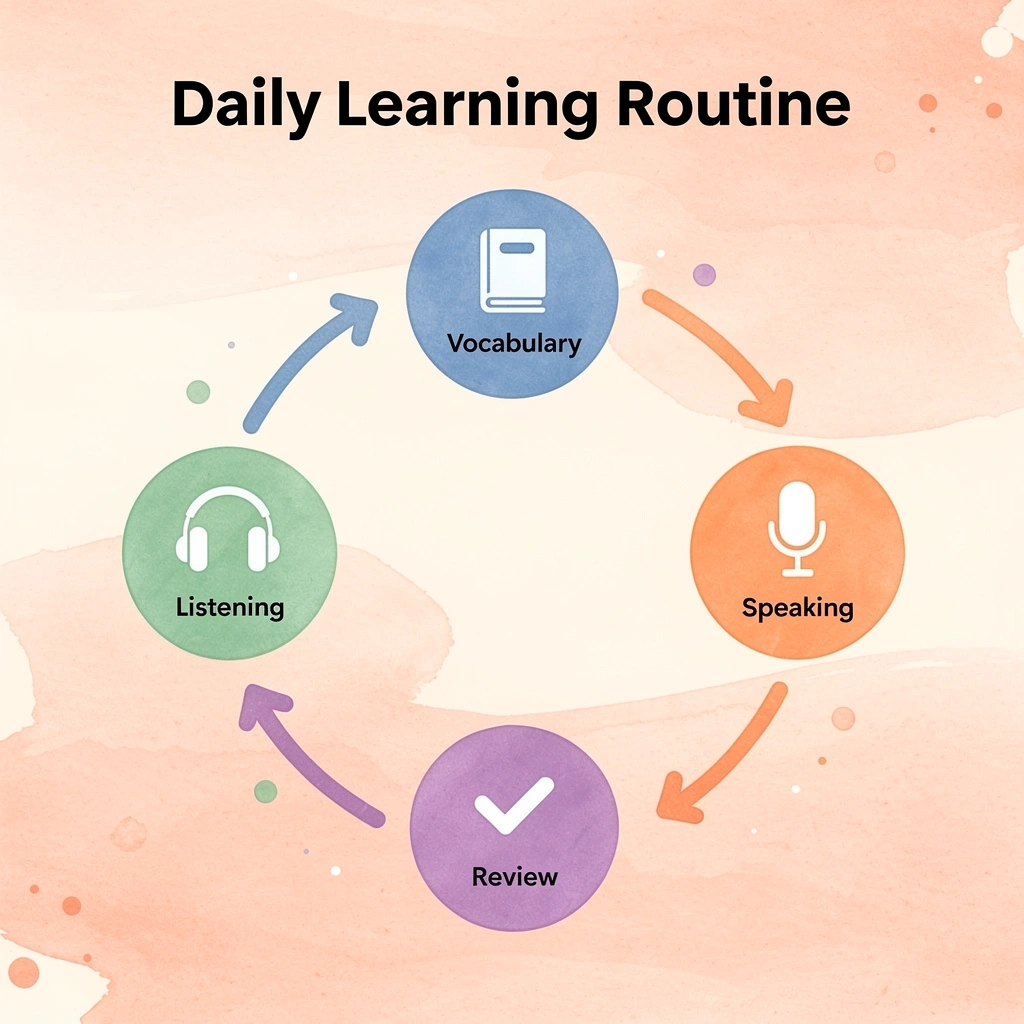
Build a consistent schedule that combines medical vocabulary, general Spanish, listening, and speaking. You don't need to spend hours every day — even short, focused sessions compound into real fluency over time. Focus on communication situations that matter for your job instead of passively memorizing every medical term.
"Consistency in targeted language practice — not volume — is the defining factor in clinical communication fluency." — Language Learning Research
💡 Tip: Structure your weekly routine around the 4 core pillars — vocabulary, grammar, listening, and speaking — so every session builds a different skill.
A balanced learning routine combines specialised vocabulary, general language foundations, and frequent exposure to listening and speaking:
Medical vocabulary – Focus on clinical terms and body systems 3× per week to build job-specific language.
General Spanish – Practise grammar and sentence structure 2× per week to strengthen the underlying language foundation.
Listening practice – Use patient conversations and audio daily to develop comprehension and familiarity with natural speech.
Speaking practice – Practise role-play and pronunciation 2–3× per week to build confidence and active communication skills.
⚠️ Warning: Avoid the common mistake of only drilling medical terms in isolation — real clinical communication requires fluency in everyday Spanish too.
🎯 Key Point: The most effective routines prioritize job-relevant communication scenarios — like taking a patient history or explaining a diagnosis — over rote memorization of terminology.
The key is to focus on communication scenarios relevant to your role rather than trying to memorize every medical term in Spanish.
If You Have 30 Minutes a Day
A 30-minute routine can cover the essentials
10 minutes: Study medical vocabulary and useful phrases.
10 minutes: Listen to medical or general Spanish.
5 minutes: Review vocabulary you've encountered in context.
5 minutes: Practice speaking, shadowing, or self-talk.
For example, if you're preparing to work with Spanish-speaking patients in a clinical setting, your vocabulary practice could focus on symptoms and medical history while your listening practice exposes you to people describing health problems naturally.
If You Have 60 Minutes a Day
With an hour available, increase your exposure and speaking time rather than simply adding more vocabulary memorization:
15 minutes: Structured medical Spanish study.
20 minutes: Medical or authentic Spanish listening.
10 minutes: Contextual vocabulary review.
15 minutes: Speaking, role-play, or conversation.
This gives you enough time to work on both specialized medical language and the broader Spanish skills needed to communicate naturally.
Build Your Week Around Real Communication
Your daily schedule doesn't need to look identical. A weekly routine can help you maintain variety while making sure you're practicing the skills that matter.
Every day: Get some exposure to both general Spanish and medical Spanish.
3–4 times a week: Include focused listening or shadowing.
2–3 times a week: Review medical vocabulary you've encountered in context.
1–2 times a week: Practice role-play or conversation with a tutor, language partner, or colleague.
Once a week: Complete a longer scenario-based practice session and identify the areas where you struggled.
Practice Scenarios You Actually Encounter
Don't try to learn medical Spanish as one enormous subject. Start with situations you're likely to encounter in your work.
You could practice
Taking a medical history.
Asking a patient about their symptoms.
Discussing pain and its severity.
Asking about medications and allergies.
Explaining preparation for a procedure.
Giving basic follow-up instructions.
Communicating with a patient's family members.
For each scenario, learn the vocabulary you need, listen to examples of the language being used, and then practice producing your own questions and responses.
This is more practical than memorizing hundreds of medical terms without knowing when or how you'll use them.
Combine Medical Spanish With General Spanish
It's also important not to let medical terminology completely replace general Spanish practice.
A patient may talk about their health, but they may also explain what they were doing when their symptoms began, describe their daily routine, discuss their family, or ask questions about their appointment.
General Spanish gives you the foundation for those conversations, while medical Spanish gives you the specialized vocabulary needed to discuss healthcare.
Your routine should therefore include both.
Know When Medical Spanish Isn't Enough
Learning medical Spanish can improve your ability to communicate with Spanish-speaking patients, but it does not replace qualified medical interpretation when professional interpretation is required.
The U.S. Department of Health and Human Services states that covered healthcare organizations must take reasonable steps to provide meaningful access for people with limited English proficiency and identifies competent oral interpretation as an important form of language assistance.
Your language-learning routine should therefore complement your organization's interpreter policies and established clinical communication procedures. When a situation requires a qualified interpreter, use one rather than relying on your personal Spanish ability.
Make Authentic Spanish Part of the Routine
A structured medical Spanish course can teach you the terminology and phrases you need, but you also need to hear Spanish being used naturally.
That means making room for understandable, authentic Spanish alongside your medical study. Regular exposure can help you become more comfortable with different voices, speaking speeds, accents, everyday vocabulary, and the way Spanish sounds outside a textbook.
For independent learners, that's often one of the hardest parts of maintaining a medical Spanish routine: finding enough Spanish you can understand and engage with outside your structured medical lessons.
And that's where the right learning environment can help you continue developing your listening skills beyond the medical vocabulary you're deliberately studying.
How Parrot Helps You Build Medical Spanish Through Authentic Exposure
Medical Spanish training teaches you essential medical words and phrases, but you need to get comfortable hearing and processing Spanish as people actually use it. Parrot supports this by providing real, easy-to-understand Spanish content that works seamlessly with structured medical Spanish study.
"You need to get comfortable hearing and processing Spanish as people use it, not memorizing vocabulary in isolation." — Core Principle of Authentic Language Acquisition
💡 Tip: Don't rely on structured drills alone. Authentic exposure to real Spanish speech bridges the gap between classroom knowledge and real-world fluency.
🔑 Takeaway: Parrot combines comprehensible input with medical Spanish study, giving you structured learning and authentic language exposure in one place.

What happens when medical Spanish lessons focus too much on terminology?
The problem
You can memorize medical vocabulary without becoming comfortable understanding Spanish when people speak it in real time. Knowing the Spanish word for a symptom doesn't mean you'll recognize it when someone mentions it naturally in conversation.
How Parrot helps
Our platform uses comprehensible input through engaging short-form videos to expose you to real Spanish from native speakers. Learners hear Spanish in complete sentences and real conversational contexts rather than studying isolated words.
The outcome
You strengthen general listening comprehension alongside structured medical Spanish training, becoming more comfortable understanding Spanish beyond vocabulary exercises.
How does Parrot make authentic Spanish accessible when it feels too difficult?
The problem
Native Spanish content can be valuable, but it isn't always easy to access for learners still building their listening skills. Fast conversations that are difficult to understand can be frustrating.
How Parrot helps
Our AI-powered recommendation feed personalizes Spanish videos based on your skill level and interests, eliminating the need to search through content that's too easy or too difficult.
The outcome
You gradually increase listening practice difficulty as your understanding improves, rather than struggling with advanced native content from the start.
How does Parrot help when unfamiliar vocabulary interrupts your listening?
The problem
When you encounter unfamiliar words, you must stop watching and look them up in a dictionary, which disrupts your comprehension of the overall message.
How Parrot helps
You can click on subtitles for instant translations, letting you check unfamiliar words without interrupting your viewing.
The outcome
You get quick help with unknown words while still being able to follow what's happening in the conversation.
How does Parrot help you retain vocabulary that's easy to forget without context?
The problem
Learning a medical or everyday Spanish word in isolation doesn't guarantee you'll recognize or remember it later. Repeated exposure helps you become familiar with how the word appears in Spanish.
How Parrot helps
You can save words from videos and review them in real situations, reinforcing language you've already encountered.
The outcome
Useful vocabulary receives more exposure after initial learning, giving you more chances to recognize it in future Spanish conversations.
Use authentic exposure to complement medical Spanish training
Medical Spanish requires basic Spanish skills, medical vocabulary, listening comprehension, speaking practice, and knowledge of how different patients use Spanish. Parrot supports the listening and contextual exposure essential to this system. Structured medical Spanish resources provide healthcare-specific vocabulary and scenarios, while tutors, conversation partners, or professional training offer speaking practice. The goal is to ensure your Spanish practice includes the real-world listening exposure needed to understand Spanish outside a textbook.
Related Reading
Mango Vs Rosetta Stone
How To Learn Spanish Fluently
Best App To Learn To Speak Spanish
Fastest Way To Learn Spanish
How To Learn Spanish On Your Own
Rosetta Stone Spanish Reviews
Best App To Learn Mexican Spanish
Best Way To Learn Spanish As An Adult
How To Learn Colombian Spanish
Start Learning Spanish Today
Download Parrot and start your free 7-day trial. In your first session, watch Spanish videos matched to your level, use clickable subtitles for support, and save vocabulary directly from real content. This real-world exposure builds listening comprehension that flashcards and grammar tables cannot match.
"Real-world input from native content builds the kind of listening comprehension that no flashcard deck or grammar table can replicate." — Parrot
💡 Tip: In your first session, focus on understanding the gist. Let clickable subtitles do the heavy lifting while your brain absorbs natural spoken Spanish.
⚠️ Warning: Relying only on grammar tables and flashcards trains you to read Spanish, not understand it at native speed. Real content exposure is essential from day one.

Learn Spanish with Parrot in short daily sessions, letting repeated comprehensible input close the gap between understanding written Spanish and following spoken language.
Different learning methods develop different language skills, but real-world content adds the contextual exposure needed for natural comprehension and fluency:
Flashcards – Build vocabulary recall by reinforcing individual words and phrases.
Grammar tables – Build understanding of structural rules, helping learners recognise how sentences are formed.
Parrot (real content) – Builds listening comprehension and natural fluency by exposing learners to authentic language in context.
🎯 Key Point: Consistency beats intensity — short daily sessions with comprehensible input are far more effective than occasional long study marathons for building real spoken Spanish skills.
Related Reading
Rocket Spanish Vs Babbel
Duolingo Vs Pimsleur
Rocket Spanish Review
Pimsleur Vs Babbel
Rosetta Stone Alternatives
Rosetta Stone Vs Pimsleur
Duolingo Vs Rosetta Stone
Rocket Spanish Vs Rosetta Stone
Alternative To Pimsleur
Pimsleur Spanish Review
Best Free App To Learn Spanish
Babbel Spanish Review
Duolingo Alternatives
Best Duolingo Alternative For Spanish
Living Language Vs Rosetta Stone