
Colombian Spanish is widely regarded as one of the clearest dialects for new learners, thanks to its neutral accent and relatively straightforward pronunciation. For anyone serious about finding the best way to learn conversational Spanish, starting with Colombian Spanish is a practical choice that pays off quickly. Understanding the local accent, common expressions, and everyday speech patterns gives learners a strong foundation that transfers well across the broader Spanish-speaking world.
Building real fluency requires more than memorizing vocabulary or working through grammar drills. Consistent conversational practice, ideally with tools designed around how people actually speak, accelerates progress in ways that textbooks rarely can. For learners ready to move beyond the basics and hold genuine exchanges, Parrot offers exactly that kind of focused, practical approach to learning Spanish.
Table of Contents
Why So Many Learners Want to Learn Colombian Spanish
What Makes Colombian Spanish Different?
Why Many Learners Still Struggle to Understand Colombians
How to Learn Colombian Spanish Effectively
Is Colombian Spanish the Right Variety for Your Goals?
How Parrot Helps You Learn Colombian Spanish Naturally
Start Learning Spanish Today
Summary
Colombian Spanish is often described as one of the clearest and most accessible dialects for new learners, but that reputation applies unevenly across the country. Colombia is home to approximately 50 million Spanish speakers and at least five distinct regional dialect zones, meaning the "Colombian accent" most learners imitate on YouTube may only reflect one city in one region. The gap between standard Bogotá speech and Caribbean coast patterns is real enough to challenge even advanced speakers.
The pronoun system catches most learners off guard because it operates differently than any other Spanish variety they have studied. Colombian Spanish maintains a three-way distinction between vos, tú, and usted as second-person singular forms, and the correct choice depends entirely on region and social context. In Bogotá, usted appears even between close friends, while in Medellín, vos dominates informal conversation entirely, and using the wrong form signals clearly that you learned your Spanish somewhere else.
The most common reason learners struggle to follow Colombian conversations has nothing to do with vocabulary gaps. Most learners who hit a wall already know enough Spanish to get by, but they have spent their study time reading transcripts and listening to slow, scripted audio rather than absorbing the pace and rhythm of authentic speech. Familiarity with written Spanish does not transfer automatically to spoken Colombian conversation.
The translation habit is the specific cognitive pattern that collapses under real conversational pressure. Learners who process Spanish by converting it into English first can manage at slow speeds, but that approach fails when a speaker from Bogotá strings three phrases together without a pause. Overcoming it requires listening volume, not more vocabulary drilling, because the shift happens through repeated exposure to authentic speech rather than through studying about listening.
Regional vocabulary is real but frequently overstated as a barrier. Words like chévere, parce, and bacano are useful social currency, but they sit on top of a shared Spanish foundation that transfers from any variety a learner has already studied. The expressions that trip people up most are not colorful slang but the filler words and conversational rhythms that fill the space between sentences, including o sea, pues, and cierto, which rarely appear in textbooks but show up in nearly every real Colombian exchange.
Choosing Colombian Spanish over a broader approach is only worth the investment when Colombia is genuinely central to a learner's life. Learners motivated by relationships or belonging are not just trying to communicate transactionally but are trying to understand the joke, catch the tone shift, and feel at home in a conversation, and that kind of fluency comes from spending consistent time inside the language as it is actually spoken.
Parrot Learn Spanish addresses this by delivering short-form video from real native Colombian speakers so learners absorb natural speech patterns across regions in the gaps of a normal day rather than through structured study blocks.
Why So Many Learners Want to Learn Colombian Spanish
People learn Colombian Spanish for specific reasons: a trip to Medellín, a relationship with someone from Bogotá, a Colombian colleague, a Netflix series with incomplete subtitles. The motivation is personal and emotional, tied to a real person or place.
"The most powerful language learning happens when motivation is personal: tied to a real culture, a real relationship, or a real destination." — Language Acquisition Research
🎯 Key Point: Personal, emotionally-driven motivation is one of the strongest predictors of language learning success. Colombian Spanish learners possess this in abundance.
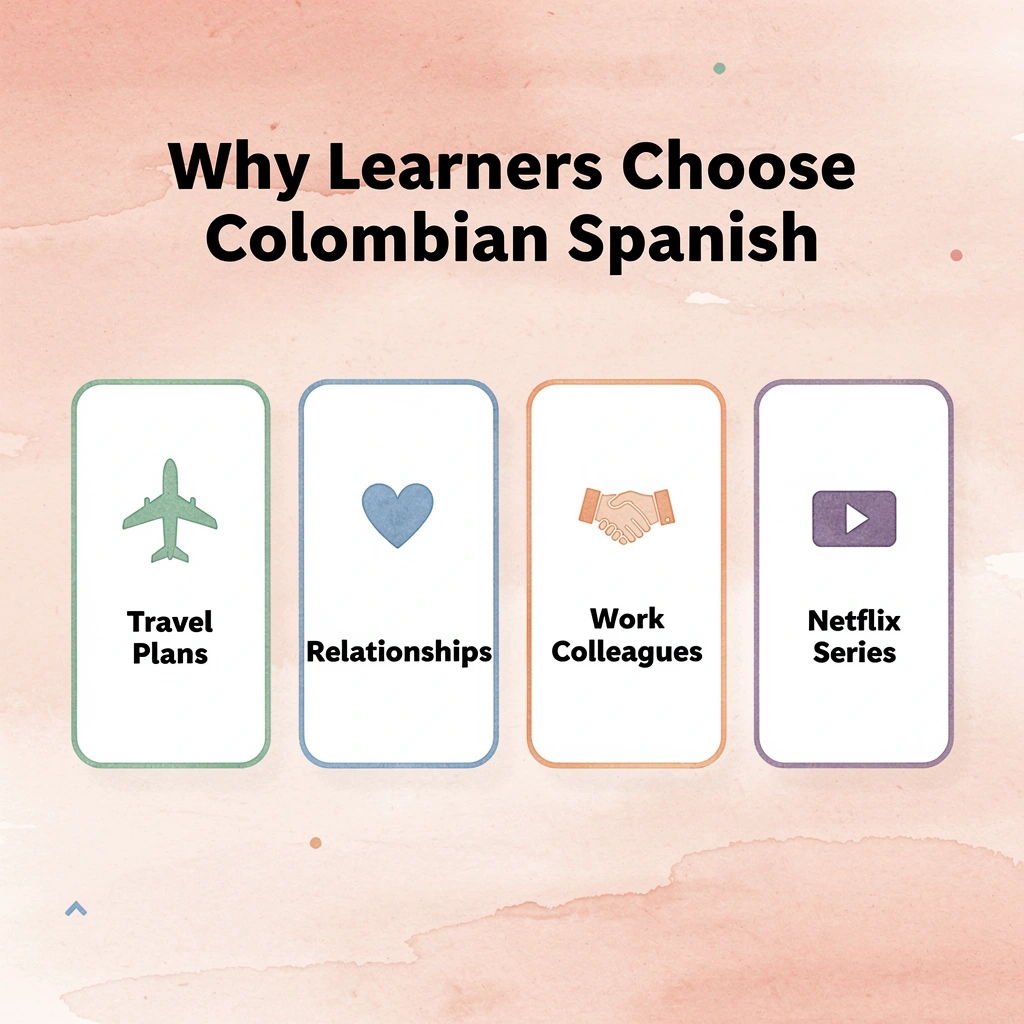
That specificity matters because it changes how you should learn. When your goal is to connect with a particular culture, generic Spanish instruction feels like the wrong tool. Most learners searching for Colombian Spanish want something that sounds like the people they're trying to reach — not a course covering every dialect equally.
💡 Tip: If you have a specific Colombian connection — a person, a city, or a show — use that as your anchor. Let it guide which vocabulary, accent, and cultural context you prioritize from day one.
⚠️ Warning: Settling for generic Spanish courses when your goal is specifically Colombian Spanish means you'll spend time learning accents and expressions that may feel foreign to the real people you want to communicate with.
Trip to Medellín or Bogotá
Focus on Colombian regional vocabulary and local expressions
Colombian relationship or friendship
Prioritize natural, conversational tone and cultural nuance
Work with Colombian colleagues
Learn professional Colombian Spanish and business etiquette
Watch Colombian Netflix series
Build listening comprehension for authentic Colombian speech patterns
Should you worry about studying the wrong kind of Spanish?
A common worry emerges: learners fear studying the "wrong" Spanish and sounding foreign in real Colombian conversations. This fear is understandable but unfounded. According to Learn More Than Spanish, Colombia has approximately 50 million Spanish speakers communicating within a shared language system connected to the broader Spanish-speaking world. The foundation transfers. What changes are the details, and those details are learnable.
Why does method matter more than dialect choice?
The failure point for most learners isn't choosing the wrong dialect—it's the method. Grammar drills and vocabulary lists teach you to pass a test, not hold a conversation. When someone from Cali uses a phrase your textbook never covered, the gap isn't your dialect choice. It's that you were trained to recognize language rather than absorb it. Apps like Parrot use short-form video immersion rooted in comprehensible input so Colombian Spanish patterns become familiar through listening and context, not memorization. Ten minutes during a commute builds more fluency than an hour of conjugation drills.
What does real fluency feel like for relationship-driven learners?
People motivated by relationships or belonging want more than basic communication. They want to understand jokes, catch tone shifts, and feel comfortable in conversation. That skill comes from spending time using the language as people actually speak it, the same way a child learns to talk before reading a grammar book.
Once you understand what makes Colombian Spanish different from broader Spanish, the learning path becomes less daunting.
Related Reading
What Makes Colombian Spanish Different?
Colombian Spanish isn't one thing. According to Wikipedia's overview of Colombian Spanish, the country is home to approximately 50 million Spanish speakers, making it the second largest Spanish-speaking country by population — a scale that shows significant internal variety.
"Colombia is home to approximately 50 million Spanish speakers, making it the second largest Spanish-speaking country by population." — Wikipedia, Colombian Spanish
🔑 Takeaway: With 50 million speakers spread across diverse regions, Colombian Spanish isn't a single dialect — it's a rich mosaic of accents, vocabulary, and expressions that vary dramatically from city to coast.
💡 Tip: Don't assume all Colombian Spanish sounds the same. The regional variety is so pronounced that a speaker from Bogotá and a speaker from Cartagena can sound worlds apart to a trained ear.
Bogotá
Clear, neutral accent — often called the "standard"
Coastal Caribbean
Faster speech, dropped consonants
Paisa (Medellín)
Distinctive "cantao" sing-song rhythm

How many versions of Colombian Spanish actually exist?
Colombian Spanish breaks into at least five major regional dialect zones, so the "Colombian accent" you've learned may reflect only one city. Bogotá Spanish features careful, unhurried articulation. Medellín carries a musical lilt and uses vos in casual speech. The Caribbean coast moves faster, softens consonants, and shares rhythms with Cuban and Dominican Spanish. A learner trained exclusively on Bogotano content may struggle to understand Costeño speakers at full speed.
What about pronouns?
The pronoun system is where Colombian Spanish surprises most learners. Wikipedia's entry on Colombian Spanish confirms a three-way distinction between vos, tú, and usted—all used as second-person singular forms depending on region and social context. In Bogotá, usted appears even between close friends and siblings. In Medellín, vos dominates informal conversation. Using the wrong form won't break communication, but it signals you learned Spanish elsewhere.
How do you make each pronoun feel natural instead of calculated?
Most learners get stuck when real conversation moves faster than their mental grammar chart. The more effective approach is repeated exposure to each form in context: hearing usted used warmly between friends in Bogotá, or vos in casual Paisa speech, until the register feels intuitive rather than calculated. Apps like Parrot deliver short clips of real Colombian speech so learners absorb these patterns through repetition and context, not conjugation tables.
Does vocabulary actually differ that much?
Regional vocabulary is often overstated as a barrier. Words like chévere, parce, and ¿qué más? are useful social currency, but they sit atop a shared Spanish foundation that transfers directly from whatever variety you've studied. The expressions that trip learners up most aren't the colorful slang—they're the filler words, hedges, and conversational rhythms native speakers use between sentences. O sea, pues, ¿cierto? These don't appear in most textbooks, but they show up in nearly every real Colombian conversation.
Colombian Spanish rewards consistent listening far more than vocabulary memorization. Once your ear adjusts to the rhythm and pace of a particular region, vocabulary gaps close faster than expected. But adjustment takes longer than most learners anticipate for a specific reason that has less to do with accent than with something most study plans never address.
Why Many Learners Still Struggle to Understand Colombians
The gap isn't vocabulary. Most learners who struggle to follow Colombian conversations already know enough Spanish to get by. The real problem is they've spent study time in the wrong environment—reading transcripts, drilling conjugations, and listening to slow, scripted narrators—while rarely hearing actual conversational pace and rhythm.
"The core issue isn't what learners know—it's the environment they've been trained in. Scripted, slow-paced input creates a false ceiling that real conversation immediately exposes." — Language Acquisition Research
💡 Tip: If you can read Spanish but freeze in real conversations, the problem isn't your vocabulary—it's your listening environment. Swap at least some scripted practice for authentic, unscripted Colombian speech as early as possible.
⚠️ Warning: Relying exclusively on slow, narrated audio or written transcripts trains your ear for a version of Spanish that native Colombians simply don't speak. This creates a gap that vocabulary drills alone will never close.
Scripted narrators
Slow, artificial pacing
Low — rarely matches native speed
Conjugation drills
Grammar accuracy
Medium — useful but not enough alone
Authentic conversational audio
Real rhythm & pace
High — directly mirrors Colombian speech

Why do standardized courses leave learners lost in real Colombian conversations?
Standardized Spanish courses prioritize clarity over authenticity, creating a disconnect: learners develop strong reading comprehension but weak listening comprehension. When a Colombian speaker from Cali drops final syllables or strings phrases together without pausing, the brain doesn't recognize unfamiliar patterns. Familiarity with written Spanish doesn't transfer to spoken Colombian Spanish, leaving learners disoriented in real conversation.
The same issue affects vocabulary. Knowing "chévere" means great is useful, but if learned from a list, you'll miss it at conversational speed, folded into a sentence with other words you've only seen in print. Words learned without sound don't stick the same way. Context, emotion, and repetition in natural speech move vocabulary from recognition to fluency.
What actually builds listening comprehension in Colombian Spanish?
Most learners respond by studying more, using flashcards, and reviewing grammar—but doing more of the same produces the same result. Listening comprehension builds through regular exposure to authentic Colombian speakers across different regions and speech styles. Apps like Parrot deliver short-form video content from real native speakers, letting learners absorb natural speech patterns in 10 to 15 minutes daily rather than through long structured sessions that bear no resemblance to real conversation.
The translation habit that slows everything down
The failure point is usually this: learners try to process Spanish by converting it into English first. This works at slow speeds but breaks down in real conversations, where speakers don't pause between clauses for internal translation. The habit isn't a sign of low ability; it's a sign that listening practice has been replaced by decoding practice, a different cognitive skill entirely.
How do you break the translation habit for good?
Overcoming it requires enough repeated exposure to authentic speech that your brain stops reaching for English as a bridge. That shift happens gradually through listening volume, not through studying about listening.
Once you understand why the struggle happens, the path forward differs from what most study plans suggest.
How to Learn Colombian Spanish Effectively
Building conversational ability in Colombian Spanish follows a clear sequence: establish high-frequency vocabulary and grammar first, then add in authentic Colombian exposure, and practice speaking before you feel ready.
"The most effective language learners follow a structured sequence — building core vocabulary first, then layering in authentic exposure, and speaking early before perfection sets in." — Language Acquisition Research
1. Foundation
High-frequency vocabulary & grammar
Builds the core framework for all communication
2. Immersion
Authentic Colombian exposure
Trains your ear to real accents and expressions
3. Speaking
Active conversation practice
Accelerates fluency faster than passive study alone
💡 Tip: Don't wait until you feel ready to speak — starting early is one of the most critical steps to building real conversational confidence in Colombian Spanish.
⚠️ Warning: Skipping the high-frequency vocabulary foundation and jumping straight to immersion is a common mistake that leads to frustration — always build your base first.

Start with the Foundation, Not the Dialect
The most common mistake is chasing regional expressions before mastering everyday Spanish. Learners who spend their first months memorizing Colombian slang hit a ceiling fast—slang without structure is noise. High-frequency words, common sentence patterns, and basic pronunciation provide the foundation that makes Colombian speech understandable in real situations. Think of it as tuning your ear to a specific frequency once the receiver is already built.
Why does consistent exposure to real Colombian voices matter?
Listening to real Colombian voices regularly does most of the work. Podcasts, YouTube interviews, travel vlogs from Medellín and Cartagena, Colombian telenovelas, and street conversations teach your brain to understand natural speech patterns instead of the slow, overly clear audio that most courses use. You don't need to understand every word; grasping the main idea is enough, and comprehension improves with repeated listening.
How can short daily sessions fit Colombian Spanish into a busy schedule?
Most learners struggle to find time for dedicated listening practice, which disappears when life intervenes. Apps like Parrot solve this by delivering short-form video immersion in 10 to 15 minutes daily, fitting Colombian Spanish into a commute or lunch break rather than requiring a cleared calendar.
Vocabulary Grows Faster in Context
When you hear a word like parce or bacano in real conversation, where tone, body language, and situation provide context, you create a memory that flashcards cannot replicate. Colombian Spanish offers over 850 flashcards built around the course, but the strongest learning occurs when words first appear in real speech, with review reinforcing what you already know from hearing them used naturally.
Speak Before You Feel Ready
Listening helps you understand, but speaking builds the brain pathways that make conversation feel automatic. Shadow short Colombian audio clips, practice narrating your day in Spanish, or work with a tutor from Colombia who can correct your pronunciation in real time. Language exchanges work particularly well because they force spontaneous responses rather than scripted answers, accelerating fluency. The sooner you speak, the faster your comprehension catches up, since production and reception reinforce each other.
But choosing how to learn Colombian Spanish is only part of the decision. The more revealing question is one most learners never ask.
Is Colombian Spanish the Right Variety for Your Goals?
The question most learners never stop to ask is surprisingly simple: does the variety you're studying actually match where you're headed?
"The dialect you study shapes not just how you speak — but how well you're understood when it matters most." — Language Learning Research
🎯 Key Point: Colombian Spanish is widely praised for its clear pronunciation and neutral accent — making it one of the most strategic choices for learners targeting broad Spanish-speaking audiences.
💡 Tip: Before committing to any Spanish variety, map your goals first — whether that's business, travel, heritage connection, or academic study — because the right dialect can dramatically accelerate your path to fluency.
Business in Latin America
Colombian Spanish
Travel to Spain
Castilian Spanish
Broad, neutral communication
Colombian Spanish
Caribbean culture & music
Cuban or Puerto Rican Spanish
⚠️ Warning: Choosing a Spanish variety at random — without aligning it to your real-world goals — is one of the most common mistakes learners make, and it can cost you months of misdirected study.

When does focusing on Colombian Spanish actually make sense?
For most people, Colombian Spanish is worth focusing on only if Colombia is genuinely important to your life: travel plans, a Colombian partner, family roots, or work relationships. Otherwise, a strong foundation in widely understood Spanish will help you get understood in Bogotá, Medellín, or Cartagena without specializing first.
Choosing Colombian Spanish isn't about finding the "best" version of the language. According to Colombian Spanish, many articles claim it is the world's best, though no independent source has verified this. What Colombian Spanish offers is clarity in certain ways of speaking, particularly the Bogotá dialect—a practical advantage for beginners, not a linguistic crown.
What happens when expectations don't match Colombian Spanish's real range?
The failure point is mismatched expectations. Learners who committed to Colombian Spanish through relationships or repeated visits report that coastal accents and slang-heavy conversations still catch them off guard, even after thousands of hours of listening input.
Colombia contains at least five distinct dialect zones, and the gap between standard Bogotá speech and Caribbean coast patterns challenges advanced speakers. The most effective response is wider exposure to authentic Colombian content across regions. Apps like Parrot deliver understandable input during daily gaps rather than scheduled blocks, allowing your ear to adjust to the full range of Colombian speech naturally over time.
What if your goals aren't Colombia-specific?
If your Spanish goals are broad, regional specialization matters less than you think. Grammar, core vocabulary, and sentence structure transfer directly across dialects. A learner who spends six months with Colombian podcasts and telenovelas will understand Mexican, Peruvian, and Argentine speakers far more easily than someone who spent the same time on grammar workbooks, because listening skills transfer even when accents do not.
What does Colombian Spanish offer heritage learners and those in Colombian relationships?
Heritage learners and people in Colombian relationships operate from different ground. The expressions, rhythms, and cultural references in everyday Colombian speech carry emotional weight that standard Spanish cannot replicate. Recognizing a phrase your partner's family uses or understanding a joke without translation is a belonging moment, not merely a fluency milestone. That connection comes from repeated, genuine exposure to how Colombians actually speak, not from grammar charts.
Are you ready to start before you feel ready?
The real question isn't whether Colombian Spanish fits your goals, but whether you're ready to start before you feel ready.
Related Reading
Mango Vs Rosetta Stone
How To Learn Medical Spanish
Best App To Learn To Speak Spanish
How To Learn Spanish On Your Own
Best App To Learn Mexican Spanish
Fastest Way To Learn Spanish
Best Way To Learn Spanish As An Adult
Rosetta Stone Spanish Reviews
How Parrot Helps You Learn Colombian Spanish Naturally
Understanding Spanish the way Colombians speak it takes more than just grammar lessons—you need to hear real conversations, learn words used in different regions, and get used to how the language naturally sounds. Parrot helps you move from studying Spanish to understanding it the way native speakers actually use it.
"You need to hear real conversations, learn words used in different regions, and get used to how the language naturally sounds—not just textbook grammar." — Core Parrot Learning Philosophy
💡 Tip: Don't just study Spanish—immerse yourself in it. Regional vocabulary, natural rhythm, and authentic conversations are the keys to sounding like a true Colombian speaker.
🎯 Key Point: Parrot bridges the gap between formal Spanish education and the real-world Colombian Spanish that native speakers use every day—covering everything from regional slang to natural speech patterns.
Textbook grammar rules
Real Colombian conversations
Generic vocabulary lists
Region-specific words and phrases
Formal, scripted audio
Natural, native-speaker speech
Passive reading and listening
Active immersion and comprehension

How does comprehensible input help you follow real Colombian conversations?
Many learners finish structured lessons but struggle to follow Colombian conversations because they haven't been exposed enough to real speech. Parrot addresses this through research-backed comprehensible input via engaging short videos. Rather than scripted dialogues, you learn from authentic Spanish that native speakers use. Since the content matches your skill level, you understand the overall message while becoming comfortable with Colombian pronunciation, rhythm, and everyday expressions.
How do clickable subtitles keep you in the flow of a conversation?
Stopping to translate unfamiliar words breaks your focus and complicates conversations. Parrot's clickable subtitles and instant translations let you understand new vocabulary without leaving the video, so you spend more time following conversations and less time switching between apps.
How does saving vocabulary in context help you remember regional expressions?
Regional vocabulary is hard to remember from a single exposure. Parrot lets you save words and expressions from videos and review them in the same meaningful contexts where you first encountered them. Seeing and hearing vocabulary used naturally repeatedly makes it easier to recognize and use in future conversations.
How does Parrot surface the right Colombian Spanish content for your level?
Finding real Colombian Spanish at the right level takes time. Many learners spend more time searching YouTube than learning. Parrot's AI-powered recommendation feed solves this by personalizing real videos based on your skill level and interests, so you always have engaging, level-appropriate content ready.
Learning Colombian Spanish requires hearing real speech often enough that its pronunciation, vocabulary, and conversational style become familiar through repeated exposure. By combining understandable input, contextual vocabulary learning, and personalized recommendations, Parrot helps you build that familiarity naturally, one conversation at a time.
Start Learning Spanish Today
Starting before you feel ready is the point. If textbook Spanish hasn't prepared you for real Colombian conversations, the method is the problem, not your effort. Parrot offers a free 7-day trial with authentic short-form video matched to your level, clickable subtitles for unfamiliar expressions, and vocabulary saved in context.
"If the method isn't producing real-world results, switching your approach isn't giving up — it's the smartest move a language learner can make."
💡 Tip: Don't wait until your grammar feels "good enough." Immersive, context-rich input like Parrot's video feed accelerates fluency faster than traditional drills.
⚠️ Warning: Textbook-only learning is one of the most common reasons students plateau. If you can't follow a real Colombian conversation, change your tools rather than blame your effort.

Your first session builds a personalized feed around your proficiency level and interests — less time searching for content, more time absorbing the Spanish Colombians actually speak.
✅ Best Practice: Use that free 7-day trial to lock in a daily habit. Even 10–15 minutes of authentic video immersion per day compounds into real, measurable fluency gains.
Authentic short-form video
Exposes you to real Colombian speech patterns
Clickable subtitles
Instantly clarifies unfamiliar expressions in context
Vocabulary saved in context
Builds retention by anchoring words to real moments
Personalized feed
Matches content to your proficiency and interests
🎯 Key Point: The fastest path to Colombian Spanish fluency isn't more textbooks — it's more authentic input, delivered at the right level, starting today.
Related Reading
Alternative To Pimsleur
Babbel Spanish Review
Rosetta Stone Alternatives
Duolingo Alternatives
Rocket Spanish Vs Rosetta Stone
Best Duolingo Alternative For Spanish
Pimsleur Vs Babbel
Rosetta Stone Vs Pimsleur
Living Language Vs Rosetta Stone
Duolingo Vs Rosetta Stone
Best Free App To Learn Spanish
Rocket Spanish Review
Pimsleur Spanish Review
Rocket Spanish Vs Babbel