Duolingo is one of the most downloaded language apps in the world, and for many people, it's the first stop on the road to Spanish fluency. Short lessons, gamified streaks, and a low barrier to entry make it easy to start. But ease of use and actual progress are not always the same thing, and anyone serious about finding the best way to learn conversational Spanish will want to know what Duolingo genuinely delivers versus where it falls short.
The app builds familiarity with vocabulary and basic grammar, but it rarely pushes learners to produce spoken Spanish with confidence. Real conversational ability comes from practicing the way people actually speak, not just tapping the right answer on a screen. For learners who want to close that gap, learn Spanish with Parrot, a program built around the kind of listening and speaking practice that turns passive recognition into real fluency.
Table of Contents
Why So Many Learners Ask Whether Duolingo Is Good for Spanish
Where Duolingo Excels and Where It Falls Short
Why Some Learners Plateau With Duolingo
What Actually Helps Learners Become Conversational
Is Duolingo the Right Tool for Your Learning Goals?
How Parrot Helps You Move Beyond Language Exercises
Start Learning Spanish Today
Summary
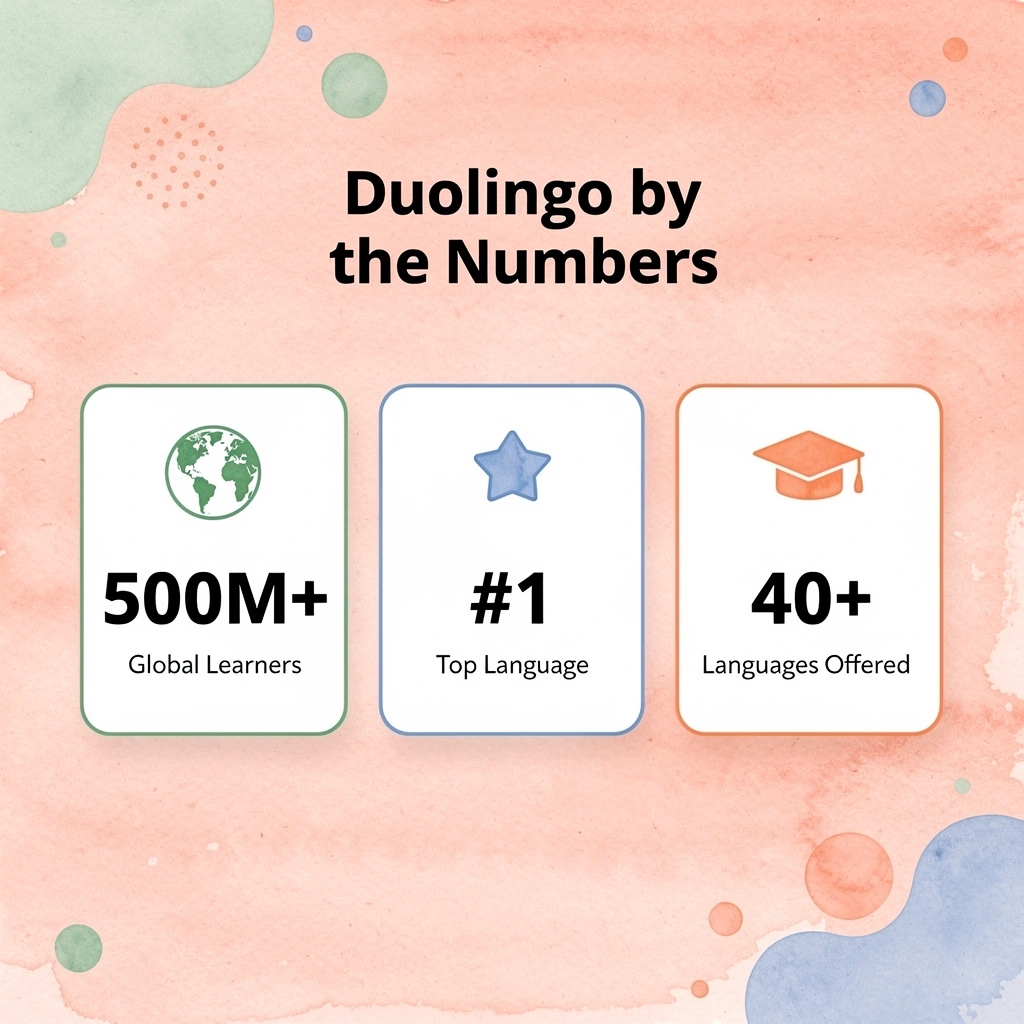
Duolingo's scale reflects genuine demand for accessible language learning, with over 500 million registered users worldwide and Spanish consistently ranking as the most-studied language in the United States. But completion rates tell a different story. Less than 0.1% of users actually finish their courses, meaning the vast majority stop somewhere between motivated beginner and conversational speaker.
The research on conversational turns points to something most learners overlook. Children who experienced more back-and-forth conversational exchange showed a 14% to 29% increase in brain activity in Broca's area, the region directly tied to language processing. That finding suggests active speaking practice physically reshapes how the brain handles language in ways that passive study cannot replicate.
Reaching conversational proficiency in Spanish, a Category I language, requires roughly 600 to 750 hours of study according to Scott H. Young's analysis of language acquisition research. The quality of those hours matters as much as the volume. Hours spent in controlled, scaffolded environments build familiarity with exercises, not the mental flexibility that authentic Spanish demands.
Even Duolingo's most advanced Spanish courses cap out at around B2 proficiency on the language-learning scale, short of C2 fluency. B2 covers structured conversations on familiar topics. C2 means following fast-moving native speech, catching humor, and responding without searching for words. That structural ceiling matters for anyone whose goal sits at genuine conversational ability.
Learners who plateau with app-based study tend to stall in the A2 to B1 range, the beginner-to-intermediate band, which is precisely where the jump to authentic comprehension becomes necessary. At that level, the controlled environment of structured lessons has been buffering learners from fast speech, regional accents, and dropped words. Stepping outside that buffer makes the gap visible quickly.
Parrot's Learn Spanish program addresses this gap by using short-form video immersion grounded in comprehensible input research, giving learners repeated exposure to authentic, natural speech within the same 10 to 15 minutes of daily practice that most structured apps already occupy.
Why So Many Learners Ask Whether Duolingo Is Good for Spanish
Duolingo's popularity is hard to ignore. According to the Duolingo Blog, the platform has over 500 million learners worldwide, with Spanish consistently ranking as one of its most studied languages. This scale raises the question: does it work? The answer is more complicated than the download numbers suggest.
"The platform has over 500 million learners worldwide, with Spanish consistently ranking as one of its most studied languages." — Duolingo Blog
🔑 Takeaway: 500 million users is a staggering number, but popularity and effectiveness are not the same thing. The real question is whether those learners are achieving meaningful fluency in Spanish.
💡 Key Insight: When an app reaches 500 million downloads, it's essential to separate marketing success from learning outcomes: the two can tell different stories.
Why do streaks and XP points fall short of real conversation?
The gap lies between what an app measures and what a learner needs. Duolingo tracks streaks, XP points, and lesson completions—metrics that feel rewarding but don't guarantee real-world ability. A learner who finishes every Spanish unit can still freeze when a native speaker responds quickly, uses regional expressions, or runs sentences together without pausing. Completing exercises differs from processing real speech in real time.
Most learners sense this gap without naming it. They practice daily, earn streaks, and still feel stuck when Spanish appears outside the app. That frustration signals that the method behind practice matters more than consistency alone. The Duolingo Blog notes that 34 hours of Duolingo Spanish equals a full university semester, a genuine achievement. But a semester of university Spanish rarely makes people conversational either.
Does studying Spanish as a subject build real fluency?
The common approach treats language learning as a subject to study rather than a skill to develop. Learners read rules, translate sentences, and match words to pictures—building conscious knowledge about Spanish. Fluent speakers, however, don't consciously recall grammar rules mid-conversation. They've internalized language through repeated exposure to comprehensible input in real speech. Apps built around gamification rarely replicate that process. Parrot's Learn Spanish program addresses this directly using short-form video immersion grounded in Dr. Stephen Krashen's comprehensible input research, building subconscious fluency rather than surface-level recognition.
The question "Is Duolingo good for Spanish?" persists because learners want to know whether their daily habit will enable actual conversations, not higher scores. The answer depends on what kind of Spanish ability they're trying to build.
What surprises most people is not what Duolingo gets wrong, but how specific its strengths and limitations are.
Where Duolingo Excels and Where It Falls Short
Duolingo is great at building vocabulary and reinforcing grammar patterns through smart habit design. However, it has real limits when you need to understand native speakers at full speed or discuss real-world topics.
"Duolingo excels at vocabulary building and habit formation — but falls short when learners face the demands of full-speed native conversation and real-world fluency." — Key Insight
Duolingo performs well in foundational language skills but has limitations in real-world communication:
Vocabulary building – Strong performance through repeated exposure and practice.
Grammar pattern reinforcement – Strong support for developing basic language structures.
Habit and consistency design – Excellent at encouraging daily practice through engagement features.
Understanding native speakers at full speed – Weaker performance due to limited exposure to natural, fast-paced conversations.
Real-world topic discussion – Limited ability to prepare learners for open-ended conversations and practical discussions.
🎯 Key Point: Duolingo is one of the best tools for building a vocabulary foundation and staying consistent — but it is not a complete path to conversational fluency.
💡 Tip: Use Duolingo for daily habit reinforcement and vocabulary, but supplement it with native listening practice and real conversation to close the fluency gap.

What Duolingo actually does well
According to the 2025 Duolingo Language Report, Spanish is the most studied language on Duolingo in the United States, with millions of learners. The app addresses a genuine problem: most people abandon language learning within weeks because the habit fails to take root. Duolingo's streak system, bite-sized lessons, and progress indicators are designed to solve this—and they do. Since consistency is essential for language skill development, Duolingo delivers it more effectively than most alternatives.
The spaced repetition system underlying those lessons deserves credit. It spaces vocabulary review across time intervals that match how human memory consolidates information, so words learned in week one are more likely to stay with you in month three. That is learning science, not gamification dressed up as education.
Where the method starts to break down
The failure point is specific: Duolingo teaches you to recognize Spanish under controlled conditions, not to process it in the wild. A lesson presents one sentence at a time, at a readable pace, with clear visual context. A conversation with a native speaker in Mexico City provides none of those supports.
Most learners handle this by practicing more in the app, hoping that more practice will translate into fluency. Instead, they become proficient at Duolingo, a different skill than speaking Spanish. Apps like Parrot use short-form video immersion to expose learners to authentic, natural speech within the same 10 to 15 minutes of daily practice, connecting the habit loop Duolingo builds to the comprehensible input that produces conversational ability.
Does completing the full Spanish course lead to fluency?
The 2025 Duolingo Language Report notes that Duolingo offers over 100 languages across more than 40 languages of instruction. Offering many languages differs from helping learners achieve proficiency. A learner who completes the entire Spanish course will have learned thousands of words and hundreds of grammar patterns, yet will likely struggle to understand a fast conversation between two friends. This skill requires exposure to real, unscripted speech.
What happens when learners clear the barrier and still feel stuck?
This is not a flaw in Duolingo's execution but a limit of its design philosophy. The app was built to lower the barrier to starting, and it succeeds. The question worth considering is what happens to learners once they clear that barrier and still feel stuck.
But what happens inside the brain when a learner pushes past that stuck feeling is more surprising than most people expect.
Related Reading
Is Duolingo Good For Spanish
Best App To Learn Spanish While Driving
Is English Or Spanish Harder To Learn
How To Learn Spanish In A Week
Can You Learn Spanish In A Year
Games To Learn Spanish
What Dialect Of Spanish Does Duolingo Teach
Best Tools To Learn Spanish
Is Pimsleur Good
Reasons To Learn Spanish
Why Some Learners Plateau With Duolingo
Plateau is the right word. Most learners who get stuck with Duolingo aren't lacking discipline or aptitude: they're hitting the natural ceiling of a method designed to start the journey, not complete it. According to Ankur Garg on LinkedIn, citing Duolingo's own data, less than 0.1% of users actually complete their courses, meaning the vast majority stop somewhere between motivated beginner and conversational speaker.
"Less than 0.1% of Duolingo users actually complete their courses — meaning the vast majority stall somewhere between motivated beginner and conversational speaker." — Ankur Garg, citing Duolingo data
🔑 Takeaway: A completion rate below 0.1% isn't a reflection of learner failure: it's a signal that app-based gamification alone cannot carry someone to real fluency. The platform is built for habit formation, not language mastery.
⚠️ Warning: If you're relying on Duolingo streaks to reach conversational ability, you're approaching the ceiling of what the method can deliver, regardless of consistency.

Where the progress stalls
The failure point is almost always the same: learners confuse recognizing Spanish with producing it. Matching words to pictures feels like progress, but recognition and recall are different thinking skills. Recognizing "quiero" in a multiple-choice prompt is far easier than retrieving it from memory mid-conversation while tracking what someone just said. The gap between those two things is where most learners get stuck.
Why do streaks stop pushing you forward?
Streaks make this worse. When keeping a streak becomes the daily goal, learners gravitate toward shorter lessons and familiar exercises—minimal friction. This preserves the streak count but prevents the brain from entering the discomfort where real learning happens. Consistency with the wrong approach builds bad habits faster.
Ankur Garg's analysis notes that engaged learners plateau in the A2-B1 range, where the jump to real comprehension becomes necessary and structured app exercises are no longer sufficient. At A2, you have enough vocabulary to feel competent within the app's controlled environment. But that environment has shielded you from the messy, fast, accent-varied reality of actual Spanish. Step outside it, and the gap becomes visible immediately.
What happens when learners double down on the wrong approach?
Most learners respond by doing more: more lessons, longer sessions, harder difficulty settings. The same brain pathways get strengthened while the pathways needed for real-time listening and speaking remain underdeveloped. Apps like Parrot address this gap by using short-form video immersion grounded in comprehensible input research, so learners encounter Spanish through meaningful, contextual exposure rather than isolated drills.
Why is waiting until you feel ready the wrong strategy?
Speaking practice is what most learners delay too long. The reasoning sounds logical: improve first, then speak. But speaking is not the reward at the end of language learning—it is the training ground. Waiting until you feel ready is like waiting to feel comfortable before learning to swim. The discomfort is not a sign you are unprepared. It is the work itself.
What happens inside the brain when learners commit to discomfort is more surprising than most people expect.
What Actually Helps Learners Become Conversational
Being able to speak Spanish naturally requires three things: comprehensible input, real conversation, and repeated practice until your brain stops translating and thinks in Spanish. No single app can do all three. Successful learners combine structured tools with real-world exposure and regular speaking practice.

Why does real conversation reshape the brain differently than passive study?
According to the Expressable Learning Center, children who engaged in back-and-forth conversations showed a 14% to 29% increase in brain activity in Broca's area, the region directly connected to language processing. Conversation physically changes how the brain handles language in ways that listening alone cannot. Listening to Spanish is helpful; responding in Spanish creates real change.
Why does producing language matter more than consuming it?
Most learners focus on comfort: consuming content, completing exercises, reviewing vocabulary. These feel productive, but production—generating language under real-time pressure—forces the brain to retrieve and automate what it has absorbed. Comprehension and production are related but distinct skills, and treating one as a substitute for the other is where most learners get stuck.
Why does the quality of your Spanish input matter as much as the volume?
The familiar approach to building Spanish—logging study time, finishing lessons, tracking streaks—has a limit. The gap appears when learners realize that completing exercises does not prepare them for real conversation, where speakers talk fast, skip words, use slang, and do not wait for you to catch up. According to Scott H. Young, reaching conversational proficiency in a Category I language like Spanish requires 600 to 750 hours of study, and the quality of those hours determines whether that time builds real fluency or surface familiarity. Apps that drip-feed controlled sentences in controlled environments fill hours without building the mental flexibility that authentic Spanish demands.
What actually breaks through the ceiling when more lessons don't?
Most learners respond by adding more structured lessons, assuming volume will break through the ceiling. What works is shifting input toward authentic, unscaffolded Spanish: real conversations, native-speed video, podcasts without transcripts. That shift is uncomfortable at first, which is why it works. Apps like Parrot use short-form video immersion to deliver comprehensible input the way the brain acquires language: in context, at natural pace, in the 10 to 15 minutes most learners already have in their day.
Speaking practice is not a reward for being ready
Learners typically treat speaking as the finish line rather than the training ground, waiting until grammar feels solid, vocabulary feels wide enough, or fear feels manageable. None of those conditions arrive on schedule. Conversational turns create language skill, not the other way around.
Research directly reinforces this: language development depends not on the volume absorbed but on active exchange. Start speaking before you feel ready, because readiness builds through doing, not before it.
The question is whether the tools you are using align with this science.
Related Reading
Best App To Learn To Speak Spanish
How To Learn Medical Spanish
Rosetta Stone Spanish Reviews
Best Way To Learn Spanish As An Adult
Fastest Way To Learn Spanish
Mango Vs Rosetta Stone
How To Learn Spanish On Your Own
Best App To Learn Mexican Spanish
Is Duolingo the Right Tool for Your Learning Goals?
Duolingo works well for your goals depending on how far you need to go. For people just starting out, it helps you build vocabulary and grammar habits in a relaxed setting — making it one of the most accessible entry points into language learning available today. For anyone trying to reach conversational fluency, however, you might hit the limit faster than you think.
"Duolingo is most effective as a habit-building tool for beginners — but conversational fluency demands more than any single app can offer on its own."
🎯 Key Point: Duolingo is a strong starting point for building foundational vocabulary and grammar, but it is not designed to carry you all the way to conversational fluency.
💡 Tip: Use Duolingo to lock in daily practice habits, then layer in speaking practice and real conversation tools once you've built your core vocabulary base.
Duolingo is effective for building foundations, but it has limitations for advanced language goals:
Building basic vocabulary – An excellent fit for learners who want to expand their word recognition and core vocabulary.
Forming grammar habits – A strong fit for developing basic grammar patterns through repetition.
Casual, low-pressure practice – Works well for maintaining a consistent daily learning routine.
Reaching conversational fluency – Limited on its own; learners need additional speaking and immersion practice.
Advanced or professional proficiency – Not sufficient alone for achieving high-level language ability.

Where the ceiling shows up
According to Makeheadway.com's analysis of Duolingo's effectiveness, even Duolingo's most advanced French and Spanish courses only reach B2 proficiency out of a possible C2. B2 means you can handle structured conversations on familiar topics; C2 means you can follow fast-moving arguments between native speakers, catch humor, and respond without hesitation. If your goal is fluency, this structural ceiling matters before you invest months of daily effort.
Why does effort alone fail to close the gap?
The failure point is usually misaligned expectations, not lack of effort. Most learners open Duolingo because it is free, accessible, and immediately rewarding. The problem surfaces when the app becomes the entire plan rather than one piece of it. Completing lessons daily feels productive, but real conversations require authentic exposure rather than controlled exercises.
Most learners default to structured app lessons because they feel measurable and safe. The hidden cost is that this loop trains you to perform inside the app's scaffolding, not outside it. Real Spanish arrives without prompts, without multiple-choice options, and without the comfortable pause between stimulus and response. The 2025 Duolingo Language Report notes that Duolingo has over 500 million registered users worldwide, yet the gap between that number and the number of learners who reach genuine conversational ability reveals what structured lessons alone can produce.
What does a more complete approach actually look like?
Platforms like Parrot use short-form video-based immersion, grounded in comprehensible input, to expose learners to authentic Spanish through 10 to 15 minutes of daily practice. Rather than completing exercises in a controlled environment, learners engage with real spoken Spanish from the start, closing the gap between recognizing vocabulary and understanding native speakers mid-sentence.
Duolingo works well as a starting point and daily habit anchor, particularly for beginners. For casual learners or travelers preparing for a two-week trip, it may suffice. For longer-term goals, treat it as one layer of a broader routine rather than your sole strategy. Pair structured lessons with authentic listening, speaking practice, and real conversational exposure; progress compounds in ways no single app can replicate.
The moment you stop asking "am I using the app?" and start asking "am I understanding real Spanish?" is the moment everything about your learning routine changes.
How Parrot Helps You Move Beyond Language Exercises
Duolingo gives you a strong foundation in Spanish by teaching important words, reinforcing grammar, and helping you build a consistent study habit. However, to speak Spanish in conversations, you need to understand Spanish as people actually speak it, not just finish lessons.
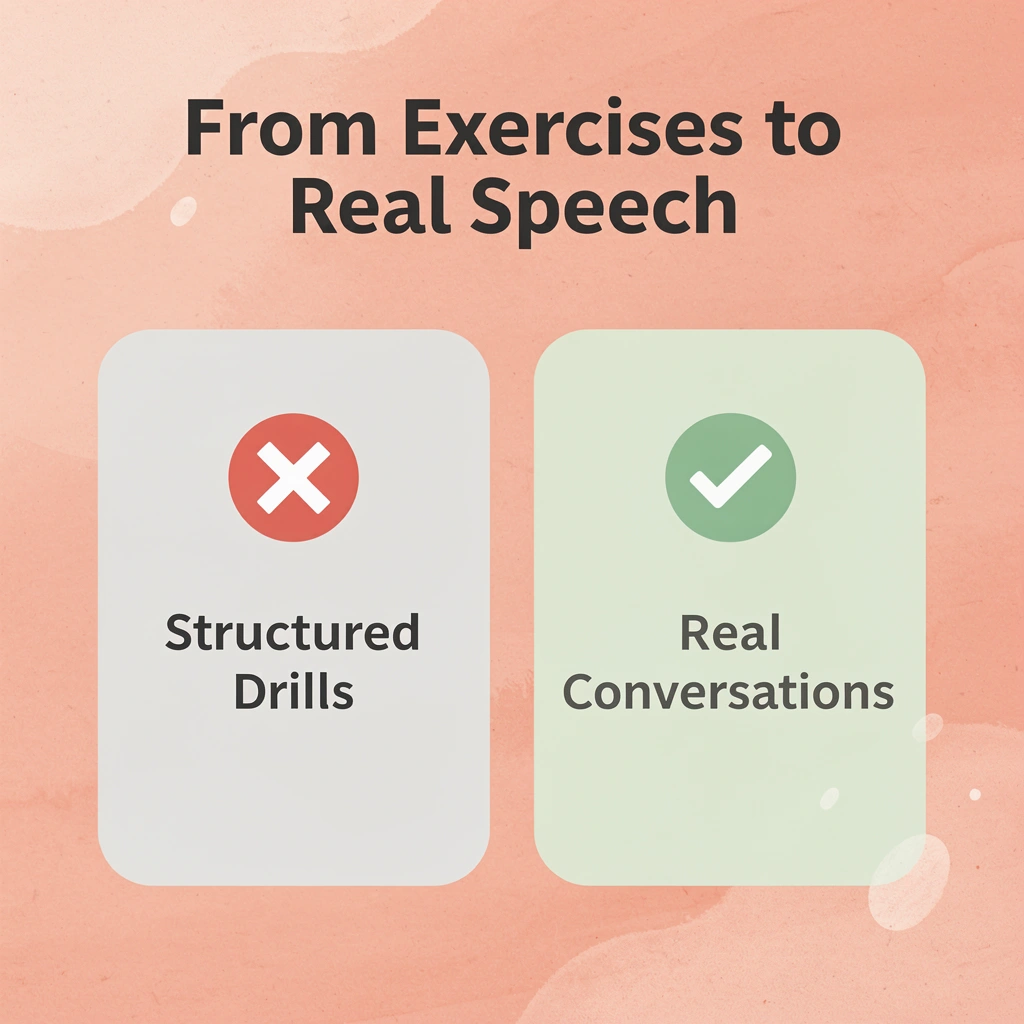
Our Parrot connects what you learn in structured exercises to understanding real-world Spanish.
"A strong foundation is only the beginning: the real leap happens when structured learning meets authentic language exposure." — Language Acquisition Research
💡 Tip: Don't stop at finishing lessons. Real fluency comes from bridging the gap between textbook Spanish and the natural, fast-paced speech you'll encounter in the real world.
🎯 Key Point: Parrot closes the gap between classroom exercises and genuine conversation, turning your Duolingo progress into a launchpad for real-world comprehension.
How does Parrot help you understand native speakers naturally?
A key challenge is understanding native speakers: real conversations often feel too fast or unpredictable even after hundreds of lessons. Parrot uses research-backed comprehensible input through engaging short-form videos that expose you to authentic Spanish while keeping it easy to understand. As your skills improve, content gradually becomes more challenging, allowing your listening ability to develop naturally.
How does Parrot make looking up new words less disruptive?
Another frustration is constantly having to pause to look up unfamiliar words. Parrot's clickable subtitles and instant translations let you learn new vocabulary without interrupting your focus.
Vocabulary sticks better when learned in context. Parrot lets you save words and expressions directly from videos and revisit them in meaningful situations, strengthening retention and recall over time.
How does Parrot find Spanish content that matches your level?
Finding Spanish content that matches your ability level takes time: material that's too easy won't help you progress, while content that's too hard can discourage you. Our AI-powered recommendation feed personalizes videos based on your skill level and interests, so you spend more time engaging with Spanish and less time searching.
Duolingo builds the vocabulary, grammar, and study habits every learner needs. Parrot builds on that foundation by helping you understand real Spanish through meaningful content, bridging the gap between exercises and real-world fluency.
Start Learning Spanish Today
Duolingo builds a foundation, but moving from recognizing words to having real conversations requires input that matches how the brain learns language, not how a test measures it.
"The gap between recognizing vocabulary and holding a real conversation is where most language learners get stuck — and where the right input makes all the difference." — Language Acquisition Research
💡 Tip: If you can pass a quiz but freeze in a real conversation, your learning method is built for testing — not true fluency.
Different learning approaches produce different levels of real-world conversational ability:
Streak-based apps (e.g., Duolingo) – Build vocabulary recognition through repetition, but rarely prepare learners for real conversations.
Comprehensible input (e.g., Parrot) – Builds natural fluency by exposing learners to meaningful language, making them more conversation-ready.
Textbook study – Builds grammar knowledge and structure awareness, but only sometimes translates into practical speaking ability.
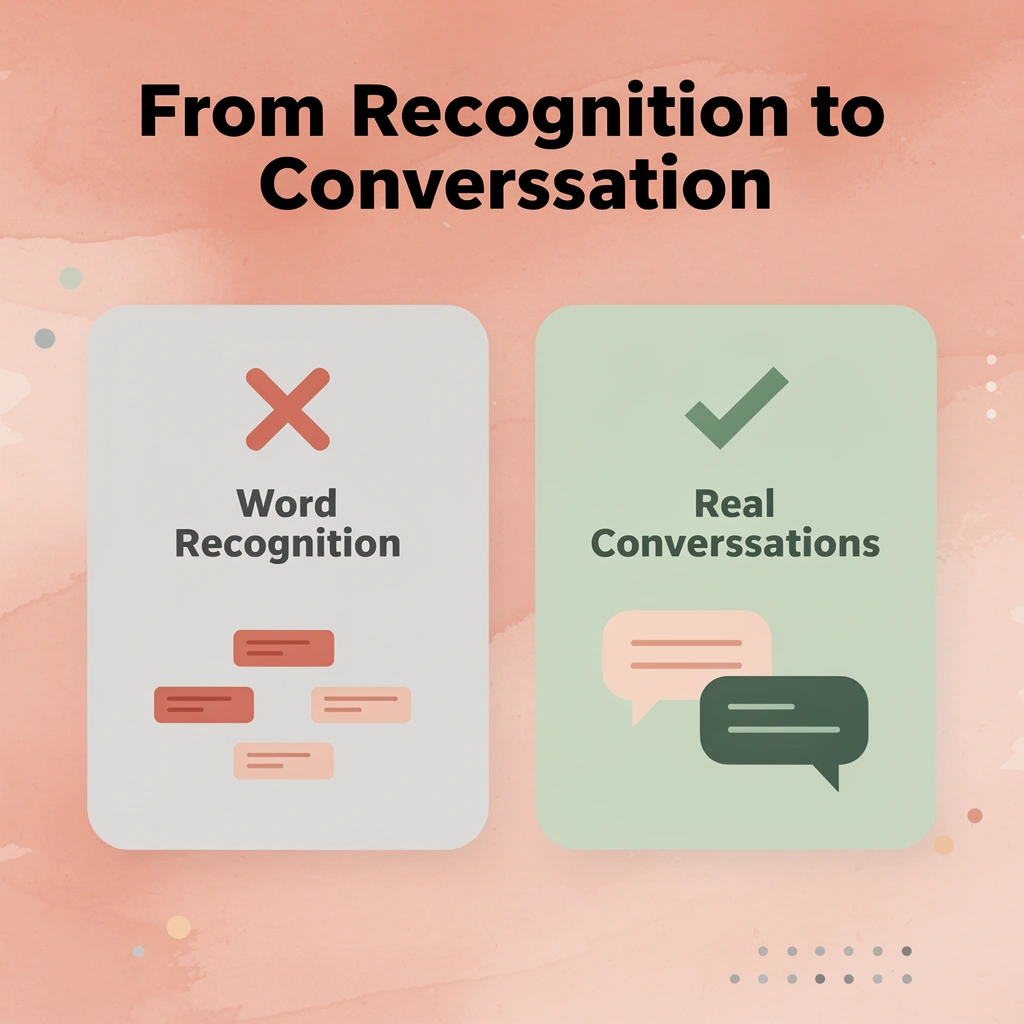
Parrot bridges that gap through easy-to-understand input using short videos. It fits into 10–15 minutes daily while exposing you to real Spanish that streak-based apps can't match. Start your free trial at Learn Spanish and experience real conversational progress.
🎯 Key Point: 10–15 minutes of comprehensible video input per day builds the conversational fluency that traditional apps fail to deliver.
⚠️ Warning: Don't mistake daily streaks for real progress. Completing app exercises feels productive but rarely translates to speaking confidently in the real world.
Related Reading
Duolingo Vs Rosetta Stone
Rocket Spanish Review
Rocket Spanish Vs Rosetta Stone
Best Duolingo Alternative For Spanish
Pimsleur Vs Babbel
Rosetta Stone Vs Pimsleur
Pimsleur Spanish Review
Rosetta Stone Alternatives
Babbel Spanish Review
Alternative To Pimsleur
Duolingo Alternatives
Best Free App To Learn Spanish
Living Language Vs Rosetta Stone
Rocket Spanish Vs Babbel