Choosing between Duolingo and Pimsleur is one of the most common dilemmas for anyone searching for the best way to learn conversational Spanish. Both apps have devoted followings, both promise real results, and both take fundamentally different paths to get there. Duolingo builds habits through gamified, bite-sized lessons, while Pimsleur relies on structured audio and spaced repetition to develop listening and speaking skills.
Neither app is a perfect fit for every learner, and understanding where each one excels makes the decision much easier. For those who want to go beyond app-based drills and practice speaking with genuine confidence, Parrot pairs well with either platform by putting learners in real conversational scenarios. Explore how it works and learn Spanish.
Table of Contents
Why Comparing Duolingo and Pimsleur Isn't as Simple as It Looks
Why Neither Duolingo nor Pimsleur Automatically Makes You Conversational
Duolingo vs. Pimsleur: What Each Program Does Best
What to Look for Beyond Duolingo or Pimsleur
Is Duolingo or Pimsleur Better for Your Spanish Goals?
How Parrot Complements Duolingo and Pimsleur With Authentic Spanish
Start Learning Spanish Today
Summary
Duolingo and Pimsleur are built around fundamentally different learning mechanisms, not just different formats. Duolingo trains pattern recognition through gamified repetition across reading, writing, listening, and speaking. Pimsleur centers every lesson on a listen-then-speak loop using its Graduated Interval Recall system. Choosing between them is less about preference and more about which mechanism matches the specific gap in your current Spanish ability.
Duolingo's primary strength is habit formation, not depth. With over 500 million registered users worldwide, the platform's streak mechanics and bite-sized lessons are precision-engineered to reduce friction and keep learners returning daily. For learners who struggle with consistency, that motivational architecture delivers real value through vocabulary recognition, reading comprehension, and exposure to basic grammar.
Pimsleur's advantage is spoken output. Every core lesson asks learners to retrieve language and say it aloud before hearing the model answer, a retrieval loop repeated across more than 150 hours of audio content across five levels. The hands-free format also lets learners practice during commutes or walks, a structural advantage most language apps cannot match.
Recognition and retrieval are not the same cognitive skill, and that distinction is where both programs show their limits. Completing Duolingo or Pimsleur lessons builds structured knowledge, but spontaneous conversation requires retrieval under pressure, a trained reflex that only develops through repeated exposure to unpredictable input. Learners who finish courses and then freeze in real conversations are not lacking effort. They are lacking the right type of exposure.
Authentic listening input builds vocabulary differently than drills. A 2023 meta-analysis published by Cambridge University Press covering 24 studies and 2,771 learners found measurable incidental vocabulary gains from meaning-focused listening and reading, with average target-word gains ranging from 9% to 18% on immediate tests. Those gains came from context alone, without drilling, which points to the value of consistent exposure to natural, varied language rather than more structured repetition.
Research summarized by Loewen and Sato in a review of second-language acquisition studies found large positive effects for learners who engaged in real interaction compared with those who did not, with benefits most evident on delayed tests, meaning the gains held over time. The real measure of conversational readiness is not completed lessons or maintained streaks. It is whether a learner can follow an unfamiliar speaker, respond to an unexpected question, and keep a conversation moving when the next word does not come immediately.
Parrot's Learn Spanish addresses this by using short-form video immersion rooted in comprehensible input research, exposing learners to natural spoken Spanish in 10 to 15 minutes a day, the kind of varied, authentic input that structured apps like Duolingo and Pimsleur were not built to replicate.
Why Comparing Duolingo and Pimsleur Isn't as Simple as It Looks
Duolingo and Pimsleur are built around genuinely different ideas about how people learn language. One rewards consistency through habit loops and visual engagement. The other believes that spoken response and audio repetition will help wire the language into your memory faster. Choosing between them is a question of which learning method matches your specific goal.
"The debate between habit-driven visual learning and audio-first spoken response sits at the heart of every serious language learning decision." — Language Learning Research
🎯 Key Point: This isn't a simple better vs. worse comparison — it's about matching the right method to the right learner.
💡 Tip: Before choosing, ask yourself one question: do you want to read and write the language, or do you need to speak and understand it fast?
Feature
Duolingo
Pimsleur
Core Method
Habit loops & visual engagement
Audio repetition & spoken response
Primary Skill
Reading & writing
Speaking & listening
Learning Style
Gamified, screen-based
Audio-first, hands-free
Best For
Consistent daily practice
Rapid spoken fluency

How do Duolingo and Pimsleur actually differ in their approach?
Duolingo's Spanish course covers reading, writing, listening, and speaking through game-like progress that encourages daily practice. Pimsleur centers every lesson on a listen-then-speak loop, with its Graduated Interval Recall system presenting vocabulary at increasing time intervals to strengthen long-term retention. These apps solve different problems, and that difference determines which will work for you.
Why do so many learners pick the wrong app for their needs?
The failure point is usually this: learners pick the app that feels more comfortable, not the one that addresses their actual gap. Someone who already reads Spanish reasonably well but freezes when speaking doesn't need more reading and writing drills. Someone with no foundation at all may find audio-only lessons confusing without visual anchors. HearSay Magazine's in-depth analysis of Pimsleur vs. Duolingo methodology explores how each platform's design philosophy shapes learner progress and creates blind spots.
What do structured lessons miss that real conversation demands?
Structured lessons, whether gamified or audio-based, practice language you already know is coming. Real Spanish doesn't offer that courtesy. Parrot approaches this differently, using short-form video immersion grounded in Dr. Stephen Krashen's comprehensible input research to expose you to Spanish as it's spoken, in 10 to 15 minutes a day.
Have Duolingo and Pimsleur expanded beyond their original designs?
Pimsleur now includes reading lessons, digital flashcards, and a Voice Coach feature for pronunciation feedback. Duolingo Max users can access AI video calls and scenario-based roleplay. Both apps' expansions reinforce their original strengths: Pimsleur's additions support its audio method, while Duolingo's extend its gamified structure.
Both apps work together in a smart learning plan, each doing what it does best, provided you're honest about their individual limitations. The gap between completing lessons and holding a conversation in Spanish is wider than either platform's marketing suggests.
Related Reading
Why Neither Duolingo nor Pimsleur Automatically Makes You Conversational
The gap between finishing a course and having a real conversation is not a motivation problem—it's a method problem that runs deeper than most learners expect. This distinction is critical: no amount of willpower or persistence will bridge a gap that is fundamentally structural. The issue isn't how hard you're trying; it's what you're training your brain to do.
"Completing a language course and becoming conversational are two entirely different cognitive achievements—and confusing them is the most common reason learners plateau." — Language Acquisition Research
⚠️ Warning: If you've finished a course and still can't hold a conversation, don't blame yourself. You were likely solving the wrong problem from the start.
💡 Tip: Recognize the gap early. Once you identify this as a method problem, not a motivation problem, you can target the right skills instead of grinding harder at the wrong ones.

Both Duolingo and Pimsleur build structured knowledge: Duolingo through gamified pattern recognition, Pimsleur through spaced audio recall. But structured knowledge and spontaneous production are entirely different cognitive skills—and this difference is everything. Completing either program gives you the first skill, not the second.
Skill Type
What It Means
Which App Builds It
Structured Knowledge
Recognizing and recalling patterns in controlled contexts
Duolingo & Pimsleur ✅
Spontaneous Production
Generating language in real time under pressure
Neither — requires additional practice ❌
Conversational Fluency
Combining both skills fluidly in live interaction
Must be trained separately ❌
🎯 Key Point: Structured knowledge is the foundation, but spontaneous production is the actual goal—and the two require fundamentally different types of training to develop.
🔑 Takeaway: Finishing Duolingo or Pimsleur is a genuine achievement, but it marks the beginning of conversational training—not the end.
Why recognition and retrieval are not the same skill
The failure point is invisible until you need the language in real time. You can recognize "¿Dónde está el baño?" in a Duolingo exercise because context narrows your options. You can recall it after a Pimsleur prompt because the cue triggers that exact phrase. But when a native speaker fires off a fast, accented question you did not anticipate, neither pathway activates quickly enough. Recognition is passive; retrieval under pressure is a trained reflex that develops only through repeated exposure to unpredictable input.
Why does doing more lessons fail to close the gap?
Most learners respond by doing more lessons, but structured practice cannot close a gap it created. Retrieval speed builds through exposure to natural, varied Spanish at a volume lessons alone cannot match. Dr. Stephen Krashen's comprehensible input research shows acquisition happens when learners encounter language they can mostly understand in context, not when they drill responses to predetermined prompts. Apps like Parrot apply this principle directly, using short-form video content to immerse learners in real spoken Spanish for 10 to 15 minutes a day, converting passive screen time into active language absorption.
What does real listening fluency actually require?
Learners practice making Spanish sounds but rarely hear enough variation to understand how those sounds change across speakers, regions, and speeds. A Pimsleur speaker sounds identical each time. A Duolingo audio clip is controlled. Neither prepares you for the shortened vowels, dropped syllables, and regional expressions in real conversation. Listening fluency requires breadth, not repetition of the same clean audio source.
Why do progress metrics miss the most important benchmark?
Progress metrics hide this gap. Duolingo's streaks and XP track app usage; Pimsleur's lesson sequence tracks lesson completion. Neither measures whether you can follow a native speaker when they change topics suddenly or stay with the conversation when you miss a word. The real way to know if you're ready for conversations isn't how many lessons you've finished—it's whether you can stay in a conversation when it doesn't go as planned.
But knowing what is missing is only half the picture; which program actually builds the skills you do have might surprise you.
Duolingo vs. Pimsleur: What Each Program Does Best
Duolingo builds the habit. Pimsleur builds the ear. Understanding what each program is optimized to do reveals why both statements are true — and why choosing the right tool depends entirely on your learning goals.
🎯 Key Point: Neither app is universally "better" — Duolingo excels at daily consistency and gamified engagement, while Pimsleur is purpose-built for spoken fluency and audio comprehension.
"The best language learning tool is the one optimized for the skill you actually need — habit formation or real-world speaking confidence." — Language Learning Research
Feature
Duolingo
Pimsleur
Primary Strength
✅ Habit building & gamification
✅ Listening & speaking fluency
Format
✅ Visual, text-based exercises
✅ Audio-first lessons
Best For
✅ Beginners & casual learners
✅ Commuters & auditory learners
Consistency Tools
✅ Streaks, XP, leaderboards
❌ Limited gamification
Speaking Practice
❌ Minimal real-world audio depth
✅ Deep pronunciation training
Cost
✅ Free tier available
❌ Premium-only model
🔑 Takeaway: Use Duolingo to lock in the daily learning habit and build vocabulary recognition — switch to Pimsleur when spoken fluency and real-world conversation confidence become your primary priority.
What Duolingo does well
Duolingo's real strength is its engagement mechanics. The streak system, XP rewards, and bite-sized lessons are designed to get you showing up every day. According to the Superlore Blog, Duolingo has over 500 million registered users worldwide, proof of how accessible it is. For Spanish learners struggling with consistency, that matters. Vocabulary recognition, reading comprehension, and basic grammar patterns all improve through repeated, low-pressure practice, which Duolingo delivers reliably.
What Pimsleur does well
Pimsleur's advantage lies in its specificity. Every main lesson requires you to recall language and speak it aloud before hearing the correct answer. This recall, repeated across over 150 hours of audio content across 5 levels according to HearSay Magazine, trains both your mouth and memory simultaneously. The hands-free format lets learners practice during commutes or walks, converting idle time into spoken Spanish practice—a structural advantage most language apps cannot match.
Does structured repetition prepare you for real conversation?
Both programs excel with certain input types but lack the natural, varied Spanish that real conversation demands. Structured repetition keeps learners comfortable within the program's framework, whereas the real world operates differently. Apps like Parrot use short videos based on comprehensible input research to expose learners to natural, spontaneous Spanish in 10 to 15 minutes daily—something neither Duolingo nor Pimsleur was designed to provide.
Where the comparison gets more interesting
The main difference between the two programs is where the thinking work happens. Duolingo asks you to recognize and select; Pimsleur asks you to retrieve and produce. Recognition is easier, which is why Duolingo feels more accessible. Retrieval is harder, which is why Pimsleur feels more demanding but also more useful for real conversation. Neither program prepares you for the moment when a native speaker changes topic mid-sentence and waits for your response.
Which gap in your learning is costing you the most right now?
It comes down to one honest question: what does your Spanish practice currently lack most? If you lack consistency, Duolingo's motivational structure will serve you better. If you're consistent but your spoken output feels slow or uncertain, Pimsleur's audio-first structure will push you further. The choice is about which gap in your learning is costing you the most right now.
But knowing which program fits your current gap is only the first step in a larger question.
What to Look for Beyond Duolingo or Pimsleur
Both Duolingo and Pimsleur work within the same fundamental limit: they are organized programs that control what you hear, when you hear it, and how you respond. That predictability helps beginners but severely limits real conversation, where native speakers change topics without warning, use regional slang, or speak far faster than audio tracks allow.
"Organized language programs prepare you for their own tests — not for the variability of real speech." — Language Learning Research
💡 Tip: Use structured apps as a foundation, but actively seek out unscripted listening practice — podcasts, native media, and live conversation — to bridge the gap between app fluency and real-world fluency.
Program Type
What It Trains
What It Misses
Duolingo / Pimsleur
Controlled vocabulary, set phrases
Regional slang, topic shifts, natural speed
Native Media
Real speech patterns, cultural context
Structured grammar progression
Live Conversation
Spontaneous response, variability
Repetition and scaffolded review

Learners who spend years in a single app often complete lessons with confidence but freeze in actual speech. The gap is not effort — it is exposure type. Organized programs prepare you for their own tests, not for the variability of real speech and the unpredictable demands of live interaction.
⚠️ Warning: Completing every lesson in an app does not equal conversational readiness — without unscripted exposure, fluency remains artificial.
🎯 Key Point: The real benchmark of language learning isn't your app streak or lesson completion rate — it's whether you can hold a conversation when a native speaker goes off-script.
What authentic input actually does
Listening that focuses on meaning builds different thinking skills than learning through apps. A 2023 study by Cambridge University Press, which examined 24 studies with 2,771 learners, found that people learned new words by reading, listening, and reading while listening. The average gains ranged from 9% to 18% on immediate tests: vocabulary learned from context alone, without repetitive practice. Learning outcomes depended on skill level, material selection, and practice frequency. Consistent, level-matched exposure drives real improvement.
Why does scattered input fail to build intuition?
Random input—a YouTube video here, a podcast there—lacks the repetition and consistent context needed for language to become natural. A better approach uses serialized content with recurring characters, repeated vocabulary in different situations, and emotional context that makes new language stick. Apps like Parrot use short-form video immersion based on comprehensible input, fitting natural exposure into 10 to 15 minutes daily rather than requiring a separate study block.
Beyond input: the speaking gap
Listening and reading help you understand language, but they don't automatically help you speak fluently. According to NBC News Select, Pimsleur offers courses for 51 languages with a spoken recall format that trains your mouth to produce sounds in sequence. However, Pimsleur's speaking practice remains scripted—you know what prompts and answers to expect, whereas real conversation does not.
Research summarized by Loewen and Sato in a review of second-language learning studies found significant positive effects for learners who engaged in real interaction compared with those who did not. The benefits were most pronounced on delayed tests, indicating the gains persisted over time rather than fading after lessons ended.
What does real conversational progress actually look like?
Progress is measured not by streaks or lesson counts, but by whether you can answer unexpected questions, follow unfamiliar speakers, and sustain conversations despite unknown words. These results require real input, spontaneous interaction, and vocabulary learned in context. Duolingo and Pimsleur can build the foundation, but what you construct on top determines whether you reach your goals.
Which app should anchor that foundation for your specific goals? The answer is more precise than most people expect.
Is Duolingo or Pimsleur Better for Your Spanish Goals?
Choosing between Duolingo and Pimsleur depends on your Spanish goals. Duolingo works well for building a daily habit, learning new vocabulary, and getting started with minimal effort. Pimsleur teaches listening and speaking together from the start with structured audio lessons you can complete while commuting or walking.
💡 Tip: If your primary goal is speaking confidently, Pimsleur's audio-first approach gives you an advantage that Duolingo's tap-and-match format cannot match.

The two programs work very differently — and understanding how matters before you commit. According to HearSay Magazine's Pimsleur vs. Duolingo comparison, Pimsleur lessons last 30 minutes each and are designed for daily audio practice. Duolingo requires less time per session — which helps if staying consistent is hard for you, but might not give you enough depth or speaking practice.
"Pimsleur lessons last 30 minutes each and are designed for daily audio practice, while Duolingo's shorter sessions prioritize habit-building over conversational depth." — HearSay Magazine
Feature
Duolingo
Pimsleur
Session Length
Short, flexible
30 minutes per lesson
Primary Skill
Reading & vocabulary
Listening & speaking
Best For
Daily habit formation
Conversational fluency
Format
Gamified app
Structured audio
On-the-Go Friendly
Moderate
Yes — hands-free
🔑 Takeaway: Neither program is universally better — Duolingo wins on consistency and accessibility, while Pimsleur wins on speaking depth. The right choice depends on whether you need habit-building or real conversational output.
⚠️ Warning: Relying on Duolingo alone may leave you able to read Spanish but struggling to speak it — if oral fluency is your goal, Pimsleur's structured audio method is the stronger investment.
What does the gap between practice and reality actually look like?
A pattern emerges among learners who stick with these programs for months before speaking face-to-face with a native speaker: they understand what they practiced, and almost nothing else. Real conversation moves faster, drops syllables, shifts tone, and carries regional color that no structured curriculum anticipates. One learner discovered that even Pimsleur's audio-focused approach had trained them in a formal spoken register that native speakers found stiff. The frustration stems not from the app's failure, but from its success at something narrower than the learner expected.
Why does drilling more lessons stop closing the gap?
Most learners address this gap by doing more of the same program, adding more lessons and levels. But as the gap between practiced phrases and real conversation widens, that approach yields diminishing returns. What changes things is not more drilling but different input: Spanish that sounds like how native speakers actually speak. Apps like Parrot work from that premise, using short-form video built around comprehensible input so that 10 to 15 minutes of daily listening practice grounds learners in how native speakers actually talk, not how a curriculum imagines they do.
Which program fits your current stage?
NBC News Select's 2025 review of language learning apps notes that Pimsleur offers courses for 51 languages with English as the source language, reflecting its focus on spoken production. This matters if speaking is your primary goal. However, if you're building vocabulary, Duolingo's wider curriculum offers more to learn early on. Your best choice evolves as your Spanish improves—sticking with one tool throughout is the fastest way to plateau.
The right program is one you'll use regularly at your current level toward your specific goal.
Related Reading
How Parrot Complements Duolingo and Pimsleur With Authentic Spanish
Duolingo and Pimsleur provide structured practice, but neither exposes you to every speaker, topic, accent, expression, or conversation situation you'll encounter outside the program. As your skills improve, you need wider exposure to how native speakers use Spanish across different contexts.
"Neither Duolingo nor Pimsleur exposes learners to the full range of accents, topics, and real-world expressions that native speakers use across different contexts." — Core limitation of structured language apps
🎯 Key Point: Structured apps build your foundation, but authentic exposure bridges the gap between classroom Spanish and real-world fluency.
💡 Tip: Once you've built basic vocabulary and grammar through Duolingo or Pimsleur, seek out native speaker content. Your comprehension will grow significantly faster.
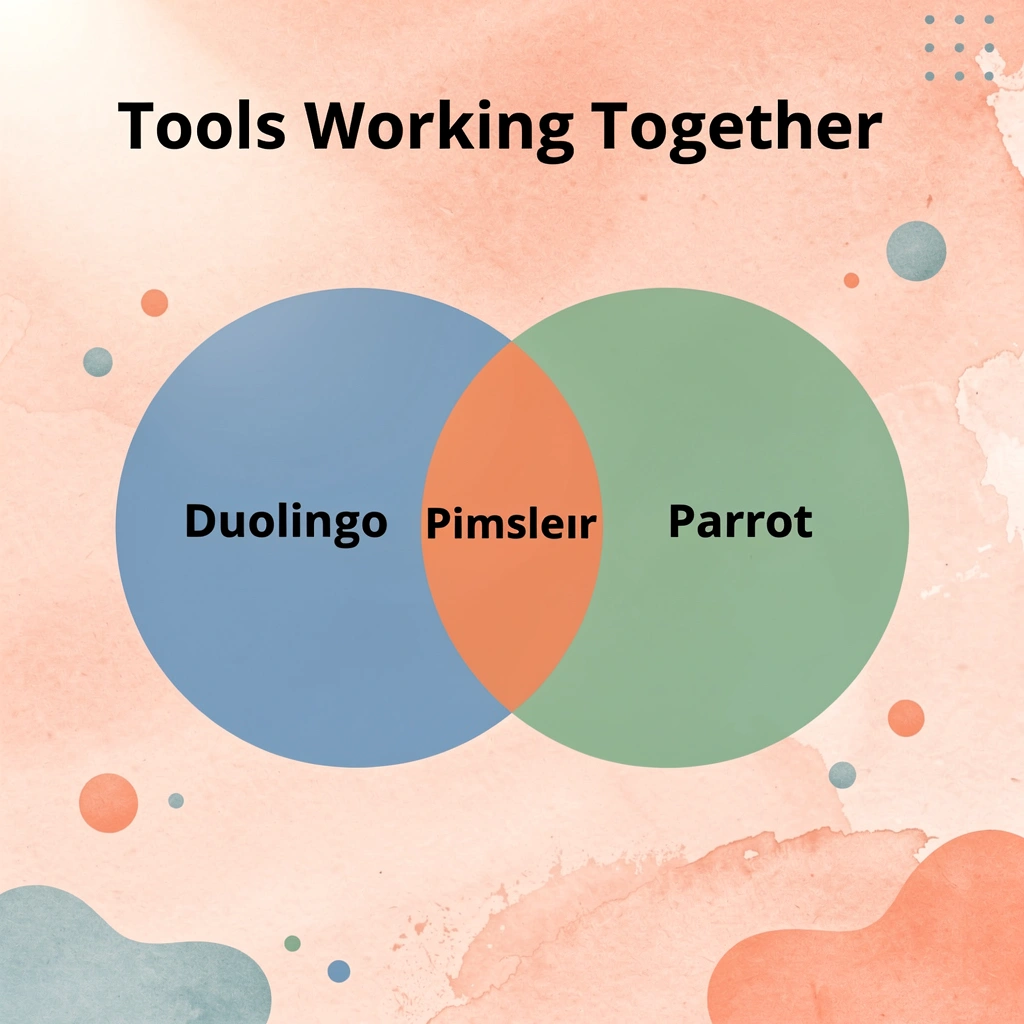
Parrot adds to structured practice by making authentic Spanish easier to find, understand, and look at again.
🔑 Takeaway: The real power of Parrot isn't replacing Duolingo or Pimsleur — it's filling the critical gap between structured lessons and the messy, unpredictable reality of native Spanish conversation.
Tool
Primary Strength
Key Limitation
Duolingo
Gamified structured lessons
Limited authentic exposure
Pimsleur
Audio-based spoken practice
Narrow topic and accent range
Parrot
Authentic Spanish discovery & review
Complements, not replaces, structured study
Can structured lessons provide every kind of Spanish you need?
Parrot uses research-backed comprehensible input through engaging short-form videos, exposing learners to authentic Spanish from native speakers. This bridges the gap between Spanish learned in structured lessons and the Spanish you encounter in everyday life.
What happens when native content is too difficult?
Going straight from structured lessons to random native videos can feel overwhelming. You might understand your lessons easily but struggle with fast interviews, unfamiliar words, or conversations between native speakers.
Parrot's AI-powered recommendation feed personalizes Spanish videos based on your skill level and interests, helping learners find engaging content while gradually increasing difficulty.
How much time does finding suitable Spanish content take?
Even motivated learners spend significant study time searching for content that's authentic, engaging, and appropriately leveled. Parrot's personalized recommendations eliminate this friction, freeing more time for listening and comprehension.
What happens when unknown vocabulary interrupts your listening?
Real content will always contain unfamiliar words. Stopping to look them up breaks your focus and impedes comprehension of the main message.
Parrot's clickable subtitles and instant translations provide immediate help without interrupting your listening experience.
How do you retain vocabulary after a single encounter?
Understanding a word once doesn't guarantee you'll remember it later. Parrot lets learners save words from videos and review them in meaningful ways, providing additional exposure beyond the initial encounter.
What do you do when structured practice starts to feel repetitive?
Duolingo's game-like features and Pimsleur's organized audio lessons provide regular practice. However, learners benefit from exposure to different speakers, topics, expressions, and conversational styles. Parrot's personalized recommendations introduce varied Spanish content matched to your skill level and interests.
How should you combine Duolingo or Pimsleur with Parrot?
You can use Duolingo if its gamified approach keeps you practicing consistently, or Pimsleur if its audio-first method suits your learning style. Then add authentic, understandable Spanish to bridge the gap between structured practice and naturally spoken language.
Parrot supports authentic exposure by making Spanish content easier to discover, understand, and revisit. The goal is to combine the right kinds of practice so the Spanish you learn transfers outside the learning environment.
Start Learning Spanish Today
The right starting point matters, but staying in motion matters more. If your current Duolingo or Pimsleur routine builds structure and keeps you consistent, protect that. Then add something that closes the gap between structured practice and real understanding: short-form video content in Spanish, matched to your current level.
"The gap between structured practice and real-world comprehension is where most learners stall — bridging it requires authentic input at the right level." — Language acquisition research
💡 Tip: Don't abandon what's working. Stack authentic Spanish content on top of your existing routine to accelerate real-world comprehension without losing momentum.

Parrot delivers this — real Spanish video content, clickable subtitles, instant translations, and vocabulary saving built directly into the watching experience. Spend 10 to 15 minutes a day hearing Spanish as it sounds in real life, while keeping your structured practice intact.
Feature
What It Does
Real Spanish Video Content
Exposes you to authentic, natural speech patterns
Clickable Subtitles
Instant word-level access — no pausing to Google
Instant Translations
Understand in context, not in isolation
Vocabulary Saving
Build a personal word bank from content you actually watched
🎯 Key Point: Just 10 to 15 minutes a day of real Spanish input can dramatically close the gap between textbook knowledge and true listening comprehension.
✅ Best Practice: Pair Parrot with your existing app routine — use structured tools for grammar and drills, and Parrot for real-world exposure. That combination is the fastest path to fluency.
Related Reading
Rocket Spanish Vs Babbel
Alternative To Pimsleur
Pimsleur Vs Babbel
Rosetta Stone Alternatives
Duolingo Vs Pimsleur
Rocket Spanish Vs Rosetta Stone