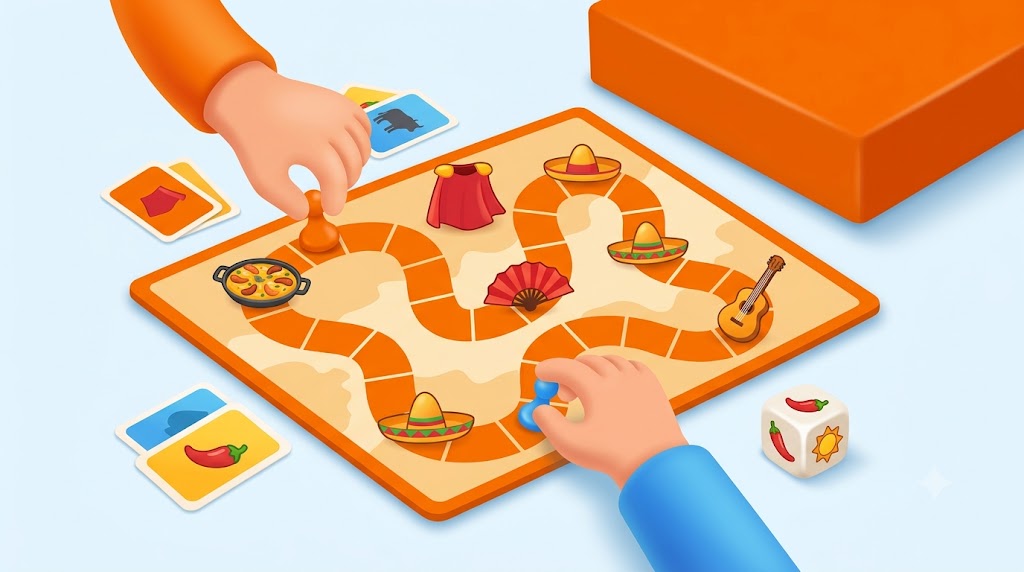
Traditional flashcards and grammar drills have their place, but they rarely build the kind of fluency that holds up in real conversation. Games designed for language learning change that dynamic by keeping practice engaging, lowering the pressure to perform, and reinforcing vocabulary through repetition that feels natural rather than forced. Research consistently shows that enjoyment and motivation are strong predictors of how far a learner progresses.
The best way to learn conversational Spanish combines structured input with enough variety to stay interesting over time. Interactive challenges, speaking exercises, and vocabulary games work together to build skills that transfer to actual dialogue. For anyone ready to move beyond rote memorization, Parrot offers a smarter starting point to learn Spanish.
Table of Contents
Why So Many Learners Look for Games to Learn Spanish
What Makes a Spanish Learning Game Actually Effective?
7 Best Games to Learn Spanish
How to Use Games as Part of an Effective Learning Routine
Which Games Are Right for Your Learning Goals?
How Parrot Turns Entertainment Into Spanish Learning
Start Learning Spanish Today
Summary
Motivation, not ability, is the real bottleneck in language learning. Most learners who search for Spanish games are not struggling to understand grammar rules. They are struggling to show up consistently, and games solve that specific problem by introducing points, streaks, and real-time feedback that make daily practice feel less like study. Searches for "learn Spanish" spiked sharply in early February 2025 according to Google Trends data reported by KXAN News, confirming that motivation to start is never the shortage. The real shortage is a method that sustains practice long enough to produce actual fluency.
Engagement and language acquisition are not the same thing. A learner can maintain a 90-day streak in a gamified app and still be unable to follow a native speaker talking at normal speed, because many apps optimize for completion rather than comprehension. Matching a picture to a word is a memory task. Understanding a sentence spoken at natural speed by a native speaker is a language task, and only one of those prepares you for real conversation.
The 80/20 principle applies directly to Spanish vocabulary. According to Homeschool Languages, just 20% of words and phrases cover 80% of daily conversation in Spanish. Effective learning tools do not need enormous vocabulary libraries. They need to expose learners to the right words repeatedly, inside real contexts, until recognition becomes instinct rather than effort.
Listening practice is the non-negotiable skill that most games leave underdeveloped. The Berlitz Blog notes that even Spanish, a Category I language, requires 600 to 750 hours of study to reach proficiency, and those hours only compound when they include authentic spoken input at a natural pace. Games that rely entirely on text-based interaction leave a critical gap in what learners can actually process when a native speaker opens their mouth.
Game-based learning does produce measurable results, but only when the content reflects real language use. A 2024 systematic review and meta-analysis published in PMC found that game-based learning showed a large overall effect size of g = 0.82 on learning outcomes. Separately, research from Engageli indicates that game-based learning increases skill-based knowledge retention by 90% compared to passive learning approaches, but that advantage only materializes when learners consistently show up over time.
Sequencing matters more than which specific game a learner chooses. Games work best as reinforcement tools placed after authentic input, not as the foundation of a routine. The pattern that produces conversational fluency puts 20 to 30 minutes of real Spanish audio or video at the center of daily practice, with games filling a supporting role to reinforce vocabulary that already has context attached.
Parrot's Learn Spanish addresses the listening comprehension gap that structured games cannot fill by delivering short-form native-speaker video content built around comprehensible input methodology in 10 to 15 minutes a day.
Why So Many Learners Look for Games to Learn Spanish
Motivation is the real bottleneck in language learning, not ability. Most learners searching for Spanish learning games aren't struggling to understand conjugation rules: they're struggling to show up consistently.
"The biggest barrier to language learning isn't comprehension — it's consistent engagement over time." — Language Learning Research
💡 Tip: If you dread practice sessions, that's a motivation problem. Gamified learning is specifically designed to solve it.

The pattern is predictable. The first few weeks feel exciting because novelty carries you. But around week three or four, novelty wears off and what remains is repetition without reward. That's when learners seek something that makes practice feel less like a chore and more like a choice.
🎯 Key Point: The drop-off point for most language learners hits between weeks three and four — when games and interactive tools can make the critical difference between quitting and continuing.
⚠️ Warning: Relying on pure willpower to maintain daily Spanish practice is a strategy that rarely lasts. Sustainable learning requires building in intrinsic rewards, which well-designed language games deliver.
How do reward loops make Spanish practice feel worth returning to?
Games solve that problem by introducing points, streaks, unlockable levels, and real-time feedback that trigger reward loops. Spanish word games and vocabulary quizzes make daily practice feel less like studying. According to Middlebury Language Schools, Spanish is spoken by over 500 million native speakers worldwide. Games lower the psychological barrier to engaging with a language of such significance.
What does gamified Spanish practice get wrong about real comprehension?
The familiar pattern is: open an app, complete a lesson, earn a streak, feel progress. But the hidden cost emerges later—a learner with a 90-day streak still can't follow a native speaker at normal speed. Gamified Spanish practice often optimizes for completion over comprehension, rewarding correct answers without building the listening instincts real conversation demands. Apps like Learn Spanish take a different approach, using short-form video from native speakers to train comprehension in context, so practice time maps directly to the skill you need most.
Engagement and acquisition are not the same thing. A Spanish word puzzle keeps you busy without moving you closer to understanding a conversation between native speakers. Google Trends data reported by KXAN News shows searches for "learn Spanish" spiked in early February 2025, suggesting motivation to start is never the shortage. The real shortage is a method that sustains practice long enough to achieve conversational fluency.
What separates the best Spanish learning games from ones that just keep you busy?
The best Spanish learning games close the gap between fun and function using spaced repetition, contextual vocabulary exposure, listening challenges, and interactive storytelling. The question isn't whether games belong in a language learning routine, but whether the game you're playing trains the right skill.
Related Reading
Best App To Learn Spanish While Driving
How To Learn Spanish In A Week
Games To Learn Spanish
Best Tools To Learn Spanish
Reasons To Learn Spanish
What Makes a Spanish Learning Game Actually Effective?
The difference between a game that feels like it helps you learn, and one that actually does help you learn comes down to what skill it teaches. Learning to recognize vocabulary in a controlled environment builds a foundation. Understanding Spanish the way people actually speak it builds real fluency.
"The gap between recognizing vocabulary and using it fluently is where most Spanish learners get stuck — and where game design either wins or fails."
🎯 Key Point: Not all Spanish games are created equal — the best ones target authentic comprehension, not just controlled recognition.
💡 Tip: When evaluating a Spanish learning game, ask yourself: does it teach you to understand Spanish the way people actually speak it, or only in simplified, artificial scenarios?
Different language game types develop different skills and lead to different learning outcomes:
Vocabulary drills – Teach word recognition in controlled environments, helping learners build a basic language foundation.
Conversation-based games – Expose learners to real-world speech patterns, supporting more natural conversational fluency.
Grammar-focused games – Reinforce structural language rules, improving accuracy in writing and sentence formation.

Does the game focus on the words that actually matter?
According to Homeschool Languages, 20% of words and phrases cover 80% of everyday conversation in Spanish. An effective game doesn't need a huge vocabulary library; it needs to show you the right words repeatedly in real situations until you recognize them without thinking. Games that spread your attention across thousands of uncommon words feel productive but don't help you learn as much.
What separates effective games from entertaining ones?
Good Spanish learning games provide extensive listening practice by embedding vocabulary in stories or conversations rather than isolated flashcards. They require learners to understand meaning, not simply match symbols. Matching a picture to a word is a memory task; understanding a sentence spoken at natural speed by a native speaker is a language task. Only the latter prepares you for real conversation.
Why do most popular games fall short for real comprehension?
Most learners are drawn to games with clear levels, instant feedback, and satisfying completion sounds: a structure that motivates but fails when the goal is understanding, since real Spanish lacks progress bars. Apps like Parrot use native-speaker video content built on comprehensible input methodology, training learners on actual rhythms and vocabulary of spoken Spanish rather than simplified game versions.
Why listening practice is the non-negotiable
The Berlitz Blog notes that even a Category I language like Spanish requires at least 600 to 750 hours of study to reach proficiency. Listening to Spanish at a natural pace with authentic intonation and connected speech builds comprehension over time. Text-based games leave learners unprepared for native speakers' actual speech.
Does engagement alone actually build conversational ability?
Engagement becomes a problem when it's the only measure of learning. A game can hold your attention for thirty minutes daily and still leave you unable to follow a conversation after six months. The games worth your time connect engagement with real learning.
7 Best Games to Learn Spanish
Seven games can strengthen your Spanish learning routine. The best choice depends on which skill you're building and what you combine it with outside the game.
"The most effective language learners don't rely on a single method — they combine multiple engaging tools to reinforce vocabulary, grammar, and comprehension from every angle."
🎯 Key Point: Not all Spanish learning games are created equal — the right game targets your specific weak spot, whether that's vocabulary, listening comprehension, or grammar.
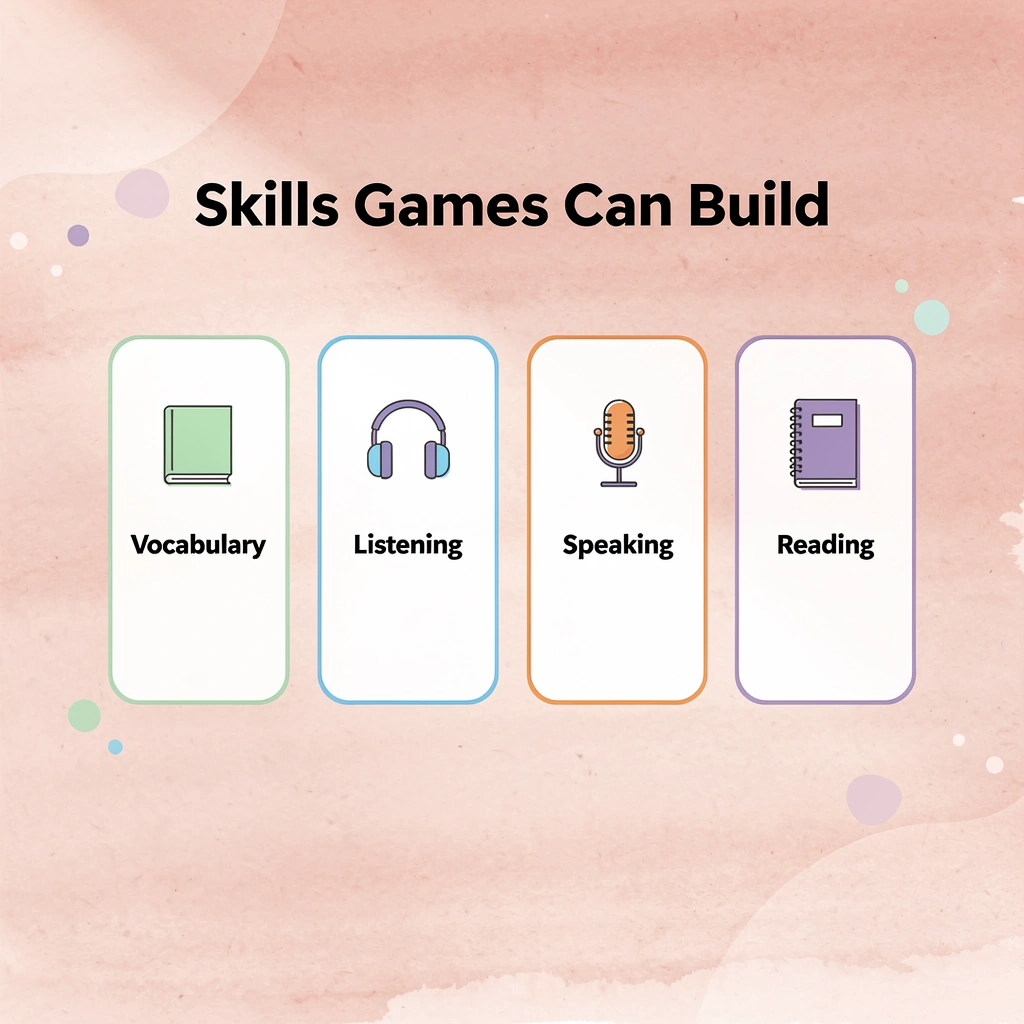
Choose language-learning games based on the specific skill you want to develop:
Vocabulary retention – Look for games that use flashcard-style review or word-matching activities to reinforce new words.
Listening comprehension – Choose audio-focused or immersive story-based games that expose you to spoken language in context.
Grammar accuracy – Use games with sentence-building exercises or fill-in-the-blank challenges to strengthen grammar patterns.
Speaking confidence – Prioritise games that include voice recognition or pronunciation practice to encourage active speaking.
Reading fluency – Select narrative-driven or text-rich adventure games that improve reading speed and comprehension.
💡 Tip: Always pair your game-based practice with real-world exposure — games work best as a supplement, not a standalone solution.
1. Duolingo: Best for Building Daily Learning Habits
Duolingo remains the most widely used language learning app because it solves the hardest problem first: showing up. Short lessons, streaks, and reward mechanics lower the friction of daily practice to nearly zero. For absolute beginners, that consistency matters more than the content itself, because a habit you maintain beats a perfect method you abandon.
What does Duolingo actually train you to do?
The limitation is real. Duolingo builds recognition, not production. You learn to identify correct answers, not generate sentences under pressure. Most learners who finish a Duolingo tree still struggle to follow native speakers at normal speed, because the app never trained that skill.
2. Lingo Legend: Best RPG for Vocabulary Reinforcement
Most gamified vocabulary tools reward recognition over retrieval—identifying the right answer when presented rather than recalling it independently. Lingo Legend excels at this format because its RPG structure creates genuine motivation to return. Quests, character progression, and resource collection transform repetitive review into compelling gameplay.
Use it to reinforce words you've already encountered elsewhere. It's ineffective for meeting new language, but excellent for locking in words you've started to recognize.
3. Influent: Best for Immersive Vocabulary Learning
Visual learners who struggle with vocabulary lists find Influent helpful. Clicking on objects like lamps, coffee mugs, or bookshelves and hearing the Spanish word spoken aloud creates a direct sensory connection that stays in memory longer than flashcard repetition, mirroring how we learned our first language.
The scope is narrow: Influent teaches nouns only. It won't help you build sentences, understand spoken Spanish, or navigate conversations. Think of it as a vocabulary starter kit, not a fluency tool.
4. Digital Dialects: Best Free Browser-Based Vocabulary Games
Digital Dialects removes cost barriers. The browser-based games cover numbers, colors, food, animals, and travel vocabulary without requiring a download or subscription, offering a low-stakes way to test whether Spanish study will stick before investing in paid tools.
The ceiling is low. Digital Dialects works well for the first few weeks, then stops delivering new challenges. Treat it as a tasting menu, not a full meal.
5. Spanish Scrabble (Apalabrados) Best for Vocabulary Expansion
Intermediate learners often know words passively but struggle to use them quickly. Apalabrados forces active recall under mild pressure, strengthening long-term retention through retrieval practice that works.
According to Noun Town, consistent play can build a working vocabulary of several hundred words within a few weeks. Word games like Apalabrados contribute to cumulative growth by making retrieval feel like play rather than drill. However, beginners need a foundation first, or they will find the experience frustrating rather than instructive.
6. Minecraft (Spanish Language Setting) Best for Immersion
Switching Minecraft's interface to Spanish builds vocabulary through repetition. You craft the same items, read the same menus, and encounter the same survival vocabulary hundreds of times across dozens of sessions. This repeated contextual exposure moves vocabulary from short-term recognition to long-term recall.
The vocabulary stays narrow, tied to crafting and survival rather than daily conversation. But reading and thinking in Spanish, even within a constrained context, trains the brain to stop translating and start processing. That shift matters.
7. The Sims (Spanish Interface) Best for Everyday Conversational Vocabulary
The Sims in Spanish covers everyday language most games ignore: emotions, relationships, careers, household routines, and social interactions in realistic contexts rather than isolated flashcards. For intermediate learners, this exposure to conversational vocabulary is useful.
Learners relying on games alone often develop vocabulary recognition without the ability to communicate spontaneously in real-world contexts. The Sims narrows that gap slightly but doesn't close it: reading "hungry" in a menu differs from understanding a native speaker say it at natural speed mid-sentence.
The gap every game leaves open
No game on this list builds conversational fluency independently. Games are designed to keep you playing, not to replicate the unpredictability of real conversation with a native speaker.
Why does listening comprehension fall through the cracks?
Playing multiple games covers different skill areas but leaves a significant gap in listening comprehension. A learner might spend an hour in Apalabrados and another in Duolingo yet have no idea what a native speaker sounds like when excited, tired, or speaking quickly. That gap is where most game-based learners get stuck.
What can fill the gap that games structurally cannot?
Learning Spanish through short-form video content built around native-speaker conversations provides exposure to real spoken Spanish at a comprehensible level that games cannot match. The US Foreign Service Institute estimates Spanish requires 600 to 750 hours of study to reach professional working proficiency for English speakers. Hours spent recognizing vocabulary in games differ fundamentally from hours spent processing authentic spoken Spanish.
The seven games above build habits, expand vocabulary, and make daily practice feel less like homework. They work best as part of a routine that includes elements games cannot provide independently.
The harder question is how to sequence games so each one reinforces the others instead of competing for the same limited hour in your day.
Related Reading
Mango Vs Rosetta Stone
Rosetta Stone Spanish Reviews
Best Way To Learn Spanish As An Adult
How To Learn Spanish On Your Own
Best App To Learn To Speak Spanish
Best App To Learn Mexican Spanish
How To Learn Medical Spanish
Fastest Way To Learn Spanish
How to Use Games as Part of an Effective Learning Routine
Games work best as tools to help you practice Spanish you've already learned, not as the main part of your Spanish learning plan. They make stronger what you've already been exposed to, but they can't build the understanding skills that you need for real conversation.
"Games are most effective when used to reinforce existing knowledge — they accelerate retention of what you've learned, but cannot replace the foundational skills built through structured study." — Language Learning Research
💡 Tip: Use games after a study session to reinforce new vocabulary — never as a substitute for core learning activities like grammar practice or conversation drills.
⚠️ Warning: Relying on games as your primary learning method is one of the most common mistakes Spanish learners make. Games build on existing knowledge — they cannot create it from scratch.
Each language-learning method serves a different purpose within an effective learning strategy:
Games – Best for reinforcing vocabulary and improving recall, but limited in developing core listening and comprehension skills.
Structured study – Ideal for building grammar knowledge and strong language foundations, though it may feel less engaging for some learners.
Real conversation – Helps apply listening, speaking, and vocabulary in authentic situations, but is most effective once a basic knowledge foundation has been established.

Build the routine around input, not activity
The most common mistake is treating daily practice like a checklist: open an app, complete a lesson, earn a streak, feel productive. But according to Engageli's research on game-based learning, gamification increases engagement by 60% and motivation by 48%. These numbers measure how people feel about learning, not what they retain. Motivation is the starting point, not the end goal. A routine built around engagement metrics keeps you consistent but won't necessarily enable real conversations.
Why does placing listening at the center actually work?
The pattern that works puts listening at the center. Twenty to thirty minutes of Spanish audio or video daily—content that challenges without overwhelming—builds the mental framework that games strengthen. Games introduce and repeat vocabulary; real input teaches rhythm, tone, and context that make vocabulary usable.
Most learners do this backward, spending most of their time in game-based apps and treating real content as optional. When you flip that ratio, words you practiced in games start appearing in videos and conversations, and recognition deepens into understanding.
Where games genuinely earn their place
Games fit naturally into two specific slots in a weekly routine. First, as a low-friction daily habit, 15 to 20 minutes of vocabulary reinforcement through interactive Spanish word games or grammar challenges keeps high-frequency language active. Second, as a review mechanism after encountering new vocabulary in authentic content. When you hear a word in a podcast and then encounter it again in a game later that week, the repetition lands differently because the word already has context attached to it.
What should fill the rest of your practice time?
Speaking practice deserves dedicated time two to three times each week. Shadowing native speakers, narrating your own day in Spanish, or working through a language exchange builds production skills that games cannot replicate. Learn Spanish through short-form native-speaker video content—our Parrot approach structures it to provide comprehensible input in 10 to 15 minutes a day, freeing your remaining practice time for speaking and review instead of passive game completion.
Which specific games belong in your routine depends on your learning stage.
Which Games Are Right for Your Learning Goals?
The right game depends on your learning stage. A beginner building basic vocabulary needs something entirely different from an intermediate learner trying to understand native speakers at full speed. Matching the game to your goal is the difference between real progress and stagnation.
"The further along you are, the less you need instruction and the more you need exposure." — Core principle of language acquisition
🎯 Key Point: No one-size-fits-all game exists. Your current proficiency level should drive every choice about how and what you play.

Beginners learn fastest from structured apps with high-frequency vocabulary and immediate feedback. Intermediate learners benefit far more from immersive environments — like playing Minecraft or The Sims in Spanish — where language appears repeatedly in meaningful context. The pattern holds: the further along you are, the less you need instruction and the more you need exposure.
The most effective language-learning games vary depending on your current proficiency level:
Beginner – Structured vocabulary apps provide immediate feedback while reinforcing high-frequency words and core language patterns.
Intermediate – Immersive sandbox games offer repeated exposure to meaningful language in realistic contexts.
Advanced – Native-language games help develop full-speed comprehension, natural vocabulary, and deeper cultural understanding.
💡 Tip: If you're at the intermediate stage, swap out structured drills and swap in open-world games played entirely in your target language — the contextual repetition accelerates retention faster than flashcards alone.
⚠️ Warning: Using a beginner-level app when you're already intermediate is one of the most common mistakes learners make — it feels productive but delivers minimal real-world gains.
Does your goal change which game wins?
Your goal determines which game wins. Travel-focused learners need practical vocabulary tied to real situations: transportation, food, directions, and social phrases. Someone pursuing long-term conversational fluency needs something different. Recognition games and vocabulary drills build word banks, but they rarely train the ear to process how native speakers actually talk—with contractions, dropped syllables, and rhythm that flashcards cannot capture.
Does chasing streaks actually build real listening comprehension?
The familiar approach is to pick the highest-rated app, log daily streaks, and measure progress by levels unlocked. That works for motivation but rarely builds the listening comprehension needed to follow real conversation at native speed. Learning Spanish through Parrot's short-form native-speaker video content addresses that gap: the input is authentic and fits into the 10 to 15 minutes most learners already spend on mobile games. According to a 2024 systematic review and meta-analysis published in PMC, game-based learning showed a large overall effect size of g = 0.82 on learning outcomes, confirming that format matters only when content reflects real language use.
Does age or schedule change which game works best?
Kids pay attention to color, reward loops, and simple goals because these elements help new words stick. Adults need the game to feel meaningful and connected to real communication, not merely task completion. A busy adult with only 15 minutes in the evening won't benefit from a game that takes 45 minutes to reach the important part.
Why does consistency matter more than any single game's features?
Showing up regularly matters more than any single game's features. Research from Engageli's 2026 gamification statistics report shows that game-based learning increases skill-based knowledge retention by 90% compared to passive learning approaches. However, this advantage requires consistent engagement. The game you'll open six months from now is worth more than the highest-rated one you abandon after three weeks.
What you do the moment you close the app matters as much as choosing the right game.
How Parrot Turns Entertainment Into Spanish Learning
Games help you build habits and stay motivated, but they have a critical limit: they teach you about Spanish rather than let you hear how people actually speak it. If you want real conversations, you need real Spanish — without losing the fun that kept you learning.
"Games teach you about a language — but real fluency comes from hearing how people actually speak it in the wild." — Language Learning Research
💡 Tip: The gap between game-based learning and real conversation is where most learners get stuck. Bridging it requires authentic Spanish input, not more levels.
🎯 Key Point: Motivation and habit-building from games are essential starting points, but real fluency demands exposure to how native speakers communicate.

Different learning methods develop different language skills, with each offering distinct strengths and trade-offs:
Game-based apps – Build learning habits, motivation, and vocabulary, but provide limited exposure to natural speech and real-world context.
Real Spanish content – Develops authentic listening skills and conversational fluency, although beginners may find it challenging without guidance.
Parrot's approach – Combines habit-building with comprehensible real-world input, helping bridge the gap between structured learning and practical language use.
How does comprehensible input help you learn conversational Spanish?
Parrot bridges that gap with research-backed comprehensible input through engaging short-form videos. Instead of practicing isolated words, you hear Spanish used by native speakers in real situations, with content matched to your level. This develops listening comprehension while naturally acquiring vocabulary, pronunciation, and sentence patterns.
How do clickable subtitles keep you focused while learning?
A common frustration is constantly stopping to look up unfamiliar words. Parrot's clickable subtitles and instant translations let you understand new vocabulary without leaving the video or breaking your focus, allowing you to stay engaged with the overall message: how language is learned most naturally.
Why does context make vocabulary easier to remember and use?
Words from games are often hard to remember because they appear in isolation. With Parrot, you save words and expressions directly from videos and review them in the same contexts where you first encountered them. Repeated exposure in authentic conversations helps them stick in your memory and makes them easier to recognize and use in conversation.
How does Parrot match Spanish content to your level and interests?
Finding fun Spanish content at your level takes time. Beginners struggle with difficult videos while intermediate learners outgrow simplified materials. Parrot's AI-powered recommendation feed personalizes authentic Spanish videos based on your skill level and interests, adjusting as your understanding improves so you're always appropriately challenged.
The best way to learn Spanish is through consistent, daily engagement with authentic, understandable Spanish. By combining engaging videos, research-backed comprehensible input, contextual vocabulary learning, and personalized recommendations, Parrot transforms entertainment into a language-learning experience that builds real conversational skills.
Start Learning Spanish Today
Learners who reach conversational fluency aren't those with the longest streaks — they're those who chose input that mirrors how Spanish actually sounds. Games can open the door, but walking through it requires genuine immersion beyond any points system.
"The gap between playing a language game and speaking a language fluently comes down to one thing: authentic, real-world input that reflects how native speakers actually communicate."
💡 Tip: If your practice doesn't expose you to natural speech patterns, rhythm, and contextual vocabulary, you're building a foundation that won't hold up in real conversation.
⚠️ Warning: Streaks and points feel like progress, but they mask a critical gap: the difference between recognizing Spanish in a controlled app environment and understanding it in the wild.
For practice that builds toward real conversation, learn Spanish with Parrot — a short-form video app that turns native-speaker content into structured comprehensible input in just 10 to 15 minutes a day. It delivers the same low-friction, scroll-friendly experience as games, but the vocabulary, listening comprehension, and contextual understanding you build actually transfer to real-world Spanish. Start your free trial today and measure progress the only way that counts: whether you can hold a conversation.
Parrot and traditional language-learning games take fundamentally different approaches to building language skills:
Input type – Traditional language games rely on controlled, gamified prompts, while Parrot uses authentic native-speaker video content.
Daily time needed – Language games vary in session length, whereas Parrot is designed around focused 10–15 minute sessions.
Real-world transfer – Traditional games offer more limited transfer to everyday conversations, while Parrot is designed to build practical language skills.
Listening comprehension – Language games typically develop basic listening ability, while Parrot emphasises structured, contextual comprehension of natural speech.
Motivation style – Traditional apps encourage consistency through points and streaks, while Parrot motivates learners through engaging, authentic content immersion.
🎯 Key Point: Comprehensible input from real native speakers is the most research-backed path to fluency — and Parrot is built entirely around that principle.
✅ Best Practice: Pair your daily 10–15 minute Parrot sessions with active listening — pause, replay, and absorb the contextual vocabulary until it feels natural, not memorized.
Related Reading
Best Duolingo Alternative For Spanish
Best Free App To Learn Spanish
Duolingo Alternatives
Rocket Spanish Vs Babbel
Babbel Spanish Review
Rocket Spanish Review
Pimsleur Vs Babbel
Living Language Vs Rosetta Stone
Rocket Spanish Vs Rosetta Stone
Alternative To Pimsleur
Rosetta Stone Vs Pimsleur
Rosetta Stone Alternatives
Pimsleur Spanish Review
Duolingo Vs Rosetta Stone