Duolingo and Rosetta Stone are two of the most recognized names in language learning, yet choosing between them is rarely straightforward. Both apps take fundamentally different approaches to building Spanish skills, and the better fit depends on how someone learns, how much time they have, and what conversational fluency actually means to them. Understanding those differences before committing saves time and frustration.
For anyone exploring the best way to learn conversational Spanish, Duolingo and Rosetta Stone each have real strengths and notable gaps. Duolingo relies on gamification to build daily habits, while Rosetta Stone emphasizes immersion to develop intuition for the language. Neither prioritizes spoken practice as heavily as many learners need, which is where tools built around real conversation become essential. Those ready to go beyond app comparisons and start speaking can learn Spanish with a platform designed around conversational fluency from the start.
Table of Contents
Why Comparing Duolingo and Rosetta Stone Isn't as Simple as It Looks
Why Neither Duolingo nor Rosetta Stone Automatically Makes You Conversational
Duolingo vs. Rosetta Stone: What Each Program Does Best
What to Look for Beyond Duolingo or Rosetta Stone
Is Duolingo or Rosetta Stone Better for Your Spanish Goals?
How Parrot Complements Duolingo and Rosetta Stone With Authentic Spanish
Start Learning Spanish Today
Summary
Conversational fluency and lesson completion are not the same achievement. Duolingo and Rosetta Stone both train learners to recognize Spanish in controlled, predictable environments, but real conversation requires retrieving, constructing, and delivering language under pressure while simultaneously processing what is being said. That gap between recognition and production is where most intermediate learners stall, regardless of how many units they have finished or streaks they have maintained.
Habit formation is one of the most underrated variables in language learning. Behavioral science research consistently shows that trigger-reward loops matter more than willpower when building consistent practice. Duolingo is engineered around this principle, which helps explain why it has accumulated over 500 million users worldwide. Irregular attendance is one of the most common reasons learners plateau in Spanish, and solving that problem has real value even if the app's linguistic ceiling is modest.
Immersive methodology and gamified repetition represent two genuinely different theories of acquisition, not just two different interfaces. Rosetta Stone's Dynamic Immersion approach trains learners to associate Spanish words with images and native audio rather than English translations, which builds intuition differently than frequency-based drilling. Neither approach is wrong on its own terms, but both platforms are optimized for comprehension and recognition rather than spontaneous, unscripted conversation.
Conversational fluency takes longer than most learners expect. Reaching conversational fluency in Spanish takes between 600 and 750 hours according to research cited by the Mezzofanti Guild, yet the average Duolingo user spends only 9 minutes per day on the app according to Preply. At that pace, daily streaks accumulate far faster than the listening hours needed to process natural speech at real speed.
Comprehensible input, the concept developed through Dr. Stephen Krashen's applied linguistics research, draws a clear line between learning about a language and actually acquiring it. Acquisition happens through meaningful exposure to content just above a learner's current level, not through drilling isolated vocabulary or completing grammar exercises correctly. A 2023 meta-analysis in Language Teaching covering 24 studies and 2,771 participants found that repeated exposure across varied, meaningful contexts is what builds vocabulary learners can actually use mid-conversation, not single encounters with new words in controlled exercises.
Pronunciation habits formed early in the learning process are genuinely harder to correct later, which makes dedicated feedback tools more valuable at the beginner stage than most learners realize. Rosetta Stone's TruAccent system offers real-time correction calibrated to native-speaker patterns, while budget constraints make Duolingo's free tier a lower-risk starting point for learners unsure about long-term consistency. Neither platform was designed to take learners past B1, which covers everyday topics but falls well short of the fluency needed for fast-moving, unscripted conversations.
Parrot's Learn Spanish addresses the gap between structured app practice and authentic listening by using an AI-powered feed of short-form native videos matched to a learner's proficiency, fitting comprehensible input into existing scroll habits rather than requiring a separate study session.
Why Comparing Duolingo and Rosetta Stone Isn't as Simple as It Looks
Choosing between Duolingo and Rosetta Stone seems straightforward: one is free and gamified, the other paid and immersive. But reducing the comparison to price or format misses what determines whether either platform works for you.
"The real differentiator between language apps isn't price or polish — it's whether the underlying learning philosophy matches how you absorb and retain a new language." — Language Learning Research
💡 Tip: Before comparing features or pricing, ask yourself: How do I learn best? Your answer will cut through the noise.
⚠️ Warning: Defaulting to the cheaper or more popular option without considering your learning style is one of the most common—and costly—mistakes language learners make.

The real question isn't which app has more features, but which learning philosophy matches how you actually acquire language and produces your desired outcome.
Duolingo and Rosetta Stone take different approaches to language learning, with one centered on habit-building and the other on immersive acquisition:
Core philosophy – Duolingo: Gamified habit-building → Rosetta Stone: Immersive natural acquisition.
Pricing model – Duolingo: Free with a paid tier → Rosetta Stone: Paid subscription.
Best for – Duolingo: Casual, consistent learners → Rosetta Stone: Structured, immersive learners.
Learning style – Duolingo: Active streaks and rewards → Rosetta Stone: Passive immersion and context.
🎯 Key Point: Matching your learning philosophy to the right platform is far more important than comparing feature lists — the best app is the one that fits how your brain naturally acquires language.
What each platform is actually built to do
Duolingo is designed to help you build habits through its streak system, XP rewards, and short lessons, which encourage consistent practice. Rosetta Stone uses Dynamic Immersion to connect Spanish words and phrases with images and native audio instead of English translations, training your brain to think in Spanish rather than constantly converting from your first language.
What theory of learning does each app actually follow?
These represent two different theories of learning. Duolingo bets that repetition aids retention. Rosetta Stone bets that contextual association builds intuition. Both platforms prioritize understanding and recognizing language over spontaneous, unscripted conversation.
Why do app learners freeze when real conversation starts?
Most learners hit the same wall: they complete lessons and score well on in-app exercises, but freeze when a native speaker talks at natural speed. Understanding Spanish in a controlled environment and producing it smoothly in real time are fundamentally different cognitive tasks. Apps like Parrot address this by centering learning around short-form video content from real speakers, providing repeated exposure to natural speech patterns without requiring dedicated 20-minute study blocks.
Why your goal changes the entire calculation
If you're a complete beginner who needs structure and accountability, Duolingo's game-like system provides daily motivation. If you prefer learning by immersion without English support, Rosetta Stone offers a clear path through Spanish grammar and vocabulary. However, if your goal is fluent Spanish conversation—understanding and responding as native speakers do—both platforms have limitations at the intermediate level.
What does the research say about how language acquisition actually works?
Dr. Stephen Krashen's comprehensible input research argues that language acquisition happens through meaningful input slightly above your current level, not through drilling isolated vocabulary or grammar exercises. By this standard, the most important variable is whether the content sounds like real people having real conversations, not gamification or immersion branding.
Why Neither Duolingo nor Rosetta Stone Automatically Makes You Conversational
Finishing lessons and having conversations are two completely different things. One measures how much structured content you've gone through. The other measures what happens when a native speaker talks faster than you expected, uses words you don't know, or takes the conversation somewhere your app never prepared you for.
"Completing structured lessons builds familiarity — but real conversational fluency is forged in the unpredictable, fast-moving moments that no app can fully simulate." — Language Learning Research
⚠️ Warning: Don't confuse lesson completion with conversational readiness — finishing a course is a milestone, not a finish line.
🎯 Key Point: True fluency is tested not by what your app covers, but by everything it doesn't — the unexpected vocabulary, the rapid pace, and the unscripted moments that define real conversation.
App progress and conversational fluency measure fundamentally different outcomes:
What it measures – App progress tracks structured content completed; conversational fluency measures real-time adaptability.
Controlled by – App progress is controlled by the app's curriculum; conversation is controlled by the native speaker.
Biggest challenge – App progress requires staying consistent; conversational fluency requires handling the unexpected.
Outcome – App progress produces lesson streaks; conversational fluency produces actual conversations.

Why do both platforms fall short of real fluency?
Both Duolingo and Rosetta Stone rely on controlled input: Spanish that's been selected, paced, and simplified for learning. According to the Mezzofanti Guild, reaching conversational fluency in Spanish takes between 600 and 750 hours. Neither platform approaches this at typical usage rates. The Preply Blog reports that the average Duolingo user spends only 9 minutes per day—enough to maintain a streak but not enough to build the automatic retrieval real conversation requires.
The critical difference is between recognition and production. You can recognize a word in a multiple-choice exercise and go blank when a stranger asks for directions. Recognition is passive; production requires retrieving, constructing, and delivering under pressure while simultaneously listening to responses. No lesson completion percentage captures that gap.
What happens when learners try to fix the problem by doing more?
Most learners respond by doing more of the same: more lessons, more review. But learners get good at the app while remaining uncomfortable in real conversations. Apps like Parrot use short-form video immersion built around comprehensible input, exposing learners to real Spanish at natural speed in authentic contexts without artificial scaffolding. The exposure fits existing scroll habits, making consistency easier.
What does the research say about how language acquisition actually works?
Dr. Stephen Krashen's research on comprehensible input is clear: language acquisition happens through meaningful input slightly above your current level, not through drilling or completing exercises. Both Duolingo and Rosetta Stone ask learners to complete tasks within a controlled system—that's learning about Spanish. Acquisition happens when you're immersed in Spanish made for native speakers, not language students.
The apps aren't the problem. Treating course completion as a sign of readiness for conversations is. Progress bars measure activity; conversations measure something else entirely.
But knowing where both platforms fall short is only half the picture; what each does well might surprise you.
Related Reading
Duolingo vs. Rosetta Stone: What Each Program Does Best
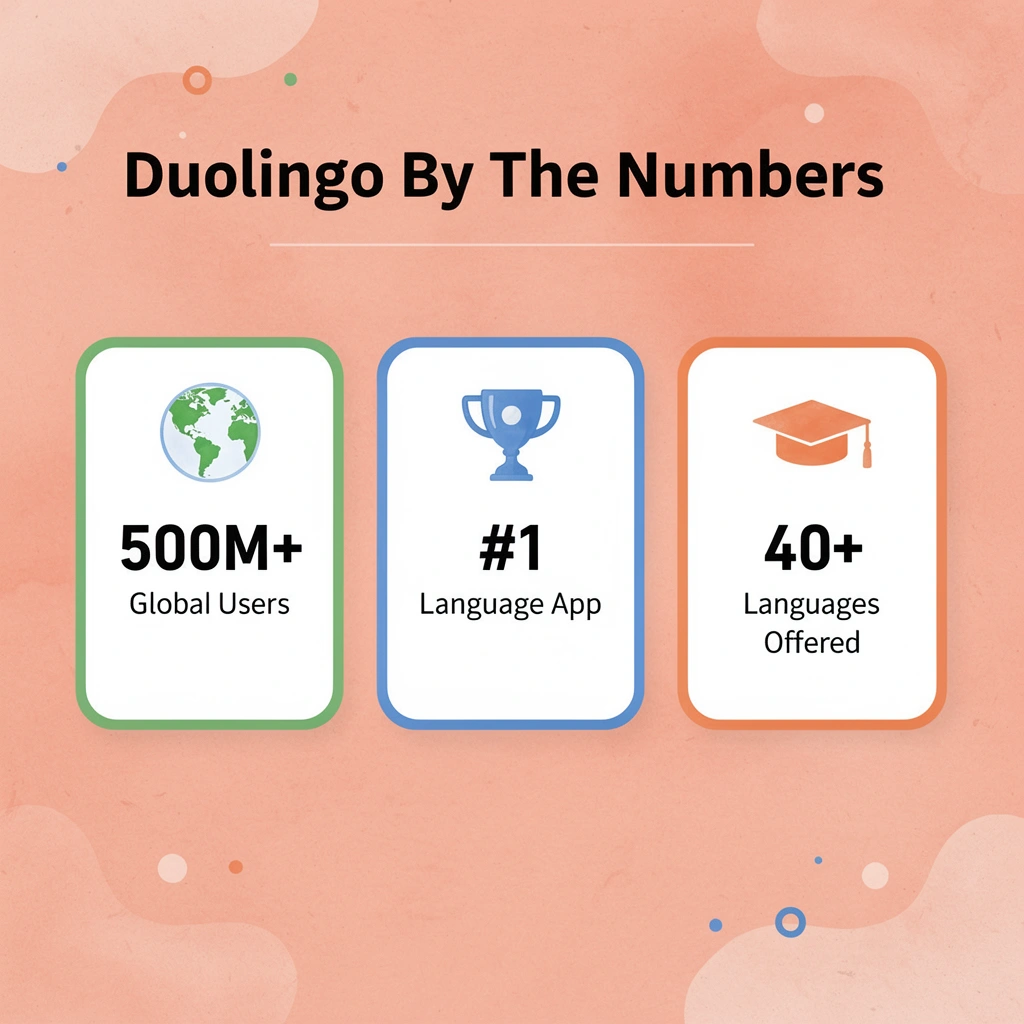
Duolingo earns its place as the most-used language app on the planet for a reason. According to Rosetta Stone vs Duolingo: Best App for Fluency in 2026?, Duolingo has over 500 million users worldwide. Streaks, XP, short lessons, and a game-like progression system turn a habit most people give up into one they actually stick with.
"Duolingo has over 500 million users worldwide, making it the most-used language learning app on the planet." — Makeheadway, 2026
🎯 Key Point: Duolingo's real superpower isn't just vocabulary — it's habit formation through gamification, keeping learners engaged when traditional methods fail.
💡 Tip: If consistency is your biggest challenge, Duolingo's streak system and bite-sized lessons are specifically designed to make daily practice feel effortless rather than overwhelming.
Duolingo and Rosetta Stone appeal to different types of learners, with one emphasizing habit-building and the other structured immersion:
User base – Duolingo: 500M+ users → Rosetta Stone: Smaller, dedicated base.
Lesson style – Duolingo: Short and gamified → Rosetta Stone: Immersive and structured.
Best for – Duolingo: Habit building and beginners → Rosetta Stone: Deep fluency and serious learners.
Price – Duolingo: Free with a premium tier → Rosetta Stone: Paid subscription.
Engagement method – Duolingo: Streaks and XP → Rosetta Stone: Milestone progression.
Speech recognition – Duolingo: ✅ Basic → Rosetta Stone: ✅ Advanced.
Offline access – Duolingo: ✅ Limited → Rosetta Stone: ✅ Full.
🔑 Takeaway: Duolingo wins on accessibility and daily engagement, while Rosetta Stone is the stronger pick for learners chasing real-world fluency and immersion.
Where Duolingo genuinely wins
Duolingo's strength lies in changing your behavior rather than teaching language rules. It solves the biggest problem with learning Spanish—showing up every day—better than any structured course. Its Stories feature adds meaningful listening and reading practice, while Roleplay and Video Call features (available to Max subscribers) simulate conversation scenarios most apps never attempt. For learners seeking an easy entry point, this combination proves useful.
Where Rosetta Stone earns its reputation
Rosetta Stone uses a completely different approach. Its Dynamic Immersion method teaches Spanish through pictures, native-speaker audio, and contextual association. It trains your brain to think in Spanish rather than translate from English. TruAccent, its pronunciation feedback system, provides instant correction based on native speaker patterns—something Duolingo's speaking exercises typically lack. For learners seeking organized, pronunciation-focused study without relying on English as a crutch, Rosetta Stone offers a distinct advantage.
How far does Rosetta Stone actually take you?
The Rosetta Stone Foundations app mostly gets you to a B1 level, which covers everyday topics and basic conversational situations but falls short of the fluency needed for fast-moving, unscripted conversations. Both apps build a foundation; neither was designed to take you past it.
What happens after you finish the course?
Most learners complete units, earn badges, and finish courses, then wait for fluency to arrive naturally. Structured input trains recognition in controlled conditions, but real conversation lacks that control. Apps like Parrot take a different approach, using short-form video built around comprehensible input so learners absorb naturally spoken Spanish through content they want to watch, fitting into existing scroll habits rather than demanding a dedicated 20-minute study block.
The choice between Duolingo and Rosetta Stone depends on which learning environment fits your current stage and what you're willing to build around it. Duolingo rewards consistency; Rosetta Stone rewards patient, structured learning. Both reward learners who understand what they're getting and what they'll need to find elsewhere.
What to Look for Beyond Duolingo or Rosetta Stone
Both apps give you a starting point, but finishing lessons doesn't mean you understand native speakers. Closing that gap requires building a system around your app — not just using it more.
"Completing app lessons is only the beginning — the real fluency gap is closed by building a system that goes beyond the screen." — Language Learning Research Consensus
💡 Tip: Think of Duolingo or Rosetta Stone as your foundation, not your finish line. The learners who achieve real fluency are the ones who layer in immersive, system-driven practice on top of their app.
⚠️ Warning: Relying solely on app lessons creates a false sense of progress. You may hit level milestones while still struggling to follow a native conversation at natural speed.
The biggest difference is whether the app is the entire learning experience or part of a broader system built around real-world use:
Structured but isolated lessons → Immersive practice beyond the app
Gamified streaks and points → Real comprehension of native speakers
Passive word recognition → Active recall in real contexts
Limited speaking exposure → Conversation practice with real people

What structured apps can't give you?
The most common pattern among learners who plateau is this: they complete exercises reliably, accumulate XP or course progress, and freeze when a native speaker talks at normal speed with a regional accent. App-based learning trains you to recognize controlled Spanish, but recognition under pressure differs fundamentally from real-time comprehension of spontaneous speech.
Why does repeated exposure matter more than single encounters?
A 2023 meta-analysis published in Language Teaching, covering 24 studies and 2,771 participants, found that learners acquire vocabulary through meaning-focused reading and listening. However, encountering new vocabulary once rarely produces lasting retention. Repeated exposure across different, meaningful contexts builds vocabulary learners can use in conversation.
The inputs that move the needle
Comprehensible input is the practical core of this. You don't need to understand every word in Spanish content; you need enough context to follow the message and connect unfamiliar words to meaning. Start with content slightly above your current level, where you catch most of it but still encounter new vocabulary in context. As your listening ability grows, increase the challenge gradually by introducing faster speech, different accents, and less predictable conversational topics.
Most learners default to dedicated study blocks because apps require them. Platforms like Parrot use short-form video immersion built around comprehensible input, fitting exposure into existing scroll habits rather than demanding a separate 20-minute session. This removes the friction that causes learners to stall between structured lessons and authentic listening practice.
Measuring what actually matters
Real-world progress differs from progress in an app. ACTFL's 2024 Proficiency Guidelines define proficiency around what learners can do in spontaneous, unrehearsed situations across listening, speaking, reading, and writing. Measure yourself against whether you can follow an unfamiliar speaker, answer unexpected questions without mentally translating, or describe something that happened today in Spanish. These benchmarks reveal far more than streak counts or completed units.
The goal isn't to abandon structured apps, but to stop expecting them to do something they were never designed to do.
Once you understand what each approach builds, choosing which one fits your specific goals becomes more interesting.
Related Reading
Mango Vs Rosetta Stone
Best App To Learn To Speak Spanish
Rosetta Stone Spanish Reviews
Is Duolingo or Rosetta Stone Better for Your Spanish Goals?
Duolingo fits you better if staying consistent is your biggest challenge. Rosetta Stone fits you better if learning through immersive, visual methods is how you pick up new information fastest. Neither choice is permanent, and neither is wrong.
"The best language learning app is ultimately the one you'll actually open tomorrow — consistency beats perfection every time." — Language Learning Research
The best language-learning app depends on what keeps you motivated and how you prefer to learn:
Staying consistent daily → Duolingo — Strong habit-building and daily engagement.
Immersive, visual learning → Rosetta Stone — Focuses on an immersive, visual method.
Gamified motivation → Duolingo — Uses gamification to encourage regular practice.
Structured immersion method → Rosetta Stone — Provides a structured immersion approach.
🎯 Key Point: Your learning style — not hype or price — should drive your decision between these two platforms.
💡 Tip: Not sure which fits you? Try both free trials before committing. Your gut reaction after the first session is often the most reliable signal.

How do you match the right tool to your specific weakness?
The decision becomes clearer when you match the tool to your specific weakness. If you stop practicing Spanish after three days because it feels like homework, Duolingo's streaks and XP system create enough behavioral friction to keep you coming back. Behavioral science research shows that habit formation depends more on trigger-reward loops than on willpower, and Duolingo is engineered around that. Rosetta Stone asks you to spend more time with the language and trust that meaning will surface through context, not translation. That patience works well for some learners and frustrates others.
Does your current level change which platform you should pick?
If you are already at an intermediate level, the choice between these two platforms matters less than most reviews suggest. The real constraint isn't which app you pick; it's whether either one can expose you to Spanish at the speed, variety, and unpredictability of real conversation. Controlled exercises present language in a clean, predictable format that native speakers never use. The failure point for intermediate learners is exposure quality, not platform loyalty.
Why does the gap between recognition and production keep growing?
Most learners at this stage default to completing another unit, earning another badge, finishing another structured lesson. But as your Spanish improves, the gap between what you can recognize inside an app and what you can produce in an unscripted moment widens. Apps like Parrot address that gap by delivering short-form video content built around comprehensible input, the approach Dr. Stephen Krashen's research identifies as the mechanism for real language acquisition. Instead of adding another study session to your calendar, it fits into the scroll habits you already have.
When does pronunciation or budget tip the scales?
If correct pronunciation is your priority, Rosetta Stone's TruAccent technology provides more detailed feedback than Duolingo's speaking exercises. Since pronunciation habits formed early are harder to correct later, this attention to detail matters. Budget is a concern: Duolingo's free tier offers genuine access without a subscription, making it the lower-risk starting point if you're uncertain about long-term commitment.
Which platform actually keeps you showing up?
The better question isn't which platform has the best features, but which one makes it easy enough that you return tomorrow, and the day after, and eventually start wondering what happens when practicing alone isn't enough anymore.
How Parrot Complements Duolingo and Rosetta Stone With Authentic Spanish
Structured apps give you a framework to learn from, but they can't teach you the Spanish you hear in real life: quick regional slang, people talking over each other at markets, and jokes with hidden meanings. That gap isn't because you're not trying hard enough — it's because the method itself has limits.
"Structured apps provide the foundation, but authentic, real-world Spanish — slang, overlapping conversations, and cultural humour — remains beyond what any rigid curriculum can fully capture." — Language Learning Research
💡 Tip: Use structured apps like Duolingo or Rosetta Stone to build your grammatical foundation, then layer in authentic input to bridge the gap between classroom Spanish and real conversation.
🎯 Key Point: The reason most learners plateau isn't lack of effort — it's that no single method can replicate the full richness of living, breathing Spanish. Combining tools is necessary for true fluency.

Where structured practice stops, and real exposure begins
Duolingo streaks and Rosetta Stone units help, but only so far. Controlled exercises teach you to recognize Spanish at your level. Real Spanish doesn't wait: native speakers talk at normal speed, skip textbook words, and your recognition skills haven't yet become listening skills.
Why does comprehensible input work faster than structured apps?
According to the Parrot App's research on comprehensible input, this method speeds up learning 2.7 times faster than image-matching methods. Comprehensible input works because it keeps you immersed in the language rather than requiring translation, as structured apps often do.
How do you find native content at the right difficulty level?
Searching YouTube or streaming platforms for native content sounds appealing until you spend twenty minutes finding something at the right difficulty level and give up. Learn Spanish with Parrot solves this problem through an AI-powered recommendation feed that matches short-form native videos to your skill level and interests. Clickable subtitles help you with unfamiliar words without interrupting the video.
What consistent authentic exposure actually produces
Parrot App's FAQ notes that most learners notice comprehension gains within 4 to 6 weeks of daily practice, with conversational ability developing within 6 to 12 months. This pattern reflects consistent, level-appropriate exposure to real Spanish. Duolingo and Rosetta Stone can support that timeline, but only if the listening practice is authentic, not scripted.
How do structure and authentic exposure work together?
Build a system where structure and real-world practice support each other. Use whichever app builds your grammar foundation and keeps you consistent, then add a steady diet of native Spanish content you can follow. Words saved from a real video, revisited in the context where you first heard them, stick differently than vocabulary drilled in isolation. That's how memory works when it has meaning.
What happens when studied Spanish starts to sound familiar?
The surprising part is how quickly the Spanish you studied sounds familiar when you hear someone use it without ever teaching it to you.
Related Reading
Pimsleur Vs Babbel
Rocket Spanish Vs Rosetta Stone
Babbel Spanish Review
Pimsleur Spanish Review
Best Duolingo Alternative For Spanish
Rosetta Stone Alternatives
Duolingo Alternatives
Rocket Spanish Vs Babbel
Rosetta Stone Vs Pimsleur
Living Language Vs. Rosetta Stone
Rocket Spanish Vs Pimsleur
Alternative To Pimsleur
Best Free App To Learn Spanish
Rocket Spanish Review
Mango Vs Rosetta Stone
Start Learning Spanish Today
You already know the gap exists between studying Spanish and actually speaking it. If your current routine includes Duolingo or Rosetta Stone, keep it. Then add Learn Spanish with Parrot to fill the space those apps were never designed for. A free 7-day trial gives you access to short-form native video matched to your level, clickable subtitles when you need them, and vocabulary saved directly from content you actually want to watch. It's the part that makes the structure matter.
"The fastest path to fluency isn't more grammar drills — it's real exposure to native content at the right level, on demand." — Language Acquisition Research
💡 Tip: Already using Duolingo or Rosetta Stone? Don't quit — add Parrot on top. These tools solve different problems, and combining them is what closes the gap between studying and speaking.
🎯 Key Point: Parrot's free 7-day trial gives you instant access to short-form native video, clickable subtitles, and vocabulary saving — the exact features that transform passive watching into active language acquisition.
Parrot takes a more immersion-focused approach, using authentic content and contextual learning alongside the strengths of traditional language apps:
Structured grammar lessons – Duolingo / Rosetta Stone: ✅ Yes → Parrot: ➖ Not the focus
Native video content – Duolingo / Rosetta Stone: ❌ No → Parrot: ✅ Yes
Clickable subtitles – Duolingo / Rosetta Stone: ❌ No → Parrot: ✅ Yes
Level-matched immersion – Duolingo / Rosetta Stone: ➖ Limited → Parrot: ✅ Yes
Vocabulary from real content – Duolingo / Rosetta Stone: ❌ No → Parrot: ✅ Yes
Free trial – Duolingo / Rosetta Stone: ✅ Yes → Parrot: ✅ 7 days free