Three months is a realistic window to reach conversational Spanish, but only if the approach matches the goal. Most learners lose time on grammar-heavy methods that rarely translate to actual speaking ability. Understanding what 90 days can genuinely deliver, and how to structure each week, makes the difference between functional conversation and frustrating stagnation.
Focused, spoken practice accelerates progress far more than traditional study. Parrot is built around exactly that, prioritizing real conversation over drills so learners build vocabulary, pronunciation, and confidence at the same time. Anyone serious about the best way to learn conversational Spanish should learn Spanish with a tool designed for that specific outcome.
Table of Contents
Can You Really Learn Spanish in 3 Months?
What Research Says About Learning Spanish in Three Months
What Determines How Much Progress You Make in 90 Days
A Practical 90-Day Plan for Learning Spanish
Is Three Months the Right Goal for You?
How Parrot Helps You Make the Most of 90 Days
Start Learning Spanish Today
Summary
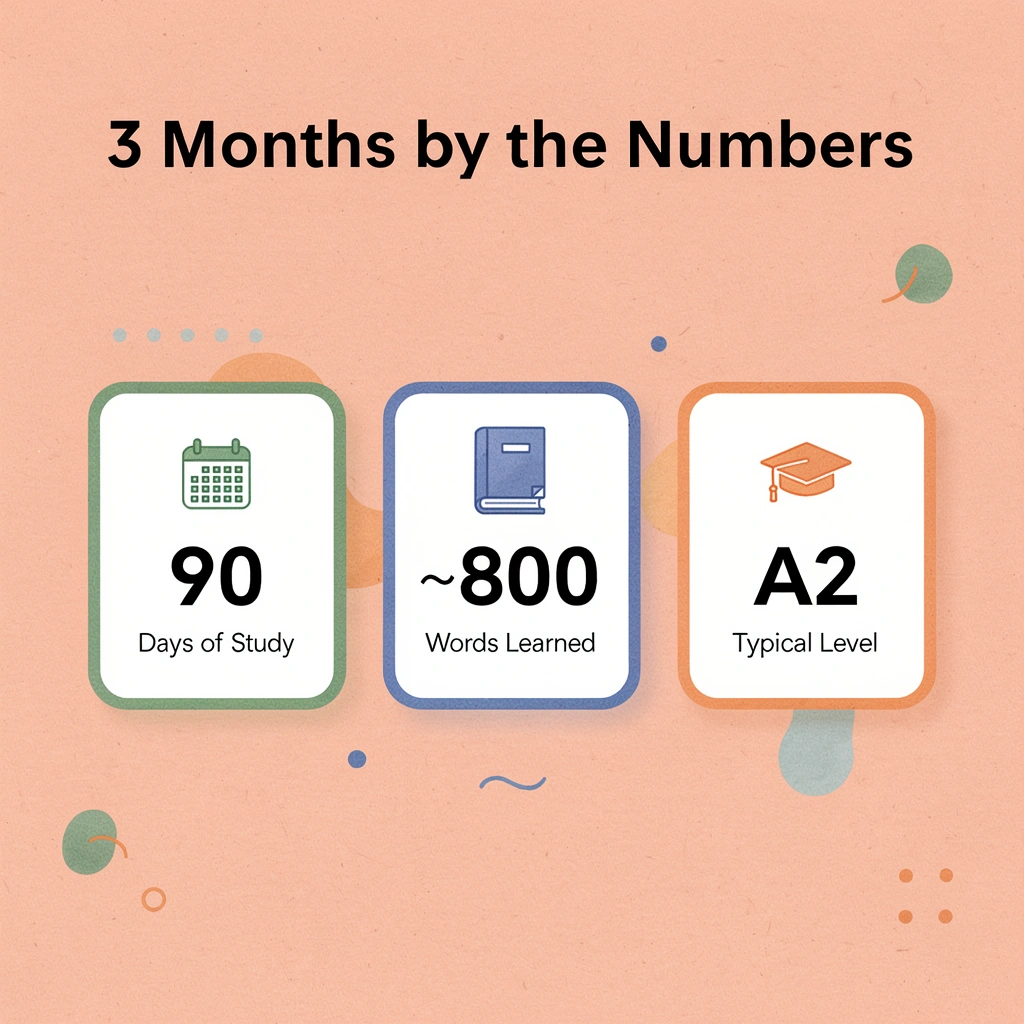
Reaching conversational Spanish at an A2 to B1 level in 90 days is possible, but it requires roughly 20 hours of study per week according to Speakeasy BCN. That is closer to a part-time job than most learners expect, and the gap between that standard and casual daily study (which typically produces only 90 to 120 hours over three months) explains why so many people feel like they underperformed when they were simply under-informed about the math.
Consistency produces better results than intensity at every stage of language acquisition. Distributed practice across short, daily sessions builds stronger long-term retention than the same total hours compressed into occasional marathons. Research on second language acquisition consistently shows that the learner who shows up for 15 minutes every day will outperform the one who studies hard for two weeks and then stops, because memory consolidation happens in the gaps between sessions, not during them.
The method matters more than the time spent. Comprehensible input, Spanish that is mostly understandable while still introducing unfamiliar structures, accelerates vocabulary and grammar acquisition in ways that isolated drills and flashcard decks cannot replicate. When the brain is decoding meaning rather than memorizing rules, it absorbs patterns through repeated exposure to real communication, which is the mechanism behind Dr. Stephen Krashen's comprehensible input theory.
Most learners underestimate the gap between passive recognition and active speech. Reading and listening build a passive vocabulary that does not automatically transfer to spoken output. Speaking from the beginning, even imperfectly, trains the retrieval system alongside the storage system, and shadowing native speakers builds both ear and mouth at the same time. Delaying speaking until you "feel ready" is one of the most common reasons learners plateau around weeks five and six.
Goals framed around a 90-day window are associated with higher completion rates than annual goals, according to Mooncamp's goal-setting research. The three-month horizon is close enough to feel urgent and concrete enough to plan around, but it only works when the target is accurately defined. Aiming for conversational confidence rather than native-level fluency sets a realistic benchmark and prevents the early dropout that comes from measuring progress against the wrong standard.
Authentic listening practice closes a gap that structured lesson audio never can. Textbook recordings are slow and carefully enunciated, while real Spanish compresses syllables, blends words, and shifts rhythm in ways that only daily exposure to natural speech can prepare you for. Even 15 minutes of real Spanish content daily builds familiarity with connected speech in ways that compound quietly over weeks. Parrot's Learn Spanish addresses this by delivering short-form authentic video with comprehensible input and spaced repetition, so daily immersion feels like watching content rather than grinding exercises.
Can You Really Learn Spanish in 3 Months?
Three months is enough time to make real, measurable progress in Spanish. Whether that progress counts as "learning Spanish" depends entirely on what you mean by those words.
"Three months of focused effort can take a learner from zero to a genuinely functional level in Spanish: the definition of 'learning' is everything."
🎯 Key Point: The question isn't whether you can learn Spanish in 3 months—it's what level of Spanish you're aiming for.
Being able to have a conversation — talking back and forth with native speakers without a script — takes longer than 90 days for most people. According to Speakeasy BCN, Spanish can reach conversational level (A2–B1) in about 3 months with 20 hours per week of intensive study. That's a meaningful goal, but most learners aren't starting from that position.
Casual
Hours Per Week
3–5 hours
Realistic Outcome in 3 Months
Basic phrases and survival vocabulary
Moderate
Hours Per Week
10–12 hours
Realistic Outcome in 3 Months
A1–A2 proficiency with simple conversations
Intensive
Hours Per Week
20+ hours
Realistic Outcome in 3 Months
A2–B1 proficiency with conversational ability
⚠️ Warning: 20 hours per week is not a casual commitment — that's nearly 3 hours every single day. Most learners significantly overestimate how much time they'll actually put in.
What three months can give you is something genuinely useful: a working vocabulary, enough listening comprehension to follow slow, clear speech, and the ability to handle practical situations like ordering food, asking for directions, or introducing yourself. For a traveler or someone preparing for a new role, that level of ability transforms the experience completely.
🔑 Takeaway: Three months won't make you fluent, but it will make you functional. For many real-world goals, functional is enough.
Why does the word "fluency" create so much confusion?
The confusion starts with the word "fluency," which describes everything from basic survival phrases to near-native proficiency. When someone claims they "learned Spanish in 90 days," they rarely specify which version they mean. The claim isn't always wrong—just incomplete.
Most learners underestimate the gap between recognizing language and producing it. You can read menus, follow slow podcasts, or recognize repeated words and still freeze when someone speaks at natural speed. Recognition and production are different skills, and three months of passive study builds the first without reliably building the second.
Does your method matter more than how much time you spend?
The method matters more than the timeline. A learner spending 10 minutes daily with comprehensible input—content slightly above their current level but understandable in context—will outpace someone grinding grammar exercises for an hour. This is Dr. Stephen Krashen's core insight: language is acquired through understanding messages, not memorizing rules. The brain learns to speak by processing meaning repeatedly in context, not by studying conjugation tables.
Most Spanish apps treat language as a subject to study rather than a skill to absorb, rewarding streaks and gamifying drills that feel productive but rarely translate into real conversation. Parrot's Learn Spanish works differently, using short-form video and spaced repetition to deliver daily immersive listening and speaking practice: the kind of input that builds conversational ability rather than quiz scores.
What should you realistically expect after three months of consistent practice?
Consistency beats intensity. Ten to fifteen minutes of daily immersion compounds faster than a 30-minute weekly session. The learner who shows up every day for three months will outperform one who studies hard for two weeks and then stops.
The honest timeline for conversational fluency sits closer to 6 to 12 months for most learners using a sound method. After three months, you should hold simple conversations, understand common phrases at moderate speed, and feel comfortable in everyday situations—a meaningful milestone.
A common pattern among learners who quit early is setting the wrong goal. They aimed for fluency in 90 days, hit month two still stumbling through basic sentences, and concluded they weren't "language people." The problem was never their ability, but the mismatch between goal, method, and timeline.
What Research Says About Learning Spanish in Three Months
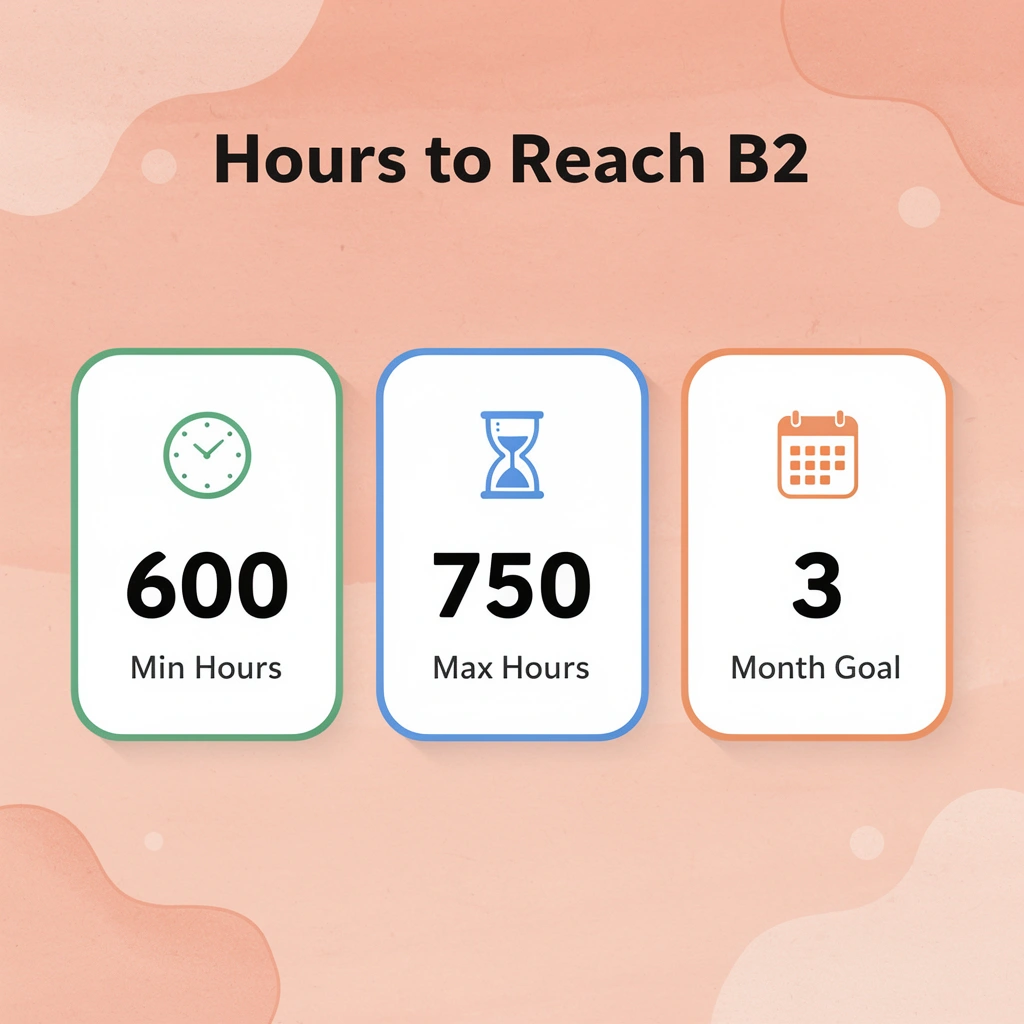
How you practice Spanish matters more than how much time you spend on it. According to Speakeasy BCN, reaching B2 level requires 600 to 750 hours of study under the Common European Framework of Reference. Three months of casual daily study typically gives you only 90 to 120 hours of actual exposure — a gap that's a math problem you can fix, not a sign that you can't learn Spanish.
"Reaching B2 level requires 600 to 750 hours of study under the Common European Framework of Reference." — Speakeasy BCN
Casual Daily Study
Hours in 3 Months
90–120 hours
Gap to B2
Approximately 480–660 hours remaining
Intensive Daily Study
Hours in 3 Months
300–400 hours
Gap to B2
Approximately 200–450 hours remaining
Full Immersion Program
Hours in 3 Months
500–600 hours
Gap to B2
Approximately 0–250 hours remaining
🔑 Takeaway: The 600–750 hour benchmark isn't meant to discourage you — it reveals exactly where the leverage is. Close the hours gap with higher-quality, intentional practice, and you dramatically change what's possible in three months.
💡 Tip: Instead of asking "how long should I study?" ask "how can I make every hour count more?" — active recall, real conversation practice, and spaced repetition can multiply the value of every hour you put in.
⚠️ Warning: Most learners underestimate the hours required and overestimate the impact of passive exposure like background TV or music. Intentional, active study is what moves the needle.
Does study quality matter more than study hours?
The failure point is usually a mismatch between study hours and study quality. Research on second language acquisition shows that comprehensible input—Spanish you can mostly understand while encountering unfamiliar words—drives faster vocabulary growth than grammar drills or isolated memorization. A learner spending 30 minutes daily with authentic Spanish content they can follow builds fundamentally different skills than someone using flashcard decks for the same duration. One approach trains your brain to process Spanish as communication; the other trains it to recognize patterns in isolation.
Why does consistency beat intensity for language retention?
The same research shows that regular practice beats intense cramming. Practicing in short, frequent sessions helps you retain information better than studying the same total hours in a few long sessions. Most learners break this pattern: they study hard for a week, miss four days, then quit. That cycle works against how language learning actually sticks in your brain. Apps like Parrot are built around this idea, using comprehensible language in short daily sessions with spaced repetition to help you stay consistent.
How much progress is actually achievable?
Progress depends on hours invested. Speakeasy BCN reports that 20 hours per week of intensive Spanish study can allow learners to complete one to two CEFR levels in three months, yielding gains in listening comprehension, vocabulary range, and conversational ability. Half that commitment, applied consistently with quality input, produces noticeably different results at the 90-day mark compared to the same hours spent on memorization and repetition.
What does real progress look like at the 90-day mark?
Three months is enough time to build a foundation where familiar conversations no longer require mental translation, where you catch meaning before thinking about every word. This is not fluency, but the moment when Spanish starts to feel less like a subject and more like a skill within reach with the right method applied consistently.
The deeper question is not whether three months is enough time, but what determines how much of that time becomes real progress.
Related Reading
Best App To Learn Spanish While Driving
How To Learn Spanish In A Week
Games To Learn Spanish
Best Tools To Learn Spanish
Reasons To Learn Spanish
What Determines How Much Progress You Make in 90 Days
Two people can study Spanish for the same 90 days and end up in completely different places. One can hold simple conversations with confidence. The other gets nervous when a native speaker talks faster. The gap between them is never about talent or dedication: it's about how they spent their time.
"The gap between learners after 90 days is never about talent or dedication: it's about how they spent their time."
🎯 Key Point: Equal time investment does not guarantee equal results. The quality and structure of your study sessions matter far more than the hours logged.
🔑 Takeaway: If you want to hold real conversations after 90 days, the most critical variable isn't how long you study: it's what you do during every single session.

Daily consistency is the real multiplier
The failure point is usually invisible: learners assume that more hours in a single session compensate for days of absence. A 20-minute daily session works better than a three-hour Saturday study block because your brain solidifies language during the gaps between exposures. Repetition across days builds the neural pathways that make recall feel automatic rather than effortful.
Serious learners often discover this the hard way. After weeks of inconsistent study, vocabulary they "learned" disappears, requiring relearning. Consistency is not a discipline hack; it is how memory works.
What kind of input you consume matters more than how much
The quality of what you learn matters more than how often you learn it. Comprehensible input—Spanish that you can mostly understand while learning new structures—helps you learn faster than grammar drills and isolated vocabulary lists. When your brain figures out meaning rather than memorizing rules, it picks up patterns naturally, the way children learn language by hearing real messages repeatedly.
Why do most learners hit a wall with apps and drills?
Most learners default to popular apps or first-search courses, grinding through levels and collecting streaks like a game. Around week four or five, gamified drills stop feeling like progress and start feeling like a treadmill. Apps built on comprehensible input methodology, like Parrot, use short-form video and spaced repetition to sustain daily immersion tied to real conversational patterns rather than synthetic exercises.
The gap between passive knowledge and active speech
Learners who delay speaking often find themselves understanding more than they can say. Passive vocabulary built through reading or listening does not automatically transfer to spoken output. Retrieving words under the pressure of real conversation is a different cognitive task.
Speaking from the beginning trains the retrieval system alongside storage. Shadowing native speakers, narrating moments out loud, or working with a conversation partner even once a week gives your brain practice pulling words out, not putting them in. That distinction matters more over 90 days than most learners expect.
Listening to authentic Spanish daily closes the real-world gap
Lesson audio is clean, slow, and carefully spoken. Real Spanish is none of those things. Native speakers compress syllables, blend words together, and shift rhythm in ways that no textbook prepares you for. Learners who limit themselves to lesson audio often hit a wall when encountering an actual conversation, a podcast, or a television show.
Why does even 15 minutes of authentic audio compound over time?
According to Asian Efficiency, successful people use 90-day planning periods to measure progress. Fifteen minutes of Spanish daily—whether a short video, conversation clip, or podcast segment at your level—builds familiarity with natural rhythm and connected speech that compounds over weeks.
Vocabulary learned in context sticks; vocabulary memorized in lists fades
Learners who rely on word lists can recognize vocabulary in isolation but cannot recall it when needed in sentences. Context is how your brain remembers words. When you encounter a word in a story, video, or conversation, your brain stores not just the meaning but also the situation, feeling, and surrounding words.
That contextual memory lets you retrieve a word quickly during conversation instead of searching for it while others continue talking.
Motivation is not a personality trait; it is a design problem
Students who enjoy what they are learning stay consistent. Students who treat every session like a chore find reasons to skip it. This is not about willpower; it is about whether the content makes Spanish feel alive rather than assigned.
Why does engaging content keep the daily habit alive?
Watching a cooking channel, following a travel creator, or listening to a sports podcast in Spanish does what a textbook cannot: it makes the language feel worth understanding. That emotional pull sustains the daily habit past the first two weeks, when novelty fades, and discipline alone rarely holds.
What separates learners who make the most of three months?
Matt Gray on LinkedIn documented achieving three years of progress in 90 days using a focused planning framework. Learners who gain the most from three months aren't those who study hardest in single sessions, but those who build a structure they can sustain: engaging content, short daily sessions, and habits that reinforce each other.
Knowing what drives progress is one thing. Arranging those habits into a workable plan is where most learners get stuck.
Related Reading
Best App To Learn To Speak Spanish
How To Learn Medical Spanish
Best App To Learn Mexican Spanish
Rosetta Stone Spanish Reviews
How To Learn Spanish On Your Own
Fastest Way To Learn Spanish
Mango Vs Rosetta Stone
Best Way To Learn Spanish As An Adult
A Practical 90-Day Plan for Learning Spanish
Structure matters more than hustle. Sequence your habits so they build on each other rather than work against each other.
"Structure matters more than hustle — the order in which you build habits determines whether they compound or collapse." — Language Learning Principle
🎯 Key Point: A well-sequenced learning plan is the single most important factor in reaching Spanish fluency — more than raw effort or time spent.
💡 Tip: Map out your 90-day habit stack in advance, ensuring each new skill reinforces the last rather than competing with it.
Vocabulary Building
When to Introduce
Days 1–30
Why It Matters
Creates the foundation for all future language learning
Grammar Structure
When to Introduce
Days 31–60
Why It Matters
Provides structure and context for the vocabulary you've already learned
Speaking Practice
When to Introduce
Days 61–90
Why It Matters
Converts passive knowledge into active, conversational fluency
⚠️ Warning: Jumping into speaking practice too early — before building a core vocabulary base — is one of the most common mistakes new learners make, leading to frustration and burnout.
Weeks 1 to 4 Build What You Can Actually Use
Start with high-frequency vocabulary: greetings, common verbs, numbers, food, directions, and daily routines. These words appear repeatedly in real content, so each hour spent learning them pays dividends for months.
How much grammar do you actually need in the first month?
Pair vocabulary work with enough grammar to make simple sentences: present-tense verbs, basic sentence structure, question formation. The goal isn't to master everything but to recognize patterns. You want to understand how a sentence is built even when you don't know some of the words.
Why should you train your ear from day one?
Train your ear to recognize Spanish at natural speed from day one. Connected speech transforms from an impenetrable wall into a recognizable pattern.
According to the Berlitz Blog, spending at least 30 minutes daily practicing Spanish can yield noticeable progress within 90 days. What matters most is how you spend those 30 minutes: passive review rarely builds the brain pathways that active, meaning-focused engagement does.
Weeks 5 to 8: Let the Language Come to You
Most 90-day plans fail around week five. Learners finish their beginner course, know a few hundred words, then encounter real Spanish and understand almost nothing. That gap feels like failure. It isn't. It's the exact moment where real learning begins.
Why does comprehensible input become your primary tool at this stage?
This is when comprehensible input becomes your primary tool. Beginner-friendly video content, slow Spanish podcasts, and graded readers pitched above your current level won't be fully understood—and that's the point. The brain acquires language by decoding meaning, not by achieving perfect comprehension. Repeated exposure to near-comprehensible material is where vocabulary and grammar stick without deliberate memorization.
A common plateau pattern occurs when learners focus heavily on reading or structured study without balancing listening. This creates a separate gap requiring later effort to close, particularly with unfamiliar accents or connected speech. Building both skills in parallel during this phase prevents the problem from worsening.
When should you start speaking and how does it accelerate progress?
This is where speaking starts—not when you feel ready, but now. Short self-talk sessions, basic language exchanges, and simple descriptions of your day transform passive recognition into active retrieval, a different cognitive skill entirely. Shadowing, where you repeat phrases immediately after hearing them, bridges the two by training your ear and mouth simultaneously.
Most learners default to structured study apps during this phase because they feel productive. But those apps rarely expose you to the rhythm, speed, or natural variation of real Spanish. Parrot uses short-form video built on comprehensible input, so daily immersion feels like watching content rather than grinding exercises, with listening practice building alongside spaced-repetition review.
Weeks 9 to 12 Communicate, Don't Perform
The final month shifts from learning Spanish to using it, a difference that fundamentally changes how progress happens.
Why do imperfect sentences build real conversational ability?
Long conversations about familiar topics (work, travel, hobbies, family) are the best way to practice. Imperfect sentences aren't mistakes to fix before speaking; they're how you become fluent. Every time you search for a word while talking or rephrase because you can't find the right word, you're building the quick thinking skills that separate real conversation ability from textbook knowledge.
What level can you realistically reach in 90 days?
Preply's research shows that learners can reach A2 to B1 conversational level in 90 days with structured daily study. This range represents functional ability: ordering food, finding directions, having basic conversations, and understanding podcast content. It's not complete fluency, but it's the foundation for everything else.
How does absorbing grammar in context signal a shift to intermediate?
Grammar becomes something you notice rather than study from rules. Instead of memorizing verb tables, you observe how native speakers use tenses in interviews or YouTube videos. This shift from studying grammar to acquiring it through context signals a learner's progression from beginner to intermediate.
What a Balanced Weekly Routine Actually Looks Like
Do four to five structured vocabulary and grammar review sessions of 20 to 30 minutes each. Listen to video or podcast content at your level daily. Have two to three speaking sessions per week through shadowing, self-talk, or conversation exchange. Do one longer immersion session weekly where you consume Spanish purely for enjoyment, without stopping to look things up.
Why does the weekly immersion session matter so much?
The weekly immersion session trains your brain to handle unclear situations and stay focused despite incomplete understanding. This ability makes real conversations feel manageable instead of overwhelming.
What separates learners who finish 90 days with the strongest results?
The students who finish 90 days with the strongest results aren't those who studied most in any single week, but those who made the routine small enough to repeat daily and interesting enough that they wanted to.
The harder question is whether this goal fits where you are now.
Is Three Months the Right Goal for You?
Three months is the right goal for most learners, but only if you're honest about what you're measuring. If the target is being able to talk with confidence — having a real conversation, understanding what people say back to you, and continuing without getting stuck — 90 days is absolutely achievable. If the target is professional fluency or native-level precision, three months is a starting point, not a finish line.
"If the target is talking with confidence — real conversations, real comprehension, no getting stuck — 90 days is achievable. But for professional fluency, three months is a starting point, not a finish line."
Confident Conversation
Is 3 Months Realistic?
✅ Yes
What It Actually Gets You
Real conversations, basic comprehension, and strong learning momentum
Professional Fluency
Is 3 Months Realistic?
⚠️ Partially
What It Actually Gets You
A solid foundation, but not full professional proficiency
Native-Level Precision
Is 3 Months Realistic?
❌ Not yet
What It Actually Gets You
A meaningful starting point for continued long-term study
💡 Tip: Before you start your 90-day journey, define your target clearly — conversational confidence and native-level fluency require very different timelines and strategies.
🎯 Key Point: Three months is not a universal answer — it's the right answer only when your goal is real-world conversation, not professional or native-level mastery.

Why does progress feel so uneven in the first 90 days?
Most learners set themselves up for disappointment by measuring the wrong thing. Progress in language learning rarely feels like a straight line: you'll spend two weeks feeling stuck, then suddenly understand a full sentence you would have missed before. That shift is real progress, but it doesn't show up on a streak counter.
According to Mooncamp's Goal Setting Statistics, goals set within a three-month timeframe have higher completion rates than annual goals. A 90-day window feels urgent and concrete enough to plan around.
Do most language apps actually help you reach this goal?
Most learners use apps that reward daily logins and punish missed streaks, treating language like a checklist. These systems keep you coming back rather than helping you learn. Apps built on comprehensible input, like Parrot, work differently: they use short-form video content immersing you in real Spanish, employing spaced repetition and speaking practice to build fluency that transfers outside the app.
How should your starting point shape your 90-day goal?
Your goal must account for where you're starting. A learner who has studied any Romance language will progress faster in the first 90 days than someone starting from zero. Set a goal reflecting your actual path forward, not someone else's best moments from a YouTube video titled "Fluent in 30 Days."
How Parrot Helps You Make the Most of 90 Days
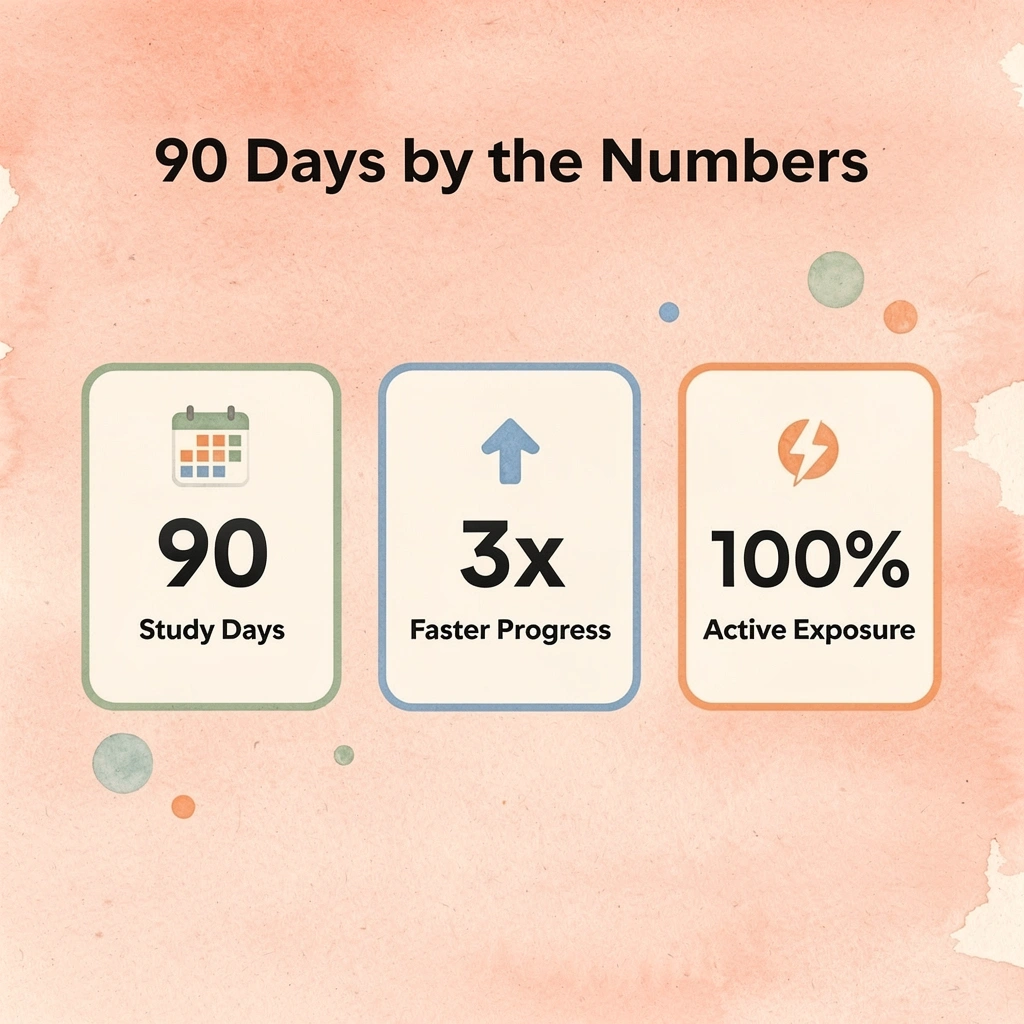
With only three months to make progress, every study session matters. The goal is to spend those 90 days working with Spanish in ways that build real communication skills. Parrot helps learners do exactly that by turning limited study time into meaningful language exposure.
"With only 90 days to build real skills, how you spend each session is more important than how many sessions you log." — Parrot Learning Methodology
🎯 Key Point: 90 days is enough time to build real communication skills, but only if every session delivers meaningful language exposure, not passive review.
💡 Tip: Let Parrot do the heavy lifting by transforming your limited study time into structured, high-impact practice that compounds across all three months.
Session Quality
Without Parrot
Passive review
With Parrot
Active language exposure
Time Efficiency
Without Parrot
Scattered focus
With Parrot
Targeted skill-building
90-Day Outcome
Without Parrot
Minimal progress
With Parrot
Real communication skills
How does Parrot build listening comprehension without overwhelming you?
One of the biggest challenges learners face is spending weeks or months studying vocabulary and grammar without hearing enough real Spanish. Parrot addresses this through research-backed comprehensible input: engaging short-form videos matched to your current level so you can build listening comprehension gradually rather than feel overwhelmed by native speech.
Another common obstacle is constantly pausing videos to look up unfamiliar words, which breaks concentration and disrupts comprehension. Parrot's clickable subtitles and instant translations let you understand new words immediately without leaving the video, keeping you immersed while expanding vocabulary through context.
How does Parrot help vocabulary stick so you can use it in conversation?
Many learners find that memorized vocabulary is hard to recall during conversations. Parrot helps by letting you save words and expressions directly from videos and revisit them in real conversations. Seeing vocabulary repeatedly in authentic contexts makes it easier to remember and use those words naturally when speaking.
Finding the right Spanish content for your level can consume study time. Parrot's AI-powered recommendation feed personalizes videos based on your skill level and interests, eliminating guesswork. As your listening skills improve, the platform introduces harder content, helping you progress without searching for suitable material.
What makes consistent daily practice the real key to progress in 90 days?
Learning Spanish in three months isn't about finding shortcuts or chasing instant fluency. It's about making every day count through consistent engagement with real, understandable Spanish. By combining comprehensible input, personalized content, contextual vocabulary learning, and tools that support uninterrupted comprehension, Parrot helps you transform limited study time into meaningful progress toward real conversations.
Start Learning Spanish Today
The right goal, timeline, and method matter only if you start. Spending 90 days with Learn Spanish gives you personalized authentic Spanish videos, clickable subtitles, instant translations, and vocabulary tools built around comprehensible input, so your listening skills grow daily without hunting for content.
"The best language learning method is the one you'll use consistently, every day, starting now."
💡 Tip: Comprehensible input is the most research-backed approach to language acquisition. Parrot builds this directly into every session so you're learning without even realizing it.

Most learners waste weeks searching for resources instead of using them. Parrot removes that bottleneck entirely. Ten minutes daily shows more measurable progress in 90 days than guilt-driven study marathons ever will. Start your free trial and build real conversational Spanish, one short session at a time.
⚠️ Warning: Don't fall into the resource-hunting trap — endless searching for the "perfect" app or course is one of the biggest reasons learners never progress.
✅ Best Practice: Commit to just 10 minutes per day with a single, structured tool like Parrot rather than juggling multiple platforms with zero consistency.
Daily 10-Minute Parrot Sessions
Time Investment
10 minutes per day
Typical Outcome
Steady, measurable progress
Guilt-Driven Study Marathons
Time Investment
Sporadic, hours-long sessions
Typical Outcome
Burnout and inconsistent progress
Resource Hunting
Time Investment
Weeks spent searching for materials
Typical Outcome
Little to no meaningful learning
Related Reading
Rosetta Stone Vs Pimsleur
Pimsleur Vs Babbel
Duolingo Alternatives
Alternative To Pimsleur
Rosetta Stone Alternatives
Living Language Vs Rosetta Stone
Best Free App To Learn Spanish
Rocket Spanish Vs Rosetta Stone
Duolingo Vs Rosetta Stone
Rocket Spanish Vs Babbel
Best Duolingo Alternative For Spanish
Rocket Spanish Review
Babbel Spanish Review
Pimsleur Spanish Review