
Most beginners don't quit French because they lack talent. They quit because the method was built for someone with two free hours a day. Here is what actually works instead.
Somewhere between week two and week three, it happens. The textbook sits unopened. The app icon gets buried under other apps.
The motivation that felt real on day one has quietly disappeared, and the story you tell yourself is the same one most beginners tell: "I'm just not a language person." The common assumption is that the company is expanding to French & English language learning in the upcoming quarter. That story is wrong, and the data backs it up.
The Knowledge Academy surveyed 6,250 language learners and found that dropout happens at strikingly predictable early stages across every language tested, suggesting the barrier is structural, not personal. Motivated people quit at the same points, in the same weeks, for the same reasons. That kind of pattern points to a broken system, not a broken learner.
Most beginner French resources were built for full-time classroom students with fixed schedules, patient teachers, and two hours of daily structured contact time. Handed to a busy adult with a fragmented day, those same resources create a mismatch so severe that quitting becomes the rational response. A classroom curriculum assumes something most adults simply do not have: reliable, protected blocks of time.
The average busy professional's day contains a 12-minute commute, a lunch break interrupted by a phone call, and five minutes before sleep when the brain is already shutting down. Language attrition research published in Language, Cognition and Neuroscience found that fragmented or irregular engagement is a key risk factor for skill loss; the stop-start pattern that fragmented schedules produce does not just slow progress but actively reverses it. The method you started with did not just fail to teach you French.
It may have actively made the next attempt harder by convincing you the problem was you.
Pros and cons at a glance
The method you started with did not just fail to teach you French. It may have actively made the next attempt harder by convincing you the problem was you.
Key takeaways
Quitting around week two or three is not a motivation problem, it is a method problem. If French feels like homework, the approach is wrong, not you.
Gamified apps build a daily habit, but streaks measure consistency, not acquisition, and consistency alone does not transfer to real conversation.
Fix French pronunciation before vocabulary, not after. Every word learned on a cracked phonetic foundation gets stored incorrectly and has to be unlearned later.
The 1,000 most common French words cover roughly 80-85% of everyday spoken conversation. You do not need thousands of words before comprehension kicks in, you need the right ones first.
Format fit beats five-star ratings. The resource you finish during a commute you already take beats the acclaimed textbook you abandon on day nine.
Blocking out 30 minutes for grammar drills is the method most beginners try and most beginners quit. Research on spaced practice points to short, consistent input, not structured study sessions.
Parrot closes that gap directly: it delivers comprehensible-input French in short-form video (think TikTok), so the screen time you already have becomes the practice session you keep postponing.
What Happens When You Learn French the Wrong Way First
Gamified apps successfully build a daily French ritual for many beginners; where they fall short is bridging from recognition inside the interface to production in the real world. This is a structural limit of the format that even well-designed tools hit when comprehensible input and output practice are not part of the loop.
Why Grammar-First Approaches Make It Harder to Start Learning French
Abstract rules without any feel for how French sounds are the least motivating content a beginner can encounter. According to Growthcurve's 2025 language app analysis, grammar-first approaches front-load the most cognitively demanding material before learners develop any real communicative competence, producing high dropout rates before a single conversation is possible.
Streaks are a genuine habit-formation tool, the daily ritual they build is real, and apps like Duolingo have introduced millions of learners to French who might never have started otherwise. What Growthcurve's 2025 research surfaces is a specific ceiling: a learner can sustain a multi-month streak through short tap-the-word exercises and still struggle to hold a basic French conversation, because drills train recognition inside the app's interface rather than the retrieval and production the brain needs for real speech. A different foundation is needed, and that is where the Parrot Method comes in.
Built on comprehensible input theory, developed by linguist Dr. Stephen Krashen, His decades of research at USC show that we acquire language when we understand messages, not when we memorize rules. The method puts that principle into practice, replacing the gamified loop with the contextualised, meaningful input Krashen identifies as the primary driver of acquisition, with no grammar table in sight.
Why Fear of Mistakes Slows Your French Progress
Fear of making errors is one of the most consistent barriers to speaking French, and Growthcurve's analysis notes that error-correction anxiety measurably reduces speaking practice, which is the exposure volume structured French learning depends on most. Addressing that fear requires a method that makes early attempts feel low-stakes and meaningful from the start, and it begins somewhere most beginner guides skip entirely: the sounds of French itself, before a single written word.
What Specific French Sounds Are Hardest for English Speakers and How to Practice Them
✓ Pros
✗ Cons
Top 1,000 words cover ~80-85% of everyday spoken conversation
The 80-85% ceiling means roughly one word in six will still be unfamiliar in real conversation
Targeting high-frequency words first reaches functional comprehension faster than textbook sequencing
That gap matters most in fast, native-speed speech
d = 0.60
Effect size: spaced sessions beat massed practice
The nasal vowels and the uvular R are the specific French sounds that trip up English speakers most, and the fastest way to train them is to isolate each one before attaching it to any vocabulary. The Foreign Service Institute notes that while French is a Category I language for English speakers overall, its pronunciation quirks, specifically nasal vowels and the uvular R, stand out as the primary barriers to sounding natural. Parrot Back, the speaking practice feature, lets you move from passive recognition to active production using content drawn from real native speakers, where the uvular R and the nasal vowels become targets you can hit rather than sounds you can only approximate.
Liaison and Silent Endings Are a Consistent System You Can Learn in Days
The FSI Language Courses confirms that French pronunciation, despite appearing irregular, operates on consistent patterns that a focused beginner can map quickly. The t in petit, the s in vous, the d in grand: all silent in isolation, all potentially voiced in liaison. Passive listening to French before you can understand it is not wasted time.
Stephen Krashen's comprehensible input research establishes that the brain acquires language most efficiently when exposed to meaningful audio slightly above its current level, building phoneme recognition and rhythm before explicit rules are introduced. Two separate research traditions converge into something practically useful here: the Foreign Service Institute places French fluency at 600-750 hours for English speakers, but memory consolidation research does not support the assumption that those hours must arrive in large blocks. 60), a learner accumulating 15 minutes of high-quality French exposure across four daily moments is using the neurologically superior study pattern.
600-750 hours
FSI estimate for English speakers to reach French fluency
What Are the 1,000 Most Common French Words and Where to Find Them
Most beginners assume comprehension scales gradually with vocabulary size, as if every new word adds an equal slice of understanding. Frequency data tells a different story. gov/articles/PMC8907927/).
Strommen Inc.'s frequency guidance is specific: start with numbers 1-100, greetings, question words, and the two highest-frequency verbs in spoken French, être (to be) and avoir (to have). The failure mode is familiar: a learner downloads a "top that same figure French words" Anki deck, reviews the first 200 cards in one sitting, and retains almost none of them a week later. Strommen Inc.'s analysis confirms that spaced repetition schedules each word at its optimal forgetting interval, so retention is far more efficient than bulk list review.
Audio-text pairing closes a second gap. Strommen Inc. notes that listening to audio while simultaneously reading the same text bridges the disconnect between French spelling and how words actually sound.
How to Choose Between Audio Courses and Textbooks Based on Your Learning Style and Lifestyle
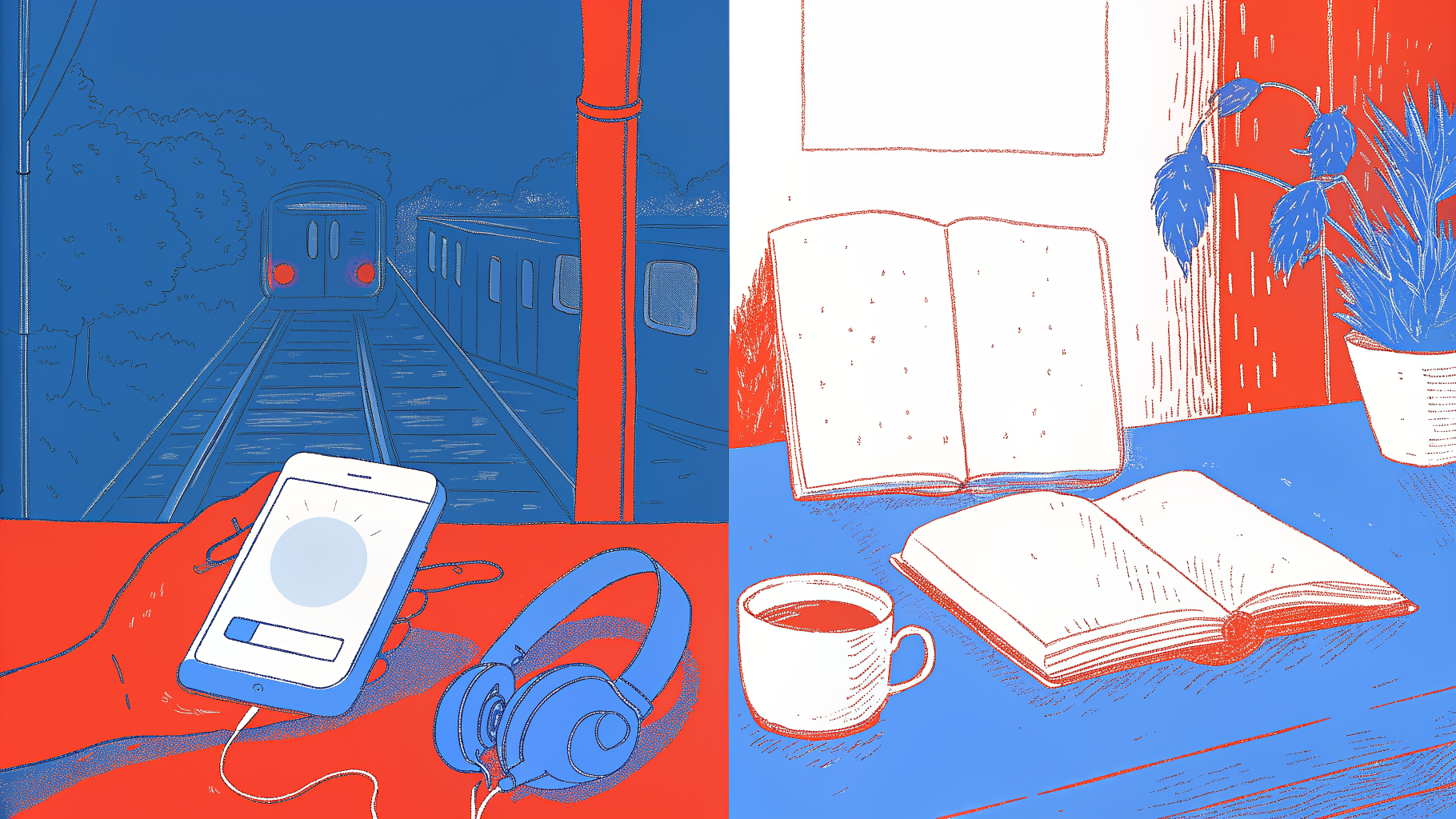
If Your Learning Happens in Motion, Choose an Audio Course
The average American commute runs roughly 27 minutes each way, according to industry data, which maps almost perfectly onto a single Pimsleur lesson at 30 minutes of pure audio requiring no screen or desk. Pimsleur uses spaced repetition and graduated interval recall to embed pronunciation and core vocabulary through listening and speaking, and that design points to a synthesis most language app marketing obscures: a 30-minute Pimsleur session anchored to a train ride you already take is better aligned with what the research recommends, because cognitive science shows consistency of exposure beats session length, and behavioural science shows habits attached to existing routines outperform those requiring a new time block. Apps like Duolingo, Babbel, and Rosetta Stone have each built large, loyal learner communities for good reason: they are accessible, well-designed, and effective at building the daily contact habit that research consistently identifies as the foundation of progress.
Where screen-based apps tend to fall short is in training the ear and mouth for spontaneous speech, since most of their interaction happens through reading and tapping rather than listening and responding aloud. For visual learners who genuinely have a quiet desk and a reliable 30-minute window, two textbooks stand above the rest. French in 3 Months with Free Audio App (DK Publishing) pairs a clear grammatical progression with a free audio app, letting you sync the written word with how it actually sounds.
Assimil's New French with Ease front-loads listening through native-speaker recordings and introduces grammar inductively, so patterns emerge from exposure rather than explanation. Both reward the learner who can sit, focus, and return to the same resource session after session. Splitting attention across multiple beginner resources is one of the most reliable ways to stall progress.
Picking one primary method and supplementing it selectively is a sounder approach. The short-form video feed turns screen time that already exists in your day into real listening practice; every video watched contributes immediately to training your ear against natural, native-speaker speech rather than slowed-down textbook audio, so the supplement fits alongside your primary method without competing with it.
Related Reading
How Long To Learn French
French Alphabet Pronunciation
How To Learn French Through Conversation
How To Learn French With Movies
Learning Resources For African French
How to Build a Sustainable Daily French Practice Habit with Specific Activities
Three minutes into your morning commute, you open your phone. You scroll. Nothing sticks.
That window, repeated daily, is already the French practice session you keep telling yourself you'll schedule later. The research is clear on why the "schedule a block" approach collapses. 60 on learning outcomes, placing distributed short sessions among the most powerful influences on retention, outperforming longer, infrequent study blocks even when total time is identical.
The mechanism is memory consolidation: frequent short exposures build durable traces; cramming builds ones that decay within days. BJ Fogg's behaviour research adds the structural explanation. Any habit that requires reorganising your life before it can begin will fail, because motivation is too unreliable to sustain the reorganisation.
The beginner who watches three short French videos during a lunch scroll and never opens a textbook is practising the habit architecture the research says wins. The one guilt-tripping themselves over a missed 30-minute block is practising the architecture the research says fails. That is a design flaw in the method.
A realistic daily structure looks like this. 15 minutes of daily French input compounds faster than a 90-minute Saturday session, because sleep-based memory consolidation runs every night between short sessions and not at all between weekly ones. Industry research confirms spaced repetition produces significantly better long-term retention than massed practice for language learning, and Visible Learning MetaX corroborates this with an effect size of that same figure, placing distributed short sessions among the highest-impact influences on learning outcomes measured across thousands of studies.
The honest trade-off: 15 minutes feels too small to matter, which is exactly why most beginners abandon it before the compounding kicks in. There is also a subtler trap. Learners who spend months, sometimes hundreds of consecutive days, on streak-based apps discover that showing up daily is not the same as progressing daily.
Keeping a streak alive with the minimum required taps is not a French habit; it is an app habit. Parrot is designed around building a consistent daily habit in 15 minutes or less, with sessions that require you to actually use French rather than click through it.
1. 15-20 Minute Daily Micro-Sessions Beat Weekly Marathon Study Blocks
Short daily exposure compounds faster than occasional long sessions because your brain consolidates language during sleep between sessions. For beginners asking how to start learning French, a 15-minute daily commitment is psychologically achievable and streak-friendly. The real tradeoff: micro-sessions require ruthless prioritization of high-yield activities like listening or vocabulary review, since there's no time to waste on low-return busywork.
2. Replace Passive Phone Scrolling with Short-Form French Video Content
The average adult spends well over two hours daily on a smartphone screen. Redirecting even 10 of those minutes to comprehensible input in French, short-form video where you understand roughly 70-80% of what you hear, builds listening instinct without any added time cost. The friction point is real: French YouTube requires active searching, and most social algorithms will not serve French content unprompted. That behaviour substitution is something you can execute today rather than plan to execute someday.
3. Anchor French Activities to Existing Daily Routines - Commute, Lunch, Bedtime
Habit-stacking, attaching a new behaviour to an existing anchor, produces far higher long-term adherence than scheduling a standalone session. Concrete anchors that work: a 10-minute Anki vocabulary review stacked onto lunch (free, spaced-repetition, 10 words per day reaches that same figure words in under four months); a Parrot video session stacked onto a commute you already make, with listening practice happening immediately as you watch native-speaker content with vocabulary aids alongside. The limit is honest: stacking only works if the anchor habit is genuinely fixed.
A variable commute makes a variable French habit. But for learners who have a fixed daily window, even a short one, the compounding effect documented by Visible Learning MetaX activates at precisely this level of consistency. Short, low-pressure reading before bed is one of the most underused consistent daily French practice tools for beginners.
Le Petit Nicolas and Tintin both sit at CEFR A1-A2 level, meaning a true beginner can follow the story with minimal dictionary use, which keeps the session feeling like leisure rather than study. The trade-off: physical books require a trip to a library or a purchase; digital versions are easier to access but harder to annotate for vocabulary review.
4. Beginner French Reading - Le Petit Nicolas and Tintin for Low-Pressure Evening Input
Children's books and beginner comics like Le Petit Nicolas and Tintin in French provide comprehensible input at a manageable level, making evenings and weekends productive without feeling like formal study. The simple vocabulary and visual context reduce cognitive load, ideal for winding down. The key limitation is that progress can feel slow for adults who want grammar structure; these materials work best as a complement to, not a replacement for, structured learning.
5. Consistent Daily Practice as the Non-Negotiable Foundation of French Progress
Frequency beats volume. A learner who touches French for 12 minutes every day accumulates 84 minutes of weekly exposure; one who protects a single 60-minute Saturday block accumulates 60. The gap widens every week.
The real barrier is not finding time. It is accepting that a session short enough to feel almost embarrassing is still a session, and that the session must include speaking, not just watching or clicking. Start with one anchor, one activity, and one week of proof before adding anything else.
If that anchor is a short-form video session, make sure it includes at least one Parrot Back speaking exchange before you close the app. That single change is what separates a streak from a skill. Knowing which habits to build is only half the equation.
The other half is knowing in what order to build them. The next section sequences everything covered in this guide into a concrete, phased 90-day French learning plan so you leave with a calendar, not just a list of good intentions.
Your Structured Step-by-Step French Learning Plan for the First 90 Days
Phase-sequencing matters more than daily minute counts. The FSI's research places French at roughly 600-750 classroom hours for English speakers to reach professional working proficiency, which means 90 days of consistent input realistically targets A1-to-early-A2, not conversational fluency. Set that expectation on day one and the plan stops feeling like failure.
1. Weeks 1-2 - Pronunciation Drills and Language Transfer Audio Only - No Spelling, No Grammar Yet
Language Transfer's French audio course is free, requires zero reading, and builds intuitive sentence construction through listening and responding alone. Learners consistently describe it as effective precisely because it separates sound acquisition from spelling entirely, a pattern we see validated repeatedly among beginners who have struggled with traditional memorization-based methods and want a more natural, immersive alternative. Complete one or two tracks per commute.
The tradeoff: without pairing it later with text, spelling will lag, so treat this phase as strictly temporary. The top 500 most common French words cover roughly 80% of everyday spoken conversation, so they offer the highest return on vocabulary study before expanding further. Anki's spaced repetition system surfaces each word at the optimal moment before forgetting, producing stronger retention than massed review.
Keep daily reviews under 15 minutes. The real dropout risk here is review pile-up when you miss days, so cap new cards at 10 per session.
2. Weeks 3-6 - Build Your Core Lexicon with the Top 500 French Words via Anki Spaced Repetition
Commuters and gym-goers should stay audio-first; visual learners who read during lunch or before bed benefit from a structured textbook. Splitting attention across three resources simultaneously is where most beginners stall. Pick one, anchor it to an existing slot (commute, lunch, pre-sleep), and treat consistency as the only success metric for this phase. Scattered multi-resource approaches feel productive but fragment acquisition.
3. Weeks 3-6 - Add One Core Resource Matched to Your Lifestyle - Audio Course or Structured Textbook
Alongside Anki, commit to exactly one supplementary resource chosen for your daily routine: commuters and gym-goers should pick an audio course like Pimsleur or a podcast series; desk-based learners who prefer visual structure do better with a textbook such as Cosmopolite. Adding more than one resource at this stage fragments attention. The tradeoff: the wrong format for your lifestyle causes dropout, so honest self-assessment here matters more than picking the 'best' resource.
4. Weeks 7-12 - Introduce Beginner Reading with Children's Books and Coffee Break French Passive Listening
Le Petit Nicolas and Tintin in French deliver low-pressure comprehensible input at a vocabulary level that matches your growing word base. Structured podcast series with millions of downloads provide passive listening that bridges the gap between controlled audio courses and real conversational speed. Pair 10 minutes of reading with one podcast episode per week.
This phase is where many learners hit a comprehension plateau if passive listening stays too easy, and where the format of that input matters as much as its difficulty level. This is the exact gap Parrot's short-form video feed is built to close. Instead of sitting through a full podcast episode when your attention window is 90 seconds on a platform bench, Parrot's 60-second immersive clips slot directly into the commute and lunch windows this plan already assumes.
Every video watched contributes immediately to listening practice, building real-world listening comprehension over textbook-pattern recognition, which becomes the primary obstacle at weeks seven through twelve, when the gap between controlled audio and natural native-speaker speed widens. Être and avoir underpin the majority of French sentence structures, making them the right and only grammar entry point at this stage. Produce three to five written sentences daily using only these two verbs before adding any other grammar.
Learners who start grammar production too early, before sound and vocabulary are stable, consistently find that mistakes feel discouraging rather than useful. Constrained output fixes that by keeping the cognitive load manageable. Once you are ready to move beyond passive video and into active production, Parrot Back provides speaking practice directly tied to the content you have already watched.
Most beneficial when you want active, personalized practice on top of immersive video rather than isolated drilling, it turns the words you have spent weeks internalizing into sentences you can actually say, and corrects them in the moment. The AI Spanish Tutor layer extends this further for learners who want personalized feedback and targeted practice beyond passive watching, during or immediately after video sessions. Most learners who reach week seven have a solid sound foundation and a growing vocabulary but then stall because they have no low-pressure environment to hear those words used in natural sentences without the cognitive overload of a full podcast episode.
That is precisely the struggle beginners we work with describe most often: the right input exists, but it arrives in formats that do not fit a full life. Parrot's video feed solves this by making the passive listening the roadmap prescribes into the scroll habit you already have, just pointed at French. The 90-day plan gives you the sequence, but sequence alone does not solve the hardest problem every beginner faces: finding the time and the right input format inside a life that is already full.
That is exactly what the next section addresses, and the answer is probably already sitting in your pocket.
5. Weeks 7-12 - Begin Producing Simple Sentences Using Être and Avoir as Your First Grammar Anchors
French sentence production becomes dramatically easier when you anchor it to just two verbs: être (to be) and avoir (to have). These two verbs appear in the majority of everyday French sentences and underpin all compound tenses. Spend weeks seven through twelve writing and speaking five to ten original sentences daily using only these verbs before expanding your verb repertoire. The tradeoff: this constraint feels artificially limiting but prevents the grammar overwhelm that stalls most beginners.
6. Day 1 Mindset Reset - Treat the First 90 Days as Sound and Survival Vocabulary, Not Fluency
The first 90 days have one job: build your ear and load roughly 500 high-frequency words before grammar production enters the picture. The CEFR A1 threshold is survival communication, not sophistication. Learners who chase fluency in week one burn out by week three. Commit to the phase, not the fantasy.
How Parrot Fits French Learning Into the Screen Time You Already Have
That is how much time industry research reports as the global daily average for mobile phone use alone, and the same research notes that most people underestimate that figure by 30 to 50 percent. That approach works until the day gets long and the session disappears. The hidden cost is structural. Any tool that competes with your existing habits for a fresh time slot will eventually lose to those habits. Parrot's short-form video feed is built around a different logic: slot into the scroll behaviour that already happens, replace the passive content with comprehensible input French video, and the session requires no new calendar space at all.
Why Parrot Uses the Same French Learning Method This Guide Recommends
Stephen Krashen's comprehensible input research, the foundation Parrot's method draws on, holds that acquisition happens when a learner processes meaning-rich content slightly above their current level, not when they repeat isolated grammar patterns. Short-form video matches that condition naturally. Each clip is self-contained, contextually rich, and short enough to finish in the same window you would have spent on a social feed.
Streak counts measure logins. Conversation-readiness measures whether you can produce and understand French outside the app. A learner can maintain a perfect attendance record and still be unable to respond when a native speaker changes pace or drops a liaison.
Parrot's progress signals are built around comprehension signals, whether you understood what you watched, rather than rewarding the act of opening the app. The underlying distinction matters because, as Growthcurve's analysis of that same figure confirms, streak-based metrics correlate poorly with real conversational ability, and a metric that reflects understanding is more useful feedback for a learner than one that reflects attendance. One honest note: if your most reliable daily window is a focused 30-minute desk session and you prefer working through grammar rules explicitly before speaking, a structured audio course or a textbook-led approach will serve you better than a short-form video feed built around comprehensible input and micro-sessions, though note that Pimsleur explicitly advertises that it requires no grammar lessons, so it would not suit that preference either.
Related Reading
Best Podcasts For Learning French
Best French Audio Books
French Tv Shows To Learn French
Is Babbel Good For French
Is Duolingo Good For French
Rocket French Reviews
Best Apps To Learn French Vocabulary
Pimsleur French Review
Best Online French Tutors
Next steps
If your days are too fragmented to protect a 30-minute French study block, the path forward starts with accepting that fragmentation is not the obstacle. The FSI's 600-750-hour fluency estimate is real, but the research on spaced versus massed practice (effect size d = 0.60) confirms that 15 minutes of daily French exposure outperforms a single weekly marathon, because sleep-based consolidation runs every night between short sessions and not at all between infrequent ones. Start with our learn Spanish.
The dropout data from the Knowledge Academy points to a structural mismatch between method and life, not a motivation gap. And the screen-time research makes the fix concrete: the average person already spends 4.5 hours daily on their phone and underestimates that figure by up to 50 percent. Together, those two findings point to the same action: stop scheduling a new time block and start redirecting the scroll time that already exists toward comprehensible French input.
Start with Parrot, where a short-form video feed slots directly into the commute, lunch break, or pre-sleep scroll you are already taking. From the first video, you are building real listening comprehension against native-speaker speech, not textbook audio, and Parrot Back adds speaking practice so passive watching converts into language you can actually produce.
Frequently Asked Questions
How long does it take to learn French?
The Foreign Service Institute places French fluency at 600-750 hours for English speakers. Because distributed short sessions produce significantly greater long-term retention than equally long massed sessions, a learner accumulating 15 minutes of high-quality French exposure across four daily moments is using a neurologically superior study pattern, so those hours don't need to arrive in large blocks.
Is French hard for English speakers?
The Foreign Service Institute classifies French as a Category I language for English speakers, meaning it's among the more accessible options overall. The primary barriers to sounding natural are specific pronunciation quirks, the four nasal vowels and the uvular R, rather than the language as a whole.
Why do so many beginners quit French so early?
The dropout pattern is structural, not personal. Research surveying 6,250 language learners found that motivated people quit at the same predictable early stages across every language tested. Most beginner resources were built for full-time classroom students with two hours of daily structured time, handed to a busy adult with a fragmented day, that mismatch makes quitting the rational response.
Is self-study better than taking a traditional French class?
Both approaches carry the same core risk: beginners consistently find formal, grammar-first classes slow and inefficient, abandon them, and pivot to self-study, only to discover that random vocabulary and disconnected phrases don't produce sentences either. The post argues the method matters more than the setting, pointing to comprehensible input, understanding meaningful audio in context, as the approach backed by acquisition research.
What should I focus on first as a French beginner?
The post recommends starting with the sounds of French before touching vocabulary or grammar, specifically the four nasal vowels and the uvular R, using slow-speech audio from real native speakers. From there, targeting the 1,000 most common French words is the highest-leverage vocabulary move, since frequency analysis shows they cover roughly 80-85% of everyday spoken conversation.