French uses the same 26 letters as English, but almost none of them sound the same. Here is what actually trips up beginners and how to fix it before it costs you a hotel reservation.
Seeing the same 26 letters staring back at you from a French alphabet chart feels reassuring. Familiar, even. But that comfort is exactly the trap, because the letters look identical while the sounds they represent have almost nothing in common with English.
Most learners spend their first French sessions drilling letter names in isolation, flashcard by flashcard, and feel productive doing it. The hidden cost only surfaces later, when real spoken French hits and the sounds feel completely foreign all over again. Sharing the same alphabet is a superficial coincidence.
As Go Overseas notes, French uses the same letters as English, but that equivalence conceals fundamental differences in how each letter is pronounced, both as a name and within words. Your eyes recognize every letter, but your mouth has no reliable model for what to do with them. Three sounds blindside English speakers faster than any others.
English speakers instinctively reach for the English names ("Jee" for G, "Jay" for J) and land on the exact opposite of what French requires. Spell a name or email address aloud and you will almost certainly swap them, causing genuine miscommunication in real interactions. The French U requires lips tightly rounded as if to whistle while simultaneously producing an English "E" sound; there is no English equivalent.
Then there is the French R: soft friction at the back of the throat. Go Overseas identifies the guttural R as one of the sharpest phonetic divergences for English speakers. Drilling letter names in isolation trains recognition.
It does not build the muscle memory that real speech demands.
Key takeaways
The 26 French letters look identical to their English counterparts on the page, but nearly every single letter name is pronounced differently, treating them as familiar is the core mistake most learners never catch.
Spelling your name or email out loud at a hotel desk, on a phone call, or at a government office is a daily high-stakes moment where a single mispronounced letter creates a real-world failure, not just an accent slip.
Four letters, G, J, R, and H, account for the majority of foreigner-accent signals in spoken French, and knowing what they sound like intellectually does nothing for your mouth's decades of English muscle memory.
French accent marks are functional pronunciation instructions, not decorative holdovers; skipping or ignoring them builds a reflex that actively resists correction the longer it goes unchallenged.
Drilling the alphabet as a list stores it in declarative memory, the same system you use to recall a PIN, but producing sounds mid-conversation is a procedural skill, and research confirms the two systems do not transfer to each other.
Short, frequent exposure to naturalistic spoken French produces stronger phonological retention than longer massed study sessions, which means ten minutes of real input beats an hour of flashcard drilling.
Parrot (parrotapp.com) closes the gap by feeding you short-form French video content built on comprehensible input, the most researched method for language acquisition, so your ears and mouth learn pronunciation the same way native speakers did: from real language in context, not isolated drills.
Why Learning French Letter Names Matters for Practical Communication
Knowing how French letters are named is the skill that determines whether a hotel receptionist writes down your name correctly or whether a confirmation email reaches the right inbox. The sub-sections below walk through those real-world pressure points and explain why closing that gap requires more than drilling a chart in isolation.
Spelling Your Name, Email, or Address Out Loud Is a Daily High-Stakes Moment
A single mispronounced letter can cascade into a frustrating chain of errors. It means the receptionist writes down the wrong name, your reservation disappears, and you spend considerable time proving you exist. That is the real cost of treating French letter names as a beginner warm-up rather than a practical, high-frequency skill. As CCFS Sorbonne puts it, mispronouncing French "leads to genuine miscommunication rather than merely sounding awkward, making accurate spoken French a practical necessity, not just an academic goal." French "I" sounds like English "ee," and French "E" sounds closer to English "uh."

Say out loud and repeat what you hear to build speaking confidence and sharpen comprehension, so the letter name absorbed while listening to a native speaker is the same letter name that can be produced when a receptionist asks you to spell your surname. Bridging that gap between recognition and production is what makes alphabet practice worthwhile in real-world situations.
How to Pronounce Each of the 26 French Letters with English Phonetic Approximations
The French letters look identical to their English counterparts on the page, but the vast majority of letter names are pronounced differently in French than their English equivalents. That is not a rounding error. That is the whole problem. A learner who skims the alphabet because the shapes look familiar is building on a foundation that does not exist. The table below maps all 26 French letter names to their closest English phonetic approximations. Drill these before anything else.
Letter
French Name
Closest English Sound
Example Word
A
Ah
"a" in calm
avion (plane)
B
Bay
"b" in bay
bateau (boat)
C
Say
"s" in see
cerise (cherry)
D
Day
"d" in day
dimanche (Sunday)
E
Euh
"uh" in sofa
éléphant
F
Eff
"f" in fun
fleur (flower)
G
Zhay
soft "zh" (like measure)
genou (knee)
H
Ash
silent; no English match
hibou (owl)
I
Ee
"ee" in see
igloo
J
Zhee
"zh" in measure
jus (juice)
K
Kah
"k" in kite
kangourou
L
Ell
"l" in love
lapin (rabbit)
M
Emm
"m" in man
maison
N
Enn
"n" in no
nuit
O
Oh
"o" in go (lips rounded)
oiseau
P
Pay
"p" in pay
poisson
Q
Koo
"coo" in cool
quartier
R
Air
guttural, back of throat
rue
S
Ess
"s" in snake
souris (mouse)
T
Tay
"t" in table
tortue (turtle)
U
Ew
"ee" with rounded lips
uniforme
V
Vay
"v" in van
vache (cow)
W
Doobluh-Vay
"double-v"
wagon
X
Eeks
"ks" in box
xylophone
Y
Ee-Grek
"ee-greek" (two syllables)
yaourt
Z
Zed
"z" in zebra
zèbre
Now the entries that demand extra attention before you move on.
1. A - Pronounced 'Ah' Like the Doctor's Office Command
The French letter A is one of the easiest wins for English speakers. Its name is simply a pure, open 'ah' sound, like the noise you make when a doctor checks your throat. Unlike English, where A can shift between multiple sounds (ay, ah, uh), the French letter name stays consistent. Beginners should anchor their confidence here before tackling trickier vowels.
2. E - The Notoriously Slippery French Vowel Name Pronounced 'Euh'
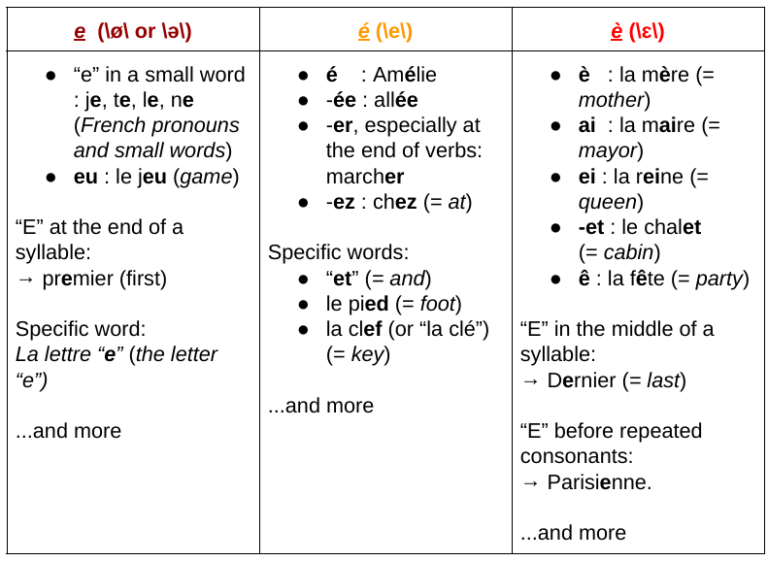
The French E is a schwa, the same lazy "uh" sound at the end of sofa. It is not "ee," not "ay," and not silent. Learners who default to the English letter name "ee" mispronounce entire word families in one move. Drill the schwa early: it is one of the most frequent vowel sounds in spoken French.
3. I - The Clean 'Ee' Sound That Actually Matches English Intuition
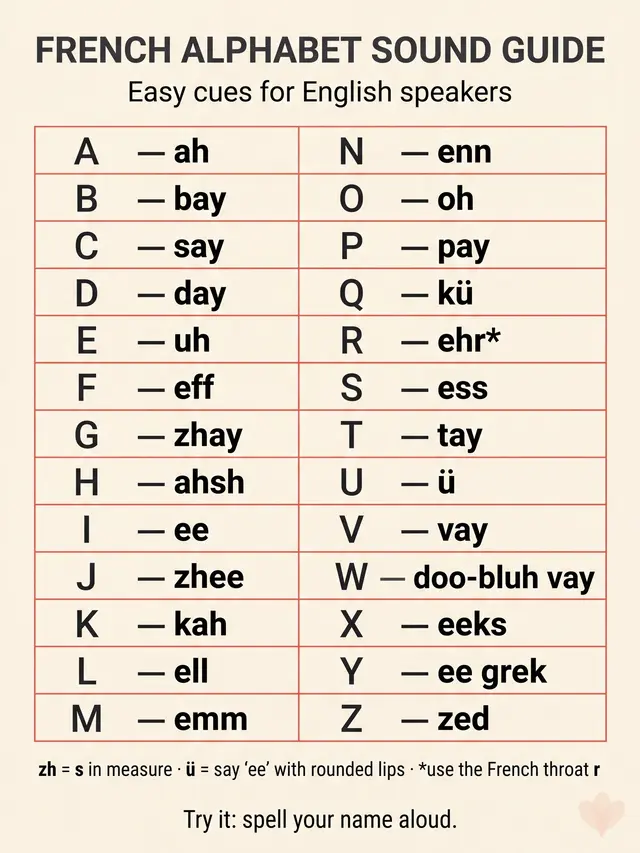
French I is one of the few letter names that maps cleanly to English. Pronounce it "ee" as in see or graffiti, and you are correct. The example word igloo works because English borrowed it. Do not overcorrect by rounding your lips or shortening the vowel. This is a genuine shortcut, and taking it confidently frees up mental bandwidth for the letters that genuinely have no English equivalent.
4. O - Rounded 'Oh' That Demands Lip Rounding English Speakers Often Skip
French O sounds like "oh" in go, but the lip rounding is more deliberate than in English. English speakers often produce a flattened version that sounds slightly off to native ears. The fix is physical: push your lips forward into a small circle before the sound leaves your mouth. This is a small change, but skipping it is one of the signals that marks a speaker as foreign even when every other sound is correct.
5. U - The Uniquely French 'Ew' Sound That Has No English Equivalent
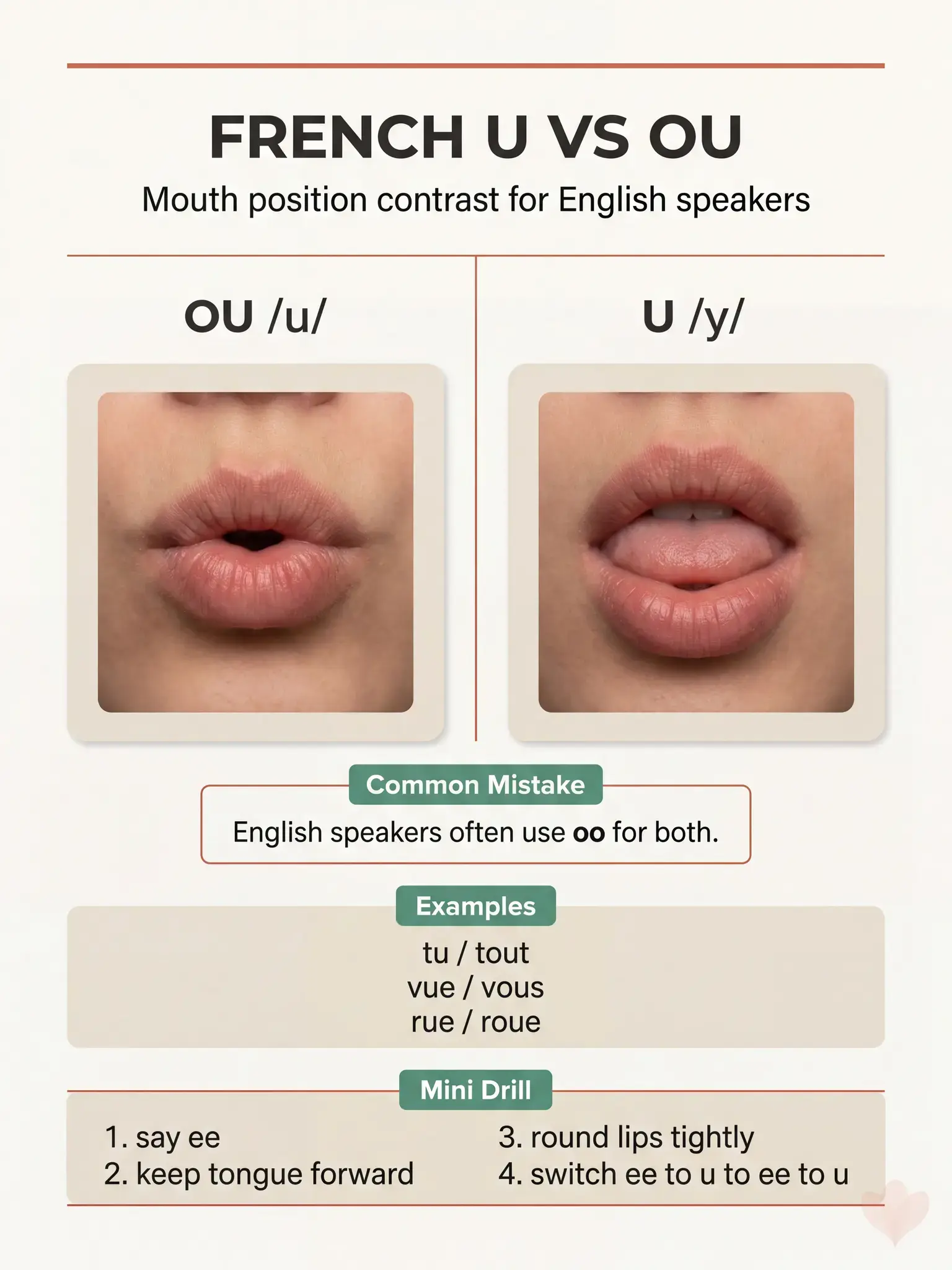
French U is the single most important vowel to drill early, and the most commonly skipped. It requires saying "ee" while simultaneously rounding your lips as if whistling. No English word produces this sound naturally, which is why learners consistently substitute "oo" (as in food) and never notice the error until a native speaker looks confused. Practice it in isolation before attaching it to any word.
6. Y (I-Grec) - The 'Greek I' Vowel With a Two-Syllable Letter Name
Y in French is called i grec, meaning "Greek i." English speakers who say "why" are producing a completely different sound. The vowel quality matches French I ("ee"), so once you have I locked in, Y follows immediately. The only real work here is remembering the name and not reverting to English habit under pressure.
7. R - The Guttural Back-of-Throat Sound Nothing Like the English 'Ar'
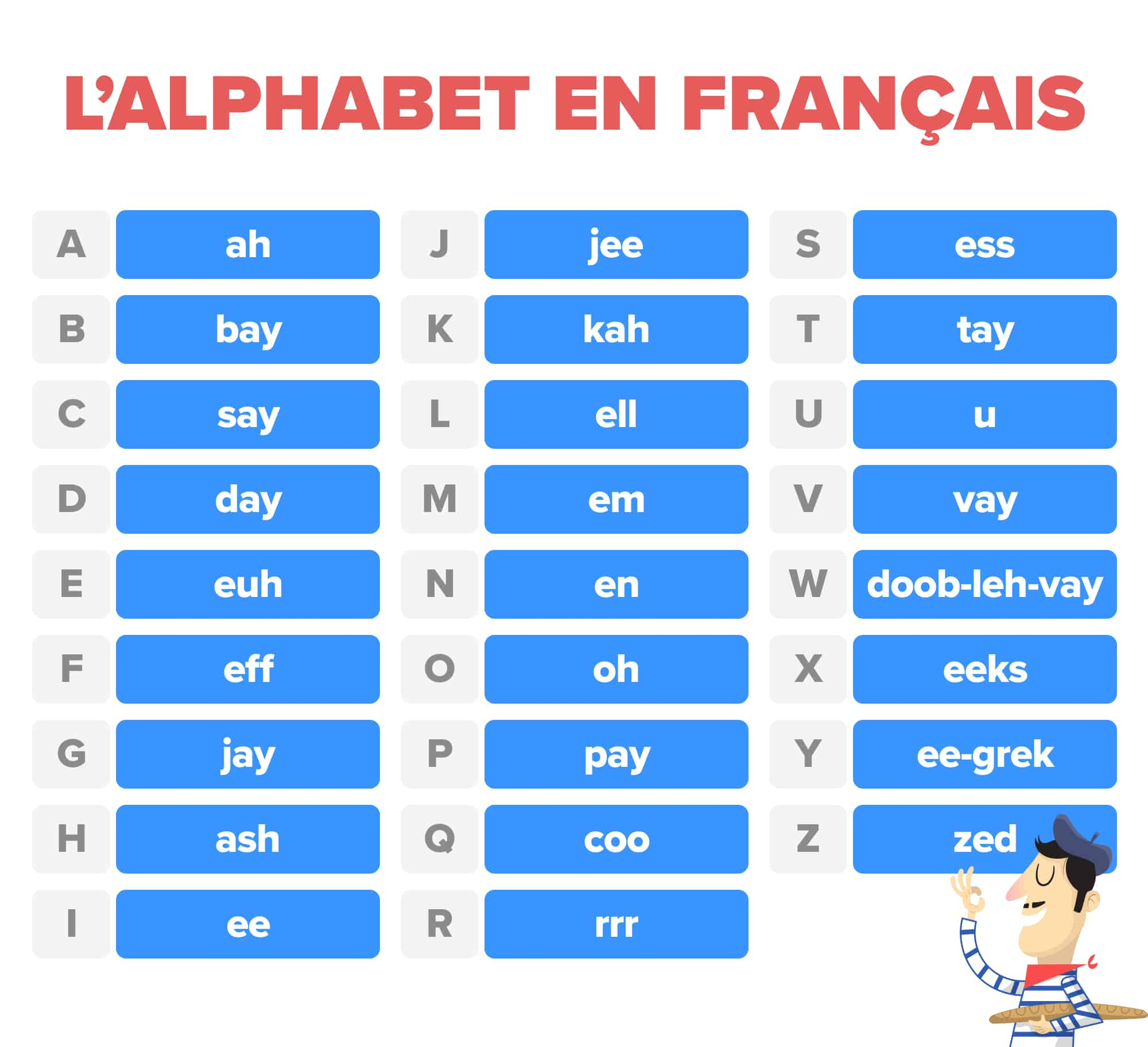
The French R is called "air," a name that sounds nothing like the English "Ar." The sound comes from the back of the throat, closer to a gentle gargle than a tongue-tip tap. Treating it like an English R is one of the most persistent foreigner signals in spoken French.
Practice the R in the letter name itself ("air") before attempting it inside words, because the isolated form is the clearest way to feel where in your mouth the sound originates. French G is called "zhay," using the soft "zh" sound from the middle of the English word measure. The letter name G ("zhay") and the letter name J ("zhee") are separated by only one vowel sound, making them easy to confuse when spelling aloud.
Drill them as a pair, back to back, until the distinction is automatic rather than deliberate.
8. G - Pronounced 'Zhay,' Softer and More Voiced Than the English 'Jee'
The French G letter name is 'zhay', a soft, voiced sound like the 's' in English 'measure,' followed by 'ay.' English speakers instinctively say a hard 'jee,' which is wrong. This distinction matters because G's letter name directly reflects how G behaves before E and I in French words. Mastering the letter name accelerates recognition of the soft-G spelling rule.
9. J - 'Zhee,' the Voiced Palatal Fricative That Confuses English Ears
French J is "zhee," the same "zh" consonant as G but followed by "ee" instead of "ay." English has no letter named with this sound, which is why learners frequently freeze when asked to spell a word containing J in real time. The sound itself appears in English words like measure and vision, so it is not foreign to your ear; it is just foreign as a letter name.
Connecting the sound to those familiar English words is the fastest way to anchor it. H, Silent 'Ash,' the Letter That Makes No Sound in French H is called "ash" in the alphabet, but it produces no sound in actual French words. Hibou (owl) and hôtel both begin with sounds that ignore the H entirely.
The letter name "ash" is worth knowing precisely because you will need it when spelling words aloud; in live speech, however, H does nothing.
10. H - Silent 'Ash,' the Letter That Makes No Sound in French
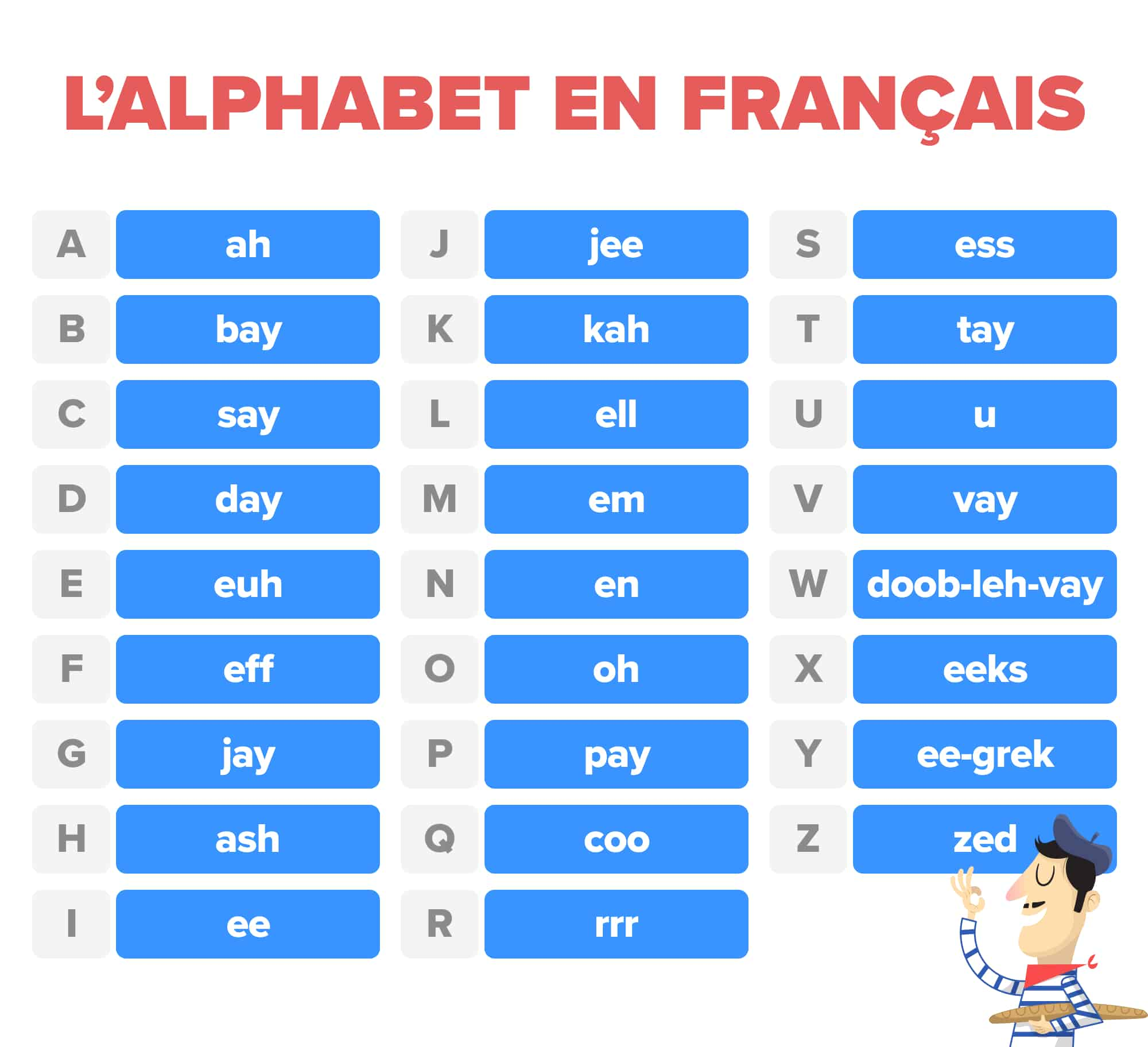
French H is called 'ash' (pronounced roughly like the English word 'ash') but is almost always silent in spoken French. Its letter name is one of the simpler ones to approximate, yet its behavior in words is uniquely confusing: H aspiré blocks liaison while H muet allows it. Understanding the letter name is easy; understanding when H affects surrounding sounds is the real challenge.
11. W - 'Doobluh-Vay,' the Longest French Letter Name in the Alphabet
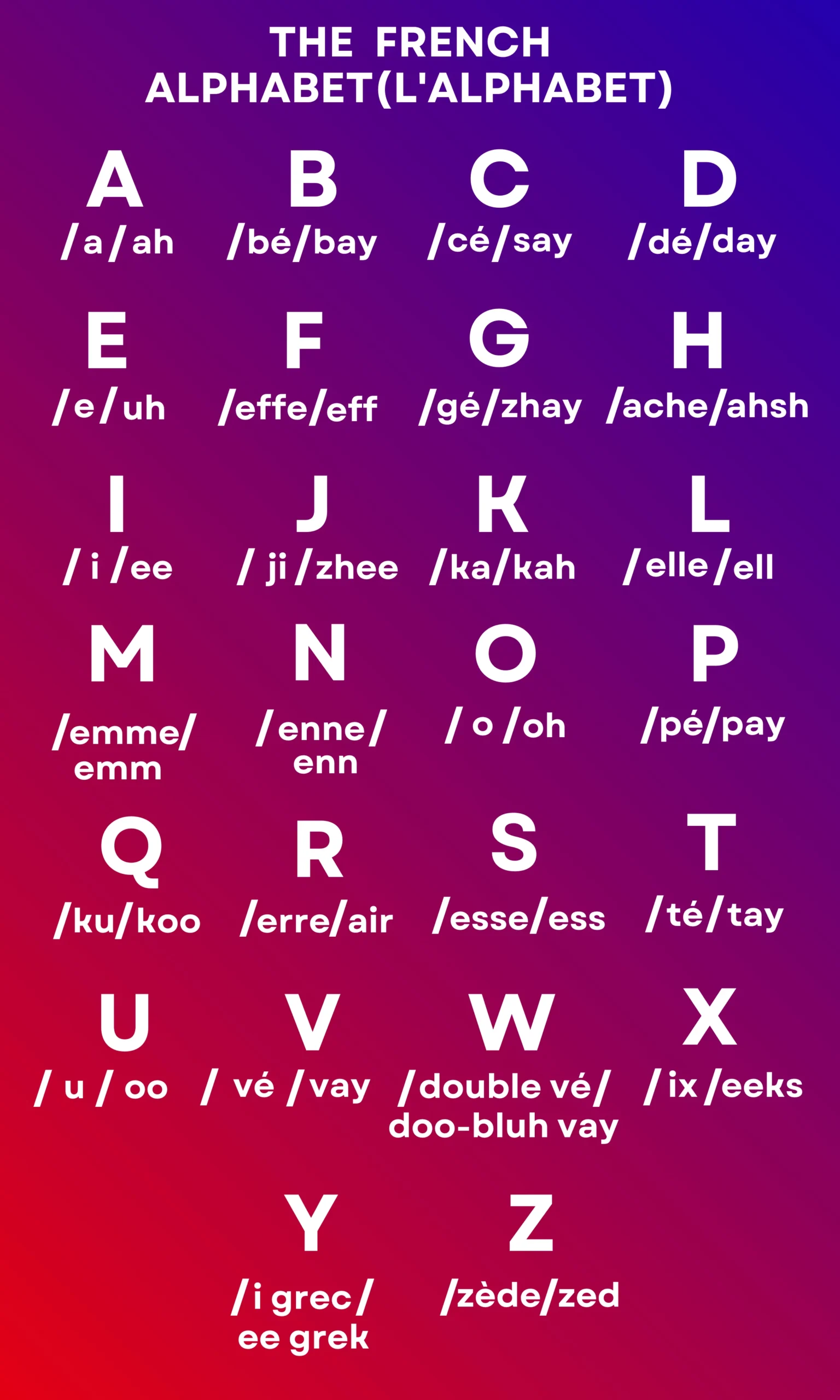
French W is called "doobluh-vay" (double-v), and it is the longest letter name in the French alphabet by syllable count. W appears almost exclusively in borrowed foreign words, which is why the example word wagon is itself a loanword. In practice, you will rarely need "doobluh-vay" outside spelling exercises. Learn it for completeness, but prioritize the vowels and high-frequency consonants that appear constantly in core French vocabulary.
12. The French ABC Song as a Rhythm Scaffold for Memorizing All 26 Letters
The French alphabet song follows the same 26-letter sequence as the English ABC song but uses French letter-name pronunciations throughout. Hearing it even once resets your mental audio map faster than reading a list, because the melody carries the sequence and the sounds together as a single chunk. Use it as a first-pass scaffold, not a final destination. The rhythm helps with sequence; it does not build the muscle memory needed to produce individual sounds under pressure in real conversation.
13. Vowel Sub-Group (A, E, I, O, U, Y) - Why These Six Letters Confuse English Speakers Most
The six French vowels (A, E, I, O, U, Y) share letter shapes with English but diverge on every name. A is "ah." E is "euh." U is a front rounded vowel English does not produce at all. Y is a two-syllable name ("ee-grek") rather than a single sound. Learners who struggle to distinguish between similar French vowel sounds find that the mismatch compounds quickly: one wrong vowel name during dictation throws off the entire word. Prioritize U and E first, then return to refine A, O, and Y.
14. C, S, and Z - Three Consonants Whose French Names All End in the 'Ay' Sound
French C ("say"), S ("ess"), and Z ("zed") are worth grouping because their names follow a similar ending pattern, which helps with memorization but also creates confusion when spelling aloud at speed. C and S in particular sound close enough that a listener who mishears one for the other will write the wrong letter. The practical fix: when spelling aloud in French, slow down on C, S, and Z more than on any other consonant cluster, and pair each with a short example word to confirm which letter you mean.
French Q is "koo" and French K is "kah," separated by a single vowel. Both use a hard K sound at the front, which makes them easy to swap when spelling under pressure. K appears almost exclusively in loanwords and proper nouns in French, so in practice you will reach for Q far more often.
Knowing that distinction reduces the cognitive load: when you hear a hard-K letter name in a French spelling context, Q is the statistically safer assumption unless the context signals a foreign word. Most learners drill these 26 letter names in isolation, repeating them into a void with no feedback and no real-speech context, which is exactly why the sounds fade within a week. Parrot's short-form video feed drops you into real speakers using these letter sounds inside actual words and sentences, supporting the comprehensible-input method that gives the brain the contextual signal it needs to build automatic retrieval.
Most beneficial when you have struggled with traditional memorization-based methods and want the sounds to stick through exposure rather than rote recall: a commute scroll becomes a comprehensible input session, and the letter names you just drilled start appearing in living context rather than sitting inert on a table. Knowing how each letter is named is the foundation, but knowing the name and being able to produce it under pressure are two very different skills. The next section zeroes in on the four specific letters that cause the most persistent errors for English speakers, and more importantly, the exact muscle-memory habits you need to unlearn to fix them.
15. Q and K - Two Letters That Sound Nearly Identical in French ('Koo' and 'Kah')
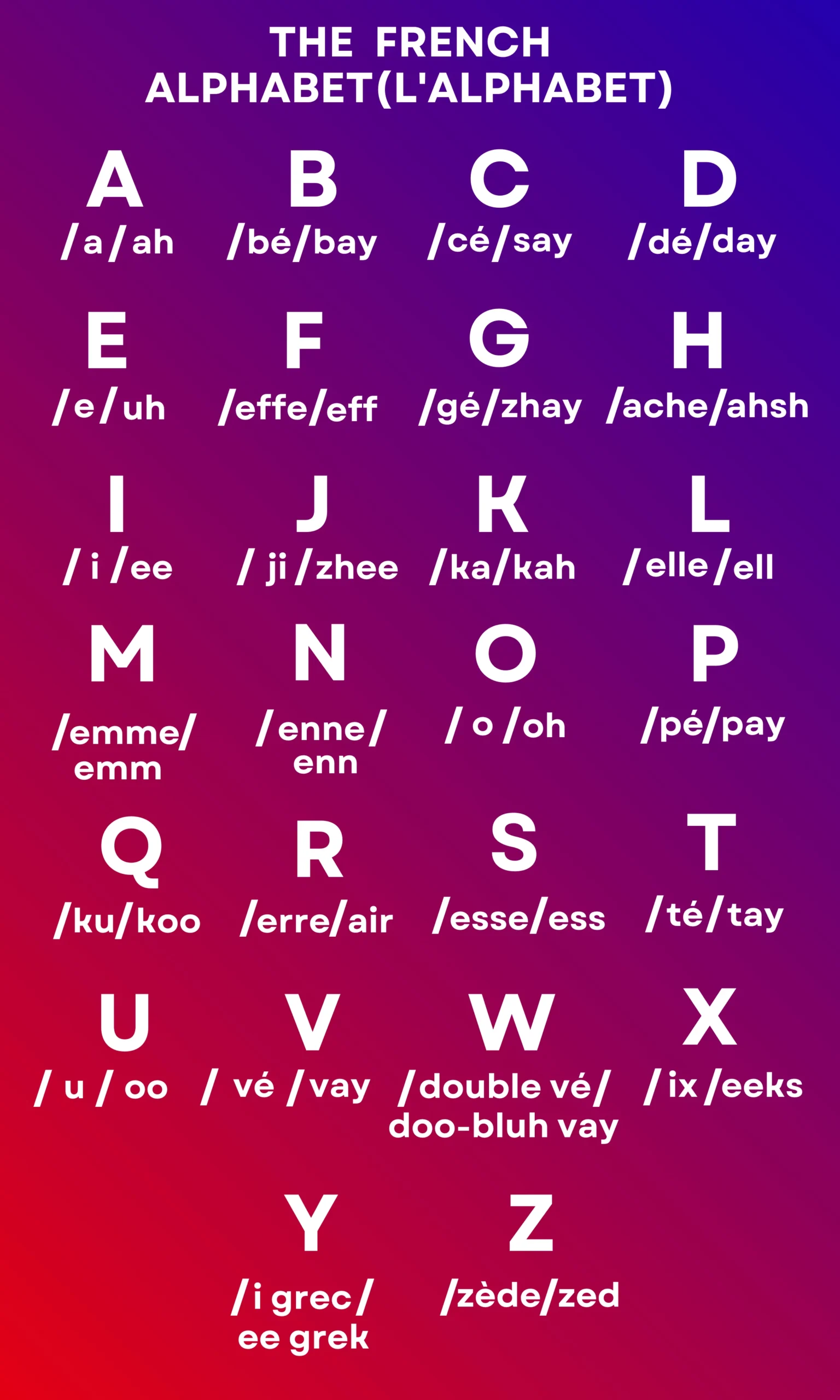
French Q is pronounced 'koo' (like the English word 'coo') and K is 'kah', two letter names so phonetically close that learners frequently confuse them when spelling aloud. K is rare in native French vocabulary and appears mainly in loanwords, while Q almost always pairs with U. Understanding both letter names prevents mix-ups during dictation and reinforces why QU is the dominant spelling pattern for the 'k' sound in French.
The Most Common Pronunciation Mistakes English Speakers Make with French Letters
The four French letters below account for the majority of foreigner-accent signals in spoken French. Knowing what each one sounds like is the easy part. The hard part is that your mouth has spent decades building English muscle memory, and that muscle memory fights back the moment you're under pressure.
1. The G/J Swap - When 'G' Sounds Like 'Jay' and 'J' Sounds Like 'Jee'
Across the market, the G/J inversion is the single most common beginner error for English speakers: in French, G is pronounced "Jay" and J is pronounced "Jee." A learner who has drilled the alphabet still instinctively reaches for the English sound when spelling their name aloud under pressure, because knowing the rule and owning the sound are two different achievements. The correction: rehearse G and J together as a pair, always in that order, until the reversal feels automatic.
This is precisely where early-to-mid level learners benefit most from reading support layered on top of real spoken content. Seeing the letter in context while hearing it pronounced by a native speaker closes the gap between knowing and owning far faster than alphabet drills alone. The French E lands as a soft, hesitant "euh" sound, closer to the neutral vowel in "uh-oh" than anything in the English alphabet name "ee."
Lingua notes that learners who default to the English vowel end up mispronouncing entire word families built around that letter. What makes this harder to fix than it looks: the G/J inversion and the schwa-like French E together reveal a structural trap. Drilling the alphabet in isolation actively reinforces wrong neural associations, making the driller measurably worse off than a learner who never memorized letter names at all.
For learners who have struggled with traditional memorization-based methods, a comprehensible input approach, encountering the French E inside real, naturally-paced speech across short, repeated sessions, is the research-backed alternative that lets correct pronunciation settle into instinct rather than rule-recall.
2. The Letter E - A Hesitant 'Euh…' Not the English 'Ee'
English learners default to a crisp 'ee' sound for the French letter E, but the correct pronunciation is a neutral, slightly open schwa, closer to a hesitant 'euh.' This mistake silently corrupts entire word families, since E appears constantly across French vocabulary. The tradeoff is that mastering this sound requires unlearning a deeply automatic English reflex, which takes deliberate, repeated exposure before it feels natural.
3. The French U - Rounded Lips Whistling While Your Tongue Says 'E'
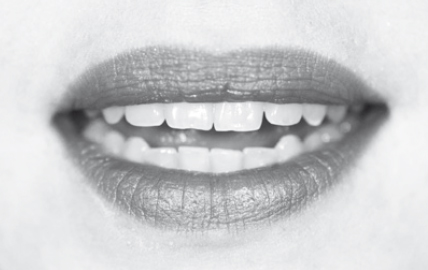
Lingua describes the physical requirement precisely: lips tightly rounded as if to whistle, while simultaneously attempting to say the English "E" sound. The correction is physical repetition in context, not rote recitation of the letter name. Hearing the U embedded inside real native-speaker speech, where the surrounding words give your ear the meaning anchor it needs, lets you start catching your own mistakes before they leave your mouth.
Parrot's short-form video feed puts that contextual exposure at the center of every session, and its Parrot Back speaking practice gives you the immediate feedback loop that makes visible progress possible from the very first week. The French R is produced with soft friction at the back of the throat, similar to gently gargling water, with no tongue movement at all. Lingua identifies treating it like an English R as one of the most telltale signals of a foreign accent, and letter-name memorization does nothing to address the physical repositioning required.
What most learners and teachers report, consistently, is that practising sounds in isolation is insufficient for comprehensible production; the sound must be encountered and produced within meaningful speech context before it transfers reliably to real conversation. Drilling the R as an abstract letter name rarely translates to producing it mid-sentence for exactly this reason. Listening practice built around native-speaker video content at natural speed is what trains your ear to recognise the R in the flow of real speech, the prerequisite step before your mouth can reproduce it on instinct.
4. The French R - Soft Throat Friction, Never a Tongue Roll
Treating the French R like an English R, or worse, rolling it like Spanish, is one of the most telltale foreigner signals in spoken French. The correct sound is produced at the back of the throat with gentle friction, similar to softly gargling a small amount of water, with the tongue staying flat and uninvolved. The real challenge is that English speakers have no existing throat-friction habit to draw on, requiring conscious repositioning of airflow every single time.
5. Silent and Shifted Consonants - How French Consonant Rules Differ from English
French consonants at the end of words are usually silent, and several consonant letter names are systematically the near-opposite of their English equivalents. This means the English speaker's instinct, built on decades of sounding out final consonants, works directly against them. The fix here is not more drilling.
Broader trends in second-language phonology research consistently finds that isolated phonetic practice is insufficient for comprehensible production; contextual exposure is required. Hearing these sounds embedded inside real speech at natural speed, across repeated short sessions, is what allows your ear to start recognising them in the conversational contexts where your mouth eventually needs to produce them on instinct. Every video session in Parrot's short-form feed contributes directly to that listening practice, making scrolling productive rather than passive, and the comprehensible input method that underlies how content is selected and sequenced for each learner ensures you are always hearing sounds at the edge of your current level, not above it or below it.
Fix these four letters and you've already eliminated the most glaring foreigner signals in your spoken French. But there's a second layer of complexity waiting underneath: accent marks and silent letters that quietly rewrite the sounds of letters you thought you'd already mastered. That's exactly where the next section picks up.
Related Reading
How To Learn French Through Conversation
How To Learn French With Movies
Learning Resources For African French
French Accent Marks and Silent Letters That Change Every Sound You Thought You Knew
Accent marks in French are not stylistic choices left over from medieval manuscripts, and understanding them is essential to correct pronunciation. According to industry data, French uses five accent marks: the accent aigu (é), accent grave (è/à/ù), accent circonflexe (ê/â), tréma (ë/ï), and cédille (ç), each modifying the base letter in a specific, non-negotiable way. The accent aigu tightens the E into a sharp, closed sound, like the "ay" in "say," while other marks shift vowel quality in equally precise ways.
The cédille converts a hard C into a soft S sound entirely, and beginners regularly underestimate exactly how distinct these five marks are from one another. Recognising them accurately matters because before you can produce the right sound, you have to see the right mark clearly. Compounding this challenge is the behaviour of final consonants.
Spokira confirms that silent letters in French final positions are among the leading sources of mispronunciation for English speakers, because English speakers expect written letters to earn their place audibly. Then French liaison arrives and resurrects them. Spokira describes liaison as a normally-silent final consonant being reactivated when the following word begins with a vowel sound, a behaviour with no direct English equivalent.
The difficulty is the phrase, not the isolated word. The next section addresses the method.
Why Drilling Letters in Isolation Keeps You Stuck and What to Practice Instead
The problem is neurological, not motivational. When you drill the alphabet as a list, your brain files that knowledge in declarative memory, the same system you use to recall a PIN or a birthday. But producing sounds mid-conversation is a procedural task, closer to riding a bike than recalling a fact. Research published in Frontiers in Psychology confirms that automatic, fluent sound production in real speech depends on procedural memory systems that rote recitation simply does not engage.
Input must be 95 to 98% comprehensible for subconscious sound acquisition to occur, because only then can the brain use surrounding context to form implicit, automatic sound mappings. When input falls below that threshold, it becomes noise to the acquisition mechanism, which cannot use it regardless of how many times you repeat it. What the brain can use is meaningful context: it is pattern-matching across meaning, and that process, repeated across spaced exposures, is what builds the automatic retrieval that makes sounds feel effortless rather than recalled.
Even short sessions of contextual French audio do more durable phonological work than equivalent time spent on alphabet recitation, because only one of those two activities actually engages the procedural memory system that makes sounds stick, a distinction the comprehensible-input research surveyed throughout this guide returns to repeatedly.
The Spaced Short-Session Method That Mirrors How Your Brain Naturally Acquires Sound Patterns
Spacing those exposures across time matters as much as the quality of the input itself. Massed drilling produces short-term recognition that fades, whereas distributed practice lets each session reinforce what the last one began to encode. Parrot's short-form native-speech video feed is built on exactly this principle, delivering comprehensible input in scroll-native, bite-sized clips so that sound-to-meaning mapping forms through repeated contextual exposure rather than conscious memorisation.
The parrot-back speaking practice layer then activates the same sounds in production, completing the loop that isolated drilling never closes. Even short sessions of the right kind of French audio do more for your pronunciation than equivalent time spent on alphabet recitation, a pattern consistently supported by second-language acquisition research showing that short, frequent naturalistic-exposure sessions produce stronger phonological retention than massed study, and the next section shows you exactly how to build that habit into the gaps you already have in your day. Parrot is built for learners who want pronunciation to become automatic through repeated listening and speaking practice, not for those who feel most confident working through conjugation tables and written exercises first.
Next steps
If your drilled alphabet still leaves you freezing when a native speaker talks, the path forward starts with hearing those letter sounds woven into real words repeatedly, not reciting them one more time in isolation. Start with our learn Spanish.
Rote alphabet drilling loads declarative memory while leaving procedural memory completely untrained, which is exactly why the sounds fade within a week of any session. And because comprehensible input research sets a hard floor of 95 to 98% context comprehension for subconscious sound acquisition to occur, an isolated letter name scores zero on that metric regardless of how many times you repeat it. Together, these two realities point to the same corrective action: replacing decontextualized letter drills with short, repeated exposure to real spoken French inside sentences you mostly understand, so your brain's acquisition mechanism can finally engage.
Start with Parrot's short-form native-speaker video feed, which sequences comprehensible input so every clip pulls its weight toward automatic sound retrieval. From there, Parrot Back speaking practice closes the loop, moving you from absorbing sounds to producing them under real conversational pressure.
Frequently Asked Questions
Does the French alphabet song actually help you learn the letter names?
Yes, but only as a starting point. The French alphabet song follows the same 26-letter sequence as the English ABC song but uses French letter-name pronunciations, and hearing it even once resets your mental audio map faster than reading a list. Use it as a first-pass scaffold for sequence and sound together, not as a substitute for the muscle memory needed to produce individual sounds under real conversational pressure.
What's the difference between French G and French J, they sound so similar?
French G is called "zhay" and French J is called "zhee", both use the same soft "zh" consonant found in the middle of the English word measure, but G is followed by "ay" and J is followed by "ee." Because they are separated by only one vowel sound, they are easy to swap when spelling aloud, so the post recommends drilling them as a pair, back to back, until the distinction becomes automatic.
Why is the French U so hard to pronounce, and is there an English sound close to it?
There is no English equivalent for French U, it requires saying "ee" while simultaneously rounding your lips as if whistling, which no English word naturally produces. Learners consistently substitute "oo" (as in food) and often don't notice the error until a native speaker looks confused, which is why the post recommends practicing it in isolation before attaching it to any word.
What about the less common French letters, K, Q, W, X, and Y, do I really need to learn them?
They are worth knowing for completeness, but context matters: K appears almost exclusively in loanwords and proper nouns, W ("doobluh-vay") shows up mainly in borrowed foreign words, and Q ("koo") is the statistically safer assumption when you hear a hard-K letter name in a French spelling context. Y is called "i grec" (Greek i) and is a two-syllable name, once you have the French I sound locked in, Y follows immediately since they share the same "ee" vowel quality.
Why does getting French letter names wrong cause real problems, not just an accent issue?
Mispronouncing French letter names leads to genuine miscommunication, not just an awkward accent, for example, swapping French I ("ee") and French E ("euh") on a phone call can send a confirmation email to the wrong address entirely. Situations like hotel check-ins, administrative appointments, and phone calls require spelling out names, addresses, and reference codes, and France also uses a formal spelling protocol on official calls where operators confirm ambiguous letters by naming them explicitly.