
Flashcards build recognition. Conversation demands retrieval. Here is why the gap keeps winning, and what actually closes it.
The common assumption is that if you study hard enough, more lists, more flashcards, more drilling, your vocabulary will eventually grow. The harder truth is that most vocabulary study methods were built for a version of your life that doesn't exist: one with a clear desk, thirty quiet minutes, and the mental bandwidth to drill word lists after a full day of work, commuting, and everything else. If you've ever downloaded a flashcard app, used it twice, and quietly deleted it three weeks later, that's not a discipline failure. That's the method failing you.
If you've ever downloaded a flashcard app, used it twice, and quietly deleted it three weeks later, that's not a discipline failure. That's the method failing you.

Pros and cons at a glance
✓ Pros
✗ Cons
Forces activation at the moment of recording
Demands more than thirty seconds per word
Positions word inside a semantic neighbourhood
Words in journal fade if never activated in conversation or writing
Anchors word to a real moment of use
,
Encodes word the way the brain actually stores knowledge
,
,
Recognising a word and being able to use it are two completely different cognitive skills. This is one of the most consistent frustrations among adult learners: a reading vocabulary that feels enormous, paired with a speaking vocabulary that feels frozen in place. Words understood through reading or flashcard review stay permanently in a "recognise only" zone. They never cross over into active use.
The International Journal of Applied Linguistics and English Literature found that learners may acquire a word immediately after study but fail to retain it when tested four weeks later, because short-term recognition and durable recall are separate things. The same study found that words studied in isolation are not reliably transferred into usable, long-term knowledge, and that contextualised reading with embedded vocabulary aids produced significantly stronger retention outcomes. Because isolated drilling doesn't anchor a word to meaning, emotion, or story, the memory trace is shallow. Forgetting is the default.
The structural mismatch is this: traditional vocabulary study demands a dedicated block of focused time. Busy adults almost never have that consistently. The problem isn't that you've been choosing the wrong words to study. It's that the methods most people default to were never designed for the life you're actually living, and they don't just fail quietly: they leave a residue that makes every future attempt harder to start.
Key takeaways
Drilling word lists feels productive but trains recognition, not production, you can know a word cold on a flashcard and still go blank the moment you need it in conversation.
60% of English words carry Latin or Greek roots, which means learning a handful of morphemes unlocks dozens of words faster than memorizing each one individually.
Spaced-repetition apps work as retention accelerators, not discovery engines, using them as your primary input source is asking one tool to do three jobs it was never built for.
A vocabulary journal entry earns its keep only when it contains five fields: the word, its definition, a synonym and antonym, the sentence you first encountered it in, and a sentence you wrote yourself.
The average adult already spends four-plus hours a day on a phone screen, the vocabulary gap is an allocation problem, not a time problem.
Words absorbed through real content in natural spoken rhythm, stress, intonation, context intact, encode faster and surface more reliably under conversational pressure than words met on a page.
Parrot applies this directly: it delivers short-form video built on comprehensible input, the most research-backed method for acquisition, so words enter through the same channel your brain already trusts, English is coming soon alongside Spanish, French, and Italian.
The Vocabulary Advice That Keeps Failing Busy Learners
The problem is that these tools train recognition in calm, controlled conditions and leave a specific gap untouched: knowing which word actually fits when a real conversation is moving fast.

Why Word Lists and Flashcard Apps Don't Improve English Vocabulary Under Conversational Pressure
"Non-native English speakers struggle to know which word fits a specific situation, even when they know multiple similar words, a gap that standard vocabulary advice rarely addresses."
— what we hear from non-native English learners
At a glance
App/Tool
Strength
Gap/Limitation
Design Approach
Duolingo
Building recognition vocabulary; maintaining daily learning momentum through consistency prompting and gamified reinforcement
Used as standalone drilling environments disconnected from real-world context; words don't surface under real-time conversational pressure
,
Babbel
Building recognition vocabulary; maintaining daily learning momentum through consistency prompting and gamified reinforcement
Used as standalone drilling environments disconnected from real-world context; words don't surface under real-time conversational pressure
,
Memrise
Building recognition vocabulary; maintaining daily learning momentum through consistency prompting and gamified reinforcement
Used as standalone drilling environments disconnected from real-world context; words don't surface under real-time conversational pressure
,
Parrot
Meets learners inside scrolling behavior they already have; personalized sequencing from first session; no onboarding maze
,
Short-form video feed; streaks that build habit without guilt-tripping; Comprehensible Input Method; content calibrated to learner's level
Apps like Duolingo, Babbel, and Memrise are genuinely effective at building recognition vocabulary and maintaining daily learning momentum, their strength is consistency prompting and gamified reinforcement.
One specific pattern surfaces repeatedly among learners: they write down advanced vocabulary words in personal dictionaries, convinced the effort is building something, then never use those words when it counts, leaving the whole exercise feeling wasted. Cognitive research on memory and language acquisition consistently identifies the same bottleneck: durable word retention requires deeper processing than passive drilling can provide, and recognition and retrieval under real-time pressure draw on meaningfully different cognitive pathways.
The 30-minute desk model assumes something most working adults simply don't have: a predictable, protected block of time every day. Research on adult time allocation consistently shows that employed adults have very limited discretionary time on weekdays, leaving little room for structured, scheduled study. Each abandoned attempt compounds the damage: psychologist Albert Bandura's research on self-efficacy shows that repeated failure raises the psychological cost of attempting a task again, making the next start feel riskier than the last.
Parrot sidesteps this entirely. Its short-form video feed meets learners inside the scrolling behavior they already have, and Parrot uses streaks because building a daily habit is a big part of learning a language, but never guilt-trips or threatens learners: streaks that build the habit, without the guilt-tripping, a design backed by behavioral research showing that habit-compatible tools sustain engagement longer than obligation-based ones (Fogg, Stanford Persuasive Tech Lab). Critically, that feed is not random: Parrot's personalized sequencing governs how content is selected and ordered for each learner from the very first session, so learners start consuming meaningful, level-appropriate content immediately upon opening the app, no onboarding maze, no blank slate.
Related Reading
How To Speak English Fluently And Confidently
How To Learn English Grammar Step By Step
English Language Learning Methods
How To Learn English
How Reading Diverse Content Builds English Vocabulary Faster
Consistent daily reading quietly outperforms infrequent marathon study sessions when it comes to word acquisition, and the reason comes down to how vocabulary actually sticks rather than how much time a learner logs.
A short, consistent daily reading session generates enough new word encounters to produce measurable weekly gains without the cognitive fatigue that kills longer sessions. This is the core of Parrot's approach: rather than scheduling overwhelming study blocks, the platform is built around the principle of building a consistent daily habit in 15 minutes or less.

15 minutes
Daily habit enough for real vocabulary gains
At a Glance
Vocabulary Type
Definition
How Built
Limitation
Receptive vocabulary (recognition)
Words you understand when you see them
Passive reading, drilling, flashcards, re-reading
Does not transfer to production; words stay at recognition level
Productive vocabulary (active use)
Words you can actually use mid-conversation
Micro-output moments: saying a new sentence aloud or rephrasing a paragraph in your own words
Passive re-reading and repeated writing fail to close the gap from recognition to productive use
Receptive vocabulary (words you understand when you see them) and productive vocabulary (words you can actually use mid-conversation) are two different stores. For every passage you read, pairing it with a brief micro-output moment, saying a new sentence aloud or rephrasing a paragraph in your own words, is what drags a word from recognition into genuine use. This is precisely the gap that passive re-reading and repeated writing fail to close. Many early-to-mid level learners discover that no matter how many times they copy a word down, it refuses to surface naturally in conversation, pointing to the need for richer, more contextually grounded input.
Parrot's Reading Practice with Video Transcripts and Inline Translation is designed for exactly this scenario: an early-to-mid level learner who needs reading support to make video content comprehensible gets both the listening input and the full transcript in one place, so each new word arrives with acoustic, visual, and contextual cues simultaneously, a richer encoding event than any single-channel method can produce. The International Journal of Applied Linguistics and English Literature study by Elekaei, Faramarzi & Koosha supports this direction: their research on incidental vocabulary acquisition through contextualized input confirms that meaning-rich exposure, not rote repetition, is what moves words into durable memory.
Sustaining that exposure, however, depends on learners actually returning each day, and interest is the most reliable driver of consistency. Parrot's short-form video feed addresses this directly by giving learners content they actually want to watch, so the 15-minute daily habit feels pulled rather than pushed.
The Genre-Mixing Rule
Why novels, journalism, and niche blogs each unlock a different vocabulary layer is straightforward: single-genre reading creates a vocabulary echo chamber. The same high-frequency words recycle across familiar topics while lower-frequency, domain-specific terms never appear, leaving significant gaps in a learner's range.
Nation's 2001 lexical coverage research found that readers need a very high degree of lexical coverage to process an authentic text without constant interruption. Crossing genre boundaries is one of the most reliable ways to push that coverage upward, since each new domain introduces vocabulary that simply does not appear elsewhere.
Parrot's inline translation layer keeps that threshold manageable during video-based reading, letting learners stay inside the text instead of bouncing to a dictionary and losing the thread.
What Vocabulary Size Benchmarks Actually Mean for Your Fluency
For learners who have already tried and abandoned memorization-based methods, flashcard decks, vocabulary lists, repeated writing, Parrot is built as a research-backed alternative: the Comprehensible Input Method underlies every video session, governing how content is selected and sequenced so that each day's input sits just above a learner's current level, keeping acquisition active without tipping into frustration.
What a Vocabulary Journal Should Actually Contain

The Five-Field Entry That Actually Encodes a Word, Not Just Records It
the word
its definition
at least one synonym and one antonym
the sentence you first heard or read it in
a sentence you wrote yourself
That five-field structure is not busywork; it is the direct application of a principle that existing research points toward but rarely states outright: drilling words in isolation doesn't just slow retention, it actively skips the brain mechanism that makes vocabulary stick. Research on vocabulary acquisition consistently establishes that true word mastery requires knowing a word's collocations, register, and contextual range, because meaning is always embedded in use.
Writing terse as a synonym and verbose as an antonym forces your brain to position the word inside a semantic neighbourhood. Research into semantic neighbourhood mapping shows that knowing a word's relational context predicts active use far better than knowing its definition alone. Pair that with Merriam-Webster's Word of the Day format, which models exactly this kind of layered entry, and you have a credible template that is already field-tested.
This is where Parrot's Comprehensible Input Method becomes directly relevant: because it governs how content is selected and sequenced for each learner, the vocabulary surfaced during a Parrot video session is calibrated to the learner's current level rather than pulled at random from a dictionary. The words you are journaling after a Parrot session are words the method has already judged to be within your acquisition range, which makes the five-field entry dramatically more likely to convert into active use.
The International Journal of Applied Linguistics documents how words encountered inside meaningful context, interlinear glosses embedded in real text, produced superior retention four weeks later compared to decontextualised study. Separate cognition research confirms that deep cognitive processing, not repetition volume, is the engine of durable word memory. Together, these findings point to a clear distinction between:
a vocabulary journal that records a word alongside the sentence you heard it in, the emotion it triggered, and the moment you'd use it yourself encodes the word the way the brain actually stores knowledge
turning a notebook into a retention machine rather than a second flashcard deck
Parrot's short-form video feed and its AI Spanish Tutor are both designed to surface engaging educational content that learners actually enjoy returning to, which matters here because re-encountering a journaled word in a new video or during a Parrot Back speaking-practice session is exactly the kind of spaced, contextual re-exposure that consolidates it.
The Vocabulary Journal That Fails Is the One You Stop Opening
The medium you choose shapes both what you retain and whether you return. Handwriting a journal entry produces stronger memory encoding than typing the same content, a finding replicated across multiple studies examining the generative processing demands of forming letters by hand. But a handwritten notebook cannot send you a notification when a word you journaled three weeks ago appears in a new Parrot video, cannot sort entries by acquisition status, and cannot surface a forgotten entry at the moment spaced repetition logic says it is most likely to consolidate.
Parrot's AI Spanish Tutor creates a natural checkpoint for this maintenance habit because a conversation session has a defined beginning and end, which means it has a natural two-minute window on either side.
Which Apps Actually Help You Learn Vocabulary (and How to Use Them Right)
Spaced repetition apps are among the most evidence-backed tools in vocabulary learning, but only when used as retention accelerators, not discovery engines. The learner who opens an app expecting it to introduce new words, build context, and create conversational fluency from scratch is asking one tool to do three jobs it was never designed for. The core problem is not that vocabulary apps are broken; it is that they are used in a broken way: as isolated drilling environments disconnected from meaningful context or real output. A learner who uses an app as a contextual discovery tool, finding a word, immediately seeking a real video or sentence that uses it, then producing it aloud, is operating through a fundamentally different mechanism than the learner grinding through flashcard queues, even if both are on the same screen.
1. Spaced Repetition Scheduling - How Anki and Memrise Time Reviews at the Exact Moment Before You Forget
Spaced repetition works by surfacing a word just as your memory of it starts to decay, not too early, not too late. Anki and Memrise both use this mechanism, but algorithmically: the more confidently you recall a word, the longer the interval before it reappears. The tradeoff is that the system only works if you trust the schedule and stop cramming words you already know.
2. The Habit Problem - Why Apps Can't Fix the Consistency Gap That Kills Vocabulary Progress
It's a familiar pattern: download the app, build a three-day streak, miss one session, watch the review backlog balloon to 200 cards, close the app, never open it again. The app did not fail; the friction point did. Spaced repetition requires consistent short sessions to function; skip two days and the algorithm punishes you with an overwhelming queue. The learners who stick are the ones who treat the app as a two-minute daily habit, not a study session.
3. Vocabulary.com's Adaptive Model vs. Anki's Manual Decks - Choosing the Right Tool for Your Learning Stage
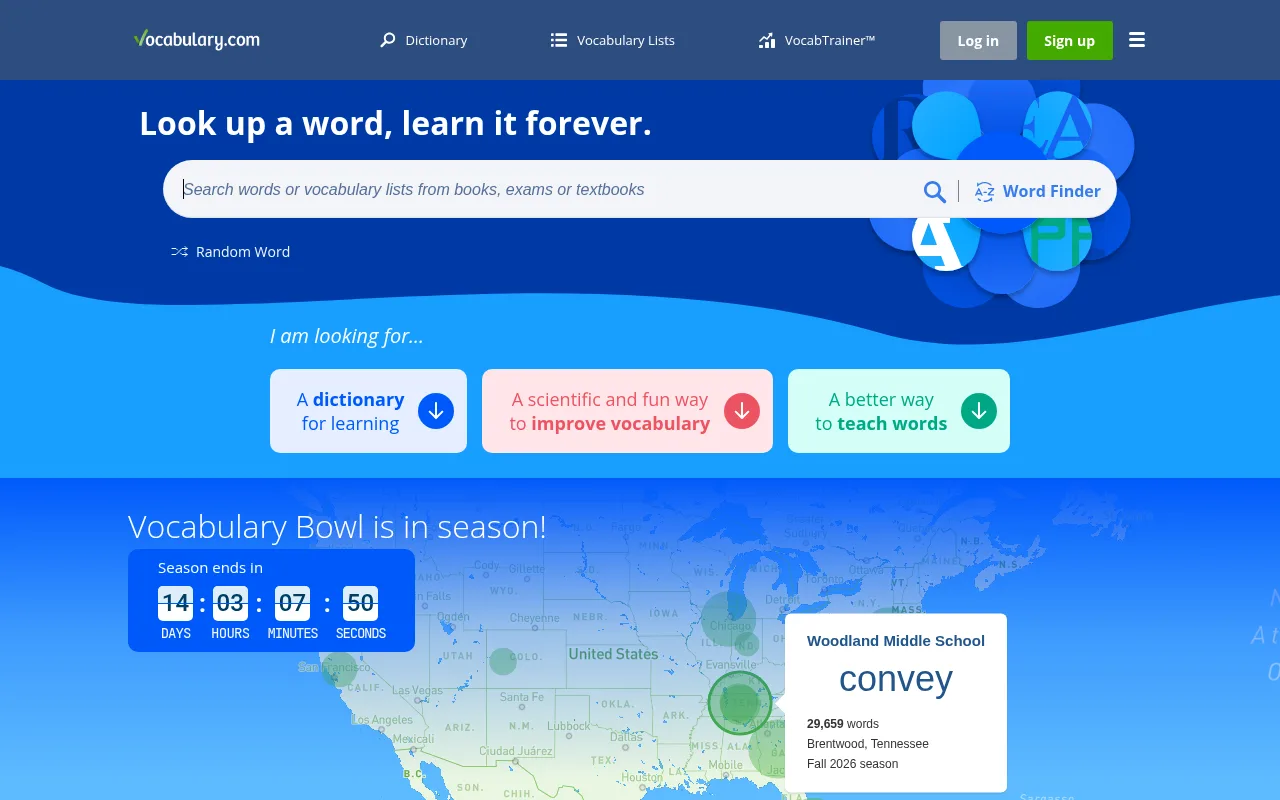
Choosing the right tool depends on your learning stage. Vocabulary.com uses an adaptive model that selects words based on your demonstrated gaps, removing the manual-deck burden entirely. Anki gives you full control but demands the discipline to build and maintain your own decks. Vocabulary.com suits learners who want a low-friction start; Anki suits learners who already capture words in a journal and want spaced repetition applied to their own word list. Neither is objectively better; the right pick depends on whether you want curation or control.
4. The Rule of Three - Use Every New Word Three Times Within 48 Hours to Move It from App Memory to Real Memory
Recognition-only practice never builds speaking ability. The science of contextualised input shows that words are encoded most deeply when met inside natural language, not stripped of it, while the receptive-to-productive gap research confirms that drilling recognition alone leaves the speaking pathway undeveloped. The fix is deliberate output: use every new word three times within 48 hours, in a sentence you write, a text you send, or a conversation you have. This active production forces your brain to retrieve the word under real conditions, not just identify it in a multiple-choice prompt. Apps can prompt the review; only you can supply the output that moves a word from passive recognition into genuine conversational use.
5. Supplementary Tools That Accelerate App-Based Learning - Dictionaries, Word Journals, and Immersion Resources
The learners who get the most from spaced repetition apps are the ones who feed them well. Creating an Anki deck directly from your paper vocabulary journal entries means the same words get spaced-repetition treatment without double effort. For learners who want the organic first encounter to happen inside real, engaging content rather than a blank flashcard, Parrot's short-form video feed supplies that context naturally, so by the time a review interval fires, the word already carries emotional and situational weight behind it. These supplementary tools are most beneficial when you are already consistent with a journal or reading habit and need the digital layer to handle the review scheduling you would otherwise forget.
Related Reading
How Long Does It Take To Learn English Fluently
Best Apps To Learn English
Types Of Music Good For Learning English
Learning English As A Second Language
English Learning App For Kids
Best Websites To Learn English
How To Learn English Speaking At Home
Game To Learn English
English Learning Activities
Best Podcasts For Learning English
Tof
How Word Roots and Affixes Unlock Dozens of Words at Once
Roughly 60% of English words carry Latin or Greek roots, a figure linguists and etymologists have long documented when making the case for morpheme-based vocabulary study, which means the fastest vocabulary investment you can make is learning the structural patterns underneath words rather than memorizing more of them individually.

One Root, a Dozen Words - How mal-, bene-, and anti- Pay Off Immediately
Learning word roots, prefixes, and suffixes unlocks multiple words at once because a single morpheme like mal- (Latin for "bad") immediately makes malevolent, malfunction, malnutrition, and malpractice decodable, without prior exposure to any of them. The real gain is the generative pattern itself, and that is precisely what Parrot's Comprehensible Input Method is designed to do: it governs how content is selected and sequenced for each learner, surfacing the same root families repeatedly inside native-level video so that every derived form arrives with the context, visual, emotional, situational, that makes it stick.
Why TOEFL and GRE Word Lists Are Secretly Root Lists in Disguise
Because TOEFL and GRE word lists are dominated by Latinate and Greek-derived vocabulary, a pattern well-documented in the history of English as a classical language, learners who study root families gain disproportionate coverage of high-frequency academic test words compared to rote list drilling. A GRE prep list of 500 words is a much smaller set of root families in disguise, and recognizing that structure can dramatically reduce the memorization burden. Parrot's short-form video feed reinforces this by exposing learners to authentic vocabulary and natural speech patterns from native-level content, giving those root-linked words repeated real-world exposure rather than the one-and-done treatment a word list delivers.
How to Decode an Unfamiliar Word in Real Time Without Looking It Up
Spot a recognizable morpheme.
Assign its meaning.
Test it against the sentence's logic.
Parrot's comprehensible-input video format closes a second gap: the one between isolated root study and real language, since encountering a known root inside genuine speech reinforces both its meaning and its natural usage at the same time. For learners who want to move beyond passive recognition into active production, Parrot Back, the platform's speaking-practice feature, and the AI Spanish Tutor provide personalized feedback during or after video sessions, turning a decoded root into a word the learner can use in speech.
One limitation worth naming: root decoding works best for Latinate vocabulary and is less reliable for Germanic everyday words like get, put, or bring, making it a high-leverage tool for academic and professional registers, not a complete system on its own.
Audio and Video Resources That Build Vocabulary Without a Study Session
A fraction of weekly commute time, pointed at the right audio content, is enough to generate a significant number of contextualised word encounters without opening a notebook or sitting at a desk. The research backs this up: as Feyten (1991) established, hearing words in natural spoken rhythm, with stress and intonation cues, encodes meaning more durably than silent study. The most leverageable vocabulary gain available to most learners comes from substituting a fraction of the screen time they already spend with native-language audio-visual content, turning dead time into continuous, low-effort immersion without increasing the total hours in the day. The real opportunity is redirecting time you already spend.
The common assumption is that you need to pause, rewind, and take notes to actually learn from audio. In practice, the learners who build the largest vocabularies from media are the ones who consume enough content consistently that high-frequency words become familiar long before they ever look them up. Volume and consistency come first. Structured reflection follows.
1. Podcasts and Audiobooks - Vocabulary Absorbed Through Natural Spoken Rhythm

Podcasts and audiobooks are the most accessible entry point for commute-based vocabulary exposure, because they require nothing except a phone and earbuds. The tradeoff is attention drift: long-form audio during a busy commute can become background noise rather than genuine input, especially on high-density routes. They are most beneficial when a learner picks content pitched just above their current level, so the language stays comprehensible but unfamiliar words keep surfacing in context.
2. BBC 6 Minute Vocabulary - Maximum Vocabulary Density for Busy Learners
BBC 6 Minute Vocabulary delivers focused, theme-based vocabulary instruction in a format short enough to complete during a single commute leg. Each episode unpacks a word cluster with real examples, making it one of the highest-density audio resources available for free. The limitation is that episodes target intermediate learners, so advanced speakers may find the ceiling low. It is most beneficial when a learner wants structured input without committing to a longer podcast series.
3. Merriam-Webster Word of the Day Podcast - One Precise Word, Fully Unpacked Daily
Merriam-Webster's Word of the Day podcast delivers etymology, usage examples, and pronunciation in under three minutes. One word, fully contextualised, every day. The honest limitation: a single word per episode means acquisition volume stays low unless a learner stacks several episodes back-to-back. It is most beneficial as a daily anchor habit rather than a primary acquisition channel, pairing well with higher-volume listening for learners who want precision alongside immersion.
4. Films and TV with Strategic Subtitles - Emotional Context That Makes Vocabulary Unforgettable

Emotional stakes change how words land. A word heard during a tense scene encodes differently than the same word on a flashcard, because the brain tags it with feeling and narrative context. Research on input enhancement confirms that words met inside meaningful content are retained more reliably than isolated vocabulary drilling. The tradeoff: passive subtitle-reading without active listening is easy to fall into, and it reduces the cognitive work that drives retention. Turn subtitles on to confirm, not to replace, what you hear.
5. Short-Form Video Browsing - Passive Entertainment That Builds Vocabulary Momentum

Most learners already spend significant daily time scrolling short-form video. None of that exposure is calibrated to their level or designed to build vocabulary momentum. Platforms like Parrot redirect that existing scrolling behaviour with comprehensible-input video, where clickable words inside each clip let learners catch unfamiliar vocabulary in the moment without breaking the viewing experience, an approach aligned with Krashen's comprehensible-input hypothesis, which establishes that language acquisition accelerates when input is meaningful and pitched just above the learner's current level. It is most beneficial when a learner wants immersive, real-world exposure that fits existing screen habits without scheduling a separate session.
Every resource here does the same job: it puts words in front of you repeatedly, in context, until recognition becomes instinct. But recognition alone is not fluency. The next section closes the loop on how to take a word you have heard ten times and finally make it yours to use.
How to Actually Use New Vocabulary So It Sticks for Good
You can understand a word perfectly on the page and still go completely blank the moment you try to say it out loud. It is a structural one: recognition and production are stored differently in the brain, and exposure alone does not bridge them.

Why Recognising a Word and Producing It Are Two Completely Different Skills
Studies in second-language acquisition show that the receptive vocabulary of a typical learner is two to five times larger than their productive vocabulary; the words are stored but not wired for retrieval under real-time pressure.
At a glance (How to Actually Use New Vocabulary So It Sticks for Good)
Vocabulary Skill
What It Involves
Size / Scale
What Builds It
Receptive vocabulary
Words stored but not wired for retrieval under real-time pressure; words you understand when encountered
Two to five times larger than productive vocabulary in a typical learner
Reading and listening; exposure builds the raw material
Productive vocabulary
Words retrieved, sequenced, and deployed simultaneously in real time
Significantly smaller than receptive vocabulary
Output: production in real communicative contexts; texting, emails, low-stakes conversation; forces different cognitive processing than recognition
Merrill Swain's Output Hypothesis established why: production forces a different kind of cognitive processing than recognition does.
When you have to generate a word, your brain must retrieve it, sequence it, and deploy it simultaneously. That process is what consolidates the word for long-term active use. Reading and listening build the raw material; output is where the material gets fired into permanent form.
The Low-Stakes Output Loop Using Conversations, Texts, and Emails
These are the low-stakes output moments that second-language acquisition research identifies as essential for moving words from passive storage into active retrieval. Production in real communicative contexts is what consolidates a word beyond the recognition level. The limitation worth naming: output practice only works if you are already encountering enough new words through input.
Practical Signals That Tell You Vocabulary Is Actually Growing
The clearest signal: you reach for a new word in a real moment and it arrives without effort. Research on spaced retrieval suggests that actively producing a word in varied contexts improves long-term retention significantly compared to passive re-reading.
Related Reading
Best Apps For Learning English Pronunciation
Best Tv Shows To Learn English
Best Books To Learn English Grammar
English Pronunciation Exercises
Best Audiobooks To Learn English
Best Movies For Learning English
Best Youtube Channels To Learn English
Best Apps To Improve English Speaking Skills
Best Books For Learning English
Next steps
If your vocabulary keeps growing on the page but freezing in conversation, the path forward starts with treating output as a non-negotiable paired step, not an optional follow-up to input. Start with our learn Spanish.
The finding that words encountered in meaningful context produce stronger retention four weeks later than decontextualised study means recognition built through passive exposure has a short shelf life without something to reinforce it. The separate finding that receptive vocabulary runs two to five times larger than productive vocabulary means the words are already there, just not wired for retrieval under real-time pressure. Together, they point to one action: get inside content you actually want to consume, then produce the words you pick up before the memory trace goes cold.
Start by using Parrot's short-form video feed, where the Comprehensible Input Method sequences every session to sit just above your current level. After each clip, say one new sentence aloud. That single output moment is what moves a word from the recognition store into the production store, and it fits inside the screen time you are already spending.
Frequently Asked Questions
Why do I keep forgetting words even after reviewing them on flashcard apps?
Because recognition and durable recall are not the same thing. The International Journal of Applied Linguistics and English Literature found that learners may acquire a word immediately after study but fail to retain it four weeks later, because words studied in isolation are not reliably transferred into usable, long-term knowledge, the memory trace is simply too shallow without context, emotion, or story anchoring it.
I read a lot in English, so why can't I use those words when I'm actually speaking?
Receptive vocabulary (words you understand when you see them) and productive vocabulary (words you can actually use mid-conversation) are two different stores. Passive reading keeps words at the recognition level; to drag a word into genuine use, you need to pair each reading session with a brief micro-output moment, saying a new sentence aloud or rephrasing a paragraph in your own words.
Does reading one type of content, like just news articles, give me a well-rounded vocabulary?
No. Single-genre reading creates a vocabulary echo chamber where you keep re-meeting the same words. Nation's 2001 lexical coverage research found that the vocabulary threshold shifts by genre, so deliberately rotating across novels, long-form journalism, essays, and niche blogs is what keeps new word encounters spiking rather than plateauing.
Is it really a discipline problem if I keep abandoning vocabulary study methods?
No, the post is clear that it's the method failing you, not your discipline. Psychologist Albert Bandura's research on self-efficacy also shows that repeated failure raises the psychological cost of attempting a task again, meaning each abandoned attempt makes the next start feel riskier, which is a structural problem with obligation-based study design rather than a personal shortcoming.
How much time do I realistically need to set aside each day to build vocabulary?
Far less than most methods assume. The post cites research showing that a short, consistent daily reading session generates enough new word encounters to produce measurable weekly gains without the cognitive fatigue that kills longer sessions, Parrot's approach is built around a daily habit of 15 minutes or less, meeting learners inside the scrolling behavior they already have rather than demanding a dedicated, protected block of time.