
English is not too hard for you. The method you were sold was never built to get you to real conversation. Here is what the gap actually looks like, and how to cross it.
Months of consistent effort. Hundreds of completed lessons. And yet, the moment a native speaker opens their mouth at normal speed, the mind goes blank.
That gap between study time logged and actual conversation ability is where confidence quietly collapses. The common assumption is that if progress stalls after consistent effort with an app, it must mean English is too hard personally, or that the learner simply lacks the ability to learn languages. Before concluding that English is simply beyond reach, it is worth asking a harder question: was the method ever designed to get you there?

See our learn Spanish for how this works in practice.
An enormous share of the world's population is currently learning English, making it the most studied language in human history. According to the British Council, about 1.5 billion people worldwide were learning English as of 2024. Yet early dropout rates tell a different story: research on adult language learning consistently shows that most learners disengage early, long before any real conversational ability takes hold. That is not a talent crisis. That is a method crisis.
1.5 billion
people worldwide learning English in 2024
The failure point is almost never the learner. A person who completes hundreds of structured lessons but freezes when a native speaker says hello has not failed at English.
They have succeeded at an activity that was never connected to real conversation in the first place.
The failure point is almost never the learner.
The critical difference between apps that build streaks and methods that build fluency comes down to one mechanism: comprehensible input. The Parrot Method is built on comprehensible input theory, developed by linguist Dr. Stephen Krashen. His decades of research at USC show that we acquire language when we understand messages, not when we memorize rules. Grammar drills produce grammar knowledge. They do not reliably produce the automatic, real-time processing that conversation actually demands. If the method is the problem, the method can be changed.
Key takeaways
English has 26 letters but 44 sounds, that mismatch alone derails pronunciation for most learners before they ever open their mouths in a real conversation.
The Foreign Service Institute ranks English among the easier languages for speakers of related tongues, which means your native language is quietly setting your difficulty level before you choose a single lesson.
Stalled progress after months of app streaks is almost never an aptitude problem, it's a method problem. Grammar drills and gamified point systems were built for engagement metrics, not fluency.
Comprehensible input, meaningful exposure to language just above your current level, is the most researched path to real acquisition, and it's what most mainstream courses skip entirely.
Switching from rule memorization to contextualised listening and speaking collapses the gap between study hours logged and actual conversation ability faster than any streak-based approach.
Parrot applies that same comprehensible-input method through short-form video, the format your brain already processes fluently, with English coming to the platform soon alongside Spanish, French, and Italian.
The Hardest Aspects of Learning English Most Courses Never Warn You About
26 letters. 44 sounds. That mismatch is not a quirk of English; it is the first structural trap waiting for every learner who feels confident after the beginner stage.
44
sounds squeezed from just 26 letters
1. The Spelling-Pronunciation Disconnect - 26 Letters, 44+ Sounds
English uses 26 letters to represent over 40 distinct phonemes, a ratio that makes reliable spelling-to-pronunciation mapping structurally impossible, according to a 2024 phoneme analysis at Sorumatik. The same letter combination behaves differently depending on the word. "Tough," "through," and "though" share four letters in sequence yet produce three completely different vowel sounds. No rule set covers that. You absorb it through exposure, or you keep guessing.
2. Phrasal Verbs - When 'Give Up,' 'Give In,' and 'Give Out' Mean Three Different Things
Phrasal verbs are among the hardest aspects of learning English because their meaning cannot be decoded from their parts. "Take off" means to leave the ground, to remove clothing, or to become suddenly successful depending on context. "Run out of" signals depletion. "Give up" signals surrender. English contains a vast number of phrasal verbs in active use. Most structured courses cover a few dozen. The gap between those two numbers is where intermediate fluency quietly collapses.
3. A Vocabulary of 170,000+ Words - and Near-Synonyms That Feel Identical Until They Don't
The Oxford English Dictionary records an enormous number of words currently in use in English. That scale alone is not the problem. The problem is density: English carries hundreds of near-synonym clusters where "slim," "slender," "lean," and "thin" overlap in meaning but carry different connotations depending on register, tone, and audience. Choosing the wrong one does not break communication. It signals, to a native speaker, that something is slightly off. That gap between technically correct and naturally fluent is where learners plateau longest.
4. Homophones and Heterographs - Words That Sound Identical but Mean Something Completely Different
English has a large number of documented homophone pairs. "There," "their," and "they're." "Flour" and "flower." "Bare" and "bear." In speech, context carries the meaning. In writing, a single wrong choice reads as careless, even when the learner knows the rule. The volume of these pairs is not a footnote; it is a persistent, low-level tax on every writing task at every level.
5. Idioms That Cannot Be Decoded - 'Bite the Bullet' Has Nothing to Do with Bullets
"Spill the beans" involves no beans. "Under the weather" describes no weather event. Idiomatic density in English is high enough that a learner can understand every individual word in a sentence and still miss the meaning entirely. Native-speaker conversation runs on these phrases. Textbooks mention a handful. Real fluency requires absorbing hundreds of them through context, which is exactly what most grammar-first courses are not built to deliver.
6. Irregular Verbs and Unpredictable Past Tenses - Why 'Go/Went' Defies Every Rule You Learned
English has a substantial list of common irregular verbs, and they dominate everyday speech. "Go" becomes "went." "Buy" becomes "bought." "Think" becomes "thought." These are not edge cases; they are the verbs learners use in almost every sentence. There is no derivation logic to apply. Memorization is the only path, which means the learners who encounter these most often, through real spoken and written input, build the pattern fastest.
7. Learner Debates on Reddit, Quora, and Linguistics Stack Exchange - Is English Hard for Beginners or Only at Advanced Levels?
Community discussions across Reddit's r/languagelearning, Quora, and Linguistics Stack Exchange reveal a consistent split: beginners often find English deceptively accessible, no grammatical gender, simple verb conjugations, while intermediate and advanced learners report hitting a wall with idioms, register, and collocations. This beginner-friendly surface masks deep complexity that courses rarely prepare students for, making the question 'is learning English hard' genuinely dependent on what level of fluency you are actually targeting.
Related Reading
How To Learn English
How To Learn English Grammar Step By Step
English Language Learning Methods
Where Should I Start If I Want To Learn English?
How To Speak English Fluently And Confidently
How To Improve English Pronunciation
English For Tourism
How To Improve English Speaking Skills
How To Improve English Vocabulary
Best Online English Courses
22 Reasons English Feels Hard or Surprisingly Easy Depending on How You Approach It
Difficulty is not a property of English. It is a property of the gap between the method you use and the 22 structural variables the language actually presents. Some of those variables work hard against you. Others hand you a genuine head start. Which side dominates your experience is almost entirely a function of approach, not aptitude.
The Foreign Service Institute estimates that English sits in Category I, requiring roughly 600 to 750 class hours for speakers of similar languages to reach professional working proficiency. That figure is not a verdict on difficulty; it is a time-and-method equation. Learners who stall before conversational fluency are rarely being stopped by English's genuinely hard parts. They are being stopped by a method that never moved them efficiently past the easy parts.
The 22 variables below are split symmetrically: 11 reasons English resists you, 11 reasons it cooperates. Read both sides before you decide which story is yours.
1. Irregular Spelling-to-Sound Mapping - English Breaks Its Own Rules Constantly
English spelling-to-sound correspondence is widely recognised by linguists as among the most irregular of any alphabetic language, meaning learners cannot reliably decode new words by sounding them out, a structural fact documented across decades of literacy and second-language acquisition research. This is most painful for readers who rely on phonetic logic, and it does not resolve through grammar study alone.
2. 40+ Phonemes from Just 26 Letters - The Sound Inventory Problem
English encodes more than 40 distinct phonemes using only 26 letters, forcing the alphabet to do double and triple duty through combinations like "sh," "ch," and "th." For learners whose native language has a tighter, more consistent phoneme inventory, such as Spanish, this creates a genuine perceptual gap: sounds that exist in English simply do not exist in the ear yet. Pronunciation problems at this level are not accent issues; they are inventory issues.
3. Massive Vocabulary with Nuanced Synonyms - More Words, More Decisions
English draws from Germanic, Latin, French, and Norse roots simultaneously, which is why you can "begin," "start," "commence," or "initiate" the same action with four words that carry subtly different register weight. The Oxford English Dictionary records an extensive number of words in active use. Mastery-level command of near-synonyms takes years of contextual exposure, not vocabulary lists. Most learners who feel stuck here are trying to memorize their way through a problem that only immersive reading and listening can solve.
4. Phrasal Verbs with Non-Literal Meanings - 'Give Up' Has Nothing to Do with Giving
Phrasal verbs are among the most consistently cited frustrations for intermediate learners, and for good reason: no amount of grammatical analysis predicts what "put up with" means. The only reliable acquisition path is repeated exposure to these combinations in real context. Learners who avoid phrasal verbs in conversation remain permanently audible as non-native speakers, regardless of their grammar accuracy.
5. Inconsistent Grammar Rules - Irregular Plurals and Past Tenses Defy Pattern Logic
English past tense follows a clean rule until it does not: "walk" becomes "walked," but "go" becomes "went" and "buy" becomes "bought." High-frequency irregular verb forms represent a substantial list of individually memorized items. The frustrating part is that the most common verbs in everyday speech are disproportionately irregular, so beginners encounter the exceptions before they have fully internalized the rule. Pattern-based learning apps handle this poorly because the patterns keep breaking.
6. Idiomatic Expressions Opaque to Literal Translation - 'Under the Weather' Isn't About Climate
None of these yield meaning through their component words. English idioms are culturally embedded, regionally variable, and constantly evolving, which means a learner who studied from a textbook published a decade ago may be fluent in idioms nobody uses anymore. The practical consequence is that intermediate learners often understand every word in a sentence and still miss the meaning entirely.
7. Complex Tense System with 12+ Forms - Aspect and Time Are Two Different Things
English separates when something happens from how it happens in time, which is why "I eat," "I am eating," "I have eaten," and "I have been eating" are all grammatically valid present-tense constructions with meaningfully different implications. Full command of English's tense-aspect system is a genuinely advanced requirement, meaning full mastery is advanced work. Conversational fluency, however, survives on a much smaller subset of these forms.
8. False Friends with Other Languages - 'Actual' Doesn't Mean What Spanish Speakers Think
"Embarrassed" in English has nothing to do with the Spanish "embarazada," which means pregnant. False friends are vocabulary traps that punish learners precisely because their prior knowledge feels relevant. The more cognates a learner's native language shares with English, the more confident and the more occasionally wrong they become. This variable cuts both ways: cognates accelerate vocabulary building until a false friend derails a sentence at the worst moment.
9. Natural Spoken Speed vs Textbook Pace - Real English Sounds Like a Different Language
Native English speakers in casual conversation speak significantly faster than textbook audio, which is typically recorded at a slower, clearer pace. The gap is not just speed; it is elision, contraction, and connected speech that swallows syllables entirely. "Want to" becomes "wanna," "going to" becomes "gonna," "did you" becomes "didja." Learners trained exclusively on textbook audio are often unprepared for the pace and compression of authentic speech, even after years of formal study.
10. Filler Words and Contractions - The Invisible Grammar of Fluent Speech
They are the rhythmic scaffolding of fluent spoken English, and they appear constantly in authentic conversation. Learners who have never been exposed to them through real audio or video content sound stilted even when grammatically correct, because their speech lacks the texture that signals natural fluency. No grammar worksheet teaches this layer of the language.
11. Indirect and Culturally Loaded Register Shifts - Politeness Isn't Just About Vocabulary
Register in English is contextual, culturally specific, and often deliberately indirect in ways that confuse learners from more explicitly hierarchical language backgrounds. Misreading register does not produce grammar errors; it produces social friction. This is one of the hardest variables to acquire through structured study because it requires cultural exposure, not rule memorization.
12. No Grammatical Gender on Nouns - Every Noun Is Just a Noun
English assigns no grammatical gender to nouns. "The dog" and "the table" are both "the," with no masculine or feminine distinction to track. For learners arriving from French, Spanish, Italian, Arabic, or German, where every noun carries a gender that cascades into adjective and article agreement, this is a genuine structural relief. Second-language acquisition research consistently identifies the absence of grammatical gender as one of English's core structural simplicities, and learners from gendered-language backgrounds consistently report it as an early win.
13. Minimal Verb Conjugation Compared to Romance Languages - One Form Does Most of the Work
Spanish verbs conjugate differently for six distinct subject pronouns in every tense. English verbs conjugate for one: third-person singular present adds an "s" ("she runs"), and everything else stays flat. "I run, you run, we run, they run" requires zero adjustment. This means English beginners can produce grammatically acceptable sentences much earlier than learners of heavily inflected languages, which is a structural advantage that most grammar-drill methods fail to exploit efficiently.
14. No Noun Case Declensions - Word Order Does the Job Instead
Russian, German, Latin, and Finnish modify noun endings depending on the noun's grammatical role (subject, object, possession). English abandoned this system almost entirely. Word order carries the load instead: "the dog bit the man" and "the man bit the dog" are both grammatical, and meaning is clear from position alone. For learners from case-heavy languages, this removes an entire layer of morphological complexity from the learning curve.
15. No Tonal Pronunciation System - Pitch Doesn't Change Word Meaning
In Mandarin, pitch conveys emotion and emphasis, but it does not change lexical meaning. "Apple" means apple regardless of how you say it. For the hundreds of millions of learners arriving from tonal languages (Mandarin, Cantonese, Vietnamese, Thai), this is a significant structural simplification. Mispronouncing a tone in Mandarin produces a different word; mispronouncing stress in English produces an accent, not a different meaning.
16. Global Media Exposure Gives Passive Input Before Formal Study Begins
English dominates global film, music, gaming, and social media at a scale no other language approaches. A learner in Seoul, São Paulo, or Warsaw has almost certainly absorbed hundreds of hours of English audio before opening a textbook. This passive input creates phoneme familiarity, vocabulary seeds, and cultural context that formal instruction rarely accounts for. Most learners dramatically underestimate how much English they already carry into their first lesson, which means their actual starting point is higher than they think.
17. Cognates with Germanic and Romance Languages Ease Vocabulary Building
A Spanish speaker encounters "hospital," "animal," "natural," "important," and "possible" in English and recognizes all five immediately. A French speaker finds "nation," "culture," "action," and "information" essentially unchanged. Cognates do not eliminate the vocabulary challenge, but they compress it significantly for learners whose native language shares Latin or Germanic roots with English. The false-friend caveat applies, but the net effect of cognate density is a measurable reduction in new vocabulary load at the beginner and intermediate stages.
18. Straightforward SVO Sentence Order - Subject, Verb, Object, Done
English follows Subject-Verb-Object order with very little flexibility. "She reads the book." The structure is fixed, predictable, and consistent across almost all sentence types. Languages like Japanese, Korean, and Turkish use Subject-Object-Verb order, and German inverts the verb in subordinate clauses. English's rigid but simple word order means learners can produce syntactically correct sentences early, even before they have mastered vocabulary or pronunciation. The structure itself is not the obstacle.
19. Widespread Use Means Abundant Conversation Practice Partners Everywhere
English is the world's most widely spoken second language, with more non-native speakers than native ones. This means a learner in any major city, and on virtually any online platform, can find a conversation partner without planning. Practice is not a scarce resource. The learners who fail to reach conversational fluency are rarely failing because they could not find someone to talk to; they are failing because the method they used never built the confidence to start the conversation in the first place.
20. A Beginner Can Communicate Meaningfully with Just a Few Hundred Words
A small core of the most common English words covers the majority of everyday spoken conversation. A beginner who acquires this core vocabulary can order food, ask for directions, handle basic social exchanges, and follow simple conversations without touching the complex tense system or the irregular verb list. The CEFR framework places meaningful communication at A2, well below the C1 mastery level where English's genuinely hard features concentrate. Most learners who quit before this threshold are not being stopped by English; they are being stopped by a method that never got them there efficiently.
21. CEFR Levels A1–C2 - What 'Learning English' Actually Means Depends on Your Target
It is six distinct benchmarks, from A1 survival phrases to C2 near-native mastery. The distance between A2 conversational fluency and C2 literary precision is enormous, and conflating them is one of the most damaging mistakes a learner can make. Most adult learners who want to travel, work, or connect socially need B1 to B2, not C2. Targeting the wrong level inflates the perceived difficulty of the entire project and guarantees the learner will feel perpetually behind.
Most learners spend months attacking the 11 hard variables in isolation, drilling irregular verbs on flashcard apps and memorizing grammar rules on worksheets, while the 11 easy variables sit completely unexploited. The passive input head-start, the cognate density, the minimal conjugation, the global media saturation: none of these get activated by a grammar drill. Parrot's comprehensible-input approach is built around exactly this asymmetry, using short-form native video to turn the easy side's structural advantages into the engine of acquisition so the hard side's obstacles shrink through exposure rather than memorization.
Parrot Review Cards reinforce vocabulary from that same native content, connecting what you hear in context to what you retain long-term, which is most beneficial when you are in the A2 to B1 range and need vocabulary to consolidate fast.
But here's the catch: every one of these 22 factors, hard or easy, shifts dramatically depending on the language you already speak. The next section maps exactly how your native language reshapes the entire difficulty equation before you type your first English sentence.
How Your Native Language Makes English Easier or Harder Than Average
The Foreign Service Institute has spent decades tracking exactly how long it takes English speakers to reach professional proficiency in other languages, and its data reveals something most learners never hear: the difficulty gap between a Dutch speaker learning English and a Japanese speaker learning English is not a matter of effort or aptitude. It is a matter of structural distance between two languages.

Why Dutch, German, Swedish, Spanish, and French Speakers Get a Built-In Head Start
Germanic and Romance languages share deep structural roots with English, giving their speakers a measurable head start. Roughly 60 percent of English vocabulary derives from Latin and French roots, according to etymological analysis of the English lexicon, and another substantial share comes from Germanic sources. Sentence structure, verb conjugation patterns, and even punctuation conventions transfer with relatively little friction.
That figure reflects genuine structural proximity, not any inherent advantage in the learner.
Why Mandarin, Japanese, Korean, and Arabic Speakers Face a Genuinely Different Mountain
English difficulty for Mandarin, Japanese, Korean, and Arabic speakers is categorically different in kind. These learners must cross four simultaneous gaps that Germanic and Romance speakers never face: a new writing system, an unfamiliar phoneme inventory, reversed or deeply different sentence structure, and near-zero vocabulary overlap.
Mandarin uses roughly 400 syllables; English uses over 1,500 distinct phoneme combinations. Every layer of the language requires construction from scratch. The FSI places these languages in Category IV, estimating 2,200 hours to professional proficiency, and that figure assumes motivated, well-taught learners.
A persistent frustration among learners from these backgrounds is the ceiling effect: reaching conversational competence feels achievable, but the gap between B2 and genuine fluency stays stubbornly wide because the brain has no native-language scaffold to lean on. Method and input level become critical at that point. Parrot's placement test calibrates exactly where a learner sits before any content is served, so the input stays comprehensible rather than overwhelming.
Your L1 Is the Only Honest Baseline for Measuring Your English Difficulty
Ignore global averages and generic timelines. Your personal difficulty benchmark is the structural gap between your L1 and English, measured in three dimensions: script overlap, phoneme inventory similarity, and grammatical typology. A French speaker closing that gap in that same figure hours is not working harder than a Korean speaker who needs 2,200. They are simply starting closer to the destination. Comparing your pace to someone whose native language shares 40 percent of English's vocabulary tells you nothing useful about your own capacity.
With that baseline established, the next section makes the case that the method you choose is the second biggest lever on your difficulty, and that most popular methods were engineered for engagement metrics rather than for closing the gap your native language created.
Related Reading
How Long Does It Take To Learn English Fluently
Best Apps To Learn English
Types Of Music Good For Learning English
Learning English As A Second Language
English Learning App For Kids
Best Websites To Learn English
How To Learn English Speaking At Home
Game To Learn English
English Learning Activities
Best Podcasts For Learning English
Tof
Tips to Accelerate English Learning by Ditching the Method That Was Never Built for Fluency
Most learners logging daily streaks aren't failing because English is hard. They're failing because the method was never built to produce real conversation.
1. Comprehensible Input Over Grammar Drills - The Method That Actually Builds Fluency
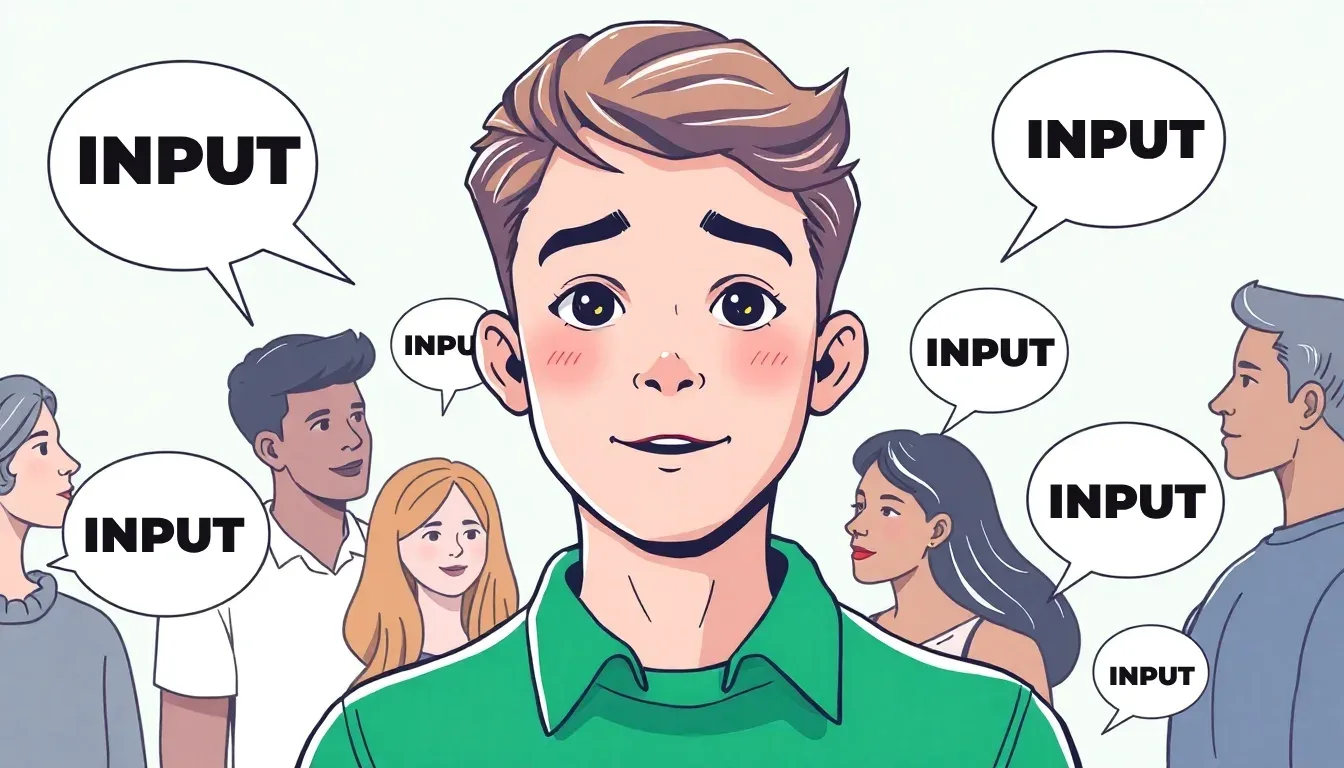
Stephen Krashen's Acquisition-Learning Hypothesis draws a sharp line between two entirely different brain processes: subconscious acquisition through meaningful, context-rich exposure, and conscious learning through grammar rules. Only acquisition produces the automatic, fluent output you need mid-conversation. Grammar study produces an internal editor that kicks in after the fact, too slow for real speech. That distinction explains something frustrating that many learners experience: years of formal study, strong exam scores, and still freezing the moment a native speaker talks at full speed. The method, not the learner, is the problem.
2. Doomscrolling Repurposed - How Native-Speed Video Hijacks Existing Habits to Deliver Input
Adults already spend a significant portion of their day watching short-form video. That habit already exists. The question is whether it works for you or against you.
Watching a short native-speed English clip with captions during a commute pairs sound, meaning, and context simultaneously, the exact conditions Krashen's Input Hypothesis identifies as fluency-building. Nation & Newton's (2009) research supports the broader principle: contextualised vocabulary encounters produce significantly stronger retention than isolated drill, which is why brief, well-chosen input sessions consistently outperform decontextualised grammar exercises of comparable or longer duration.
Passive scrolling only becomes intentional when the content is leveled to your current ability, which is where structure matters.
3. The i+1 Principle - Consume Content Just One Step Above Your Current Level
Krashen's Input Hypothesis specifies that acquisition happens when input is slightly above your current level. Content you understand 95% of stretches comprehension without triggering the anxiety that shuts acquisition down. Content that overwhelms you teaches nothing. This is a practical filter: if you understand almost nothing of a video, it is not yet useful input. If you understand everything, it is review, not growth.
4. Conversation Practice First - Why Speaking Beats Memorizing Grammar Rules

Speaking early feels uncomfortable. Most learners avoid it, defaulting to more preparation. That instinct backfires. Controlled studies in ESL and EFL contexts consistently show that learners who spend more time in actual output practice, even imperfect output, develop oral fluency faster than those who extend grammar study before speaking. Worrying about fluency itself becomes a psychological barrier that actively slows progress. The fix is low-stakes output: voice notes, short recordings, simple exchanges where being wrong carries no real cost.
5. Short Daily Sessions Win - Why 10-15 Minutes Every Day Beats Weekend Cramming
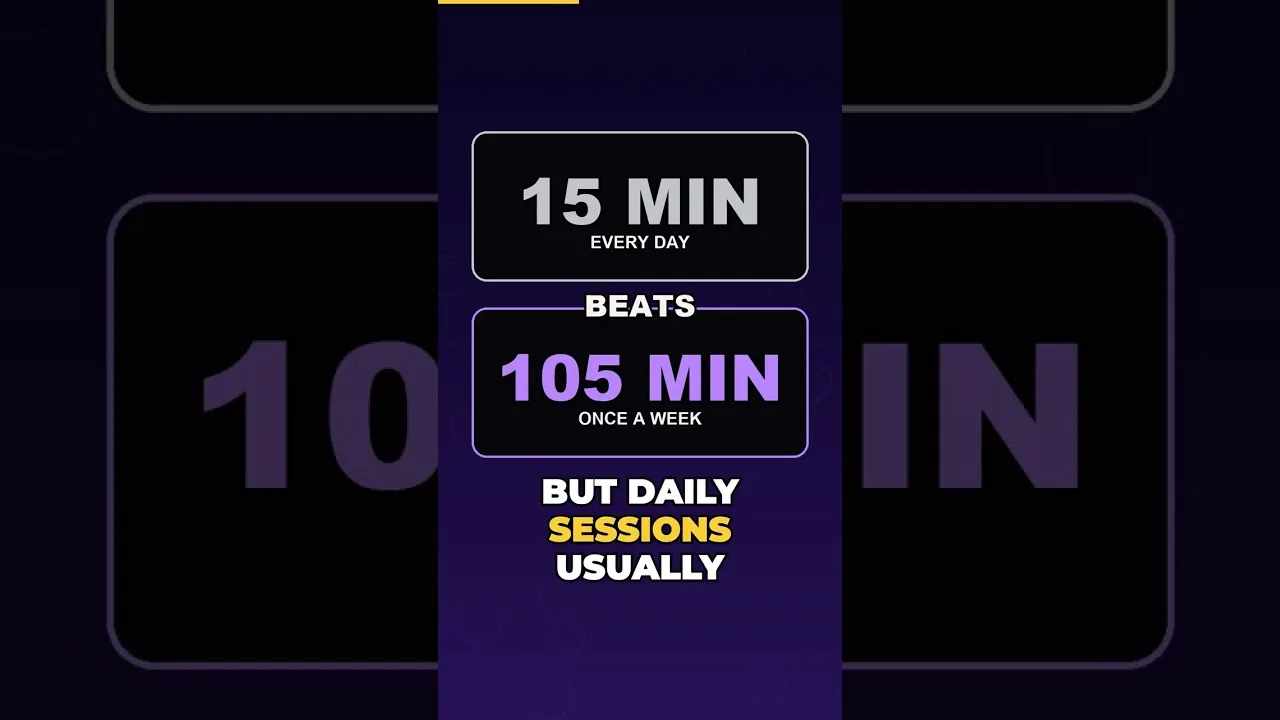
Gamified apps exploit streak mechanics to manufacture daily engagement, but the underlying behavioral insight is sound: frequency beats duration for language acquisition. Ten to fifteen minutes of focused English exposure daily outperforms a two-hour weekend session because spaced repetition consolidates memory more effectively. For busy learners who cite time as the reason English feels hard, this reframe removes the biggest perceived barrier. The tradeoff is that short sessions require higher intentionality, passive background noise does not count.
Next steps
If months of consistent app use left you unable to hold a real conversation, the path forward starts with recognizing that grammar drills and gamified streaks measure engagement, not acquisition. The method was never designed to build the automatic, real-time processing that conversation actually demands. Start with our learn Spanish.
Krashen's Acquisition-Learning distinction means that hundreds of hours logged on flashcard apps may be neurologically close to zero hours of actual fluency-building, because conscious rule memorization and subconscious acquisition activate different brain processes entirely. The Affective Filter research means that decontextualized, low-stakes exercises raise anxiety, block input processing, and produce a failure loop the learner misreads as personal inability. Together, they point to one practical next step: replace the input source with something that meets the minimum conditions the brain's acquisition system actually requires, specifically comprehensible, contextually rich content pitched just above your current level.
Start with Parrot's comprehensible input method to see how the same research-backed approach applies across languages. A placement test maps your current level, a scroll-native feed of real native video adjusts to where you actually are, and speaking practice with pronunciation scoring sits inside the same experience when you are ready to move beyond listening.
Frequently Asked Questions
Why do I freeze up talking to native speakers even after completing hundreds of lessons?
The gap between study time and real conversation ability is almost never a talent problem, it is a method problem. Apps built around streaks and grammar drills produce grammar knowledge, but not the automatic, real-time processing that conversation actually demands. A learner who completes hundreds of structured lessons but freezes when a native speaker says hello has succeeded at an activity that was never connected to real conversation in the first place.
Why is English so hard for people whose first language sounds very different?
English encodes more than 40 distinct phonemes using only 26 letters, and for learners whose native language has a tighter, more consistent phoneme inventory, like Spanish, sounds that exist in English simply do not exist in the ear yet. On top of that, spelling-to-sound correspondence in English is widely recognised by linguists as among the most irregular of any alphabetic language, so learners cannot reliably decode new words by sounding them out. These are structural features of the language, not personal shortcomings.
How long does it actually take to reach a working level of English?
The Foreign Service Institute estimates that English sits in Category I, requiring roughly 600 to 750 class hours for speakers of similar languages to reach professional working proficiency. That figure is a time-and-method equation, not a verdict on difficulty, learners who stall before conversational fluency are rarely stopped by English's genuinely hard parts, but by a method that never moved them efficiently past the easy parts.
Why does progress suddenly feel like it stops after the beginner stage?
Learners typically hit what the post calls the A2–B1 wall, a point where structured courses stop being useful but native content still feels impossibly fast. Every new word or grammar rule learned at this stage has a smaller individual impact on overall ability than it did at the start, so progress feels stalled even when it has not. Most courses are never designed to bridge that gap, they hand you vocabulary lists and conjugation drills right up to the point where real fluency begins, then leave you there.
Does the method I use actually matter, or is English just objectively hard?
According to the post, difficulty is not a property of English, it is a property of the gap between the method you use and the structural variables the language presents. Research by linguist Dr. Stephen Krashen shows that language is acquired when you understand messages, not when you memorize rules, meaning a method built on comprehensible input, content pitched just above your current level, can close gaps that grammar-first courses consistently cannot.