
French pronunciation rules don't fail you because they're wrong. They fail you because your brain can't retrieve a phonetic chart fast enough to move your mouth.
The common assumption is that if you just memorize enough rules and charts, your pronunciation will click into place on its own. But French uses a relatively small alphabet to represent a far larger inventory of distinct sounds, and the mapping between them shifts depending on context, neighboring letters, and word origin. That structural mismatch is why learning French pronunciation feels like trying to read a map where the same road symbol means three different things depending on which county you're in.
See our learn Spanish for how this works in practice. If you've ever drilled every rule in a pronunciation chart and still stumbled the moment a native speaker responded, the problem wasn't your effort. The problem was the map itself.
Spanish and Italian have near-perfect grapheme-to-phoneme consistency: one letter, one sound, almost every time. French does not. Research published in Applied Psycholinguistics found that contextual letters like "g," "s," and "e" produced significantly more incorrect pronunciation responses than control items, because a single letter can sound different in every word.
The same study concluded that "the difficulty of decoding French should not be underestimated," and that inconsistent correspondences leave critical pronunciation gaps that rule-based instruction cannot close. Silent final consonants compound the problem: letters like "d," "p," "s," and "t" generated significantly more unexpected answers even among adult readers. Knowing a rule and producing a sound are neurologically separate tasks.
Reading a rule activates declarative memory; speaking activates procedural, motor-based memory. Under conversational pressure, the brain cannot retrieve a phonetic chart fast enough to guide the mouth. Pronunciation fluency is built through repeated auditory exposure and physical repetition, not through reading descriptions of sounds.
Every hour spent re-reading a phonetic table is an hour your mouth isn't building the muscle memory that only comes from hearing and repeating real speech. More rules and more charts widen this gap rather than closing it.
Knowing a rule and producing a sound are neurologically separate tasks.
Key takeaways
French uses a small alphabet to represent a much larger set of sounds, and the mapping shifts based on context, neighboring letters, and word origin, that mismatch is why rules alone never stick.
Knowing a pronunciation rule and deploying it mid-sentence at natural speed are two completely different skills, and most beginners only discover the gap when they freeze in front of a native speaker.
French vowels are monophthongs, your mouth holds one fixed position with no glide, which is physically opposite to how English vowels work, making them a motor skill problem, not a knowledge problem.
At least 28% of French words end in a silent letter, according to the Silex database study published in Behavior Research Methods, silent endings are the default state of the language, not the exception.
Liaison, the rule that wakes those silent consonants back up before a vowel, follows its own logic, and hearing it in real speech dozens of times trains the pattern far faster than reading about it.
The uvular R and nasal vowels have no English equivalent, there is no existing muscle memory to retrain, only a blank space to fill through repetition of real input.
Parrot (parrotapp.com) closes that gap by feeding you short native French video clips, the same comprehensible input method that research consistently ranks as the most effective path to spoken fluency, so your mouth gets the reps your chart-drilling never could.
The Phonetic Chart Trap That Keeps Beginners Stuck
Most beginners discover this the hard way: they ace the phonetic chart at home, then freeze solid when a native speaker actually responds to them.
Why Your Brain Files Phonetic Symbols as Trivia Not Speech
Abstract symbols like IPA characters get stored in memory the same way trivia does: retrievable when you're calm, sitting still, and have time to think. What most teams of cognitive researchers report is that working memory is critically involved in language processing, and abstract symbolic representations place high demands on its resources, making retrieval under real-time conversational pressure unreliable. In a live conversation, your brain is already juggling listening, parsing meaning, and formulating a response. Adding "look up the nasal vowel rule" to that list exceeds available capacity entirely, because the retrieval process itself is the bottleneck.
The 80/20 Reality Most Guides Bury Under Obscure Rules
Most beginner guides front-load an overwhelming number of rules in the first chapter. Native speakers, meanwhile, rely on a small set of high-frequency sound patterns for the vast majority of everyday conversation. That's exactly where we're headed next: the vowel sounds that carry 80% of French conversation, explained as physical positions your mouth can try right now.
80%
of French conversation from a small sound set

French Vowel Sounds Every Beginner Needs to Know
Several distinct vowel sounds catch English speakers off guard in French, and the reason they're hard isn't complexity. It's physics.
1. The Letter 'A' - From Open 'ami' to Rounded 'âme'
French uses six core vowel letters, each with a primary sound beginners must internalize before tackling exceptions. The letter 'a' in 'ami' (friend) produces a bright, front-of-mouth sound, while 'e' in 'été' (summer) sits mid-range, 'è' in 'fête' opens wider, 'o' in 'beau' rounds the lips, 'u' in 'tu' requires tight lip-rounding with no English equivalent, and 'eu' in 'coeur' blends both. Mastering these six anchors every French pronunciation rule that follows.
2. The Acute Accent (é) - Locking the Vowel to a Crisp, Closed 'ay' Sound
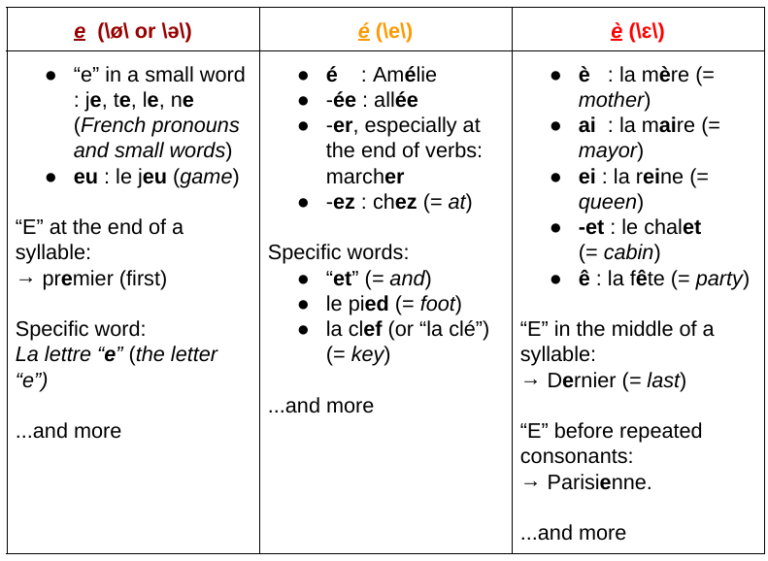
The acute accent signals a closed vowel: lips pull slightly back, jaw stays relatively high, and the sound does not glide. Spokira confirms that é produces a closed /e/ sound, distinct from anything English maps to the letter 'e'. English speakers instinctively add a glide at the end, turning café into something closer to "caf-ay-ee", a direct consequence of the English /eɪ/ diphthong firing automatically, a sound category that simply has no place in the Metropolitan French vowel inventory. Holding the position still, without that drift, is the entire skill, and it only becomes automatic through repeated listening to real native speech.
3. The Grave and Circumflex Accents (è, ê, â, ô) - Opening the Vowel Sound Wider
Where é closes the mouth, è and ê open it. Your jaw drops slightly, the sound spreads, and the result is a noticeably looser vowel quality heard in words like fête and père. The circumflex on â and ô signals a similar opening and rounding effect.
These accent marks shift the vowel sound produced, not merely the spelling, a distinction Spokira consistently emphasizes and one that French spelling reform debates have circled for over a century. Treating them as punctuation rather than mouth instructions is the most common beginner error, and it persists until audio exposure corrects the habit. The an/en nasal is produced by letting air flow through the nose while the back of the tongue rises slightly.
The result is the sound in blanc and enfant, a resonant, open quality with no equivalent in English. Beginners often substitute a plain 'ah' followed by an 'n' consonant, which sounds clipped and unnatural to French ears. Hearing blanc spoken naturally dozens of times until the breath pattern becomes instinctive is more effective than memorizing a rule about nasal resonance.
Because Parrot's comprehensible input method governs how content is selected and sequenced for each learner, high-frequency nasal vowel words surface repeatedly across sessions, not as drills, but embedded in real conversational audio, which is exactly the repetition density the ear needs to stop treating /ɑ̃/ as an exotic symbol and start recognizing it as a familiar sound. The in/ain nasal, heard in pain (bread), sits higher and brighter than the on nasal in bon (good), which is rounder and produced further back in the mouth. On paper the distinction looks manageable.
In real speech, under the pressure of listening and responding simultaneously, learners consistently collapse the two into one approximate sound. Part of what makes this so persistent is the IPA-to-ear gap: /ɛ̃/ and /ɔ̃/ look unambiguously different in a textbook, yet in connected speech at native speed they blur in ways that make beginners question whether they've been studying the right sounds at all. Spokira is consistent on this point: the four nasal categories appear in high-frequency everyday words and must be internalized through active listening and muscle memory, not rule memorization alone.
Minimal-pair listening, hearing pain and bon back to back in context, is the fastest path to separating them reliably, and every Parrot video session contributes to that listening bank immediately, from the very first watch. The structural difference between French and English vowels is physical, not abstract. French vowels are held at a single, steady mouth position without any glide, while English vowels routinely shift mid-sound, a structural contrast documented in comparative phonetics research and a foundational reason English speakers struggle with French vowel production.
Say "oh" in English and your lips round then release. Say eau in bateau and your mouth parks and holds. That stillness feels unnatural to English speakers because every vowel in their native system moves, and because the diphthong /eɪ/ that English speakers reach for most automatically has no counterpart anywhere in the Metropolitan French vowel system.
The practical implication is significant: even when a beginner reads the correct accent mark and understands the rule, the English diphthong habit fires automatically in real speech. Training it out requires hearing pure vowels in real conversational audio repeatedly, not reviewing a chart one more time.
4. The Nasal Vowel 'an/en' - Breath Through the Nose on 'blanc' and 'enfant'
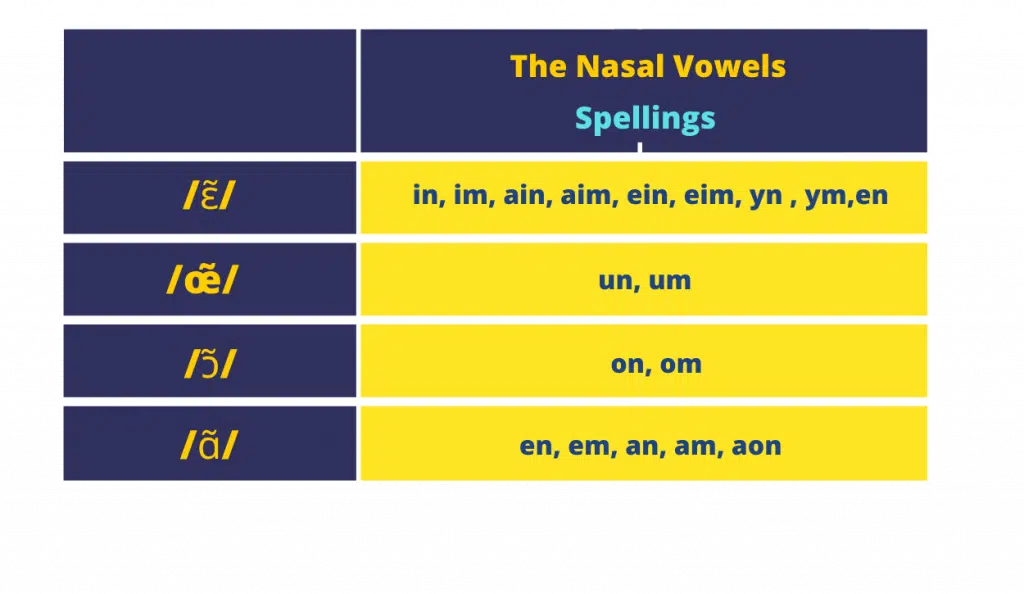
French nasal vowels are produced by letting air flow through the nose while shaping the mouth for the base vowel, no separate nasal consonant sound follows. The 'an/en' group, heard in 'blanc' (white) and 'enfant' (child), requires an open, back-of-mouth position with nasal resonance. English has no true equivalent, making this one of the hardest French pronunciation rules for beginners. The key trap: do not close the sound with an 'n' or 'm', the nasal quality replaces the consonant entirely.
5. The Nasal Vowels 'in/ain' and 'on' - Hearing the Difference in 'pain' and 'bon'
The 'in/ain' nasal (as in 'pain', bread) sits higher and more forward in the mouth than 'an', while 'on' (as in 'bon', good) rounds the lips like a nasal 'o'. These two sounds appear constantly in everyday speech, 'un bon vin blanc' (a good white wine) contains all four French nasals in four words. Beginners frequently merge 'in' and 'an' into a single muddy sound; keeping the lip and jaw positions distinct is the critical French pronunciation rule that separates clear speech from incomprehensible guessing.
6. Pure Vowels vs. English Diphthongs - Why Your Mouth Must Stay Still
French vowels are 'pure', the mouth shape is set at the start and held steady for the entire duration of the sound. English speakers naturally glide from one position to another (the 'o' in 'go' ends with rounded lips moving forward), but applying that habit to French produces a foreign accent immediately. Practicing words like 'beau' or 'tu' in front of a mirror to confirm zero jaw or lip movement is the single most transferable French pronunciation rule, correcting dozens of vowel errors at once.
Related Reading
How Long To Learn French
French Alphabet Pronunciation
How To Learn French Through Conversation
How To Learn French With Movies
Learning Resources For African French
French Consonant Sounds That Surprise English Speakers
That automatic diphthong habit is only part of the problem. Four consonant sounds will betray an English accent just as fast, and they resist correction for a different reason: each one requires placing your mouth or throat in a position English never demands, so there is no existing muscle memory to retrain, only a blank space to fill.
1. The French R - A Throat Sound English Speakers Must Unlearn
The French R is produced at the uvula, the small tissue at the back of your throat, not at the tip of your tongue the way English speakers instinctively reach for it. This is not a minor adjustment. It represents an extreme articulatory jump, from the alveolar position that English uses all the way back to the uvula, a place of articulation with no equivalent in standard English phonology.
Because there is no English sound even close to it, there is no existing motor habit to retrain; the movement has to be built from scratch. Spokira recommends approximating the French R by mimicking a light gargling motion and drilling it inside high-frequency words like rouge, rue, and merci until the throat position becomes automatic. Say "Paris" with an English R and a native speaker clocks you immediately.
Muscle memory for the uvular R takes deliberate, repeated exposure to real speech before it stops feeling forced, and that exposure has to be inside real words, not isolated drills, because the sound shifts shape depending on every word around it. Parrot's short-form video feed puts this sound in front of you inside natural, native-speaker sentences continuously, so your ear registers what the uvular R actually feels like at conversational pace rather than in the sanitised version a textbook recording offers.
2. Silent Final Consonants - The D, S, T, X, Z Default Rule and Its Exceptions
The default rule is simple: D, S, T, X, and Z at the end of a French word are almost always silent. "Vous" is "voo," not "vooz." Every English instinct pushes you to pronounce that final letter, so the rule has to be drilled until silence becomes the reflex. The tradeoff is that exceptions exist, and they matter. As Spokira notes, fixed words like fils, net, and sens break the pattern, and liaison contexts wake those consonants back up entirely. This section hands that liaison territory to the next layer of spoken French.
3. French U vs. OU - The Single Vowel Swap That Marks a Non-Native Speaker Instantly
Confusing tu (you) with tout (everything) does not just mark your accent; it changes the meaning of your sentence. Among the vowel distinctions that mark a non-native speaker most quickly, the u vs. ou confusion is widely cited by French phonetics instructors as the most persistent: u requires lips pushed forward with the tongue high and front, while ou is a back rounded vowel. The physical positions feel almost identical to beginners, which is exactly why mixing them up persists even after learners consciously know the rule. Hearing native speakers use both sounds in context, the way Parrot's video feed delivers them, gives your ear the real acoustic gap between the two rather than the abstraction a diagram provides.
4. C, G, and S Context Rules - How the Following Vowel Changes Everything
These three consonants do not have fixed sounds. Their pronunciation shifts based entirely on the vowel that follows them. The mechanics follow a consistent pattern: c is soft before E or I, hard before A, O, or U; g follows the same pattern; s between two vowels becomes a Z sound.
Knowing the rule is straightforward. Executing it at real conversational speed is a different cognitive act entirely. The shift has to become anticipatory, something your mouth does before your brain registers the next letter, and that only happens through hearing these sounds move inside real words repeatedly.
Parrot's Comprehensible Input Method governs how content is selected and sequenced for each learner, which means these context shifts appear in your feed at a density and difficulty level calibrated to your current stage, not dumped on you all at once.
5. The French Nasal Consonants - N and M That Disappear Into the Vowel
In French, N and M after a vowel often stop being consonants at all. They nasalize the vowel before them and then dissolve. The word maison does not end with a crisp N; the vowel absorbs the nasal quality and the N itself disappears into it.
Conscious knowledge does not transfer to reflex without the right input. Even after learners can produce a passable nasal vowel in isolation, real speech collapses that effort: the surrounding sounds change the target, and a mouth that has only rehearsed the sound in silence cannot keep up. This is where most learners hit a wall they cannot think their way out of.
The honest limitation of any written guide, including this one, is that describing these sounds in text only gets you so far. The French R, context-shifting consonants, and nasal vowels are motor habits that change shape depending on every word around them, and the only training that transfers to real speech is hearing those shifts inside natural sentences until your mouth learns to anticipate them. Parrot's short-form native video feed embeds these sounds in real spoken French at natural pace, drawn from content by real native speakers, so your ear and mouth calibrate together rather than rehearsing an isolated sound that collapses the moment real speech speeds up.
When passive watching surfaces a pattern you want to lock in, Parrot Back puts you into active speaking practice against that same material, so the sounds you have been hearing become sounds you can produce with confidence. Master these consonant mechanics and you have built the core sound-production layer of French. But knowing how individual sounds work is only half the picture.
The next layer is what happens between words in real spoken French, where silent letters suddenly wake up and consonants leap across word boundaries in ways that can make even a well-drilled beginner feel like they are hearing a completely different language.
Silent Letters and Liaisons in French Spoken Like a Native
At least 28% of French words end in a silent letter, according to the Silex database study published in Behavior Research Methods in November 2016. These silent letters are fossilized sounds, consonants that were fully pronounced in Old French but gradually dropped from spoken use between roughly the 13th and 17th centuries, while the spelling stayed frozen in place. Understanding this history changes how you approach the problem: instead of memorizing a blacklist of silent letters word by word, you recognize that final consonants in French are silent by default as a result of a dateable, directional historical shift.
The mnemonic CaReFuL identifies the four final consonants that are typically still pronounced in French: C, R, F, and L. These are the main exceptions to that default silence. Liaison is the mechanism by which a normally silent final consonant reactivates before a vowel-initial word.
Liaison is mandatory in specific grammatical contexts and forbidden in others. After the conjunction et, liaison never occurs; saying et-amis marks you immediately as a non-native speaker. A related process, elision, works differently: the articles le and la drop their vowel before a vowel-initial noun, giving you l'ami and l'école rather than le ami or la école.
The next section shows exactly why your mouth learns faster from listening than from any rule you can read.
Related Reading
French Language Learning Resources
Fastest Way To Learn French
Best App To Learn French For Travel
Best Books To Learn French
How Long To Learn French
French Alphabet Pronunciation
How To Learn French Through Conversation
How To Learn French With Movies
Learning Resources For African French
How To Conjugate Re Verbs In French
How Listening to Native French Speech Actually Trains Your Mouth
French pronunciation trips most learners up not because they lack the right rules, but because rules alone cannot train the muscles in your mouth to produce sounds that do not exist in English. This section breaks down why that process works and how pairing authentic audio with text, the way Parrot is built to do, is what finally makes those sounds stick.
Why Your Mouth Needs Reps Not Rules - The Comprehensible Input Case
Consider that the uvular R is produced deep in the throat, in a place most English speakers have never consciously engaged. Sounds like this are not intellectual concepts you can simply understand and then execute. They are motor skills, and your articulatory system can only learn them through imitation of real speech.
Stephen Krashen's Input Hypothesis established in 1982 that people acquire language the same way children do: through massive, repeated exposure to meaningful messages, not through conscious rule memorization. The brain absorbs sound patterns implicitly when it hears authentic speech repeatedly in context, a process that phonetic charts simply do not trigger. Hearing a sound repeatedly in real sentences tells your mouth how to make it, automatically, without thinking.
The Subtitle Method - How Dual-Channel Listening Locks In French Sound Patterns
Watching French content with subtitles does something a phonetic table cannot: it pairs the sound with meaning in real time. Your brain processes the audio channel and the text channel simultaneously, building a direct link between what you hear and what it signifies. A learner who watches one 60-second French video clip daily and shadows the speaker naturally internalizes liaisons, the way "les amis" collapses into "lay-za-mee," without ever reading the rule. Compare that to reading a liaison rule in isolation, where there is no sound, no meaning, and no muscle memory being built.
10-Minute Listening Slots That Beat a Weekly 90-Minute Study Session
Frequency matters far more than session length when it comes to pronunciation. Research on spaced learning and phonological acquisition consistently points in the same direction: the brain consolidates implicit sound patterns more effectively through repeated, contextual exposure than through infrequent, longer grammar-study sessions. Short daily contact with authentic audio compounds in a way that weekly study blocks simply do not replicate. Parrot operationalizes this directly by replacing aimless scrolling with short, comprehensible French video clips. Listen in short, frequent bursts to real native speech, let your ear lead your mouth, and let subtitles do the heavy lifting your phonetic charts never could.

Next steps
If your pronunciation still collapses the moment a native speaker responds, the path forward starts with replacing rule retrieval with motor habit. Working memory is already full in live conversation, and your brain drops the phonetic chart first. That is not a discipline problem. It is a capacity problem, and no additional rule closes it. Start with our learn Spanish.
The research on comprehensible input shows that 70 hours of meaningful exposure achieves what 286 hours of traditional instruction cannot, because the brain absorbs sound patterns implicitly through repeated contact with real speech, not through conscious recall. At the same time, sounds like the uvular R, nasal vowels, and context-shifting consonants are motor skills, not intellectual facts. Your articulatory system can only learn them through imitation. Together, those two findings point to the same next step: your mouth needs reps inside real native audio, not another chart to memorize.
If you want to go deeper on how listening-first methods build the kind of automatic pronunciation this guide describes, parrotapp.com shows how comprehensible input applies across romance languages. The principles carry directly into French, and seeing the method in a parallel language often makes the logic click faster than re-reading the French rules one more time.
Frequently Asked Questions
Why do French accent marks actually matter for pronunciation?
Accent marks in French actively shift the vowel sound produced, not merely the spelling. For example, the acute accent (é) signals a closed vowel where your lips pull slightly back and the jaw stays high, while the grave and circumflex accents (è, ê) open the vowel wider by dropping the jaw, treating them as punctuation rather than mouth instructions is the single most common beginner error.
Why do French vowels sound so different from English vowels?
French vowels are monophthongs, meaning your mouth holds a single, steady position for the entire sound without any glide. English vowels routinely shift mid-sound, say "oh" in English and your lips round then release, but the equivalent French sound requires your mouth to park and hold, a physical habit that only becomes automatic through repeated listening to real native speech.
Is it really possible to learn the same French spelling but get two completely different sounds?
Yes, research published in Applied Psycholinguistics found that contextual letters like "g," "s," and "e" produced significantly more incorrect pronunciation responses than control items precisely because a single letter can sound different in every word. The study concluded that "the difficulty of decoding French should not be underestimated," since inconsistent correspondences leave gaps that rule-based instruction cannot close.
What's the biggest mistake beginners make when trying to improve their French pronunciation?
The biggest mistake is relying on phonetic charts and rules instead of building muscle memory through audio repetition. Knowing a rule activates declarative memory, but speaking fluently requires procedural, motor-based memory, and under the cognitive load of live conversation, your brain drops retrieved rules first, falling back on automatic habits like the English diphthong, no matter how well you memorized the chart.
Why are French nasal vowels so hard to tell apart in real conversation?
On paper, nasal vowels like /ɛ̃/ in pain and /ɔ̃/ in bon look clearly different, but in connected speech at native speed they blur in ways that make learners question whether they've been studying the right sounds at all. The distinction isn't a rule you can recall mid-sentence, it's a muscle memory built through repeated exposure to real audio, which is why minimal-pair listening inside real conversational context is the fastest path to separating them reliably.