
Most adult learners book a qualified tutor, nail their conjugations, then freeze ordering coffee in Paris. The problem is not your effort: it is the format you chose.
The common assumption is that a qualified human tutor who corrects grammar and assigns structured exercises is what adult beginner learners need to finally speak French. Booking a private French tutor feels like the responsible choice. You're paying for expertise, accountability, and a real human who corrects your mistakes.
Yet a striking pattern emerges among adult learners who go this route: months of sessions, a solid grasp of verb conjugations, and then a trip to Paris where ordering a coffee feels impossible. The gap between lesson performance and real conversation is structural. Fixed lesson blocks demand that your life bends to the calendar.
A Tuesday at 7 PM slot works perfectly in week one. Then a work deadline hits, a kid gets sick, or a dinner runs long, and suddenly you have missed two sessions in a row. That friction is not random.
Research published in Behavioral Sciences by Tan and Li in April 2025, studying a large-scale sample of online learners across hundreds of courses, found that engagement collapses at predictable structural breaks, not because learners lose interest but because rigid scheduling creates dropout moments baked into the format itself. Research on adult language learner dropout consistently identifies scheduling conflicts and time constraints among the most commonly cited reasons learners disengage from structured programs entirely. Most tutor sessions default to what is easiest to teach and measure: grammar rules, vocabulary lists, and textbook phrases.
The problem is that Stephen Krashen's comprehensible input research, the most cited framework in second-language acquisition, draws a hard line between learning a language consciously and acquiring it through real exposure. Grammar instruction builds test-takers. Comprehensible input builds speakers.
A pattern language researchers and educators observe consistently is a gap between written or tested grammar competence and real-time spoken comprehension. Learners who perform well on structured exercises often report freezing when a native speaker accelerates or uses informal phrasing no textbook captured. The mechanism, as Krashen's comprehensible input framework explains, is that knowing rules consciously does not automatically produce spontaneous speech.
The classroom version of French and the Parisian café version are not the same language.

Private online French tutors on major platforms typically charge a wide range of hourly rates, with many professional teachers sitting well above what a casual learner might initially budget for. The financial pressure that was supposed to create accountability instead creates an exit ramp. You stop opening the booking app not because you gave up on French, but because every reminder of the unpaid session stings.
Skilled online French tutors offer something no app can fully replicate: real-time error correction, cultural nuance, and the accountability that comes from a live human watching you work. The constraint is structural, not qualitative. The platform model, the pricing tier, and the fixed-slot format can work against habit formation even when the tutor is excellent, and that friction is worth understanding before you book.
Key takeaways
Reaching B2 conversational French requires 600-650 cumulative hours of study, one weekly 60-minute session gets you there in over a decade, not a year.
Most tutoring platforms are built around rotating teachers, rigid subscriptions, and zero quality vetting, the format works against fluency before the tutor even opens their mouth.
A trial lesson is a sales call: it's designed to make you feel capable enough to buy a package, not to surface how inflexible the scheduling becomes once you're a paying student.
Grammar correction and structured drills produce learners who are fluent on paper and silent in conversation, comprehensible input, not error marking, is what rewires an adult brain for a new language.
Booking a tutor slot as your starting gun costs you days of pattern recognition and vocabulary exposure that can't be rescheduled.
Platform model determines your outcome more than any individual tutor's résumé or star rating, match the format to your goal first.
Parrot's AI tutor closes the gap by delivering personalized, adaptive French practice that fits the actual gaps in your day, no booking window, no rotating teachers, no waiting to start.
How to Compare Online French Tutoring Platforms Before Spending a Cent
Most adult individual learners (beginners) arrive with a clear conviction: "A qualified human tutor who corrects my grammar and assigns structured exercises is what I need to finally speak French." Learners who have already cycled through Preply, italki, and AmazingTalker and still haven't found the right fit aren't doing something wrong; the comparison problem is real, and most platforms do nothing to solve it before you pay. - Does this actually cost me if I quit?
Can I book around my real week, not my ideal one? - Does this tutor's specialty match what I'm trying to do? Budget, scheduling flexibility, and goal alignment are the only three axes that predict whether a platform sticks.
Platform Comparison Checklist - Use This Before You Pay
"I find it difficult to locate affordable online French tutors through standard search methods, as most platforms surface only 'professional' tutors with high hourly rates (e.g. $30+/hour minimum)."
— what we hear from online language learners

Budget fit → What to ask: What is the total monthly cost if I attend every session? → Red flag: Hidden credit-expiry or lapsing fees.
Scheduling flexibility → What to ask: Can I book within 24 hours? Is there a cancellation window? → Red flag: Rigid weekly slot with no rescheduling.
Goal alignment → What to ask: Does this tutor list my specific goal (conversational, DELF, business)? → Red flag: Tutor whose profile lists no specialty.
Trial lesson quality → What to ask: Can the tutor describe my next 10 sessions concretely? → Red flag: Vague or improvised answer.
Between-session support → What to ask: What homework or resources do they assign? → Red flag: Nothing assigned outside live sessions.
Methodology match → What to ask: Do they use comprehensible input, grammar-translation, or hybrid? → Red flag: Pure grammar-translation for a fluency goal.
Aligning platform choice with your specific learning goal matters more than most learners expect. As italki's guide to tutor costs makes clear, whether your target is conversational fluency, exam preparation, or business French, choosing the wrong specialization wastes both time and money. A platform with 400 tutors sounds like flexibility, but if your realistic practice window is a commute, a lunch break, or twenty minutes before bed, you need to confirm coverage before you pay, not after.
Price ranges vary enough to matter. italki's pricing data shows French tutors charging anywhere from $5 to $80+ per hour, with community tutors generally occupying the lower end of that range and professional teachers commanding significantly higher rates. Most tutoring marketplaces also take a platform cut of tutor earnings, a cost that flows back to learners through higher session prices, making true cost transparency a legitimate comparison factor before you commit.
Italki's pay-as-you-go structure means learners are not locked into any hard commitments, with no subscriptions required. As italki's guide notes, trial lessons exist to assess teaching style and lesson structure before purchasing a package. A tutor who can't answer the ten-session question is improvising, and improvisation at $30 a lesson adds up fast.
Whether same-week or next-day booking is actually available at the times you use, not just listed as a feature.
What the cancellation window is and whether a late cancel costs you a credit.
Whether your tutor has enough open slots that rescheduling is a real option rather than a theoretical one.
Preply ties learners to a subscription that renews regardless of attendance, which means a busy month costs the same as an active one.
italki's pay-as-you-go model removes that particular pressure, but it does not automatically solve the availability problem if the tutors you can afford have limited time slots.
LanguaTalk and AmazingTalker vary by individual tutor, so the platform's stated flexibility may not match the specific person you want to book.
The honest test is whether your tutor's actual calendar, at the hours you genuinely have, holds enough open slots to absorb a rescheduled session without a two-week gap.
A two-week gap at the beginner stage is close to a reset.
-
Does This Tutor's Specialty Match What I Am Actually Trying to Do?
A tutor who is excellent at DELF exam preparation is a different hire from one who is excellent at getting a nervous beginner to hold a five-minute conversation without freezing. - Both may be qualified, experienced, and well-reviewed. - The mismatch only becomes expensive once you have booked a package and realized that every session is drifting toward grammar rules and written accuracy when what you needed was repetition, modeling, and low-stakes speaking volume. - Credentials and star ratings do not surface this distinction. - A five-star tutor whose reviews come entirely from exam candidates is a five-star tutor for a specific purpose, and that purpose may not be yours. - When reading a tutor profile, look past the credential list and read the review text for language that matches your actual goal. - Reviews that mention "helped me pass DELF B2" and reviews that mention "I can finally order food and understand the response" are describing two different tutors even if both profiles list conversational French as a specialty. - During the trial lesson, the methodology question is where this gap becomes visible fastest: a tutor whose instinct when you struggle is to stop and explain a grammar rule is running a different program than one whose instinct is to rephrase, slow down, and model the correct form in context until it lands. - Neither approach is universally wrong, but the grammar-explanation reflex tends to serve learners who are preparing for written tests and tends to frustrate learners who are trying to build spoken fluency through volume and exposure. - Knowing which reflex your tutor has before you buy a ten-session package is the difference between a method that compounds and one that reproduces the same ceiling you hit on the last platform you tried.
Related Reading
French Language Learning Resources
Best App To Learn French For Travel
Best Books To Learn French
How Long To Learn French
French Alphabet Pronunciation
How To Learn French Through Conversation
How To Learn French With Movies
Learning Resources For African French
How To Conjugate Re Verbs In French
10 Best Online French Tutors and Platforms to Book for Private Lessons in 2026
Platform model determines your outcome more than any individual tutor's résumé. A credentialed instructor on a platform built around rotating teachers, rigid subscriptions, or zero quality vetting can cost you months of progress before you realize the format itself was working against you. The ten picks below each solve one specific problem. Match the platform to your goal, not to the star rating.
Pros and cons at a glance
✓ Pros
✗ Cons
Monthly subscription enforces consistency via payment structure
Unused lessons lapse if schedule shifts mid-month
One tutor, one time slot, no weekly decision fatigue
Sunk cost compounds fast under standard subscription terms
Works well for people who procrastinate without financial commitment
Only right pick when calendar is genuinely stable
Lingoda operates as a structured online language school, not a tutor marketplace. Its curriculum does not reach C2 for any language; the highest level offered is C1 (for German and English), while French, Spanish, and Business English top out at B2, and Italian at A2. This makes it a strong choice for learners who want a defined progression path with measurable milestones, but those targeting C1 or C2 in French will need to look elsewhere. The structural limitation is significant: Lingoda uses rotating teachers across its group and private classes, so you will not build a relationship with one instructor. Learners who plateau without a consistent teaching voice, and many do, find this format frustrating regardless of how well-designed the curriculum is.
Parrot App - Immersive Input and Speaking Practice Between Tutor Sessions
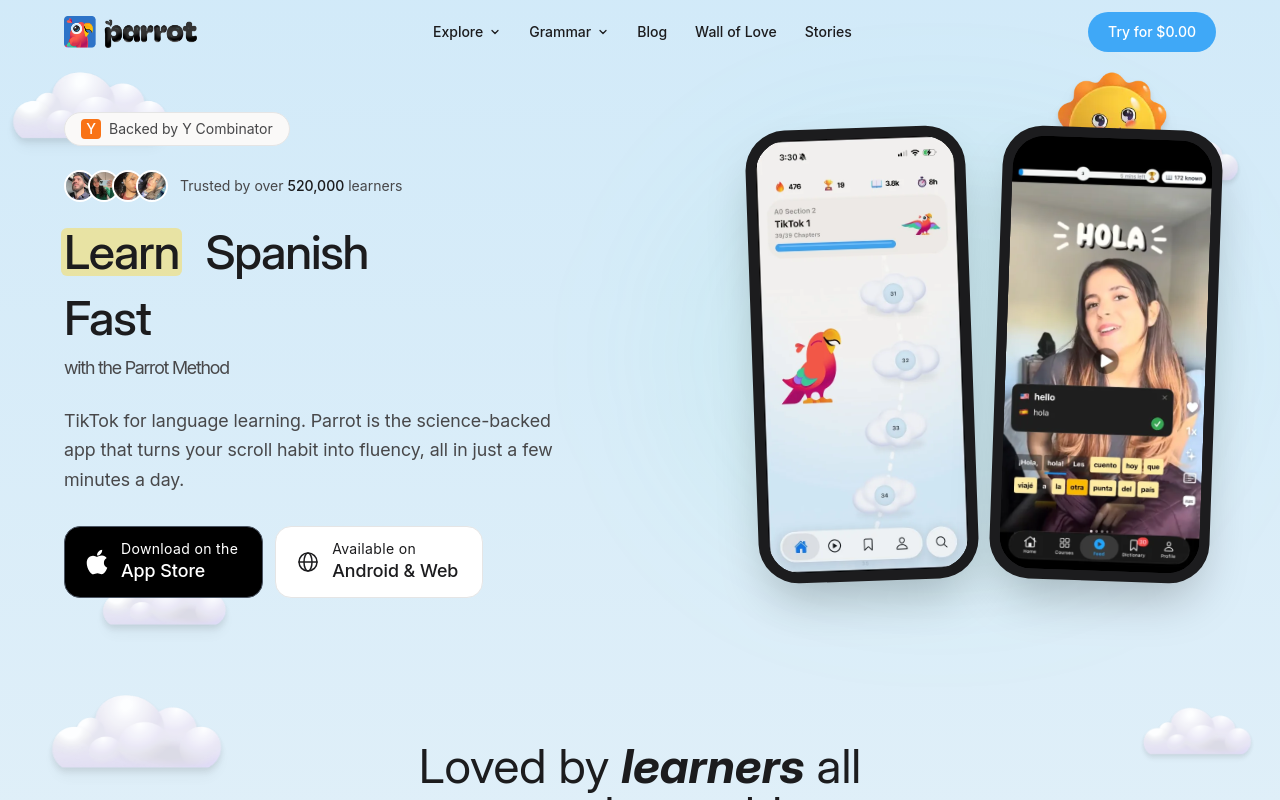
The gap between "textbook French" and real spoken French is not a tutor problem; it is a format problem. Most adult beginners reach a wall where conjugation drills feel fluent on paper but dissolve the moment a native speaker accelerates through a sentence, drops a syllable, or reaches for slang that never appeared in a lesson. That disconnect is what drives learners away from traditional methods and toward something built around actual spoken language from the start.
The method is 80% input (listening, reading) and 20% output (speaking). A TikTok-style scrollable feed of short videos created by native Spanish speakers, delivering real, engaging content matched to the learner's level, is the core delivery mechanism of the entire app. For learners who have found that memorization-based approaches produce knowledge that doesn't survive contact with a real conversation, this is the structural alternative.
Expanding to French & English language learning in the upcoming quarter, it adds a layer of active, personalized practice on top of that immersive content. When passive watching surfaces a gap, Parrot Back (speaking practice) lets you act on it immediately, producing and refining the language rather than re-reading it. The comprehensible-input method underlies every session, governing how content is selected and sequenced for each learner individually.
Parrot is most beneficial when a learner wants active, personalized practice on top of immersive video content, particularly if they have struggled with memorization-based approaches and need a research-backed alternative that fits the 10-minute windows already in their day, not the 60-minute blocks that never quite materialize. There is no booking window, no subscription tier, and no tutor whose calendar fills before yours does. The honest trade-off: learners who need a human to hold them accountable for structured grammar correction will want to pair it with a professional teacher.
1. italki - Best Open Marketplace for Filtering by Price, Dialect, and Specialty
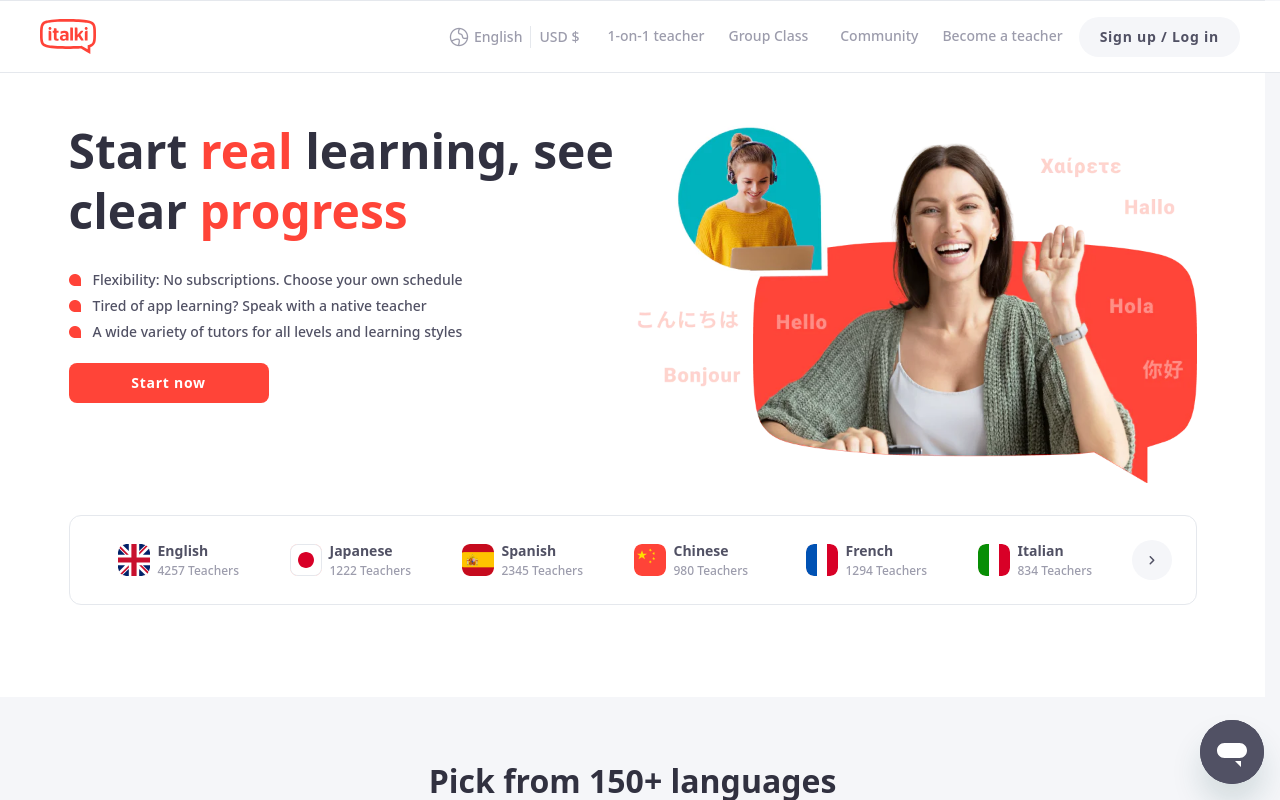
italki's marketplace model works like this: you browse teachers by language and price, then book individual lessons with no recurring commitment required. According to Glassdoor's salary data, the average italki Community Tutor earns $23 per hour, but community tutors and professional teachers occupy very different price bands on the platform, and that gap matters enormously for a certification candidate. The real risk: without a quality floor, a low-cost community tutor who defaults to casual chat will not move a DELF candidate forward.
2. Preply - Best Subscription Platform for Recurring Weekly Lesson Cadence
Preply suits learners who want consistency enforced by a payment structure. Its monthly subscription model bundles a set number of lessons per week, which works well for people who know they will procrastinate without a financial commitment already made. The trade-off is well-documented among subscription learners: if your schedule shifts mid-month, unused lessons lapse under standard subscription terms, and the sunk cost compounds fast, a dynamic that Preply's own subscription FAQ acknowledges through its rollover and pause policies. Preply is the right pick when your calendar is genuinely stable and you want one tutor, one time slot, and no decision fatigue each week.
3. Lingoda - Best CEFR-Aligned Online School with A1–C2 Curriculum
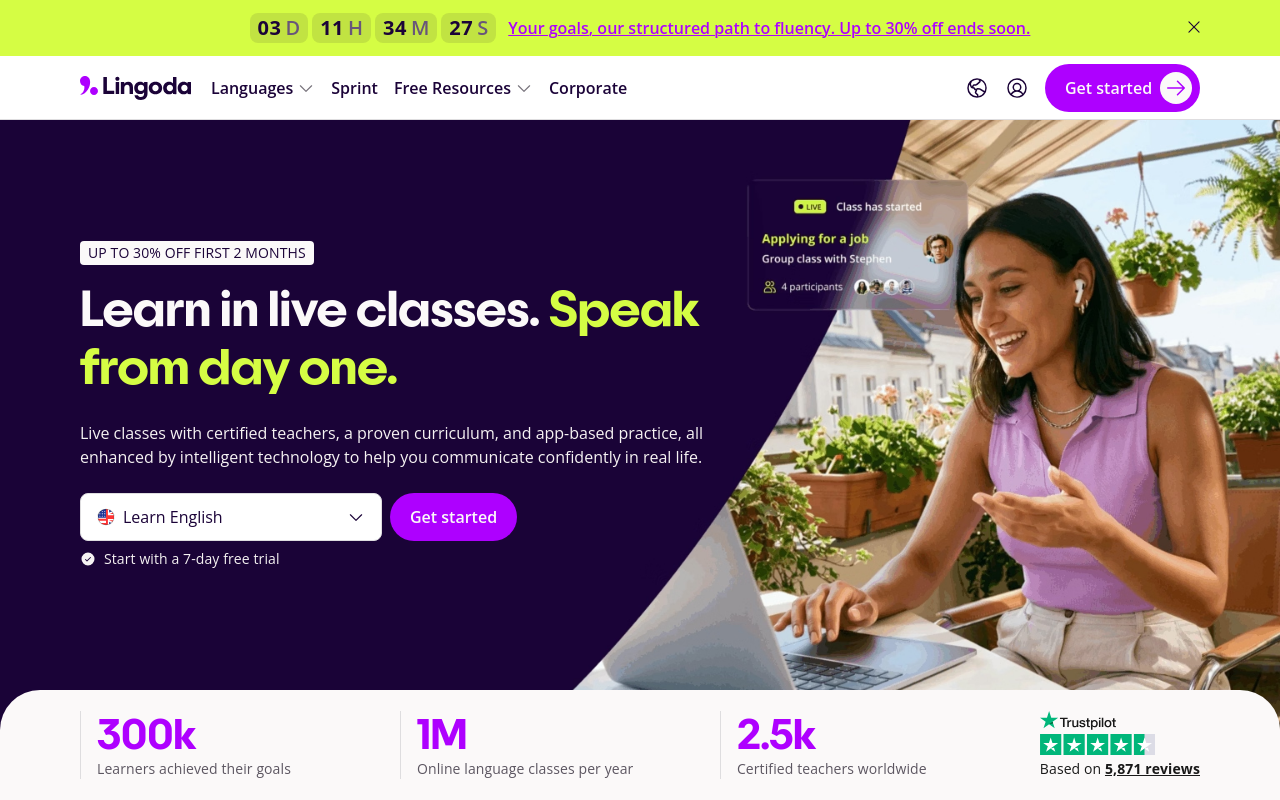
Lingoda operates as a structured online school rather than a tutor marketplace, offering a CEFR-mapped French curriculum from A1 through C2 with standardised lesson materials across all teachers. Its rotating teacher model means learners attend group or private classes with different native-speaker instructors, building exposure to varied accents and teaching styles. Best for learners who want classroom-style progression with certificates. The tradeoff: no single dedicated tutor relationship, which some learners find disorienting.
4. Verbling - Best for Friction-Free Browser-Based French Lessons
Verbling markets itself as an "all-in-one platform" accessible wherever you go, but its own page makes no mention of a browser-based classroom or the absence of setup or download requirements; the "friction-free browser-based" distinction is not supported or stated by Verbling's page. Tutor quality varies, as it does on any open marketplace, but the interface removes one genuine barrier to showing up consistently. Best for learners who have abandoned previous tutoring attempts partly because the tech felt like a chore before the lesson even began.
5. LanguaTalk - Best Vetted Tutor Network with Free Trial Lesson
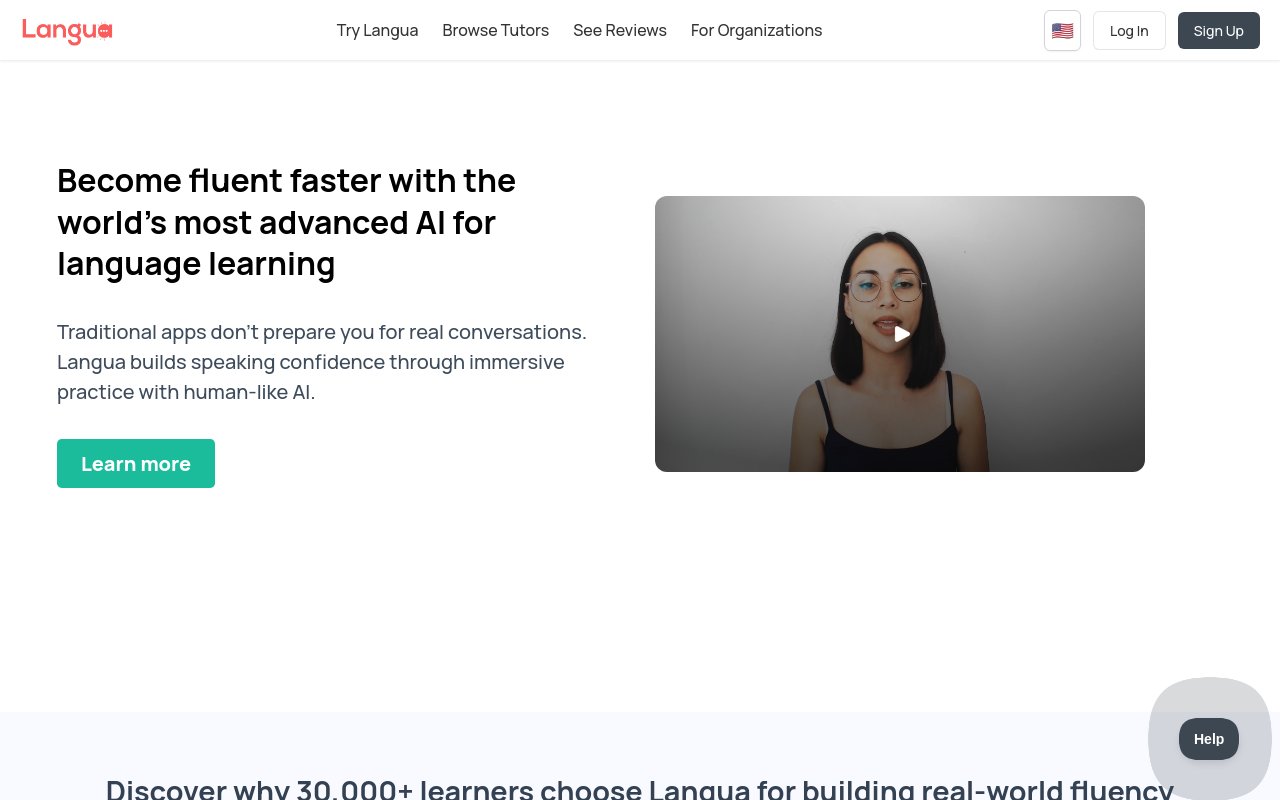
LanguaTalk states a specific acceptance threshold of the top 5% of applications, which gives it a meaningful quality floor relative to open marketplaces where any qualified applicant can list. Learners who have been burned by inconsistent quality on larger platforms tend to find the narrower, curated pool worth the trade-off in selection depth. The free trial lesson removes the financial risk of discovering a poor fit after you have already committed to a package, an advantage that LanguaTalk's own refund policy confirms. The trade-off is selection depth: a smaller, curated network means fewer dialect options and specialty filters than italki's open marketplace. Pick LanguaTalk when tutor quality consistency matters more than having 500 profiles to browse.
6. DELF/DALF Exam Preparation - Which Platform Is Best Suited for Official French Certification
top 5%
LanguaTalk only accepts top tutor applicants
For DELF and DALF candidates, platform choice is a filtering decision, not a browsing one. italki's specialty filter lets you surface professional teachers who list DELF/DALF prep explicitly, which is the fastest way to find someone who knows the oral production and written comprehension rubrics. Lingoda's CEFR-aligned curriculum maps naturally to the exam's level structure. The consistent finding among certification-track learners is that structured tutor-led preparation meaningfully outperforms self-study alone, not because grammar correction is the mechanism, but because a tutor familiar with the exam's specific task formats trains you on the right targets.
7. Supplementary Tutor Tools - Google Docs, Quizlet, and Anki for Spaced Repetition

The best tutors assign work between sessions because a single weekly lesson cannot carry the full acquisition load. Google Docs enables real-time annotation of written work. Quizlet handles vocabulary drilling at scale. Anki's spaced repetition system is the most research-supported of the three: it surfaces vocabulary at the precise interval before forgetting occurs, compounding retention across weeks in a way that passive review cannot. The practical warning: skipping between-session review causes learners to lose most of what a lesson produced within 48 hours. The tool only works if the habit is there.
Why Pay-Per-Lesson Flexibility Can Work Against French Beginners
The pay-per-lesson flexibility that platforms advertise as a learner-friendly feature may be masking a structural problem. Learners who can quit at any time often do. Research on online education dropout shows that disengagement spikes at the exact structural breaks that flexible scheduling creates, the week you skip because work got busy, then the second week, then the habit is gone.
Choosing a platform that removes scheduling friction entirely, rather than one that simply lowers the cost of quitting, is what breaks the attrition cycle for adult learners. Flexibility sounds like freedom; for most adults, it functions as a permission slip to stop. Each of these platforms solves a real problem.
But they all share one quiet assumption: that sitting down for a scheduled lesson is how adults actually get fluent. The next section challenges that assumption with data most tutor-comparison guides never surface.
Related Reading
Best Podcasts For Learning French
Best French Audio Books
French Tv Shows To Learn French
Is Babbel Good For French
Is Duolingo Good For French
Rocket French Reviews
Best Apps To Learn French Vocabulary
Pimsleur French Review
What the Best Online French Tutor Search Misses About How Adults Actually Get Fluent
Most searches for the best online French tutor treat the tutor as the solution. What the research on adult acquisition actually points to is a volume problem that no single weekly session, however well-taught, can solve on its own. Understanding that gap, and what fills it between sessions, changes how you approach learning French entirely.
Why 60-Minute Weekly Sessions Can't Rewire an Adult Brain for French
Six hundred to six hundred fifty hours. That is the cumulative study time research on adult French learners identifies as necessary to reach B2 conversational French. A weekly 60-minute tutor session delivers only a modest number of contact hours across a full year, which means the gap between what sessions provide and what fluency requires is enormous.
High-frequency contact with real French, spread across many short windows, is what builds a conversational brain. The French Lab's review of adult language learning identifies comprehensible input, receiving language pitched just above your current level, as the primary driver of fluency, not grammar correction or structured drills. What builds a conversational brain is high-frequency contact with real French, spread across many short windows, not massed into one weekly event.
A tutor who is genuinely excellent cannot override that structural reality. The limiting factor is not instruction quality. It is volume.
How the Time Between Tutor Sessions Can Slow Your French Progress
The six days between sessions do not sit empty. They fill with passive scrolling. Adults spend a substantial portion of each day on short-form video platforms, screen time that builds nothing in French and quietly absorbs the micro-windows that distributed language practice would otherwise fill. The loss is rarely noticed. It just accumulates.
How AI-Adaptive Practice Fills the 23 Hours a Tutor Never Touches
Spaced repetition research consistently shows that distributed, frequent micro-sessions outperform massed weekly practice for long-term retention and conversational automaticity. The familiar fix is to book more sessions, but as the cost audit in the previous section shows, that path hits a budget ceiling fast. Parrot's short-form video feed intercepts the doomscroll window instead, delivering level-adaptive comprehensible input in the 10 to 15 minute gaps a human tutor structurally cannot reach, consistent with spaced-repetition research showing distributed micro-sessions outperform massed weekly practice for long-term retention, so the acquisition clock keeps running on an ordinary Tuesday morning rather than waiting for Thursday night's Zoom link. It is the daily immersive layer that makes any tutor session more productive when you do attend one.

Next steps
If your French lessons have left you conjugating correctly but freezing the moment a native speaker actually talks to you, the path forward starts with accepting that grammar correction in scheduled sessions builds test-takers, not speakers. Start with our learn Spanish.
The 600-plus hours of cumulative input that research identifies as necessary for conversational French cannot be delivered by a once-weekly Zoom call, the arithmetic simply does not close. That volume gap is the structural problem, not your tutor's quality. At the same time, pay-per-lesson flexibility, the feature platforms market as freedom, functions in practice as a permission slip to quit: disengagement spikes at exactly the scheduling breaks that flexible models create, not at motivation failures. Together, those two realities point toward a format that embeds daily language exposure into the windows you already have, rather than one that asks you to schedule fluency into a Tuesday evening that may never materialize.
Start building that daily input habit by using Parrot to absorb native-speaker content in the commute, lunch break, or ten minutes before bed that no booked session can reach. The speaking practice follows naturally from the listening, and the acquisition clock keeps running on the days a tutor slot was never going to open.
Frequently Asked Questions
What should I actually look for when comparing French tutoring platforms?
The post identifies three axes that predict whether a platform sticks: budget fit, scheduling flexibility, and goal alignment. Before paying, confirm the real monthly cost (including any credit-expiry fees), whether you can book within 24 hours, and whether the tutor's listed specialty matches your actual goal, conversational fluency, DELF prep, or business French, because choosing the wrong specialization wastes both time and money.
Why do I keep freezing when speaking French even after months of grammar lessons?
This is a well-documented structural gap, not a motivation problem. Stephen Krashen's comprehensible input framework explains that consciously knowing grammar rules does not automatically produce spontaneous speech, grammar instruction builds test-takers, while comprehensible input builds speakers. The classroom version of French and the Parisian café version are not the same language, and most tutor sessions default to grammar rules and vocabulary lists rather than the real spoken exposure that produces fluency.
Which French proficiency levels do the platforms covered here actually support?
Coverage varies significantly by platform. Lingoda's French curriculum tops out at B2, so learners targeting C1 or C2 will need to look elsewhere. On italki, the right filter depends on your level: a community tutor works as a reasonable starting point for beginners, while a learner targeting DELF B2 should filter specifically for a professional teacher with exam-prep credentials.
Is there a good option for practicing French in short windows instead of scheduling hour-long sessions?
Yes, Parrot is built specifically around fragmented windows like a commute, a lunch break, or twenty minutes before bed, using a TikTok-style scrollable feed of short native-speaker videos and Parrot Back speaking practice. There is no booking window, no subscription tier, and no tutor whose calendar fills before yours does, making it the approach the post recommends for learners whose practice windows don't fit a 60-minute scheduled slot.
How do I prepare for a DELF or DALF exam using an online tutoring platform?
The post is direct on this: credentials matter, but only when they match your goal, a credentialed tutor who specializes in DELF/DALF exam prep is the wrong hire if your goal is conversational fluency, and the reverse is equally true. On a marketplace like italki, you should filter specifically for professional teachers who list DELF or DALF as a specialty, and use the trial lesson to ask whether they can describe, concretely, how they'd structure your next ten sessions around exam preparation.