Learn Chilean Spanish with Parrot: Video-First Immersion
Master Chilean Slang and Fast Speech
Parrot prepares you to learn Chilean Spanish with short-form video from native speakers across Latin America and Spain, training your ear on the rapid pace and unique expressions that make the dialect challenging. More granular Spanish accent options, including Chilean Spanish, are coming soon.
Start with level-matched content today and build comprehension on real Spanish from Mexico, Colombia, Argentina, and Spain. When you can follow native speakers at natural speed, Chilean conversations become far easier to decode.


- 789,858+ learners
- 4.7 on the App Store
- iOS, Android and the web
- Backed by Y Combinator

Quick Answer: Learning Chilean Spanish with Parrot
Parrot Prepares You for Chilean Spanish Through Native Video Immersion
Parrot uses short-form video from native speakers across Latin America and Spain to build the listening comprehension and vocabulary you need for Chilean Spanish. Videos today mix accents from Mexico, Colombia, Argentina, and Spain. A dedicated Chilean accent option is coming soon.
The app's comprehensible input method trains your ear on real Spanish at natural speed, so you can follow Chilean conversations, slang, and rapid speech patterns. Learners who take it seriously can have a basic conversation in under two months.
Why Video-First Immersion Works for Chilean Spanish
Chilean Spanish is one of the fastest and most slang-heavy dialects, making it hard to follow without extensive listening practice. Parrot's level-matched video feed exposes you to native speech every day, building the comprehension foundation you need before tackling Chilean-specific expressions.
Platforms, Languages, and Access
Parrot teaches Spanish today on iOS, Android, and web. French, English, and Italian are coming soon.
The app is free to download with a seven-day trial on the annual plan.
Trusted by over 789,858 learners. Rated 4.7 stars on the App Store (19,389 ratings) and 4.6 stars on Google Play (1,060 ratings) as of November 2026.
Key Takeaways: Mastering Chilean Spanish
- 1
Parrot Builds the Listening Foundation You Need for Chilean Spanish
Parrot's short-form video feed trains your ear on native Spanish from across Latin America and Spain, building the comprehension skills required to follow Chilean Spanish's rapid pace and heavy slang.
- 2
Chilean Spanish Is Fast and Slang-Heavy, Requiring Strong Listening Skills
Chilean Spanish is known for dropped consonants, rapid speech, and unique slang terms like 'cachai' (do you get it?), 'po' (emphasis particle), and 'weón' (dude or friend, depending on tone). Without extensive listening practice, even intermediate Spanish learners struggle to follow Chilean conversations.
- 3
Learners Can Have Basic Conversations in Under Two Months
Learners who take Parrot seriously can have a basic conversation in under two months.
- 4
Parrot's Video Library Features Tens of Thousands of Native-Speaker Clips
Parrot's library includes tens of thousands of videos sourced from native speakers and licensed YouTube clips under Creative Commons. None of the audio or video is AI-generated. Every piece of content is screened by a person.
Videos cover everyday life, including work situations and health situations, so you learn Spanish you can actually use in real conversations.
- 5
The App Is Free to Download with a Seven-Day Trial
Parrot is free to download with a seven-day trial on the annual plan, giving you full access to test the method before you pay.
Parrot refunds on request if the app isn't the right fit.
Why Chilean Spanish Is Challenging for Learners
Rapid Speech and Dropped Consonants Make Chilean Spanish Hard to Parse
Chilean Spanish is spoken at a faster pace than most other Latin American dialects, with frequent dropping or aspiration of final 's' sounds. A phrase like '¿Cómo estás?' becomes '¿Cómo estái?' in casual Chilean speech, leaving learners who studied textbook Spanish confused.
Without extensive listening practice, even intermediate learners struggle to follow Chilean conversations in real time. Parrot's video feed trains your ear on native speech at natural speed, building the comprehension foundation you need.
Unique Slang and Grammar Patterns Require Contextual Learning
Chilean Spanish features a unique grammatical system that pairs the pronoun 'tú' with voseo-style verb endings (e.g., 'tú tenís', 'tú hablís'). The dialect also includes extensive local slang, or chilenismos, like 'cachai' (do you get it?), 'po' (emphasis particle from 'pues'), 'weón' (dude or friend, depending on tone), 'al tiro' (right now), 'bacán' (cool), and 'fome' (boring).
Parrot's short-form videos deliver Spanish in real-world contexts, so you see how slang and grammar work in actual conversations rather than isolated drills.
Level-Matched Video Keeps You in the Comprehension Sweet Spot
Parrot's personalized sequencing keeps you in the sweet spot, delivering content slightly above your current level so you're always challenged but never lost. Too easy and you zone out. Too hard and you quit.
As your comprehension improves, the app progressively exposes you to faster, more complex Spanish. When you can follow native speakers from across Latin America, Chilean Spanish becomes far more approachable.
Speaking Practice Reinforces What You Hear
Parrot's 'Parrot Back' feature asks you to repeat what you hear out loud, building speaking confidence and sharpening comprehension. The more you repeat, the more natural it feels.
The app scores your pronunciation with proprietary models built and trained by Parrot, giving you feedback inside the AI Spanish Tutor speaking activities.
The Comprehensible Input Advantage for Chilean Spanish
You Acquire Language When You Understand Messages, Not When You Memorize Rules
Parrot is built on comprehensible input theory, based on research by Dr. Stephen Krashen. His research shows that we acquire language when we understand messages slightly above our current level, not when we memorize grammar rules or drill vocabulary lists.
For Chilean Spanish, this means you need extensive exposure to native speech in context, not textbook exercises. Parrot's video feed delivers exactly that: real Spanish from native speakers, matched to your comprehension level.
80% Input, 20% Output Mirrors How You Learned Your First Language
The Parrot method is 80% input (listening and reading) and 20% output (speaking). You spend most of your time absorbing Spanish through short-form videos, building a mental library of words, phrases, and sentence structures.
When you're ready to speak, the language comes naturally because you've heard it used in real contexts many times. Parrot's speaking practice reinforces what you've absorbed, turning comprehension into fluency.
Clickable Words Let You Decode Meaning Without Leaving the Video
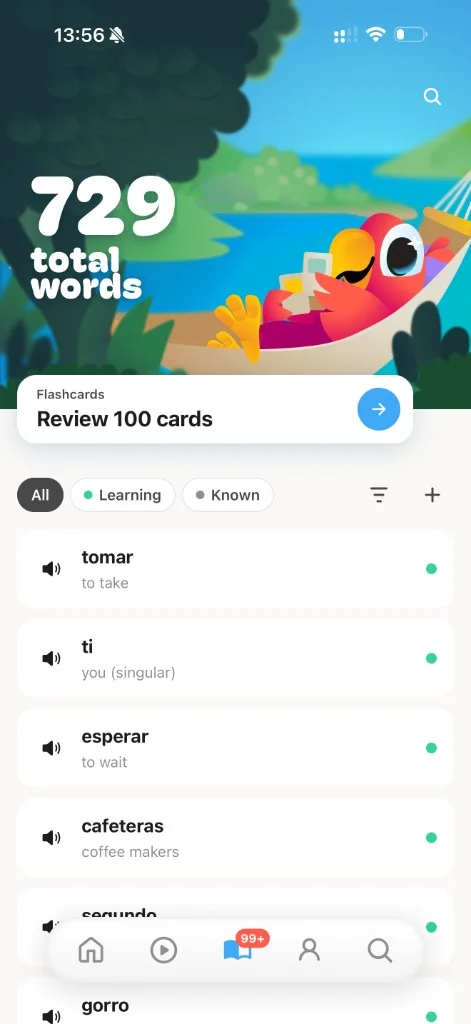
Every word in Parrot's videos is clickable. Tap any word you don't know to see its translation and save it to your personal dictionary.
Tap-to-translate builds vocabulary in context, and transcripts with inline translation let you read along. It's like learning the way you watch shows with subtitles.
Chilean Accent Option: On the Roadmap
More Granular Accent Options Are Coming Soon
Parrot's videos today mix Latin American Spanish and Spain Spanish, featuring native speakers from Mexico, Colombia, Argentina, and Spain. A dedicated Chilean accent option is coming soon, along with other granular accent filters.
While you can't select Chilean Spanish specifically today, the broad Latin American exposure you get from Parrot's current library builds listening skills that carry over to other Latin American accents, including Chilean.
Why Broad Latin American Exposure Prepares You for Chilean Spanish
Chilean Spanish shares vocabulary, grammar, and pronunciation patterns with other Latin American dialects, even though it's faster and more slang-heavy. When you can understand native speakers from Mexico, Colombia, and Argentina, you're far better equipped to decode Chilean-specific expressions.
Parrot's level-matched video feed trains your ear on real Spanish at natural speed, so you're not starting from zero when you meet Chilean slang like 'cachai', 'po', or 'weón' elsewhere.
Stay Updated on New Features
More granular accent options are coming soon. Check parrotapp.com for updates on new features.
Your Daily Routine: 15 Minutes a Day
- 1
Morning: Immersion While You Drink Coffee
Scroll through short videos with native Spanish speakers while you drink your morning coffee. Immerse yourself in content that's easy to understand, matched to your current level.
- 2
Lunch: Parrot Back What You Heard This Morning
Replay a clip from this morning and say it out loud.
- 3
Evening: Review Saved Words with Spaced Repetition
Spaced repetition surfaces the words you saved earlier, right before you'd forget them. Review your personal dictionary on a spaced-repetition schedule.
Learners have tapped over 20 million words in Parrot. The words you save today become the vocabulary you use in real conversations tomorrow.
- 4
Total: About 15 Minutes, Spread Across the Day
No 30-minute blocks. Parrot uses streaks to build the habit, without the guilt-tripping. Just three short moments that fit the gaps in your day: commute, lunch break, before bed.
Most learners spend about 15 minutes a day split into short sessions. Power users go well past an hour. Consistency turns comprehension into fluency.
How Parrot Compares to Duolingo, Babbel, and Others
| App | Approach | Native-speaker video | Spanish dialect options | Free trial |
|---|---|---|---|---|
| Parrot | Short native-speaker videos (comprehensible input) | Yes | Latin American and Spain, mixed; more options coming soon | 7 days, annual plan |
| Duolingo | Gamified drills, streaks and points | No (only an AI video call, Max plan) | Not published | 1 week on duolingo.com; 14 days in the US App Store |
| Babbel | Structured, teacher-designed lessons | No (native-speaker audio) | Latin American or Spain | No fixed trial; first lesson free |
| Rosetta Stone | No-translation immersion | No (native-speaker audio) | Latin America or Spain | 7 days |
| Pimsleur | Audio-first lessons | No (audio lessons) | Separate Latin American and Spain courses | 7 days, card required |
Duolingo: Gamified Drills vs. Real Conversations
Duolingo is activities-based, focusing on gamified drills, streaks, and points. Parrot is video-first immersion, delivering real Spanish from native speakers in short-form video.
Babbel: Structured Lessons vs. Authentic Input
Babbel offers structured, teacher-designed lessons focused on practical conversation skills. Parrot delivers authentic native video content that mirrors how Spanish is actually spoken in real life.
Rosetta Stone: No-Translation Immersion vs. Comprehensible Input
Rosetta Stone uses a no-translation immersion approach, teaching through image-and-audio association. Parrot uses comprehensible input, the method built on Dr. Stephen Krashen's research.
Pimsleur: Audio-Only vs. Video-First
Pimsleur is an audio-first program emphasizing speaking and listening skills. Parrot is video-first, with transcripts and inline translation so you can read along with what you hear.
What Parrot Learners Say
One learner used Duolingo for two years, went on a trip to Salvador, and barely got by in Spanish. After switching to Parrot's video feed, they felt their Spanish improve.
Another learner used Duolingo on and off for a few years and couldn't remember a single thing. After starting Parrot, their Colombian boyfriend was shocked at how well their Spanish had improved.
One learner can finally express themselves to their Mexican best friend and communicate easier with their family. Another is finally able to talk to their abuela after years of wanting to connect in Spanish.
A Puerto Rican and Cuban learner who was often bullied for not knowing Spanish says Parrot has really brought their confidence up. They're now proud to speak Spanish with their family.
One learner was recently listening to a conversation at a park with their Spanish-speaking girlfriend's family and understood the story almost fully. They were surprised with themselves.
Another learner loves the real-life aspect of watching native videos. It's trained their ears to understand Spanish a lot better than any other app they've tried.
One learner has always been interested in learning different languages but struggled to stay consistent with apps like Duolingo. Parrot keeps them coming back every single day.
The short video format is genius. Learners report learning during their commute, during lunch breaks, before bed. It never feels like studying. They're addicted in the best way possible.
Chilenismos You'll Hear in Real Conversations
Po: The Emphasis Particle You'll Hear Everywhere
'Po' is a shortened form of 'pues' and is used constantly in Chilean Spanish to add emphasis or soften a statement. You'll hear it at the end of sentences: 'Sí po' (yes, of course), 'No po' (no way).
Parrot's video feed builds the listening skills that help you pick up particles like 'po' when you hear them in real speech.
Cachai: Do You Get It?
'Cachai' (from the English 'to catch') means 'do you get it?' or 'you know?' in Chilean Spanish. It's used constantly in conversation to check understanding or emphasize a point.
Parrot's native-speaker videos build the listening skills that help you follow words like 'cachai' in real speech.
Weón (Huevón): Dude, Friend, or Jerk Depending on Tone
'Weón' (or 'huevón') is one of the most versatile and commonly used words in Chilean Spanish. Depending on tone and context, it can mean 'dude', 'friend', 'idiot', or 'jerk'.
Parrot's video feed trains your ear for tone and context, which is what makes 'weón' friendly or insulting.
Al Tiro, Bacán, and Fome: Essential Everyday Slang
'Al tiro' means 'right now' or 'immediately'. 'Bacán' means 'cool' or 'awesome'. 'Fome' means 'boring' or 'lame'. These three terms are used constantly in everyday Chilean Spanish.
Parrot's level-matched video feed builds the comprehension you need to pick up terms like these in context rather than drilling flashcards.
Other Common Chilenismos: Carrete, Luca, Taco, Pega, Pololo/Polola
'Carrete' means 'party'. 'Luca' is slang for 1,000 pesos. 'Taco' means 'traffic jam'. 'Pega' means 'job' or 'work'. 'Pololo' and 'polola' mean 'boyfriend' and 'girlfriend'.
These terms appear frequently in Chilean conversations. Parrot's native video library builds the listening skills to follow them when you hear them.
Best Tools and Resources to Support Your Progress
Parrot: Video-First Immersion for the Dialect
The app's short-form video feed trains your ear on native Spanish from across Latin America, preparing you for Chilean conversations.
Speaking Chileno: A Book for Slang and Culture
Speaking Chileno is a book that explains Chilean slang, pronunciation, and cultural context. It's a great complementary resource for learners who want a reference guide to chilenismos.
Pair Speaking Chileno with Parrot's video immersion to see how the slang you read about is actually used in real conversations.
Italki and Baselang: Tutoring Platforms for Speaking Practice
Italki and Baselang are online tutoring platforms where you can book one-on-one lessons with native Spanish speakers, including tutors from across Latin America. They're useful for learners who want personalized speaking practice.
Parrot's video immersion builds the listening foundation you need before you start speaking with a tutor. When you can understand native speakers at natural speed, your tutoring sessions become far more productive.
Music and Media: Los Prisioneros, Mon Laferte, Ana Tijoux
Listening to Chilean music and watching Chilean media is a great way to immerse yourself in the dialect. Artists like Los Prisioneros, Mon Laferte, Ana Tijoux, and Gepe are popular starting points.
Parrot's video feed features everyday-life videos, so you're learning Spanish you can actually use, not just song lyrics.
Related pages
Frequently Asked Questions About the Dialect and Parrot
Can I Choose the Chilean Accent in Parrot Today?
Not yet. Parrot's videos today mix Latin American Spanish and Spain Spanish, featuring native speakers from Mexico, Colombia, Argentina, and Spain. A dedicated Chilean accent option is coming soon, along with other granular accent filters.
While you can't select Chilean Spanish specifically today, the broad Latin American exposure you get from Parrot's current library builds the listening foundation you need to follow Chilean conversations when you encounter them.
How Does Parrot Prepare Me for the Dialect if the Chilean Accent Isn't Available Yet?
Parrot's level-matched video feed trains your ear on native Spanish at natural speed, building the comprehension skills required to follow Chilean Spanish's rapid pace and heavy slang. Chilean Spanish shares vocabulary, grammar, and pronunciation patterns with other Latin American dialects, even though it's faster and more slang-heavy.
When you can understand native speakers from Mexico, Colombia, and Argentina, you're far better equipped to decode Chilean-specific expressions like 'cachai', 'po', and 'weón' in real conversations.
What Platforms Is Parrot Available On?
Parrot is available on iOS, Android, and web. Android has the same features as iOS. The web app is slightly behind.
The app is free to download with a seven-day trial on the annual plan.
How Long Does It Take to Reach Conversational Fluency with Parrot?
Learners who take Parrot seriously can have a basic conversation in under two months. Everyone learns at a different pace, and Parrot adapts to each learner's level.
Most learners spend about 15 minutes a day split into short sessions during commutes, lunch breaks, or before bed. Power users go well past an hour. Consistency turns comprehension into fluency.
How Is Parrot Different from Duolingo for the Dialect?
Parrot is video-first immersion, delivering real Spanish from native speakers in short-form video. Duolingo is activities-based, focusing on gamified drills, streaks, and points.
Does Parrot Teach Speaking, or Just Listening?
Both. The method is 80% input (listening and reading) and 20% output (speaking). Parrot's 'Parrot Back' feature asks you to repeat what you hear out loud, building speaking confidence and sharpening comprehension.
The app scores your pronunciation with proprietary models built and trained by Parrot, giving you feedback inside the AI Spanish Tutor speaking activities. Listening comes first. Speaking reinforces what you've absorbed.
Is Parrot Good for Complete Beginners?
Yes. Flight School is a beginner course built for day one. You hear Spanish from your very first session.
Parrot's personalized sequencing keeps you in the learning zone, delivering content slightly above your current level so you're always challenged but never overwhelmed.
What Languages Does Parrot Teach?
Parrot teaches Spanish today. French, English, and Italian are coming soon.
The app's video library includes tens of thousands of Spanish videos featuring native speakers from around the world. Every piece of content is screened by a person. None of the audio or video is AI-generated.
Can I Use Parrot Alongside Other Resources Like Speaking Chileno?
Yes. You can pair Parrot's video immersion with books like Speaking Chileno or tutoring platforms like italki and Baselang.
Parrot builds the listening foundation you need to understand Chilean Spanish at natural speed. When you can follow native speakers in Parrot's videos, the slang and grammar you read about in Speaking Chileno or practice with a tutor will make far more sense.
Start Your Free Trial
Build the listening foundation for Chilean Spanish with short native-speaker videos, in about 15 minutes a day.
Start Your 7-Day TrialLast updated November 20, 2026