Learn Argentinian Spanish with Real Native Speakers
Immerse Yourself in Argentine Spanish Through Short-Form Video
Parrot, the Spanish learning app, lets you learn Argentinian Spanish from real native speakers. Its TikTok-style feed includes speakers from Argentina, Mexico, Colombia and Spain, so you hear Rioplatense pronunciation and voseo in context. Videos mix Latin American and Spain Spanish today, and more granular Spanish accent options are coming soon.
Built on Dr. Stephen Krashen's comprehensible input research, Parrot delivers content just above your level. Learners who take it seriously can have a basic conversation in under 2 months.


- 789,858+ learners
- 4.7 on the App Store
- iOS, Android and the web
- Backed by Y Combinator

Can You Learn Argentine Spanish with Parrot?
Yes, Parrot Includes Native Argentine Speakers in Its Video Library
Parrot, the Spanish learning app, features native speakers from around the world, including Argentina, so you hear authentic Rioplatense pronunciation, voseo, and porteño intonation in real contexts. More granular accent options, including choosing the Argentine accent, are coming soon.
Tap Any Word to See Inline Translation and Save It
Every video in Parrot's library is screened by a person and sourced from native speakers, including creators from Argentina. You'll encounter voseo conjugations like vos tenés and vos sos, plus the distinctive sh/zh pronunciation of ll and y as you scroll.
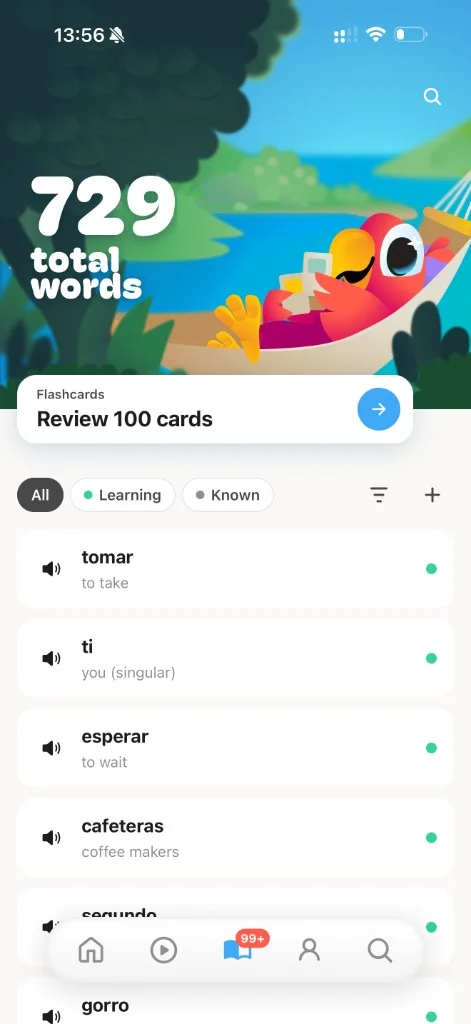
Tap any word in the video transcript to see its translation instantly. Save unfamiliar Argentine expressions to your personal dictionary, then review using spaced repetition so vocabulary sticks in long-term memory.
What's Coming: Granular Accent Selection
Parrot is building more granular accent options so learners can choose the Argentine accent. That feature is coming soon. Today, the feed mixes accents from across the Spanish-speaking world, giving you broad exposure that includes Argentine speakers.
What You Need to Know About Learning Argentine Spanish on Parrot
- 01
Parrot Features Native Argentine Speakers in Its Video Library Today
Parrot's short-form video feed includes native speakers from Argentina, Colombia, Mexico, and Spain, so you hear authentic Rioplatense pronunciation and voseo conjugations as you scroll. More granular accent options are coming soon, but Argentine Spanish is already part of the experience.
- 02
The App Uses Comprehensible Input, the Method Developed by Dr. Stephen Krashen
Parrot delivers content just above your current level, so you acquire language naturally through understanding, not memorization.
- 03
You'll Hear Voseo and Rioplatense Pronunciation in Real-Life Contexts
Argentine Spanish uses vos instead of tú, with conjugations like vos tenés and vos sos, and pronounces ll and y with a distinctive sh/zh sound. Parrot's videos feature these patterns in everyday conversations, so you build comprehension through immersive exposure rather than isolated drills.
- 04
Parrot Fits Your Scroll Habit, Not Against It
The app is built like TikTok: short videos you can watch during your commute, lunch break, or before bed. Parrot is built around about 15 minutes a day, which you can fit into the gaps in your day. No guilt if you miss a session.
- 05
Tap Any Word to Save It, Then Review Using Spaced Repetition
Parrot's personal dictionary and spaced-repetition system surface saved words right before you'd forget them, so Argentine vocabulary and expressions stick in long-term memory. Learners have tapped over 20 million words across the platform.
Why Argentine Spanish Sounds Different
Voseo: Argentina Uses Vos Instead of Tú
In Argentina, you'll hear vos instead of tú for 'you' (informal), with distinct verb conjugations: vos tenés (you have), vos sos (you are), vos hablás (you speak). Parrot's videos feature native Argentine speakers using voseo in everyday conversations.
The voseo conjugations follow predictable patterns. Hearing them in context, rather than memorizing tables, is how your brain internalizes them. Tap any verb in a Parrot video to see its conjugations.
Rioplatense Pronunciation: The Distinctive Sh/Zh Sound
Argentine Spanish pronounces ll and y with a sh or zh sound (called yeísmo rehilado): yo me llamo becomes 'sho me shamo,' calle becomes 'cashe.' This is one of the most recognizable features of porteño speech, and you'll hear it across Parrot's Argentine video content.
Exposure to this pronunciation through short-form video trains your ear to recognize and reproduce it.
Intonation and Rhythm: The Italian Influence
Argentine Spanish has a melodic, rising-and-falling intonation influenced by Italian immigration, making it sound distinct from Mexican or Spain Spanish. Parrot's native-speaker videos capture this rhythm in real conversations.
Lunfardo Slang and Everyday Expressions
Argentine Spanish is rich with lunfardo slang like che, boludo, and laburo, plus everyday fillers like viste, dale, and bueno. Parrot's videos feature these expressions in context, so you learn what they mean and when to use them by hearing native speakers in real situations.
How Comprehensible Input Teaches Argentine Spanish
Personalized Sequencing Keeps You in the Learning Zone
Parrot is built on comprehensible input theory, which shows that we acquire language when we understand messages slightly above our current level, not when we memorize rules. The app's personalized sequencing keeps you in the sweet spot, surfacing Argentine Spanish content that's neither too easy nor too hard.
The Parrot method is 80% input (listening and reading) and 20% output (speaking).
Parrot Back Speaking Practice: Say It Out Loud
Parrot's speaking activities with pronunciation scoring give you feedback on how closely you match the native Argentine speaker. The app uses proprietary models it built and trained to score your pronunciation.
Videos are a mix of content Parrot buys (paying creator fees) and licensed YouTube clips under Creative Commons. None of Parrot's audio or video is AI-generated.
Fits Your Scroll Habit: 15 Minutes a Day, Split Into Short Sessions
Parrot is built for the scroll habit you already have, not for guilt-laden 20-minute sessions. Parrot is built around about 15 minutes a day, split into short moments during your commute, lunch break, or before bed.
The app uses streaks to build the habit, without the guilt-tripping. Progress shows inside the app through streaks and badges, vocabulary progress, and learning-path completion milestones, so you see tangible gains without the pressure.
A Day in the Life: How Parrot Fits Your Routine
- 1
Morning: Immerse While You Drink Coffee
Open Parrot and scroll through short videos with native speakers, including speakers from Argentina, while you drink your morning coffee. When an Argentine speaker comes up, you'll hear voseo conjugations and Rioplatense pronunciation in everyday conversations.
- 2
Lunch: Parrot Back What You Heard This Morning
During your lunch break, replay a clip from this morning and say it out loud. Parrot's pronunciation scoring gives you feedback on how closely you match the native speaker. Repeat until it sounds like yours.
- 3
Evening: Review Saved Words Using Spaced Repetition
Before bed, Parrot's spaced-repetition system surfaces the Argentine expressions you saved earlier, like che, boludo, and vos tenés. The app tracks your vocabulary progress so you see tangible gains.
Total: about 15 minutes a day, split into short sessions that fit the scroll habit you already have. Power users go well past an hour.
How Argentine Spanish Compares to Mexican, Colombian, and Spain Spanish
| Feature | Argentina | Mexico | Colombia | Spain |
|---|---|---|---|---|
| 'You' forms | vos (vos tenés, vos sos) | tú (tú tienes, tú eres) | tú in most regions; vos in Paisa Spanish | vosotros for plural 'you' (habláis, coméis) |
| Signature sound | ll and y as sh or zh (calle sounds like 'cashe') | Standard y sound | Standard y sound; the coast drops the final s | The 'th' sound in gracias and hacer |
| Rhythm | Melodic, rising and falling (Italian influence) | Flatter rhythm | Clear in Bogotá; fast and musical in Medellín | Rapid-fire cadence |
| Slang examples | che, boludo, laburo | güey, chido, ahorita | parcero, chévere, ¿Qué más? | tío, vale, ordenador |
Voseo vs. Tú: Argentina, Colombia, and Mexico
Argentina uses vos (vos tenés, vos sos) instead of tú, while Mexico and most of Colombia use tú (tú tienes, tú eres). Parrot's videos feature speakers from all three regions, so you hear both forms in context and build comprehension that transfers across dialects.
Tap any verb to see its conjugations across different forms.
Pronunciation: Rioplatense Sh/Zh vs. Standard Y Sound
Argentine Spanish pronounces ll and y with a sh or zh sound (yo becomes 'sho,' calle becomes 'cashe'), while Mexican and Colombian Spanish use a standard y sound.
Parrot's native-speaker videos expose you to all these variations, training your ear to recognize the differences.
Intonation and Rhythm: Italian Influence in Argentina
Argentine Spanish has a melodic, rising-and-falling intonation influenced by Italian immigration, making it sound distinct from the flatter rhythm of Mexican Spanish or the rapid-fire cadence of Spain Spanish.
Hearing these patterns in short-form video trains your ear to recognize and reproduce them.
Vocabulary and Slang: Lunfardo, Mexicanismos, and Peninsular Spanish
Argentine Spanish is rich with lunfardo slang like che, boludo, and laburo, while Mexican Spanish has its own set of expressions like güey, chido, and ahorita, and Spain Spanish uses peninsular terms like tío, vale, and ordenador. Parrot's videos feature all these varieties, so you build a flexible vocabulary that works across contexts.
Bottom line: Parrot's multi-accent library is a strength. Hearing Argentine Spanish alongside Mexican, Colombian, and Spain Spanish builds flexible comprehension, and more granular accent options are coming soon.
What Learners Say About Parrot
After two years on Duolingo, one learner went to El Salvador and barely got by in Spanish. After using Parrot, their Spanish instantly improved to a conversational level thanks to the video feed features.
Another learner used Duolingo on and off for a few years and couldn't remember a single thing. After starting Parrot, their Colombian native boyfriend told them how shocked he was at how well their Spanish had improved.
One learner finally expressed themselves to their Mexican best friend and communicated easier with their family after using Parrot for a while. Another learner, a Puerto Rican and Cuban male, said the app brought their confidence up after being bullied for not knowing Spanish.
A third learner was recently listening to a conversation at a park with their Spanish-speaking girlfriend's family and understood the story almost fully, surprising themselves with how much they'd absorbed.
One learner never thought scrolling could teach a language, but Parrot feels like TikTok and they're actually learning. Their friends are amazed they can hold a conversation in Spanish.
Another learner said the short video format is genius: they learn during their commute, lunch breaks, and before bed, and it never feels like studying. They're addicted in the best way possible.
One learner said Parrot gets it: no boring grammar drills, no guilt-tripping streaks, just real Spanish content that sticks in your brain.
Another learner struggled to stay consistent with apps like Duolingo, but Parrot keeps them coming back every single day. The real aspect of watching native videos trained their ears to understand Spanish a lot better.
Download Parrot on iOS, Android, or Web
Available on iOS, Android, and Web
Parrot is available on iOS (App Store, 4.7 stars from 19,389 ratings), Android (Google Play, 4.6 stars from 1,060 ratings in November 2026) and the web. Android has the same features as iOS. The web app is slightly behind in features.
Download free and start your 7-day trial with full Premium access. The trial is available on the annual plan only. A card is required to start, and you'll get a reminder before the trial ends.
Premium is $90 a year or $20 a month in the US, and prices are localized by country. Parrot refunds on request, and App Store purchases are refunded through Apple.
Languages: Spanish Live Today, More Coming Soon
Parrot teaches Spanish today. French, English, and Italian are coming soon, with no launch dates announced yet.
The Spanish course includes tens of thousands of videos in the library.
Trusted by Over 789,858 Learners Worldwide
Parrot is trusted by over 789,858 learners worldwide. The app launched in March 2025 and is backed by Y Combinator (Fall 2025 batch). Parrot Learning US Inc. is based in San Francisco, California.
Facts checked November 2026.
Related pages
Everything You Need to Know About Learning Argentine Spanish on Parrot
Can I Choose the Argentine Accent on Parrot Today?
Not yet. Parrot's videos mix Latin American and Spain Spanish today, including native speakers from Argentina, Colombia, Mexico, and Spain.
More granular accent options, including choosing the Argentine accent, are coming soon. You'll hear authentic Rioplatense pronunciation and voseo in the feed right now.
The multi-accent library is a feature, not a limitation: hearing a variety of speakers helps you build flexible comprehension that transfers to any Spanish-speaking context. Learners who take it seriously can have a basic conversation in under 2 months, regardless of which accent they encounter first.
Does Every Video Feature Argentine Speakers?
No. Parrot's library includes native speakers from around the world, including Argentina, Colombia, Mexico, and Spain. The app's personalized sequencing surfaces content that matches your level and interests, but not every video features Argentine speakers.
This approach mirrors how comprehensible input works in real life: you hear a variety of voices and dialects, building flexibility and comprehension. Tap any word to save it to your personal dictionary, then review using spaced repetition so Argentine vocabulary and expressions stick in long-term memory.
What Is Voseo and Will I Hear It on Parrot?
Voseo is the use of vos instead of tú for 'you' (informal), with distinct verb conjugations: vos tenés (you have), vos sos (you are), vos hablás (you speak). Argentina, Uruguay, and parts of Central America use voseo. You'll hear it in Parrot's videos featuring Argentine speakers.
Tap any verb to see its conjugations across different forms (vos, tú, usted), then save it to your dictionary for review. This is how you acquire voseo naturally through context, not by memorizing tables.
How Is Parrot Different from Duolingo for Learning Argentine Spanish?
Parrot is video-first immersion, delivering short-form content from native speakers, including speakers from Argentina, using comprehensible input, the method developed by Dr. Stephen Krashen.
Parrot's streaks build the habit without the guilt-tripping, and progress shows in the app through badges, vocabulary progress and learning-path milestones.
Is Parrot Good for Complete Beginners Who Want to Learn Argentine Spanish?
Yes. Flight School is Parrot's beginner course, built for day one learners.
You hear Spanish, including Argentine speakers, from your very first session. The app's personalized sequencing keeps you in the learning zone.
The method is 80% input (listening, reading) and 20% output (speaking), so you build a strong comprehension foundation before you start producing.
Does Parrot Teach Speaking, or Just Listening?
Both. Parrot's 'Parrot Back' feature lets you repeat what you hear out loud, building speaking confidence and sharpening comprehension.
The method is 80% input and 20% output, so listening comes first. This is how you acquire the patterns and sounds of Argentine Spanish naturally, then produce them with confidence.
How Much Time Do I Need to Spend Each Day?
About 15 minutes a day. Power users go well past an hour.
Is Parrot Free, or Do I Need a Subscription?
Parrot is free to download with a 7-day free trial that gives you full Premium access. The trial is on the annual plan only, and a card is required to start.
Nothing stays free after the trial today. Premium is $90 a year or $20 a month in the US.
Parrot refunds on request, with no one turned down.
Start Your Free Trial
Hear native speakers from Argentina, Mexico, Colombia, and Spain in short videos matched to your level, in about 15 minutes a day.
Start Your 7-Day Free TrialLast updated November 20, 2026