Advanced English Learning That Fits Your Life
English is coming soon to Parrot. Parrot teaches Spanish today. Join the waitlist and we'll tell you the moment the English course opens.
Native-Speed Video, Real Idioms, Zero Grammar Drills
For advanced English, Parrot's learn English app (coming soon) will bring short-form video immersion, the format over 789,858 learners already use with Parrot. You will absorb native-speed speech, idioms, and natural phrasing through a TikTok-style feed built on comprehensible input, the research-backed method from Dr. Stephen Krashen.
No textbook exercises or artificial dialogues. Just real English from native speakers, sequenced to keep you in the learning zone: you understand about 80% and stretch for the rest.
- 789,858+ learners
- 4.7 on the App Store
- Spanish live on iOS, Android and the web
- Backed by Y Combinator

What Is Advanced English?
Quick Answer
Advanced English means understanding native speakers at full speed, using idioms and phrasal verbs naturally, and expressing nuanced ideas with precision. It's the gap between knowing grammar rules and sounding fluent in real conversation.
Parrot's English course (launching soon) will close that gap through short-form video immersion: native speakers, real contexts, and comprehensible input sequenced to your level. You'll absorb colloquial phrasing, cultural references, and natural rhythm without drilling vocabulary lists or grammar charts.
What Sets Fluent Speakers Apart
Conciseness and Precision
Fluent speakers choose exact words and trim filler. Instead of 'I think maybe we should probably consider doing that,' you say 'Let's do it.'
Parrot's native-speaker videos will model this economy of language in real contexts, so you absorb concise phrasing without memorizing rules.
Idioms and Phrasal Verbs
Native English is full of expressions like 'call it a day,' 'run into someone,' and 'get the hang of it.' These don't translate literally, and textbooks rarely teach them in context.
Parrot's native-speaker videos will show expressions used naturally in real contexts.
Natural Collocations
Fluent speakers say 'make a decision' and 'take a break,' not 'do a decision' or 'have a break.' These word pairings sound right because you've heard them hundreds of times.
Parrot's comprehensible input method will expose you to collocations in context, so they stick through repetition, not rote memorization.
Nuance and Register
Knowing when to say 'Could you help me?' versus 'Can you help?' or 'Give me a hand' separates textbook learners from fluent speakers. Register shifts with context: formal emails, casual chats, professional meetings.
Parrot's English video library will span everyday life, work situations, and social contexts, so you hear how native speakers adjust tone and formality naturally.
Complex Grammar in Real Use
Fluent speakers use conditionals, passive voice, and embedded clauses without thinking. You don't learn this by drilling exercises. You acquire it by hearing it used correctly, over and over.
Complex structures become familiar through exposure, not grammar charts.
Bottom line: Fluency is pattern recognition, not rule memorization. Parrot builds the patterns.
How Beginner and Fluent Phrases Differ
| Situation | Beginner | Fluent |
|---|---|---|
| Everyday requests | Can you give me the report? | Could you send over the report when you get a chance? |
| Expressing opinions | I think this is good. | I'd say this is a solid approach, though we might want to tweak a few details. |
| Describing problems | The system is not working. | We're running into some issues with the system. It's been acting up since this morning. |
| Making suggestions | We should do this. | It might be worth trying this approach and seeing how it goes. |
Everyday Requests
The fluent version softens the request and adds natural phrasing ('send over,' 'when you get a chance') that textbooks rarely teach. Parrot's native speaker videos will model these patterns in real workplace contexts.
Expressing Opinions
Fluent speakers hedge, qualify, and add nuance. Parrot's video feed will expose you to these conversational moves in context, so you absorb them naturally.
Describing Problems
The fluent version uses phrasal verbs ('running into,' 'acting up') and adds context. Parrot's comprehensible input method will deliver these phrases in real scenarios, not isolated drills.
Making Suggestions
Fluent speakers soften suggestions and leave room for discussion. Parrot's video library will include native speakers navigating these conversational dynamics, so you learn by watching real interactions.
Bottom line: The gap isn't vocabulary. It's exposure to how native speakers actually talk.
How to Practice on Your Own
- 1
Consume Authentic Content Daily
Read native level articles, listen to podcasts, and watch videos in English. The key is comprehensible input: content slightly above your current level, where you understand most of it and stretch for the rest.
Parrot's English video feed will do this automatically.
- 2
Study Idioms and Phrasal Verbs in Context
Memorizing idiom lists doesn't work. You need to see 'call it a day' or 'get the hang of it' used in real sentences, multiple times, before they stick.
- 3
Track Your Progress
Building a daily habit is a big part of learning a language. Seeing your progress keeps you motivated without guilt or pressure.
In the Spanish app, Parrot shows streaks and badges, vocabulary progress, and learning path completion milestones. Its streaks build the habit, without the guilt-tripping.
- 4
Shadow Native Speakers
Shadowing means repeating what you hear, out loud, to match rhythm, intonation, and phrasing. It helps you sound more natural.
Say out loud and repeat what you hear to build speaking confidence and sharpen comprehension.
Bottom line: These strategies work. Parrot's English course will make them sustainable.
The Research Behind Short-Form Video Learning
Comprehensible Input at Native Speed
Dr. Stephen Krashen's research shows you acquire language when you understand messages slightly above your current level. Advanced learners need native speed input with real idioms, not slowed down textbook dialogues.
Scroll Habit Meets Language Acquisition
Parrot turns short form video into fluency practice without requiring 30 minute study blocks.
Every scroll exposes you to natural phrasing, cultural context, and real vocabulary.
Clickable Words for Instant Clarity
When you encounter an unfamiliar word or phrase in a video, you can tap it to see the translation without leaving the clip.
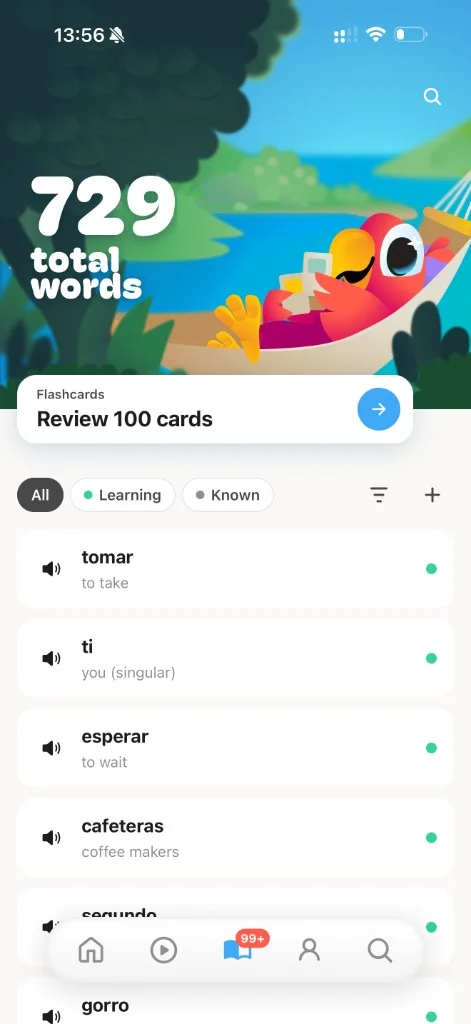
This keeps you immersed in the content while filling gaps in real time. Your personal dictionary saves every word you tap, and spaced repetition brings them back before you forget. Video transcripts with inline translation let you read along.
Active Recall Through Speaking
Listening alone isn't enough. Speaking reinforces comprehension and builds muscle memory for pronunciation and rhythm.
Parrot's 'Parrot Back' feature lets you replay clips and say them out loud. The Parrot Method is 80% input and 20% output, balancing absorption with active practice. In the Spanish app, Parrot's AI Spanish Tutor adds speaking activities with pronunciation scoring by Parrot's own models, built into the listening experience.
Bottom line: Passive video consumption becomes active acquisition when content is sequenced to your level.
Videos Matched to Your Level
Content That Grows With You
Too easy and you zone out. Too hard and you quit. Parrot keeps you in the sweet spot: content slightly above your current level, where you understand most of it and stretch for the rest.
As your comprehension improves, the feed adapts, so the content keeps stretching you.
Placement Test and Ongoing Calibration
In the Spanish app, your level is set from onboarding answers plus a short placement test (5 minutes or less).
Native Speakers From Around the World
Parrot's videos feature native speakers, so you hear natural speech in real contexts. Every video is screened by a person, and none of Parrot's audio or video is AI-generated.
No Artificial Ceilings
Parrot's English videos will span a range of levels, from English for beginners through intermediate English and up, so advanced learners stay challenged as the feed adapts to their comprehension.
Bottom line: Parrot adapts as your comprehension grows.
A Typical 15-Minute Practice Session
Here is how 15 minutes a day will fit into your routine once the English course launches.
- 1
Morning: Immersion
Scroll through short videos while you drink coffee. Watch native speakers talk about everyday topics, work scenarios, or cultural insights.
You're absorbing natural phrasing without it feeling like study.
- 2
Lunch: Parrot Back
Replay a clip from this morning and say it out loud. Match the speaker's rhythm, intonation, and phrasing.
This active recall reinforces what you heard and builds speaking confidence. The more you repeat, the more natural it feels.
- 3
Evening: Review
Spaced repetition surfaces the words you saved earlier. Review them in context, not as isolated flashcards.
- 4
Total: About 15 Minutes, Spread Across the Day
No 30-minute blocks. No guilt if you miss a session. Just three short moments that fit the gaps in your day.
Learners spend about 15 minutes a day on Parrot. Power users go well past an hour.
Bottom line: Consistency beats intensity. Parrot makes daily practice easier.
What Advanced Learners Need to Know
- 1
Advanced English fluency requires exposure to native-speed speech, idioms, and natural phrasing, not grammar drills or vocabulary lists.
- 2
Parrot's English course (coming soon) will deliver comprehensible input through short-form video, the format over 789,858 learners already use with Parrot.
- 3
Parrot sequences native-speaker videos to your level, keeping you in the sweet spot where you understand about 80% and stretch for the rest.
- 4
Parrot's 'Parrot Back' feature lets you practice speaking by repeating clips out loud, building pronunciation and rhythm without a tutor.
- 5
Practice with Parrot takes about 15 minutes a day, which fits your existing scroll habit.
Where You Can Use Parrot
- 01
Platforms
Parrot is available on iOS, Android, and the web at app.parrotapp.com. Android has the same features as iOS; the web app is slightly behind. Subscribers can download videos for offline use.
- 02
Languages
Parrot teaches Spanish today. French, English, and Italian are coming soon, with no launch dates confirmed.
- 03
Free Access
Parrot is free to download with a 7-day free trial on the annual plan. Nothing is free after the trial today; a free tier is coming soon.
- 04
Learner Count
Trusted by over 789,858 learners.
Related pages
Common Questions About Advanced English
What Is the Best App for Learners Beyond the Basics?
Parrot's English course (coming soon) is being built for learners who've outgrown beginner apps and need native-speed input. The app will deliver short-form video from native speakers, sequenced to your level using comprehensible input, the research-backed method from Dr. Stephen Krashen.
You'll absorb idioms, phrasal verbs, and natural phrasing through a TikTok-style feed that fits your scroll habit. You'll be able to tap any word to save it, replay clips to practice speaking, and review vocabulary with spaced repetition. Over 789,858 learners already use Parrot.
How Is Parrot Different From CEFR Levels C1 and C2?
CEFR levels (C1, C2) describe proficiency benchmarks. Parrot is the tool that gets you there. The app focuses on comprehensible input: native-speaker video content sequenced slightly above your current level, so you're always in the learning zone.
Instead of studying for a test, you will absorb fluency through daily exposure to real English. The method is 80% input (listening, reading) and 20% output (speaking), balancing absorption with active practice.
Can I Use Parrot if I'm Already Fluent?
Yes, once the English course launches. Parrot adapts difficulty as your comprehension grows, so advanced learners can maintain fluency, absorb new idioms, and stay sharp.
How Long Does It Take to Reach Mastery?
Advanced fluency depends on consistency and starting level. Everyone learns at a different pace, and Parrot adapts to each learner. Spanish learners who take it seriously can have a basic conversation in under 2 months.
The key is daily practice. Learners spend about 15 minutes a day on Parrot. Power users go well past an hour.
Does Parrot Teach Grammar?
Parrot doesn't drill grammar rules. You acquire complex structures (conditionals, passive voice, embedded clauses) through repeated exposure to native speakers using them correctly.
A free English grammar library is available on parrotapp.com. The focus is comprehensible input: absorbing language naturally, the way children learn a first language.
Is Parrot Free?
Parrot is free to download with a 7-day free trial on the annual plan. Nothing is free after the trial today; a free tier is coming soon.
In the Spanish app, the trial gives you full Premium access to the video feed, Parrot Back speaking practice, personal dictionary, and spaced repetition. The trial is on the annual plan only, a card is required to start, and Parrot sends a reminder before the trial ends.
What Platforms Does Parrot Support?
Parrot is available on iOS, Android, and the web at app.parrotapp.com. Android has the same features as iOS; the web app is slightly behind. Platforms for the English course will be confirmed at launch.
When Will the English Course Launch?
Parrot teaches Spanish today. French, English, and Italian are coming soon, with no launch dates confirmed.
Join the waitlist to be notified when the English course goes live. Learning Spanish? Advanced Spanish is live now.
Be the first to learn advanced English with Parrot.
Join the waitlist and Parrot will tell you the moment the English course opens.
Join the English waitlistLast updated November 20, 2026