Your method probably quit on you before you did. Here is why most English learning systems are built for a life you do not have, and what actually works instead.
Sixty-seven percent of adult language learners abandon a new method within the first three months, and the most common explanation is that they "just didn't stick with it." That verdict is too easy. It lets the method off the hook entirely. The common assumption is that if you just find the right structured course and stick to it long enough, the grammar will eventually click and conversation will follow naturally. But that belief deserves serious scrutiny. These methods were built for a 45-minute classroom period, a live teacher, and a schedule cleared for study.
When you're a busy adult fitting learning into a commute or a lunch break, those methods don't bend. Your life does, and your progress pays the price. See our learn Spanish for how this works in practice.

most English learning methods were never designed for the life you actually live. The first friction point is grammar burnout.
Cognitive science research on the forgetting curve shows that explicitly drilled grammar rules decay by roughly 50 percent within 24 hours without contextual reinforcement. You memorize the rule on Monday. By Wednesday it's gone. That cycle repeats until the learner stops showing up. The second friction point is time mismatch. Adults average fewer than 20 minutes of genuinely free, focused time per day, yet most structured methods assume 30-to-45-minute sessions as a baseline. The method is dead on arrival before a single lesson loads.
The third friction point is the hardest to see. Learners spend months on apps, maintain streaks, complete units, and still cannot hold a real conversation. Streak-optimized engagement metrics measure time in the app, not comprehensible language acquired. Progress feels invisible. Invisible progress feels like failure. The friction points above are symptoms. The root cause runs deeper, baked into the assumptions traditional English teaching was built on. That's exactly what the next section unpacks.
Key takeaways
67% of adult language learners quit a new method within three months, and the method itself is usually the culprit, not the learner's discipline.
Grammar drilling and verb conjugation feel like serious study because they look like serious study; the brain acquires spoken language through meaningful context, not memorized rules.
The method you choose matters far less than three things underneath it: daily consistency, spaced practice, and content pitched at the right level for your brain to process as language rather than noise.
Immersion is not a geography problem, adults already spend six-plus hours a day on screens, and most of that time can be quietly redirected toward English acquisition without adding a single minute to a schedule.
Comprehension and spoken production are neurologically separate skills, which is why months of input practice can still leave a learner frozen the moment someone asks a real question.
Choosing a method before mapping your available hours, learning context, and current level is why most method-switches fail before they start.
Parrot's Comprehensible Input Method closes the gap by delivering content calibrated just above a learner's current level, grounded in Krashen's input research, so English is acquired through natural exposure rather than memorization that fades by the weekend.
The Hidden Cost of Traditional English Teaching Methods
The problem is that the brain does not acquire spoken language by retrieving stored grammar rules; it builds fluency through pattern recognition in meaningful context, and most traditional courses are engineered to deliver exactly the wrong thing.

Grammar-Translation Was Designed for Dead Languages, Not Living Conversations
According to a 2023 EFL methods review from Universidad Tecnológica Equinoccial, the grammar-translation method was built for reading classical Latin and Greek texts, not for producing spoken language.
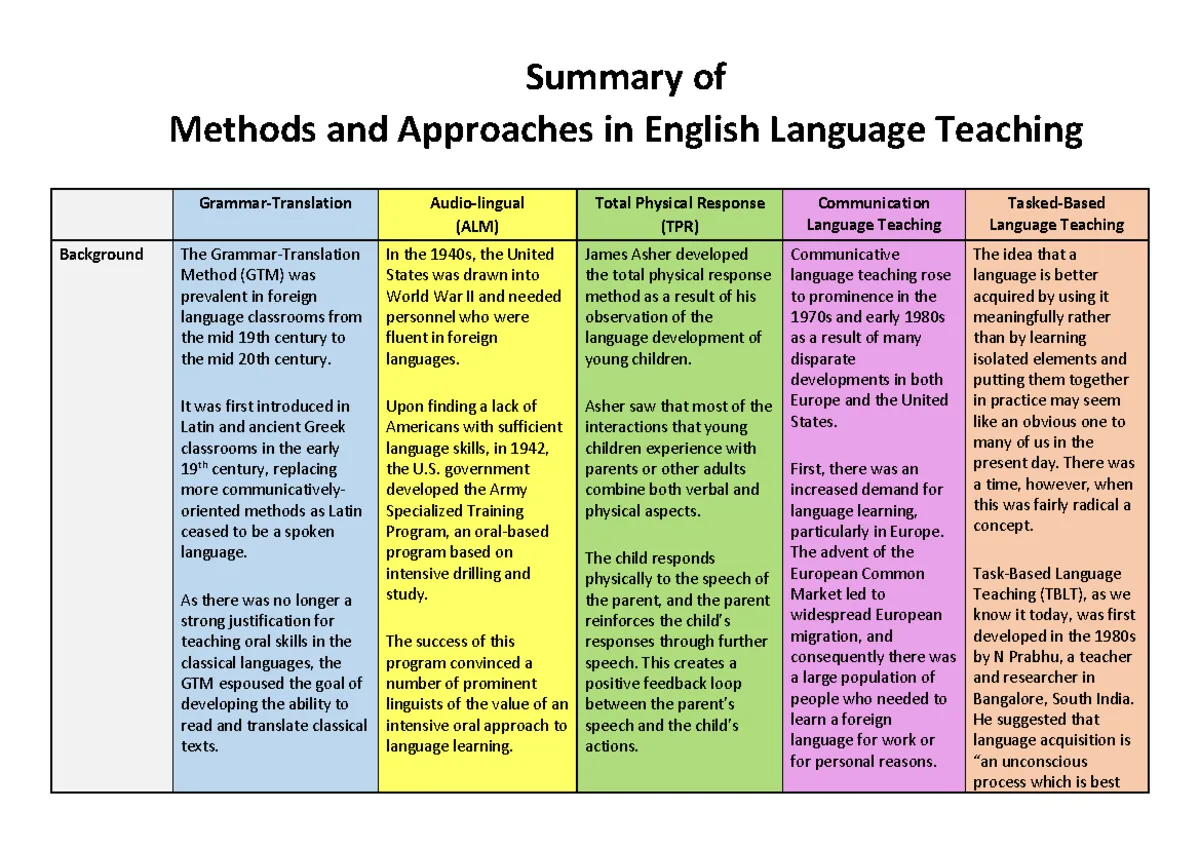
The output looks like progress, pages completed, exercises ticked, but the underlying skill is shallow. Grammar-translation textbooks make this worse by filling pages with drills so disconnected from real conversation that they border on absurd: think "The inhabitants of the island bring water to the…" as your model of authentic English.
Real spoken English is full of contractions, ellipsis, dropped subjects, and idiomatic shortcuts that the grammar-translation textbook has told you are errors.
Parrot is built for learners who have already tried the memorization route and found it lacking.
Why Audio-Lingual Drilling Produces Recognition Without Retrieval
Passive recognition and active speech production are two completely different cognitive skills. As a 2022 EFL methods analysis from ECZ found, decontextualized sentence repetition does not train learners to generate language spontaneously in real communicative situations.
Parrot's short-form video feed addresses this at the content level by keeping every clip anchored to a real communicative situation, the kind of context that gives a word or phrase its actual meaning. When a learner is ready to move from recognizing language to producing it, Parrot Back (speaking practice) provides the active retrieval layer that drilling skips entirely, and the AI Spanish Tutor offers personalized feedback during or after video sessions for targeted practice that goes beyond passive watching.
ESL vs. ESOL Learners, Why Method Choice Is Not One-Size-Fits-All
An ESL learner studying in their home country has no such safety net. Grammar-translation and audio-lingual drilling hurt ESL learners disproportionately. The ECZ 2022 analysis makes clear that methods generating comprehensible input and meaningful interaction outperform isolated rule-recall for conversational ability.
Parrot is most beneficial precisely for learners who have struggled with traditional memorization-based methods and want a research-backed alternative, which is the exact profile of an ESL learner who has spent months conjugating verbs in a vacuum and emerged without the ability to hold a conversation.
Related Reading
How To Learn English
How To Learn English Grammar Step By Step
Is Learning English Hard
Where Should I Start If I Want To Learn English?
English For Tourism
How To Improve English Speaking Skills
How To Improve English Vocabulary
How To Improve English Pronunciation
How To Speak English Fluently And Confidently
Best Online English Courses
The Strategic Principles That Make Any English Learning Method Work
Getting these principles right is what Parrot is built around, and understanding them will help you evaluate any learning tool with far more confidence.

The Method Matters Less Than the Meta-Layer Beneath It
What actually determines whether you acquire English or just accumulate study hours is the meta-layer underneath every method: how you space your practice, whether you show up daily, and whether the content you consume is pitched at the right level for your brain to process it as language rather than noise.
Spaced Repetition and Daily Consistency Outperform Every Clever Curriculum
Spaced repetition outperforms massed practice for vocabulary retention by timing reviews to occur just before the point of forgetting, reinforcing memory traces more efficiently over time.
This is the core logic behind one of Parrot's design principles: making scrolling productive and turning screen time into learning time. Rather than asking learners to carve out a dedicated study block they will eventually skip, Parrot's short-form video feed distributes exposure across the day in the same rhythm people already use their phones, so the spaced, repeated contact that memory science demands is built into the format itself, not bolted on as a willpower exercise.
The 5 C's Framework as an Evaluative Lens for Every Method
The 5 C's of language learning, Communication, Cultures, Connections, Comparisons, and Communities, were established by ACTFL as the national standards framework for language education in the United States. Together they offer a practical way to measure how fully any given method engages a learner with real language use, and methods that score low across these dimensions tend to plateau at passive recognition, which is why structured textbook learning shows measurable but limited effectiveness for vocabulary retention when used in isolation. The 5 C's are a lens for spotting a method's ceiling before you invest months in it.
Parrot scores well on the Communication and Cultures dimensions specifically because its content is built around real, conversational English rather than textbook phrases.
Why Learners Default to the Techniques That Work Least
For learners who need explicit grammar scaffolding first, Parrot surfaces verb conjugations and grammar insights within the flow of content as a reference layer that reduces anxiety without replacing immersive exposure. When a learner wants to move from watching to producing, Parrot Back provides speaking practice, and the AI Spanish Tutor offers personalized feedback and targeted practice during or after video sessions, turning passive comprehensible input into active, corrected output at the moment a learner is ready for it.
Parrot's design, a feed that rewards daily return and surfaces incremental progress through content difficulty, is built to hold learners through that invisible phase rather than leaving them to trust the process alone.
App-Based and Gamified English Learning Tools Worth Your Time
A 300-day streak is not a conversation. That gap sits at the heart of every honest review of English learning apps, and it explains why the feature count on an app store page tells you almost nothing about whether you'll be able to order coffee in English six months from now.
The critical question to ask about any app is not "how many languages does it support?" or "does it have a leaderboard?" It is simpler: does this tool move me closer to understanding a native speaker talking at natural speed? Most app reviews never measure that at all. According to research published in Exposure: Jurnal Pendidikan Bahasa Inggris (Hamma, Nur, Ammade and Latifa, 2025), Duolingo's value is amplified by learner autonomy, not by passive course completion alone.
That finding points to a synthesis claim worth naming directly: app-based tools amplify results only when learners drive their own exposure choices, and an app that locks learners into a fixed syllabus sequence actually undermines the very cognitive mechanism it claims to exploit. Spaced repetition outperforms massed practice precisely by timing reviews around the individual's forgetting curve, which means the efficiency gain belongs to the learner who controls the cadence, not to the course that dictates it.
That is the honest frame for evaluating every tool below.
1. Duolingo - Best Free App for Vocabulary and Reading via Spaced Repetition
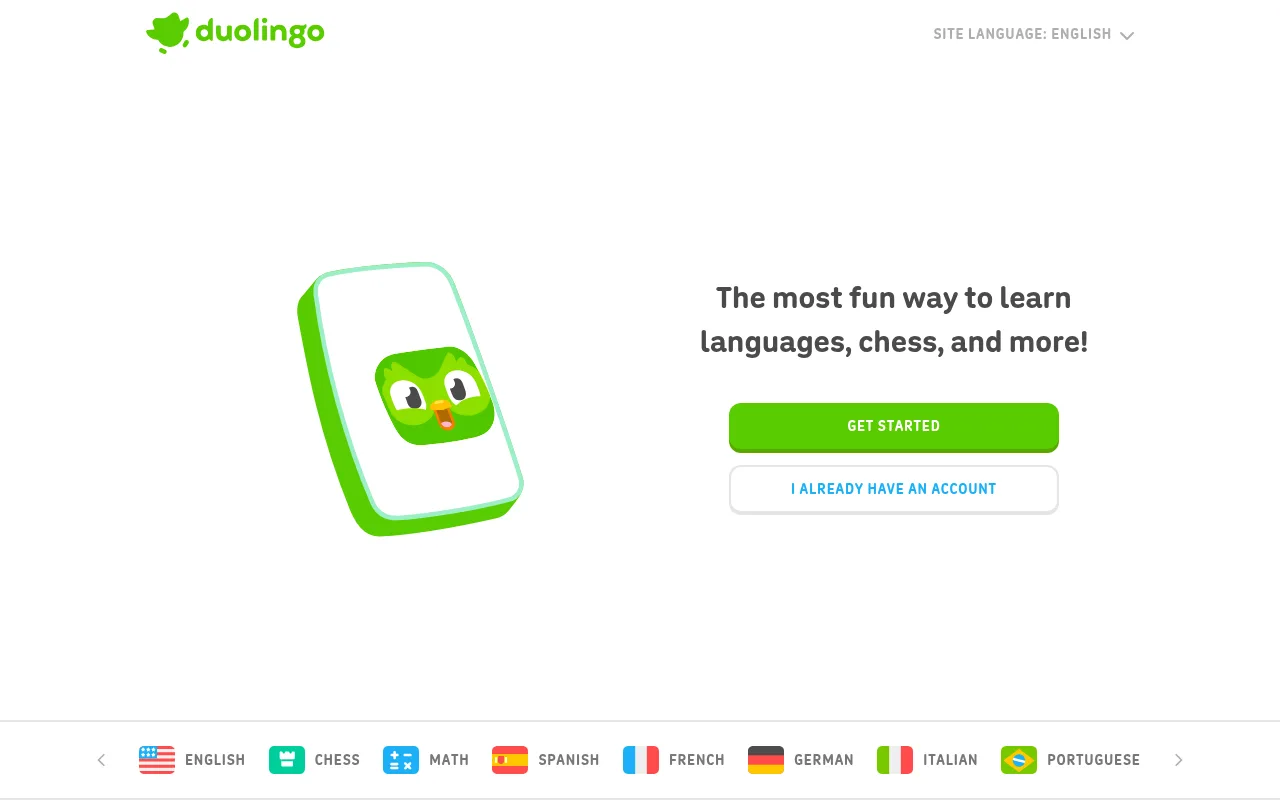
Duolingo is the most accessible free entry point for building English vocabulary across 37 languages, using gamified streaks and bite-sized lessons to make daily habit formation low-friction. It genuinely works for reading recognition and basic vocabulary recall. The real limitation is the one that the same research surfaces: learners who follow the course passively, without driving their own exposure choices outside the app, consistently report completing full courses and still freezing in real conversation.
A second, practical frustration compounds this: the app's free experience is genuine at first, but the subscription prompt arrives quickly, and learners who have invested time in a streak suddenly face a paywall before they have enough evidence to know whether the method works for them. Best suited for beginners who need a daily habit anchor, not a fluency engine.
2. Pimsleur - Best Audio-First Method for Pronunciation and Listening Habit Formation

Pimsleur's 30-minute audio-only lesson structure is the sharpest contrast in the app category. It offers two distinct modes:
No screen required
No leaderboard or streak notifications
Research supports its effectiveness for pronunciation and listening comprehension at the beginner stage, making it the strongest pick for learners whose primary gap is decoding spoken English rather than reading it. The tradeoff is format fatigue; 30 uninterrupted minutes is a real commitment, and learners who struggle to carve out that block consistently tend to abandon it faster than shorter-session alternatives. The novelty of audio-only learning fades, and without an adaptive engine adjusting content to where the learner actually is, consistency becomes the learner's problem to solve alone.
3. Babbel - Best App for Explicit Grammar Scaffolding and Conversational Structure
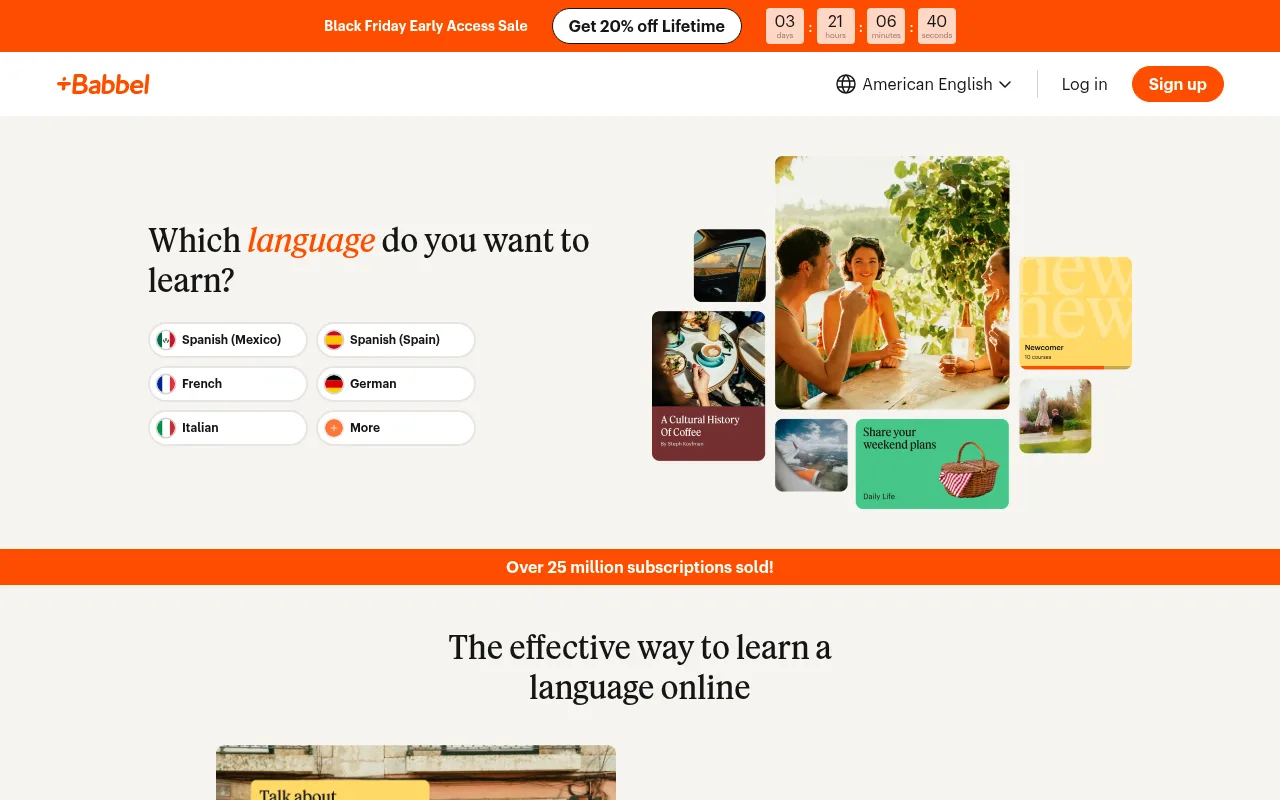
Babbel is built around teacher-designed lessons that explain grammar rules in plain language before asking learners to use them, which makes it the clearest choice for adult beginners who want to understand why a sentence works, not just whether it sounds right. The structured dialogue format transfers more directly to real conversation than pure flashcard drilling. The practical limitation is cost: Babbel offers a free tier that includes the first lesson of every course at no cost, with up to 80 free lessons available depending on the language selected.
4. Quizlet - Best Flashcard Tool for Targeted Vocabulary and Phrase Memorization
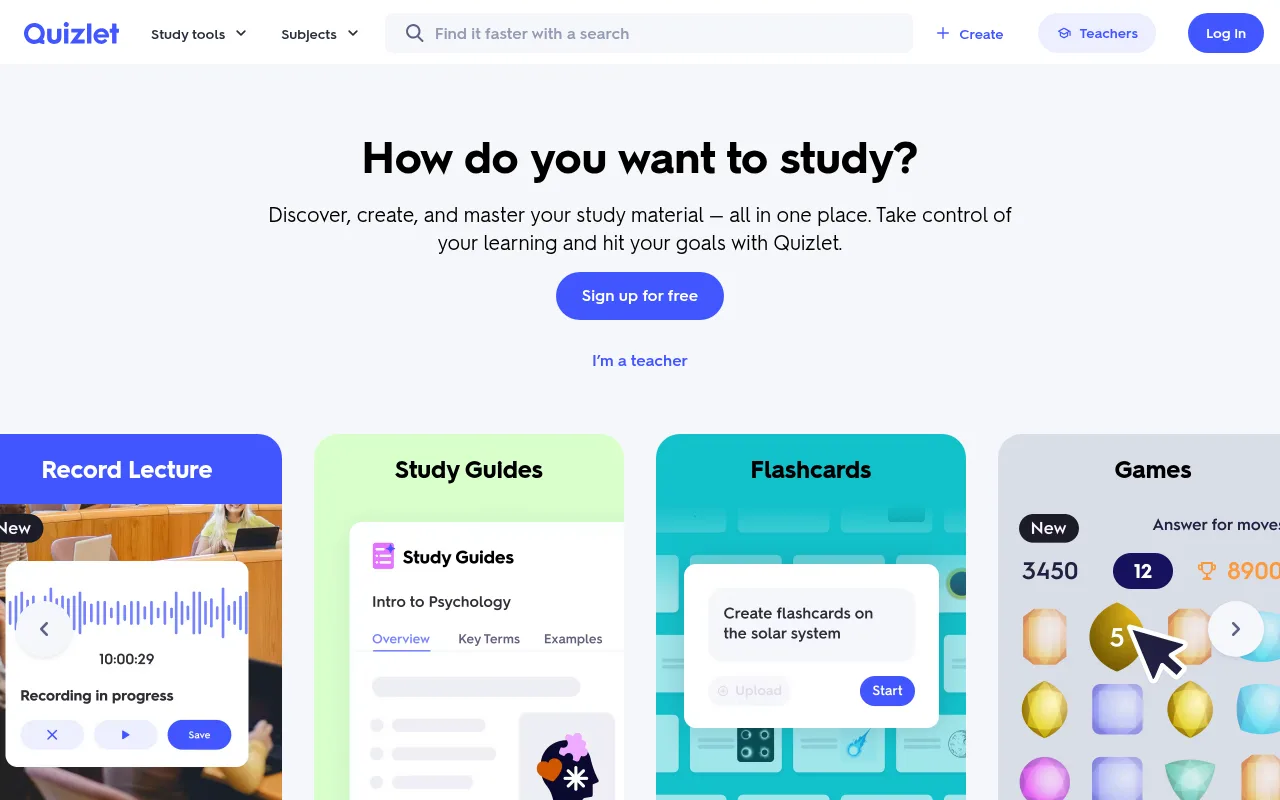
Quizlet is the most flexible vocabulary tool in this list, letting learners build or import custom decks rather than following a preset curriculum. That flexibility is its real advantage for intermediate learners who have identified specific vocabulary gaps, including native English speakers who encounter vocabulary gaps when reading older or more complex books, a more common ceiling than most apps acknowledge. The limitation worth naming plainly: memorizing a word on a flashcard and acquiring it as usable language are neurologically distinct processes. Quizlet builds recognition; it does not build the kind of contextual fluency that lets you retrieve a word mid-sentence under conversational pressure. Use it as a supplement, not a primary method.
5. BBC Learning English - Best Free Structured Resource for Self-Directed Learners at All Levels
BBC Learning English reaches tens of millions of learners monthly and covers grammar, vocabulary, pronunciation, and news-based listening across every level, all without a paywall. For self-directed learners exhausted by apps that surface a subscription screen after 20 minutes of genuine engagement, it is the most trustworthy no-cost option available. The honest tradeoff is that it requires the learner to direct their own path through the content; there is no adaptive engine or streak mechanic to create accountability, so consistency depends entirely on the learner's own structure.
Every app above measures what is easy to measure: streaks, XP, flashcard accuracy, lesson completion. SLA research is consistent that these metrics track time-on-task rather than communicative competence, which is why learners can complete full courses and still struggle to decode a native speaker at natural speed. Comprehensible input approaches, feeding learners contextual, slightly above-level content rather than isolated drills, are designed to address that specific gap.
This is where Parrot sits in the landscape. Rather than adding another drill-based layer, Parrot is built around the Comprehensible Input Method, the same SLA framework that explains why passive course completion consistently fails to convert into real speech. Its short-form video feed delivers content that is contextual and sequenced for each learner; the sequencing is governed by an underlying adaptive engine, not a fixed syllabus, which keeps input slightly above the learner's current level rather than recycling what they already know. For learners who have already worked through memorization-based methods and hit the ceiling where recognition stops converting into actual speech, that distinction is the whole game.
Parrot also addresses the two failure modes that follow learners out of every app above: the paywall surprise and the consistency cliff. The free trial runs for seven days with full Premium access on the annual plan, enough time to run the placement test, work through verb conjugations and grammar insights inside the video feed, and use Parrot Back for real speaking practice before committing. A reminder is sent before the trial ends, so there is no silent charge. After that, Premium is $20 per month or $90 per year (US pricing; other markets see localized prices). That structure removes the trust problem that undercuts every app that asks for a card before proving its value.
The same short-session format that works for families using Parrot together in daily sessions works for individual adult learners fitting practice into a fragmented schedule.
Parrot's Review Cards bring an additional layer of targeted reinforcement: after video sessions, key vocabulary and phrases surface for review in a format that ties words back to the context in which they appeared, addressing the gap Quizlet cannot close, the difference between recognizing a word on a card and retrieving it mid-sentence because you encountered it in real use first.
Most beneficial when a learner has already tried memorization-based methods and hit the ceiling where recognition stops converting into actual speech. These tools are the most accessible on-ramps to English, but they are still the surface layer of what language acquisition research actually recommends. The next section goes deeper, into the cognitive science methods that SLA researchers study but that almost never make it into an app store.
Research-Backed Cognitive Science Methods for English Learning Beyond Apps
Knowing rules and speaking fluently are two entirely different cognitive skills, and the gap between them is precisely where most adult learners stall, often after memorization-based methods have already run out of road. The research explains exactly why.
"Years of failure with grammar-heavy methods and vocabulary lists suggest that traditional, non-cognitive-science-backed approaches do not produce lasting retention or fluency."
— what we hear from language learners
Stephen Krashen's Input Hypothesis, first published in 1982, draws a hard line between acquisition (subconscious absorption from meaningful exposure) and learning (conscious rule memorization). Only acquisition produces spontaneous speech. Conscious grammar study, at best, acts as a slow editor for output you have already formed.
The implication is uncomfortable: the hours spent drilling conjugation tables produce knowledge about a language, not the ability to use it. Learners who plateau at A2 after months at a language institute, or who can recite verb conjugations but freeze the moment a native speaker responds, are running up against a structural ceiling built into grammar-heavy instruction. Years of failure with vocabulary lists and rule memorization reflect the method, not the learner, because those approaches were never designed around how the brain acquires language.
There is a second variable most learners never account for. Krashen's Affective Filter Hypothesis shows that anxiety and low confidence raise a neurological barrier that stops comprehensible input from converting into usable language. This means even a perfectly calibrated method stalls if the emotional conditions of practice feel threatening. Anxiety is an active acquisition blocker. Any approach that maximizes input quality while ignoring emotional safety will plateau at comprehension and never reach speech.
The three methods below are what SLA researchers actually study. Most learners never encounter them because the evidence lives in academic journals, not app stores.
1. Comprehensible Input (Krashen's i+1): Acquire Grammar Through Context, Not Drills
The i+1 principle holds that acquisition happens when input is slightly above your current level, around 90% familiar with 10% new vocabulary in context (Stephen Krashen's Theory of Second Language Acquisition). Grammar is absorbed through pattern recognition, the same mechanism children use, not through explicit rules. The practical form is watching a video you mostly understand and letting the unfamiliar 10% resolve through context. The real tradeoff: this requires honest self-assessment of your level. Input pitched too high produces confusion, not acquisition.
This is precisely where Parrot's Comprehensible Input Method is most useful. Rather than asking you to self-assess your level in a vacuum, Parrot's placement test establishes your baseline before content is served, so the i+1 calibration happens automatically. You do not spend time configuring anything: immediately upon opening the app, learners start consuming content, a short-form video feed that surfaces material at the right level from the first session. For learners who have burned out on conjugation drills and vocabulary lists that never translated into real speech, the shift from studying grammar to absorbing it through contextually grounded video is where measurable progress restarts.
2. Lexical Chunks - Memorize 'Could You Help Me' as One Unit, Not Three Words
A study in Frontiers in Psychology found that learners trained on formulaic sequences (whole phrases like "take a break" or "I was wondering if") spoke faster and with more natural phrasing than word-by-word assemblers. The brain retrieves a chunk as a single unit, cutting processing time mid-conversation. The limitation is coverage: chunk learning works best alongside comprehensible input, not as a standalone method.
Learners who memorize vocabulary lists but find the words never surface naturally in conversation are experiencing the word-by-word assembly problem chunks directly solve. Pairing chunk recognition with Parrot's video feed, where formulaic phrases appear in natural, native-speaker context, gives the brain both the retrieval shortcut and the exposure density needed to make those phrases automatic (Stephen Krashen, Input Hypothesis / Second Language Acquisition Theory).
3. Shadowing Technique - Mirror Native Rhythm and Intonation in Real Time
Shadowing, repeating native speaker audio a half-second behind in real time, trains pronunciation and listening simultaneously. Research on the shadowing technique shows improvements in both prosody (rhythm and stress) and listening comprehension, because the method forces active phonological processing rather than passive exposure. The honest limitation: beginners often find it overwhelming before they have a listening base. It works best at the low-intermediate level, using clear, natural-speed audio from native speakers rather than slow pedagogical recordings.
For learners ready to move from input to active output, Parrot's Parrot Back feature bridges exactly this gap, providing speaking practice during or after video sessions so that the patterns absorbed through comprehensible input get tested and reinforced in production. The two work together: comprehensible input builds the internal grammar; speaking practice converts it into retrievable, spontaneous speech.
---
These three methods share a common thread: they all work best when the input around you is rich, contextual, and relentless, which is exactly the problem the next section solves. If comprehensible input is the engine, immersion is the fuel supply, and you do not need to move countries to build it.
Comprehensible Input trains the brain to absorb grammar through pattern recognition rather than explicit rules.
Lexical Chunks replace word-by-word assembly with whole-phrase retrieval, cutting processing time mid-conversation.
Shadowing trains pronunciation and listening simultaneously by mirroring native rhythm and intonation in real time.
Immersion Strategies That Build English Acquisition Outside the Classroom
Your phone's default language is one tap away from becoming your most powerful English teacher. Adults spend over six hours a day on screens, and most of that time is idle scroll time that could be quietly redirected toward English acquisition without adding a single minute to the day. Immersion is an engineering problem, and the raw material is already in your pocket.
1. Switching All Device Menus and Keyboards to English for Round-the-Clock Passive Exposure
Changing your phone, laptop, and smart TV interface language to English forces micro-encounters with vocabulary dozens of times daily without any scheduled study. This works best for intermediate learners who already recognize enough words to navigate menus without frustration. The real tradeoff: beginners risk confusion and accidental setting changes, so pair this with a reference screenshot of key menu paths in your native language.
2. Watching English TV Series with English Subtitles Instead of Native-Language Dubbing
Pairing spoken English audio with English on-screen text creates a dual-channel reinforcement loop where the ear and eye confirm the same word simultaneously, accelerating word recognition and natural pronunciation mapping. This suits pre-intermediate to advanced learners and is especially powerful for idioms and connected speech. The limitation: learners who rely on reading subtitles without listening actively can develop a reading crutch that slows true listening comprehension.
3. Streaming English-Language Radio and Podcasts as Continuous Background Audio Throughout the Day
Running English talk radio or news podcasts during commutes, cooking, or exercise replicates the Mongolian-Russian phenomenon documented by language learners: sustained ambient exposure gradually tunes the brain's phonological filters to English rhythm and intonation. Best for learners at A2 level and above who can catch partial meaning. The honest caveat: purely passive listening without occasional focused attention produces slow vocabulary gains and should be supplemented with active sessions.
4. Authentic Interaction Over Scripted Drill - Replicating CLT Conditions via English-Language Online Communities
Communicative Language Teaching research consistently shows that meaning-focused, unpredictable interaction outperforms scripted repetition for fluency development. Outside a classroom, English Reddit threads, Discord servers, or language exchange apps recreate CLT conditions by forcing real-time comprehension and spontaneous production. This is ideal for learners who have basic grammar but stall on speaking. The tradeoff: unmoderated online spaces can reinforce non-standard usage if learners lack a feedback mechanism.
5. Using English-Language Social Media Feeds and Comment Sections as a CLT-Style Authentic Text Environment
Following English-only accounts on Instagram, Twitter/X, or YouTube and engaging in comment threads puts learners inside genuine communicative exchanges around topics they already care about, satisfying CLT's requirement that language serve real communicative intent. Upper-beginner and intermediate learners benefit most because content is bite-sized and contextually rich. The limitation: algorithm-driven feeds can create vocabulary bubbles, exposing learners to only one register or topic domain.
6. Extensive Reading at the i+1 Comprehension Level as a Daily Low-Friction Vocabulary Habit
Reading English graded readers, simplified news sites like Newsela, or genre fiction slightly above current comfort level allows learners to acquire vocabulary through context without stopping to look up every word, the core mechanism of extensive reading theory. Fifteen to twenty minutes daily compounds into thousands of word encounters per month. The key tradeoff: choosing texts too far above comprehension level turns extensive reading into intensive decoding, killing the habit-forming ease that makes it effective.
7. Building an English-Only Reading Routine with Pleasure-First Genre Selection to Sustain the Daily Habit
Extensive reading only compounds when it is genuinely sustained, which means genre and topic enjoyment must come before linguistic difficulty. Learners who choose English crime novels, fantasy series, or sports blogs they would read in their native language maintain the habit far longer than those who read assigned texts. This strategy suits all levels when material is correctly leveled. The limitation: pleasure-first selection can lead learners to avoid the academic or professional registers they ultimately need.
8. Passive Listening - Playing English Audio Without Active Attention as the Entry Point of the Immersion Spectrum
Passive listening, playing English audio while doing something else entirely, is the lowest-effort entry point on the immersion spectrum. It builds familiarity with English rhythm, intonation, and sound patterns before vocabulary retention kicks in meaningfully. Ambient audio alone produces a measurable but slow acquisition rate, and learners who rely on it exclusively tend to plateau early. Treat it as a warm-up layer that lowers the cognitive shock of active listening sessions, not as a standalone acquisition strategy.
9. Semi-Active Viewing - Watching English Content with Deliberate Attention but No Pausing or Note-Taking
Semi-active viewing sits one step above background audio: you are watching with genuine attention but letting the content flow without stopping to look anything up. This mirrors the way children acquire language, absorbing patterns through repeated exposure rather than analysis. It is most beneficial at intermediate level, once you can follow 60 to 70 percent of dialogue without constant confusion. Below that threshold, uninterrupted native-speed content risks becoming incomprehensible input, which produces frustration rather than acquisition. Parrot's Comprehensible Input Method sequences your video feed to keep you just above your current level, not so easy that nothing sticks, not so hard that nothing lands.
10. Interactive Viewing - Pausing English Media to Repeat, Shadow, and Mimic Speaker Pronunciation Aloud
Interactive viewing converts passive screen time into active acquisition by pausing after a line of dialogue and repeating it aloud, matching the speaker's rhythm and intonation as closely as possible. This shadowing technique improves both pronunciation and listening comprehension simultaneously because it forces you to process what you heard precisely enough to reproduce it. It is time-intensive compared to passive watching, so it works best in focused 15-minute sessions rather than across a full episode. Parrot's Parrot Back feature is built for exactly this loop: short-form native-speaker video clips brief enough to shadow completely, with speaking practice built into the session rather than bolted on afterward.
11. Active Annotation - Keeping a Running Vocabulary Log While Consuming English Media
Stopping to write down an unfamiliar word or phrase the moment you encounter it in a show, article, or podcast creates a personal vocabulary record built entirely from real context. Unlike isolated word lists, annotated vocabulary carries the sentence it came from, which dramatically improves retention because meaning is anchored to a specific moment. This directly addresses one of the most persistent struggles beginners face: vocabulary lists that feel disconnected from real usage and therefore fail to stick. The limitation is friction: annotation slows consumption and can interrupt flow enough to reduce enjoyment. Reserve it for one focused session per day rather than applying it to every English media hour, or it becomes another habit that quietly gets abandoned.
12. Full Active Note-Taking During English Documentaries or Lectures as the High-Intensity End of the Immersion Spectrum
At the most demanding point of the seven-technique immersion spectrum, taking structured notes in English while watching documentaries, TED Talks, or YouTube lectures simultaneously trains listening comprehension, writing fluency, and content retention. This mirrors university lecture conditions and is ideal for advanced learners preparing for academic or professional English environments. The significant tradeoff: cognitive load is high enough that beginners and intermediates often miss content while writing, making this counterproductive below B2 level.
13. Task-Based Media Challenges - Setting a Communicative Goal Before Each English Immersion Session
Before pressing play, set a specific communicative goal: summarize the episode's main argument in two English sentences, identify three new phrases you could use in a real conversation, or write a one-paragraph opinion on what you watched. This task-based framing shifts the session from passive consumption to purposeful engagement, which is the core principle behind task-based learning in SLA research. The gap between passive input and active output is where most immersion strategies stall; setting a micro-task before each session is a low-effort way to start closing it without adding structured study time.
Parrot's AI Tutor can serve as the accountability partner for that micro-task, available during or after video sessions to give you personalized feedback on the sentences you produced, the phrases you tried, or the grammar you are still unsure about.
Related Reading
How Long Does It Take To Learn English Fluently
Best Apps To Learn English
Types Of Music Good For Learning English
Learning English As A Second Language
English Learning App For Kids
Best Websites To Learn English
How To Learn English Speaking At Home
Game To Learn English
Tof
English Learning Activities
Best Podcasts For Learning English
Interactive and Conversational Practice Methods That Build Real Speaking Fluency
Comprehension and spoken production are neurologically distinct skills. Learners who have spent months absorbing podcasts, shows, and articles often discover this the hard way: they understand nearly everything they hear, then freeze the moment someone asks them a question. The library is full. The retrieval system has never been tested under pressure.
Merrill Swain's output hypothesis (1985) explains why: comprehensible input builds receptive knowledge, but only forced output reveals the gaps in it. When you have to produce language in real time, you notice what you cannot yet say. That noticing is what drives acquisition forward. Waiting until your grammar feels solid enough before attempting conversation is, structurally, waiting for the wrong thing. Grammar knowledge and spontaneous speech run on separate tracks, and the speaking track only develops through speaking.
The good news: structured conversational practice de-risks that first step considerably.
1. Tandem and HelloTalk - Structured Language Exchange Apps for Finding Conversation Partners
HelloTalk and Tandem together serve tens of millions of active learners, making app-based language exchange a mainstream method rather than a niche workaround. Both platforms match you with native speakers who want to learn your language, creating a natural reciprocal incentive. The real limitation is that without agreed structure, sessions drift toward whichever partner is more confident, and the less fluent speaker gets less practice, not more.
2. Structuring a 50/50 Session Split to Ensure Both Exchange Partners Actually Benefit
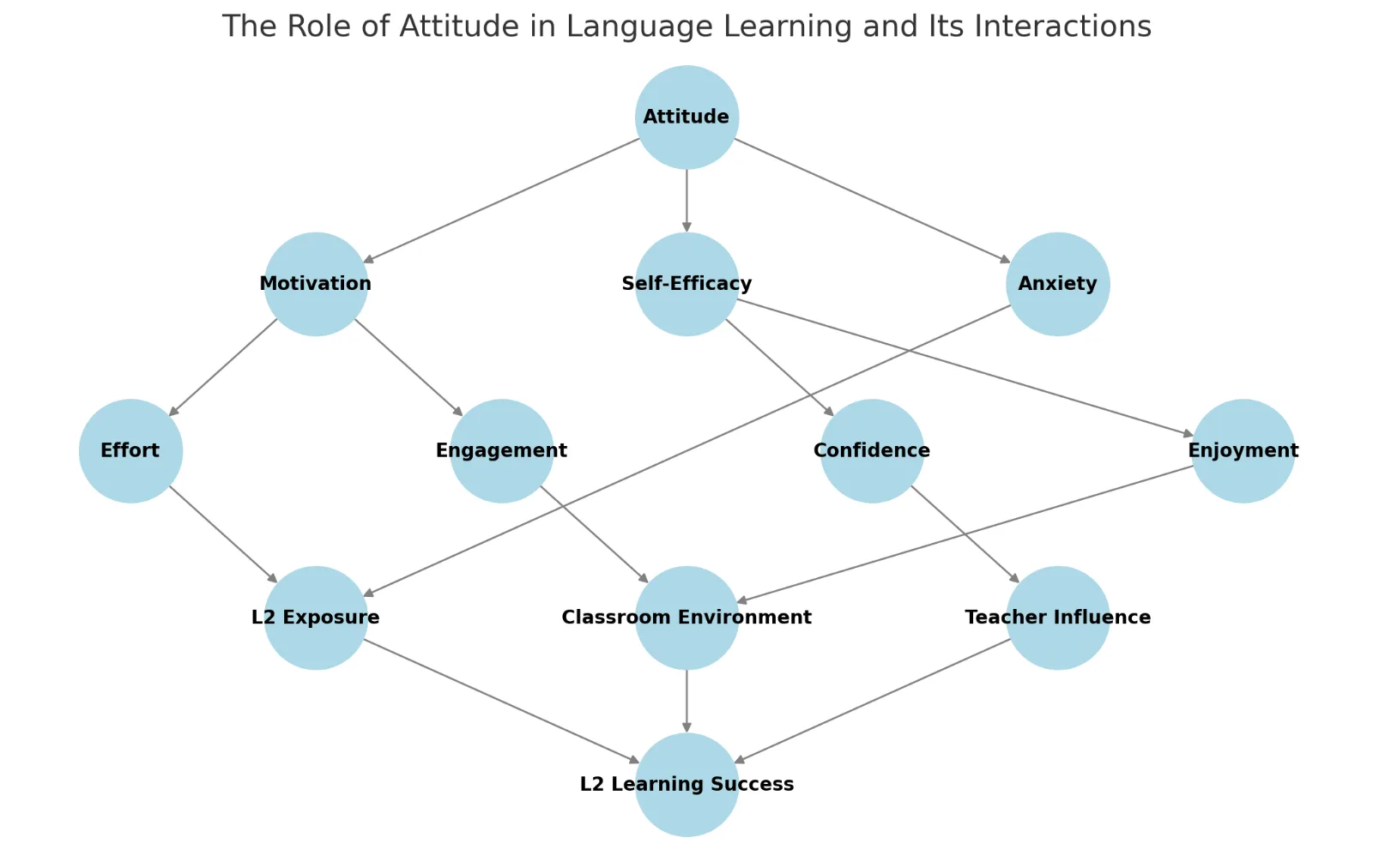
A common frustration in language exchange is that one partner dominates because they are more comfortable speaking. The fix is mechanical: agree before the session starts on strict 10-minute language blocks, set a timer, and switch regardless of where the conversation is. Preparing five topic sentences in advance removes the freeze risk at the start of each block. Without this structure, exchanges collapse into one language within minutes, which is a pattern learners report repeatedly.
3. Hosting In-Person Language Exchange Evenings to Build Community-Level Speaking Practice

In-person exchange evenings, organized through local meetups or community boards, distribute the social pressure across multiple partners in a single session. The freeze risk drops because no single conversation lasts long enough to become high-stakes. The tradeoff is inconsistency: skill levels vary widely, sessions without a facilitator stall at small talk, and attendance is unpredictable. They work best as a supplement to structured one-on-one practice, not a replacement for it.
4. CrossTalk Method - Speaking Your Language While Your Partner Speaks Theirs

CrossTalk means each speaker uses their own language while their partner uses theirs. Both parties focus entirely on comprehension rather than production. Learners who have tried it report faster listening comprehension gains in the early stages, but slower speaking development compared to full target-language exchanges. It is a useful confidence-builder for absolute beginners who are not yet ready to produce full sentences, not a long-term fluency strategy.
5. AI Conversation Simulators - Practicing Real-World Scenarios Without Scheduling Constraints
AI conversation simulators enable active speaking fluency practice at any hour, without coordinating schedules. Tools like Speak and ELSA Speak let learners rehearse realistic scenarios, from job interviews to ordering food, with immediate feedback on fluency and phrasing. The structural limitation is emotional flatness: AI exchanges lack the unpredictability of a real conversation, so they function best as a low-pressure rehearsal space that reduces freeze risk before a real human interaction.
6. AI Pronunciation Feedback via Real-Time Transcription - Closing the Accent Gap
Speech recognition systems flag errors at the phoneme level, surfacing specific sounds a human exchange partner might politely overlook. The limitation is that transcription accuracy drops with strong accents, which means early-stage learners may receive less reliable feedback precisely when they need it most.
7. Communicative Language Teaching (CLT) - Prioritizing Meaning and Function Over Grammatical Form
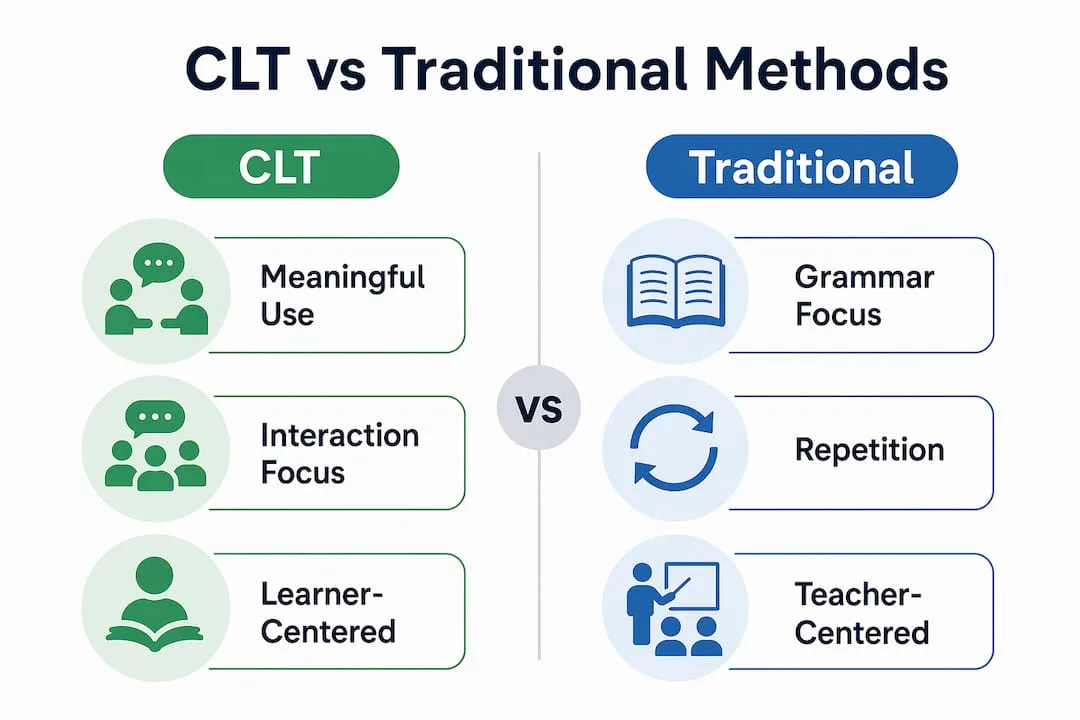
The communicative language teaching method organizes practice around completing real tasks: booking a table, giving directions, negotiating a price. Research comparing CLT to grammar-translation methods consistently shows faster functional fluency gains because the method forces authentic interaction rather than scripted repetition. The constraint is that it requires a willing partner or tutor who understands the approach. Solo learners need to simulate tasks through role-play scripts or AI simulators.
8. The Passive-to-Active Production Gap - Why Understanding English Does Not Mean You Can Speak It
Comprehension and spoken production are neurologically distinct skills. Merrill Swain's output hypothesis (1985) established that input builds receptive knowledge, but only forced output reveals the gaps in it. When you produce language under real-time pressure, you notice what you cannot yet say, and that noticing is what pushes acquisition forward. Learners who wait until their grammar feels solid before attempting conversation are, structurally, training the wrong system.
9. Bridging the Comprehension-Production Gap Through Structured Output Tasks
The most direct way to close the production gap is to create output pressure before you feel ready. Preparing a two-minute spoken response to a prompt, recording it, and listening back externalizes the distance between how fluent you sound internally and how fluent you actually are. Learners who plateau after heavy input phases consistently report that this technique surfaces specific vocabulary and phrase gaps that more passive input alone would never have revealed. Discomfort here is the signal that acquisition is happening.
10. Using a Romantic or Close Personal Relationship as an Immersive Speaking Environment

A close personal relationship with a native or fluent speaker can create a high-frequency conversational environment, but it carries a tradeoff that purely practical methods do not: the emotional stakes of the relationship often cause both parties to avoid correction to preserve comfort, which can slow progress precisely because the interaction feels too safe to push through errors. Setting explicit, mutually agreed correction norms at the outset, for example, flagging preposition errors but not interrupting mid-sentence, helps preserve both the relationship dynamic and the acquisition value. The tradeoff is that partners naturally accommodate non-native speakers by simplifying their own language, which can slow exposure to natural-speed, idiomatic speech.
Setting explicit agreements, such as "correct me when I use the wrong preposition," prevents the relationship from becoming a comfort zone that protects you from the productive friction you actually need.
11. Asking a Teacher or Tutor as a Parallel Resource to Fill Gaps Exchange Partners Cannot
Exchange partners and AI tools cannot reliably explain why something sounds unnatural or correct fossilized errors with pedagogical precision, a trained teacher fills that gap. Using a tutor in parallel with conversational practice ensures that speaking errors get diagnosed, not just tolerated. Best deployed at A2–B1 level when learners are producing enough output to generate correctable errors. The tradeoff is cost and scheduling, making it a supplement rather than a daily practice method.
How to Choose the Best English Learning Method for Your Life
Thirteen methods reviewed, and the most important variable still isn't which one you pick. It's whether the method can survive contact with your actual Tuesday.

Map Your Learner Profile Before Picking a Method
The Foreign Service Institute estimates 1,100 hours of study to reach professional working proficiency in English for a native Spanish speaker. The math forces an honest question before you touch any method: how many minutes does your real schedule actually allow, not the schedule you wish you had?
Beginners need high-comprehensibility input and heavy context support. Intermediate learners need production pressure and exposure to faster, less scaffolded content. Time-poor adults, which describes most working people, need a method that colonizes existing time rather than demanding new time. That single constraint eliminates more methods than any academic comparison ever could.
Why the Method-vs-Habit Gap Kills More Learners Than the Wrong Method Ever Could
The failure rarely comes from choosing the wrong method. It comes from choosing a method that requires a dedicated block of focused attention that a busy adult never consistently finds. Learners who spend years studying without gaining real conversational ability almost always share one pattern: the method asked them to create new time rather than reclaim time they were already spending, and that demand quietly erodes adherence until the habit collapses entirely.
Colonize Dead Time Instead of Carving Out Study Time
The average adult spends approximately 6-7 hours per day on screens, much of it passive scrolling rather than intentional activity. That time already exists in your day; it just isn't working for you yet.
Second language acquisition research has established that comprehensible input, absorbing language pitched just above your current level in meaningful context, produces stronger long-term fluency outcomes than explicit grammar instruction alone when both are measured against conversational ability. Replacing a fraction of passive scroll time with a short-form video feed built on comprehensible input principles is therefore an acquisition-first approach that requires no schedule overhaul. It won't suit a learner who needs exam preparation or formal writing skills; for those goals, structured grammar work still earns its place.
Related Reading
Best Apps For Learning English Pronunciation
Best Tv Shows To Learn English
Best Books To Learn English Grammar
English Pronunciation Exercises
Best Audiobooks To Learn English
Best Movies For Learning English
Best Books For Learning English
Best Youtube Channels To Learn English
Best Apps To Improve English Speaking Skills
Next steps
If you have spent months inside apps, completed every unit, and still freeze when a native speaker responds, the path forward starts with accepting that grammar study builds a map but cannot teach you to drive. Spontaneous speech only emerges from repeated comprehensible exposure, not from finishing one more structured course. Start with our learn Spanish.
App-based tools amplify results only when learners control their own exposure choices, which means a fixed syllabus sequence actively undermines the spaced repetition mechanism it claims to use. Conversational fluency and grammar knowledge are also products of two separate neurological processes that must be trained in parallel, not sequentially, so waiting until grammar feels solid before attempting conversation systematically starves the only process that produces real speech. Together, those two realities point to one action: replace passive scroll time with contextually sequenced, comprehensible input that runs alongside speaking practice from day one.
Start with Parrot's short-form video feed, built on the Comprehensible Input Method, with a placement test that calibrates content to your actual level before you watch a single clip. From there, Parrot Back opens speaking practice inside the same micro-sessions, and the AI Tutor provides personalized feedback during or after each session, turning passive input into active, corrected output without adding a single new block to your calendar.
Frequently Asked Questions
What's the difference between ESL and ESOL learners?
An ESOL learner studies English while living inside an English-speaking country, which means they receive hours of ambient comprehensible input every day. An ESL learner studies in their home country and has no such safety net, which makes method choice far more consequential, grammar-translation and audio-lingual drilling hurt ESL learners disproportionately because there is no surrounding immersion to compensate for the method's weaknesses.
What are the 5 C's of language learning?
The 5 C's, Communication, Cultures, Connections, Comparisons, and Communities, are the national standards framework for language education established by ACTFL. The post recommends using them as an evaluative lens before committing to any method: methods that score low across these dimensions tend to plateau at passive recognition and are unlikely to develop real conversational ability.
Why do I keep forgetting grammar rules even after I study them?
Cognitive science research on the forgetting curve shows that explicitly drilled grammar rules decay by roughly 50 percent within 24 hours without contextual reinforcement. The brain doesn't acquire spoken language by retrieving stored grammar rules, it builds fluency through pattern recognition in meaningful context, so isolated rule memorization is structurally misaligned with how language is actually learned.
Is studying for a few hours on the weekend just as good as practicing a little every day?
No, daily short sessions are more effective at the level of neuroscience. A learner who reviews vocabulary daily via spaced repetition will retain far more after 30 days than one who studies in a single long session, because spaced repetition times reviews to occur just before the point of forgetting, reinforcing memory traces more efficiently. A three-hour weekend session compresses all practice into one window and then leaves a six-day gap where forgetting accelerates.
If I complete all the units in an app and keep my streak going, why can't I hold a real conversation?
Streak-optimized engagement metrics measure time in the app, not comprehensible language acquired, so visible progress inside the app doesn't translate to conversational ability. The deeper issue is that passive recognition and active speech production are two completely different cognitive skills, decontextualized repetition trains you to recognize language, not to generate it spontaneously in a real communicative situation.