Logging hundreds of podcast hours but still freezing mid-conversation? The problem is not effort. It is the mode, and fixing it changes how fast your speaking actually improves.
The common assumption is that if you just listen to enough English every day, your speaking will naturally improve on its own. Hundreds of hours of English podcasts. Still freezing the moment a native speaker talks to you at work.
That gap is not a motivation problem, and it is not a sign you lack ability. It points to something more specific in how the brain processes language, and understanding it changes everything about how you practice. For learners who want a faster path from listening to actually speaking, active immersion tools are increasingly where that shift happens.

See our learn Spanish for how this works in practice.
The problem is that the brain files familiar audio under recognition, not production. Recognition and production are different cognitive skills, built by different kinds of practice. A learner who has absorbed 200 episodes can still blank completely when a colleague asks a simple question, because understanding English and generating it in real time are not the same pathway. The feeling of productivity is the trap. It keeps listeners logging hours without ever closing the gap.
200
Episodes absorbed, yet still blanking mid-conversation
According to industry research, acquisition only happens when a learner actively engages with meaningful input, not when language washes over them as background noise. Passive listening builds ear familiarity but skips the deeper encoding that speaking ability requires.
Output practice, actually producing language, is what forces the brain to build production pathways. The issue is purely the mode: passive consumption trains your ears while leaving your mouth completely untrained. The question is whether you are using podcasts in the one mode that actually triggers acquisition, and that is exactly what the next section maps out.
Key takeaways
Passive listening builds comprehension, it does not build speaking ability, and those two skills run on separate cognitive tracks.
The brain acquires language fastest when input is slightly above your current level and you're actively engaged with it, not letting it run in the background.
Beginners stall when they pick podcasts built for entertainment rather than ones with controlled speed, limited vocabulary, and short episodes matched to A1–A2 level.
Intermediate learners at B1–B2 gain the most from content that includes conversational fillers and real idioms, the kind of language classrooms and textbooks consistently skip.
Advanced learners face a specific trap: fluent comprehension feels like readiness, but Swain's research shows comprehension and production plateau independently without structured output practice.
A 10-minute active listening drill, pause, repeat, reconstruct, produces more speaking progress than hours of uninterrupted commute listening.
Parrot is built around this exact gap: short-form video content (think TikTok) structured around comprehensible input so learners move from understanding to speaking, not just one or the other. English is coming soon; Spanish is live now.
How Podcasts Actually Improve Your English When You Use Them Right
Research on comprehension thresholds in second-language listening consistently points to a high familiarity bar before incidental vocabulary acquisition reliably kicks in during audio exposure. Understanding why that threshold matters is what separates learners who grow from podcasts and learners who quietly give up after a few confusing episodes.

Why Native-Speed Podcasts Overwhelm Beginners
Native English speakers talk at a pace that research on conversational speech consistently describes as fast enough that beginner processing cannot keep up word by word. It is a mismatch between input level and current competence. Krashen's Input Hypothesis is precise on this point: input pitched too far above a learner's current level does not produce acquisition, regardless of how many times they replay it.
The i+1 Benchmark for Knowing Whether a Podcast Fits Your Level
Comprehensible input works on a simple rule: the content must sit at i+1, meaning just one step above what you already control.
Key takeaway: If you understand the great majority of an episode without a transcript, the podcast is in your acquisition zone. Below that, you are training frustration tolerance, not English.
If you understand the great majority of an episode without a transcript, the podcast is in your acquisition zone. Below that, you are training frustration tolerance, not English.
Parrot's placement test removes that blind spot by locating a learner's real competence before any content is selected, so the i+1 principle has an accurate baseline to work from.
From there, Parrot's short-form video feed applies the Comprehensible Input Method directly: the method underlies every video session, governing how content is selected and sequenced so that each piece of input stays in a learner's acquisition zone rather than drifting into noise.
Accent, Speed, and Level as Podcast Selection Variables
British and American English differ enough in vowel sounds, rhythm, and vocabulary that a learner targeting a specific context, an exam, a job, travel, should match their input to that goal.
The same logic applies when a whole family wants to build listening skills together in short daily sessions: content needs to be accessible enough for the least advanced member without feeling condescending to the most advanced, a balance that only deliberate level-matching, not random browsing, can achieve.
The next section maps out which specific podcasts meet those conditions for A1 and A2 learners.
Best English Podcasts for Absolute Beginners at A1 and A2 Level
The best English podcasts for absolute beginners are those built around controlled speech speed, limited vocabulary, and short episode length, not just any audio labeled "for learners." When those three factors align with your current level, you build comprehension fast. When they don't, you stall.
One of the most consistent struggles beginners face is finding enough podcast options genuinely suited to A1 and A2 listening. Content that claims to be beginner-friendly but still moves at a pace that leaves early learners lost after the first thirty seconds pushes learners toward material that is too advanced, triggering the exact comprehension collapse the right podcast is supposed to prevent.
According to industry research, acquisition happens only when input is slightly above your current level, what he calls i+1. Input that overshoots your level does not produce slow learning; it produces anxiety that blocks the brain from absorbing anything at all. That is the structural problem with grabbing any popular English podcast and hoping exposure alone does the work. Volume without comprehensibility produces stress, not fluency.
The eight picks below are ranked around the specific frustration each one eliminates for A1 and A2 learners.
1. ESL Pod - Deliberately Slow, Studio-Clear Speech Built for A1 Ears
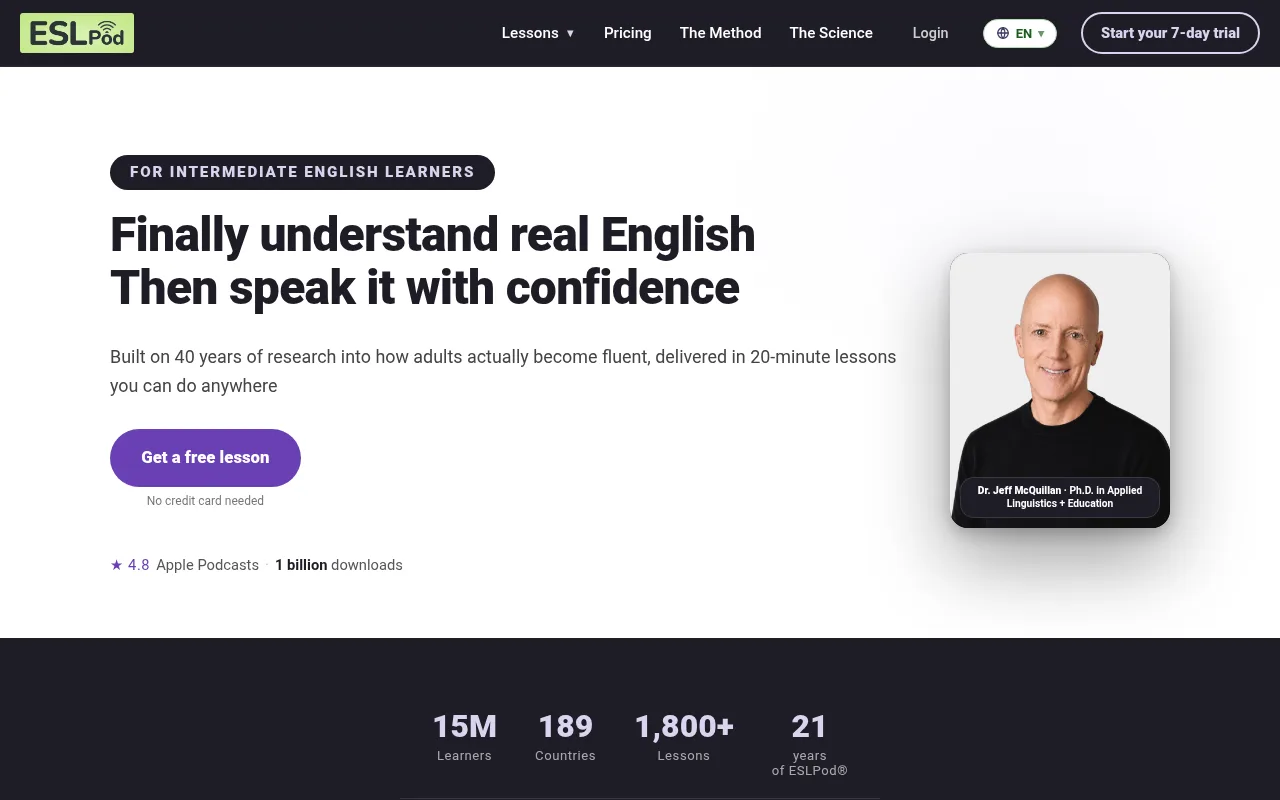
ESL Pod targets intermediate English learners, using its Slow-Explain-Fast Technique to record dialogue at a clear, slow speed before explaining it and replaying it at natural speed. That deliberate structure is the entire point: learners catch individual words and meaning in context instead of hearing one long blur of sound. The tradeoff is that episodes are relatively long for a commute slot, and the format feels scripted rather than natural. Best pick when your single biggest obstacle is speech speed.
2. VOA Learning English - Free Graded News Podcast with A2-Friendly Vocabulary
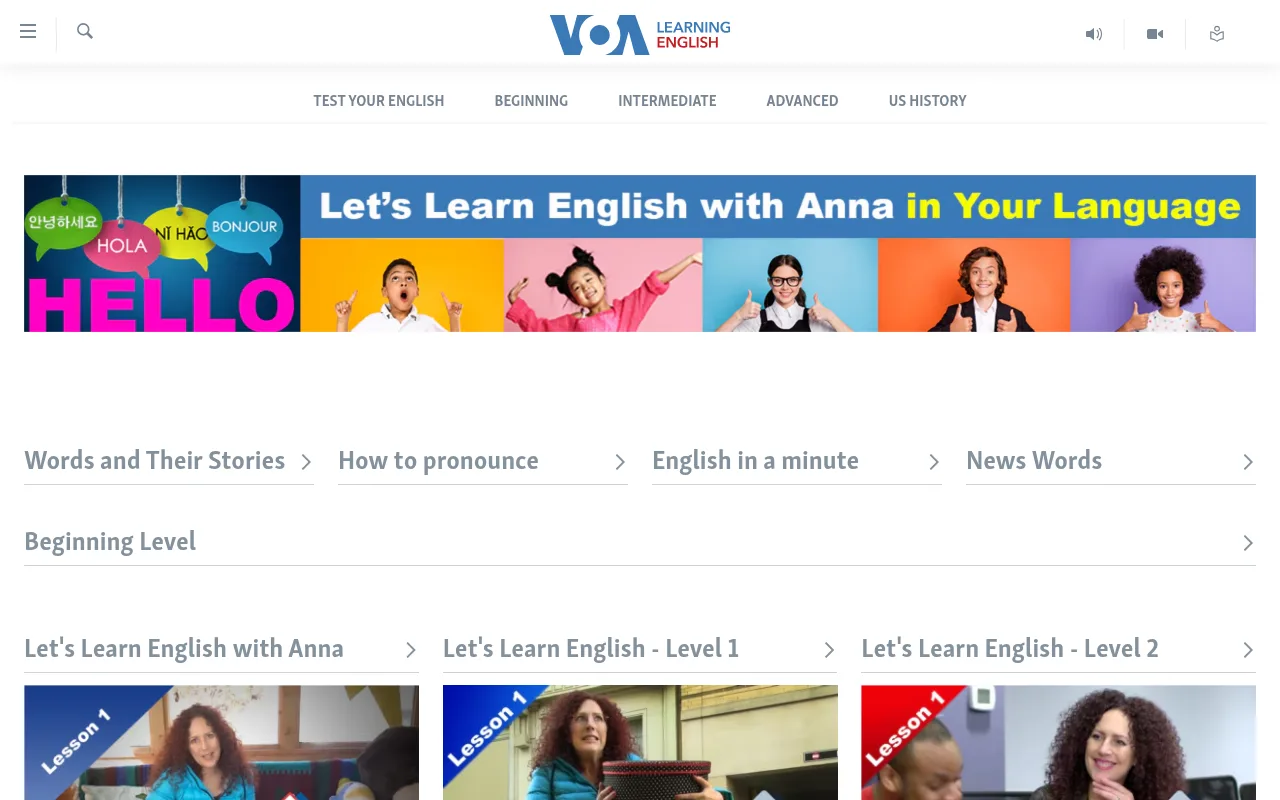
VOA Learning English restricts its word list to a tightly controlled core set, publicly documented as part of its Special English editorial standards, making it one of the few news-format podcasts genuinely accessible at A2 level. Real-world topics keep motivation high because the content feels meaningful, not manufactured. The limitation is that even simplified news assumes background knowledge about world events, which can create comprehension gaps unrelated to English level. Strongest fit for learners who want to connect English practice to things they already care about.
3. 6 Minute English by BBC Learning English - Short Episodes That Fit Any Commute
6 Minute English is the closest thing to a perfect beginner format: episodes are short, focus on a single vocabulary theme, and feature two clear speakers at a managed pace. The BBC Learning English archive holds hundreds of episodes, giving A1 and A2 learners months of graded material without repeating content. The one honest limitation is that British accent and idiom choices occasionally surface phrases that feel formal rather than conversational. Still the strongest starting point for most beginners.
4. Completely Free Access - Why Zero Cost Removes the Biggest Barrier for New Beginners
Every podcast on this list is free. That matters because learners who are unsure whether a habit will stick should not pay for it first. Free access means you can test three or four options in a single week without commitment, find the one that holds your attention, and build the daily routine before investing in premium tools. The hidden cost of free-only listening, however, is that it rarely includes the speaking practice that converts comprehension into actual conversation.
5. Graded Content Structure - How Matched Difficulty Stops Beginners from Quitting
A common pattern among learners who abandon podcast habits early is that they chose content aimed at intermediate speakers, hit a wall of unfamiliar words within the first two minutes, and quietly concluded the problem was their ability rather than the mismatch. Graded content eliminates that false signal. When you understand most of what you hear, the portion you miss becomes a learning opportunity rather than a source of discouragement. That ratio, grounded in Krashen's Input Hypothesis, is what keeps the habit alive past the first two weeks.
6. Spotlight English - 10-Minute Episodes with Transcripts for A2 Independent Review
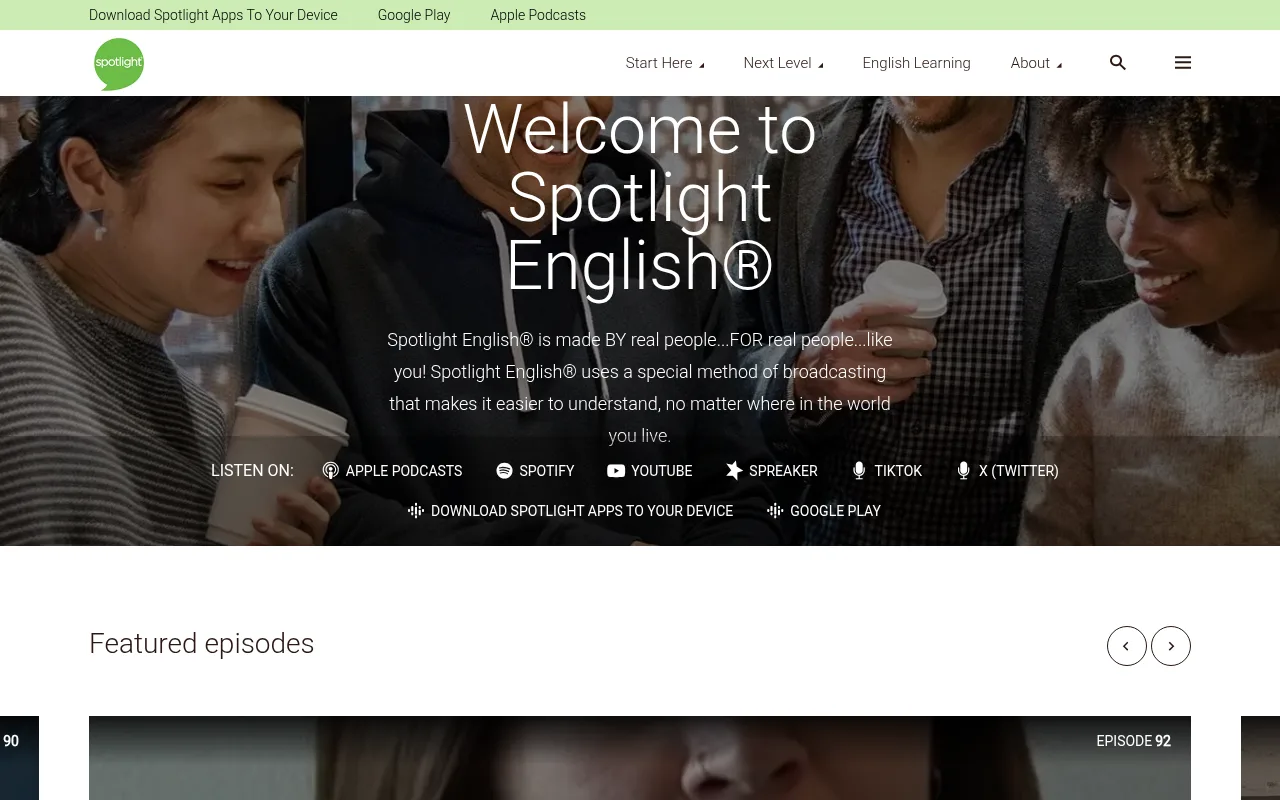
Spotlight English publishes free transcripts alongside every episode, which is rare and useful at A2 level. Listening once, then reading the transcript, then listening again is a three-pass method that dramatically increases retention compared to passive listening alone. Episodes are short and use a slower, clearer delivery than standard native speech. The limitation is that topic variety is narrower than BBC or VOA, so learners who want fresh subject matter each session may exhaust their preferred themes faster.
7. English Learning for Curious Minds - Familiar Topics That Let A2 Learners Infer Unknown Words
English Learning for Curious Minds is a pronunciation and ESL software platform (eEnglish/Pronunciation Power) produced by English Computerized Learning Inc., not a podcast covering history, science, and culture in short episodes for A2 learners. The tradeoff is that episodes assume slightly more background knowledge than pure beginner formats, so true A1 learners may find it a better second step than a starting point.
8. Predictable Episode Structure - How Recurring Segments Reduce Cognitive Load for A1 Listeners
Podcasts like 6 Minute English use the same opening question, discussion format, and vocabulary reveal in every episode. That predictability is a genuine cognitive advantage for beginners. When you already know what is coming structurally, your brain spends less energy tracking the format and more energy processing the language itself. Shows such as Coffee Break English and Easy Stories in English follow a similarly consistent structure, which is why they hold beginner attention better than variety-heavy formats. Choose podcasts with consistent structure until your comprehension rate feels effortless, not effortful.
These podcasts solve the overwhelm problem well. The gap they leave, though, is real: learners who finish episodes regularly and understand most of what they hear still find that the words do not come when they try to speak. That is because recognition and production are different skills.
Parrot is built on the same Comprehensible Input Method these podcasts use, where content is selected and sequenced to stay at your i+1 level, but adds the output layer. Its short-form video feed exposes early-to-mid level learners to authentic vocabulary and natural speech patterns from native-level content, while reading support built into each video keeps that content comprehensible rather than overwhelming. Say out loud and repeat what you hear to build speaking confidence and sharpen comprehension, which is the step that converts listening gains into actual conversational ability.
For learners who have struggled with traditional memorization-based methods and want a research-backed alternative, that combination is the missing piece podcasts alone cannot provide.
These eight picks give any A1 or A2 learner a clear, zero-cost starting point. The moment episodes start feeling easy and you are finishing them without pausing, that is your signal to move on. The next section covers the podcasts built for B1 and B2 learners, where the real fluency gains begin to compound.
Best English Podcasts for Intermediate Learners at B1 and B2 Level
The best English podcasts for intermediate learners are those that deliver natural pacing, real idioms, and accent variety without dropping you into unscripted native-speed conversation before you're ready. As The English Farm notes, intermediate learners at B1 and B2 benefit most from content that includes conversational fillers and idiomatic language rarely found in classroom input. The six podcasts below are evaluated on exactly those criteria.
One pattern that shows up consistently among B1 and B2 learners: the confidence to engage with content is uneven. Many intermediate learners hold back from anything that feels specialized, a science topic, a news segment, an unscripted debate, not because they lack the vocabulary, but because they underestimate what they already know. That confidence gap is real, and it compounds into a wider problem: a passive-English-only phase where comprehension is building but spoken output stays frozen.
These learners can follow a podcast episode reasonably well, yet cannot produce a single fluent sentence in response to what they just heard. What most language researchers and teachers consistently find is that passive input alone rarely closes that gap. Production practice has to be built in deliberately. The six podcasts below address the input side of that equation.
The output side is covered at the end of this section.
1. 6 Minute English (BBC) - Best for Natural Pacing and Everyday Idioms at B1-B2
Six minutes per episode makes this the most accessible entry point in any curated list of best English podcasts for intermediate learners. The BBC presenters model natural connected speech at a pace a B1 learner can track, and each episode introduces a handful of idioms in context. The real limitation: because episodes are scripted and tightly edited, you get very little exposure to the hesitations and repairs that define real conversation.
2. The English We Speak - Idiom-Focused Scripted Dialogue for B1-B2 Learners
This BBC series is the sharpest English idioms podcast on this list, delivering one phrase per very short episode with a scripted dialogue that shows the idiom in use. For B1 learners building vocabulary, the density-per-minute ratio is hard to beat. The tradeoff is format: every episode is scripted and produced, so the speech rhythm feels polished rather than spontaneous, which limits authentic accent exposure.
3. All Ears English - Unscripted Banter with Full Episode Transcripts
All Ears English is hosted by two American teachers and focuses on idioms, American cultural references, and the kind of casual speech patterns that textbooks skip. The unscripted format means you hear real hesitations, overlapping turns, and filler phrases. Full transcripts are available for every episode, and broader findings across language acquisition research confirm that transcript-paired listening helps learners close the gap between what they hear and what they understand. Best for B1-B2 learners targeting American English specifically.
4. Culips ESL Podcast - Interview and Conversation Format with Transcript Support
Culips Everyday English uses a consistent interview and conversation format across episodes, which means you hear the same hosts enough times to calibrate to their rhythm before tackling new guests. Transcripts are included, making it one of the stronger B1-B2 English podcast options for learners who need reading support to catch fast speech. The content skews toward everyday topics rather than current events, so it suits learners who want conversational fluency over news vocabulary.
5. NPR News Now - News Podcast for Upper-Intermediate B2 Learners Seeking Real-World Accent Variety
NPR News Now is the one podcast on this list that was not built for language learners, which is precisely its value at B2. You hear multiple American regional accents, field reporters, and unscripted live reactions within a single short episode. Across the market for language learning resources, over-reliance on a single dialect is widely flagged as a source of comprehension blind spots at B1-B2, and NPR directly addresses that. Not ideal for B1 learners; the vocabulary density is genuinely challenging.
6. ESL Pod - Slow-Paced Scripted Dialogue Podcast Bridging B1 to B2 Proficiency
ESL Pod positions itself as a resource for intermediate English learners. The host reads scripted dialogues at a reduced pace, then explains vocabulary and grammar in plain English. It is the right pick for learners who find the other five podcasts on this list too fast, and a natural bridge from beginner content to authentic B1-B2 material. The limitation is ceiling: once you can follow All Ears English comfortably, ESL Pod will feel too slow to push acquisition forward.
Here is the honest constraint that applies to every podcast above. This is a well-established principle in language acquisition: passive listening alone does not build speaking fluency. Learners need active, structured practice that pushes them to produce language, not just consume it. Swain's Output Hypothesis explains why: immersion learners who received years of rich input still could not produce fluent speech until they were required to push language out. The podcast library fills up fast at B1-B2. The speaking practice account stays nearly empty unless you add an output layer.
That is precisely where a tool like Parrot becomes most useful. Before you start, Parrot's placement test identifies exactly where your comprehension sits, which removes the guesswork of deciding whether a given episode or exercise is at the right level. Its short-form video feed delivers content through the same mechanism that governs the podcasts above, level-matched, naturally paced material, while speaking activities with pronunciation scoring are built into the listening experience.
Parrot scores pronunciation with proprietary models it built and trained. Listening comes first; speaking is about 20% of the experience. For intermediate learners who have built baseline comprehension and are ready to start producing spoken language, that combination, structured input, immediate output prompts, and placement-calibrated sequencing, is what breaks through the plateau these podcasts alone cannot touch.
The six podcasts above are calibrated for learners who can follow connected speech but still need structure to catch what they miss. They are not built for someone who can already follow a fast-moving debate or parse a dense documentary without effort. If you are finding B1-B2 content genuinely comfortable rather than productively challenging, that is the signal to move up: the next section covers podcasts built for advanced learners, and tackles the accent strategy question that most intermediate listeners ignore until it costs them.
Related Reading
How Long Does It Take To Learn English Fluently
Best Apps To Learn English
Types Of Music Good For Learning English
Learning English As A Second Language
English Learning App For Kids
Best Websites To Learn English
How To Learn English Speaking At Home
Game To Learn English
English Learning Activities
Tof
Best English Podcasts for Advanced Learners and Which Ones Teach British vs American English
At C1 and C2, the challenge is rarely vocabulary and almost always the gap between understanding English and producing it under real conversational pressure. The podcasts and strategies in this section are chosen specifically for learners who can follow native speech comfortably but still feel frozen when it is their turn to speak. How you use a podcast at this level matters far more than which one you pick, and that distinction shapes every recommendation here.
The C1–C2 Bottleneck Is Not Vocabulary, It Is the Gap Between Comprehension and Production
Advanced learners face a unique trap: because they can follow almost any podcast, they mistake comprehension comfort for conversational readiness, but the research shows these are entirely separate abilities. Swain demonstrated that even years of rich immersion input produced learners who could understand everything and produce almost nothing fluently under real speaking pressure. For C1–C2 learners, the decisive variable is no longer input quality or accent variety; it is whether every listening session is paired with a forced speaking task that makes the brain retrieve and produce language in real time.
This matters especially for learners who have already hit the ceiling of traditional memorization-based methods. Drilling vocabulary lists and conjugation tables can carry a learner deep into B2 territory; it rarely breaks the C1–C2 production barrier, because the barrier is about retrieval under pressure. Learners who reach this stage and still feel frozen in conversation have almost always over-invested in recognition and under-invested in real-time output.
This means the question at C1–C2 is not simply which podcast to choose, but how you use it. As Mahmoudi and Mahmoudi's 2015 research in the International Journal of Language and Linguistics found, strategic, conscious selection of input sources matters far more than undifferentiated passive exposure. Choosing the wrong accent variety or content register at this stage does not just slow progress; it builds habits that require months of correction when real-world interaction arrives.
The best C1–C2 podcasts are those that deliver unscripted native speech, high idiomatic density, and a deliberate accent match to your actual life goals. Here is how the strongest options compare.
1. Unscripted Native-Speed Immersion - Exposing C1-C2 Learners to Authentic Register and Cultural Nuance
This American Life is the benchmark American English recommendation for C1–C2 learners. Its long-form narrative journalism runs at full native speed with dense cultural reference, colloquial register shifts, and overlapping speech patterns that textbook audio never replicates. Episodes are long-form, which suits focused immersion sessions rather than commute fills. The trade-off: no transcripts are bundled by default, so learners who need reading support to catch fast-speech reductions will need to seek them separately.
2. Matching Podcast Dialect to Real-World Usage - How Accent Choice Shapes Long-Term Fluency Goals
Accent choice is a strategic decision, not a preference. Learners targeting IELTS, a UK workplace, or British university study should build their primary diet around BBC-register content; learners heading to North America or sitting TOEFL should anchor on American sources. Research on internal and external factors affecting language acquisition consistently shows that learners who consciously align their input sources with their real-world goals outperform those who treat accent exposure as a background detail. Thinking in English covers global news and politics with full transcripts available, making it a strong British-leaning option for learners who want reading support alongside audio.
3. Dual-Accent Feeds - Podcasts That Deliver Both British and American English in a Single Subscription
English Across the Pond is co-hosted by an American and a British speaker, which makes it the most efficient single feed for learners who need fluency across both varieties. Each episode surfaces vocabulary differences, pronunciation contrasts, and cultural divergences in direct comparison. The limitation is density: the conversational, explanatory format runs at a slightly lower idiomatic register than fully unscripted shows, so advanced learners should treat it as accent calibration rather than their sole comprehensible input source.
4. Accent-Agnostic Comprehension Training - Building Flexibility Across British, American, Australian, and Irish Varieties
A single-accent podcast diet creates a real comprehension ceiling. Learners who report difficulty with Scottish, Irish, or Australian speakers after years of study have typically over-indexed on one variety. Rotating across at least two accent sources per week builds the phonological flexibility that real-world English demands. Radiolab offers dense, fast-paced American speech; BBC Radio 4 documentaries provide formal British register. Neither is designed for learners, which is precisely their value at C1–C2.
Even the best podcast diet leaves one gap open. Passive listening trains recognition; it does not train retrieval under pressure. This is the gap that Parrot's beginner courses built for day one learners, teaching cognates and foundational Spanish through guided modules are built to close.
Underlying every session is the Comprehensible Input Method, which governs how content is selected and sequenced for each learner, so the immersive short-form video feed advances at the right level of challenge rather than overwhelming or under-stimulating. When a learner wants to move beyond passive watching, Parrot Back pushes them into active speaking practice, creating the real-time retrieval loop that converts an advanced listener into a confident speaker. For learners who want personalized feedback on top of video immersion, particularly those who have already exhausted memorization-heavy approaches and need a research-backed alternative, the AI Spanish Tutor is available during or after video sessions to target specific gaps and answer questions in the moment.
Once you have locked in your accent strategy and your advanced listening diet, the next layer is vocabulary breadth and conversational authenticity, the kind that comes from news cycles, idioms, and the phrases native speakers actually reach for under pressure. That is where the next section picks up.
Best English Podcasts for News, Idioms and Everyday Vocabulary Practice
Research on native speaker conversation consistently finds that idioms appear far more often than most learners expect. Casual exchanges are dense with set phrases, fixed expressions, and figurative language that formal study rarely covers. That number matters because news vocabulary and idiom fluency are separate skills, and no single podcast builds both at once.
The most effective learners treat these as two separate inputs stacked in a weekly rotation. News podcasts expand vocabulary breadth and train you to follow current events in real time. Idiom podcasts build the conversational texture that makes you sound like someone who actually lives in the language. Swapping one for the other leaves a permanent gap.
Pros and cons at a glance
✓ Pros
✗ Cons
Keeps comprehension high enough to prevent anxiety-triggered shutdowns
Hard ceiling: acquisition gains stop once you follow every episode comfortably
Exposes learners to real-world vocabulary textbooks never include
Genuinely useless once you have cleared it
Genuinely useful for vocabulary breadth during the B1–B2 window
Controlled delivery rate and limited vocabulary become friction past that stage
In practice, VOA Learning English is genuinely useful for vocabulary breadth during the B1–B2 window, and genuinely useless once you have cleared it. The controlled delivery rate and limited core vocabulary are features for an anxious intermediate learner and friction for anyone past that stage.
1. VOA Learning English - Slow-Paced News Podcast for B1–B2 Learners
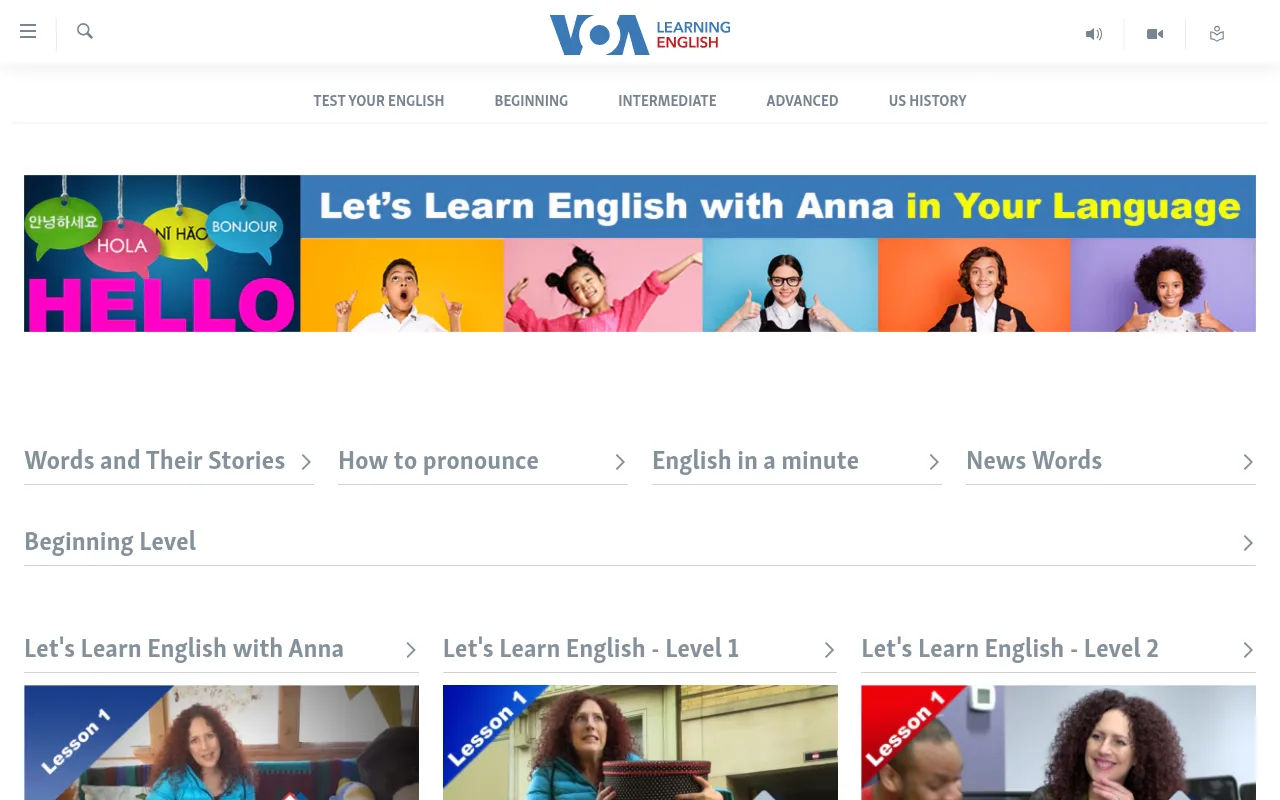
One real struggle learners at this stage face is feeling unready for complex or technical English content, science topics, economic reporting, anything that sits outside everyday conversation. That gap between where you are and where you want your comprehension to reach is a sequencing problem. Simplified news formats like VOA Learning English occupy a specific and underappreciated category: they are one of the few resource types that simultaneously keep comprehension high enough to prevent anxiety-triggered learning shutdowns while still exposing learners to real-world vocabulary and phrasing that textbooks never include.
That combination is rarer than it looks, but it comes with a hard ceiling. Once you can follow every episode comfortably, acquisition gains stop entirely, because the brain only acquires language that sits just above its current level, not language it already understands.
2. The English We Speak (BBC) - One Idiom Per Episode Micro-Podcast
The best English idioms and slang podcast for busy schedules, The English We Speak packages one idiom per episode into roughly three minutes of natural British conversation. The format is efficient for retention: you hear the phrase used in context, explained, then used again, which is closer to how idioms actually stick than a vocabulary list ever is. The trade-off is narrow coverage per episode, so it rewards daily listening rather than binge sessions, and it will not help you follow fast-moving news topics.
3. Learn English Podcast - Story-Driven Episodes for 5-10 Minute Commute Gaps
The average American commute offers a limited window, and the usable gap between stops is often far shorter than the full journey. Learn English Podcast targets that reality with self-contained, story-driven episodes that fit a single gap without requiring you to pick up where you left off. It works well for everyday English practice because the narrative format embeds vocabulary in emotional context, which improves retention compared to news summaries. It is less suited to learners who need current-events vocabulary or formal register.
Stacking these three across a week gives you structured news input, idiom exposure in natural speech, and story-driven vocabulary in context. The hidden cost is that even a well-stacked podcast diet stays an input loop: you absorb vocabulary and idioms, but you never get a low-stakes moment to produce them out loud, so the phrases stay passive.
This is precisely where Parrot's short-form video feed, built around the Comprehensible Input Method, closes the gap. Every video watched contributes directly to real-world listening comprehension. Parrot's spaced repetition system expands vocabulary using native content, sequencing what you see based on where you actually are, so the input stays in that productive zone just above your current level rather than looping back over material you have already absorbed.
For learners who have struggled with traditional memorization-based methods, the Comprehensible Input Method offers a research-backed alternative: immersion in context, not lists out of context. And when passive listening has built enough of a foundation, Parrot Back, the speaking practice feature, and the AI Tutor give you a way to take what you have just heard and immediately practice producing it, with personalized feedback rather than silence.
Stacking these three podcasts gives you the raw material: current vocabulary, natural idioms, and cultural context. The next section covers the active listening system that converts what you hear into language you can actually use.
The Active Listening System That Turns Podcast Episodes Into Speaking Practice
They freeze when told to 'just speak,' which is exactly the gap an active listening system using podcast content (pre-loaded topics) would solve. | what we hear from language learning educators
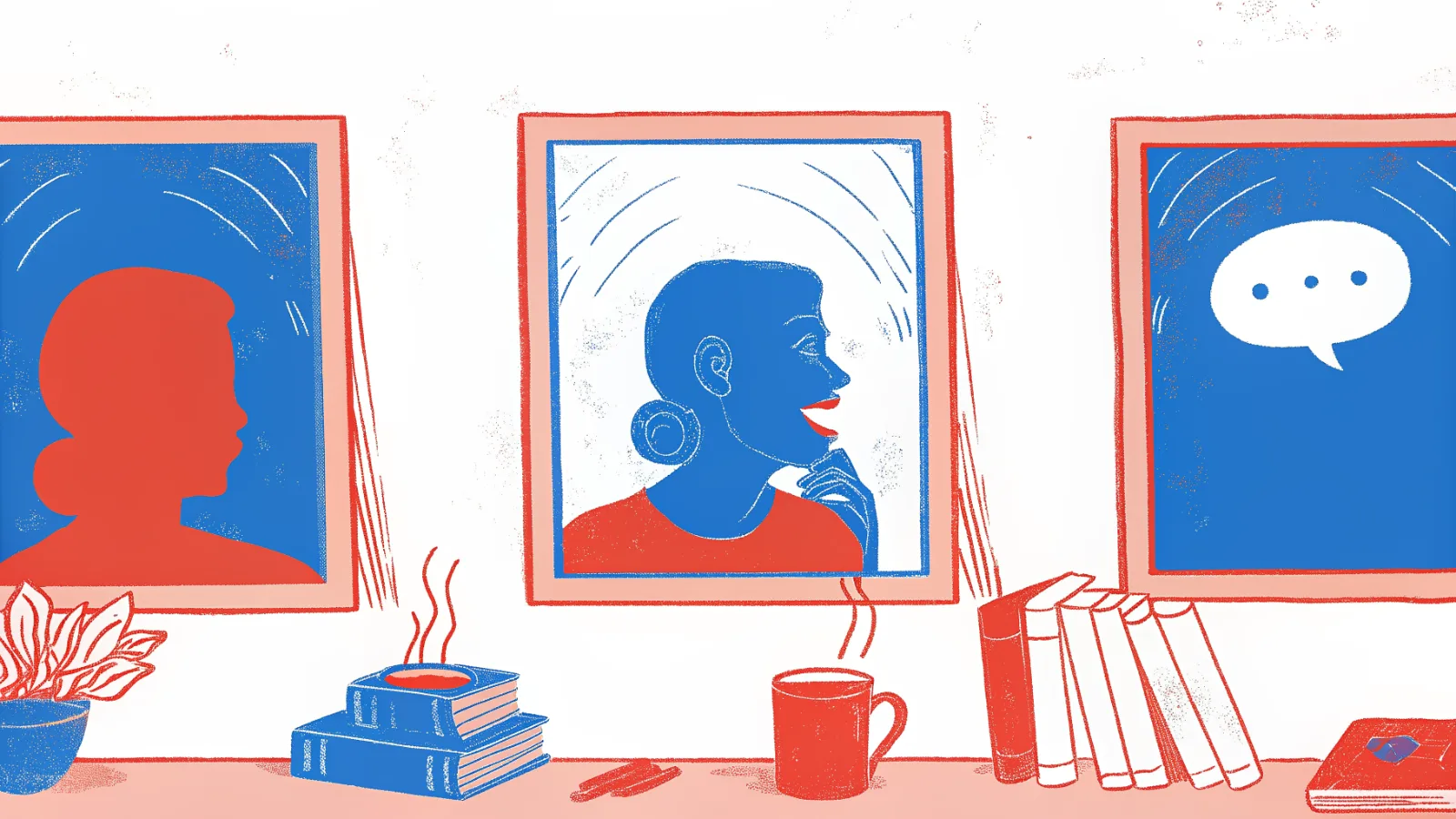
That gap is the real reason so many learners finish episode after episode and still freeze mid-sentence in a real conversation.
The Three-Move Micro-Drill You Can Run in Any 10-Minute Gap
Listen once for meaning.
Listen again and pause after each sentence to repeat it aloud.
Close the app and say the main idea in your own words before moving on.
That final retrieval step is the one most learners skip, and it is the one that matters most. Practitioner guidance and the broader research on active listening techniques consistently confirm that pause-and-repeat and shadowing force the brain to produce language rather than merely absorb it, with documented benefits for both pronunciation accuracy and fluency development.
Why Podcasts Create an Input Ceiling
Passive listening builds familiarity with the language, but it does not build retrieval. After a certain point, finishing more episodes produces no additional speaking gains because the brain never practices finding words under pressure.
Key takeaway: What separates learners who make real speaking progress from those who stagnate for years is what happens immediately after each phrase.
Active recall within the same study session, before the initial memory trace begins to decay, produces stronger long-term retention than returning to the same material a day or more later. That body of evidence supports doing the output step, shadowing, pause-and-repeat, or forced retrieval, during the session itself rather than deferring it. Consistent short daily sessions outperform hours of passive accumulation precisely because they force the brain to produce language before the memory trace weakens.
The ceiling is structural.
Stacking Podcast Input With a Speaking Output Layer
Use purely passive listening for situations where speaking aloud is not practical, and reserve the three-move drill for commutes where you can speak aloud.
For learners who want the output layer built in rather than bolted on, Parrot pairs short comprehensible-input video clips with prompted speaking practice, slotting into the same short gaps you already have. It is the retrieval step, ready to go.
Next steps
If you have spent months finishing English podcast episodes without being able to hold a basic conversation, the path forward starts with pairing every listening session with a forced speaking task that makes your brain retrieve and produce language in real time. Start with our learn Spanish.
Simplified news formats like VOA Learning English keep comprehension high enough to prevent anxiety-triggered shutdowns while exposing you to vocabulary textbooks skip, but their ceiling is low: once episodes feel comfortable, acquisition stops because the brain only acquires language that sits just above its current level. And as Swain's Output Hypothesis makes clear, even years of rich immersion input produced learners who could understand everything and produce almost nothing fluently under real speaking pressure. Those two findings point in the same direction: the input layer podcasts provide is necessary, but the speaking layer has to be built deliberately, in the same session, before the memory trace decays.
Start with Parrot's short-form video feed, which sequences level-matched content through the Comprehensible Input Method, then use Parrot Back to immediately retrieve and say aloud what you just heard. That combination closes the gap between understanding a language and actually speaking it.
Frequently Asked Questions
Does listening to podcasts actually help you learn English?
Yes, but only under the right conditions. Passive listening builds ear familiarity, but acquisition only happens when you actively engage with meaningful input that sits just one step above your current level, what researchers call i+1. If the content is too easy or too hard, or you are listening as background noise, your brain files it under recognition rather than building the production pathways you need to actually speak.
Why can I understand a podcast fine but still freeze when speaking to a native speaker?
Because understanding English and generating it in real time are different cognitive skills built by different kinds of practice. Listening trains recognition, while speaking requires production pathways that only get built through output practice, actually producing language. Hours of listening without any speaking practice leaves your mouth completely untrained even as your ears improve.
Which podcasts are genuinely suitable for absolute beginners at A1 or A2 level?
The post highlights options built around controlled speech speed, limited vocabulary, and short episode length as the key filters for A1 and A2 learners. Among those covered, 6 Minute English by BBC Learning English is described as the strongest starting point for most beginners, with its short episodes, single vocabulary focus, two clear speakers, and a large archive of graded material.
How do I know if a podcast is the right level for me?
Apply the i+1 check: if you understand the great majority of an episode without a transcript, the podcast is in your acquisition zone. If you are frequently lost in the first two minutes, the content is too advanced and you are training frustration, not English. Matching input to your actual current level, not the level you wish you were at, is what keeps progress moving.
How can I make my daily podcast habit actually stick?
Choose podcasts with a predictable, recurring structure, like a consistent opening question, discussion format, and vocabulary segment, because knowing what is coming structurally frees your brain to focus on the language itself rather than tracking the format. Graded content that you can mostly understand also removes the false signal that makes learners quit early, replacing discouragement with genuine learning opportunities.