
Memorizing French phrases feels like preparation. It isn't. Here's why the freeze happens, and how to wire your brain for the reply, not just the opener.
A large share of language learners report freezing or going completely blank the moment a native speaker responds. Most adult individual learners (beginners) think: "If I memorize enough phrases from a list, I'll be able to handle real conversations in France." That number matters because it tells you the freeze is not a personal failure. See our learn Spanish for how this works in practice.
It is a structural one, baked into the way most survival French is taught. It makes complete sense to load up on beginner French phrases before a trip. But the silent cost is that your first real exposure to fast, native-spoken French happens at the worst possible moment: standing at a train counter with a queue behind you, a rapid-fire answer coming at you that your brain has no stored audio pattern to catch.
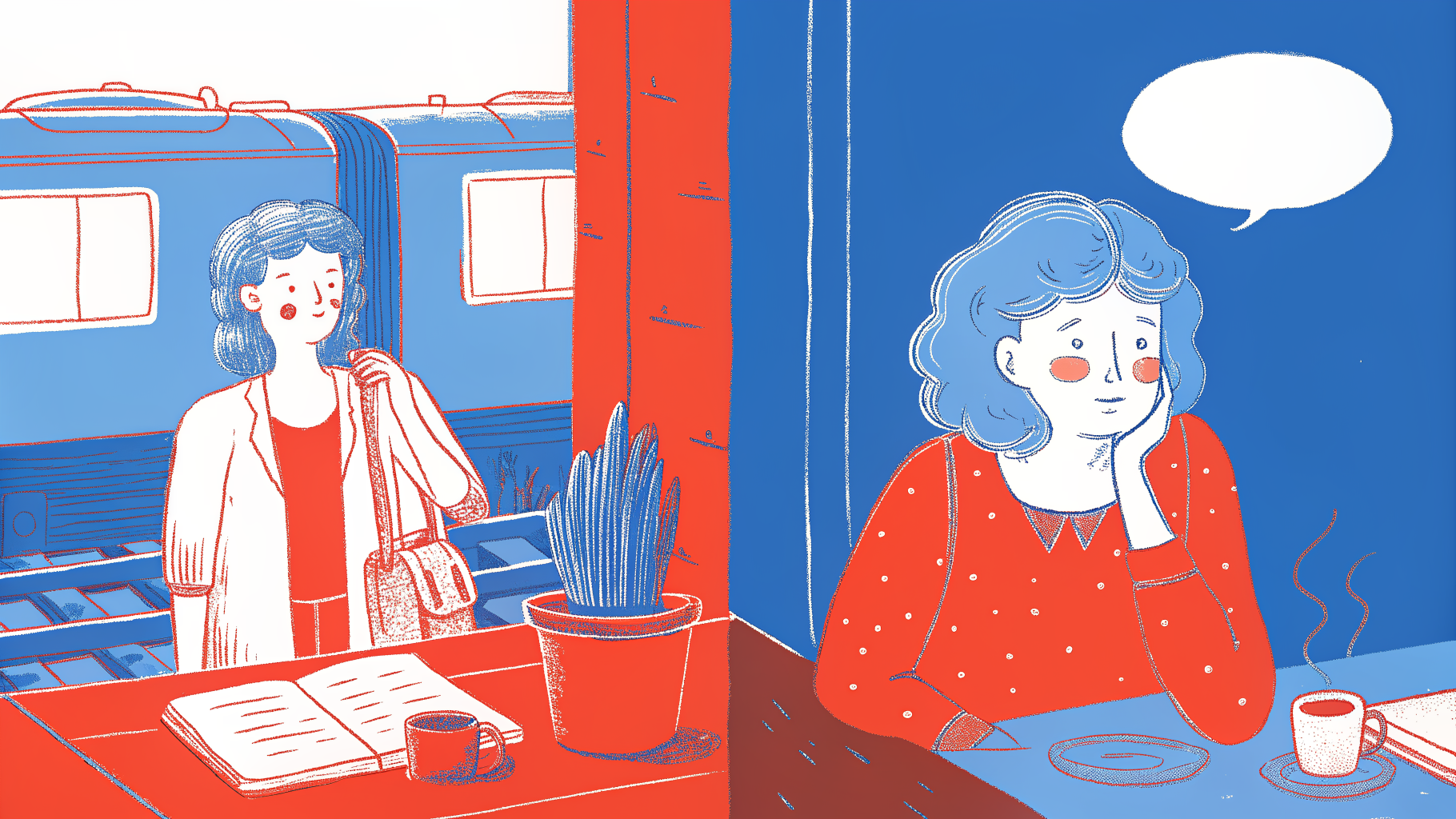
Tools built around comprehensible input sessions exist precisely to close that gap before you ever board the plane. The breakdown point is the listening. Phrases memorised without sound, rhythm, or conversational context are stored as reading-based knowledge, leaving the brain with no auditory anchor to draw on when the same words arrive at native speed in a real exchange.
Key takeaways
Freezing the moment a native speaker responds is not a personal failure, it is a structural flaw in how phrase-list memorization trains the brain, wiring output only and leaving comprehension completely unwired.
Skipping 'Bonjour' before any request in a French shop is read as outright rude, one missing social cue can poison an entire interaction before you have said anything else.
Between 22 and 64 percent of international travellers fall ill on a trip abroad, and that covers only illness, the real odds you will need urgent French are close to certain, not low.
Memorizing a phrase and firing it under real conversational pressure are separate cognitive events; retrieval research confirms that drilling from a table does not build the reflex you need when a Parisian replies at full speed.
The same phrase sounds genuinely different across regional accents, a Lyonnais café owner clips vowels differently than a Parisian barista, and your brain needs exposure to both before it can process either in the wild.
Parrot (parrotapp.com) closes that gap by delivering short-form native French video, comprehensible input, the most researched method in acquisition science, so your ear and your mouth train together on real speech, not rehearsed lines.
How Memorizing Phrase Lists Trains the Wrong Skill for Surviving Abroad
Most adult individual learner (beginner)s think: "If I memorize enough phrases from a list, I'll be able to handle real conversations in France." Phrase lists feel productive. You highlight, you repeat, you close the app feeling ready. The problem is what the effort actually trains, and what it leaves completely unwired.
Phrase Lists Are Output-Only Training and Real Conversations Are 50% Listening
Memorizing a phrase builds one cognitive pathway: production. You learn to retrieve and say the words. What it does not build is the separate, deeper pathway your brain needs to decode a reply.
A study drawing on roughly 670,000 English-language learners found that adult learners who acquire language through explicit rules and memorized forms disproportionately develop output skills while lagging in the implicit, listening-based processing that native speakers use. That asymmetry is precisely why you can deliver a phrase flawlessly and then stand there, frozen, when the answer comes back at natural speed. The opener worked.
The wiring for the reply was never built.
This is one of the most consistent struggles beginners face: they reach a point where they can produce rehearsed lines but cannot process the response. The listening gap is a training method problem.
Parrot's Comprehensible Input Method addresses it directly, sequencing native-speaker video content so that every session you watch is simultaneously a listening workout. The short-form video feed places you inside real spoken language, not a controlled studio script, so your brain begins building the receptive pathways that phrase lists never touch. Parrot's dedicated Listening Practice feature reinforces this further: every video watched contributes immediately to real-world listening comprehension, not just textbook recognition.
Textbook French vs. Boulangerie French - Why Formal Phrases Sound Wrong in Casual Settings
The gap between written French and spoken French is measurable. Elision, contraction, and dropped syllables are not exceptions in casual speech; they are the rule. "Je voudrais un café, s'il vous plaît" is textbook-correct, but in a Paris café most people say "Un café, s'il vous plaît," and the server hears the longer form as stiff, foreign, slightly odd.
Spoken French contracts and compresses constantly, and phrase lists built from written sources cannot capture that. Research drawing on approximately 670,000 English-language learners confirms that even highly motivated adult learners who accumulate large phrase inventories plateau well below native-speaker comprehension norms, because biological critical-period constraints govern receptive competence, not the quantity of material memorized. The learners who break through that plateau share a common shift: they stop training on written lists and start training on real spoken input.
Parrot's short-form video feed is built around exactly that principle. Content is selected and sequenced by the Comprehensible Input Method so that what you hear matches spoken-register language, not the sanitized written form found in textbooks. When you follow a video session with Parrot Back speaking practice, you are not rehearsing a phrase in isolation; you are producing language in the context of what you just heard, which is the closest a solo practice session can come to a genuine exchange.
The Skimming Problem - Why Busy Adults Forget Lists Before They Board the Plane
Without contextual reinforcement, the Ebbinghaus forgetting curve predicts that the vast majority of newly memorized material is lost within days. Retention requires repeated retrieval in varied contexts, which a static list cannot provide. The phrases disappear because isolated text, read without sound or situation, never encodes deeply enough to survive real-world pressure.
Every phrase rehearsed in silence is a phrase never heard at native speed, with the reply attached. Busy adults face a compounding version of this problem: practice sessions are short, irregular, and easy to skip when life intervenes, which means the forgetting curve accelerates before any real consolidation can happen.
Parrot's short-form video format is designed for that reality. Sessions fit into the gaps of a real schedule, and because the Comprehensible Input Method governs content sequencing, each session builds on previous exposure rather than starting from zero. The AI Spanish Tutor adds a layer of active, personalized practice on top of passive video watching, giving learners targeted feedback that deepens encoding beyond what silent repetition ever could. The goal is to maintain and sharpen language skills daily, without the burnout that comes from grinding through vocabulary tables that reset every morning.
The good news: the phrases in this guide are not meant to be drilled from a table. They are a context-first map of the situations you will actually face. Start with the ones that open every French interaction: the greetings and polite expressions that signal to any local whether you are worth slowing down for.
Essential French Greetings and Polite Expressions Every Beginner Needs
Walking into a French shop without saying a word first is not a neutral act. According to industry data, Université Paris-Saclay's guide for international visitors, saying "Bonjour" before making any request is a non-negotiable social norm, and skipping it is considered outright rude before you have said anything else. That single omission can color every exchange that follows. The phrases below are ranked by social weight, not alphabetical order, because in French culture, not all greetings are equal.
Pros and cons at a glance
Pros: Polished reply that shows you know French social protocol.
Pros: Fits any first introduction, professional or social.
Cons: Forgetting gender agreement can signal a lack of effort.
Cons: Using the wrong form (masculine/feminine) is a noticeable error.
S'il vous plaît is the formal version of "please," and it belongs in every request you make to a stranger, server, or service worker. Ohlala French Course notes that politeness in France is a sign of respect, a way of acknowledging another person's presence and importance. Dropping s'il vous plaît from a request makes it sound like a demand. The casual version, s'il te plaît, is for friends only. Beginners should default to the formal form in every public setting until they know a person well.
1. Bonjour - The Non-Negotiable Formal Hello Every Beginner Must Master
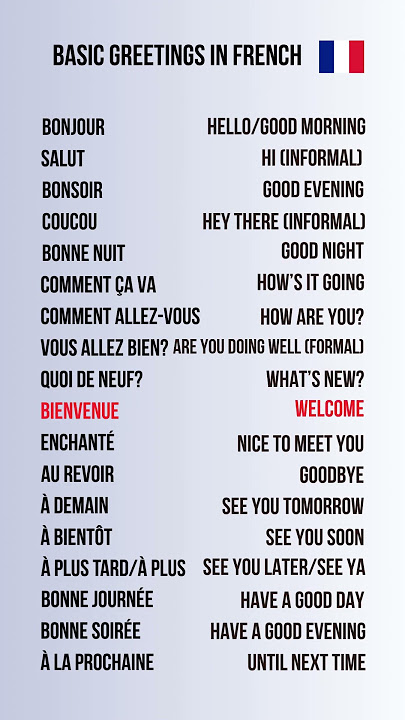
Bonjour is the cultural ignition key of every French interaction. Use it the moment you walk into any shop, café, pharmacy, or office, before you ask anything at all. Université Paris-Saclay frames it as a social ritual that signals respect, not just a linguistic formality. Skip it once and the staff's entire attitude toward you shifts. No other phrase on this list carries that much weight for a beginner.
2. Bonsoir - The Evening Greeting That Shows Cultural Awareness
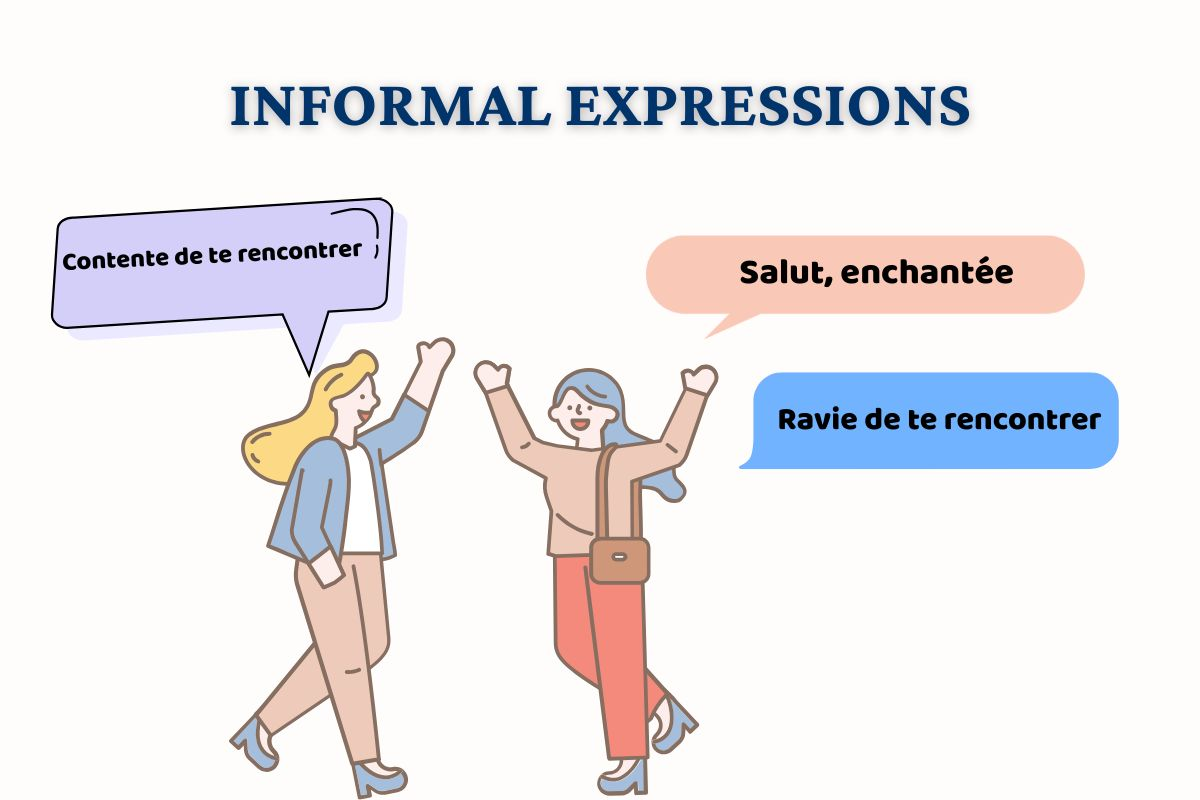
Switch from Bonjour to Bonsoir once the sun goes down, roughly from 6 p.m. onward, though locals often make the call based on mood and light rather than a clock. Using Bonjour at 8 p.m. in a restaurant marks you as someone who learned French from a textbook. Bonsoir costs nothing extra to learn and immediately signals that you understand French greetings shift with the time of day, which native speakers notice and appreciate.
3. Salut - The Casual Hi Reserved for Friends and Peers
Salut is the greeting that trips up more beginners than almost any other word on this list. It sounds friendly and easy, which is exactly why learners reach for it with shopkeepers, waitstaff, and strangers. That is the wrong call. Salut belongs with friends, classmates, and people you already know well. Using it with a stranger or authority figure reads as either careless or disrespectful, and the social fallout arrives instantly in the form of a cooler, shorter response.
4. Enchanté / Enchantée - The Polite Way to Say Nice to Meet You
When someone introduces themselves, Enchanté (masculine) or Enchantée (feminine) is the polished reply that shows you know French social protocol. It is more formal than a casual "cool to meet you" equivalent and fits any first introduction, professional or social. The tradeoff: if you forget the gender agreement and say the wrong form, most French speakers will understand, but getting it right signals genuine effort. Beginners should learn their own form first and practice it until it is automatic.
5. S'il vous plaît - The Formal Please That Opens Every Door
S'il vous plaît is the formal version of 'please' and one of the highest-frequency polite phrases a beginner will use. It pairs naturally with Bonjour when ordering, asking directions, or making any request. French speakers notice its absence immediately. The tradeoff: in casual settings with friends, the shorter s'il te plaît (using tu) sounds more natural, so beginners need to track formality level.
6. Merci - Thank You, the Most Essential Polite Word in French
Merci is short, universal, and expected after every transaction, gesture, or favor. It works in formal and informal settings without adjustment, which makes it one of the safest words a beginner can reach for. The one trap: saying merci in a flat, rushed tone can read as dismissive. French speakers respond to warmth in delivery, not just the word itself. A clear, unhurried "merci" lands far better than a mumbled one, especially in service contexts where eye contact matters.
7. De rien - You're Welcome, and When to Use a Better Alternative
De rien literally means "it's nothing," which is fine between friends but can sound slightly dismissive in formal situations. A shopkeeper who goes out of their way to help you deserves more than "it's nothing." In those moments, Je vous en prie (listed below) is the better choice. Beginners often use de rien everywhere because it is the first phrase they learn, but understanding when to upgrade it is one of the clearest signals of cultural awareness French speakers pick up on immediately.
8. Excusez-moi - The Polite Attention-Getter and Apology Starter
Excusez-moi does two jobs: it gets someone's attention politely before a question, and it opens an apology when you have bumped into someone or interrupted. Use it before asking a stranger for directions, before flagging down a server, or any time you need to step into someone's space. The casual equivalent, excuse-moi, is for people you know. In crowded spaces like the Métro or a market, excusez-moi delivered clearly and calmly is the socially correct way to move through a crowd without causing friction.
9. Oui and Non - Mastering the Basics of Yes and No in French
Oui and non seem too obvious to include until you hear how often beginners nod silently or say "yes" in English instead. In French interactions, a clear oui or non confirms you are engaged in the exchange. One cultural note: responding with a very soft "ouais" (a casual yeah) is common among friends but can sound sloppy in formal settings. Stick to a clean oui in any service or professional context, and save ouais for conversations with people you know.
10. Au revoir - The Standard Formal Goodbye for Every Exit
Au revoir is the exit phrase that closes an interaction cleanly and respectfully. It works in every formal setting, from a pharmacy to a hotel front desk, and signals that you understand the interaction has a proper ending. Beginners who simply walk out without saying au revoir leave an interaction feeling abrupt to the French person on the other side. The phrase takes two seconds and costs nothing; skipping it is the goodbye equivalent of skipping Bonjour at the start.
11. À bientôt - See You Soon, the Warm Informal Goodbye
À bientôt adds warmth to a farewell when there is a reasonable chance you will see the person again, such as at a neighborhood café or a local shop you plan to return to. It is slightly more informal than au revoir and signals a friendly, ongoing relationship rather than a one-time transaction. The tradeoff: do not use it with someone you are unlikely to see again, as it can read as hollow. In repeat-visit contexts, it is a small phrase that builds genuine rapport over time.
12. Bonne journée - Have a Good Day, the Polite Parting Gift
Bonne journée is the phrase shopkeepers and service staff deliver as you leave, and it is also the phrase you should return. Most beginners freeze here because they have memorized their own exit line but not the response. When a French speaker says "bonne journée," the natural reply is "vous aussi" (you too) or simply "merci, bonne journée." Hearing this phrase in real spoken French before your first trip is worth more than reading it ten times. Parrot's short-form video feed lets you absorb natural farewell exchanges before you need them in real life, applying the same comprehensible-input exposure principle documented in industry research, so recognition replaces panic.
13. Bonne soirée - Have a Good Evening, the After-Dark Farewell
Bonne soirée is the evening equivalent of bonne journée and follows the same logic: it is both something you say and something you will hear as you leave a restaurant or evening event. The response is identical: "merci, bonne soirée" or "vous aussi." Beginners who know bonne journée but not bonne soirée will still be caught off guard after dark. Learning both together takes minutes and removes an entire category of awkward exit moments from your trip.
14. Coucou - The Ultra-Casual Greeting for Close Friends Only
Coucou is a warm, playful greeting that French people use with close friends and family, roughly equivalent to "hey you" in English. It is charming in the right context and completely wrong in any other. Using coucou with a stranger, a shopkeeper, or anyone you have just met will land as odd at best and disrespectful at worst. Beginners sometimes pick it up from French media and assume it is widely usable. It is not. File it under "know it, but wait until you genuinely know someone before using it."
15. Comment allez-vous - The Formal How Are You That Demands a Polite Response
Comment allez-vous is the formal "how are you" and carries a social expectation: the person you ask will give a polite answer, and you need to be ready to receive it. Beginners who ask this phrase and then go blank when the answer comes back have created an awkward moment. The standard reply you will hear is "très bien, merci, et vous?" (very well, thank you, and you?). Knowing the question without knowing the expected response loop is half-learning that can backfire in a formal setting.
16. Ça va - The Casual How Are You and Its Built-In Answer
Ça va is both the question ("how's it going?") and the answer ("fine"). This dual function confuses beginners at first but is actually useful: when someone asks "ça va?", you can reply "ça va, merci" without constructing a full sentence. Use it with people you know or in casual settings. In formal contexts, comment allez-vous is the correct register. The most common beginner mistake is using ça va with a shopkeeper or authority figure, which signals informality that was not invited.
17. À tout à l'heure - See You Later Today, the Precise Short-Term Farewell
À tout à l'heure means "see you later today" and is more precise than à bientôt. Use it when you genuinely expect to see the person again within the same day, such as when leaving a colleague for lunch or stepping out of a shop you will return to before closing. Using it when you will not see the person again that day is a small inaccuracy that native speakers notice. It is a phrase that rewards precision: get the context right and it sounds natural; get it wrong and it creates a minor but real confusion.
18. Je vous en prie - The Elevated You're Welcome for Formal Situations
Je vous en prie is the formal "you're welcome" and the phrase to reach for when de rien feels too casual. It translates closer to "please, it was my pleasure" and fits situations where someone has genuinely helped you, such as a hotel concierge, a pharmacist, or a government office worker. Université Paris-Saclay emphasizes that understanding French forms of communication is essential for meaningful interaction, not just memorizing phrases. Je vous en prie is the phrase that demonstrates you understand the register difference, not just the vocabulary.
19. Pardon - The Quick Apology and Excuse Me for Tight Spaces and Mishaps
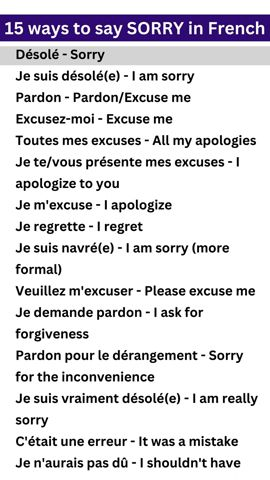
Pardon is the fastest, most versatile apology in French. Use it when you bump into someone, step in front of someone accidentally, or need to pass through a crowded space. It is softer than excusez-moi and requires no full sentence around it. One word, clearly delivered, handles the moment. Beginners sometimes over-explain in English when a simple "pardon" would close the situation immediately and more gracefully. In Paris especially, where streets and Métro carriages are packed, pardon is a word you will use multiple times a day without thinking.
Greetings get you through the door, but what happens when something goes genuinely wrong? The next tier of phrases is the one most beginner lists bury at the bottom, even though it is the one you will be most desperate for: the emergency and survival expressions that matter most when the stakes are highest.
Essential Survival French Phrases Beginners Need in Emergencies
Between 22 and 64 percent of international travellers fall ill during a trip abroad, according to a 2017 review published in the Journal of Travel Medicine, and that figure covers only illness, not theft, accidents, or passport loss. Over enough trips, the probability that you will need to communicate something urgent in French approaches certainty.
The phrases below are ordered by stakes, not by frequency. Start here. Most beginners we work with share a specific fear before their first trip to a French-speaking country: they feel nervous and underprepared because they have not learned any survival phrases before an emergency situation forces the issue.
That nervousness is well-founded. It is not anxiety about grammar; it is anxiety about the gap between reading a phrase list and actually producing those phrases when adrenaline is spiking. The phrases below address that gap directly. The notes on each phrase tell you when and why to use it, not just what it means.
Je n'ai pas de signal
The phrase that most beginner lists omit entirely. When your phone fails and someone offers to help, this phrase explains immediately why you cannot pull up Google Translate, show a map, or call your embassy.
It resets the interaction to spoken French and signals that you need the other person to take the lead. That shift from passive tourist to active communicator asking for help is what these phrases are designed to create. The honest limitation of any phrase list is that it trains your mouth, not your ear.
The Journal of Travel Medicine's 2017 review notes that pre-travel communication preparation is a recognised component of traveller safety precisely because language barriers complicate the communication of symptoms and urgent needs in real time. Reading these phrases once builds familiarity. Hearing them spoken by native French speakers, in the rhythm and register they actually use, is what wires them into the kind of fast-access memory that holds under stress.
This is where the method behind Parrot matters most. Early-to-mid level learners, the exact audience who needs these survival phrases most urgently, benefit most from comprehensible input: encountering language slightly above their current level, supported by enough context to make it understandable without a dictionary. Parrot's short-form native video feed applies this principle directly: every video session exposes you to real spoken French at natural speed, with vocabulary support alongside, so your ear builds a library of heard patterns rather than memorised text strings.
That distinction matters when adrenaline spikes and text-based memory dissolves. Learners who have struggled with traditional memorisation-based methods find this approach different because it stores the phrase as a sound you recognise, not a sentence you have to reconstruct under pressure. For phrases that require you to produce language rather than recognise it, Parrot Back, the speaking practice feature, lets you rehearse your output and receive feedback so that "Je suis allergique aux arachides" is not something you are attempting for the first time at a restaurant table in Lyon.
Surviving an emergency is the floor. Once the crisis passes, you will need to find the right metro line, flag a taxi, or read a departure board. The next section gives you the French phrases that get you moving again.
1. Au secours! - The Universal French Cry for Help
Shouted loudly, it signals immediate danger to every nearby French speaker regardless of context, accident, medical crisis, or threat. Its brevity makes it easy to recall under stress. The tradeoff: it conveys urgency but gives no detail, so follow-up phrases are essential.
2. Appelez la police! - Commanding Bystanders to Call the Police
Use this to direct a bystander when you cannot make the call yourself. In France, the police emergency number is 17, but 112 also connects. The phrase is short enough to shout across a street and clear enough that no French fluency is required on the listener's end. It does not require you to explain the situation first.
3. J'ai besoin d'un médecin - Declaring You Need a Doctor
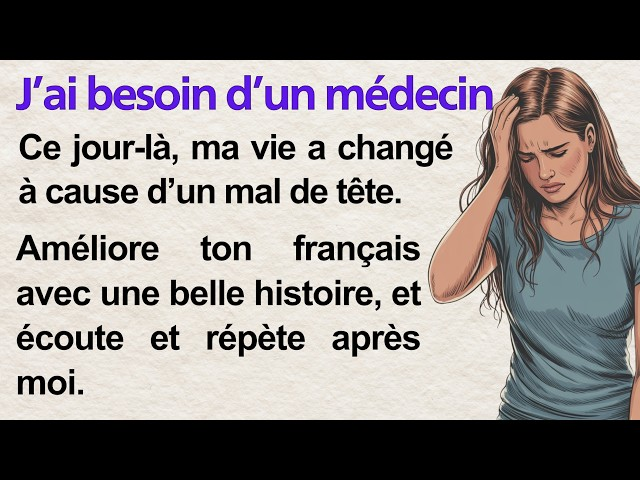
Calmer in register than "Au secours," this phrase works for situations that are serious but not immediately life-threatening: a bad fall, severe stomach pain, a high fever. French medical staff respond to this phrase as a clear, professional request. It is also the phrase most likely to get you taken seriously at a pharmacy counter.
4. Appelez une ambulance, s'il vous plaît - Requesting an Ambulance Politely but Urgently
Adding "s'il vous plaît" to an ambulance request signals both urgency and respect, which matters in French culture where politeness opens doors even in crises. This phrase is ideal when someone has collapsed or is seriously injured and bystanders need clear direction. Beginners benefit from its straightforward structure. The tradeoff is that calling 15 (SAMU) directly is faster than relying on bystanders to act.
5. Je ne comprends pas - Signaling a Language Barrier Before Miscommunication Escalates
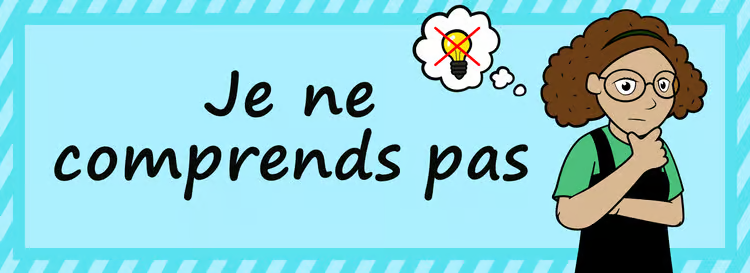
This is the single phrase that can de-escalate any confusing interaction and signal to a French speaker that you need their help, not their impatience. Knowing this phrase transforms a one-way panic into a two-way exchange. It is also the phrase beginners most consistently fail to rehearse because it feels passive. It is the phrase that keeps the conversation alive.
6. Pouvez-vous parler plus lentement? - Asking Someone to Speak More Slowly
This phrase transforms a one-way panic into a two-way exchange. Beginners consistently skip rehearsing it because it feels passive. It signals to a French speaker that you need their help, and most people respond by slowing down and rephrasing. Under stress, this phrase keeps the conversation alive when everything else collapses.
7. Pouvez-vous répéter, s'il vous plaît? - Asking for a Repetition When You Miss Critical Information
Shorter and slightly less formal than the previous phrase, this works when you caught the general meaning but missed a key word. Use it in police stations, pharmacies, and hotel lobbies where the speaker is likely to slow down and rephrase rather than repeat at the same speed. The limitation: some speakers will simply repeat the same sentence louder.
8. C'est une urgence! - Conveying the Gravity of a Situation to Locals Instantly
Use this phrase to open any call to emergency services or to flag severity to a bystander. It sets the register instantly so the person you're speaking to shifts into crisis mode rather than customer-service mode. Most beginners bury this phrase at the bottom of their list. It belongs at the top.
9. J'ai perdu mon passeport - Reporting a Lost Passport to Authorities or Hotel Staff
Passport loss is one of the most disruptive travel emergencies a beginner can face, triggering embassy visits, replacement paperwork, and potential delays of days. This phrase gets you to the right desk at a police station and opens the conversation with your country's consulate. Pair it with the address of your nearest embassy, saved offline before you travel.
10. On m'a volé mon sac - Reporting a Theft to Signal Criminal Distress
Paris pickpocket rates in high-traffic tourist zones are among the highest in Europe, particularly around the Eiffel Tower and on the Métro. This phrase is your opening sentence at a police station (commissariat) when filing a theft report (une déclaration de vol), which you will need for any insurance claim. Say it clearly; the officer will take it from there.
11. Je suis malade - Communicating Illness Quickly When Symptoms Are Severe
Calmer in register than "Au secours," this phrase works when the situation is serious but not immediately life-threatening: a high fever, severe stomach pain, or persistent vomiting. According to that same review in the Journal of Travel Medicine, between 22 and 64 percent of international travellers fall ill abroad, making this one of the statistically most likely phrases you will actually need.
12. J'ai mal ici - Pointing to Pain Without Knowing Medical Vocabulary
When vocabulary fails and adrenaline is spiking, this two-word phrase plus a gesture communicates location of pain faster than any anatomical term you might half-remember. Emergency responders and pharmacists are trained to work with it. Simple, concrete, and reliable under pressure.
13. Je suis allergique à... - Preventing Medical Errors by Declaring Allergies
The phrase is incomplete by design: you finish it with the allergen. "Je suis allergique aux arachides" (peanuts), "aux fruits de mer" (shellfish), "à la pénicilline" (penicillin). This is the one survival French phrase where a half-learned version can cause genuine harm, so rehearse the full sentence with your specific allergen before you travel, not after. Write it on a card in your wallet as a backup; a phrase you cannot say aloud under stress still works when a bystander can read it.
14. Où est l'hôpital le plus proche? - Locating the Nearest Hospital Under Pressure
The directional response you receive will likely be fast and in full French, so treat this phrase as a signal-flare rather than a conversation-opener. Your goal is to prompt the person to point, show you on a map, or walk you there. The phrase works best when you hold up your phone showing a maps app so they can tap the destination for you.
15. Pouvez-vous écrire ça, s'il vous plaît? - Asking Someone to Write Down What They Said
Particularly useful at a police station when you are reporting a theft and need to confirm a document reference number or an address for your insurance claim. Most officers will comply without hesitation.
16. Je suis perdu(e) - Communicating Being Lost to Signal Distress and Need for Help
The feminine form adds the final "e" in writing; pronunciation differs only slightly. Beyond its literal meaning, this phrase signals vulnerability and invites help rather than demanding it, which tends to produce a warmer response from French speakers than more commanding phrases. Use it early, before disorientation compounds into a genuine safety situation, especially after dark or in an unfamiliar arrondissement.
17. Parlez-vous anglais? - The Honest First Step When French Fails Completely
The honest opener when your French has run out. Asking in French first, rather than defaulting immediately to English, signals respect and almost always produces a warmer response. Even if the answer is "non," the attempt resets the interaction positively and often prompts the person to find a colleague or bystander who can help. It is not a failure phrase. It is a bridge phrase.
18. J'ai besoin d'aide - The All-Purpose Distress Phrase That Works in Any Emergency
Broader than "Au secours" and less alarming, this phrase works across the full range of urgent situations: medical, logistical, or emotional. It is also the phrase most likely to surface reliably under stress precisely because it is short, structurally simple, and emotionally direct.
Most beneficial when the specific nature of your emergency is too complex to explain in French and you need a willing person to stop and engage first. The Journal of Travel Medicine's review identifies pre-travel language preparation as a recognised component of traveller safety because language barriers directly complicate the communication of symptoms and urgent needs in real time. A phrase list read once is familiarity.
A phrase heard repeatedly in real spoken context, at natural speed, by native speakers, the way Parrot's short-form native video feed delivers it, is the version that stays accessible when it matters. Every video session contributes to that listening bank, and for early-to-mid level learners who need reading support to make video content comprehensible, Parrot pairs vocabulary aids alongside native content so the input stays comprehensible rather than overwhelming. Surviving an emergency is the floor.
French Phrases for Getting Around Town and Using Transport
Standing at the ticket window of Gare du Nord, 31.5 million international tourists pass through Paris each year, and the vast majority of them do not speak French as a first language. The Paris Métro spans many lines and hundreds of stations, and a single wrong turn can cost you significant time and a missed connection. Knowing what to say gets you into the conversation.
The harder problem is what comes back at you. Most beginners rehearse transport phrases in silence and assume that's enough. The real failure point hits on the platform: a station employee rattles back directions in rapid, connected French, and every memorized phrase evaporates under pressure.
That is an auditory-processing problem. Beginners who can initiate a French interaction confidently often freeze the moment a native speaker responds at full speed, because the gap between producing a rehearsed phrase and parsing an unrehearsed reply is enormous, especially in transport and town settings where quick exchanges are the norm and there is no time to regroup. Readiness for the Paris Métro is therefore less a vocabulary problem than a listening problem.
Pairing every phrase below with its likely reply, and training your ear to recognize it at native speed, is the skill that actually gets you to the right platform. Parrot's short-form video feed addresses exactly this gap through the Comprehensible Input Method. Every video session exposes your ear to native speakers delivering real directional responses at natural pace, so your brain learns to recognize the answer before you're standing under a departure board trying to parse it cold. That listening practice begins immediately: every video you watch contributes to building the auditory map that makes fast French legible.
The 20 phrases below are organized from street-level navigation through ticketing, trains, buses, taxis, and airports. Each entry covers what to say, what you'll likely hear back, and the one detail that changes the outcome.
1. À gauche / À droite - Turning Left and Right in French
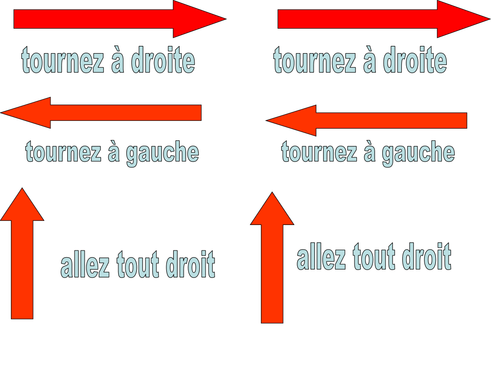
These two words appear in nearly every set of spoken directions you will receive in France, and mishearing one for the other is the single most common navigation error beginners make. À gauche means left; à droite means right. A local will often say "c'est à gauche, juste après le feu" (it's on the left, just after the traffic light). Train your ear on both before you need them, because in fast speech the vowel sounds compress significantly. Parrot's short-form video feed lets you hear real speakers deliver exactly these direction words in natural, connected sentences, so the distinction is already locked in before you reach the street.
2. Tout droit - Keeping Straight and Not Turning Too Early
Tout droit means "straight ahead," but learners frequently mishear it as à droite (to the right) because the final syllables rhyme at speed. This is one of the most documented confusion points in French directions. When a local says "continuez tout droit jusqu'au carrefour" (continue straight to the intersection), the word jusqu'au signals how far to go.
Listen for it. Turning too early because of a mishear adds real distance to any walk. Repeated exposure to native-speaker video content, the kind Parrot surfaces in your feed, trains your ear to catch the distinction automatically, before the pressure of a live exchange.
3. Près de / Loin de - Gauging Distance When Asking for Directions
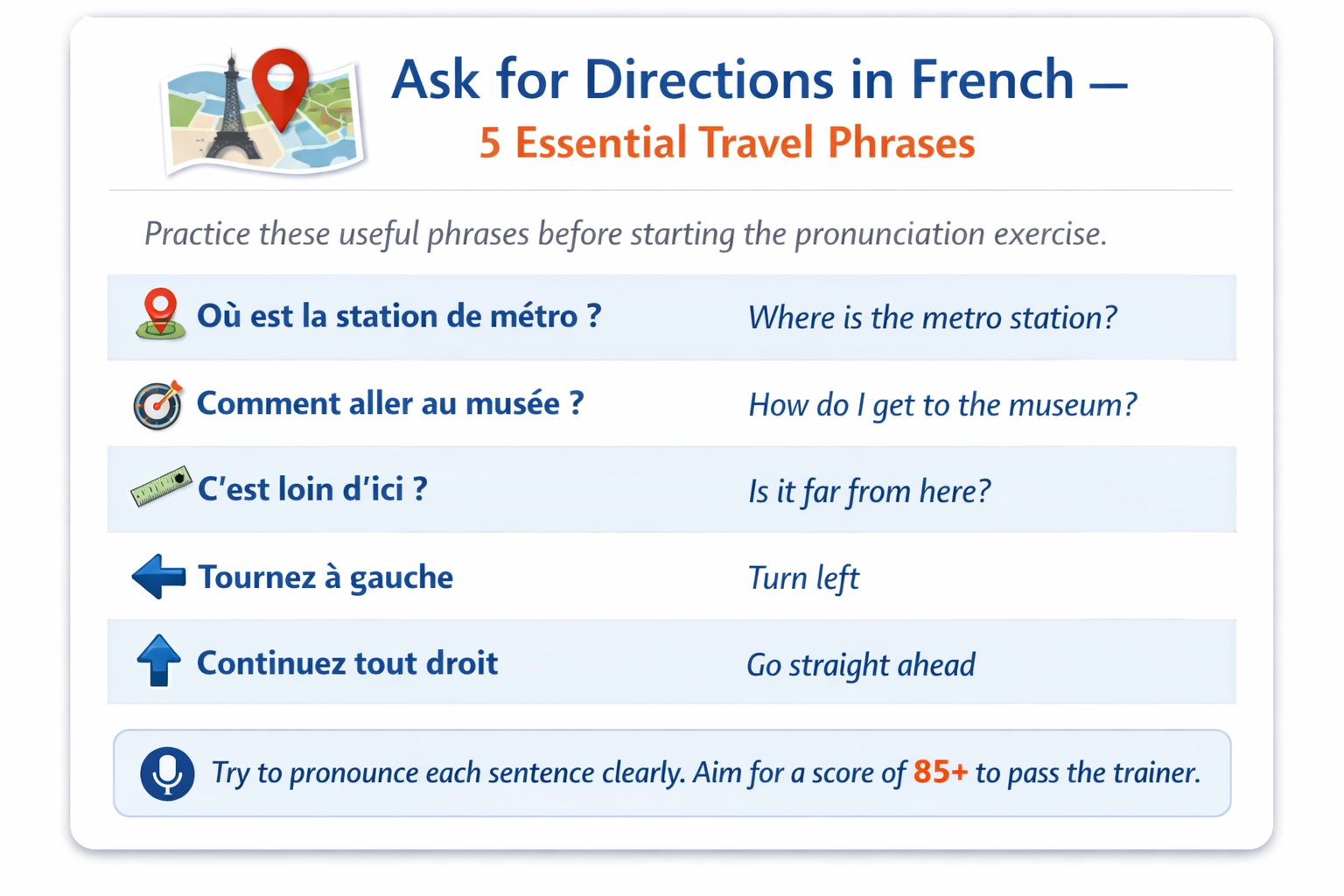
Près de means "near" or "close to"; loin de means "far from." When you ask where something is, the answer almost always includes one of these. "C'est près de la mairie" (it's near the town hall) tells you the landmark to look for. "C'est assez loin" (it's quite far) is your cue to ask about a bus or Métro instead of walking. Recognizing these distance markers prevents you from setting off on a 25-minute walk you weren't prepared for.
4. Excusez-moi, où est… ? - Politely Asking Where Something Is
This is the foundational directions phrase. "Excusez-moi, où est la gare?" (Excuse me, where is the station?) opens almost any navigation exchange.
French speakers respond warmly when you lead with excusez-moi rather than launching straight into a question. The reply will typically include a landmark, a distance, or a direction word. Your job is to listen for those three signal types and not panic if the full sentence doesn't land.
One landmark is enough to get moving. A second challenge shows up here that goes beyond vocabulary: learners who lack the casual filler phrases native speakers use instinctively, words like alors, donc, eh bien, can sound stilted when they try to buy time or bridge to a follow-up question. Parrot's video feed builds exposure to these conversational connectors naturally, because they appear constantly in real native-speaker content.
5. Où est la station de métro la plus proche ? - Finding the Nearest Métro
La plus proche means "the nearest." This phrase is your fastest route to the Métro when you're disoriented on a Paris street. The reply will usually name a street or landmark: "C'est rue de Rivoli, à deux minutes à pied" (It's on Rue de Rivoli, two minutes on foot). Listen for the street name and the time estimate. You don't need the whole sentence; those two data points are enough to confirm you're heading the right direction. With so many Métro stations spread across multiple lines, getting pointed toward the right one quickly is everything.
6. Un billet pour… - Buying a Ticket to Your Destination
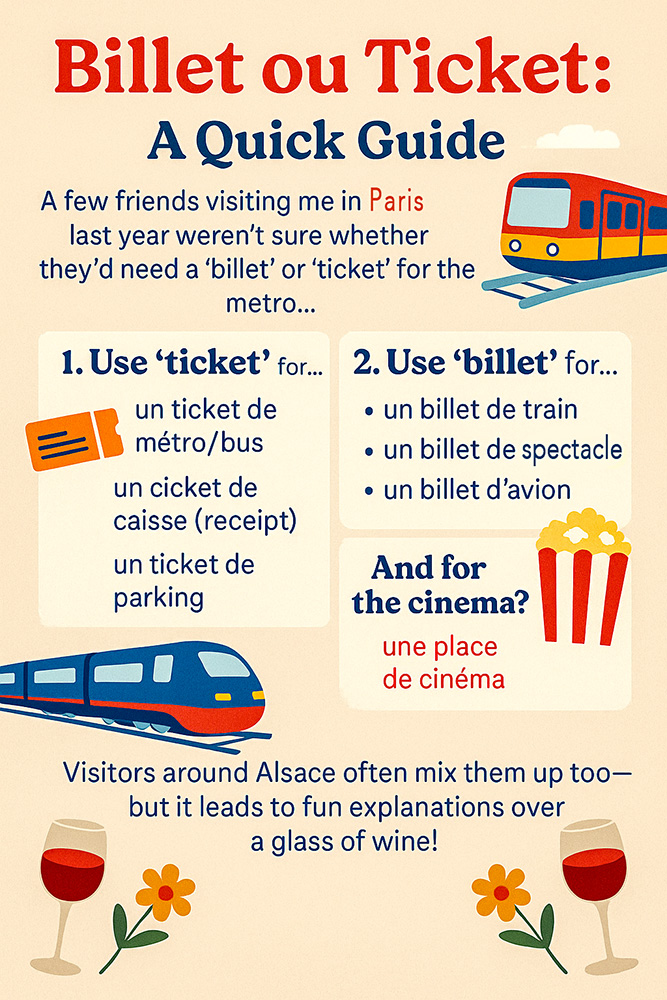
At the guichet (ticket window), say "Un billet pour Lyon, s'il vous plaît" to buy a single ticket to your destination. For the Métro, "Je voudrais un carnet, s'il vous plaît" requests a book of 10 tickets, which saves money over buying singles. The agent may ask "aller simple ou aller-retour?" (single or return?). Know your answer before you reach the window. Hesitating here creates a queue behind you and pressure that makes even simple French harder to produce.
Parrot's Parrot Back speaking-practice feature is well suited to drilling this exact exchange. You practice producing the phrase, get feedback, and build the muscle memory that holds under pressure.
7. Où est l'arrêt de bus ? - Locating the Bus Stop
Bus stops in French cities are marked with a blue-and-white sign, but they are not always visible from a main street. This phrase gets you pointed in the right direction fast. The reply often includes a direction word and a landmark: "C'est là-bas, devant la pharmacie" (It's over there, in front of the pharmacy). Là-bas (over there) is a high-frequency reply word worth knowing cold. If you hear it, look for someone pointing, which usually accompanies the phrase.
8. À quelle heure part le train ? - Asking When the Train Departs
À quelle heure means "at what time." This phrase works at any station window or information desk. The reply will be a time: "Il part à quatorze heures trente" (It departs at 14:30). French train times use the 24-hour clock consistently, so 14h30 means 2:30 PM. If you're not comfortable with 24-hour time conversions under pressure, practice them before your trip. Mishearing "seize heures" (16:00) as "six heures" (6:00) is the kind of error that puts you on the wrong platform entirely.
9. C'est quel quai ? - Asking Which Platform to Use
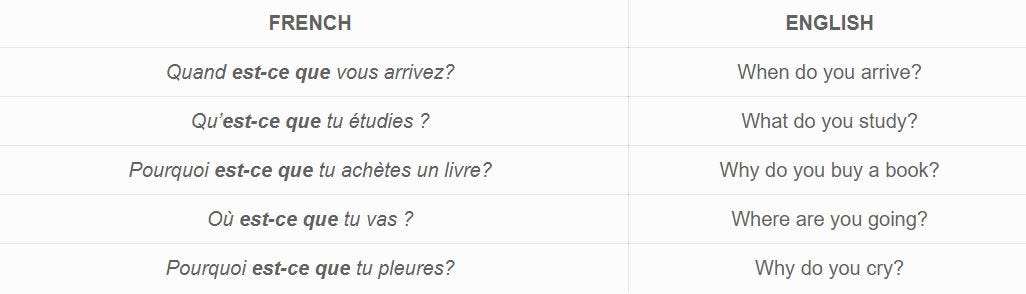
Quai means platform. At large terminals like Gare du Nord or Gare de Lyon, platforms are announced on departure boards, but boards update late and sometimes change. Asking "C'est quel quai pour le train de dix heures?" (Which platform for the 10 o'clock train?) gets you a number: "Quai numéro sept" (Platform 7). Listen for the number. Everything else in the reply is secondary. If you miss it, say "Vous pouvez répéter?" (Can you repeat that?) without embarrassment.
10. Je voudrais un taxi, s'il vous plaît - Requesting a Taxi in French
At a hotel desk or taxi rank, this phrase is clear and complete. The driver may ask "Vous allez où?" (Where are you going?).
Have your destination ready as a street address or landmark name, written down if necessary. Showing a written address removes ambiguity for both parties. Taxi drivers in Paris deal with non-French speakers daily and will not be surprised.
The limitation here is that spoken addresses in French can be hard to parse if the driver confirms back at speed, which is the listening gap that consistent exposure to Parrot's native-speaker video content is designed to close over time.
11. Composez votre billet - Understanding the Ticket Validation Requirement
This is one of the most consequential phrases on this list. Before boarding a regional or intercity train in France, you must validate (composter) your paper ticket in the yellow machines on the platform. Failing to do so can result in an on-the-spot fine from SNCF controllers. Travellers who have been caught describe the experience as both costly and confusing, because nothing on the ticket itself warns you in English. If a station employee says "Composez votre billet," they are doing you a favor. Act immediately.
12. Où est l'enregistrement ? - Finding Check-In at a French Airport
Image: French Phrases for Beginners - est enregistrement finding check
L'enregistrement means check-in. At Charles de Gaulle or Orly, this question gets you directed to the right terminal zone. The reply will typically name a hall or a letter: "C'est au terminal 2E" or "Suivez les panneaux" (Follow the signs). Panneaux means signs, a word worth knowing because it appears in airport replies constantly. If you hear it, look up. French airports sign-post heavily in both French and English, but knowing the French word means you catch the instruction before you spot the sign.
13. Où est la livraison des bagages ? - Locating Baggage Claim
La livraison des bagages is the French term for baggage claim. In a busy arrival hall, asking this phrase gets you a zone number or a direction. The reply often includes a carousel number: "C'est le tapis numéro trois" (It's carousel number three). Tapis literally means carpet or belt. Knowing this word prevents confusion when the reply doesn't use the word livraison again. Airport staff at major French hubs will often switch to English if they sense difficulty, but initiating in French consistently gets a warmer, faster response.
14. Mon vol est… - Giving Your Flight Details at the Airport
When speaking to airport staff about a flight, lead with "Mon vol est Air France deux cent quarante" (My flight is Air France 240). Spelling out the airline name and number clearly is more reliable than showing your phone screen in a noisy terminal. Staff may reply with a gate number: "Porte vingt-deux" (Gate 22). Porte means gate in this context, not door, which is a frequent source of confusion for beginners. The word does double duty in French, so context is everything.
15. Prenez la première rue à gauche - Repeating Back Turn-by-Turn Directions
When someone gives you multi-step directions, repeat the key steps back to confirm: "Donc, je prends la première rue à gauche, puis tout droit?" (So, I take the first street on the left, then straight ahead?). This technique, called reformulation, is standard in French conversation and signals competence rather than weakness.
Locals almost always confirm or correct immediately. The one tradeoff: if your pronunciation is unclear, the confirmation may come back too fast to follow. Parrot Back speaking practice helps here. You rehearse the phrase, receive feedback on your production, and build the pronunciation accuracy that keeps the exchange at a manageable pace.
16. C'est bien le bus pour… ? - Confirming You're on the Right Bus
Before boarding, ask the driver "C'est bien le bus pour Montmartre?" (Is this the right bus for Montmartre?). The driver will say "Oui" or "Non" and often add the correct bus number if you're at the wrong stop. This is a low-stakes, high-value phrase because the reply is almost always a single word. It is most useful when you're at a stop served by multiple routes and the signage is unclear. The risk of not asking is boarding the wrong bus and not realizing until several stops later.
17. Tournez au carrefour - Understanding Intersection-Based Directions
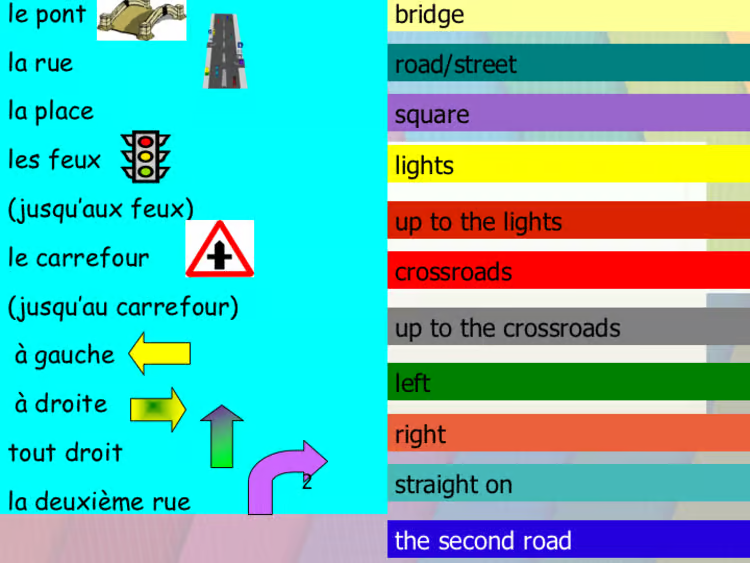
Carrefour means intersection or crossroads. When a local says "Tournez au carrefour" (Turn at the intersection), the implied question is: which direction? The full instruction will be "Tournez à gauche au carrefour" or "Tournez à droite." Listen for the direction word that follows tournez. If you only catch carrefour, you know to turn at the next intersection but not which way, which means you need to ask again. That is fine. Asking twice is always better than walking confidently in the wrong direction.
18. Je ne comprends pas - Asking for Directions to Be Repeated or Simplified
(Can you speak more slowly, please?). Most French speakers will slow down and simplify when asked directly.
The limitation is that slowed-down French still arrives as connected speech, not word-by-word recitation. If slowing down doesn't help, try "Pouvez-vous l'écrire?" (Can you write it down?).
A written street name or number removes the auditory processing problem entirely and is a completely acceptable tool. The deeper fix, though, is the one Parrot's Comprehensible Input Method is built around: systematic exposure to native-speed audio across many short sessions, so that fast speech gradually stops feeling fast.
19. Quelle ligne de métro dois-je prendre ? - Asking Which Métro Line to Take
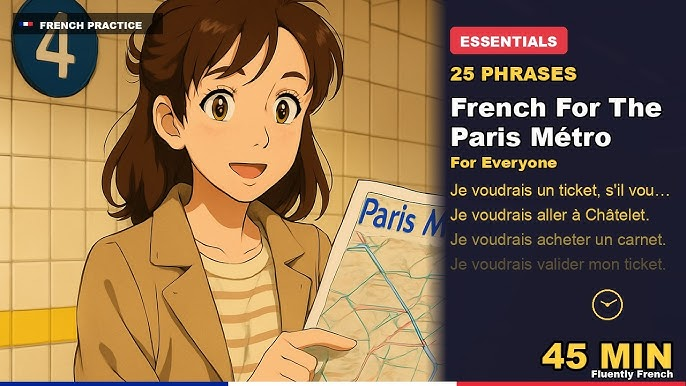
With many Métro lines crossing hundreds of stations, choosing the wrong line wastes significant time. "Quelle ligne dois-je prendre pour aller à Châtelet?" (Which line should I take to get to Châtelet?) gets you a number: "Prenez la ligne quatre" (Take line 4). Line numbers in French are straightforward, but direction names on the Métro, the terminus name shown on the front of the train, are what you actually follow underground. Ask "Direction quelle station?" to confirm which end of the line you're heading toward.
20. Où dois-je descendre ? - Asking Where to Get Off the Train or Bus
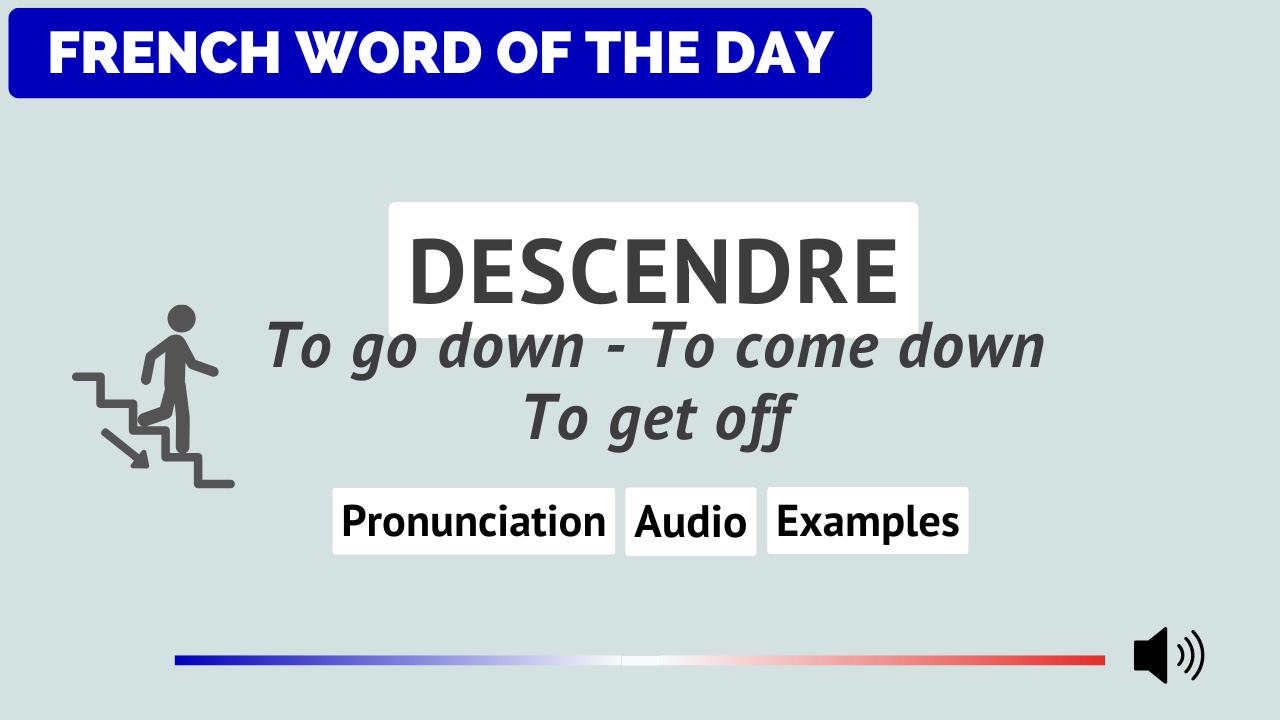
(Where should I get off for the Louvre?) is the phrase that prevents you from riding past your stop.
On the Métro, a fellow passenger or driver will give you a station name. On a bus, they may say "Dans trois arrêts" (In three stops) or name the stop. Arrêt means stop.
Counting stops is a reliable backup strategy when station names are hard to catch in announcement audio. This phrase is most valuable on unfamiliar suburban routes where stops are less frequent and overshooting costs real time. Getting from the airport to your hotel is only the first test.
The next one happens the moment you sit down at a café and a server rattles off the plat du jour at full speed. In the next section, you'll get the exact French phrases for ordering food and reading a menu, from a casual brasserie to a formal dining room, so you can eat well without pointing at the wrong thing.
French Phrases for Ordering Food and Navigating Restaurants Like a Local
Knowing the right phrases at the right moment, from the greeting at the door to requesting the bill, is what separates a smooth French dining experience from an awkward one. The sections below cover every stage of a restaurant visit, in order.
1. "Une table pour deux, s'il vous plaît" - Requesting a Table for Two
This is the foundational seating phrase every beginner needs before stepping into any French restaurant. It signals confidence and politeness immediately. Pair it with "Bonsoir" on arrival and staff will seat you without switching to English. The tradeoff: solo diners should swap to "une table pour une personne", "pour un" alone can sound grammatically odd to native ears.
2. "Avez-vous une table de disponible ?" - Politely Asking If a Table Is Free
Use this when you arrive without a reservation and are not sure whether the restaurant can seat you. The casual street version is Vous avez de la place? (Do you have room?), which locals use freely in informal spots. The formal version above works in any setting. If the answer is Complet, the restaurant is fully booked and you will need to move on. Knowing both versions means you can read the room and match the register.
3. "Je voudrais faire une réservation" - Making a Phone Reservation in French
This phrase becomes essential outside Paris, where English menus and English-speaking staff are far less common than in the capital. Pair it with the date and time: Je voudrais faire une réservation pour vendredi soir, à vingt heures, pour trois personnes (I would like to make a reservation for Friday evening, at eight o'clock, for three people). Speak slowly and confirm the details back to the host. A reservation made in French earns immediate goodwill before you have set foot in the door.
4. "La carte, s'il vous plaît" - Asking for the Menu
This is how you ask for the full list of dishes. Do not say le menu here, the distinction is worth memorizing cold before you sit down, because le menu refers to a fixed-price meal, not the full à la carte list.
5. "Je voudrais…" - The Beginner's All-Purpose Ordering Phrase
Je voudrais (I would like) is grammatically correct, polite, and understood everywhere. It is the phrase most beginners learn first, and it will not let you down in any French restaurant. The honest trade-off is that in casual bistros and neighborhood cafés, it reads as slightly formal and tourist-coded. Native speakers in those settings tend to use Je vais prendre instead. Reserve Je voudrais for upscale or formal dining, where its register fits naturally.
6. "Je vais prendre…" - The Casual Local's Ordering Phrase
Literally "I'm going to take," this is what French speakers actually say when ordering in brasseries, bistros, and casual cafés. It sounds relaxed and confident rather than rehearsed. Threads among French language learners consistently flag this as the phrase that most visibly shifts how waitstaff respond, with servers often continuing the conversation in French rather than switching to English. Use it in any informal setting and pair it with a direct noun: Je vais prendre le steak frites.
7. "J'aimerais…" - A Softer, More Elegant Way to Order
J'aimerais (I would love) sits between Je voudrais and Je vais prendre in register. It is warm, slightly deferential, and works well in mid-range to upscale restaurants where you want to sound polished without being stiff. It is also useful when making a special request, such as asking for a dish to be modified, because the softness of the phrasing signals that you are asking rather than demanding. In a casual café, it is slightly over-formal; in a nice restaurant, it lands exactly right.
8. "Vous désirez ?" - Understanding What the Waiter Is Asking You
This is the phrase your waiter will fire at you the moment you sit down, and it is the one that most reliably causes beginners to freeze. It means "What would you like?" or "What can I get you?" The equivalent you might also hear is Vous avez choisi? (Have you chosen?) or Je vous écoute (I'm listening). Recognizing these server-side cues before you arrive is the difference between responding fluidly and staring blankly while the waiter waits.
9. "Un café, s'il vous plaît" - Ordering Coffee the French Way
In France, un café means a small espresso, served after the meal, not during it. Ordering coffee with your food marks you immediately as a tourist. If you want something larger, ask for un café allongé (a long espresso with added water) or un grand crème (a large coffee with steamed milk, served at breakfast). In a casual café, dropping the full sentence and simply saying Un express, s'il vous plaît is exactly what locals do and sounds far more natural than a constructed phrase.
10. "Une carafe d'eau, s'il vous plaît" - Getting Free Water Without Awkwardness
Asking for une carafe d'eau (a jug of tap water) is entirely normal and not considered cheap or impolite. The phrase l'eau du robinet (tap water) is the more explicit version if the server looks uncertain. In Paris this request is routine; in smaller towns, a brief pause before it arrives is normal.
11. "Quelle cuisson ?" - Understanding the Steak Doneness Question
Your waiter will fire this at you the moment you order steak or duck, and it arrives fast. It means "How would you like it cooked?" The expected answers are bleu (very rare, barely seared), saignant (rare), à point (medium), or bien cuit (well done). French kitchens default toward rare, and ordering bien cuit can earn a subtle look. Know your answer before you order the meat, not after the question lands, because hesitating here is where the interaction most visibly stalls.
12. "Je suis allergique à…" - Communicating Food Allergies Clearly
State this clearly and early, ideally when you first sit down, not after the menu has been discussed. The honest limitation is that French restaurant kitchens are less standardized around allergy protocols than those in the UK or US, so follow up with C'est très important (It is very important) and confirm the server has understood before ordering. Never assume the message landed without a verbal confirmation.
13. "Sans gluten, s'il vous plaît" - Requesting Gluten-Free Options
If you have celiac disease rather than a dietary preference, lead with Je suis allergique au gluten rather than sans gluten alone. The distinction matters because sans gluten can read as a lifestyle choice in a French kitchen, affecting how seriously the request is treated. In upscale Parisian restaurants, awareness is higher; in a rural auberge, be prepared to ask more explicitly about ingredients.
14. "Je suis végétarien(ne)" - Declaring Vegetarianism in France
France's plant-based dining scene has grown steadily, but the country's meat-heavy culinary tradition means vegetarian options remain genuinely limited outside major cities. Use the feminine ending végétarienne if applicable. In practice, following the declaration with Y a-t-il des plats sans viande? (Are there dishes without meat?) often gets a more useful answer, because it invites the server to think through the menu with you. Many French dishes contain meat-based stock or lardons without being listed as meat dishes, so the follow-up question is not optional.
15. "Est-ce qu'il y a de la viande dans ce plat ?" - Confirming Hidden Meat in a Dish
This is the essential follow-up for vegetarians and anyone with dietary restrictions, because French cooking regularly incorporates meat-based stock, lardons, or anchovies into dishes that appear plant-based on the menu. Asking this question directly, about a specific dish rather than in the abstract, gets a more reliable answer than a general declaration of your diet. Add Et du poisson? (And fish?) if you need to cover seafood as well. Be specific; broad questions get broad answers.
16. "Sans lactose, s'il vous plaît" - Navigating Dairy-Free Needs in a Cheese-Loving Country
France is one of the world's great cheese cultures, and dairy appears in a wide range of dishes, sauces, and desserts that are not obviously dairy-forward on the menu. Sans lactose (without lactose) is understood in cities, but in rural areas or traditional restaurants you may need to be more explicit: Je ne peux pas manger de produits laitiers (I cannot eat dairy products). As with gluten, framing this as a medical need rather than a preference improves how seriously kitchen staff treat the request.
17. "L'addition, s'il vous plaît" - Asking for the Bill Correctly
The bill will not arrive automatically in France; you must request it. L'addition, s'il vous plaît is the standard phrase, and it works in every setting. The casual version you will hear locals use is On peut avoir l'addition? (Can we have the bill?). What you must never do is snap your fingers or call across the room. According to L'Amour de Paris, making eye contact and using a subtle hand gesture is the accepted approach. The waiter will come to you.
18. "Le service est compris" - Understanding That Tipping Is Optional in France
A service charge is legally required to be included in French restaurant bills, making tipping discretionary rather than expected, according to L'Amour de Paris. When you see service compris on the bill, you have already paid for service. Leaving a few euros for genuinely attentive service is appreciated but carries none of the social weight it does in the United States. Knowing this removes one of the most common sources of post-meal confusion for North American visitors eating in France.
19. "Bonjour" Before Everything - The Non-Negotiable French Restaurant Greeting
Say this before anything else, without exception. In the evening, swap it for Bonsoir. In a casual café, Salut works between friends but never with staff you have never met. One word, said first, changes the entire interaction.
20. "On est deux" - The Casual Local Way to Announce Your Party Size
Literally "we are two," this is what you will actually hear French speakers say when they walk into a neighborhood spot. It is shorter, warmer, and less textbook-formal than the full Une table pour deux, s'il vous plaît. Use it in brasseries and casual cafés. In a Michelin-starred setting, stick with the full formal phrase. Knowing the casual version signals that you have spent real time around French speakers, not just a phrasebook.
21. "Excusez-moi" - Getting Your Waiter's Attention Politely
This is the correct way to flag your server when you need something. Make eye contact first, then say Excusez-moi at a normal conversational volume. L'Amour de Paris is explicit that snapping fingers or loudly calling out is considered rude and disrespectful in French dining culture. A subtle raised hand paired with this phrase is the accepted local approach. If your server is across the room, patience is part of the cultural script; French dining moves at a deliberate pace by design.
22. "Je prends le menu à [price]" - Ordering a Set-Price Menu Confidently
Fill in the price shown on the board or card: Je prends le menu à vingt-deux euros (I'll have the set menu at twenty-two euros). This is the natural, local way to order a fixed-price meal. It confirms you know the difference between la carte and le menu, which immediately signals cultural literacy. Set menus are often the best value in French restaurants, typically including two or three courses at a bundled price that undercuts ordering à la carte.
23. "C'est quoi, exactement ?" - Asking What a Dish Actually Is
Use this when a menu item is unclear and you need a plain description before committing. The more formal version is Pourriez-vous me décrire ce plat? (Could you describe this dish?), which suits upscale settings. In a casual bistro, C'est quoi exactement? is direct and completely acceptable. French servers generally appreciate genuine curiosity about the food. Asking this question is far better than ordering blind and receiving something you cannot eat or do not want.
24. "Je me suis installé(e) par là" - Letting Staff Know Where You're Seated
If you have been seated by a host but your server has not yet found you, this phrase lets you flag your location without causing confusion: "I sat myself over there." Use a gesture toward your table. It is a niche phrase but genuinely useful in busy brasseries where the seating flow is informal. The feminine form is installée; the masculine is installé. Getting this detail right is a small but real credibility signal.
Beginner French Word Lists for Shopping, Errands and Everyday Situations
That post-meal clarity is worth extending into every transaction you'll have in France, because the language gap hits just as hard at a market stall or hotel desk as it does over a restaurant bill. The frustration beginners consistently run into is that those tools don't go further than textbook phrases. What they skip are the 18 phrases that actually carry a transaction from open to close, plus the colloquial glue words a vendor fires back before you've even processed the question.
The Banque de France confirms that card payments only surpassed cash at French points of sale for the first time in 2024, so travellers still need to be fluent in two parallel transaction registers simultaneously. That duality is exactly why the list below is organized the way it is: shopping openers, payment checks, accommodation phrases, and the colloquial confirmations that close every exchange.
1. Combien ça coûte ? - Asking the Price at Any Market or Shop
The textbook version. Every phrase list includes it, and it works, but notice what happens next: the vendor answers. That reply, delivered at full speed with a regional accent, is where most beginners freeze. Use this phrase confidently at any market stall or boutique, but pair it with C'est combien? as your backup, because that shorter form is what you'll actually hear Parisians use when they're the ones asking. The gap between knowing a phrase and reacting to the reply in real time is exactly what listening practice, watching real conversational French at native speed before you travel, is designed to close.
2. Je cherche… - Telling a Shop Assistant What You're Looking For
Je cherche une veste (I'm looking for a jacket) or Je cherche un cadeau pour un ami (a gift for a friend) signals intent without committing to a purchase. It opens the conversation on your terms and gives the assistant a clear brief. The limitation: if you don't know the French word for the item, this phrase stalls fast. This is precisely where learners who've relied on generic apps hit a wall; those tools tend to teach vocabulary categories rather than the words French people actually use in daily errands. Keep a short personal vocabulary list on your phone for exactly this gap, and prioritize building it from real conversational input rather than textbook glossaries.
3. Avez-vous… ? - Politely Asking Whether a Store Stocks Something
Avez-vous du pain aux noix? (Do you have walnut bread?) is the polite, formal register that works in any shop, from a pharmacy to a fromagerie. It signals respect and gets a direct yes or no. The tradeoff is register: in a casual market, Vous avez…? without the inversion sounds more natural and less like you're reading from a phrase card. Knowing which register fits which context is something memorized lists can't teach; it comes from exposure to the way French people actually speak.
4. C'est trop cher - Negotiating Price or Declining Politely

Useful at flea markets and brocantes where price is genuinely negotiable; less so in supermarkets or chain boutiques where it will just confuse the cashier. Pair it with Vous pouvez faire un geste? (Can you make a gesture on the price?) for a softer negotiation opener. The honest limitation here: French market vendors are not obligated to bargain, and pushing too hard reads as rude rather than savvy.
5. Je regarde, merci - Browsing Without Pressure in a Boutique
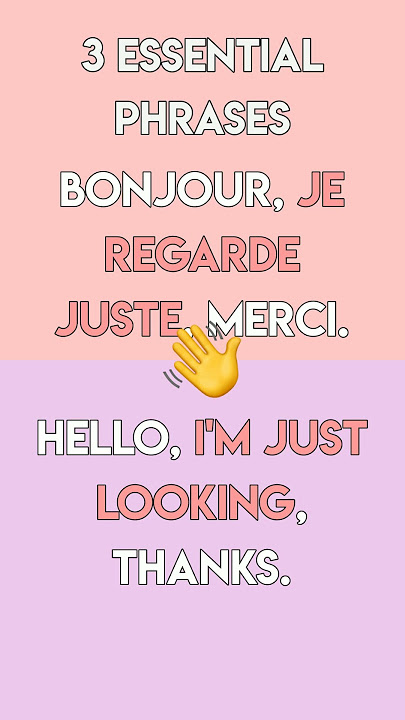
This is the phrase that saves you from a 10-minute guided tour of a shop you wandered into by accident. Je regarde (I'm just looking) is universally understood and accepted. Deliver it with a small nod and a smile and the assistant will leave you alone. Skip the smile and it can land as dismissive, which matters in a culture where warmth inside a transaction is expected, not optional.
6. Vous acceptez les cartes ? - Checking Card Payment Before You Queue
Ask this before you load your arms with produce at a market stall, not after. According to Payments Europe, cards are the preferred payment method for both consumers and retailers in France, but smaller vendors and outdoor markets still operate cash-only or enforce minimum spend thresholds. The Banque de France SPACE 2024 data underlines this duality: even as card use passed cash for the first time in 2024, cash remains deeply embedded in everyday French commerce. Knowing this phrase before you reach the till is the difference between a smooth transaction and an awkward scramble.
7. Avez-vous la monnaie ? - Asking for Change When Paying Cash
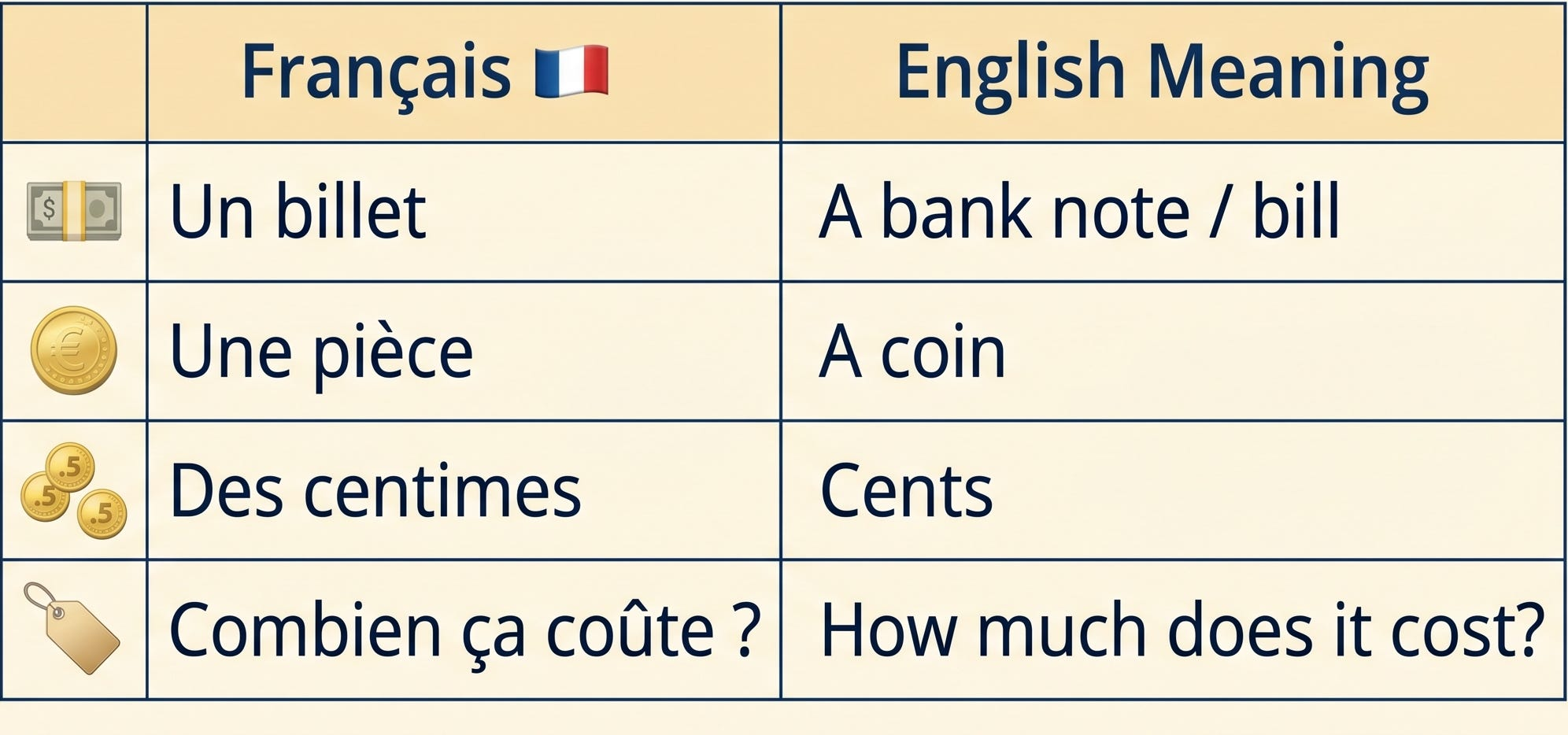
La monnaie means change or small bills, and this question is essential when you're handing over a 50-euro note at a boulangerie at 7 a.m. Many small vendors genuinely cannot break large notes early in the day, a practical reality the Banque de France SPACE findings reflect in noting that French people still value cash even as habits shift. Asking upfront is polite, practical, and prevents the silent frustration of a vendor who has to turn you away or hunt through a cash box for five minutes.
8. J'ai une réservation - Checking Into a Hotel or Airbnb Confidently
The anchor phrase for any accommodation check-in. Follow it immediately with your name: J'ai une réservation au nom de Smith. This phrasing is what front-desk staff expect and it moves the interaction forward without ambiguity. The gap beginners hit is what comes next: the receptionist's reply about room type, floor, or breakfast time. That's where a trained ear matters more than a memorized opener, and it's exactly the listening comprehension skill that passive exposure to real conversational French, at native speed, builds over time.
9. À quelle heure est le check-out ? - Confirming Departure Time at Your Accommodation
Ask this at check-in, not the morning you're leaving with a packed bag. Standard check-out in France is typically noon, but boutique hotels and rural chambres d'hôtes vary. If you need a late check-out, follow with Est-il possible de partir plus tard? (Is it possible to leave later?) The worst they say is no, and they'll say it politely.
10. Ma chambre est… - Reporting a Problem With Your Hotel Room
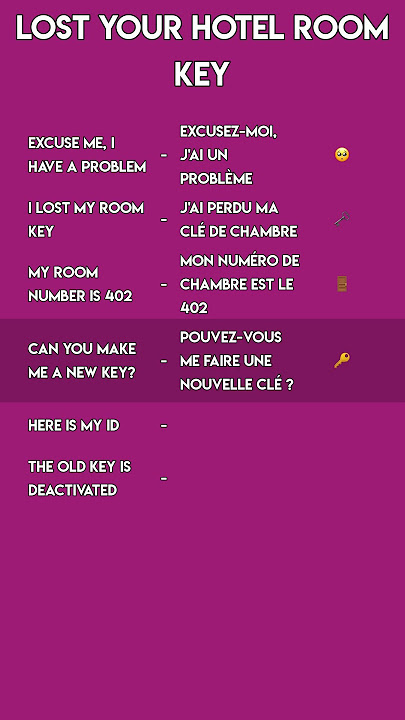
The construction Ma chambre est (My room is) lets you attach any adjective: trop chaude (too hot), trop bruyante (too noisy), sans eau chaude (without hot water). This is more useful than memorizing a list of specific complaints, because the structure is flexible. The one phrase to add: Pouvez-vous changer ma chambre? (Can you change my room?) closes the loop and makes your need explicit rather than leaving the staff to guess.
11. C'est bon - The Everyday French Phrase That Means Everything Is Fine
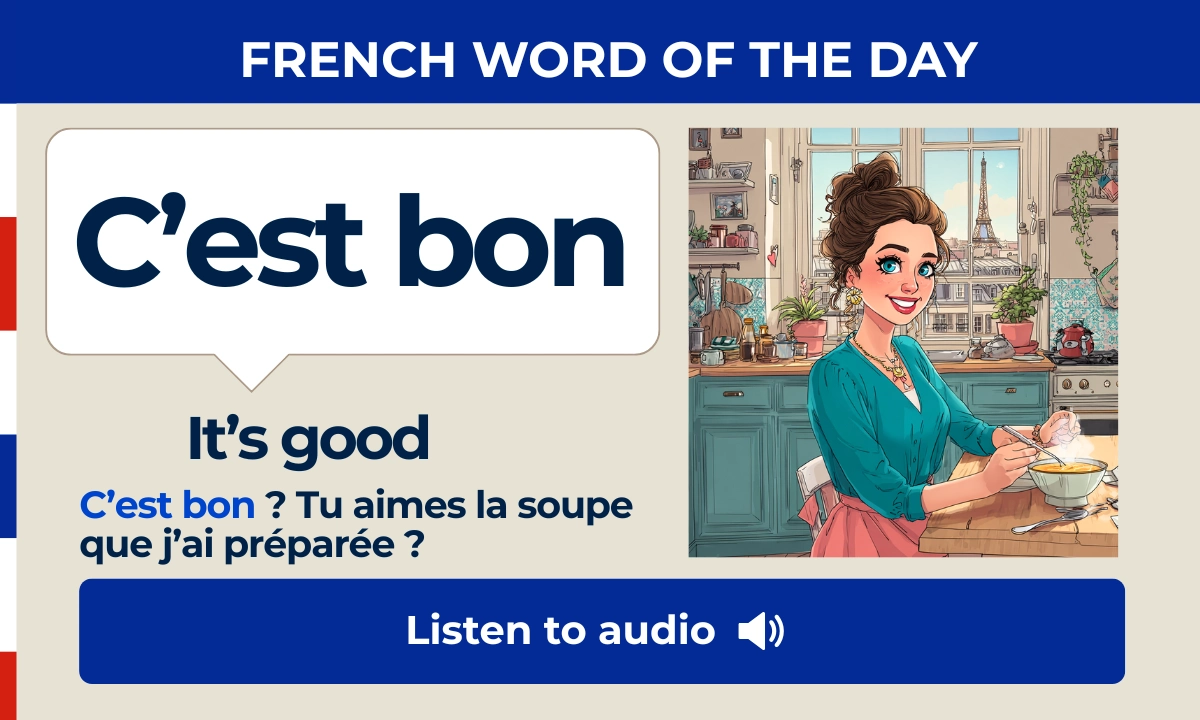
This is the phrase textbooks consistently underserve, and generic apps rarely flag it because it doesn't fit neatly into a vocabulary category. C'est bon does not just mean "it's good." It means "that works," "we're fine," "I'm satisfied," "no need to continue."
A vendor saying it after handing you change is checking whether the transaction is complete, not complimenting the quality of the coins.
Beginners who haven't heard this phrase spoken in real conversational French freeze at exactly this moment, because the words look simple but the function is invisible on a static list.
Hearing it in context, the way French people actually use it, is the only way to wire the meaning to the sound before you need it.
12. Ça marche - The Colloquial 'That Works' You'll Hear Everywhere in France
Ça marche literally translates as "it walks" or "it works," but functionally it means "sounds good," "deal," or "understood." You'll hear it from a boulanger confirming your order, a market vendor agreeing to hold something, and a hotel receptionist acknowledging a request. Learners who encounter this phrase for the first time mid-transaction often mistake it for a question about a machine or a process. This is a textbook example of what real, conversational French sounds like versus what memorization-based study prepares you for; hearing it spoken in context before you need it is the only reliable fix.
13. Pas de problème - Reassuring Locals When Something Goes Slightly Wrong
Use this when you've accidentally handed over the wrong coin, bumped into a display, or asked a question the vendor can't answer. Pas de problème signals ease and goodwill. It also works as a response when a shopkeeper apologizes for being out of stock. The register is casual and warm, which is exactly right for the small frictions of daily errands. Using the more formal Ce n'est pas grave works too, but sounds noticeably stiffer in a casual market setting.
14. Bonjour / Bonsoir - The Non-Negotiable Greeting Before Every Interaction
Walking into a French shop without saying Bonjour first is not a neutral act. French retail culture treats the ungreeted entrance as a minor social offense, and shopkeepers notice. A common frustration among French vendors is that foreign visitors launch directly into a request without any greeting, which reads as demanding rather than polite. Bonjour before noon, Bonsoir from early evening onward. Two syllables that change the entire temperature of every interaction that follows.
15. Où sont les toilettes ? - Finding a Restroom During Errands or Sightseeing
Practical, urgent, and universally understood. In a department store or shopping centre, staff will point you in the right direction immediately. In a café, the convention is to order something small first, then ask. Knowing this phrase removes one of the more stressful micro-moments of a long day of errands, and it works in any public building, museum, or transport hub without modification.
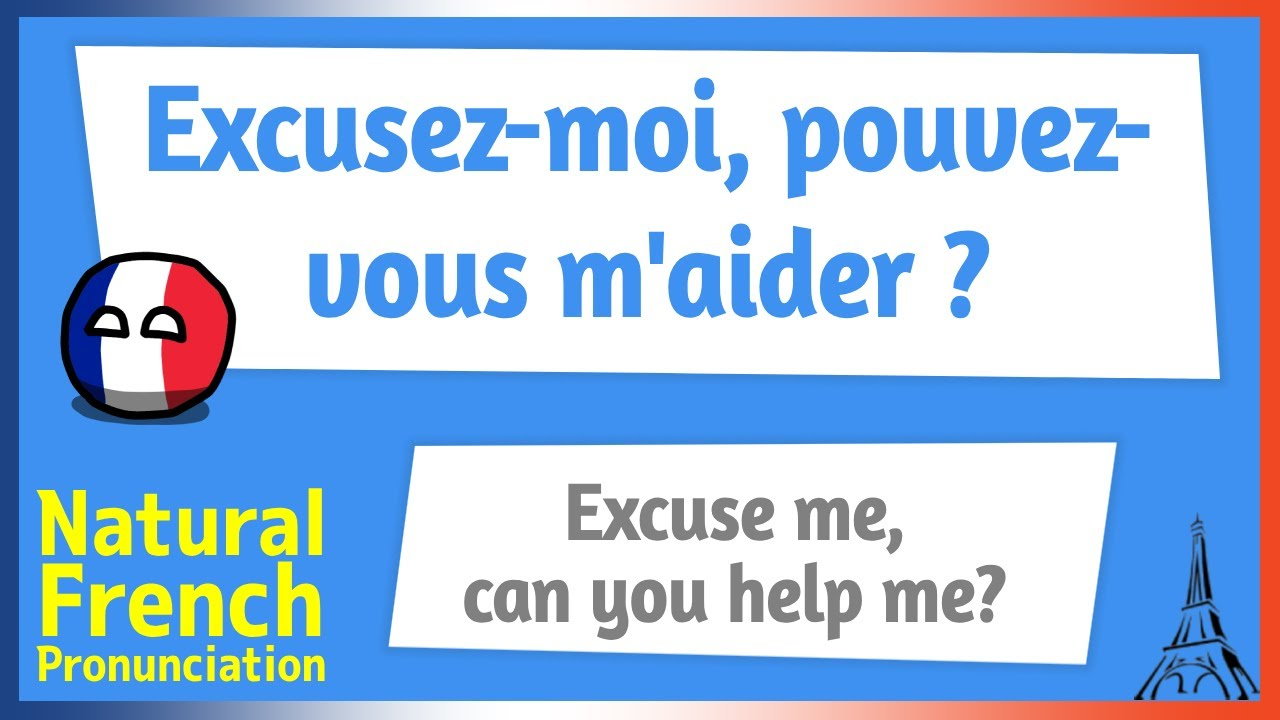
16. Excusez-moi, pouvez-vous m'aider ? - Politely Asking for Help in Any Situation
The full phrase (Excuse me, can you help me?) is formal enough to be respectful and simple enough to be understood anywhere. It opens every assistance request, from finding a product in a supermarket to asking a passerby for directions. The key is the Excusez-moi opener: skipping it and leading with the question directly sounds abrupt in French social norms, even when the question itself is perfectly formed.
17. Un sac, s'il vous plaît - Requesting a Shopping Bag at the Register
Plastic bags are no longer free at most French retailers, and in many shops they are not offered at all unless you ask. This phrase prevents the awkward moment of standing at the till with your arms full of purchases and no way to carry them. If you have your own bag, J'ai mon sac (I have my bag) signals that you're prepared and keeps the transaction moving without a pause.
18. C'est pour offrir - Letting a Shop Know a Purchase Is a Gift
Say this at a perfumery, a chocolatier, or a boutique and the staff will often offer gift wrapping, a ribbon, or a decorative bag at no extra charge. It is one of the small cultural pleasures of shopping in France that phrase lists almost never include, because it is not strictly transactional. The phrase signals that you understand French retail hospitality, which tends to unlock a noticeably warmer level of service in return.
19. Je voudrais… - The Beginner's Polite Order Phrase for Shops, Cafés and Bakeries
Je voudrais (I would like) is the phrase that separates a polite request from an abrupt demand. Je veux (I want) is grammatically correct but lands as blunt in a service context, and French shopkeepers register the difference immediately. This is the phrase beginners should default to in any shop, café, or bakery until they're confident enough to read the register of a specific interaction. Most friction between foreign visitors and French shop assistants traces back to this single word swap.
You now have the phrases: the market openers, the hotel check-ins, the colloquial glue words that signal you actually know French rather than just studied it. But a recurring frustration for beginners, one that generic apps haven't solved, is the distance between recognizing a phrase on a list and deploying it when a vendor fires back at full conversational speed. That gap comes down to one variable: whether you've heard these phrases spoken at real speed, in real context, before you need them in person.
Parrot's short-form video feed puts you inside exactly these everyday errand moments, a market exchange, a boulangerie order, a hotel check-in, before you ever need to react to them live. The app is built on the Comprehensible Input Method, which governs how content is selected and sequenced for each learner, wiring the sound of real conversational French to its meaning the way our understanding of language acquisition shows works best. Every video you watch is simultaneously listening practice: not textbook audio slowed down for learners, but the kind of French people actually use.
When you're ready to move from passive listening to active production, Parrot Back gives you speaking practice against what you've already absorbed. That's exactly what the next section is about.
Related Reading
Fastest Way To Learn French
Best App To Learn French For Travel
Best Books To Learn French
French Language Learning Resources
How To Conjugate Re Verbs In French
How To Learn French With Movies
Learning Resources For African French
How Long To Learn French
French Alphabet Pronunciation
How To Learn French Through Conversation
How Hearing Real French in Context Makes These Phrases Actually Stick
Most beginners memorize French phrases from a list and then feel blindsided the moment a native speaker actually says them. The gap between reading a phrase and recognizing it in real speech comes down to how your brain built the sound pattern in the first place, and whether you gave it enough listening time before you tried to speak. This section breaks down exactly why the sequence and the source of your input matter far more than most learners realize.
Why Hearing Phrases Across Multiple Native Voices Builds Accurate Pronunciation
The same phrase sounds genuinely different depending on who says it. A Lyonnais café owner clips the vowels in "Un café, s'il vous plaît" differently than a Parisian barista does. What most learners find, and what broader acquisition research consistently supports, is that input pitched at the 95-98% known-vocabulary threshold lets learners focus cognitive resources on the unfamiliar 2-5%, which is the precise condition for acquiring real spoken form rather than a sanitized text version.
Exposure to one voice repeating a phrase trains recognition of that voice. Multiple voices train the underlying sound pattern. That's the model your ear actually needs in the field.
Input Before Output, Why Beginners Who Listen First Speak Sooner
Across the body of input-acquisition findings, it is well established that beginners who attempt output before sufficient comprehensible input has been processed risk locking in fossilized errors, because the mental representation of the target phrase is not yet stable enough to produce correctly. In practical terms, speaking too early tends to cement the mistakes that were present at the moment of first production. Most learners who re-read their phrase list are doing the equivalent of rehearsing a script without ever hearing the play.
Parrot's short-form video feed is built on exactly this input-first principle: beginner-calibrated French video that delivers sound, rhythm, and real-world context together, so the phrases from a list arrive wired to meaning rather than floating loose in text memory.
The hidden cost of skipping this step is the freeze.
You now have the phrases. The next question is how to make sure they fire when you actually need them. The final section shows you exactly where to start hearing them spoken by real French speakers today.
Next steps
If your rehearsed phrases dissolve the moment a native speaker replies, the path forward starts with fixing the encoding problem, not the phrase count. Memorization gives you a visual trace. What your brain needs under real conversational pressure is sound, rhythm, and meaning arriving together, which is what the comprehensible input principle described in the listening sections above is built around. Start with our learn Spanish.
The insight on retrieval under load (the higher the stakes, the less reliable a memorized phrase becomes) means drilling a list is the wrong preparation for a pharmacy or a Métro platform. The insight on output before sufficient input (speaking too early cements the mistakes present at first production) means the sequence matters as much as the content. Together, they point to one concrete next step: get your ear trained on real spoken French before you attempt to produce anything under pressure.
For a deeper look at how input-first methods apply beyond French, see learn Spanish as a worked example of the same comprehensible input approach across a second language. The principle is identical: listening comprehension built on native-speaker content at natural speed is what creates the retrieval architecture that holds when adrenaline spikes and the reply comes back faster than your phrase list can keep up.
Frequently Asked Questions
Why do I freeze up when a French person responds, even after memorizing phrases?
The freeze happens because phrase lists train you to produce language, not decode it. Phrases memorized without sound, rhythm, or conversational context are stored as reading-based knowledge, so your brain has no auditory anchor to draw on when the same words arrive at native speed in a real exchange.
Is it really that big a deal to skip 'Bonjour' when I walk into a shop?
Yes, skipping 'Bonjour' is considered outright rude before you have said anything else, and that single omission can color every exchange that follows. According to Paris-Saclay's guide for international visitors, saying 'Bonjour' before making any request is a non-negotiable social norm in France.
When should I use 'Salut' instead of 'Bonjour'?
'Salut' belongs only with friends, classmates, and people you already know well. Using it with a shopkeeper, waiter, or any stranger reads as careless or disrespectful, and you will notice the social fallout immediately in the form of a cooler, shorter response.
Is 'De rien' always the right way to say you're welcome in French?
'De rien' is fine between friends, but it can sound slightly dismissive in formal situations because it literally means 'it's nothing.' When a shopkeeper or service worker goes out of their way to help you, 'Je vous en prie' is the more appropriate choice and a clearer signal of cultural awareness.
Why do my memorized French phrases fade before I even get on the plane?
The Ebbinghaus forgetting curve predicts that the vast majority of newly memorized material is lost within days when it is not reinforced. Isolated text read without sound or situational context never encodes deeply enough to survive real-world pressure, and busy adults face a compounding version of this problem because practice sessions are short and irregular.